Monday, May 24, 2021
The Dave Brubeck Quartet - The Complete Storyville Broadcasts
© Copyright ® Steven Cerra, copyright protected; all rights reserved.
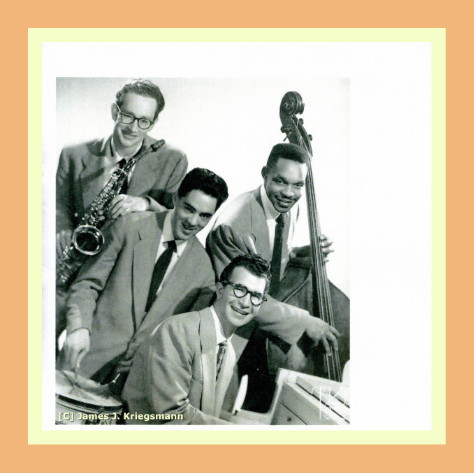
The original members of the Dave Brubeck Quartet shown in a publicity photo by James J. Kriegsmann, the noted New York photographer whose specialty was portrait photography of entertainment personalities.
Members of the quartet are Paul Desmond, alto saxophone; Dave Brubeck, piano; Herb Barman, drum set & bongos; and Wyatt "Bull" Ruther, acoustic double bass.
The Dave Brubeck Quartet made their first east coast tour at the beginning of 1952 with stops in New York at Birdland, Boston at George Wein's Storyville Club in the Hotel Buckminster, Gamby's in Baltimore, the Skybar in Cleveland, the Blue Note in Philadelphia, and a second engagement at Birdland in New York.
As documented in Richard Vacca’s seminal The Boston Chronicles: Faces, Places and Nightlife 1937-1962 [2012], the Storyville Jazz club was located primarily in the Copley Square Hotel during its storied existence [sorry, I could resist the pun, bad though it may be].
But what isn’t so widely known is that it quickly closed [the second week of December] after it opened at the Huntington at Exeter hotel location following its opening there on October 25, 1950.
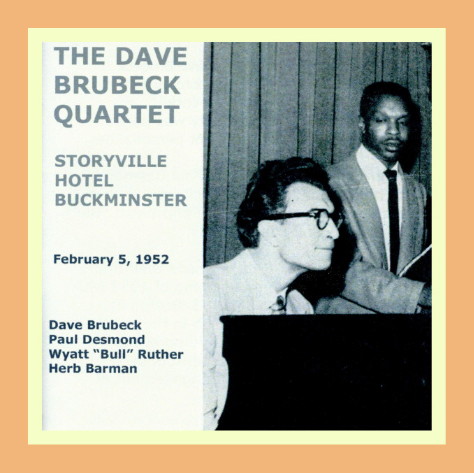
Also not widely known is that the club was for a time located at the Hotel Buckminster in Kenmore Square:
“It doesn't hurt to mention a few of the high points of Weins two-and-a-half seasons at the Buckminster: four appearances each by Dave Brubeck, Erroll Garner, and Lee Wiley; three appearances each by Ella Fitzgerald and Josh White; rwo appearances by Sidney Bechet, Billie Holiday, Pee Wee Russell, George Shearing, Art Tatum, and Sarah Vaughan; employment for many local musicians including Braff, Field, LeFave, Marquis Foster, Alice Ross Groves, the Jones Brothers, Herb Pomeroy, Pat Rainey, Al Vega, and Jimmy Woode; Wein's own house trio with the marvelous Jo Jones on drums; a night of Leonard Bernstein doing his best to play the blues with Pee Wee Russell; live broadcasts over WMEX and WHDH; and what must have been the most unusual week in Storyville history, in April 1952, when John Carradine recited Shakespeare, Johnny Windhurst played Dixieland, and Sam Gary sang folk songs.”
And although, much of the music recorded by the Dave Brubeck Quartet at Storyville was released on Fantasy and Columbia LPs, there were a number live broadcasts from the Hotel Buckminster Storyville on WMEX and WHDH with Nat Hentoff as the radio announcer that were never commercially issued until 2014.
In that year, Essential Jazz Classics issued a 3 CD set with 21 tracks from the radio broadcasts [with snappy and hip comments from Nat as intros to each track] serving as a prequel to the Fantasy and Columbia albums under the heading - Dave Brubeck Quartet featuring Paul Desmond: The Complete Storyville Broadcasts [[EJC55654] replete with a sixteen page booklet that contains the original insert notes from the Fantasy and Columbia recordings as well as this new commentary by Jason Yale.
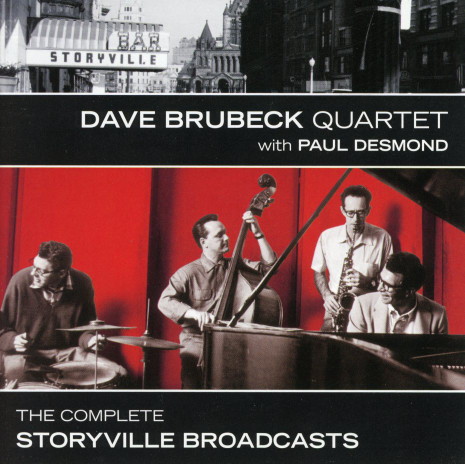
“The Storyville club, in Boston, was opened by jazz promoter and producer George Wein (a Beantown native) in 1950. Ahead of its time, it was a magnet for music titans like Billie Holiday, Ella Fitzgerald, Sarah Vaughan, Duke Ellington, Louis Armstrong, Charlie Parker, Lennie Tristano, and Dave Brubeck, who performed there regularly. The club took its name from the country's first red light district in New Orleans known for being the place where jazz truly came into its own. Storyville was first located downstairs in the Copley Square Hotel. In February 1951 it relocated to the Hotel Buckminster in Kenmore Square but returned to the Copley Square Hotel in 1953 - this time at street level. In 1959, the club moved to the Bradford Hotel on Tremont St. for one year.
"In September [1951] I reopened the Boston Storyville," wrote George Wein in his memoirs, Myself Among Others, "and said a silent prayer for this upcoming year's grosses. My hope would soon be rewarded when we welcomed an up-and-coming group led by pianist Dave Brubeck. Brubeck was not yet the major artist he would become. But he had made a splash with a club date in San Francisco, and word had travelled about his appeal. His agent called me to say that I should try this guy at Storyville; he was already booked in New York City, and a Boston stop would help defray the cost of the East Coast tour. His fee was a mere $800 for the week, and didn't cover transportation, hotel accommodations, or the commission for their agency. So obviously Brubeck and his guys were working for next to nothing."
Brubeck's first recordings with Paul Desmond were made with the former's octet in 1946-50, but they would form a quartet in August of 1951, when they made a studio session for Fantasy on which they recorded two songs that would be included on the live repertoire of their first years and are, thus, heard on this collection; "Crazy Chris" and "Lyons Busy". The other members of the quartet on that date were Fred Dutton on bass, and Herb Barman on drums. By November 1951, bassist Wyatt Ruther had replaced Dutton, and that's the group heard on most of these radio broadcasts.
Nearly all of Brubeck's early quartet recordings had been made live on location, many of them at universities or colleges. By the time the last of these broadcasts were played, the quartet had only made one LP for the Columbia label, and it was the live album Jazz Goes to College, recorded during various college concerts in 1954.
As stated by Columbia producer George Avakian: "The 1950's saw the emergence of a new kind of audience for jazz -one which existed all along, but had never before been brought together in its native habitat. This was the college jazz audience; more precisely, the audiences which were already present on college campuses throughout the country, but who had not been given the chance to assemble to hear jazz on the home grounds. Campus concerts prior to the early fifties consisted of classical music series sponsored by the schools; beginning in 1952, student organizations, or small groups of students acting with the faculty's permission but independently of an official university group, began to engage jazz artists to appear in individual concerts. From the beginning, these concerts were a success, and today virtually all colleges have at least one jazz concert a year in the campus auditorium or gymnasium. The pioneer combo that broke this field wide open was the Dave Brubeck Quartet. Working mostly in the Middle West, with a certain degree of concertizing on the West Coast as well, Dave almost single handedly opened up this market, and by 1953 enjoyed what amounted to a personal college circuit. Many other jazz artists have followed in his wake, but none so intensively as Dave. It is reasonable and fitting that his Jazz Goes to College album is still his biggest all-time seller, and is in fact the most popular album the modern jazz field has ever known."
The location of the radio shows presented here is not, however, that of a college concert, but that of a jazz club. "In those early days", explained George Wein, "Brubeck and his alto saxophonist, Paul Desmond, looked disconcertingly alike. They had the same medium height and slender build; they wore similar suits and identical horn-rimmed glasses. For the first few nights that they were in the club, I couldn't tell them apart. But after a few days, I finally knew whom I was talking to -especially after I caught on to Desmond's dry sense of humor. Clothing aside, in a musical sense, Brubeck and Desmond were already stylish characters when they came to Boston.
When the group started to play, their sound created a musical alchemy that everyone could feel. Brubeck's style and time were a little different; he had a dynamic sensitivity and a unique touch at the keyboard. And Desmond's lyrical, melodious sound borrowed from a number of sources but resembled no one else. They had a distinctive interplay. They swung, but with their own inimitable momentum. They were unique. Although they debuted to a small crowd, word quickly got around. After three or four nights into their engagement, the club was filled. This was the beginning of an association and friendship with Dave Brubeck that has lasted to this day. Dave and his wife, lola, personified elegance and grace."
Brubeck played at the Storyville club in 1952,1953 and 1954, and various of his performances were recorded via radio broadcasts. A few recordings made at the club were issued by Fantasy (along with two selections taped in Carmel, included here as a bonus) on the album Jazz at Storyville: The Dave Brubeck Trio and Quartet (Fantasy LP 3-240). Also, some of the 1954 shows were acquired by Columbia, and six performances were released that year on the LP Dave Brubeck at Storyville: 1954 (Columbia CL 590).
This edition contains, in chronological order, all of the band's known existing performances at the club, among them five never before released broadcasts in their entirety. It is not known whether or not other material from the sets issued on the Columbia LP still exists.”
Sunday, May 23, 2021
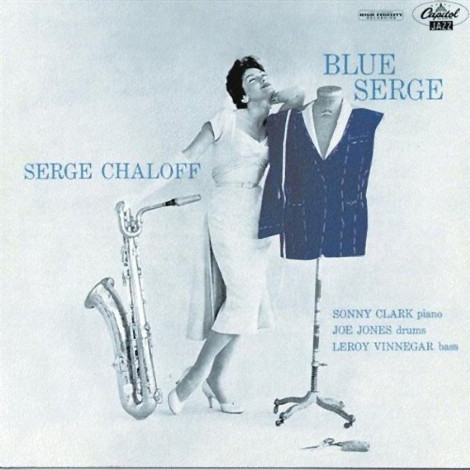
Serge Chaloff by Gordon Jack
© Copyright ® Steven Cerra, copyright protected; all rights reserved.
Gordon Jack is a frequent contributor to the Jazz Journal and a very generous friend in allowing JazzProfiles to re-publish his perceptive and well-researched writings on various topics about Jazz and its makers.
Gordon is the author of Fifties Jazz Talk An Oral Retrospective and he also developed the Gerry Mulligan discography in Raymond Horricks’ book Gerry Mulligan’s Ark.
The following article was published in the May 11/12, 2021 edition of Jazz Journal.
For more information and subscriptions please visit www.jazzjournal.co.uk
© -Gordon Jack/JazzJournal, copyright protected; all rights reserved; used with the author’s permission.
“During the nineteen-forties Serge Chaloff along with Leo Parker and Cecil Payne showed how successfully the baritone saxophone could adapt to the intricacies of the new music. He was born on 24 November 1923 in Boston and both parents were distinguished musicians and educators. His father Julius had played piano with the Boston Symphony and his mother the legendary Madame Chaloff taught at the New England Conservatory. Over the years her students included Leonard Bernstein, George Shearing, Keith Jarrett, Herbie Hancock, Steve Kuhn and Chick Corea. Serge studied the piano from the age of six and had clarinet lessons with Manuel Valerio of the Boston Symphony. Inspired by Harry Carney and Jack Washington he took up the baritone at the age of 12 on which he was self-taught. “Who could teach me?” he asked in a Leonard Feather interview. “I couldn’t chase Carney all around the country”.
During WW II with so many musicians away in the service there were plenty of opportunities to play with big bands and Serge served time with Shep Fields, Ina Ray Hutton, Boyd Raeburn, Georgie Auld and Jimmy Dorsey. Although he did not record any solos with these bands he was in the sax section on a 1944 Raeburn date that introduced Bernie Miller’s Bobby Socks which became better known as Bernie’s Tune. Band road trips could be brutal and Chaloff once remembered 60 consecutive one-night stands with Raeburn often with 500 miles between bookings. It was around this time he was given a shot of heroin which is when he “Began walking on clouds”. By the mid-forties he was working with Dizzy Gillespie, Benny Harris, George Handy, Oscar Pettiford and Earl Swope. He was becoming acknowledged as “The white Charlie Parker” – quite an accolade for a baritone saxophone player.
On 21 September 1946 he recorded Blue Serge which is a contrafact of Cherokee. Ray Noble’s tricky bridge modulations had become a right-of-passage for the boppers just as [Coltrane’s] Giant Steps was for a later generation. He shows how well he had adapted the new language to what was then an unwieldy solo horn. By early 1947 he was sharing an apartment on New York’s 56th. Street with Red Rodney and the dilettante of the tenor Allen Eager. “Serge was a groovy guy to be around.” Eager said years later. “The three of us were all pretty much in the same zone as far as musical leanings go”. This is confirmed by a 1947 January session under Rodney’s leadership where two jazz standards were introduced: Gerry Mulligan’s Elevation which became a minor hit for Elliot Lawrence and Al Cohn’s The Goof And I which Chaloff made his own when he was with Woody Herman.
1947 was the year Allen and Serge often played sessions at Milton Greene’s photography studio on Lexington Avenue. Greene later became Marilyn Monroe’s manager and Buddy Rich, a regular attendee once told him, “Bring the women and we’ll bring the music”. In 2003 Uptown Records released previously unissued material recorded there in April which includes Eager, Chaloff, Jimmy Johnson and Rich performing The Goof And I, Lullaby In Rhythm and Fine And Dandy. That same month he was at the Three Deuces with Georgie Auld’s sextet along with Red Rodney, Tiny Kahn and Lou Levy –“Wonderful band” he said later “but we didn’t make a nickel”. He was also booked into Smalls Paradise in Harlem for a Battle Of The Baritone Sax with Leo Parker, another performer who died far too young. Later that year he joined Woody Herman’s nonpareil Second Herd, an event that prompted Gene Lees to say in his Leader of the Band, “Hiring him must be accounted one of Woody’s worst errors. Serge was a serious heroin addict and like so many of his kind, a dedicated proselytizer for the drug. He would hook a number of the Second Herd bandsmen”. Apparently half the band including the entire saxophone section were on heroin. Amphetamines were also in use prompting Woody to say, “Everybody was on practically everything except roller-skates… I’ve chased ‘connections’ out of clubs from coast to coast”. Just to compound his problems there were four alcoholics in the ranks too.
The music though was superb and Serge put his highly individual stamp on several of the band’s classic recordings like Keen and Peachy, The Goof And I, Four Brothers, Northwest Passage, Godchild, That’s Right, Lemon Drop and Keeper Of The Flame. His fluent invention, control of dynamics and formidable technique revealed a soloist of uncommon originality. Woody certainly agreed because he told William D. Clancy in Chronicles Of The Herds, “Serge was probably the freshest, newest –sounding baritone that had come along in years.” Apart from Harry Carney with Duke Ellington no other baritone player at that time was featured as extensively as Chaloff was with Herman. The story of how the leader tried to fire him because of his outrageous drug-fuelled behaviour is one of the great jazz anecdotes. One night in Boston having been warned of his impending dismissal Serge called Herman to a window overlooking the Charles River. He pointed to numerous papers floating on the water and said, “That’s the baritone book. You can’t fire me because I’m the only one that knows it by heart”.
He remained with the Second Herd until Herman disbanded in December 1949 which was the year Down Beat readers voted it the Number One big band. It was a musical success but a financial failure. The leader lost approximately $180,000 which is equivalent to about two million dollars today. Although Woody had problems with him this is what Zoot Sims once said about his fellow-section man, “When Serge was cleaned up he could be a delight to be around – a lot of fun. He could get pretty raunchy when he was strung out but he could also be very charming”. Someone else who was active on the New York scene at the time was Brew Moore. He had his own personal demons prompting Serge’s mother to warn him to keep away because she thought Brew was a bad influence.
As a result of his high-profile work with Woody Herman he won Down Beat’s baritone poll from 1949 to 1951 together with similar Metronome awards from 1949 to 1953. In January 1950 he was on a Metronome All-Stars date with Dizzy Gillespie, Stan Getz and Kai Winding performing two titles one of which was No Figs. It is a typically cerebral Lennie Tristano original based on Indiana with a particularly intimate Chaloff contribution. Lee Konitz who was also on the date told Andy Hamilton that he thought Serge “Messed it up” although to these tin ears he sounds just fine. He did a week at Boston’s Hi-Hat early in 1950 with Count Basie’s octet which included Clark Terry, Buddy DeFranco and Charlie Rouse. He formed a group with Earl Swope, Bud Powell, Joe Shulman and Don Lamond for a Birdland date in February 1950 on a bill that also featured Lester Young and Erroll Garner. Barry Ulanov in Metronome said, “Serge Chaloff waved his big baritone horn at Birdland last month and inaugurated what will be a very interesting career as a leader”. He then moved back to Boston for two weeks with a local rhythm section performing repertoire associated with the Second Herd. In 1994 Uptown Records released this material together with Celebrity Club dates in Rhode Island which featured a revolving cast of players like Sonny Truitt, Milt Gold, Nat Pierce and Joe Shulman. The enthusiastic audience reactions confirm that he generated a powerful air of excitement whenever he performed. The CD also includes a three minute Chaloff interview.
In late 1950 he met Dick Twardzik who was one of his mother’s students when the nineteen-year old pianist sat-in at the Red Fox Café in Lynn, Massachusetts. They were to remain very close until the end. “Musically (Dick) had one of the most discriminating and imaginative minds that I have ever encountered” Chaloff said later. In January 1951 he was one of the performers appearing on another Metronome poll-winners session which was to be his last studio date until 1954. After ten years on the road he decided to remain close to home in Boston where his family lived. Gigi Gryce had studied with Madame Chaloff and Serge often visited the apartment Gryce shared with Sam Rivers and Jaki Byard. Informal sessions were held there with Charlie Mariano, Alan Dawson and Joe Gordon together with visiting stars from New York like Charlie Parker, Stan Getz and Zoot Sims.
For a couple of months early in 1951 he led the house band in Boston’s Hi-Hat with Nat Pierce, Jack Lawlor and occasionally Alan Dawson. In the summer that year he and Twardzik secured a residency in a club on the shore of Cape Cod. The pianist wrote home to his parents from a cottage they were renting, “Serge is reading Kafka and we listen to Bird, Ernest Bloch, Alban Berg and Bela Bartok”. This idyllic booking was followed by a tour of the New England circuit taking in Detroit, Chicago and East St. Louis along the way which lasted until early 1952. When he returned to Boston he carried on working at the Hi-Hat and other local venues like Primo’s and the Melody Lounge. Unfortunately he had problems with the local police who impounded the van his mother bought him during an investigation into narcotic charges. Leaving town he toured as a single working with local rhythm sections for most of 1953. Around this time he had an affair with Kay Starr. It must have been pretty serious because she bought him a diamond-studded wrist watch which she had engraved with his christian-name.
His come-back as a recording artist began in 1954 during a residency at George Wein’s Boston Storyville club where he fronted the back-up band. Bob Martin was a disc-jockey there hosting broadcasts from the club and after a live interview with Serge he became his agent. “I was trying to help the guy – help him keep his records straight and keep things together”. Wein, who had been yet another of Madame Chaloff’s students, was so impressed with Serge’s performances opposite Chet Baker’s quartet that he recorded him on his Storyville label. Six titles were released including Easy Street which was the first of several sublime ballad readings he was to record in the twilight of his career. Boots Mussulli who was teaching locally after years on the road playing alto with Kenton sight-read Chaloff’s arrangements with ease.
While playing at the Jazz Workshop he began giving private lessons. One of his students was Steve Adamson, a seventeen year old beginner who was interviewed for the IAJRC in 2006. He admitted that telephoning Chaloff was like someone who had just bought a violin asking for lessons from Jascha Heifetz. “Serge was a very likeable guy (but) as a heroin addict he could be moody”. Occasionally the teacher would borrow his student’s horn and when it was not returned, Steve would ask Serge’s mother to get it back from the pawn shop. The lessons were five dollars an hour which was what Steve’s parents had paid for his bar mitzvah lessons. Adamson remembered that Serge had to make use of Boston’s subway system because he did not have his own transport. A famous encounter occurred around this time when Chaloff worked at the New Storyville club opposite the Clifford Brown-Max Roach quintet. The second part of the booking featured just trumpet and baritone with Max and the rhythm section although Nick Catalano does not mention this in his definitive Clifford Brown biography. The Mosaic booklet The Complete Serge Chaloff Sessions has several photos of him at his brother’s wedding reception in August 1954 playing tenor and also dancing with his mother.
The following month he recorded Twardzik’s Fable Of Mabel using a borrowed horn because his own gold-plated baritone was in the pawn shop. Herb Pomeroy who was on the date confirmed, “(He) was not in the best of shape but his heart and soul went into it. He was a glorious player.” Mabel was a satirical three-part composition. It had tempo changes, free blowing by Charlie Mariano and the obscure Varty Haroutunian, a passionate Chaloff statement together with the composer’s own unique time-feel and Bartok-inspired chord voicings. This date was a prelude to Serge entering a local sanatorium where he finally managed to overcome his heroin habit after “Nine years of living hell”. His re-emergence on the scene four months later was not always welcomed by his peers because of his former role in dealing drugs. There were constant rumours too of the part he played in his friend Sonny Berman’s death from an overdose in 1947. One critic called him “One of the most chaotic personalities in music”.
In April 1955 his sextet with Mussulli and Pomeroy recorded twelve titles for Capitol. It was a fairly run-of-the-mill blowing session that produced two memorable and highly emotional ballad performances – What’s New and his speciality Body And Soul. In October that year his good friend Dick Twardzik died in Paris from a drug overdose while on tour with Chet Baker. Peter Littman (another addict) was Baker’s drummer. Serge blamed him for the pianist’s death and when Littman returned to Boston Chaloff hit him in a crowded Jazz Workshop leaving him on the floor.
His next recording in March 1956 occurred after a booking with Sonny Stitt at Hollywood’s Jazz City. Blue Serge with its tip-top rhythm section (Sonny Clark, Leroy Vinnegar and Philly Joe Jones) is his masterpiece featuring classic standards like All The Things You Are, How About You and A Handful Of Stars. He takes a fresh and highly original look at Bob Hope’s old theme song Thanks For The Memory avoiding the tongue-in-cheek whimsy usually associated with it. His Ben Webster-like vibrato creates something far more profound and deeply moving.
A few months later he was diagnosed with cancer but after treatment he continued playing using crutches or a wheelchair. His last album was Four Brothers Together Again on 11 February 1957 with Herbie Steward, Zoot Sims and Al Cohn. Although sick he played with his usual fire and intensity but on some ensemble passages Charlie O’Kane had to take over on baritone.
Serge Chaloff died five months later on 16 July 1957 in Boston, his home-town.
In compiling this appreciation I would like to acknowledge the valuable help received from Bob Weir and the Jazz Institute in Darmstadt, Germany.”
Selected Discography
Serge Chaloff: Boston 1950 (Uptown 27.38)
Serge Chaloff: Boss Baritone (Proper Box 158)
The Complete Serge Chaloff Sessions (Mosaic MD4-147)
Woody Herman: Complete Capitol Recordings (Mosaic MD6-196)
Recommended Reading
Serge Chaloff: A Musical Biography & Discography by Vladimir Simosko.
Bouncin’ With Bartok: The Incomplete Works of Richard Twardzik by Jack Chambers.
Rat Race Blues: The Musical Life of Gigi Gryce by Noal Cohen & Michael Fitzgerald.
Woody Herman: Chronicles of the Herds by William D. Clancy.
Saturday, May 22, 2021
Badd Steve Gadd - Redux
© Copyright ® Steven Cerra, copyright protected; all rights reserved.
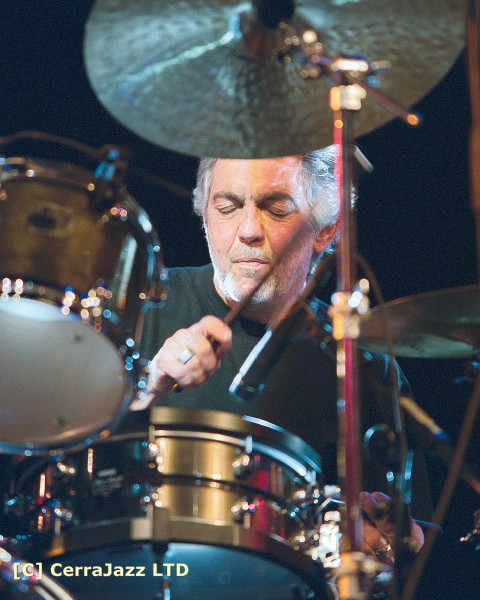
I’ve shared this quotation from trumpeter, composer and bandleader Wynton Marsalis before, but it bears repeating in the context of this blog feature: “Change the rhythm and you change the music.”
Drummer Steve Gadd changed the rhythm and he changed Jazz.
The revolution that he brought to Jazz drumming is akin to what Gene Krupa did for swing music, Kenny Clarke and Max Roach did for bop, Philly Joe Jones did for hard bop and the polyrhythms that Tony Williams and Elvin Jones brought to Jazz in the 1960s.
Of course, many other drummers made their contributions to changing the “time feel” of Jazz and therefore changing the music over the years but, with the exception of Tony Williams, few other drummers bridged Jazz into Rock and Salsa to the extent that Steve Gadd did.
Earl Palmer, Jim Keltner and Hal Blaine made a fortune as “in the pocket” Hollywood studios drummers for Rock sessions and while are all very fine drummers, Steve Gadd brings many added dimensions to the backbeat drumming that predominates in today’s Jazz-Rock fusion.
He wraps the backbeat in a New Orleans marching band syncopation in the manner of drummer Idris Mohammed, simplifies the right-hand cymbal beat to a straight four-four, plays a cow bell as though it is a ride cymbal to create Latin Jazz inflections which he also heightens with the addition tom toms; tunes his drums to sound flat and tubby including a tight, cracking sounding snare drum and carefully crafts sustained grooves that give the music insistence and intensity.
Steve grooves, cooks and burns; his playing is never flashy but he always envelopes you in the rhythm he lays down.
His versatility is such that he sounds equally at home backing Rock vocalist James Taylor, or the late, pianist Michel Petrucciani or making classic Jazz recordings with Chet Baker, Paul Desmond and Jim Hall.
Yet, whatever the setting, you can tell immediately that it’s Steve Gadd.
At one time in Jazz parlance, to refer to a musician as a “bad” player meant just the opposite. A “Bad” player was one who had the epitome of skills, one who sometimes left you shaking your head in disbelief over what you had just heard.
“Badd” Steve Gadd is one such musician.
- The editorial staff at JazzProfiles
Not surprisingly, given his impact on modern drumming, there are many interviews with Steve in Modern Drummer magazine. Most require a subscription to unlock for online reading. [It’s $4.99 a month with no contract.]
Chary of violating copyright, the following visit with Steve and MD was online and unlocked and I thought I would share it with you.
This interview is particularly instructive about how Steve, over the years, used the playbacks in the recording studio to identify what worked and what didn’t to adjust his playing accordingly.
After reading it I think you will agree that Steve is as articulate talking about drums as he is in playing them.
“There’s a whole lot of drumming going on. Hundreds of thousands of people currently play the drums. Through the years, perhaps millions have played. But in spite of all that drumming, just a couple of dozen amazing innovators have shown us the way. Of course, Steve Gadd is a member of that group, but he’s also a member of an even more elite bunch; Steve is one of the very few drummers whose innovations changed the way other musicians heard music.
Gadd first came to national attention in the early 1970s through associations with such jazz luminaries as Chuck Mangione and Chick Corea. But he quickly established pop and funk credentials as well with artists such as Paul Simon (his innovative drum part on Simon’s “Fifty Ways To Leave Your Lover” became his best-known showcase) and the band Stuff. Gadd soon became one of the busiest drummers in New York, and the hundreds of albums he appeared on inspired legions of young drummers to aspire to careers as studio musicians.
Over the past decade, Gadd has spent a lot of time on the road, doing major tours with Paul Simon, James Taylor, and Eric Clapton. He continues to appear on notable albums, such as Simon’s You’re The One (2000), Clapton’s One More Car, One More Rider (2001), Taylor’s October Road (2002), and David Sanborn’s Time Again (2003). Due out soon are DVD and CD versions of Corea’s “Three Quartets” band recorded live.
Gadd was recently in the studio with Clapton, and will be touring with the guitar legend shortly. Also recently released are DVD versions of Gadd’s classic instructional videos Up Close (1983) and In Session (1985), and in September Gadd was honored by Zildjian with an American Drummer Achievement Award. (A Gadd tribute DVD that ties in with the event will soon be released by Hudson Music, who also included a recent performance by Steve’s band The Gadd Gang on the Drummers Collective 25th Anniversary DVD.)
In the past, Steve has tended to let his playing do the talking. Steve’s openness, and the insights he shares in the following interview, may well change the way we play and hear music yet again.
MD: I was a freshman at North Texas State in 1972, and my teacher was John Gates, who had been in the Army with you. He told me, “There’s this guy that nobody knows about named Steve Gadd, and he’s something else.” That began my search for your recordings. Chuck Mangione’s Alive was the first record I heard you on, and the groove was incredible. Your solos on “High Heel Sneakers” and “St. Thomas' ' have the clarity of Max Roach, and there is an incredible fluidity and a contemporary slant. Do you recall what you were listening to and practicing at that time?
Steve: That was done right after I moved to New York. I had just gotten out of the Army, and before that I was in school. My main background was listening to guys like Gene Krupa, Buddy Rich, Max Roach, Elvin Jones, Philly Joe Jones, Tony Williams, and Art Blakey. Then I got to New York and started hearing some funk players, so I started to concentrate more on the groove than on the freedom of straight-ahead stuff. One of the first guys I heard that had a really great groove was Rick Marotta.
MD: So he was established before you?
Steve: We both got to New York around the same time. But he grew up with a different background—more of a backbeat thing—and he had a hell of a pocket. Still does. So having come from the kind of background I came from and then hearing that groove, I was inspired to technically emulate those jazz guys but to put some of that stuff in a great pocket.
MD: I hear that in your earliest recordings. How did you develop that deep, relaxed pocket?
Steve: I think it’s a matter of being aware of it and trying to do it. No matter how “out” and over-the-bar whoever you’re trying to sound like did it, the challenge is to try and do it in a way where you’re paying tribute to what they did but that is understandable in terms of a groove.
MD: Did you have a method for practicing that?
Steve: No, it was just a matter of being in a situation where I had the chance to record and hear it back. That’s a tremendous education right there, because there are a lot of things you do in the studio that get very creative and exciting, and you think they sound great, but on playback you can tell it’s jumbled up and not easy for the listener to understand. So you go back and simplify some things and you find out that it’s a lot more understandable when you leave some space. So being in the studio and hearing things back was a good education. And then years later, when they started using clicks, when things got exciting you could tell where you got away from the click. So those were ways of testing yourself and trying to develop the pocket.
MD: Your playing is highly supportive and highly interactive. But there’s also transparency. Although the playing may be busy, it doesn’t create interference.
Steve: When you’re playing high-energy music in the studio, a lot of times when the soloist gets busy, everyone gets busy. I’ve learned that that’s the time to not get busy and just be supportive. When he takes a breath, that’s a better time to play something in terms of being a support player. You have to pick and choose your spots, sort of like filling in the blanks.
MD: I was in the studio once in the early ’80s watching you do a Dave Liebman record called What It Is. I remember the rhythm section putting down a track, and then Dave put a saxophone solo on. The groove was kind of static, but he played on top, behind, and all around the time, and it was a really interesting contrast. Mike Mainieri was producing, and after Dave put his solo on, I remember Mainieri saying that something was missing. You said, “I have an idea.” You went in and made a pass that corresponded to the saxophone solo. Do you remember that?
Steve: I remember working with Dave, but I don’t remember that particular session. What condition was I in?
MD: At that time you seemed to be burning the candle at both ends. You were playing sessions all day, and then I remember you playing at Mikel’s all night. It seemed like an amazingly stimulating but exhausting period.
Steve: Yeah, it was a great period, but it was pretty exhausting. So I don’t remember that particular session. How did it come out?
MD: It came out incredible. You did exactly what you were just describing: following the emotional path that he was on, but not talking when he was talking, so to speak.
Steve: I’ve found over the years that the feel overcomes everything. If you get a good groove happening, that carries it along. If it feels good, there’s not a lot you have to do. You can pick and choose your spots to dynamically respond to what’s going on, but you don’t have to technically, constantly challenge yourself to fill in those spaces.
When you play live, it’s another ballgame. People can see the excitement, and that helps them put it together with the audio. When you don’t have that visual thing, it’s better to keep it simple. It’s a lot more understandable.”
Friday, May 21, 2021
A FLG Maurepas upload - Cal Tjader - This Masquerade - Latin Jazz
