Friday, October 1, 2021

Jazz Centenaries in The Decade of the 2020's - The Chicagoans: Part 2

 © Copyright ® Steven Cerra, copyright protected; all rights reserved.


Austin, a suburb to the west of Chicago, was an inauspicious setting for a jazz movement. In 1922, a group of students began gathering regularly at a soda parlor located near the nondescript buff brick Austin High School. The parlor featured a windup Victrola and a pile of records. "One day we found a record by the New Orleans Rhythm Kings in the stack, and we put it on, not knowing what kind of band we were about to hear," Bud Freeman later recalled, "Were we excited by it! We were used to hearing commercial dance bands, but this sound was something. 

“Right then and there,” Jimmy McPartland continues the story, "we decided we would get a band and try to play like these guys. So we all picked out our instruments. Tesch [Frank Teschemacher] said he was going to buy a clarinet, Freeman plumped for a saxophone, (Jim] Lannigan picked a bass tuba, my brother [Dick McPartland] said he'd play the banjo, and I chose cornet, the loudest instrument." All but Freeman had studied violin before their introduction to the jazz idiom. Within a short while, the students had formed a working band, the Blue Friars —named after the Friars Inn. the Chicago nightspot where the New Orleans Rhythm Kings played - in emulation of the new jazz sounds they had discovered. Nonetheless, mastering the transition to improvisation required a practical education, in which study of the Rhythm Kings was supplemented by careful listening to recordings (especially the Wolverines' sides with Bix Beiderbecke), as well as Saturday night visits to performances (including firsthand appreciations of King Oliver's Creole Band at Chicago's Lincoln Gardens). Before long, other young players fell into the orbit of the Austin High Gang. Drummer Dave Tough, who was dating an Austin girl, became a close associate of the group. Some time later, when Tough left the band to travel to Europe, his younger friend Gene Krupa stepped in to play drums with the Austin High crew. Clarinetist Benny Goodman, then a freshman at nearby Harrison High, became acquainted with the Austin High gang when he attended a performance at a boathouse in Columbus Park. Soon he too was playing with various members of the group.”

- Ted Gioia, The History of Jazz, 1st Ed. [1997]


“There can never be another group like the Chicagoans, for they represent the coming together of two provincial forces—the New Orleans musical fraternity and the Chicago jazz gang—and the sturdy music that resulted from this meeting. While ingrown cliques will always be with us, it is no longer possible for one self-contained group of jazzmen to find direct inspiration in the work of another self-contained group imported nearly intact from a different part of the country. Today the patterns of change and influence are national and international in scope, a situation that was only forecast before the twenties with the first traveling jazzmen and the first commercial jazz recording. It is a loss, in a way, because the Chicagoans accomplished what they did by playing and listening together. The weak members were not rejected but encouraged, prodded, and helped along until they could stand alone. On the other hand, this very feature of the Chicago attitude may be a clue to the vein of melancholy that runs beneath the blithe music of these men. They were a kind of adolescent gang, and some of them never grew up. There is, after all, something fundamentally sad about an adolescent who is pushing 60. 


As the swing era, during which each of the Chicagoans reached the apex of his creative powers, came to a close, members of the old gang either withdrew from the competitive arena or huddled together for protection again—this time against the shift to modern jazz. Goodman, Krupa, and Freeman explored the new music but failed to become part of it. Only Tough could have done that, and he drank himself into the grave without finishing the job.


So the music of the Chicagoans came and went. Their records tell us how good it was — while it lasted.”

- Richard Hadlock, Jazz Masters of the 20s


Here’s more from Richard Hadlock’s piece about The Chicagoans.


Back in Chicago, the well-schooled players were finding good jobs in 1924 and 1925, and the seat-of-the-pants improvisers were taking what was left, Benny Goodman played the Midway Gardens with pianist Elmer Schoebel (another former New Orleans Rhythm King who had never been to New Orleans). Then Art Kassel took over the band, which included, in addition to Goodman and Schoebel, former Rhythm King Steve Brown (who was from New Orleans) on bass, Danny Polo on reeds, and a Mares-Oliver cornet disciple (who sounded something like Spanier) named Murphy Steinberg.


Spanier and de Faut, the Bucktown Fivers, were at the White City Ballroom with Sig Meyers, and Joe Sullivan was grinding out vaudeville assignments with Elmo Mack and his Purple Derby Orchestra. Trumpeter Al Turk and saxophonist Wayne King were working steadily. Jess Stacy was playing with Joe Kayser at the Arcadia Ballroom. The Teschemacher-Freeman-Tough entente had become, in 1925, Husk O'Hare's Wolverines. In 1926, they had a couple of good jobs at the White City Ballroom, about a block from the Midway Gardens, and drew admiration from Beiderbecke, Armstrong, and drummer Zutty Singleton (who had recently arrived from St. Louis). This kind of praise was, of course, highly valued.


The Chicagoans were, by and large, a cocky and self-impressed group. Teschemacher was moody and serious, McPartland brash and outgoing, Tough cynical and questioning, Freeman impulsive and ingenuous, but all were convinced that they had something no one else had, and each member of the gang bristled with enthusiasm. It was, however, inevitable that the band would break up. Each man needed a wider exposure to varying musical climates and a chance to develop his own identity. Whether it was the result of a conscious recognition of this need or not, the first move was made by Teschemacher, who joined Floyd Towne's band, first at the Triangle Cafe and then at the Midway Gardens in 1926. This group was an outgrowth of Sig Meyers' band and included trombonist Floyd O'Brien, George Wettling, Danny Altier on alto, Towne on tenor, Muggsy Spanier, and eventually Jess Stacy on piano. It wasn't too far from musical home for Teschemacher, after all.


Benny Goodman found a promising spot in August, 1925, when he answered Ben Pollack's call to join his new band in California. Pollack had hopes of building a first-class jazz band that could also present modern, cleanly executed arrangements instead of mere jamming on a select list of "jazz" tunes all night. He hired Glenn Miller, a skilled trombonist and arranger, and Joseph "Fud" Livingston, an imaginative arranger, composer, and reedman.


Fud had been around Detroit and Chicago for about a year, working with Jean Goldkette units and broadening his knowledge of jazz. Although he was born in South Carolina, Livingston fit the Chicago pattern — a deep love for jazz, an aggressive and optimistic instrumental style, an interest in widening the expressive scope of jazz through unusual harmonies (his interest in whole-tone scales may have come in part from Beiderbecke, who was jobbing with Goldkette about the same time Fud was), and, one might add, a colossal thirst for alcohol.


Pollack's idea was a kind of sophisticated extension of the King Oliver band approach: over a steady, swinging rhythmic foundation, make the music sound impromptu, but base the improvisations on a real structure, with interesting scored passages worked out in advance. The Pollack unit would not be as free as the unique Oliver band, but it might go beyond it in other respects because its members were good readers as well as skilled improvisers. It would also borrow a little from the outlook of the best Goldkette bands. The idea looked good and sounded good, but Pollack had to make concessions to commercial demands and finally watered the band down with a couple of violins in order to keep working. And then, too, Glenn Miller, as arranger, was less aware of New Orleans music than Pollack and leaned toward the more salable Roger Wolfe Kahn sound. 


Goodman's first released record was a Pollack date in December, 1926, when Benny was 17. His solo on an ordinary popular tune, He's the Last Word, bubbles with vitality and confidence and contains an explosive staccato burst that may be the first such Chicagoan musical device on record. Livingston's tenor also reveals a feeling for the tense "shuffle" style (sharply accented dotted eighth notes followed by weak sixteenth notes) that has often been identified with Chicago musicians and probably came from the New Orleans Rhythm Kings, Bix, Jimmy Noone, and Johnny Dodds.


The Austinites didn't approve of the Pollack compromise and said so. They held out for the all-improvised sound of the smaller band, although most of them had been working off and on with bands just as commercial and usually not as good as Pollack's.


The Wolverines, under McPartland, secured one more good engagement before breaking up. Art Kassel took them, with Bud Jacobson in Teschemacher's place, to the Greystone Ballroom in Detroit (another lively jazz center in the twenties), where they were delighted to find themselves playing opposite Fletcher Henderson's excellent 1926 band. Freeman was the one most affected by this circumstance, for it was his first encounter with Coleman Hawkins, who had already lapped all competition on the tenor saxophone. It can be assumed that a different Bud Freeman came away from Detroit after the Greystone job. Even a decade or so later, Bud remembered the stomping, on-the-beat approach of the Henderson saxophonist in 1926-1927 as his favorite of several phases of the Hawkins style that had evolved over the years.


Dave Tough left the group next, then McPartland and Lannigan joined Bill Paley's band, and the others were left to dig up whatever they could find. Mezz Mezzrow had been sitting in with the gang now and then and occasionally had enlarged the sax section to three men for special jobs. He cut quite a father figure among the Austin gang, for Mezzrow was seven or eight years older and seemed very worldly, indeed. He was acquainted with most of the South Side musicians, with several gangsters, with a connection for obtaining quality marijuana, with booking agents, and with the insides of several jails. Teschemacher, Freeman, Sullivan, and Gene Krupa were impressed, but Tough, though friendly, could see through the bluster. Mezzrow favored all-out emulation of the New Orleans players, and gradually the gang lined up against him, stressing instead the development of then-own group style. When Eddie Condon moved into the inner circle, he, too, was unconvinced by Mezzrow's arguments, and the Chicagoans ventured further away from New Orleans jazz.


As a matter of fact, the New Orleans men themselves were breaking up their bands and the old improvised marching style. Armstrong had left Oliver, the Dodds brothers (clarinetist Johnny and drummer Baby) were playing a more intimate kind of jazz at Kelly's Stables, Jimmy Noone had a two-reeds-plus-rhythm-section group, and Oliver himself had hired a saxophone section. Only Jelly Roll Morton continued to cling to the earlier forms. Mezzrow's attempts to convince Sullivan of the virtues of playing the Morton style were again unsuccessful, for Sullivan had heard the young and very modern Earl Hines, who was clearly the man of the hour among Chicago pianists in 1926-1927. Tough and Krupa still regarded Baby Dodds with enormous respect and affection, but now Zutty Singleton seemed more in step with their musical thinking.


Bix was at nearby Hudson Lake with Pee Wee Russell in 1926, and most of the Chicagoans made pilgrimages to the resort to hear the band, play records, discuss music, and drink. Mezzrow went, too, but he had begun to feel left out when the gang discussed non jazz works by composers like Stravinsky and Eastwood Lane. Even purist Muggsy Spanier had become interested in formal music, and, of course, Sullivan had had plenty of it in his background to begin with. Mezz just wanted to play the blues and was unhappy about this new digression.


Teschemacher was especially fond of Beiderbecke and began to show it in his playing. Like Russell, who had been deeply affected by Bix's melodic and harmonic concepts, Tesch introduced a hard, rasping quality into his tone that brought it closer to the brassy bite of the cornet and carried it away from the more liquid sound of the conventionally played clarinet. Benny Goodman and Fud Livingston had also found this an effective means of adding punch and excitement to their solos. Beyond this characteristic (which Goodman eventually dropped), these four clarinetists also shared an admiration for Jimmy Noone, who had changed during the twenties from a delicate contrapuntal ensemble style to a powerful cornet-like lead with graceful embellishments. Thus was created what many call "Chicago style" clarinet.


Rhythm came first for the Chicagoans. They leaned heavily upon the skills of Tough, Krupa, and Wettling in establishing the fundamental pulse. Stacy and Sullivan picked up pointers from various Chicago blues pianists, as well as from Hines, and pushed the band either by hammering out steady four-beat chords or by adding an eight-to-the-bar pattern borrowed from the popular boogie-woogie specialists on Chicago's South Side. The banjo player was encouraged to maintain a steady four beats to the measure and refrain from the fancy flourishes common in earlier jazz bands. The drummer was allowed to fill in empty spaces, and it required taste and understanding to carry this responsibility. Tough was the ideal man for the job, but Krupa and Wettling were quite acceptable.


As for the bass, it was pretty much up to the individual player, but no one argued with the Steve Brown approach that Lannigan used, which alternated from a two-to-the-bar pattern to contrapuntal triplets and clever off-the-beat accents.


All horns played on the beat or even slightly in front of it. Melodic ideas were important, but they usually came in rhythmic bursts and clusters. How the player pounced on a note was as important to the Chicagoans as the pitch of the note itself. Emotional impact was everything. No group of jazzmen had ever attacked music with more vigor and bravado than did this eager fraternity.


Russell and Stacy, who had formed their musical habits independently of the Chicagoans, were not quite so ferociously inclined. They had each investigated the subtle art of understatement in their solo work and had come up with excellent results. Pee Wee's unusual sensitivity at a time when the entire country, including its jazz musicians, seemed caught up in a "get hot" complex, can be heard on a mid-1927 Red Nichols recording of Ida. Here Russell explores the harmonic pockets of the song's structure in a restrained, almost recalcitrant manner, borrowing from Bix's ballad approach and adding the unique Russell sense of whimsy that marks all his best work. His solo created a bit of a stir among some musicians at the time, but most of the Chicagoans were not ready for "pretty" jazz yet. They didn't care for cornetist Nichols either, whom they regarded as a mere Bix imitator and not a very convincing "hot" player.


Early Stacy on record is rare, but a glimpse of his 1928 style can be had on a recording by Danny Altier's orchestra, which included Spanier, Wettling, clarinetist Maurie Bercov (who played much like Teschemacher), and guitarist Ray Biondi. Jess, at 24, had already formed the mature style for which he became widely known years later with Benny Goodman's orchestra. His right-hand figures were more linear than those of Hines or Sullivan, but the Chicago rolling bass line was there and so were the hornlike melodic statements so characteristic of the best Chicago pianists of the period. There was, though, no hammering on the keyboard; Stacy displayed superb control and an advanced sense of dynamics throughout his solo on My Gal Sal and behind the dismal vocal on I’m Sorry Sally.


While most of the Chicago gang wrestled with all these problems, Benny Goodman, now back home, was continuing to play with Pollack whenever there was work or to accept casual engagements whenever the band's luck ran out, which was often. In 1927, he recorded a couple of trio performances with Chicagoans Bob Conselman on drums and Mel Stitzel on piano (That's a Plenty and Clarinetitis) that reveal him as a gifted young clarinetist at that time, with an already recognizable style, but a style yet rooted in the same Dodds-Noone-Beiderbecke idiom within which Teschemacher worked. The vibrato, phrasing, attack, and general ebullience were quite similar to Teschemacher's later work, but the tone was cleaner and clearly Goodman's own.


A favorite hangout for Chicagoans in 1927 was the Three Deuces, where Sullivan, Freeman, Tough, Krupa, Teschemacher, Condon, Wettling, and Mezzrow were regulars at frequent jam sessions held in the dank basement.


Goodman, Beiderbecke, and others dropped in whenever possible and helped to establish the saloon as a kind of recreation center and clubhouse for local and visiting jazzmen. The sessions held there, some still remembered by the participants, marked the arrival of the Chicagoans as jazzmen with their own following of musicians, tyros who were now attracted to them just as they had been attracted to New Orleans jazz groups in the first place.


About this time, Dave Tough picked up his drums and went to France with clarinetist Danny Polo. Dave was a restless man, unhappy with his environment. (Mezzrow recalled in later years how Tough read the American Mercury from cover to cover, "especially the section called 'Americana,' where all the blue-noses, bigots, and two-faced killjoys in this land of the free got a going over they never forgot.") It seemed logical to Tough to go where other creative Americans were gathering.


Gene Krupa had met most of the Chicagoans through the Benson booking office, and Mezzrow was already preaching Baby Dodds to the i8-year-old drummer and helping him to fit into the spot vacated by Tough. Gene's enthusiasm was boundless, and by late 1927 he was, after Wettling, the Chicagoans' favorite available drummer. That fall, practically everyone in the gang got a chance to make records, partly as a result of a selling job by singer-promoter-comb player Red McKenzie, who had now settled in Chicago and usurped Mezzrow's big brother role among the Austinites.


The first date was for Charles Pierce, a local butcher and sometime alto saxophonist who admired the Chicago jazz gang and often hired them for his band. Spanier and Teschemacher were the bright lights of the session, which produced China Boy, the familiar Chicago war-horse, and a real blues called Bull Frog Blues. China Boy was arranged for two cornets and three reeds and is of interest chiefly for Teschemacher's agitated, explosive solo, which overcomes a series of clinkers (usually a result of Tesche's pinching and straining in the upper register, causing a higher note than intended to come out) and ignites an otherwise rather stodgy band performance. Spanier blows a disappointing stock chorus on Bull Frog Blues, but Tesche grasps the blues idea quite well and is close to the Jimmy Noone sound throughout. The arrangement was probably based on Jelly Roll Morton's Jungle Blues, recorded three or four months before Bull Frog.


The next record, made the following month, is more satisfactory. Again a straightforward blues was included, called Friars Point Shuffle, as well as a popular song, then about a decade old, Darktown Strutters' Ball. The personnel was mostly first-string Chicagoans: Spanier, Teschemacher, Mezzrow (tenor sax), Sullivan, Condon, Lannigan (tuba), Wettling, and Red McKenzie (vocals). Spanier seems happier on this one, plays a good enough blues solo, and Tesch sounds even deeper into Noone, except for a wider vibrato and a nervous, almost frenzied, quality that the more assured Noone never displayed. Sullivan solos with characteristic vitality, featuring a rolling left-hand bass line and closely grouped, powerful chord clusters in the right. Lannigan manages to establish an oscillating rhythm with his tuba by playing a stream of dotted-eighth- and sixteenth-note patterns. The record is, in all, a good representation of what was going on among the more talented Chicagoans in 1927.


Benny Goodman defected from the struggling Pollack band for a while to play with Isham Jones in 1927, but he soon returned, and at approximately the same time, Jimmy McPartland joined the Pollack crew. They got out another record in late 1927, Waiting for Katie and Memphis Blues. Oddly enough, the blues side was poor and Katie was, in the final passages, an excellent band performance, with almost fully mature Goodman (he was 18) and advanced saxophone section work. On this number, Pollack comes close to the best of Jean Goldkette, a very high level for 1927, indeed. His ace soloist was Goodman, whose ears and fingers were ahead of most of his contemporaries, including the slightly older Austin gang. "The boys that hung out at the Three Deuces were terrifically talented guys," Benny wrote in his autobiography, "but most of them didn't read, and we thought their playing was rough. We didn't pay them much mind, although we liked to jam with them."


McPartland, who has never shed the Beiderbecke mantle he acquired so early, quite naturally showed great improvement in 1927 over his 1924 Wolverine level (which can be heard on a single record cut at that time), though he was never to be more than a pleasant utility cornetist. He participated in another Wolverine recording session in 1927 with a group that included Maurie Bercov and Dick Voynow, but nothing much came of it.


Prior to his first record date in late 1927, Krupa worked all over the Chicago area with bandleaders like Joe Kayser, Leo Shukin, and Thelma Terry. He studied, at one time or another, with Al Silverman, Ed Straight (from whom Tough learned his rudiments ), and Roy Knapp, striving to become a thoroughly trained and highly flexible drummer. At the same time, Freeman played with Herb Carlin's band, followed up casuals through the booking offices, and worked a movie theater job with Tough and Condon in a band fronted by Jack Gardner, a good Chicago pianist. Freeman and Tough were close friends, and when Dave left for France, Bud let Mezzrow talk him into striking out for Hollywood, presumably to make a fortune as an actor. They got as far as Colorado, then turned around and ran for home.


Joe Sullivan was busy with dance bands like Sig Meyers’ or Louis Panico's and did occasional radio work. And Teschemacher, according to Condon, was dropping into the Apex Club to hear Jimmy Noone at least five times a week. He also continued to work in Floyd Towne's band at the Midway Gardens with Spanier, Stacy, Wettling, and trombonist Floyd O'Brien.


More than twenty years later, Artie Shaw, who visited Chicago with Irving Aaronson's orchestra about 1928, described (in his book The Trouble with Cinderella) his reactions to O'Brien and Teschemacher:


“I remember one night—or morning, rather, for it started around four A.M.—when a bunch of us, who had decided to have ourselves a little session, wound up in some dance hall where they were holding one of the Marathon Dance contests that were always taking place in those days. Different musicians floated in and out, sat in for a while, played a few choruses, and then got up to let some other guy blow. There was a piano player named Jess Stacy, and another named Joe Sullivan. There was one trombone player, Floyd O'Brien, who had one of the most peculiar, lazy, deliberately mistaken-sounding styles I've ever heard. He would almost, but not quite, crack a note into little pieces, and each time you thought he was about to fall apart he'd recover and make something out of what started out to sound like a fluff — till after a while you began to get the idea that this guy not only wasn't making any mistakes at all, but had complete control over his horn. He would come so damn close to mistakes that you couldn't see how he was going to get away with it; but he always recovered somehow — and this trick of almost, but never quite, making the mistake, and each time recovering so that the things he played went off in altogether unexpected and sometimes quite humorous directions, was what made his style so peculiar to start with — although it's impossible to give the flavor of it in language. ... I sat next to him [Teschemacher] and watched him while he played. We were all slightly drunk on bad bootleg gin, but it didn't seem to affect his playing any. He too had this odd style of playing, but in an altogether different way from O'Brien's. Even while he'd be reaching out for something in his deliberately fumbling way, some phrase you couldn't quite see the beginning or end of (or, for that matter, the reason for it in the first place), there was an assurance about everything he did that made you see that he himself knew where he was going all the time; and by the time he got there you began to see it yourself, for in its own grotesque way it made a kind of musical sense, but something extremely personal and intimate to himself, something so subtle that it could never possibly have had great communicative meaning to anyone but another musician and even then only to a jazz musician who happened to be pretty damn hep to what was going on.”


A recording session for the Okeh company in December, 1927, was arranged by Red McKenzie, whose valuable contacts with that firm were left over from his earlier commercial successes with the group he called the Mound City Blue Blowers. As McKenzie and Condon's Chicagoans, McPartland, Freeman, Teschemacher, Krupa, Sullivan, Lannigan, and Condon cut four sides that obtained wide distribution throughout the country and made a favorable impression on Eastern jazzmen, most of whom had not realized how much the Chicagoans had improved. The biggest surprise was Krupa, an unknown, whose well-recorded drum work on these sessions rocked the New York jazz cliques, and ultimately unseated Vic Berton as their chief percussionist, Krupa's intense study of Dodds, Singleton, and Tough, along with his vast natural energy and superb sense of time, placed him, as of the last days of 1927, in the front rank of jazz drummers.


The tunes recorded were Sugar, China Boy, Nobody's Sweetheart, and Liza (not Gershwin's), all in F, which must have been the gang's favorite key signature. Tesch wrote out a few connecting passages to give the ensemble fabric more strength, but most of the music was freely improvised in a small-band style that stemmed from the New Orleans Rhythm Kings, various Beiderbecke recording groups, the Dodds brothers' combination, Jimmy Noone, and, inevitably, a number of semi commercial units around Chicago in which the gang had played over the years. Teschemacher's scored interludes were borrowed in part from such standard dance band sources, and the clarinetist frequently sought similar straight parallel-harmony parts in the improvised ensemble passages rather than a weaving New Orleans contrapuntal line, as advocated by Mezzrow. He also devised an unusual introduction to Liza, in 6/4 time.


Freeman, nervous on his first recording, demonstrated that, while his tone was still rough, he had ideas and a rapidly developing command of his horn. Sullivan, after Krupa, emerged as the steadiest and most arresting performer in the group. His powerful left hand and Hines-like right tied the rhythm section together and provided much of the lift for which these records are famous.


Teschemacher was in better form for this date than he had been on earlier recordings, but he was still an uneven player. His solos ranged from breathtakingly inventive melodic paroxysms, with notes flying off in unexpected directions like so many fireballs (China Boy), to stilted, groping phrases that amounted to little more than rough caricatures of Jimmy Noone (Sugar). For all his faults, though, Tesch had achieved a personal, identifiable, and highly stimulating mode of expression that soon rubbed off on dozens of other clarinetists around the country.


Two Chicagoan ensemble devices that intrigued Eastern jazzmen can be heard on these records. Mezzrow described them some years later (in his autobiography Really the Blues) as the "explosion," a sudden flare preceding each repetition of the initial melodic statement in a conventional song structure, and the already mentioned "shuffle rhythm," a staccato, heavily accented eighth-note pattern usually applied to the bridge, or release, of a song. These and other simple but effective methods of increasing and releasing tensions came largely from the mind of Dave Tough, who, more than any other single musician, translated New Orleans musical ideas into the jazz language of the Chicagoans. Had he been in town for the occasion, Tough would doubtless have been the hero of the McKenzie-Condon recordings.


The Chicagoans knew they had left their mark when Red Nichols recorded Nobody's Sweetheart a couple of months later, complete with shuffle rhythms, explosions, and a Chicago-like clarinet solo by Fud Livingston.


For a few months after the Okeh sessions, there was little change in the Chicagoans' job situations. Krupa played for Benson orchestras, in Eddie Neibauer's Seattle Harmony Kings, and, for three months or so, with Mezzrow (Milton Mesirow and His Purple Crackle Orchestra); Tesch and Jess Stacy were still with Floyd Towne; Sullivan continued with Louis Panico; Tough was still seeking culture in France. Benny Goodman, encouraged by the success of the McKenzie-Condon recordings that featured his old friend and fellow Pollack sideman McPartland, secured a one-session Vocalion date using the same instrumentation. Bob Conselman played drums, but the others were drawn from the Pollack fold. The titles were A Jazz Holiday and Wolverine Blues, and the performances were more directly derived from Bix Beiderbecke's small-band records of the preceding year than from either the New Orleans bands or the Austin gang. The session pointed up a split among the Chicagoans that had been widening for some time and could now be heard in their music. McPartland, Goodman, Freeman, Wettling, and Teschemacher were drifting away from New Orleans patterns toward a more sophisticated, lighter music that emphasized clean execution, advanced harmonies, and melodic wit. Their guiding light was the modern work of Beiderbecke. Sullivan, Mezzrow, and Spanier were primarily Armstrong-blues men. As Sullivan once expressed it, "I love Bix like I love my right arm, but I go by way of Louis."


Not that Freeman et al, didn't have a deep admiration for Louis ("Too much Armstrong," Teschemacher once admonished Bud after one of his tenor solos); nor did Spanier and the others fail to appreciate Bix. Each side still indulged in a good deal of hero worship in both directions, but the split was there.


McKenzie and Condon, figuring they had a winning combination, landed two more record dates. One record, under the heading of McKenzie and Condon's Boys, was not issued, but the other, by the Chicago Rhythm Kings, was successfully released in April, 1928. Three sides, There'll Be Some Changes Made, I've Found a New Baby, and Baby, Won't You Please Come Home? (the last not issued at the time), feature Teschemacher, Spanier, Mezzrow, Sullivan, Condon, Lannigan, and Krupa. Mezzrow was included because Freeman had gone to New York to join Pollack, who had been impressed by Bud's first records.


The reproduction quality and studio balance of these recordings are superior to the December sessions for Okeh, and Spanier furnishes a solid Armstrong-inspired lead. Krupa, who can be heard clearly this time, is again the lion of the date. Although Gene was not the first to use the then difficult-to-record bass drum on records (Baby Dodds, for one, preceded him), he makes daringly prominent use of it here, filling out the rhythm section in a way that had never before been caught on wax. His tom-tom accents and explosions were, too, unusual and very exciting in 1928, when electrical recording methods, permitting a more extensive use of deep-tone drums, were only about two years old. Also to Krupa's credit was his ability to hold a firm tempo behind Spanier's pushing lead, which caused many weaker drummers to accelerate in a misguided attempt to catch up with the cornetist. Spanier has trouble with drummers on this point to this day.


Teschemacher seems more contemplative here than on previous recordings and is even closer to trumpet phrasing. The effect of the tenor-clarinet-cornet Chicago front line is, in fact, that of three tightly knit parallel melody voices and a distinct departure from the old New Orleans Dixieland format, which calls for a trombone bass line, a simple cornet lead, and contrapuntal clarinet figures. Tesch explored this new idea even further at this time by working out a fourth tune, Jazz Me Blues, for three reeds and rhythm. It is, interestingly, the best side of the date, and Tesch seems more comfortable playing lead over the saxophones of Mezzrow and Rod Cless than he had before in his wandering ensemble lines above Spanier's horn. Tesch's Jazz Me Blues is rather close, too, to the ensemble approach of the trumpetless band Jimmy Noone fronted at that time.


I've Found a New Baby and There'll Be Some Changes Made settled any question that might have remained about the emergence of a new crop of talent from Chicago. These men had created a fine, workable method of small-band collective improvisation that accommodated the newer trends in jazz (solo virtuosity, a steady four-to-the-bar swing, harmonic explorations beyond simple triads with added sevenths, an enlarged set of responsibilities for the drummer) while retaining some of the good things in New Orleans jazz (the blues, a "vocal" approach to personal expression, unified collective spirit, a driving on-the-beat momentum, intelligent use of understatement). For some Chicagoans, this formula for small-band swing, with the addition of a relaxed ballad style, served well for a lifetime; others continued to search elsewhere for musical fulfillment.


To be continued and concluded in Part 3.


Thursday, September 30, 2021

Jazz Centenaries in The Decade of the 2020's - The Chicagoans: Part 1

 © Copyright ® Steven Cerra, copyright protected; all rights reserved.


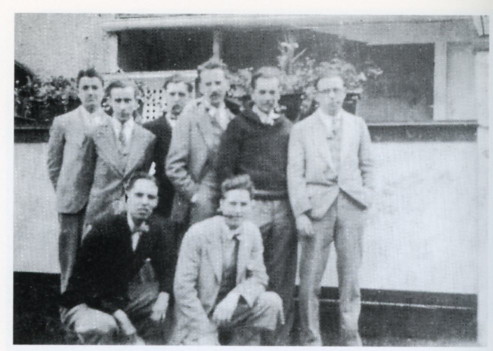
Austin High School Gang in a non-musical moment.

L to R, standing Eddie Condon [bjo], Dave Tough [dr], Dick McPartland [gtr]., Dave North [p], Bud Freeman [ts], Frank Teschemacher [cl]; 

Front, Jim Lanigan [b] and Jimmy McPartland [cnt].


This decade - the 2020’s - marks the 100th anniversary of many significant dates and events in the development of what Gunther Schuller’s excellent book on the subject categorizes as Early Jazz.


100 years ago, Jazz came up from New Orleans to Chicago and then went east to New York, a migration that took place throughout the 1920s [with a stop-over in Kansas City and a quick left turn to Los Angeles and San Francisco along the way].


Among many other highlights, the contributions to the evolution of Jazz by a group of talented white musicians often referred to as The Chicagoans and overlooked by many Jazz fans when considering important developments in “Early Jazz.”


In considering the significance of The Chicagoans in the History of Jazz, it’s important to keep in mind both the positive as well as the negative attributes of the group as underscored in this excerpt that closes the chapter about them in Richard Hadlock’s Jazz Masters of the 20s [1965]:


“There can never be another group like the Chicagoans, for they represent the coming together of two provincial forces—the New Orleans musical fraternity and the Chicago jazz gang—and the sturdy music that resulted from this meeting. While ingrown cliques will always be with us, it is no longer possible for one self-contained group of jazzmen to find direct inspiration in the work of another self-contained group imported nearly intact from a different part of the country. Today the patterns of change and influence are national and international in scope, a situation that was only forecast before the twenties with the first traveling jazzmen and the first commercial jazz recording. It is a loss, in a way, because the Chicagoans accomplished what they did by playing and listening together. The weak members were not rejected but encouraged, prodded, and helped along until they could stand alone. On the other hand, this very feature of the Chicago attitude may be a clue to the vein of melancholy that runs beneath the blithe music of these men. They were a kind of adolescent gang, and some of them never grew up. There is, after all, something fundamentally sad about an adolescent who is pushing 60. 


As the swing era, during which each of the Chicagoans reached the apex of his creative powers, came to a close, members of the old gang either withdrew from the competitive arena or huddled together for protection again—this time against the shift to modern jazz. Goodman, Krupa, and Freeman explored the new music but failed to become part of it. Only Tough could have done that, and he drank himself into the grave without finishing the job.


So the music of the Chicagoans came and went. Their records tell us how good it was — while it lasted.”


Here’s more from Richard Hadlock’s piece about The Chicagoans.


“THE CHICAGO STOBY is, if one wants it to be, part of the nation's romantic image of the Roaring Twenties, complete with hip flasks, illicit gin mills, Midwestern provincialism, dynamic migration patterns, organized crime, and some new rumblings of social protest. Though these aspects of the decade may lurk in the background, the history of the Chicagoans has to do with their music and how it grew, and that's quite a story by itself.


There were many Chicagoans in jazz, but they are usually discussed as a group, for most of Chicago's young jazzmen of the twenties who became important were part of a loosely knit single gang, the core of which was an almost fanatic, exclusive inner clique. These men listened, practiced, worked, recorded, drank, and finally found fame together. They regarded themselves as a kind of musical family devoted to the task of nurturing in each member a valid form of personal expression, a family bound together by an overwhelming mutual desire to make music just as exciting, but not the same as, that which the men from New Orleans played. Some were highly successful, a few gave up the quest, and others were simply not endowed with enough talent; but their average level of achievement was high and had an influence on later jazz developments. [Emphasis mine].


Any man with a horn who stopped in Chicago for a while was eligible to be a "Chicagoan" if he listened to the right bands and really believed in jazz as a way of life. There was a nomadic, one-handed trumpeter from New Orleans called Wingy Mannone and there was a well-trained clarinetist from Arkansas named Volly de Faut. A good clarinet player from Iowa whose name was Rod Cless became accepted as a "Chicagoan," as did a first-rate pianist from Missouri named Jess Stacy. Even after the hard-core Chicagoans had moved to New York in the late twenties, they went on recruiting new members for the club, some of whom had seldom been west of New Jersey.


The first wave of well-known Chicago jazzmen included drummer Earl Wiley, who worked the Mississippi riverboats and traveled to New Orleans prior to 1920, and Ben Pollack, a highly skilled drummer who landed a job with a direct-from-the-source band, the New Orleans Rhythm Kings, and in turn became an important influence on Chicagoans only slightly younger than Pollack himself. Mezz Mezzrow, a kind of combination jazz preacher, clarinetist, and, later, marijuana dealer, was another enthusiast-musician who discovered New Orleans jazz in Chicago through performers like Tony Jackson, Freddie Keppard, and Sidney Bechet during and just after World War I.


By 1920, a 14-year-old boy named Muggsy Spanier was permitted to sit in the shadows of the Dreamland Cafe's balcony to listen to cornetist King Oliver's New Orleans band. When Spanier began to play creditable cornet a little later, it was Oliver's forceful, bluesy style he went after and came close to capturing. About that time, cornetist Paul Mares came up from New Orleans and put together the New Orleans Rhythm Kings, who played the same sort of music—with perhaps less drive than the Oliver band —and the new group became another model for the Chicagoans.


Other kids were finding out about the South Side dance halls and coming to listen. Those who couldn't arrange to get in free usually sat outside, catching whatever sounds drifted out the windows and doors. By 1923, when Louis Armstrong was appearing with Oliver at the Lincoln Gardens, there would be fifty or more young musicians down front trying to remember every note the two cornetists played. Among the most avid listeners were young apprentice jazzmen like drummers Dave Tough and George Wettling, who were there mostly to learn about Baby Dodds. Every college musician in the area knew about and visited the places where the New Orleans Rhythm Kings and King Oliver played, and commercial band leaders frequently dropped in looking for musical novelties to add to their books.


Some students at Chicago's Austin High School, most of whom had had some musical training, heard a few recordings by the New Orleans Rhythm Kings in 1922 and decided to form a band around that style. They had listened to the latest records by popular musicians like Isham Jones, Paul Whiteman, Paul Biese, Ted Lewis, and even the Original Dixieland Jazz Band, but it was the Rhythm Kings who finally struck the right chord. Their activities centered around the home of Jimmy and Dick McPartland, who wound up taking over the cornet and banjo functions in the new band. Frank Teschemacher had played a little violin, so he eventually became the clarinetist. Bud Freeman, who had attended Austin briefly and quit to take a job at Sears Roebuck, obtained a tenor saxophone after an early bout with the C-melody saxophone (an instrument now passé). Other friends filled out the initial unit. Drummer Dave Tough, from the well-heeled Oak Park district, joined the gang and eventually brought a trombonist, Floyd O'Brien, into the fold.


Other teen-age players were popping up around Chicago. Pianist Joe Sullivan, who at 17 had had twelve years of classical keyboard training, began to play popular music in a nonunion gangster hangout in the bohemian sector. It turned out that the club had also hired an authentic jug band from the South, and the group was for Sullivan—whose listening experience had been confined to theater pianists and records by Art Hickman or Paul Whiteman—a first contact with something resembling honest jazz.


In 1922, a precocious West Side boy of 13 named Benny Goodman was playing clarinet remarkably well after only three years of instruction. His sources of inspiration were shifting and improving rapidly, from Ted Lewis and Bailey's Lucky Seven (a New York recording band) to Leon Roppolo (clarinetist with the New Orleans Rhythm Kings) and Jimmy Noone. Goodman studied alongside Buster Bailey (an experienced Memphis jazzman seven years Benny's senior) under Franz Schoepp, an outstanding teacher and symphony man who at one time counted Jimmy Noone among his pupils.


The inner circle at Austin High, including bassist Jim Lannigan (then courting the McPartland boys' sister, Ethel) and pianist Dave North, were rehearsing tirelessly to achieve the sound of the New Orleans Rhythm Kings. The McPartlands, as sons of a music teacher, had a slight advantage and led the way. Teschemaeher was also learning fast, but Freeman, without earlier musical training, lagged behind. The Austinites, whose ages in 1923 ranged from 16 (Jimmy McPartland) to 21 (Lannigan), were something less than men of the world at this point. "We were too young to get into Friar's Inn, so the only way we could hear the Rhythm Kings was to go down and stand in the doorway and listen," McPartland recalled. "It was great when someone opened the door and we could hear it louder." Dave Tough knew his way around Chicago, however, and had come in contact with other young musicians who were finding their way into the New Orleans style—clarinetist Don Murray, cornetist Bix Bciderbecke, pianist Dick Voynow, and drummer Bob Conselman were a few. More resourceful than his Austin pals, Dave imposed upon slightly older musicians like Volly de Faut to accompany him to South Side clubs where he could hear Baby Dodds, King Oliver, and Louis Armstrong. Through Tough, the Austin crowd began to open its ears to more than just the sounds of the New Orleans Rhythm Kings.


1923 and 1924 were eventful years for the Chicagoans. A new band grew out of a series of Northwestern University fraternity jobs involving clarinetist Jimmy Hartwell, drummer Vic Moore, and saxophonist George Johnson. Pianist Voynow and cornetist Beiderbecke brought a touch of class to the group, and they called themselves the Wolverines. They decided to stick together, made some records, and the sound of Bciderbecke's cornet became a new major influence on the kids back in Chicago. At the same time, King Oliver's band began turning out recordings on which Louis Armstrong and clarinetist Johnny Dodds could be heard. 


The McPartland-Freeman-Teschemacher-Tough axis was making fine progress as the Blue Friars (named for the Friar's Inn, of course) and began to be talked about by musicians on the South Side. Professionals called them the "wild West Side mob," but alert listeners could tell they were coming into a worthwhile style of their own. Teschemacher was still playing violin a lot of the time, especially when talented guests like Benny Goodman sat in.


Goodman played off and on with the "wild West Side mob" at high-school gym dances or in sessions at public park recreation areas and worked an amusement park job in the summer of 1923 with Jimmy McPartland, but he found that he could make better money with real professional bands. He joined the union the same day that Dave Tough did.


"I got along better than they [the Austin gang] did because I could read right from the start and played correct clarinet," Benny remembered some years later. That word "correct" is the key to a philosophical dichotomy that set Goodman and some others on a course quite different from that traveled by the West Side mob, although their final musical goals were not entirely dissimilar. Goodman, like his fellow music student Buster Bailey, was primarily a clarinetist, and jazz was his favorite mode of expression. For Teschemacher and Freeman, and to a lesser extent their comrades, becoming a jazzman was the important point, and the instrument was simply whatever chance had dropped into their hands. It was a distinction that became more subtle as the performers improved, but it was still there. Curiously enough, Goodman's attitude toward his instrument was much closer to the outlook of the New Orleans clarinetists and several older Chicagoans who came under their direct influence than it was to the West Side gang's musical position. Chicagoans Darnell Howard and Omer Simeon, for example, picked up the clear-toned, flowing New Orleans style, without leaving home, from Lorenzo Tio, Jr. (Simeon was born in New Orleans but began playing in Chicago.) The Tios (junior and senior) had already taught New Orleans reedmen Jimmy Noone, Albert Nicholas, and Barney Bigard. Most of these Tio-trained musicians later regarded Goodman as, at the very least, their equal. It was a judgment not so readily bestowed upon Teschemacher and others in the young Chicago gang.


Chicagoans like Teschemacher, Freeman, Tough, Mezzrow, and Sullivan were probably the first self-conscious students of jazz to appear. For them, the music was not merely a functional aspect of the entertainment world but a challenging art that required deep thought and study. They tried to weed out what they regarded as trivial or tasteless (the side of King Oliver that involved imitations of a baby crying or Clifford King's barnyard squeals on the clarinet) and to listen instead to the musicians who were totally involved with the art of jazz (Beiderbecke, Earl Hines, Armstrong).


About this time Tough was also participating in poetry and jazz sessions at a Chicago bohemian hangout called the Green Mask. Among his intellectual friends there were poets Kenneth Rexroth, Langston Hughes, and Maxwell Bodenheim, as well as an odd assortment of musicians, entertainers (comic Joe Frisco was one), and artists. A few other Chicago jazzmen may have shared Tough's enthusiasm for such gathering places, but most of the Austin High gang was not concerned with much of anything outside music in those early days of discovery.

It was about 1924 when 20-year-old pianist Jess Stacy hit town, after a long apprenticeship on Mississippi riverboats with Tony Catalano's band. Stacy had come under the New Orleans jazz spell in much the same way the Chicagoans had, except that Jess worked more from first hand experience than from recordings. He had spent the winter months in ballrooms along the river, such as the Coliseum in Davenport, where he was charmed by the playing of Bix Beiderbecke. He had heard Louis Armstrong and Baby Dodds on the boats when they put in at Cape Girardeau, Missouri, where Jess was born. Like Bud Freeman., he had started out wanting to play drums; and like Joe Sullivan, he had put in long years of formal study and classical training. Like Muggsy Spanier, but unlike the West Side mob, Stacy was in 1924 a thoroughgoing professional. As soon as he arrived in Chicago, he belonged.


Chicago was a vital music center in the mid-twenties, and almost any musician who could carry a tune and go through the motions of "getting hot" found work of some kind. For the young players, nearby summer resorts were a favorite outlet. Youthful patrons, informal surroundings, and an impudent spirit that came from constant defiance of Prohibition Laws added up to a good setting for a troupe of iconoclastic kid musicians. The Blue Friars found work at Lost Lake. Benny Goodman picked up odds and ends, including a lake-boat job with Bix Beiderbecke, an engagement at Waverly Beach in Neenah, Wisconsin, and other casuals in and out of Chicago. Joe Sullivan worked the lakes in Wisconsin or Indiana, sometimes with drummer George Wettling, and was beginning to move away from popular novelty tunes (Get Out and Get Under, San, Abba Dabba Honeymoon., etc.) toward jazz-based material (Panama, Farewell Blues, etc.).


By 1924, most of the Chicagoans had left school (the law then allowed one to quit at 14) and had begun playing music in earnest. Goodman, whom Tough had talked into attending Lewis Institute because classes began at 11:30 A.M., dropped out to take a steady job at Guyon's Paradise with Jules Herbeveaux. Joe Sullivan had played a few dances at Lewis Institute with some of the boys, but continued at Lakeview High School, finally leaving after his second year there. The Blue Friars couldn't have cared less about school, for they were beginning to attract attention as an organized unit.


There were several important people to know in Chicago at that time. They were the men who operated booking offices and found work for individual musicians or entire bands. Charlie "Murphy" Podolsky was a prominent figure in this field, through whom the Chicagoans obtained many of their jobs and thereby met men of similar musical interests from other quarters of the area.


In late 1924, Jimmy McPartland was called to replace Bix Beiderbecke with the Wolverines in New York, leaving the Blue Friars leaderless and somewhat adrift for about a year. They spent much of that time listening, theorizing, discussing, and arguing about jazz. Tough, the youngest, was the intellectual in the gang and was constantly turning over, questioning, and evaluating everything he heard. Teschemacher had improved so rapidly that the others often looked to him as their musical leader and guide. Freeman was still attempting to catch up to the rest, hampered by a lack of fundamental training and the inherent problems of trying to produce an acceptable tone on a saxophone and mouthpiece manufactured before instrument companies learned how to make them very well. Eddie Condon, a one-eared banjo player and promoter who ran into the gang about this time, remembers that Freeman's horn appeared green with corrosion and sounded the way it looked.


A South Side youngster of about 15 heard the gang in a movie theater job about this time. He was Gene Krupa, an intense fellow who had taken up saxophone briefly but had finally settled on drums, and he admired Dave Tough's Dodds-inspired playing. Krupa had worked summer jobs, too, including one at Wisconsin Beach with a group called the Frivolians. In 1924, he was preparing for priesthood, but it never worked out. Like most of the Chicagoans, he became utterly and hopelessly fascinated with playing jazz and with the endless struggle to master his chosen instrument.


Discounting records by the New Orleans Rhythm Kings (a hybrid group of Chicagoans and New Orleanians), the first Chicagoan jazz recordings of any consequence were turned out by the Bucktown Five in early 1924. Muggsy Spanier sparked this session with a jumping, biting cornet lead that was right out of Oliver; Volly de Faut, who followed Roppolo on clarinet with the Rhythm Kings and later recorded with Jelly Roll Morton, demonstrated why his graceful, flowing style was highly respected in the Midwest. Spanier went beyond Paul Mares (also an Oliver man) to demonstrate that the lead voice, as he felt it, should be neither behind nor in front of the beat but right on top of it. The result was electric, something like running downhill and trying to keep up with yourself. The Spanier thrust, although seldom enhanced by a flow of original ideas, was a significant factor in the formation of an independent Chicago style.


The Bucktown Five records were, however, all but eclipsed within a couple of months by a brace of Wolverine recordings, featuring the brilliant ensemble and solo work of Bix Beiderbecke. The Wolverines were, of course, a going band rather than a studio pickup group, and their records showed it. Everywhere musicians began copying Bix's solos and the original riffs of the group. It was, in fact, McPartland's note-for-note knowledge of these records that landed him the job as Beiderbecke's replacement later in 1924. Cornetist Bill Davison, who recorded with the Chnbb-Stein-berg orchestra in the same year, also borrowed much from Bix.


As the Wolverines struggled along after Beiderbecke's departure, McPartland gradually replaced each member with one of his old Austin friends. Now reunited, the gang found work through booking agent Husk O'Hare, who even put them on radio station WHT as O'Hare's Red Dragons.


A couple of new reed players appeared on the scene in this 1925-1926 period. One was Rod Cless, whom the gang met on a job in Des Moines, Iowa. The other was Pee Wee Russell, an experienced clarinetist-saxophonist whose musical views have caused many to regard him a front-rank Chicagoan, although he was not noticed much in jazz circles in the city before 1925 and never did put in a lot of time there.


Russell was brought up in Oklahoma, heard and liked clarinetist Larry Shields on Original Dixieland Jazz Band records, and was attracted to in-person performances by New Orleans clarinetist "Yellow" Nunez. He studied violin, piano, and drums before getting to the clarinet. Russell played on an Arkansas River pleasure boat and with the band at Western Military Academy in 1920 and 1921 at Alton, Illinois, not far from the St. Louis area where he was born. For a while, Pee Wee attended the University of Missouri, but he spent most of his time listening to jazz on the Mississippi boats, admiring the band of Charlie Creath (a good cornetist with a haunting, aged-in-wood tone), and hanging out with the small but eager jazz gang around St. Louis. There he met New Orleans players like Armstrong, Baby Dodds, bassist Pops Foster, and drummer Zutty Singleton. Saxophonist Frank Trumbauer, playing with Ted Jansen's band, was already a local hero, and youngsters like trombonists Vernon Brown and Sonny Lee, bassist Bob Casey, and clarinetist Artie Gruner were to St. Louis what the Austin gang and their friends were to Chicago. From time to time, wandering jazzmen like Wingy Mannone and Fud Livingston turned up in St. Louis, too.


Russell, unlike the Chicagoans, was a loner. By 1922, he was knocking about the Southwestern states, playing jobs in Phoenix, Arizona, El Paso, Texas, across the line in Mexico, and in Houston, where there was a stint with the celebrated band of pianist Peck Kelley, which, in 1924, included clarinetist Leon Roppolo and trombonist Jack Teagarden. Russell returned to St. Louis and Herb Berger's band. Later, in 1926, the clarinetist played in another celebrated but unrecorded group, a Jean Goldkette unit fronted by Trumbauer at the Arcadia Ballroom in St. Louis.


It is said that Pee Wee was so enthused about working alongside Bix Beiderbecke in this band that he refused to be fired and continued to play without pay after receiving his notice. He also tried, without success, to get Peck Kelley into the St. Louis orchestra. Russell absorbed all he heard and played as he pleased, working out the details of style by himself rather than through the group therapy approach favored by the Austin boys. Happily, both methods worked out rather well for the men involved.


To be continued.


Wednesday, September 29, 2021

Jazz Centenaries in The Decade of the 2020's - Louis Armstrong and The Hot Fives and Sevens

 © Copyright ® Steven Cerra, copyright protected; all rights reserved.


“I don't know who got the idea for the Hot Five records. It may have been Richard M. Jones, who worked for the Okeh company at that time. He worked for them in Chicago, as a pianist for different blues singers and writing and selecting tunes, and it may have been through him that the Okeh company approached Louis.


The idea was that we would have a regular band at Dreamland, and then that five of us from the band would make records together. I got to Chicago a few weeks before Louis, and played around at different clubs. Then Louis got there, and we rehearsed the band for a few days before we opened at the Dreamland. We had Johnny Dodds, Johnny St. Cyr, and Lil with us.


We made our first records in Chicago at the Okeh studios, and, of course, when we made them we didn't have any expectation that they would be as successful as they became. The time was something like today, with people crazy about jazz and the Charleston, and so our kind of music went over very well. Times were good, and people had money to buy records. One thing that helped the sale was the fact that for a while the Okeh people gave away a picture of Louis to everyone that bought one of the records. When they did that, the sales went way up, because Louis was so popular. . . .


The only one of the Hot Five I hadn't played with was Lil, but that made no difference. She was a fine piano player, and from the first we all worked together very easily. . . .


Even though we were working in different clubs, we kept the Hot Five going. The records were very successful, and Heebie Jeebies was what today would be called a hit record. That was the record where Louis forgot the lyrics and started scattin'. We had all we could do to keep from laughing. Of course, Louis said he forgot the words, but I don't know if he intended it that way or not. It made the record, though.


The Hot Five never played together as a band outside of a few benefits. We'd all take a short time off from the regular jobs we had and play for a half hour or so at some affair. We always would break it up, and then go back to our jobs.


Our recording sessions would start this way: The Okeh people would call up Louis and say they wanted so many sides. They never told him what numbers they wanted or how they wanted them. Then Louis would give us the date, and sometimes he'd call me and say I'm short of a number for this next session. Do you think you can get one together? I'd say all right, and that's the way Savoy Blues came to be composed, two days before we recorded.


We would get to the studio at nine or ten in the morning. We didn't have to make records at night, with the lights out, or get drunk like some musicians think they have to do before they can play. In the beginning we made records acoustically, and there was a separate horn for each man. The recording engineer would motion us if we were playing too loud or too soft, and then we'd know to move back or to move in closer. Then later, of course, we made records electrically.


When we'd get in the studio, if we were going to do a new number, we'd run over it a couple of times before we recorded it. We were a very fast recording band. In fact, the records I made with the Hot Fives were the easiest I ever made. We spoiled very few records, only sometimes when one of us would forget the routine or the frame-up, and didn't come in when he was supposed to. Even then, we'd try to cover up. After we'd make a side, Louis would say, "Was that all right?" And if one of us thought we could do it over and do it better, why Louis would tell them we wanted to do it again, and so we would do it over.


I think one reason those records came out so well was that the Okeh people left us alone, and didn't try to expert us. Another reason was we all knew each other's musical styles so well from years of working together. And then, of course, there was Louis, himself. You couldn't go wrong with Louis. I always liked his style the best. That's not to take anything away from Oliver, but I always thought Louis was the greatest, and I still think so.”

- KID ORY, in Nat Shapiro and Nat Hentoff, Hear Me Talkin’ To Ya: The Story of Jazz As Told By The Men Who Made It [1955]


This decade - the 2020’s - marks the 100th anniversary of many significant dates and events in the development of what Gunther Schuller’s excellent book on the subject categorizes as Early Jazz.


100 years ago, Jazz came up from New Orleans to Chicago and then went east to New York, a migration that took place throughout the 1920s [with a stop-over in Kansas City and a quick left turn to Los Angeles and San Francisco along the way].


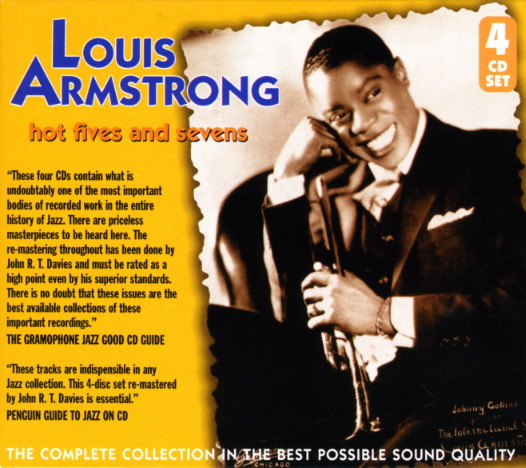
Among many other highlights, the decade featured what many Jazz fans consider to be the most important body of recorded work in the entire history of Jazz - Louis Armstrong: Hot Five and Sevens.


“Few jazz records can have had so drastic an impact as the series Louis Armstrong began making in Chicago during the autumn of 1925. Three years earlier he had caught the train from New Orleans to Chicago to join King Oliver's band on second cornet. In 1923 that band's pianist, Lil Hardin, became his second wife and promptly began planning a career for her husband. It was she who persuaded him to hand in his notice to Oliver, then to accept an offer to work in the big band that Fletcher Henderson was leading at New York's Roseland Ballroom. At the first rehearsal Henderson's musicians were sceptical about this cornet player from out of town who looked like a simple country boy ("He was big and fat and wore high-top shoes with hooks in them, and long underwear down to his socks" was how Don Redman, Henderson's arranger, recalled that original encounter. But Armstrong brought with him a rhythmic sophistication and a boldness of imagination that was a revelation to even the most hardened of New York professionals.


A year later - in the first week of November, 1925 - Louis Armstrong returned to Chicago and immediately set about performing in the cabarets and theatres which catered for black audiences. Lil had organised a band to feature him at the Dreamland Cafe on South State Street. The following month he also began working with Erskine Tate's twenty-piece "Little Symphony" Orchestra at the nearby Vendome Theatre. At both venues he played in a style that was noticeably more advanced than what his contemporaries were up to. And within a week of arriving back in Chicago he had begun making records with the group he called his Hot Five, records which at the beginning, anyway - used the collective improvisation typical of New Orleans bands and were aimed at the vast numbers of Southern blacks who had moved northward during and just after World War I.


Four members of the Hot Five - Armstrong, his wife Lil, Johnny Dodds and Johnny St Cyr- had worked alongside one another in King Oliver's Creole Jazz Band; Armstrong had played the cornet with Kid Ory's band in New Orleans not long before leaving for Chicago and Ory was now playing with him nightly at the Dreamland Cafe, So the musicians knew one another well enough to be relaxed. Indeed, every recording by the Hot Five was a "first take" with no worrying out fluffs or missed cues or other occasional streaky moments. The first session was something of a warm-up, a preparation for a more ambitious future. Even the tune titles had a homely flavour. Yes, I'm In The Barrel was slang for being without money (in other words, if you couldn't afford clothes you wore a barrel instead). In Gut Bucket Blues (a gut bucket collected the drippings from wine and beer barrels in barrel horses) Armstrong introduced everybody in the band. It is noticeable, in fact, that Armstrong's voice came to be heard regularly on his own records (he had, he declared later, resented Fletcher Henderson's reluctance to allow him to sing). In February 1926 he could be said to have popularised scat singing by his gravelly improvising on Heebie Jeebies. It was not the first scat to get on to record (that honour seems to belong to Don Redman on Fletcher Henderson's 1924 version of My Papa Doesn't Two-Time No Time) but it certainly became the most influential. Heebie Jeebies was Armstrong's first hit record, selling 40,000 copies within a few weeks. 


But fellow cornet players were overwhelmed by another recording made at that session, one that seems lucky to have been released (a test pressing found many years later had "Recommended for rejection" scribbled on its label). That was Cornet Chop Suey, full of exciting stop-time solo work and demonstrating how Armstrong was breaking away from the tradition of New Orleans ensemble playing, turning instead into an individual virtuoso. That session also saw the first recording of Muskrat Ramble, destined to become one of the most enduring of all Dixieland-style tunes. Martin Williams (in "Jazz Masters of New Orleans'') has outlined the conflict of evidence about its composition. Kid Ory claimed to have written it in 1921 while working at a taxi dance-hall in Los Angeles ("It had no name then", he recalled, "Lil Armstrong gave it that title at the record session". On the other hand, Louis Armstrong, interviewed by 'Down Beat', also claimed that he wrote the tune ("Ory named it, he gets the royalties," he said, "I don't talk about it"). Meanwhile Sidney Bechet maintained that at least part of the theme had come from an old folk song, The Old Cow Died and the Old Man Cried.


The Hot Five performed together in public on only two occasions. Both took place - the first on February 27, 1926, the second on June 12 - at the Coliseum Theatre. Both were organised by the Okeh Record Company in association with the local black musicians' union. Bands taking part included those of King Oliver, Charlie Elgar, Bennie Moten and Erskine Tate as well as the Hot Five, while among the singers were Lonnie Johnson, Sara Martin, Chippie Hall, Sippie Wallace and the duo of Butterbeans and Susie. Perhaps that occasion prompted Okeh to use the Hot Five to accompany the last-named two performers on He Likes It Slow, recorded about a week after the concert. Jody ("Butterbeans") Edwards came from Georgia, his wife Susie from Florida. They had been, respectively, fifteen and fourteen when they were married - on-stage - in 1916. They remained favourites; on the black vaudeville circuit for decade after decade, recording for the last time only a short while before their deaths in the early 1960s.


A couple of days earlier, Armstrong's Hot Five recorded a set of pieces that reflected the pop-song patterns of 1926. Just as he had done in the earlier Come Back Sweet Papa, Johnny Dodds played alto saxophone in Don't Forget To Mess Around, while Who' sit had Armstrong taking a chorus on the Swanee (or slide) whistle, a popular novelty instrument of the day. The session that took place on June 23 allowed Clarence Babcock to earn a tiny niche in jazz history by acting as the master of ceremonies in Big Fat Ma and Skinny Pa, and, more memorably, as the intrusive West Indian character offering to play "one o' me matove jazz tunes" in The King Of The Zulus (subtitled "A Chit'lin' Rag"). The reference here was to the Zulu Aid and Pleasure Club, one of the organisations which takes a prominent part in the annual Mardi Gras Parade in New Orleans. By a pleasing twist of history, Armstrong himself was in 1949 to be crowned King of the Zulus - and to ride in the parade.


Five months later the Hot Five came up with two of their very finest performances. In both his singing and playing on Skid-Dat-De-Dat Armstrong began exploring a melancholy ambience, bringing to it his own mixture of the poignant and the majestic. A different kind of eloquence, exuberant rather than introspective, emerged in his solo on Big Butter and Egg Man. That was one of several pieces devised by Percy Venable, who produced the floor shows at the Sunset Club where Armstrong was currently featured with Carroll Dickerson's Orchestra. May Alix, who sings on both that track and Sunset Cafe Stomp, was part of that floor show and most renowned for a running split which had her sliding halfway across the clubs' small stage. Venable also collaborated with Armstrong on You Made Me Love You When I Saw You Cry - not to be confused with James V. Monaco's more famous You Made Me Love You (I Didn't Want To Do It). published in 1913 - and Irish Black Bottom ("I was born in Ireland" may be the most unlikely line Armstrong was ever called upon to sing).


Kid Ory had to miss the Hot Five's final session in 1926. Otherwise the personnel had remained unchanged throughout the preceding twelve months. It was a period which saw Louis Armstrong's emergence as a blazing new presence in jazz, a cornet player who elbowed his way out of the ensemble to become the music's first great soloist. During the following year he not only consolidated that reputation but with his expanded group, the Hot Seven, took jazz to even greater heights of virtuosity and expressiveness.”

- CHARLES FOX - insert notes to Vol. 1, JSP Records 4 Volume, Boxed Set


Charles Richard Jeremy Fox (1921 - 1991) was an English writer and broadcaster who specialised in jazz. Fox worked as the jazz critic of the New Statesman. In addition he occasionally contributed to The Guardian, The Sunday Times and The Gramophone. From the early 1960s onwards, he hosted the British radio programme Jazz Today and regularly contributed interviews and documentary series to BBC Radio 3. He also wrote liner notes for British jazz record releases. Fox's book on Fats Waller was published in 1960. In 1972 he authored a guide to the history of Jazz titled The Jazz Scene. Later in 1984, he co-wrote a guide to jazz recordings titled The Essential Jazz Recordings, Ragtime to Swing with Max Harrison and Eric Thacker.