Saturday, March 12, 2022

Gary McFarland: Voyage of Discovery

© -  Steven A. Cerra, copyright protected; all rights reserved.


“Gary McFarland was unknown at twenty-eight when he turned up at a 1961 rehearsal [of Gerry Mulligan’s Concert Jazz Band] with two pieces, "Weep" and "Chug-gin'," profoundly influenced by Ellington and Strayhorn.

When he died tragically ten years later, his reputation had been sullied by several com­mercial projects. But the McFarland that Mulligan sent on his way was an impressive writer (he soon fulfilled his promise with The Jazz Version of How To Succeed in Business, Point of Departure, and The October Suite), with an ear for melody and the ability to layer rhythms in the wind sections.

Like Bob Brookmeyer and Thad Jones, McFarland extended El­lington's harmonic density, employing what the arranger and educator Rayburn Wright called "grinds"—major and minor seconds woven into the voicings.”
- Gary Giddins, Visions of Jazz [p.362-363]


Any musician who is self-taught to any degree knows this as an almost universal truth: if you can hear it, you can find a way to play it.

I had to “unlearn” everything once I began taking drums lessons, because there is the right or correct way to execute music on the instrument; and then there is the way we learn to play when only the ear is the guide.

But I was a Jazz drummer before I became a technically proficient Jazz drummer. I just found a way to replicate on the instrument sounds that I heard while listening to records. 

And although I wasn’t in their league, many of the Jazz greats learned to play by ear and received technical training later in life or, in some cases, not at all.

This is also true of composer-arrangers.

As a teen-ager, Gil Evans listened to records at speeds slower than 78rpm’s to pick out sounds from the Louis Armstrong recordings that he treasured and then invented his own notation system to write arrangements before he had any sort of schooling in the art of orchestration.

This may account for the fact that Gil’s arrangements always seem to use unique combinations of instruments including tubas with flutes and rarely heard [in Jazz] reed instruments such as the oboe and English horn.

He was trying to replicate into music sounds that he heard in his head and these odd or unusual instruments were the best source to emulate his impressions.

He didn’t know what he couldn’t do, because he had no formal training to tell him otherwise.

Enter Gary McFarland.


Gary was initially self-taught both on vibraphone and as a composer arranger and, like Gil Evans, one of his heroes, he altered the course of composing, arranging and scoring Jazz while trying to replicate or notate in music what he heard in his head.

As Bob Brookmeyer, an unparalleled valve trombone player and one of the premier Jazz composer-arranger of our times said of Gary:

“… he didn’t know enough to be like anybody else. So he developed his own way of writing, and I was really interested in him because he was so individual.”

Pianist Steve Kuhn remarked of his collaboration with Gary in The October Suite, which was composed and arranged by McFarland:

“… how beautifully Gary’s writing for the strings and woodwinds came off when you consider he has not had much training in scoring for these instruments.”

In his liner notes to the recording, Nat Hentoff expanded on this thought when he observed:

“Clearly, in Gary’s case this lack of formal training freed him from pre-set conceptions of what could and could not be done and that’s why the results are so personal.”

“So personal” is a phrase that needs to be emphasized for although Gary would later go on to formal training with stints at the Lenox (Massachusetts) School of Jazz and the Berklee College of Music [in Boston], Gary’s music always retained an individual vitality and a singularity of sound which were no doubt reflections of his wanderings in the World of Musical Self-Discovery.

Bill Kirchner, composer-arranger, multi-reed player, educator and editor of The Oxford Companion to Jazz, wrote these insert notes to Gary McFarland’s The Jazz Version of How to Succeed in Business Without Really Trying and has kindly allowed us to reproduce them on these pages.

He, too, notes how Gary took his personal curiosity and determination of purpose and - with “a little help from his friends” - developed them into a musical world that was characteristically his own.


© -  Bill Kirchner: used with the author’s permission; copyright protected; all rights reserved.

“Here … [is one] of the finest big-band jazz recordings of the early 1960s, featuring the cream of New York studio jazz talent plus writing that is still astoundingly fresh and creative more than three decades later.  … The album, unavailable for many years, was the product of a studio system that has largely disappeared — one that enabled some of the best instrumentalists and composer/arrangers in jazz to create, with seemingly routine efficiency, a host of memo­rable recorded works.

The careers of … Gary McFarland and Bob Brookmeyer frequently intertwined in those days. In fact, Brookmeyer was responsible for McFarland's first impor­tant break in New York. Though only four years McFarland's senior, Brookmeyer, born in 1929, was at that time a far more experienced musician, having been in several big bands and a featured soloist during the mid-Fifties with the Stan Getz, Gerry Mulligan, and Jimmy Giuffre groups. Highly regarded as a valve trombonist, pianist (he recorded a piano-duet album with Bill Evans), and composer/arranger, Brookmeyer was an important presence on the New York scene. He had made substantial inroads as a studio musician, was straw boss of the newly formed Gerry Mulligan Concert Jazz Band (CJB) and, in August 1961, formed a quintet with Clark Terry that lasted for five years.

McFarland, when he moved to New York, was a comparative novice; until his mid-twenties he had been a self-described "nickel-and-dime hedonist", a musical illiterate who, with well-timed encouragement from several sources (columnist Ralph Gleason, flutist Santiago Gonzalez, John Lewis, pianist/vibraphonist Buddy Montgomery, and Cal Tjader), taught him­self the vibraphone, learned to write music, and obtained scholarships to the Lenox (Massachusetts) School of Jazz and the Berklee College of Music. Though his stay at Berklee was brief, it enabled him to meet Herb Pomeroy, the trumpeter/arranger/educator who, apart from his teaching duties, led a fine professional big band; McFarland got impor­tant experience writing for this group. In September 1960 he moved to New York and met Brookmeyer at a social gathering.

Invited soon thereafter to Brookmeyer's West Village apartment, McFarland brought the score to one of his compositions, "Weep". As Brookmeyer recalls, the newcomer was "a complete original". He told McFarland to bring the piece to a CJB rehearsal; within a year, the band recorded "Weep" and "Chuggin"' and, later on, three other McFarland compositions. Creed Taylor, the new head of Verve Records, took an interest in McFarland, and the erstwhile fledgling became one of the most important new writ­ing talents in New York. "I used to look at his scores and try to figure out how they got to sound that way, because they looked wrong on paper," says Brookmeyer. "He apparently hadn't had a whole lot of history of any kind, and he didn't know enough to be like anybody else. So he developed his own way of writing, and I was really interested in him because he was so individual."

McFarland himself credited Duke Ellington, Billy Strayhorn, Gil Evans and, most of all, Miles Davis as his biggest influences, and though one can hear all of them in his writing, one primarily hears a musician with a very personal melodic gift and a unique sense of orchestral color and texture. (I once had the opportunity to examine the scores to McFarland's October Suite, written in 1966 for pianist Steve Kuhn, and was amazed at how simple the individual parts were, consid­ering how dense they sounded cumulatively.)


McFarland's first album as a leader was a jazz adaptation of the score of How to Succeed in Business Without Really Trying, the hit satirical Broadway show with words and music by Frank Loesser. Though the original score had exceptional moments (I Believe in You in particular), it was hardly as fertile musically as My Fair Lady. That McFarland succeeded in fashioning from this material one of the most memorable "jazz versions of" — an overworked genre in the late Fifties and early Sixties — is a trib­ute to his resourcefulness. Not the least of his talents was the ability to put together a crack all-star band and write perceptively for its squad of soloists. …”

Bill wasn’t kidding about putting together “a crack all-star band” as Gary assembled the likes of Doc Severinsen, Bernie Glow and Clark Terry and Herb Pomeroy in the trumpet section, Bob Brookmeyer, Willie Dennis and Billy Byers in the trombone section, a reed section made up of Ed Wasserman, Phil Woods, Al Cohn, Oliver Nelson and Sol Schlinger, Hank Jones on piano either Jim Hall or Kenny Burrell on guitar, George Duvivier or Joe Benjamin on bass and Mel Lewis or Osie Johnson on drums for How to Succeed in Business Without Really Trying.

It must have been immensely satisfying for Gary to take his “voyage of discovery” as a Jazz composer-arranger into the New York studios with a band comprised of the likes of these musicians.

All of it beginning with the idealism and a passion of youth and the desire to do it.

Gary died under tragic circumstance in 1971 at the young age of thirty-eight [38].


We always wondered what might have happened if Gary McFarland had crossed paths with Stan Kenton during the 1960’s?

In our recently published feature on composer arranger Pete Rugolo, Bill Russo, who followed Pete in the role of chief arranger with the Kenton band, reflected: “Stan's encouragement of his arrangers was powerful and convinc­ing—he got people to do things they might not otherwise have done. He always tried to get the best out of people and frequently succeeded.”

Pete Rugolo shared: "I guess that an arranger's idea of paradise is some place where he can write anything he wants to and still manage to make a living. That's why I felt like I was walking through the pearly gates when, fresh from the army, I went to work with Stan Kenton. Not only could I arrange the way I wanted to, but I could even compose originals and know they'd be heard. To make the situation more unbelievable, Stan never said 'Don't do it this way' or 'Don't do it that way.' He was willing to try anything so long as he felt the writer really meant what he was saying.”

What with Stan’s life-long interest in extended, symphonic-like compositions continuing with his Neophonic Orchestra in the mid-1960’s as well as his movement to more rock-inflected Jazz as a result of the young musicians then coming on the Kenton band who were comfortable with both Jazz and Rock, Gary McFarland’s adroit handling of Jazz suites inflected with aspects of Rock might have made for an interesting pairing.

Kenton and McFarland may have been to the Kenton band of the 1970’s what Kenton and Rugolo were to the band’s musical style in the 1940’s. Alas, it was not to be as Gary died at the beginning of the decade and Kenton would pass before the end of it.

One can perhaps get an idea of what such a McFarland-Kenton pairing might have sounded like by listening to the excerpt that forms the audio track to the following video tribute to Gary.


My favorite among Gary’s extended compositions, the full suite is in six-parts and is entitled America The Beautiful: An Account of its Disappearance [DCC Jazz DJZ-615]. The work is still available both as a CD and as an Mp3 download.

The title is reflective of the fledgling ecology movement which was gathering momentum in the USA in the 1960’s thanks to the work of authors such as Rachel Carson and Marya Mannes and biologist Paul Ehrlich.

The music on the video is from the Second Movement which is entitled 80 Miles An Hour Through Beer-Can County.

The work begins quietly with horns and strings in dissonance before a strong rhythmic riffs kicks in around 2:00 minutes. These rhythmic pulsations suspend at 3:05 minutes when Warren Berhhardt’s solo piano enters to beautifully state the movement’s main melody before the rock portion engages at about 4:40 minutes.

The guitar solo is by Eric Gayle, Chuck Rainey is the bassist with Bernard Perdie is on drums. George Ricci plays the cello solo, the violin concertmaster is Gene Orloff and the oboe part which brings the movement to a close is played by Romeo Penque.

Also heard in the piece are tuba played by Harvey Phillips, the French Horns of Ray Alonge and Jimmy Buffington and a trumpet section made up of Bernie Glow, Ernie Royay, Marvin Stamm and Snooky Young.

The loss of Gary McFarland at the ridiculously young age of 38 has to be one of the Jazz World’s greatest tragedies.  I would have liked to hear what other music he would have created during his personal, voyage of discovery.


Thursday, March 10, 2022

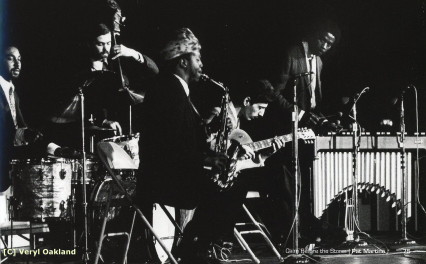
Pat Martino - Calm Before the Storm - Veryl Oakland

 © Copyright ® Steven Cerra, copyright protected; all rights reserved.


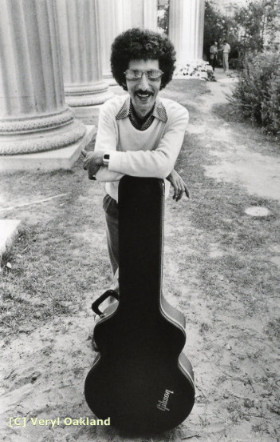
This piece on guitarist Pat Martino who passed away in November, 2021 at the age of 77 is from photographer/essayist Veryl Oakland’s exquisite work Jazz in Available Light: Illuminating the Jazz Greats from the 1960s, ‘70s and ‘80s.


You can find more background about the book as well as order information via this link to an earlier posting on Veryl’s book on these pages.


True to the northern California geographic area denoted in his last name, Veryl photographed Jazz musicians primarily at the Berkeley Jazz Festival, the Monterey Jazz Festival and at various clubs in the San Francisco area like Keystone Korner.


Although from Philadelphia and an East Coast cat during most of his playing days, guitarist Pat Martino signed with southern California based Warner Brothers Music in the 1970s and the record label brought him to California to promote his recordings which is when Veryl had the opportunity to take the commercial photographs that populate this post. 


The in-performance photos date back to the 1967 inaugural Berkeley Jazz Festival when Veryl first heard Pat as a member of saxophonist John Handy’s group along with Bobby Hutchinson on vibes, Albert “Sparky” Stinson on bass and Doug Sides on drums.


Pat Martino - Calm Before the Storm - San Francisco, CA


Among Martino's many peers was guitarist John Abercrombie, who offered the following testimony in Pat's autobiography about the first time he saw him performing with organist Jack McDuff: "That night, Pat came on the bandstand... playing a black Les Paul Custom guitar. We knew the guitar was like carrying a Buick on the stage—it was so heavy. And Pat was such a frail tittle guy. So when we saw this young, very thin little guy walking up to the bandstand with this heavy guitar... our reaction was, 'Oh, man this can't be the guitar player! Who is this? 'So we were all chuckling. And then, he started to play and we ceased chuckling. Because he just floored everybody in the club. I never heard anything like that... it was the constant stream of eighth notes and his amazing time, his feeling that was so perfect."


SAN FRANCISCO, CALIFORNIA


“Every once in a while, I wonder what it might be like to reach out to the man again... to reconnect, and possibly even relive those enjoyable moments we had together that late 1976 weekend in San Francisco. After all, I was sharing the afternoon with one of a handful of my all-time favorite jazz guitarists, Pat Martino.

But, of course, that could never have happened. Even if it had been one of his greatest experiences ever, Pat wouldn't remember me or our afternoon together. That's because just a few years after our visit—in 1980— Martino's lifelong, but misdiagnosed, struggle with AVM (arteriovenous malformation) would culminate in a brain aneurysm and near-death.


Life for Pat Martino would have to start all over again.


The guitarist was four years younger than me, just a skinny kid in his early twenties, when I first saw him perform with alto saxophonist John Handy and vibraphonist Bobby Hutcherson at the inaugural University of California, Berkeley Jazz Festival in 1967. Despite clearly being the youngest, smallest person onstage, he caught the audience by surprise when he took one solo, weaving together a meticulous flow of blistering eighth-note phrases. It was amazing.


Handy recalled those times, saying, "He was a tiny guy, but he played big music. He could play his little ass off, man."


Every time I witnessed Martino's future performances, he did things that were totally surprising, even revelatory. He never disappointed.


When we met for our photo session that afternoon at the Palace of Fine Arts, Pat was joined by his newest pianist, Berklee College of Music alum Delmar Brown. The two were in the midst of an international tour promoting their Warner Brothers release, Joyous Lake, which would become one of the finer jazz/fusion recordings from that period. The guitarist was jovial and upbeat our whole time together. It was obvious that Pat Martino was enjoying the fruits of his ever-expanding career.


It was only many years later, following his miraculous surgery, that I learned the details of Martino's life-altering course through his revealing autobiography, Here and Now! The Autobiography of Pat Martino. In it, Pat chronicled how he overcame the devastating effects of memory loss, depression, anxiety, and overwhelming negativity throughout an arduous recovery period. I discovered how it took years for him to re-learn his art and re-emerge as one of today's most vibrant and inspiring performers.


It occurs to me that all of us in the jazz community have been truly blessed, given a second chance to see and hear two highly productive — and beyond talented — walking miracles: Pat Martino and Quincy Jones, who also survived a brain aneurysm and surgery in 1974. Both escaped near-death and just kept on contributing, kept on creating some of the greatest music for us all to enjoy.”


PAT MARTINO (Pat Azzara)

guitar, composer 

Born: August 25,1944

Died: November 1, 2021


Tuesday, March 8, 2022

The Art of Jazz Guitar [From the Archives]

 © -Steven Cerra, copyright protected; all rights reserved.


There’s a reason why the name for the long part of a guitar is “the neck.”

For there are times when one becomes so frustrated trying to play such an unforgiving instrument that one is tempted to strangle it by grabbing it by – you guessed it - “the neck.”

Those who play Jazz guitar seem destined to play it for how else would you explain the choice of an instrument whose sound is difficult to sustain and whose volume can rarely be heard above other instruments unless it is electrically amplified?

It’s also an instrument that can easily get in the way by clashing with the piano as both serve the function of feeding chords and “comping” [accompanying] in most Jazz groups. Unless it is lightly “feathered” to the point of being more felt than audible, many drummers dislike its intrusion as part of the rhythm section because it makes the time sound chunky and/or feel stiff.

As a lead instrument, it doesn’t phrase easily with other instruments such as the trumpet, trombone or one of the saxes.

When it does find a natural category for expression, for example, in combination with a Hammond B-3 organ and drums, it risks disapproval due to the dislike that many have for the organ in Jazz [“sounds comical;” “belongs at an ice show or a circus;” “overbearing or domineering;” “Why doesn’t someone just pull the plug?”]

So what’s a self-respecting Jazz guitarist to do in order to have a place in the music?

One avenue of expression is to quietly and unobtrusively add a “light touch” to the rhythm section as guitarist Eddie Condon did for many years in Chicago-style and Dixieland Jazz groups or guitarist Freddie Green did as part of the Count Basie Big Band.

Another is to match up with other string instruments as did Eddie Lang with violinist Joe Venuti or the legendary Django Reinhardt with violinist Stephane Grappelli and the Hot Club of Paris.

In his essay The Electric Guitar and Vibraphone in Jazz: Batteries Not Included [Bill Kirchner, ed., The Oxford Companion to Jazz [London/New York, OUP, 2000], Neil Tesser observed of Django:

“Acoustic Jazz guitar reached an apotheosis with Django Reinhardt [whose French guitar had an extra internal sound chamber, which helped boost the volume]. Reinhardt founded his vibrant melodies upon fervid folk rhythms and unexpected chord voicings, the latter being inventions of necessity: a fire that damaged two fingers on his left (chord-making) hand forced him to reimagine his approach to har­mony. Reinhardt belied the then prevalent opinion that "Europeans can't play jazz"; tapping his experiences as a minority "outsider" (he was a Gypsy), he achieved an emotional power commensurate with that of jazz's African-American inventors, and his finger-picking tech­nique continued to stun jazz and even rock guitarists into the 1960s. Souvenirs (London) remains the best single-disc collection of his work with the Quintette du Hot Club de France, costarring Reinhardt's brilliant alter ego, violinist Stephane Grappelli.”

Elsewhere in his essay, Neil points out that “Before amplification, the guitar had little impact on Jazz, with a dozen or so important objections. … not until the mid-1930’s – when Gibson and others began fitting Spanish-style guitars with electromagnetic pickups, to amplify the strings themselves did Jazz guitarists have what they needed [to sustain sound and to increase volume on the instrument]. …

Pound for pound, no instrument has been more profoundly affected by twentieth-century technology than the guitar ….”


The Jazz electric guitar was pioneered by Charlie Christian who performed in Benny Goodman’s Swing era small groups as well as with the early beboppers at Minton’s Playhouse in Harlem before his death at a tragically early age.

Oscar Moore with Nat King Cole’s trio helped make the piano-bass-guitar trio a viable Jazz unit - a tradition that was continued first by Barney Kessel and then by Herb Ellis with pianist Oscar Peterson’s trio which included bassist Ray Brown. Pianist Ahmad Jamal’s earliest trio also included a guitarist, Ray Crawford.

Pianist George Shearing unique sound in the 1950s was made possible by the way in which the now-amplified electric guitar was voiced in unison, but octaves apart, with the piano and the vibraphone.

Tal Farlow with Red Norvo’s trio, Jimmy Raney with valve trombonist Bob Brookmeyer’s quartet, Johnny Smith with tenor saxophonist Stan Getz’s quartet and Jim Hall with clarinetist Jimmy Giuffre’s trio used “a softer tone and a less pronounced attack to mold the guitar into a cool Jazz voice….” [Tesser]

Hall could also heat it up a bit as he demonstrated with Sonny Rollins’ quartet in the 1960’s and Kenny Burrell used his “exceptionally mellow tone” [Tesser] to raise the temperature in a variety of hard bop settings, including Hammond B-3 organist Jimmy Smith’s trio. Kenny’s work may also have influenced that of guitarist Grant  Green “… whose soulful tone and ringing lyricism distilled the bluesy essence of 1960’s hard bop.” [Tesser]

Wes Montgomery also came along in the 1960’s and blew everybody away with his propulsive melodies and his startlingly effective technique based on improvising in octaves.


As Wes explained in a 1961 Downbeat interview with Ralph J. Gleason:

”I’m so limited. I have a lot of ideas - well, a lot of thoughts—that I'd like to see done with the guitar. With the octaves, that was just a coincidence, going into octaves. It's such a challenge yet, you know, and there's a lot that can be done with it and with chord versions like block chords on piano. But each of these things has a feeling of its own, and it takes so much time to develop all your technique.

"I don't use a pick at all, and that's one of the downfalls, too. In order to get a certain amount of speed, you should use a pick, I think. You don't have to play fast, but being able to play fast can cause you to phrase better. If you had the technique you could phrase better, even if you don't play fast. I think you'd have more control of the instrument.

"I didn't like the sound of a pick. I tried it for, I guess, about two months. I didn't even use my thumb at all. But after two months time, I still couldn't use the pick. So I said, 'Well, which are you going to do?' I liked the tone better with thumb, but I liked the technique with the pick. I couldn't have them both, so I just have to cool.

"I think every instrument should have a certain amount of tone quality within the instrument, but I can't seem to get the right amplifiers and things to get this thing out. I like to hear good phrasing. I'd like to hear a guitar play parts like instead of playing melodic lines, leave that and play chord versions of lines. Now, that's an awful hard thing to do, but it would be different. But I think in those terms, or if a cat could use octaves for a line instead of one note. Give you a double sound with a good tone to it. Should sound pretty good if you got anoth­er blending instrument with it.”

Following its pronounced appearance in organ trios and on ‘funky Jazz’ records in the 1960s,  Jazz guitar seemed to veer off into an area of music that came into existence with the rising popularity of Rock ‘n Roll during the same period.

As Neil Tesser goes on to explain in his essay: “It’s no surprise that the spread of Jazz guitar paralleled the rise of rock. Funk Jazz had dipped into the blues, a guitar-driven music and the primary precursor of Rock-and-Roll. As Rock ascended in the 1960’s, the guitar came to dominate American music; as Rock and Jazz converged, the guitar symbolized the evolving musical fusion.”

The Jazz guitar also fused with other styles of music as well including Indian ragas, country and western music and folk music. These myriad, hybrid styles can he heard in the guitar playing of George Benson, Larry Coryell, John McLaughlin, Lenny Breau, John Abercrombie, John Scofield, Bill Frisell, and Pat Metheny.

Of course, there continue to be those Jazz guitarists who play in a more straight-ahead manner such as Joe Pass, Pat Martino, Ed Bickert and Lorne Lofsky, Peter Bernstein, Jake Langley and two, young Dutch guitarists based in Holland – Jesse van Ruller and Martin van Iterson.

Fortunately, when these plectarists grab the instrument by “the neck,” the result is one of the loveliest and liveliest sounds in all of Jazz and one that’s easy for most of us to identify with.

The guitar is rivaled by only the human voice in its universality.

The following YouTube is our way of paying tribute to all of the great Jazz guitarists. The tune is a smokin’ version Freddie Hubbard’s Gibraltar as performed by Jake Langley on guitar, Joey DeFrancesco on Hammond B-3 organ and drummer Terry Clarke.


Sunday, March 6, 2022

Jimmy Knepper [From the Archives]

 © -  Steven A. Cerra, copyright protected; all rights reserved.


Photo by Tom Marcello.

A contrafact is a musical work based on a prior work. The term comes from classical music and has only since the 1940s been applied to jazz.  In classical music, contrafacts have been used as early as the parody mass and In Nomine of the 16th century. 

After listening to Sonny Rollins’ original composition Audubon - a contrafact based on the chord progressions to Honeysuckle Rose  - from pianist Don Friedman’s Hot Knepper and Pepper CD [Progressive PCD-7036], I got to thinking about trombonist Jimmy Knepper and thought it would be nice to put up a brief feature about him on these pages.

Jimmy was born in Los Angeles in 1927 and his early career included stints with the orchestras of Freddy Slack, Charlie Barnet and Woody Herman. Knepper became widely known after his association with bassist Charlie Mingus.

Len Lyons and Don Perlo pick up Jimmy story from here in this excerpt from their Jazz Portraits: The Lives and Music of the Jazz Masters [pp. 330-331]:

“As a member of the Charles Mingus Jazz Workshop from 1957 to 1961, Knepper established a reputation for consistently well-conceived, soulful, and technically adroit solos. Though rarely complimentary, Mingus called Knepper "probably the greatest trombone player who ever lived." Their admiration was mutual; Knepper has become known as an authority on Mingus's intriguing music and personality.

Knepper began studying trombone at age nine. As a teenager, he was working in Los Angeles — based big bands, and in 1945 he joined saxophonist Dean Benedetti's band, one of the first bebop groups in Los Angeles. It was in this band that Knepper met Mingus, who was filling in for Benedetti's regular bassist.

Knepper spent the late 1940s and early 1950s traveling between California and New York in search of steady jobs. The highlight of this disheartening period was a week of sitting in with Charlie Parker. In 1953 Knepper retreated to Los Angeles to attend college. He was now planning to become a teacher. But three years later, disenchanted with school and finding few opportunities to work, Knepper returned to New York with his wife and daughter.

In 1957 Mingus hired Knepper away from the Claude Thornhill Orchestra, where Knepper had found work, on the recommendation of Mingus's departing trombonist, Willie Dennis. Knepper maintains a smooth, glowing tone on his earliest recordings with Mingus, even through his most axing double-time and upper-register figures (Tijuana Moods, RCA). His plaintive blues licks embroider Mingus's earthy compositions like "Boogie Stop Shuffle" and "Better Git It in Your Soul." Although Knepper claims his chief inspiration was Parker, his playing makes explicit reference to the trombone tradition, including tailgate style, the "talking" sounds of Sam Nanton, and the luxurious muted tone of Lawrence Brown (Better Git It in Your Soul, Columbia).

An infamous incident in which Mingus struck Knepper in the mouth over a musical disagreement precipitated a ten-year estrangement between them. During this period, Knepper toured the Soviet Union with Benny Goodman (1962) and free-lanced in studio groups, pit orchestras, and pick up bands for social functions. In the late 1960s, Knepper began a seven-year association with the Thad Jones—Mel Lewis big band. Knepper rejoined Mingus for the bassist's final recording sessions in the mid-1970s, and from 1979 to 1981 he toured with the Mingus Dynasty band, still playing with great fluency (Live at Montreux, Atlantic).”


In their Penguin Guide to Jazz on CD, 6th Ed., Richard Cook and Brian Morton remarked of Jimmy:

“Long associated with Charles Mingus, Knepper has an astonishingly agile technique (based on altered slide positions) which allows him to play extremely fast lines with considerable legato, more like a saxophonist than a brass player.

Doing so has allowed him to avoid the dominant J.J. Johnson style and to develop the swing idiom in a direction that is thoroughly modern and contemporary, with a bright, punchy tone.”

In Leonard Feather and Ira Gitler’s, The Biographical Encyclopedia of Jazz,
Frank von Dixhoorn wrote of Jimmy:

"Every inflection in Jimmy Knepper's phrases, every move from third to fourth position is a split-second victory of form over vacuum. His wit, the veil over one measure and the razor-sharp intonation which reveals another, all these might be described. But they can't be predicted." [p. 389]

Before his death in 2003, Jimmy would also be associated with the Gil Evans Orchestra, the Thad-Jones Mel Lewis Orchestra, the Toshiko Akiyoshi Orchestra, the American Jazz Orchestra, the National Jazz Ensemble and the Smithsonian Jazz Orchestra.

Gunther Schuller in his essay on The Trombone in Jazz in Bill Kirchner, editor, The Oxford Companion to Jazz, ranked Jimmy as one of the “young Turks” who were influenced by J.J. Johnson’s style of playing Bebop on the trombone while noting that:

“All were spectacular technicians, easily expanding the range of the trombone to the trumpet’s (!) upper register (high B flat and C), and with their new-won technical wizardry capable of playing things that a few years earlier could have only been played on a trumpet, or a flute or violin. Knepper in particular carved out a remarkably successful career in New York, both as a much sought-after, highly individual freelance studio and session player — possessing superior reading skills and the ability to play in a variety of jazz styles — and, most important, as Charles Mingus's favorite trombonist, which led to a long-term association with the great composer-bassist.” [pp. 638-639].

With Jimmy Knepper, one thing was certain: two notes and you knew it was him.” [Pun intended]

Jimmy, Pepper and Don are joined by bassist George Mraz and drummer Billy Hart on this version of Audubon.


Friday, March 4, 2022

Frank Griffith Interview with Gordon Jack


© Copyright ® Steven Cerra, copyright protected; all rights 

reserved.


Gordon Jack is a frequent contributor to the Jazz Journal and a very generous friend in allowing JazzProfiles to re-publish his perceptive and well-researched writings on various topics about Jazz and its makers.


Gordon is the author of Fifties Jazz Talk An Oral Retrospective and he also developed the Gerry Mulligan discography in Raymond Horricks’ book Gerry Mulligan’s Ark.


The following article was published in the June 2010 edition of Jazz Journal. 


For more information and subscriptions please visit www.jazzjournal.co.uk


© -Gordon Jack/JazzJournal, copyright protected; all rights reserved; used with the author’s permission.


“Prior to arriving in London in 1996 where he is Music Lecturer and Director of Performance at Brunel University, Frank Griffith had spent fifteen years working and studying in New York City. Ron Carter, Jon Hendricks, Mel Lewis, Lionel Hampton, Jack McDuff and Mel Torme’ were just a few of the leaders he performed with there at that time. He studied with Manny Albam, Bob Brookmeyer and Bob Mintzer and recorded with Billy Drummond, Tom Harrell, John Pizzarelli and Chris Rogers. While he was preparing for an engagement at London’s Pizza On The Park with his nonet we met to discuss his career.


“I was born in Eugene, Oregon in 1959 and one of our claims to fame is the ‘Red Nichols Archive’ which is held in the University of Oregon there. When I was six I started on clarinet and played a lot with my mother who was a fine pianist, but around fourteen or so I decided to concentrate on the saxophone because I didn’t want to get stuck with all the girls playing clarinet in the school marching band.


“A couple of years later I was in the high-school stage band and we were getting into the newer sounds, playing originals by Freddie Hubbard and Herbie Hancock – although we still did numbers like In The Mood. Miles, Dexter Gordon and John Coltrane became very important about then and I listened to ‘Birth Of The Cool’ a lot because it had ‘early’ Miles with an ensemble. The solos were pretty short so he wasn’t so exposed as he was with Bird where he was really in the hot-seat. I was beginning to realize too what great writers Gil Evans and Mulligan were. I liked Coleman Hawkins and Ben Webster and some post-bop ‘fifties’ people like Zoot Sims and Stan Getz. A little later I discovered Joe Henderson and Sonny Rollins who were very innovative - their music had a bit more fire with a distinct ‘edge’. Of course I listened to Benny Goodman and I loved his After You’ve Gone recording with Teddy Wilson and Lionel Hampton. It’s in Ab which is very difficult on the clarinet.” For lesser mortals improvising in four flats is very difficult on any instrument. 


“In 1980 I moved to the east coast and ended up studying at the City College of New York. I wasn’t supposed to take any gigs at first because the union had a rule that you had to live in the city for six months before you could work as a musician. Eventually I joined Larry Elgart’s band which was good experience although it paid very little. He played alto but he didn’t improvise a note so if the chart called for an alto solo he asked me to play it.” The band usually played society functions in a style that has sometimes been dismissed as the ‘Business-man’s Bounce’. There is a lovely story in Bill Crow’s book ‘Jazz Anecdotes’ concerning drummer Karl Kiffe. Trying to get Karl to adapt to the band’s approach Elgart told him, ‘When the band starts to swing I want you to play more on the ride cymbal.’ Karl innocently replied, ‘When the band starts to swing, will you please raise your hand. “In the mid eighties there was a lot of work in Manhattan and by then I knew a lot of songs so I got called for club dates, parties, functions and weddings.  I also did some TV work playing on a very popular day-time ‘Soap’ called ‘All My Children’ for ABC thanks to a recommendation from Dick Lieb.” Lieb had played trombone with Gil Evans, Woody Herman and Kai Winding.


“When I was at City College I met Ron Carter who was a professor there. After I finished my course he hired me to arrange for some of his different bands one of which was an all-string nonet – four cellos, piccolo bass and a rhythm section which was a challenge. He was very like Bob Brookmeyer who I studied with a few years later. If he was disenchanted, he’d sure let you know – he didn’t mince words. We played together sometimes at student concerts and he used to bring in major league drummers like Lewis Nash, Joe Chambers and Charli Persip and playing with those guys was the best musical education you could get.


“John Lewis was teaching a jazz history course at the college on a part-time basis and he was a real intellectual and a classicist as you know. His classes didn’t get any more modern than Basie from the ‘Lester’ era. He really loved that band and he would go through the entire personnel of all the 1937 recordings for instance down to who was on third trumpet. He was also a big fan of blues pianists like Jimmy Yancey, Albert Ammons, Willie ‘The Lion’ Smith and James P. Johnson. Dick Katz was a good friend of his and he told me that he always played their records whenever they had dinner together.  


“I started working with Jack McDuff when I finished college in 1984 and he was a pretty tough and unpredictable character. The group was organ, tenor, guitar and drums and he sometimes carried a singer. He wrote good arrangements but a lot of the stuff was riff-based so it was easy to memorise. Organ groups were very popular back in the sixties when George Benson was with him and Jack had been very big then. By the time I was there he’d been driving all over the States in a van with his organ in the back and he’d had it pretty rough so it wasn’t easy being on the road with him. The money wasn’t too good either - just bare survival wages, not even ‘scale’ because there is no such thing as ‘scale’ on the road. It didn’t matter too much when we were in Harlem because you could get home after the gig but when you’re stuck out in the wilds of Indiana or Ohio and the motel staff throw you out at 9 am even though you haven’t had any sleep – then it’s not so much fun. Jack didn’t care anyway because he slept in the van to save money which was the kind of life he led. It was rough and ready stuff. It taught me a valuable lesson because no matter how tired or hungover you were, those people in Tuscaloosa, Alabama or wherever paid their money at the door and they wanted a show which is what Jack gave them every night – he kept the customers satisfied right until the end.


“1984 was also the year I played lead alto in the Glenn Miller band and a lot of my parts were actually for clarinet. Some of the best arrangements had been written for Buddy DeFranco when he was leading the band – charts by Bill Finegan, Dave Grusin, Chico O’Farrill and George Williams and we all looked forward to playing them.” DeFranco ran the band from 1966 to 1974. “We didn’t have to play the original solos note-for-note from the early repertoire like the usual imitation Miller bands did - guys could express themselves. We played a lot of concert venues all over the country as well as the famous Sunnybrook Ballroom in Pottstown, Pennsylvania where all the great bands played.” The huge Sunnybrook Ballroom was popular with band-leaders because they got a percentage of the door. Basie, Duke, Goodman, Herman, Thornhill, Raeburn, the Dorsey brothers and many others had appeared there regularly but the attendance record was set by Glenn Miller’s band in February 1942. 7,300 dancers packed into the ballroom for the band’s final engagement before the leader disbanded to join the US Army Air Force.


“In 1986 I enrolled at the Manhattan School of Music where I studied for my Masters Degree with Bob Mintzer who was a wonderful teacher. These were one-on-one lessons and I was lucky to get him. He was very busy with recording sessions and he was doing a Broadway show at the time which is a strange gig for someone like Bob. It was one of those dreadful Andrew Lloyd Webber things which was pretty big at the time – ‘Starlight Express’. He demanded a lot and he could be critical but in a healthy way. He was just a really good guy and we still keep in touch. 


“I also studied with Danny Bank for about a year. He had a huge sound on that old Conn baritone but he also played great clarinet, alto and flute. He’d had polio as a kid which made it difficult for him to get around so he usually had one of his students help him. Because of his problem, if all the guys in the band were standing on the job, Danny would have to sit.” Bruce Talbot, an old playing colleague of mine once asked him why he didn’t seem to take any solos. Danny told him that it was because everyone else could get to the mike far quicker than he could. Danny Bank has played with just about everyone from Charlie Parker to the Four Lads. Tom Lord lists 412 jazz sessions and he has probably been on just as many pop record dates.


“Bob Brookmeyer along with Manny Albam ran a course for writers in New York which was sponsored by B.M.I. Publishing from 1988 to 1990. He was direct and provocative as a teacher and not always terribly worried about people’s feelings. He could be brutally honest but despite everything the students idolised him and still do. He wanted us to get away from conventional writing and explore new forms and shapes – to re-invent ourselves basically. Sometimes on Sundays a few of us would visit his house in Goshen, a small village in Orange County which is in upstate New York. He wasn’t paid for this but he gave his time freely because he wanted to share the gospel of writing. He’s really into modern classical composers and I remember once when we were having dinner there he put some Milton Babbitt on the stereo because he was very keen for us to understand it.  He kept saying, ‘Isn’t that wild!’ but I have to admit that it wasn’t really my cup of tea and neither was Ligeti, another of his favourite composers. Jazz-wise too he has open ears because he likes weird and wonderful stuff. He once went to see Julian Hemphill’s big band to check it out. He said, ‘They’re up to something and I can appreciate what they’re doing because they’re not just trying to recreate Fletcher Henderson or Thad Jones. The  problem with their music is that it’s too much in your face at all times. It never relaxes. There’s no release, just tension that’s all too predictable.’ 


“Manny Albam was a bit more of a ‘nuts and bolts’ man but they worked really well together. He was a very skilled writer and great at talking about orchestration but he wasn’t innovative in the way Bob is. They were very good friends and when Brookmeyer was living in Holland he had Manny send him videos of all the New York Giants games because Bob is a big football fan.


“Around 1988 I played a few times with Mel Lewis at the Village Vanguard although I wasn’t a regular. We used to finish up with one of Thad’s great war-horses – Little Pixie – and I was always given a chance to solo on it which was good for me. I played a lot of small group gigs with Mel, sometimes for dancing because he loved playing for dancers. One of them was a four-hour river-boat trip on Long Island Sound between Connecticut and New York. Mel wasn’t driving at the time so he arrived with his floor tom-tom which doubled as a bass drum, one cymbal, a hi-hat and snare which were all carried on his back.” Such a minimal kit is not that unusual. Back in 1952 Chico Hamilton used a floor tom turned on its side with a pedal attachment because Gerry Mulligan did not want him to use a bass drum.


“I started writing for Lionel Hampton in 1988 and he was one of the richest jazz musicians ever – very successful owning a lot of property. He was also notorious for under-paying while over-earning. He had a New Year’s Eve gig at the Hotel Meridian in Paris and he wanted me to write a medley of French songs. Comme Ci, Comme Ca then C’est Si Bon leading into a flag-waver on Cole Porter’s I Love Paris which isn’t French at all but it’s what Lionel wanted. He had an evil manager at the time who was under-paying the band which led to all kinds of hassles with the union. I did about two years of writing and some playing for Hampton but whenever I gave him a bill for my charts he had the manager do the dirty work when it came time for me to collect my fee. He never wanted to pay the going rate which always led to a scene but I wasn’t in a position to argue because the band already had my music. I had to take it on the chin but it was great working with Hampton who was a legend.” In 1988 the August 15th. issue of Jet Magazine reported that all 17 members of the band were prepared to strike if Hampton refused to pay the fee negotiated by Local 802 for a tour of Japan. The magazine does not say how the problem was resolved after the leader threatened to disband and reform with just a trio or quartet. 


“As you know Buddy Rich died in 1987 but a few years later I played in some concerts in Queens and Brooklyn billed as “The Buddy Rich Band Featuring Mel Torme’”. The show was built around Mel rather than the band which is what you’d expect because he was such a superb performer - he could do everything which was the problem of course. He had perfect pitch, wrote great arrangements and he was a wonderful drummer but all that talent came with a colossal ego because he was completely focused on himself. 


“One of my last recordings before I left New York was with Tom Harrell in 1990 and it’s thanks to Alastair Robertson that it was eventually released on Hep Jazz. Tom is a schizophrenic and he’s been on heavy medication for decades. I wanted him on the date so I contacted him through his girl-friend who negotiated for him. He doesn’t really interact socially – he’s much happier on his own but he can be very eloquent and articulate when he’s relaxed. I sent him some music and then went to his house in Upper Manhattan so the two of us could rehearse for about half an hour. He had just done a week’s jazz gig in Toronto so he was in good nick chops-wise and the album came out very well.


“I left the States in 1996 because I wanted to try something different and London seemed like a good option. I was married to an English girl and I found a lot of opportunities here that I didn’t have in New York. Teaching at Brunel University allowed me to become a bandleader which is expensive and I found the life-style suited me better. London and New York are built on very strong foundations culturally unlike Los Angeles for instance which is a city built on freeways. There’s a lot of musicians in both cities keen to make music – I can call guys who will rehearse and play for very little money and they come out in droves.


“I formed my nonet in 1997 and a couple of years later we performed some of the ‘Birth Of The Cool’ material at the Kingston Jazz Festival. We did Gil Evans’s Moondreams, and Gerry Mulligan’s Rocker and Venus De Milo. It was Franca Mulligan who gave us Gerry’s charts which reflect so much maturity for someone who was only 21 at the time. He should be ‘lionized’ for his work with Miles and his love of melodies really comes across when you study the orchestrations – those melodies are infectious.” Mulligan’s contribution to the Davis concept was even more important than has sometimes been acknowledged. He arranged seven of the twelve charts recorded by the ensemble. John Carisi, composer of Israel said at the time, ‘Gerry wrote more than anybody’.  


“We have 150 arrangements in the pad and I will continue working with my nonet in 2010 as we have bookings at both the Ealing and Marlborough Jazz Festivals, the Watermill at Dorking and the Pizza On The Park in London. The ‘Pizza’ date will be particularly interesting as we’re doing a ‘Tribute To Mel Torme’ using some of Marty Paich’s arrangements from the famous ‘Shubert Alley’ album and vocalist Iain Mackenzie will be our ‘Mel’. 


“I’ve already mentioned my earliest influences but some of the people I listen to now include Pete Christlieb, Tommy Smith, Julian Arguelles, Tony Coe and Mark Turner who is from the Warne Marsh school. Favourite writers would include Gerald Wilson, Bob Florence, Kenny Wheeler, Maria Schneider and Bob Brookmeyer who turns out gems with every album. Eddie Daniels too has always been very important for me as the modern, post-bop voice on clarinet. It was a great thrill when he performed my chart on Shine with the Wayne State University Big Band at the 2009 Detroit Jazz Festival which celebrated the centenary of Benny Goodman’s birth.””


SELECTED DISCOGRAPHY


As leader


Frank Griffith Sextet (With Tom Harrell). The Suspect (Hep CD 2077).


Frank Griffith Nonet. Live Ealing Jazz Festival (Hep CD 2081).


Frank Griffith Nonet. The Coventry Suite (33 Jazz 112 CD). 


As sideman


Joe Derise Tentet. Mad About You (Audiophile AP-215).


John Pizzarelli. All Of Me (Novus 63129-2 CD).


John Pizzarelli. Naturally (Novus 63151-2 CD).


Joe Temperley. Easy To Remember. (Hep CD 2083 CD).


Jimmy Deuchar. The Anglo/American/Scottish Connection. (Hep CD 2007).


Pete Cater Big Band. The Right Time. (Vocalion CDSA 6815).