Sunday, June 12, 2022

Ahmad Jamal - The Len Lyons Interview

© Copyright ® Steven Cerra, copyright protected; all rights reserved.
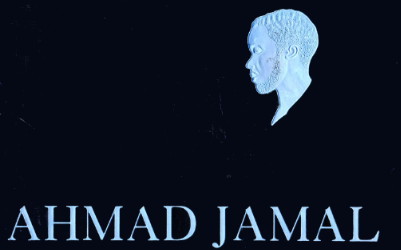


“His technique has scarcely changed over the years and remains closer to Eroll Garner than to anyone else, concentrating on fragile textures and calligraphic melodic statements, rather than the propulsive logic of bebop piano.”

- Richard Cook and Brian Morton, The Penguin Guide to Jazz on CD, 6th Ed.


“Ahmad Jamal never attained the level of celebrity that Garner, Peterson, Shearing, and Brubeck did, but for a relatively short period in the late fifties, his trio reached a mass listenership. His recordings of "Poinciana" and "But Not for Me" (Argo) were especially popular. He is a different kind of virtuoso who uses his prodigious technique sparingly and in unexpected places. His use of space and silence and his sense of form affected Miles Davis deeply, and Miles even instructed his pianist, Red Garland, to emulate Jamal's chordal voicings and Charleston-like left hand. Jamal later embraced Latin and other idioms for his trio.”

Dick Katz, Pianists of the 1940s and 1950s in Bill Kirchner, Ed., The Oxford Companion to Jazz


“At this point Jamal is just starting his musical career. He has been recording for four years now and is only twenty-five years old. He is highly regarded by fellow musicians, like Dave Brubeck, and has the same agent as Louis Armstrong. He has played in many of America's finest nightclubs, from coast to coast, including our own Blue Note. Talking with Jamal on the eve of his recent departure for Las Vegas, Los Angeles, and then New York, one had the impression of talking to a large child, yet to someone far beyond simple innocence. At times he seems at once young and a century old. Soft-spoken, grave, calm, and ascetic who does not even smoke. He still has something of the elegant and precious about him that is not at all puritanical— he talks with a light humour, but keeps about him a quiet dignity and strength most impressive in this age which counts so heavily on the spectacular. His personality is reflected in his music, which in its clarity, calm and subtle joy, deserves to be called the chamber of contemporary jazz.”

- HERBERT C. LUST, liner notes to Ahmad Jamal Trio: Chamber Music of the New Jazz [Argo LP 602 recorded May 23, 1955, Chicago IL] 


“Jamal has released nearly 70 recordings, the last in 2019 at the age of 89, and has received many awards – ‘Living Jazz Legend’ by the Kennedy Center for the Performing Arts (2007), inclusion in the Down Beat Readers Poll/Hall of Fame in 2011, and a Grammy Lifetime Achievement Award (2017).”

- Mike Rose, UK National Jazz Archive


Born in 1930 and 91 years of age as of this posting, Ahmad Jamal was half that age when he gave this interview to Len Lyons in the mid-1970s.


A man of dignified dress and manner, Ahmad Jamal appears to be as meticulous and disciplined as his music. His piano playing gained him a select following of musicians in the early fifties in Chicago, but he was virtually unknown by the public until 1958, when he recorded At the Pershing (on Chess) with bassist Israel Crosby and drummer Vernel Fournier. Jamal's light touch and carefully planned trio arrangements showed the power that could be achieved with only a few well-placed notes. With his crisp, precise attack, he builds a solo dramatically, as can few other pianists using the same, spare ingredients.


Jamal's penchant for understatement influenced many musicians, among them Miles Davis. Jamal is best known for his treatments of "But Not for Me," "Surrey with the Fringe on Top," "Poinciana," and his own composition, "Ahmad's Rhumba." This last piece was recorded in 1956 in a big band version by Miles Davis and Gil Evans, who built their orchestrations from Jamal's piano score. Quite often Jamal's interpretation of a composition sounds definitive, for reasons he explains below. An example is the simple folk melody "Billy Boy," which Red Garland popularized in 1956, following Jamal's conception of the song faithfully.


In 1959 Jamal disbanded his trio in order to make a pilgrimage to the holy places of Islam. After returning to the States later that year, he opened the Alhambra in Chicago, a "dry" nightclub which folded the following year. Dissatisfied with the musician's erratic life-style, Jamal virtually retired from music, except for sporadic recording, from 1962 to 1965. He then regrouped with Jamil Nasser on bass and Frank Gant on drums, recording for Impulse from 1969 to 1973. 


In 1974 Jamal became Twentieth Century-Fox's only jazz artist, and his recorded playing changed noticeably. Unfortunately he often submerged the piano within string and horn sections or depersonalized his playing by using an electric piano, essentially undermining the selectiveness he had exhibited in his trio work. But Jamal did continue to perform in nightclubs, where his playing displayed more favorable divergences from his earlier style. In short, the "space" (though that is a misnomer, according to Jamal) that had been a constant feature of his style was suddenly filled in by harmonic changes. That stylistic evolution, as Jamal explains below, is the result of greater self-assurance.


The following mid-career interview by Len Lyons first appeared in Keyboard Magazine and can also be found in his The Great Jazz Pianists [1983].


What was the first music you played on the piano?


I was playing Lizst etudes in competition when I was eleven years old. So if I was doing that at eleven - and they were finger breakers  -then I started very, very young: at three. Then I played everything that appealed to me, whether it was "Christopher Columbus" [by Razaf and Berry, a swing tune popular in the thirties] or my own arias. I began studying at seven with the founder of the first black opera company in America, Mary Caldwell Dawson. I also studied with fledgling and aspiring musicians around Pittsburgh, and we never had that separation of classical and so-called jazz music. It was music, either good or bad. If we wanted to play Duke Ellington, we did. We considered Art Tatum a study, just like Bach or Beethoven. Look at some early Tatum books [transcriptions], which were fairly accurate - they demand the same concentration as the three B’s. I began to study everything I could get my hands on until I was seventeen. Unfortunately I left on a professional job right after high school, so my training ended there. I never got to college because I had to support a family. I began to pursue the music from a make-a-living-or-perish point of view. But I did have good teachers when I was very young.


What technical exercises have you found valid?


I accept the rule of thumb that many of the things we did -Hanon, Czerny, and so on - were central. However, I also think there's a lack of new material, new directions, and new approaches to the basics. Everyone's physical structure varies; no two hands are the same. A runner like Jesse Owens is different from the runners of today. If we go back to the time of Mozart or Bach, there's an even greater span. I'd like to have my own approach to technical exercises based on my own thinking and physical structure. I wish I had thought of this earlier, instead of pursuing the same timeworn exercises. I think the things I studied were and are valid to a degree; they're just not exhaustive.


Some of your left-hand chording is very much in the style of Erroll Garner. Was he an early influence on you?


Erroll happens to be a milestone in pianistics. There are several: Art Tatum, Nat Cole, Teddy Wilson. I'm talking about contemporary American music, the only art form that has had its development in America. Remember, the art form that's unique to this country is not the classics, but our so-called Jazz. So anyone that has never been influenced by Erroll has not been in our field. Erroll was an orchestra within himself. He always played that way. I'd say he's from the impressionistic school and of the rank of Ravel or Debussy. Any stylist has to have influence, and in his case, it's his two-handed approach to the piano.


That list omits Earl Hines, who was an early influence on a lot of pianists.


I wouldn't rank Earl in the same category as Tatum or Garner. Hines was associated with big bands, not trios, which require the piano as the focal point at all times. I'm not taking anything away from Earl Hines, who has been rediscovered of late, but I don't think we're talking about the same sort of pianist. Like Duke Ellington: I think we listen to Duke as a whole musician, not as a pianist. We listen to his composing, his structures, his harmonies, and his great leadership abilities. Not like we listened to Art Tatum or Teddy Wilson. Then you're talking about total piano. Now I don't like to say that I'm influenced by anyone but Ahmad Jamal, because my influence comes from within, not from without. But everyone has to start out by emulating. You have to be careful who you emulate to achieve your goal.


How did the Ahmad Jamal Trio get started?


We were originally the Four Strings, which was Ray Crawford on guitar, Tommy Sewell on bass, and Joe Kennedy, violin. Joe left, and for a while we stayed as the Three Strings. In the early trio days the things that Ray did on the frets of his guitar were wonderful. Ray was the first to bring in that percussive sound you hear [in guitarists] today. If you go back to our early records like "Billy Boy" and "Will You Still Be Mine?" you'll hear a man playing conga, only it isn't a conga, but Ray hitting the frets of his guitar. This was taken up later by Barney Kessel and Herb Ellis [when they played in the Oscar Peterson Trio].


Wasn't it unusual to have a trio without a drummer?


Nat "King" Cole's was the classic cohesive trio that everyone patterned themselves after at that time [around 1949]. Nat was a fabulous pianist, and he worked with just bass and guitar. Listen to those things he did with Lester Young and his own trio. They were masterpieces. Subtlety was the trademark of that instrumentation. It was quite a challenge, especially to play some of those big rooms without a drummer. I played with that group [the Ahmad Jamal Trio] from about 1951 to '57. In 1957 I got into drums with a remarkable drummer, Vernel Fournier. That group made some monstrous headlines with Vernel and Israel Crosby on bass.


What accounts for the sudden recognition that band received? Was it solely on account of that live recording ‘At the Pershing.'?


From my point of view, it wasn't sudden recognition. I had been recording for years, and in Chicago I became an artist-in-residence at the Embers during the mid-fifties. That's a great opportunity for any musician. Everybody came to see us: musicians, singers like Billie Holiday and Sammy Davis, Jr. We were publicized only by word of mouth, which is the best publicity you can get. Another thing that made all that happen was the album, one of the most perfect albums ever made in the history of American classical music, which is what I prefer to call it [jazz].


The record came about after [Chicago deejay] Sid McCoy and I decided it would be great to do a remote recording from the Pershing. We influenced Leonard Chess to carry it through. Sid, by the way, is now the voice on some very big commercials made in Los Angeles. It was the spontaneity, that wonderful element that [producer] Norman Granz used to capture on record, that made it successful. It hadn't been done in so long; we resurrected it. We picked right out of forty-three recorded tracks for the album, and that's being very selective. All the ingredients were there, even a wonderful engineer, Mal Chisholm. Everything was right. Our concepts were strong, too. Vernel Fournier grew up in that marvelous New Orleans environment, so he had marching bands, funeral processions, and all that great stuff in his background. He had the greatest brush work in the world. Israel Crosby was marvelous, too.


Speaking of your concepts. Miles Davis said in the mid-fifties that you were his inspiration. What do you make of that, and have you ever discussed that issue with Miles?


Not really. "New Rhumba" and "Medley" were transcribed note for note by Gil Evans for Miles's big band album Miles Plus Nineteen [also called Miles Ahead, on Columbia]. He just orchestrated things I had done early in my career. I was delighted. We needed that kind of support at the time Miles came along and paid us that compliment.


Why do you think your piano playing was so easily adapted to a big band score? 


Because I've been trained to think orchestrally. That's the difference between the sound we get in our trio and some other bands. Thankfully, my three pieces sometimes give the illusion that they are six or seven pieces. We've become one instrument. Having been influenced in my childhood by the bands of Duke Ellington, Earl Hines, and Count Basie, and having stayed up late at the Savoy in Pittsburgh to hear those big bands, and playing with big bands, well, that's what happens. I don't think in single lines. I think in big band concepts.


By contrast, one of the things you've been known for is space, openness, and lightness in your music. Isn't that the antithesis of the orchestral approach?


No, it's not openness; it's discipline. Some people call it space, true. But I call it discipline.


How does your orchestral thinking get transferred to the keyboard? Do you write out your voicing [chord positions], bass lines, and so on?

Yes, contrary to what people have said, most of the things we do are written. Of course, I don't write the improvisational sections, but the songs we do are structured on paper.


Can you give me an example of how you start out with some new material? What did you do with "But Not for Me" on ‘At the Pershing’?


Well, that was about twenty-four years ago, so I honestly don't remember whether I just wrote out the chord changes in symbols or if I did something more. You know, there were other things that we definitely did not write out. When players have been together for a long time, you can do things that sound written even if they're not. Ballads, especially. I don't write out ballads unless for some reason the band can't hear where I'm going with the chords. I prefer the players to feel what I'm doing on a ballad. Otherwise, whatever we do is carefully planned and thought out.


When you're structuring a piece of music for the piano, are there any general rules that you follow?


Writing music is very difficult. When you reach a certain level, like in journalism or whatever you do, the work begins to dictate itself, as you must know. The most difficult thing is getting started. I don't push it. That's one rule. I won't sit down and force myself to think of something. Another thing I do is [write] the piano score first. When the piano part is written down, I'll set down a bass line, which is usually parallel to mine.


You mean your bass notes coincide with the bassist's?


Oh, yes. There are exceptions to that. Sometimes I'll give the bass the bottom [root tone] and I'll play the subordinate tones. If I'm working with a quintet, I'll extract from the piano score what I want for the trumpet and sax, too. I use close harmonies, very close. I also use what I'd call sensible and meaningful directions in the music, based on my experience of what works. I like strong rhythmic ideas, too. I guess that sums it up.


There are a lot of pedal tones, and superimposed chords in your playing.


That's one of the things that identify the Jamal approach to composition. I like pedal point and was influenced by it very early in life, and I like the superimposition of tones because I'm from the impressionistic school. Some of it came from my classical sources - I leaned heavily toward Ravel. He's one of my favorite composers.


Sometimes there's a large separation in your music between what's going on in the treble register and bass register on the keyboard. Do you think that's what people mean by "space"? There are also times when you don't play at all.


Well, people have to call it something, but I still call it discipline. Philosophically I felt there are times when I should just lay out because I didn't think it was necessary for me to play. 


For economy of expression?


You could call it that. But I'll still call it discipline. There might not be the same kind of discipline in my playing these days because I'm trying to achieve different things. Now I'm looking for consistency of performance as opposed to achievement. The ultimate goal of any performer has to be to play at a high level night after night.


I'm glad you brought that up. Your playing seems much fuller and busier now. Though I hate to use the word, there's not as much of what everyone called space as there used to be. I was planning to ask you about that.


When I was young, I was trying to achieve something - recognition, not necessarily from other people, but from myself. I was trying to gain confidence. When you have more confidence, the ideas flow more easily. 

That's what the difference in my playing is now. It's more fluidity, fluency. You have a greater flow of ideas when you have more confidence. I'd say my playing is fuller now, broader, and more percussive.


Where do you see yourself in the jazz piano tradition?


I don't see myself in that way, certainly not following the tradition of any other jazz pianists. I came through three different eras. I was a boy when Ellington and Hines were at their peaks. I was a young man when the Gillespie-Charlie Parker era came in, and I was quite an adult with the advent of electronics. This is also true of Thad Jones, Miles Davis, Mel Lewis, Clark Terry, and Quincy Jones. These guys have spanned the eras, and they're still around. Right now I see myself as a product of these different eras. And being fortunate enough to have that broad background, I'm just following my own individual ideas and experiences.



Friday, June 10, 2022

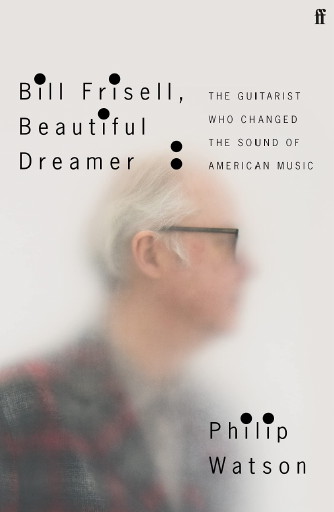
Bill Frisell, Beautiful Dreamer: The Guitarist Who Changed the Sound of American Music By Philip Watson - Reviewed by Larry Blumenfeld


Appeared in the May 21, 2022, print edition as 'Bending the Neck of Jazz Guitar'.

‘Beautiful Dreamer’ Review: Bill Frisell, Chameleon of Jazz

The musician has made a career out of challenging notions of what a guitar ought to sound like.


“A rounded and slightly trebly tone framed by a halo of overtones, along with other sounds—fuzzy-edged or transparent, elongated or truncated, tender or piercing—trace fragments of melody. They form jagged lines, loops in gentle circles. For guitarist Bill Frisell, this amounts to a singular language, by now familiar to listeners spanning genres and generations.

At age 71, Mr. Frisell is a towering figure of jazz guitar, a status he achieved largely by evading strict notions of jazz and by confounding expectations of what a guitar should sound like. With 41 albums to his credit and appearances on more than 300 more, he built his reputation gradually, arriving at the mainstream from the outside in. And then he went back out, far enough to get branded a master of a new “Americana.” He might seem a chameleon, were his sound and approach not so consistent and commanding.

Mr. Frisell wrings both complex musical implications and straightforward emotion from a ballad, thrashes his way through distortion, swings in the deepest jazz sense, and sounds as if he’s relaxing around a campfire, sometimes within a single composition. His music is wondrously odd, relentlessly logical, frequently funny and without a gratuitous note. Listen to him in enough situations, and it seems as if he weaves one cryptic song through them all. His playing sounds complete without anyone else around, yet he is among modern music’s great collaborators.

“Bill Frisell, Beautiful Dreamer: The Guitarist Who Changed the Sound of American Music” attempts to unlock the mysteries of that cryptic song. “Everybody digs Bill Frisell,” writes biographer Philip Watson. “This is the story of why.” The book is driven by what motivates most good writing about music: obsession. Mr. Watson heard Mr. Frisell perform nearly 40 years ago and just kept going. A London-based magazine writer and editor, he is also guided by the diligence that has driven his accomplished journalism on subjects as diverse as the 9/11 terrorist attacks and the effects of the Chernobyl disaster on children. His writing balances unbridled passion and dispassionate research nearly as deftly as Mr. Frisell’s playing does sound and silence. He lacks Mr. Frisell’s concision—these more than 400 pages could use whittling—but his compelling story reveals aesthetic truths.

Early in Mr. Watson’s interviews with Mr. Frisell, the guitarist asks: “But what will you write about? . . . I mean, there haven’t been any fights, or anything. And all I’ve done is stay married to the same woman for the past thirty-five years.” He has a point. This tale lacks even a whiff of scandal. No major falls or comebacks. Instead of an outsize ego, we have a musician who “unshakably splits concert fees equally with his band members.”

Lacking that sort of drama, Mr. Watson invests in paradoxes of Mr. Frisell’s character that mirror those in his music: how a painfully shy boy growing up in Denver (“I had to fight all the time against closing myself off”) came to play expansive music in front of audiences; how a young man “so timid and furtive that he must have been ‘raised by deer,’ ” according to one bassist, asserted himself on the New York scene. Mr. Frisell, by now a hero to guitarists of many stripes, is, for the critic Joseph Hooper, “the refutation of all that is heroic and priapic about the guitar tradition.” For the producer Hal Willner, who brought Mr. Frisell to wider attention at Nonesuch Records, the buoyant spirit of the guitarist’s music has a constant undertow—“darkness is always, always in the mix with Bill,” he says. “It’s his home town.”

Any book about a guitarist includes a lineage of guitars. This one begins with the one Mr. Frisell created with cardboard and rubber bands as a young boy, and includes, among others, the customized Gibson ES-175 given to him by Dale Bruning, his first important mentor. Mr. Watson details revelatory communions of man and machine: volume and delay pedals “opened up a whole new world”; bending and swaying the instrument’s neck just so became “the guitar equivalent of ‘touching your finger against the edge of an album while it spins on the turntable.’ ” Mr. Frisell doesn’t play fast and furious solos, yet the technical aspect of his brilliance is noteworthy. Fellow guitarist Marc Ribot wonders “how he managed to get his guitar to produce notes that swelled in volume as they sustained, like a violinist or horn player, instead of steadily fading, like the notes on everyone else’s guitar.”

There are moments of absorbed wisdom: the great guitarist Jim Hall, with whom Mr. Frisell studied and collaborated, and who he at first emulated, instructs him to “find yourself”; another early mentor, the vibraphonist Gary Burton, tells Mr. Frisell, who went to college primarily as a clarinetist, ‘“If you are going to play an instrument, you have to commit to it solely.” Throughout, Mr. Frisell’s career seems guided by what his biographer calls “organised serendipity”: In 1980, right after Mr. Frisell borrows a Paul Motian album from the library, he gets a phone call from the great (now late) drummer, thus setting off a relationship that spanned more than 30 years.

Mr. Watson sometimes lathers his prose with too many laudatory adjectives. Yet he also reports with accuracy and style. “Motian and Manhattan were a perfect match for each other: streetwise, wise-cracking, romantic and tough.” The 1970s were, for jazz, a “fascinatingly fractured though creatively fertile decade.” He is particularly discerning when considering whether Mr. Frisell plays jazz. “I do think it matters that we say Bill plays jazz, because there is an empathy that he has for what the music means to our culture, and then what it means to his culture,” says the pianist Jason Moran. Elvis Costello, however coyly, makes a different point: “Bill Frisell is always an American folk musician . . . that is, he works with all the music made by American folk.” Mr. Watson’s 11 “Counterpoint” sections — interludes in which he and a musician consider a Frisell recording—disturb his story’s flow yet often yield insights. In one, the Irish traditional musician Martin Hayes frames Mr. Frisell’s range and gifts: “The American music story is incredible, by any standards, especially in the twentieth century. There was such an outburst of music; there’s been no other country that has created so many different styles in such a short space of time. And it just seems like Bill feels free to graze through all of them, and to find ways in which many elements can harmoniously sit together. But it’s distilled too; there’s nothing showy or more than is needed.”

At one point, Messrs. Frisell and Ribot discuss moments when the lines separating traditions blur—when, for instance, according to Mr. Frisell, “just for ten seconds,” Bill Monroe, the father of bluegrass music, sounds like Duke Ellington.

“Is that what you look for when you’re going into that music, the moments when its borders meld?” Mr. Ribot asks.

“Yeah, where it just transcends all that stuff that’s been put on us by a record company or a writer or somebody analysing everything after the fact and then categorising it. Musicians don’t do that when they’re in the midst of playing; that stuff always comes later.”

Here, Mr. Watson, who does plenty of analyzing and categorizing, nevertheless also takes the time and care to investigate the stuff that came before. That’s where Bill Frisell lives.

Mr. Blumenfeld writes regularly about jazz and Afro-Latin music for the Journal.

Appeared in the May 21, 2022, print edition as 'Bending the Neck of Jazz Guitar'.


Wednesday, June 8, 2022

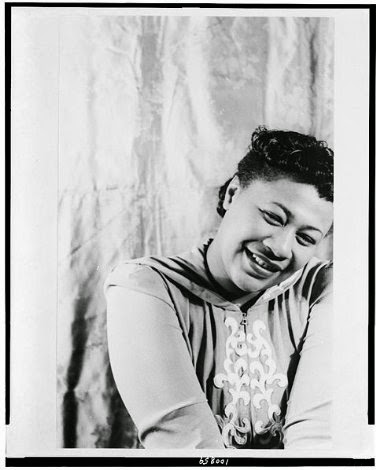
Ella Fitzgerald by Henry Pleasants [Revised from the Archives]

 © -  Steven A. Cerra, copyright protected; all rights reserved.


"I never knew how good our songs were," Ira Gershwin once said to George T. Simon, "until I heard Ella Fitzgerald sing them."

“And then there is Ella, about whom critics have surprisingly little to say, …. Her situation is not unlike that of Art Tatum — there's no way to ignore the technical and musical genius of these two, or their immense and joyous fecundity, even if you prefer your art less Olympian.”
- Henry Pleasants, The Great American Popular Singers

“She's tops! I just love her. She's Mama!”
- Jon Hendricks, Jazz vocalist

If you’ve ever wondered what made Ella Fitzgerald’s singing so singularly outstanding, you will wonder no longer after reading these excerpts about her style from Henry Pleasants, The Great American Popular Singers (1974).


“Gerald Moore, the English accompanist, tells about the time Dietrich Fischer-Dieskau, following a matinee recital Moore and the German Lieder singer had given together in Washington, D.C., rushed to the National Airport and took the first plane to New York in order to hear Duke Ellington and Ella Fitzgerald at Carnegie Hall.


"Ella and the Duke together!" Fischer-Dieskau exclaimed to Moore. "One just doesn't know when there might be a chance to hear that again!"


The story is illustrative of the unique position that both Ella Fitzgerald and Duke Ellington occupy in the musical history of our century. More than any other artists working in the Afro-American idiom, they have caught the attention and excited the admiration of that other world of European classical, or serious, music.


Ella's achievement, in purely musical terms, is the more remarkable of the two, if only because she has never ventured into the no-man's-land of semi-classical or third-stream music separating the two idioms. Duke Ellington is a familiar figure on the stage at symphony concerts, as both pianist and composer, in his jazz-flavored symphonic suites. Ella has ranged widely between the ill-defined areas known as "jazz" and "popular," but not into classical, although she has sung the songs of the great American songwriters—Arlen, Gershwin, Porter, Rodgers, for example—with symphony orchestras. Many classical singers, however, like Fischer-Dieskau, are among her most appreciative admirers.


Unchallenged preeminence in her own field has had something to do with it, along with consistent performance throughout a career that has already extended over nearly forty years. Although she has never been, in her private life, a maker of headlines, her honors have been so many that word of them has filtered through to many who never saw a copy of Billboard or Down Beat and never will.


To enumerate those honors would be tedious. Suffice it to say, citing the entry under her name in Leonard Feather's New Encyclopedia of Jazz, that, between 1953 and 1960 alone, she was placed first in Metronome, Down Beat, and Playboy polls in either the "jazz singer" or "popular singer" categories, or both, no fewer than twenty-four times. She had been a poll winner long before that — she won the Esquire Gold Award in 1946 — and she is heading the polls in both categories to this day.


With Frank Sinatra and Peggy Lee, she shares the distinction of having achieved a nearly universal popularity and esteem without sacrificing those aspects of her vocal and musical art that so endear her to fellow professionals and to the most fastidious of critics and lay listeners. Not even Frank and Peggy are admired so unanimously. The refinements of their art often fall on unappreciative or hostile ears. But with Ella, the exclamation "She's the greatest!" runs like a refrain through everything one reads or hears about her. One is as likely to hear it from an opera singer as from Bing Crosby ("Man, woman and child, Ella Fitzgerald is the greatest!").


Of what does her greatness consist? What does she have that other excellent singers do not have? The virtues are both obvious and conspicuous, and there is general agreement about them. She has a lovely voice, one of the warmest and most radiant in its natural range that I have heard in a lifetime of listening to singers in every category. She has an impeccable and ultimately sophisticated rhythmic sense, and flawless intonation. Her harmonic sensibility is extraordinary. She is endlessly inventive. Her melodic deviations and embellishments are as varied as they are invariably appropriate. And she is versatile, moving easily from up-tempo scatting on such songs as "Flying Home," "How High the Moon?" and "Lady Be Good" to the simplest ballad gently intoned over a cushion of strings.


One could attribute any one, or even several, of these talents and attainments to other singers. Ella has them all. She has them in greater degree. She knows better than any other singer how to use them. What distinguishes her most decisively from her singing contemporaries, however, is less tangible. It has to do with style and taste. Listening to her — and I have heard her in person more often than any other singer under discussion in these pages—I sometimes find myself thinking that it is not so much what she does, or even the way she does it, as what she does not do. What she does not do, putting it as simply as possible, is anything wrong. There is simply nothing in her performance to which one would want to take exception. What she sings has that suggestion of inevitability that is always a hallmark of great art. Everything seems to be just right. One would not want it any other way. Nor can one, for the moment, imagine it any other way.


For all the recognition and adulation that has come her way, however, Ella Fitzgerald remains, I think, an imperfectly understood singer, especially as concerns her vocalism. The general assumption seems to be that it is perfect. That she has sung in public for so many years—and still, when on tour, may do two sixty-minute sets six or seven nights a week—with so little evidence of vocal wear and tear would seem to support that assumption. Her vocalism is, in fact, as I hear it, less than perfect. "Ingenious" and "resourceful" would be more appropriate adjectives.


She has, as many great singers in every category have had, limitations of both endowment and technique. But, also like other great singers, she has devised ways of her own to disguise them, to get around them, or even to turn them into apparent assets. Ella's vocal problems have been concentrated in that area of the range already identified in the case of earlier singers as the "passage." She has never solved them. She has survived them and surmounted them.


She commands, in public performance and on record, an extraordinary range of two octaves and a sixth, from the low D or D-flat to the high B-flat and possibly higher. This is a greater range, especially at the bottom, than is required or expected of most opera singers. But there is a catch to it. Opera singers, as they approach the "passage," depress the larynx and open the throat — somewhat as in yawning — and, focusing the tone in the head, soar on upward. The best of them master the knack of preserving, as they enter the upper register, the natural color and timbre of the normal middle register, bringing to the upper notes a far greater weight of voice than Ella Fitzgerald does. Even the floated pianissimo head tones of, say, a Montserrat Caballe should not be confused with the tones that Ella produces at the upper extremes of her range.


Ella does not depress the larynx, or "cover," as she reaches the "passage." She either eases off, conceding in weight of breath and muscular control what a recalcitrant vocal apparatus will not accommodate, or she brazens through it, accepting the all too evident muscular strain. From this she is released as she emerged upward into a free-floating falsetto. She does not, in other words, so much pass from one register into another as from one voice into another. As Roberta Flack has noted perceptively: "Ella doesn't shift gears. She goes from lower to higher register, the same all the way through."


The strain audible when Ella is singing in the "passage" contributes to a sense of extraordinary altitude when she continues upward. In this she reminds me of some opera tenors who appear to be in trouble — and often are — in their "passage" (at about F, F-sharp, and G) and achieve the greater impression of physical conquest when they go on up to an easy, sovereign B-flat. The listener experiences anxiety, tension, suspense, relief, and amazement. It is not good singing by the canons of bel canto, which reckon any evidence of strain deplorable. But it is exciting, and in the performance of a dramatic or athletic aria, effective.


Both this sense of strain in that critical area of Ella's voice, and the striking contrast of the free sound above the "passage" may help to explain why so many accounts of her singing refer to notes "incredibly high." Sometimes they are. The high A-flat, A, and B-flat, even in falsetto, must be regarded as exceptional in a singer who also descends to the low D. But more often than not they sound higher than they are. Time and again, while checking out Ella's range on records, 1 have heard what 1 took to be a high G or A-flat, only to go to the piano and find that it was no higher than an E or an F. What is so deceptive about her voice above the "passage" is that the sound is high, with a thin, girlish quality conspicuously different from the rich, viola-like splendor of her middle range. It is not so much the contrast with the pitches that have gone before as the contrast with the sound that has gone before.


In purely vocal-technical terms, then, what distinguishes Ella from her operatic sisters is her use of falsetto; what distinguishes her from most of her popular-singer sisters is her mastery of it. One may hear examples of its undisciplined use in public performance and on records today in the singing of many women, especially in the folk-music field. With most of them the tone tends to become thin, tenuous, quavery, and erratic in intonation as they venture beyond their natural range. They have not mastered falsetto. Ella has. So has Sarah Vaughan. So has Ella and Sarah's admirable virtuoso English counterpart, Cleo Laine.


The "girlish" sound of the female falsetto may offer a clue to its cultivation by Ella Fitzgerald, and to some fundamental characteristics of her vocal art. It is, for her, a compatible sound, happily attuned to her nature and to the circumstances of her career. She entered professional life while still a girl. Her first hit record, "A-Tisket A-Tasket," was the song of a little girl who had lost her yellow basket. The girl of the song must have been a congenial object of identification for a young singer, born in Newport News, Virginia, who spent her childhood first in an orphanage, later with an aunt in Yonkers, New York, who drifted as a young dancer into Harlem clubs, and who fell into a singing career in an amateur contest at the Harlem Opera House when she was too scared to dance.


"It was a dare from some girlfriends," she recalls today. "They bet me I wouldn't go on. I got up there and got cold feet. I was going to dance. The man said since I was up there I had better do something. So I tried to sing like Connee Boswell — 'The Object of My Affection.'"


According to all the jazz lexicons, Ella was born on April 25, 1918, and entered that Harlem Opera House competition, which she won, in 1934, when she would have been sixteen. She became vocalist with the Chick Webb band the following year, was adopted by the Webb family and, following Chick's death in 1939, carried on as leader of the band until 1942. She would then have been all of twenty-four, with ten years of professional experience behind her.


According to Norman Granz, who has been her manager throughout the greater part of her career, she was younger than that. Granz says that she was born in 1920 and had to represent herself as older, when she first turned up in Harlem, to evade the child-labor laws. She was adopted by the Webbs because a parental consent was a legal prerequisite for employment.


It should hardly be surprising, then, that her voice, when she began with the Chick Webb band, and as it can be heard now on her early records, was that of a little girl. She was only fourteen. She was a precocious little girl, to be sure, and probably matured early, as other black entertainers did—Ethel Waters and Billie Holiday, for example—who grew up in the tough clubs and dance halls of Harlem while other girls were still in secondary school. What mattered with Ella, however, and affected her subsequent career, was that the little girl could also sound like a young woman — and was irresistible.


The sound worked, and so did the little girl. Ella has never entirely discarded either the girl or the sound. She was, and has remained, a shy, retiring, rather insecure person. To this day when, as a woman of matronly appearance and generous proportions, she addresses an audience, it is always in a tone of voice, and with a manner of speech, suggesting the delighted surprise, and the humility, too, of a child performer whose efforts have been applauded beyond her reasonable expectations.


Nor has Ella ever forsaken her roots in jazz. George T. Simon, in The Big Bands, remembers watching her at the Savoy Ballroom in Harlem when she was with Chick Webb:


“When she wasn't singing, she would usually stand at the side of the band, and, as the various sections blew their ensemble phrases, she'd be up there singing along with all of them, often gesturing with her hands as though she were leading the band.”


The fruits of such early enthusiasm and practice may be heard today in Ella's appearances with the bands of Count Basie and Duke Ellington, when one or more instrumental soloists step forward to join her in a round of "taking fours," with Ella's voice assuming the character and color of a variety of instruments as she plunges exuberantly into chorus after chorus of syllabic improvisation (scatting).


Ella owes at least some of her virtuosity in this type of display, or at least the opportunity to develop and exploit it, to Norman Granz and her many years' association with his Jazz at the Philharmonic tours. Benny Green, the English jazz critic, thus describes the importance of this association to the shaping of Ella Fitzgerald's art and career:


“When Ella first began appearing as a vocal guest on what were, after all, the primarily instrumental jazz recitals of Norman Granz, it might have seemed at the time like imaginative commercial programming and nothing more. In fact, as time was to prove, it turned out to be the most memorable manager-artist partnership of the post-war years, one which quite dramatically changed the shape and direction of Ella's career. Granz used Ella, not as a vocal cherry stuck on top of an iced cake of jazz, but as an artist integrated thoroughly into the jam session context of the performance. When given a jazz background, Ella was able to exhibit much more freely her gifts as an instrumental-type improvisor.”


Elsewhere, reviewing an appearance by Ella with the Basic band in London in 1971, Green has described as vividly and succinctly as possible the phenomenon of Ella working in an instrumental jazz context:


“The effect on Ella is to galvanize her into activity so violent that the more subtle nuances of the song readings are swept away in a riot of vocal improvisation which, because it casts lyrics to the winds, is the diametric opposite of her other, lullaby, self. And while it is true that for a singer to mistake herself for a trumpet is a disastrous course of action, it has to be admitted that Ella's way with a chord sequence, her ability to coin her own melodic phrases, her sense of time, the speed with which her ear perceives harmonic changes, turn her Basie concerts into tightrope exhibitions of the most dazzling kind.”


It was her activity with Jazz at the Philharmonic that exposed and exploited the singular duality of Ella Fitzgerald's musical personality. Between 1942, when her career as a bandleader came to an end, and 1946, when she joined Granz, she had marked time, so to speak, as an admired but hardly sensational singer of popular songs. With Jazz at the Philharmonic, she was back with jazz.


The timing was right. Bop had arrived, and Ella was with it, incorporating into her vocal improvisations the adventurous harmonic deviations and melodic flights of Dizzy Gillespie and Charlie Parker. Indeed, according to Barry Ulanov, in his A History of Jazz in America, the very term "bop," or "bebop," can be traced to Ella's interpolation of a syllabic invention, "rebop," at the close of her recording of " 'T'ain't What You Do, It's the Way That You Do It" in 1939.


She has cultivated and treasured this duality ever since, and wisely so. Singers who have adhered more or less exclusively to an instrumental style of singing, using the voice, as jazz terminology has it, "like a horn," have won the admiration and homage of jazz musicians and jazz critics, but they have failed to win the enduring and financially rewarding affections of a wider public. Others have stuck to ballads and won the public but failed to achieve the artistic prestige associated with recognition as a jazz singer. Ella, more than any other singer, has had it both ways.


Norman Granz, again, has had a lot to do with it. When Ella's recording contract with Decca expired in 1955, she signed with Granz's Verve label and inaugurated, in that same year, a series of Song Book albums, each devoted to a single songwriter, that took her over a span of twelve years through an enormous repertoire of fine songs, some of them unfamiliar, by Harold Arlen, Irving Berlin, Duke Ellington, George Gershwin, Johnny Mercer, Cole Porter, and Richard Rodgers.


These were the first albums to give star billing to individual songwriters, and they served the double purpose of acknowledging and demonstrating the genius of American composers while providing Ella with popular material worthy of her vocal art. "I never knew how good our songs were," Ira Gershwin once said to George T. Simon, "until I heard Ella Fitzgerald sing them."


As a jazz singer Ella has been pretty much in a class by herself, and that in a period rejoicing in many excellent ones, notably Billie Holiday, Peggy Lee, Carmen McRae, Anita O'Day, Jo Stafford, Kay Starr, and Sarah Vaughan, not to overlook, in England, Cleo Laine. I am using the term "jazz singer" here in the sense that jazz musicians use it, referring to a singer who works—or can work—in a jazz musician's instrumental style, improvising as a jazz musician improvises. Ella was, of course, building on the techniques first perfected, if not originated, by Louis Armstrong, tailoring and extending his devices according to the new conventions of bop.


There is a good deal of Armstrong in Ella's ballads, too, although none of his idiosyncrasies and eccentricities. What she shared with Louis in a popular ballad was a certain detachment—in her case a kind of classic serenity, or, as Benny Green puts it, a "lullaby" quality—that has rendered her, in the opinion of some of us, less moving than admirable and delightful. In terms of tone quality, variety, and richness of vocal color, enunciation, phrasing, rhythm, melodic invention, and embellishment, her singing has always been immaculate and impeccable, unequaled, let alone surpassed, by any other singer. But in exposing the heart of a lyric she must take second place, in my assessment, at least, to Frank Sinatra, Billie Holiday, Peggy Lee, and Ethel Waters.


This may well be because she has never been one for exposing her own heart in public. She shares with an audience her pleasures, not her troubles. She has not been an autobiographical singer, as Billie and Frank were, nor a character - projecting actress, as Ethel Waters and Peggy Lee have been, which may be why her phrasing, despite exemplary enunciation, has always tended to be more instrumental than oral, less given to the rubato devices of singers more closely attuned to the lyrical characteristics of speech.


What she has offered her listeners has been her love of melody, her joy in singing, her delight in public performance and her accomplishments, the latter born of talent and ripened by experience, hard work, and relentless self-discipline. Like Louis, she has always seemed to be having a ball. For the listener, when she has finished, the ball is over. It has been a joyous, exhilarating, memorable, but hardly an emotional, experience.


Also, like Louis, she has addressed herself primarily to a white rather than a black public, not because she has in any sense denied her own people, but rather because, in a country where blacks make up only between ten and twenty percent of the population, white musical tastes and predilections are dominant. They must be accommodated by any black artist aspiring to national and international recognition and acceptance. In more recent years, younger whites have tended to favor a blacker music. A B. B. King has been able to achieve national celebrity where a Bessie Smith, fifty years earlier, could not. When Ella was a girl, what the white majority liked was white music enriched by the more elemental and more inventive musicality of black singers and black instrumentalists.


Ella's singing, aside from the characteristic rhythmic physical participation, the finger-popping and hip-swinging, and the obviously congenial scat-ting, has never been specifically or conspicuously black. It represents rather the happy blend of black and white which had been working its way into the conventions of American popular singing since the turn of the century, and which can be traced in the careers of Al Jolson, Sophie Tucker, Ethel Waters, Mildred Bailey, and Bing Crosby.


When Ella was a girl, black singers — those in organized show business, at any rate — were modeling themselves on the white singing stars of the time, and many white singers were modeling themselves on the charmingly imperfect imitation. It is significant that Ella's first model was Connee Boswell. A comparison of the records they both made in the late 1930s shows again how perceptive an ear Ella had from the first. But it is just as significant that Connee Boswell belonged to a generation of jazz-oriented white singers— others were Mildred Bailey and Lee Wiley—who had been listening to Bessie Smith and, above all, to Ethel Waters.


Again like Louis Armstrong, Ella Fitzgerald has achieved that rarest of distinctions: the love and admiration of singers, instrumentalists, critics, and the great lay public. But while she may be for the jazzman a musicians' musician, and for the lay public the First Lady of Song, she has always been more than anything else a singers' singer. John Hendricks, of Lambert, Hendricks and Ross fame, has put it well, responding to an Ella Fitzgerald record on a Jazz Journal blindfold test:
Well, of course, she's my favorite — she's tops! I just love her. She's Mama! I try and sing my ballads like she does. I was working in a hotel in Chicago, and Johnny Mathis came in to hear me. I had just finished singing a new ballad I was doing at the time, and he came up to me and said, "Jon, you sure love your old Fitzgerald, don't you?"


"Yes," I replied, "and don't you, too?"


"We all do!" he said.


And that's it. Everyone who sings just loves little old Fitzgerald!”


Saturday, June 4, 2022

"Guy Lombardo - And about thirty years of jazz theology got blown to hell" by Gene Lees

 © Copyright ® Steven Cerra, copyright protected; all rights reserved.


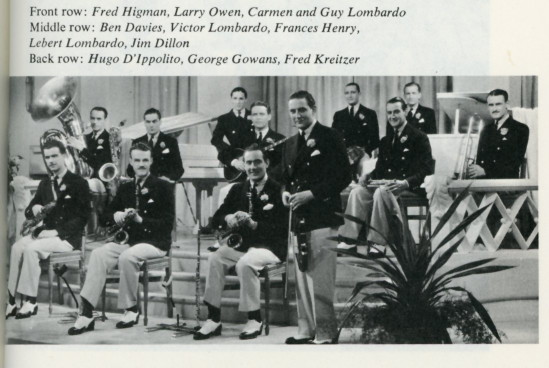
“ONE of the most listened-to, talked-about and imitated big bands of all time was that of Guy Lombardo and His Royal Canadians. Why? For a time even its leader couldn't answer that question. "We didn't know what we had," Guy once told me during a discussion of his band's early days. "We had to ask people what it was they liked about the band."


They did not have to ask for long. It soon became evident what it was that people liked about "The Sweetest Music This Side of Heaven": Carmen's lead saxophone and singing, Lebert's lead trumpet and Guy's leading of the band as a whole.


The respect that Lombardo generated from people who had been associated with the band was tremendous. As Gabler once emphasized: "Guy is just a sensational person—as a human being and as a man to work with." One of the most prominent talent agency executives, Larry Harriett, who handled dozens upon dozens of top stars, once stated: "Guy Lombardo is the nicest man that's ever been in the music business."


And Lombardo finished first in more than just personal popularity polls. His band sold more records than any other dance band.”

- George Simon, The Big Bands, 4th Ed. 


The following appeared in the May 15, 1982 edition of the Jazzletter, only the second year of this self-published ad libitum journal’s [as much or as often as necessary or desired] existence.


Although very popular during the Swing Era, the Guy Lombardo Orchestra was the subject of much derision by post World War II modern Jazz fans who considered it square, hep and essentially uncool.


This contemptuous group would have included Gene Lees until he became a convert as is described in this segment of the Jazzletter.


“... and Guy Lombardo For everyone there is a last battle, the one you don’t win, and at the time Duke Ellington was fighting his I went to hear the band of another leader, a band I had never seen, one I had never wanted to see, one whose passing has altered our New Year's Eves forever. l refer of course to Guy Lombardo. When I saw his band in person, I found, to my own incredulity, that I liked it. And about thirty years of jazz theology got blown to hell. 


In the late 1930s and during about the first eight years of the ’40s, there were hundreds of big bands traveling America. including those with a strong regional popularity, known as territory bands, which never broke through to the national and international status of “name bands”. This term was a sort of a generic catch-all that did not imply judgment of whether these orchestras were good or bad, whether they were jazz bands (the pinnacle) or sweet bands (the pits). It was useful in that it avoided the terminological confusion that has plagued discussions of music probably since pithecanthropus erectus started stomping around a stew-pot. 


All the bands, including the jazz orchestras such as those of Fletcher Henderson, Earl Hines, Duke Ellington, Lionel Hampton, Chick Webb, Count Basie, Billy Eckstine, Woody Herman, Charlie Barnet, Artie Shaw, and Jimmie Lunceford. played for dancing and had for the most part begun as dance bands. And others that were basically dance bands were capable of playing jazz — Benny Goodman, Glenn Gray, Les Brown. Harry James, Tommy Dorsey. Indeed when the Tommy Dorsey band chewed into a chart by Sy Oliver, as in Well Git It or Deep River, roaring ahead on a rhythm section fueled by Buddy Rich, it was transformed suddenly into a soaring jazz band, and often could swing as hard. For the sake of clarity, then, let's say that there were a lot of dance bands—thousands of them, if you included those whose activities were confined largely to the dance pavilions of the local amusement parks that dotted the continent. 


Some of them were infused with a jazz spirit and staffed with jazz players and they played as much jazz as they could get away with. There was another kind of band that had no apparent interest in jazz. These were the so-called “sweet” bands, detested by the jazz fans on a sliding scale according to the corn content of the music. Hal Kemp, whose band even a lot of musicians liked; Kay Kyser; Freddie Martin; Tommy Tucker; Shep Fields and His Rippling Rhythm; Richard Himber; Wayne King, even then an anachronism because his thing was waltzes in an age of unrelenting four, and Sammy Kaye. A few jazz fans secretly liked Kay Kyser, although they would not dare mention it to their- hipper-than-thou young friends. It was a good commercial band despite its Ish Kabibble comedy and Kyser’s mortarboard hat, which fact I mentioned to Johnny Mandel. “Of course,” Johnny said and, being one of those walking encyclopediae of arcane information, promptly ran off some of the personnel roll of the band. “Some pretty good players,” he said. Then he added drily, “The Sammy Kaye band, however, had no redeeming features.” 


The jazz fans considered these bands a threat to the true faith, and they were perhaps right. Mass public taste does not naturally tend toward altitude, and the businessmen who then as now dominated entertainment displayed their usual unswerving fidelity to whatever made the most money. And the sweet bands made a lot of money, none more than Guy Lombardo, who was probably the most successful bandleader since Strauss the Younger and quite possibly the richest in the history of the world. 


Consequently he was at the head of the hate list. His was the name that most immediately inspired the ire of true believers, the young finger-poppers who dug the jazz bands. And with ritual regularity we elected him King of Corn in the Down Beat poll, although Alvino Rey told me recently with a sort of shy and perverse pride, “We won that title once.” But rumor had it that Louis Armstrong liked the Lombardo band. And since he occupied in the pantheon of jazz approximately the position of Zeus, this presented a problem like the Manichean heresy. Nobody has ever determined, as far as I know, whether Charlie Parker was putting us on when he said he liked Rudy Vallee’s saxophone playing. But in the case of Louis Armstrong, rumor was in accord with fact: he did indeed like the Guy Lombardo band, whereby hangs a tale to which we shall come in due course. Louis’s opinion was so disturbing that we all chose to ignore it, hoping it would just go away. 


Almost as unsettling was the rumor that Guy Lombardo in tum was a jazz buff. Early in 1974, Lombardo was booked to play an engagement in Toronto. Don Hartford, the president of radio station CFRB and a big-band fan, asked me to interview him for the station. I threw that journalistic switch that requires you to suspend prejudice and be fair, no matter the subject, and met Guy in the studio at the station. Like Duke, he was then in his seventies—71, to be precise. Unlike Duke, he really did not look his age. He looked about 55. And he turned out to be a warm and altogether lovely man, innocent of pretense.


He invited me to hear the band and I went to do so, already beginning to catch glimpses of history. Of the few bands that survived into the 1970s, all were born in the l930s or’40s. But those of Duke Ellington and Guy Lombardo were born in the '20s. They had moved on an unaltered course from the time of F. Scott Fitzgerald, the hip flask and Shipwreck Kelly, through the eras of bread lines and shot-down workers, World War II, the bomb, the home-coming, the burgeoning of suburbs, Korea, ducktail hair, Bill Haley and the Comets, Elvis Presley, Timothy Leary, Viet Nam, the Rolling Stones, Dealey Plaza, Bangla Desh, and Alice Cooper and his snake. They had led their bands from the time of Mary Pickford and Pola Negri into that of Linda Lovelace and Georgina Spelvin. 


I settled down at a table to await the band. This was in the main dining room of the Royal York, one of the many hotels Guy still played regularly. It was a candlelight-and-wine setting, with white-and blue-haired ladies comprising much of the audience. That women generally outlive their husbands was attested to by the fact that there were tables without men where elderly ladies sat together. (Later on I watched two of them get up, at first timidly and then with growing amusement. to dance together, like schoolgirls.) There were also many white-mustached men in the audience and, surprisingly, a few thirty-year-olds. 


The band came out and sat down and Guy followed and took his bows to great applause and raised his long baton, and they began playing. And I went into mild shock, as he swooped and danced about the stage, smiling: it was a damned good band, clean and smooth. To be sure, its music was simple, none of those rich harmonies that came into use through the '30s and ’40s and ‘50s: But if I could like triadic French popular music, for exactly what it was, why couldn't I like this? And very quickly, I began to do so.


The band was a museum piece. It had preserved a style from time before people in middle age were even born. And it wasn't an imitation, a reconstruction. It was alive, as Duke's band was alive and these men knew how to play that music. Its instrumentation was what it had always been: two trumpets and one trombone, three saxophones doubling clarinets (no baritone), two pianos and drums. Tuba carried the bass line. I had never seen a tuba-bass dance band. There were only two concessions to changing times - the band included guitar and it was amplified, and one of the “two pianos” was a Fender-Rhodes. Otherwise it was a kind of a monument to and evocation of an era that had faded long ago. 


Guy joined me at the table after the first set. I told him how much I liked the band, hoping my surprise was not obvious, and asked him how he accounted for his almost solitary profession: survival. He sighed. “Well,” he said, “we lost a lot of very talented people to untimely deaths, for one thing. If Tommy and Jimmy Dorsey and Glenn Miller were still alive, they would still be in the music business, and it would be a better business because of it. “And then there are no places today to develop new bands. Th ballrooms are gone. In the old days, every hotel had a band, an some of them were very good bands. “And we were lucky. We were very lucky.” “In what way?’ I asked. 


Guy was born in London, Ontario. He and his brothers, Lebert (trumpet) and Carmen (flute), played for garden parties and weddings with four- or five-piece groups. “Sometimes,” Guy said, “we even got paid.” The success of the Paul Whiteman band ha great impact on him and his brothers. The saxophone became popular. Carmen planned to be a symphony flutist and was working toward that goal but, for the sake of the jobs they were playing, he took up the saxophone. “He wanted to avoid that reedy sound,” Guy said. 


“He wanted to get a flute sound.” “Then that explains his vibrato,” I said. “It’s a flute vibrato. 


“Exactly,” said Guy. “And it gave him a unique sound. Carmen's saxophone was one of the things we had in our favor. (And it was one of the things I learned some years after this, that Louis Armstrong liked about the band.) 


The band had grown somewhat in size. All the musicians in it wanted to improvise. “I told them, ‘Play the notes as they're bloody well written.’ That almost caused a mutiny. We had a big confrontation in a poolroom. But I told them, ‘Play the notes or you don’t work,’ and they gave up.” London, Ontario, lies halfway between Toronto and Detroit at 43 degrees north latitude on a peninsula formed by Lake Huron, the St. Clair River, and Lake Erie. Almost due south of it, acros Lake Erie, is Cleveland, Ohio. In November, 1923, the same month Sousa worked that gig in Sioux City, Guy and his brother took a chance on a trip across that invisible border in the lake to Cleveland. They were never to go home again, except on tour (But Guy played his home town once a year all his life.) 


“In Cleveland, we had another piece of luck. The owner of the Claremont was a man named Louis Bleetz, who knew the band business from A to Z. We had just enough brains to listen to him. He taught us to play softer and play slower. He schooled us for year. So when the real break came, we were ready for it.” The break came in 1927, when they were booked into the Granada Café in Chicago. The owner of the Granada didn‘t think Guy Lombardo and Company was a very classy name. And so they became Guy Lombardo and his Royal Canadians probably for a subliminal  association  with  the good  booze that was following Guy across the border.


The mob was running loose in Chicago, busy with its internecine warfare. One night two hoods came in with machine guns. The band hit the deck when the shooting started. Several people were killed. Guy didn't say whether he considered packing up and going home but the thought surely crossed his mind. For whatever reason, he stayed on, and it was in Chicago that success came, not even overnight but in four hours.


The band had picked up a few fans, including some musicians.


"Is it true that you and Louis Armstrong were friendly?"


“Yes," Guy said. "He was playing in Chicago, and I just loved him, and he loved our band. He and his whole band used to come to hear us." Guy's voice dropped then, sad with a memory. "But in those days, you see," he said, "they couldn't get in. So they used to stand on the roof of their car and look in the window." (Duke was at the Cotton Club in Harlem. Bix was with Whiteman.)


Louis Armstrong may have liked the band but few lay men knew it existed. After a time Guy did indeed begin to feel discouraged and did think about going home. A new radio station wanted to try its equipment and its manager elected to do a remote of the band. At 8 p.m., the club was almost empty. But all over Chicago, people were listening to the radio, still fascinated by the new phenomenon. College kids, hearing the broadcast and finding something totally fresh in the band, began getting into cars and driving downtown, and by midnight the club had wall-to-wall customers.


Broadcasts on subsequent nights made the band into a Chicago smash. They were offered a record contract. The label, however, had little faith in them. Thus, even in that time, one sees the phenomenon of a record company signing an act and then doing nothing to sell it. You could get the records in Chicago but they were hard to find elsewhere. And soon kids at the eastern colleges, Yale and Harvard and Princeton, were having their friends in Chicago send them to them, and the band became a hit on records too, in spite of the company. Its first hit was a song Carmen had written. Little Coquette.


Guy went back to the bandstand to play another set. By now I was fascinated by the band and the man. I stayed until the end of the evening. 

Next day Guy and I had lunch.


In the 1940s Guy had become wealthy enough to indulge in one most expensive of rich men's hobbies: speedboat racing. It is not forgotten in sports circles that he was one of the great racers.


"Do you ever miss it?” I said.


“I’ll tell you," Guy said, "I once asked that question of my friend Wilbur Shaw, the great race driver. He said, 'Sometimes. But I just go lie down in a quiet room and turn out the lights and the feeling goes away.' I feel the same way."


Nonetheless we lapsed immediately into talking about those wonderful Harry Miller engines, and the three Allison engines-built for the Bell Aerocobra, a hot but dangerously unstable fighter of World War II — that he had mounted in a boat in the late 1940s to blister his way across the water with a vast white rooster-tail behind him and set records which, he admitted, he would now and then sentimentally look up in the books.


"I gather from what you've told me," I said, "that you're a jazz lover."


"Oh yes," Guy said. "Particularly Dixieland jazz. I think good Dixieland jazz is the most creative, the most soulful music in the world. That's what I listen to a lot. "Twice I tried to change my band into a jazz band, but the public hated it. So I went back to what we've always done. Although obviously I like what we do, or I wouldn't be doing it."


"It's funny," I said, "how the public is about keeping its heroes in pigeon-holes. They wouldn't let Edith Piaf sing comic songs."


After lunch we shook hands on the street and parted. He had invited me to come and visit him. I always intended to do it. I wanted to ask him more about Chicago, about the early days, about how it all came about. But I never got the chance. He died.


Recently Gerry Mulligan played Los Angeles with his new big band, born in the 1980s and proof that the big bands will not go away, no matter what the conglomerates do. It had on lead trumpet a girl — that's one of the ways times have changed named Laurie Frink, and on tenor, young Ted Nash. Ted was 14 when Duke died. His father, the superb trombonist Dick Nash. was born while Guy was playing the Granada and Louis had to stand on the roof of a car.


I told Gerry about my experience with Guy Lombardo and how much I had liked the band the one time I heard it in person.


"I'm glad to hear you say that," Gerry said with a certain fervor "Everybody was always so busy putting that band down that they never bothered to listen to it. It was not a corny band. It was a hip, 1920s dance band."