With the passing of Jan Laurens Hartong in 2016 - its founder, keyboardist and principal composer-arranger - I assumed my writings about the Holland based Latin Jazz band Nueva Manteca were going to be limited to the eight features about them previously posted to the blog [you can locate these by scrolling the sidebar of the blog and clicking on the group’s name under LABELS].
But my curiosity about continuing possibilities peaked when Ben van den Dungen, who has been a long-standing member of the group on soprano and tenor saxophone, alluded to a new project that Nueva Manteca would soon be undertaking in our communiques on social media.
Without further details, I conjectured that perhaps Ben was talking about previously recorded but unreleased tracks by Nueva Manteca issued in something akin to “the best of …” or “the unheard …” memorial recording with Jan Laurens as the focus.
Well, I was half right as the following insert notes from the group’s new CD entitled ART will attest:
“ART is a twofold tribute. Art Blakey and The Jazz Messengers was a groundbreaking phenomenon. With much love and a lot of respect for Blakey's incredible musical legacy, we added some 'rice and beans' to it...
We hope you enjoy our guaracha, songo, cha cha, bomba and much more!
Just like Blakey, our dear friend and mentor, the late Jan Laurens Hartong gave his younger band members a lot of musical space to develop their art.
Spiritual father of Nueva Manteca, he was not only its pianist, bandleader, composer, arranger and promoter for many years, but he also constantly came up with new ideas and concepts for the band. Being a classically trained pianist, he was always totally au courant about the latest in jazz, Latin and music in general.
All his passion and knowledge was constantly injected into his creation Nueva Manteca. We are deeply grateful to him for sharing his art with us in his very own, unique way.
We love you and we will never forget you.
Thanks Jan!”
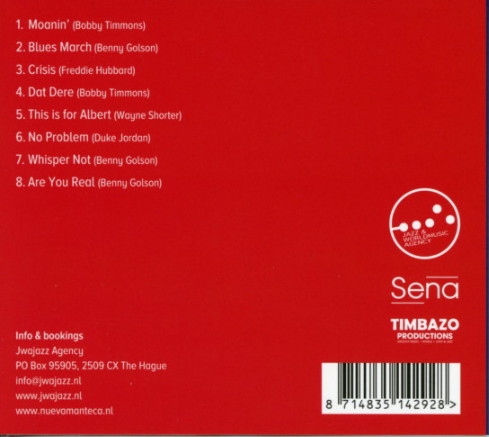
Thematically, the “rice and beans” are added to seven tunes by Bobby Timmons, Benny Golson, Wayne Shorter and Freddie Hubbard, all of whom worked as members of drummer Art Blakey’s Jazz Messengers in the early 1960, and all of which have since become Jazz Standards. Pianist Duke Jordan is also honored with the selection of his No Problem.
What intrigued me about the Latin Jazz rendering of such Jazz staples as Moanin’, Blue March, Crisis, Dat Dere, This Is For Albert, No Problem, Whisper Not and Are You Real, is how the inclusion of various clave forms altered the rhythmic sound of these tunes almost to the point of giving them the impression of being played in odd or unusual time signatures.
Clave rhythms are very different from the metronomic ones used in Jazz so they syncopate differently creating the impression that the time signatures are other than the usual 4/4 or 3/4 or 6/8 in which Jazz is usually played. Because Clave rhythms are a repeated pattern rather than a counted progression, the accents fall differently.
Furthermore, the clave rhythms are usually associated with definite Latin song and dance patterns and when these are applied to straight-ahead Jazz tunes they also create a sense of staggered or altered rhythmic progressions.
So with all this in mind I wrote to Ben and asked him to give me a breakdown of how the rhythms of each of the eight tunes on ART are configured.
Here’s his reply complete with “rice and beans” references:
“Hi Steven:
Hereby the information of the tunes in combination with the Cuban rhythms -
RITMES ART
Moanin' 4/4
Cha Cha Chá/Guajira
Blues March 12/8-4/4
Batá rhythm Wolenche on stand [one player].
Further Bembé, kind of Abakua 'invento' in mambos, piano solo: 'Onda Nueva', samba in 3/4
In conga solo play bass, piano chords of El Ratón [Cheo Feliciano, Joe Cuba, Fania]
Crisis 4/4
Combination of Mozambique, Songo, Bomba, fits with the bass!
Dat Dere 4/4
Intro Conga Habanera [comparsa], theme, solos Cha Cha Chá
Uitro: again Conga Habanera [comparsa], played a bit more freely. Planned by arranger was Guaguancó, but this worked better
This is for Albert 4/4
Danzón, Bembé, Cha Cha Chá/Guajira
No Problem 4/4
Conga accents a la 'Sazonando' and La Habana + guaguancó
Presión part for Mambo: free accents a la Charanga Habanera
Mambo and trumpet solo guaracha, with timba influences
Whisper Not 7/4
Makuta in 7/4 with Caja accents [low conga], in solos Bomba a la 'Mi Tierra', end solo - mambo: Bembé and Tumba
Are you Real 4/4
Conga Habanera [comparsa], in the solos what they called timba in Cuba in the 70s: fast heavy Latin jazz, the conga plays 'picadillo': a combination of everything, but always in clave of course.”
As Ben concludes - “... always in clave!” - the secret sauce that makes 8 tunes that have been in the Jazz repertory for sixty years sound new and distinctive.
After reviewing Ben’s descriptions of what’s involved in creating these Latin Jazz interpretations of the Jazz standards long associated with Art Blakey and the Jazz Messengers, they help us further appreciate and admire the collective knowledge and skills that went into the making of ART.
While paying respect to the traditional format of finding a theme around which to configure Latin Jazz rhythms and song forms, the talents and skills of the latest edition of Nueva Manteca lend themselves to a totally new creation.
In addition to new music there are some new faces involved in the making of ART as joining Ban van den Dungen on reeds and Nils Fischer on Latin percussion are Marc Bischoff, who assumes the piano chair for the departed Jan Laurens Hartong, Enrique Firpi steps in for Lucas van Merwijk on drums and timbales and trumpeter Oscar “Chucky” Cordero and bassist Samuel Ruiz join in for their maiden voyage on the “HNLMS New Nueva Manteca.”
As with all of the previous efforts by this group, an air of authenticity, energy and excitement permeates ART.
If you are a fan of Latin Jazz, ART should be at the very top of your wish list for this one is not to be missed.
[HNLMS = All ships entering the service of the Royal Netherlands Navy are given the prefix HNLMS (His Netherlands Majesty's Ship)].
“ … his own date for Savoy on 30 October, 1945, … reveal the saxophonist still identifiably absorbing his influences, although the distinctive compound he was brewing from them is already evident in places. Lester Young's smooth, relaxed ease, Coleman Hawkins's big, rich sonority and projection, and Illinois Jacquet's honking robustness can all be heard behind his playing,
but his fluidity and harmonic originality are clearly working their way to the surface, ….
While unquestionably cast in the emerging bebop idiom, these performances also underline the saxophonist's roots in the pre-bop era. Those polarities of sophisticated harmonic awareness and driving swing remained the basic building blocks of his style, and were a source of a great deal of creative interaction within his playing, both in generating internal tension and subverting expectations. The session also pre-figured what would become another of his trademarks (and something of a bop staple in general), a penchant for inserting quotations from other tunes into the piece he was playing, often for humorous effect. It became an overdone convention (and, in lesser hands, often a way of avoiding the demands of genuine invention), but can be effective when deployed in the right way, and Gordon, while never reluctant to ham it up, was one of its most skilled exponents.
He was back in the studio with the Benny Carter Orchestra early in 1946, ….
Gordon is in full flow on these sides, with that big, authoritative tenor sound which he cultivated throughout his career spilling across the top-rank rhythm section ….
The fourth cut is his first great ballad performance on disc; there would be many more to come. He seemed to be in particular sympathy with the ballad idiom, both in terms of sonority and expression (although he adopts a wider vibrato here than would subsequently be the case, notably on the alternate take, which may be why it was rejected). Like Lester Young, he had precise ideas on the question of ballad interpretation, including the now familiar notion that familiarity with the lyrics of the song in question is crucial even in a purely instrumental interpretation. It was a theme he returned to often in interviews, and he would sometimes introduce ballad performances on stage by reciting a line or two of the song before playing, while his ballad tempos became ever more cliff-hangingly slow as his career progressed.”
- Kenny Mathieson, Cookin’ Hard Bop and Soul Jazz 1954-1965
While the Blue Note 1961-1965 recordings were in progress, Dexter decamped for a two week gig at Ronnie Scott’s London club in 1962. He was so enamored with the European Jazz scene that he decided to stay for a while.
Apart from a few brief visits home, “a while” was to last 14 years.
He settled in Copenhagen, with the city’s Montmartre jazz club as his base.
Dexter’s presence attracted the best local musicians, who soon became much more than mere accompanists, but excellent individual soloists in their own right.
It’s hard to improve on a rhythm section composed of drummer Alex Riel, pianist Tete Montoliu and bassist Niels-Henning Ørsted Pedersen (aged 18 at the time) and they rise splendidly to the occasion as can be heard on recordings they made at the club with Dex beginning in 1964.
“Gordon was in great form, and his supple, mercurial style, with a tendency to phrase just behind the beat, would have been pretty demanding, but you can tell that Gordon feels at home from the number of outrageous quotations he inserts into his solos and the warm, dry breadth of his tone, clarity of improvised line and sheer, uplifting command of the instrument.” David Gelly, review in The Guardian].
Dexter Gordon: Dexter Calling [Blue Note CDP 746544 2] was the second, individual LP to be issued in the Blue Note series.
Here’s Leonard Feather’s notes to the second of Dexter’s Blue Note LPs
“THE first time I saw Dexter Gordon, all of twenty years ago, he was a teen-aged member of the new and at that time very exciting Lionel Hampton band. Because the band's first hit was Flyin' Home, with Illinois Jacquet as the focal point, there was no opportunity at that time to gain an adequate musical impression of Dexter. He was merely the other tenor player in the band, about whom the only noteworthy aspects were his height (even today at 6'5" he towers above every jazzman except Randy Weston] and his remarkable facial resemblance to the young Joe Louis.
A couple of years later, when the bebop phenomenon had just begun to shake up the whole jazz scene, Dexter reappeared as a member of the wild and wonderful Billy Eckstlne band, in which he had taken over Lucky Thompson's chair. The band's recordings during that potent period were few in number and atrociously recorded, but those of us who were fortunate enough to hear the Eckstine outfit in person can still think back fondly on the profound impression made by the bond and the complete upheaval effected by its soloists, principal among whom were Dizzy Gillespie, Charlie Parker and Dexter. It was then that followers of the jazz revolution became aware of Dex's status as well as his stature. He was the first major soloist to transfer the characteristics of the new music (bebop, as it was just then beginning to be called) to the tenor saxophone.
From that point forward, through a four-year era that proved to be formative and definitive in Dexter's career, Manhattan was his home base. It was in New York that he made his first combo records, with his own group, with Dizzy and with Sir Charles Thompson (featuring Bird); around the same time he was part of the fast-changing small-night-club scene on and off 52nd Street. But at the end of this period, in 1948, Dexter Gordon went back home—to Los Angeles.
Despite his long association with New York music and musicians, Dexter had always regarded Los Angeles as home base. He was born there February 27, 1923, the son of a well known doctor whose patients included Lionel Hampton and Duke Ellington. During his high school years he studied harmony, theory, clarinet and alto. Despite his height, he didn't make a specialty of basketball ("baseball was my bag," he says), and at 17 quit both school and athletics to become a full-time musician.
It was a complete shock to him when he was catapulted into the big time. "I thought Marshall Royal was kidding," he recalls, "when he called me up to offer me a job with Hamp's band. I went over to Hamp's pad, and we blew a while, and that was it. We went right out on the road, without any rehearsal, cold. I was expecting to be sent home every night!'
Dexter's orchestral experience — the three years with Hampton, six months with the Louis Armstrong big bond of 1944 and 18 months with Eckstine - were invaluable in rounding out his musicianship, but as the big band era began to fade and combos accentuated the trend toward individualism, if became obvious that Dex's future lay in this more personal context. Though he still works occasionally in big bands, such as the sporadically active Onzy Matthews group in Los Angeles, he has spent most of the past decade as a soloist backed by a rhythm section.
When Alfred Lion signed him to a Blue Note contract in the spring of 1961, he had been off the scene in the Apple for close to 13 years. All those years away from the center of modern jazz could easily have corroded the style of a less formidable personality, but fortunately in recent years, as Dex points out, there has been an increasing influx of the best modern musicians into the Southern California scene, and it has been less difficult for him to find capable musicians to work with. Nevertheless, when Lion decided to fly him to New York for his first two albums, he found an excitement and stimulus that proved invaluable in bringing out the best in him.
The first product of his visit, Doin' Allright, with Freddie Hubbard and the Horace Parlan rhythm section, was released on Blue Note 4077. This second session was recorded the night before Dex flew back home.
One member of the rhythm section on this date was an old friend. Kenny Drew, during a three-year residence in California (1953-6), frequently worked as part of Dex's accompanying team on gigs around Los Angeles.
Of the other two participants, Dexter observes: 'I'd never worked with Paul Chambers before, but I'd met him when he was out here with Miles, and of course, what I'd heard of his work made me very happy at the prospect of having him on this date. And Philly Joe, though I hadn't worked with him since I moved back to California, did play a gig with me once in Philadelphia, when he subbed for Art Blakey in a group I had. Fats Navarro, Tadd Domeron and Nelson Boyd were the others, and Philly at that time was just known as Joe Jones. He was cool that night, but I had no special reaction and no idea he'd become the major influence he is today"
Soul Sister, the original that launches the first side, is one of the themes Dexter wrote for the score of the Hollywood version of The Connection in which he had an acting, playing and writing role; it is the equivalent of Freddie Redd's Theme for Sister Salvation, composed for the original East Coast production of the Jack Gelber play and recorded by Redd's quartet on Blue Note 4027.
The opening and closing passages are played in a contagiously swinging 3/4 (Dexter's first recorded work in waltz time), but the main blowing body of the performance is in four Coincidentally, right after making this data, Kenny Draw joined still another company of The Connection for an overseas tour. Dexter, Kenny and Paul, in their solos on this track, all manage to convey the essence of a gospel-tinged soul feel without descending into the bathos that has accompanied too many performances along these lines.
Modal Mood, a beautifully conceived original by Kenny, shows several facets of Dexter's development in recent years. Compare this track (or, for that matter, any track on this LP) with some of his earlier work in the bop days, and you will find an extension of his dynamic range as well as his harmonic and melodic resourcefulness. Particularly impressive is the kicking end to his solo just before Kenny takes over. Kenny's facility, too, is brilliantly demonstrated here; there's one sudden run — I'm sure you'll notice it immediately — that is technically amazing and musically startling.
I Want More, the significantly titled Gordon theme that closes the first side, is the West Coast equivalent of O.D. (overdose), for the scene toward the end of The Connection when Leach keels over. Dexter's strength, conviction and masterful sense of building are demonstrated. Philly, after supplying an inspiring backing, is heard in fours with Dex, and has the channel to himself, on the lost chorus before the me-reprise.
End of a love Affair, the only pop song in this set, one for which Dex had developed a liking after hearing several singers use it, has some of the most authoritative blowing of the session by all concerned and is Dexter's favorite track.
Clear The Dex, a Kenny Drew original, makes impressive use of off-beat pedal-point effects on the dominant. Philly shows how vital his contribution can be at an up-tempo such as this; Paul's solo this time is arco, and Kenny gets into a funky chordal groove.
Ernie's Tune is the last of the three themes on this LP from Dexter's Connection score. It parallels Music Forever, in Freddie Redd's score, in the scene triggered by the psychopathic Ernie's wild outburst. "The interlude here,” says Dex, "represents Ernie's Jekyll-and-Hyde personality?' This is one of Dex's most attractive tunes, with unusually pretty changes.
Smile was remembered by Dexter as a song he had heard Nat Cole sing; he had no idea, until I pointed it out, that the Chaplin who wrote it is the same Charlie Chaplin who has starred in all the movies for which he has composed original scores. Dexter got into such a fine groove in tackling the vehicle that it was decided to let him retain the spotlight all the way instead of stepping aside for other soloists. It's an electrically energetic performance for which the cooking of this superb rhythm section furnished an ideal complement.
Summing up his feelings about the circumstances preceding this session and the results it produced, Dexter said: "It was beautiful to be back East after so long. Things are not as competitive, not as intense as in California. Besides, it was a gas to work with Kenny again, and to record with Philly and Paul for the first lime.
"There were no hassles at all on this date. I couldn't have asked for anything more!' For those who knew Dexter long ago — like the fans who hung up a "Dexter We Love You" sign in the hall where he recently staged a Chicago reunion with his old Eckstine band buddy, Gene Ammons — the arrival of this tenor titan on the Blue Note scene is on event rich in both music and nostalgia. For the newer student, too young to have heard him when bebop was in flower, these sides offer an indispensable introduction to a man who, in more than one sense, is a towering musical figure of our time.”
-LEONARD FEATHER (Author of The New Encyclopedia of Jazz)
“Added to this, Dexter Gordon's second Blue Note album, is an original which Dexter titled "Landslide" when it was first issued some twenty years after its recording. He explained the title by saying that something about the piece reminded him of tenor saxophonist Harold Land. For this CD release, this tune has been added to complete the session.”
-MICHAEL CUSCUNA
Dan Morgenstern Sessions Notes from the Boxed Set Booklet -
(B) MAY 9,1961
“A mere three days elapsed between Dexter's first and second Blue Note dates — obviously the label wanted more. A distinguished trio assembled for the occasion.
Pianist Kenny Drew, born in New York in 1928, was a prodigy, performing his debut recital at age 8. While still attending the High School of Music and Art, he worked with dancer-choreographer Pearl Primus. He recorded with Howard McGhee and had the opportunity to accompany Coleman Hawkins, Lester Young and Charlie Parker and make his recording debut on Blue Note prior to moving to the west coast in 1953, where he had his own trio and recorded with Dexter, among others. Back in New York, his associations included Dinah Washington, Art Blakey, John Coltrane, Donald Byrd and Buddy Rich. Shortly after this date, he went to Europe with a production of "The Connection" and settled first in Paris, and then, from 1964 until his death in 1993, in Copenhagen, where he often worked with Dexter. Bassist
Paul Chambers, born in 1935 in Pittsburgh, moved to Detroit at 13 and went to school with Donald Byrd and Doug Watkins. He was with Kenny Burrell in 1949 and came to New York in 1955, joining Miles Davis later that year and staying until 1963, when he formed a trio with section mates Wynton Kelly and Jimmy Cobb. In declining health for the final years of his life, he died in 1969.
Philly Joe Jones was Chambers' colleague in the Miles Davis Quintet until 1958. Born in Philadelphia in 1923, he studied piano as a child; after discharge from military service in 1943, he became involved in music, hanging out with the Heath brothers, making his pro debut with Benny Golson two years later, and playing with many luminaries in his hometown, Dexter among them. After touring with Joe Morris and Johnny Griffin, he came to New York, worked with Tony Scott at Minton's, and spent some seminal time with Tadd Dameron before joining Miles. His last work as a leader was with the group Dameronia. He died in 1985.”
I guess I should be grateful to the Whippanong Library of the Morris County Free Library system in New Jersey for a remainder of Henry Pleasants The Great American Popular Singers [1974] as I was able to buy it as a used edition for a very modest price.
On the other hand, it is sad to note that such a definitive book by an educated, recognized authority on the subject is no longer available to a wider public.
Henry Pleasants received his early training as a professional musician at the Curtis Institute in his native Philadelphia. For over thirty-five years he served as music critic and contributor to leading newspapers and musical journals both in the United States and abroad. Besides writing The Agony of Modern Music, Serious Music—and All That Jazz and The Great Popular Singers, he edited and translated volumes of criticism by Eduard Hanslick and Robert Schumann as well as The Musical Journeys of Louis Spohr. Mr. Pleasants also served as London music critic for the International Herald Tribune and London editor of Stereo Review.
From Jolson to Streisand, The Great American Popular Singers presents essays on the singers whose artistry, innovative styles and sheer vocal accomplishments made American popular song uniquely what it was— the true people's music of the Western world.
Henry Pleasants shows us through the lives, careers and evaluation of their musical art, why singers as different as Ethel Waters, Louis Armstrong, Johnny Cash, Bing Crosby, Frank Sinatra, Billie Holiday, Peggy Lee, Elvis Presley and over a dozen others, are closer to the tradition of bel canto — the basis of all great singing — than are all but a very few classical singers.
Mr. Pleasants finds this great vocal tradition alive in every field of popular music: in country singers (Hank Williams), gospel singers (Mahalia Jackson), blues singers (Bessie Smith and B. B. King), movie and theater singers (Judy Garland and Ethel Merman) and in scores of other singers who are introduced and put in perspective around these central figures.
"The best of them," he comments, "—and some who have not been quite the best — may, in singing for their supper, have harvested a feast. But their familiar designation and dismissal as mere entertainers has discouraged a just appreciation of their artistic accomplishment.”
No one reading The Great American Popular Singers can ever again think of popular singers as less than they really are: not merely entertainers but, as is so vividly shown in twenty-two brilliant profiles and introductory chapters, musical artists working in a great vocal tradition.
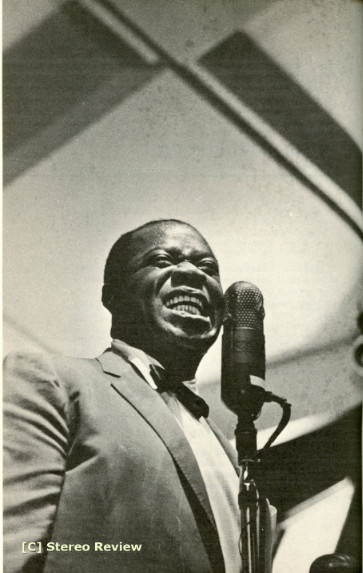
As a case in point, I’ve yet to find an analysis and explanation of what made Louis Armstrong a great vocalist that approaches the following treatment by Henry Pleasants in terms of coherence and cogency.
At long last, Pops gets his due as one of the greatest influences in American popular singing in the 20th century, as well as, a recognition of the his uniqueness as a song stylist.
“The Bessie Smith legend dates from her fatal injury in an automobile accident, and has been nurtured by tendentious accounts of what happened between the time of the crash and her death in a Clarksdale, Mississippi, hospital a few hours later. Not until many years had passed would a retrospective assessment of her artistic stature grant her a more satisfactory immortality.
How different the destiny of Louis Armstrong! He had been, at the time of his death, on July 6, 1971, a living legend for half a century, not just to his own black people, nor to the American people as a whole, but to millions of people around the world. He had been, probably, the most famous musician of the century. When a Johannesburg, South Africa, newspaper, in the summer of 1970, polled fifty-six persons at random to find out how many could remember the names of the Apollo 11 astronauts, one girl identified not Neil Armstrong, but Louis Armstrong, as the first man to set foot on the moon.
An exceptional, if charming, notion! The very word legend seems to imply semifiction, or history distorted and inflated by fancy. But Louis Armstrong, lunar adventure aside, had been everything the legend held him to be: the greatest of early jazz cornet and trumpet players; a unique and improbable vocalist; an exuberant and extrovert celebrity; a showman of genius; and an American ambassador more widely known and more warmly accepted than anyone who ever left the White House with a letter of accreditation in his pocket.
It was all true. It was all attractive. Yet, in the end, it was all wrong. Not factually wrong, but wrong because the legend was unjust to the man. Most legendary figures, being only human, fail to live up to the legend. The failure is condoned or denied because the legend, for sentimental or political reasons, is preferred to the truth. In Louis Armstrong's case it was the other way around. The truth surpassed the legend — and challenged credulity!
It must seem not merely improbable, but sheerly impossible that any one man could have exerted so original and so decisive an influence on the evolution of Western music, least of all an essentially unlettered black trumpet player from the slums of New Orleans. But he did. Almost everything we have heard in the past forty years in jazz [1974 at the time of this writing], and in a great amount of popular music not usually associated with jazz, short of folk and rock, derives from Armstrong. As jazz encyclopedist and critic Leonard Feather has written:
“Americans, unknowingly, live part of every day in the house that Satch built. A riff played by a swinging band on television, a nuance in a Sinatra phrase, the Muzak in the elevator, all owe something to the guidelines that Louis set.”
It was he who liberated the improvising virtuoso jazz musician, as soloist, from the tight collective improvisation of New Orleans jazz. It was he who, by his own example on trumpet, pushed back the technical boundaries of traditional musical instruments. It was he who broke the stereotyped rhythmic procedures of early jazz. It was he, more decisively than Bessie Smith, who established those characteristics of American popular singing that distinguish it from any kind of singing based on traditional European conventions and example.
That he should have exerted so decisive an influence on the art of the American popular singer must seem, at first glance, paradoxical. Louis, although certainly one of the most popular singers of the century, was always thought of primarily as an instrumentalist, as a trumpet player, as one who abused his vocal cords to spare his much abused chops. The common view of his singular vocalism is that it proceeded from his playing, that he sang as he played insofar as limitations of vocal compass would permit. One is tempted to suggest that it may have been the other way around, that his playing was an extension of his singing.
His instrumental virtuosity was, I believe, deceptive. The high notes, those devastating excursions above high C, unique and unprecedented in their time, diverted attention from the pervasive oratorical character and eloquence of his playing. Among those whose attention was diverted, and disastrously, were the jazz players of the next generation, and not only the trumpet players. They equaled and even surpassed him in range and dexterity, but they overlooked or ignored or disdained his roots in song.
An important contribution to the vocal or rhetorical aspects of Louis' musicality may be identified, I would suggest, in his association with the "classic" blues singers in the 1920s. The records he made with Bessie Smith are the most familiar example. But he also recorded with many others, among them Chippie Hill, Ma Rainey and Clara Smith.
More was involved in this than Louis' influence upon them or theirs upon him. Jazz and blues converged in the 1920s, much as swing and rhythm-and-blues would converge briefly in Kansas City a decade later. Not only Louis Armstrong, but also Red Allen, Sidney Bechet, Jimmy Harrison, Coleman Hawkins, Fletcher Henderson, James P. Johnson, Tommy Ladnier and Don Redman, among others, worked behind the female blues singers of the time. This collaboration required a kind of playing markedly different from the polyphonic procedures of New Orleans jazz. The instrumentalist both complemented and commented upon the singer's vocal utterance, perpetuating the call and response patterns of some African and early American black idioms, and evolving a concept of instrumental attack, phrase and cadence that would become one of the most distinctive and also one of the most attractive characteristics of jazz.
That Louis Armstrong never forsook or slighted the musician's oratorical responsibility is attributable also to the sensible and restraining influence of Joe "King" Oliver, whose band he joined in Chicago in 1922. He emphasized his debt to Oliver in countless interviews.
Louis rejoiced, of course, in a prodigious facility. As a young man fresh from New Orleans, determined to make his mark in the big city, he was tempted to show off. What Oliver told him runs like a central theme through everything that Louis ever said about his development as a musician and about his musical philosophy.
"Joe would listen to my horn,' he told Steve Allen in a radio interview late in his career, "and I was fly, making all kinds of variations like they're tryin' to call bebop. I instigated all that, 'cause I was so fast with my fingering. But Joe Oliver said: 'No, play lead, play more lead on that horn so the people can know what you're doing.'"
Similarly, he told Geoffrey Haydon, in a television interview for BBC filmed to coincide with his seventieth birthday on July 4, 1970: "I was just like a clarinet player, like the guys run up and down the horn nowadays, boppin' and things. I was doin' all that, fast fingers and everything, so he used to tell me: 'Play some lead on that horn, boy.' You know?" And in the same vein: "Ain't no sense playing a hundred notes if one will do. Joe Oliver always used to say, "Think about that lead!' "
What Joe Oliver was talking about was melody line, or tune. Louis never became a tuneful performer, either on trumpet or as a singer, in the sense of faithfully adhering to the prescribed notes of a song. He made a stab at it in the early 1930s when his prodigious accomplishments on cornet and trumpet, and the unprecedented vocalism of his 1929 recording of Fats Waller's "Ain't Misbehavin'," swept him from the black entertainment world tributary into the white American popular music mainstream. The records he made then reveal a young man stylistically ill at ease, seeking to adapt his own musicality to the sweet, vapid, sentimental white popular songs and styles of the time.
Fortunately he failed. Whether as trumpeter or as singer, his musical individuality was too strong, his manner too vigorous, his inventive impulse too sheerly irrepressible. He came close enough to achieving adaptation to make some bad records. He never made a record that was not unmistakably Armstrong, although there are echoes here and there of Al Jolson, Bing Crosby and some of the black female singers who were working more closely to white styles than Bessie Smith and Ma Rainey had worked. Nor did he ever make a record on which he was not conspicuously superior to both the song and the arrangement. But he made many that were marred by creative inhibition and stylistic insecurity.
He solved the problem, eventually, by ignoring white conventions and recasting white music in his own personal and musical image. His heeding of King Oliver's counsel saved him from disaster. It is likely that he never in his entire career sang or played a familiar tune note for note, bar for bar, from beginning to end. But neither did he ever spurn the tune and its chord structure as a frame of melodic and harmonic reference. The modern jazz musician rejects both tune and chords as a frustration of his individual creative freedom, as a violation, so to speak, of a musician's right of free speech. Louis Armstrong had no fear of traditional discipline. It was a challenge both to his invention and his ingenuity. He could accept it with relish and zest. In so doing he set precedents that would become the conventions of American popular singing and give to the singer creative opportunities—and creative responsibilities, too—that he had not enjoyed in Western music since the latter part of the eighteenth century.
Adjectives trotted out to describe the sound of Louis Armstrong's voice have included "hoarse," "rasping" and "gravelly," the last of these being probably the most apt. Humphrey Lyttelton, in a BBC tribute on Louis' seventieth birthday, came up with "astrakhan." I should not have thought of "astrakhan" as a descriptive adjective, but it impressed me at the time as singularly felicitous. The image that has occurred to me most frequently in listening to his later records is that of someone singing through a gargle.
However one chooses to describe his voice, there is no mistaking it. An axiom in the study of singers has it that the great, as opposed to the merely very good, are immediately recognizable. A Caruso, a McCormack, a Tauber—one knows them within eight measures, just as one knows Nat Cole, Bing Crosby, Billie Holiday, Peggy Lee, Frank Sinatra and Bessie Smith. None was more distinctive, more readily identifiable, than Louis Armstrong.
This probably explains why he had no imitators. He was imitated, of course, but always with a parodistic purpose. The listener knew what the imitator was up to—that it was impersonation rather than emulation. Bing Crosby and Frank Sinatra each inspired a generation of emulators, some of them admirable. Red Allen, Jack Teagarden and Jabbo Smith worked close to Louis in style, but they didn't sound like him, although Jabbo Smith may have tried.
What made the sound of his voice so utterly unique was, I venture to suggest, the cumulative effect of night after night, month after month, year after year, of bad singing; bad, that is, in traditional terms of vocal production. His voice had not always been so hoarse, so rasping, so gravelly. He had, at the outset, a reasonably agreeable quality and a reasonably extensive range, roughly two octaves from A flat to A flat. This would represent, in European music, a low tenor or a high baritone.
Louis comes through, on his early records, more tenor than baritone, and that was, I suspect, the beginning of his vocal infirmities. Every once in a while, a fine, free baritone escaped him in the middle of his range, revealing what I hear as the natural color and pitch of the voice. Had he elected to sing conventional ballads in a conventional way, he would have chosen keys at least a third below those in which he actually sang them.
He might have got away with those higher keys, for a time, at least, if he had known how to move from one register to another, to negotiate the "passage," to disguise register breaks and to cover the tone as he moved up the scale. But he knew nothing of such matters. Preferring to work in the upper fifth of his range, he was continually under vocal strain. He did not seem to mind. He may even have liked it. Many black singers, particularly those least susceptible to European musical conventions, have shown a predilection for the sense and sound of exaltation, exhortation and incantation that require a vocal production somewhere between singing and shouting, and achievable only by raising both voice and pitch. Louis Armstrong was one of these.
His procedures as a trumpet player provide the clue. He played higher than anybody had ever played a cornet or a trumpet before him. It was not just the odd, climactic, high E flat, E or F. He played consistently high. The performance was not without its purely exhibitionistic side. He obviously reveled in his ability to astonish. He wasn't, as a young man, above carving the competition. Sam Price, a pianist who worked with most of the great jazzmen of the 1920s and 1930s, remembers an encounter between Louis and Jabbo Smith in Chicago: "Louis played about 110 high Cs, and sheet, that was it; and Jabbo could play."
But the stunting was, I suspect, a by-product. Louis, early in his career, probably didn't know how high he was playing, or that what he was playing was assumed to be impossible. Playing high and recklessly was simply a satisfactory outlet for a musically exuberant and ebullient nature. One of his favorite words was "wailing"—and he used it in special contexts, notably and memorably when he told the Pope, who had asked if he and his wife, Lucille, had any children: "No, but we're still right in there wailin', Daddy!"
He was a wailer as a vocalist, too, and no singer can wail in the middle register. So, singing in a manner which came naturally to him, he sang unnaturally high. Wailing on the trumpet takes its toll on the lips, or, as Louis would have said, the chops. This could be countered by salves. The toll on the vocal cords and the muscles and cartilages of the throat was beyond remedy. The upper A flats, Gs and F sharps of the early records did not last long. To an opera singer the loss would have been a disaster. To Louis it mattered very little. If one note was no longer available, he had others to put in its place.
An example of his resourcefulness, of his inexhaustible fund of musical invention, is afforded by a comparison of two recordings of "Ain't Misbehavin'," the one made in 1929, the second in 1955. On the first, there are many high Gs. On the second there are none. But the two performances sound very much alike, and both are in the same key—E flat. Louis knew what he wanted to do with that song, and what he wanted did not essentially change in twenty-six years. If he could not get it one way, he could get it another. The casual listener, hearing the two records one after another, will not be aware that anything is missing, that anything was changed.
The earlier recording of "Ain't Misbehavin'" is instructive, too, as an example of how, with the great singers, the essential elements of their greatness are evident in their earliest work. It is true of early-Crosby, of early Sinatra, of early Fitzgerald, of early Presley and of early Ray Charles, They may waver a bit as they hit midstream. They may give inferior performances, make inferior records and flounder stylistically as they seek to widen repertoire, to accommodate their native musicality to the requirements of commercial fashion, and to escape being typed as singers of one particular kind of song.
Everything that made Louis Armstrong great is present in this earlier recording of "Ain't Misbehavin'." He subsequently made many inferior records with less congenial material before finally learning to discipline not himself, but the song.
He also learned a lot about his own singing. He never learned to sing. He would have been finished as a singer if he had. But he reacted instinctively to what was best in his singing. His phrasing was always as exemplary as it was original, including the trumpet-derived scatting. His improvisatory flights were almost always just right. But his diction, initially, was negligent and slovenly. He was thinking instrumental, granting that his trumpet playing was rooted in vocalism. As he grew older he learned about the music of language. His diction improved. He mastered the art of milking text. He must have sensed, again probably instinctively, the musicality of his own speech. As his technical prowess and physical resources waned, both vocally and instrumentally, he became more of a talker and less of a wailer.
In the end, as seems to happen with all great singers, he also became the creature of his own distinctive characteristics. He fell into mannerism. His enunciation became meticulous and over articulated. His swoops, slurs and growls became the cliches of predictable artifice rather than the unpredictable expressions of irrepressible artistic impulse. But so profound was his musicality that his procedures, even as mannerisms, still worked. There had always been too much music in his speech to suffer constraint by a mere tune. He had never been, as I have noted, a tuneful musician. As he became even less tuneful with the years, he became somehow more musical.
This was his legacy to those who came after him. All, with the exception of Billie Holiday, were more tuneful than he. They had better, more agreeable, more extensive voices. But from him they learned to escape the strictures of the printed notes and the prescribed rhythms, to distort meter in favor of a more flexibly musical prosody, to work out of syllables rather than words, to take the melodic and rhythmic structure of a song apart and put it together again so that the singer talked as he sang and sang as he talked.
They were untroubled by what remained throughout Louis Armstrong's career, his principal shortcoming as an artist and especially as a singer—his lack of emotional identification or involvement with whatever he was singing about. I was often moved by him both in personal performance and on record, but my response was one of sheer delight with his genius, his taste, his invention and his own obvious pleasure in making music. He was always a joyous, jubilant musician. The toothy smile, the waving white handkerchief, the invitation to the audience to sit back and enjoy some of the "old goodies," the gay palaver with his sidemen — all this was genuine. All this was fun.
It would be unjust, probably inaccurate, to suggest that he was ever anything but serious in his approach to a song. But it may be permissible to suggest that he rarely, if ever, took a song seriously. His identification with the music was intimate, his relationship with the textual content casual and detached, often conveying an undertone of benevolent raillery. But the devices of his musicianship have proved both valid and invaluable to those who have taken their songs more seriously than he — or made you believe they did — notably Frank Sinatra.
Louis Armstrong's importance to musical history is difficult to overestimate, and responsible critics and historians have not shied away from hyperbole. Andre Hodeir, for example, in his Jazz, Its Evolution and Essence, has said of the records Louis made with the Hot Five and the Hot Seven between 1925 and 1928: "I wouldn't go so far as to state that Louis Armstrong was the man who 'invented' jazz, but listening to these records might make me think so."
One of those records was "West End Blues," of which Gunther Schuller, in his Early Jazz, has said:
“The clarion call of "West End Blues" served notice that jazz had the potential capacity to compete with the highest order of previously known musical expression. Although nurtured by the crass entertainment and nightclub world of the Prohibition era, Armstrong's music transcended this context and its implications. This was music for music's sake, not for the first time in jazz, to be sure, but never before in such brilliant and unequivocal form. The beauties of this music were those of any great, compelling musical experience: expressive fervor, intense artistic commitment, and an intuitive sense for structural logic.”
Armstrong's reaction to this kind of commentary was characteristic. When Geoffrey Haydon, in the BBC-TV birthday program mentioned previously, asked him if he had been aware when making these records with the Hot Five and the Hot Seven that he was doing something very important, he replied, "No, we was just glad to play. We weren't paid no money, just was glad to play." Music, as Schuller noted, for music's sake.
The lay music lover or jazz fan, accustomed to think of Louis Armstrong as an amiable and irrepressible entertainer, even as a venerable and lovable clown, would be astonished to learn of the extent of scholarly literature devoted to his music. No one could have been more astonished than Louis himself, or could have found it more bewildering, more incomprehensible. He was not an intellect. But his improvisator-explosions have been copied down note for note and bar for bar in countless books and periodicals, and have been subjected to the most painstaking melodic, harmonic and rhythmic analysis.
The significance of his innovations is implicit in the fact that none of this analysis really works. Notation is inseparable from the European conventions it was evolved to record and represent. It cannot reflect the myriad shadings of attack, color, vibrato, release and so on that distinguish Louis Armstrong's playing and singing. It cannot document the slight deviations from pitch, and their harmonic and melodic connotations. Nor can it reproduce, visually, rhythmic subtleties so foreign to the fractional subdivisions of units of time in the rhythmic organization of European music.
Armstrong's own career after 1930 helped to frustrate any just evaluation of his achievement outside an inner circle of sympathetic and perceptive scholars. By the end of the 1920s he was already a celebrity. Indeed, as early as 1925, when he was twenty-five, he was being billed, probably accurately, as "the world's greatest trumpet player." The role of celebrity suited both his talent and his disposition. He drifted, or was drawn, into the mainstream of popular music, playing anything and everything that came his way. He appeared in moving pictures—usually as Louis Armstrong. He played and sang with popular musicians and popular singers, and not always with the best. He clowned and mugged and rejoiced in such monikers as "Satchmo" and "Pops."
Whatever he played or sang, he did in his own way, and there is no denying that the "way" commonly transcended the "what." He even survived an "Uncle Tom" label that would have been fatal to any other black musician after the mid-1950s. "Sure, Pops toms," said Billie Holiday, "but he toms with class!" As Benny Green, the English jazz critic, pointed out in a seventieth-birthday profile for the London Observer:
“The complaints have all come either from purist critics or political rebels. There is not a single musician of any consequence who takes exception to the personality Armstrong projects on the stage, and for a very good reason. It takes a performer to know a performer.”
If he played and sang to the grandstand, and too often accepted the grandstand's image not only of Louis Armstrong but of jazz itself, he knew exactly what he was doing. "I belong to the old school, you know," he told the French journalist Philippe Adler in 1968, "to the guys who think only of pleasing the public. I gave up the idea of playing for the critics or for musicians long ago." To Geoffrey Haydon he said: "A musician has no business being bored as long as he's pleasing the public." To Max Jones, as recounted in Jones's Salute to Satchmo, he said: "You understand, I'm doing my day's work, pleasing the public and enjoying my horn."
The jazz world, whose snobbery is, if anything, even more distasteful than the complacent snobbery of classical music, never quite forgave him. Sometimes, granting an exception for a seventieth birthday, it seemed almost to have forgotten him — or abandoned him to popular music, although jazz musicians of the generation immediately after his were usually eager to honor their debt. The best of the popular singers, too, acknowledged what their phrasing owed to his example.
Twenty years before Louis' seventieth birthday, Bing Crosby told Ken Murray, in a Down Beat interview: "Yes, Ken, I'm proud to acknowledge my debt to the Rev. Satchel Mouth. He is the beginning and the end of music in America." Similarly, Billy Eckstine, speaking to Max Jones in the winter of 1970: "Everybody singing got something from him because he puts it down basically, gives you that feeling. It's right there. You don't have to look for it."
But to younger artists, further removed from the source in time and example, he seemed an anachronism, both as man and musician. Or he appeared, to put a better face upon it, as a legend. In one sense it was a mark of his stature. Where other musicians of his generation had either to adapt their style to changing fashion or perish, he could adhere to his own style and not only survive, but prosper. But there was tragedy in it, too. He lived to see what was unique and wondrous in his early work become the clichés of the mainstream. He saw the inspired distortions that were the secret of his genius distorted beyond recognition in the work of some of his successors. He did not enjoy the experience.
He made only one bitter record, a parody of the " Whiffenpoof Song," in which he had some wry fun at the expense of the be-boppers, and on that one subject there was no mellowing with the passage of time. He sang the "Boppinpoof Song" on a Flip Wilson television program in the spring of 1971, just a few months before his death. "What's scattin' but notes — but the right notes?" he asked Geoffrey Haydon. "Just to be scattin' and makin' a whole lotta noise and faces, slobbin' all over yourself? No. Let them notes come out right, you know?"
In the span of Louis Armstrong's life and career this bitterness was only a passing shadow.
My whole life [he said in a letter to Max Jones] has been happiness. Through all the misfortunes, etc., I did not plan anything. Life was there for me, and I accepted it. And life, whatever came out, has been beautiful to me, and I love everybody.
Even in the jails, in the old days in New Orleans, I had loads of fans. One morning on my way to court, the prisoners raked pans on their cell bars and applauded thunderously, saying "Louie . . . Louie Armstrong," until the guy who was taking me to court said: "Who are you, anyway?" I said to him, "Oh, just one of the cats."