Wednesday, July 20, 2022

Dexter Gordon - "Clubhouse" - The Blue Note Years Part 9

 © Copyright ® Steven Cerra, copyright protected; all rights reserved.
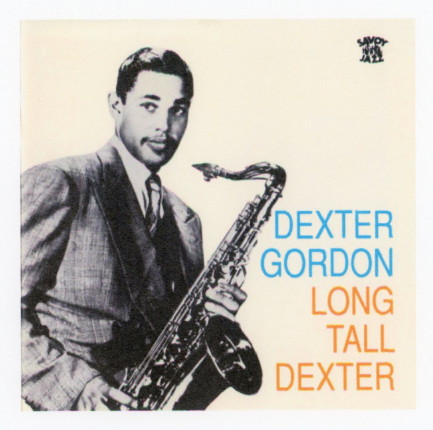

“Gordon was a major force in the emergence of modern tenor saxophone styles. His main influence was Lesler Young, but he also displays an extrovert intensity reminiscent of Herschel Evans and Illinois Jacquet. His rich, vibrant sound, harmonic awareness, behind-the-beat phrasing, and predilection for humorous quotations combine to create a unique style. Gordon's music strongly affected the two leading tenor saxophonists of the succeeding generation, Sonny Rollins and John Coltrane. Gordon was later influenced in turn by Coltrane.and even, following Coltrane's example, adopted the soprano saxophone during the late 1970s. A volume of transcriptions of his performances has been published by Lennie Niehaus (Dexter Gordon Jazz Saxophone Solos: Transcriptions from the Original Recordings, Hollywood, CA, 1979). 

- Lewis Porter, Barry Kernfeld, Ed., The New Grove Dictionary of Jazz.


“Rollins and Coltrane? I listen to them – not religiously or anything, but I hear them on the radio and on sides and so forth. I feel kinda honored and say: “Well, the seeds are spreading.” Both John and Sonny are constantly experimenting. They’re trying to come up with something new and to progress everything—which I think is great. I personally don’t go for the abstract type of jazz that some of the cats are playing today. To me it doesn’t make it. It’s not rounded enough. It seems like they’re taking one essence or one emotion and building and playing on that.


After about ten choruses of that the listener is about nuts. You come out from listening to something like that and you’re on edge. They’re only giving you a part of the story, and consequently they’re losing something.Music as we know it today is a conglomeration of several different types of jazz. For it to grow there have to be the experimenters. But as for what Ornette and the people on that Freedom kick do–I don’t think that’s it. But there are some good and essential things in it, new color and so forth.”

- Dexter Gordon in 1962 Crescendo Magazine interview with Les Tomkins, now in the UK National Jazz Archive
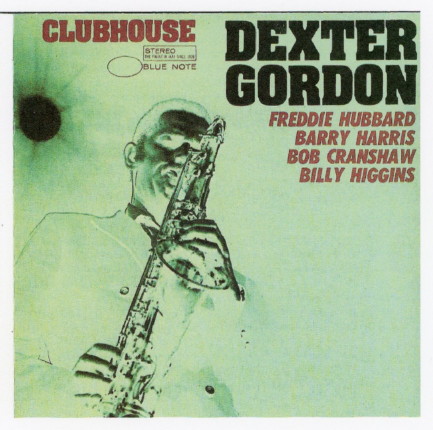


Recorded in 1965, but not released until 1979 following a discovery of this material by producer Michael Cuscuna, Clubhouse [LT-989/CDP 7 84445 2] is the second of three Blue Note recordings belately issued following Dexter Gordon’s 1961-1965 association with the label.


There’s more of trumpeter Freddie Hubbard on hand along with Dexter’s old running mate from California, Billy Higgins on drums, and first time pairings with pianist Barry Harris and bassist Bob Cranshaw.


Fortunately, Ira Gitler, who provided annotations when Dexter’s first Blue Note recordings were issued in 1962, was also available to write the insert notes for the tracks on Clubhouse which help place them in the larger context of Dexter’s recording career.


“When Dexter Gordon came to New York from Copenhagen in 1976 for appearances at Storyville (now Storytowne) and the Vanguard, he was given a hero's welcome. In 1965 his visit to Manhattan was not as widely celebrated. He had taken up residence in Europe in 1962, finally settling in Copenhagen where he became a fixture at the Club Montmartre and one of Denmark's favorite adopted sons. The series of albums he had commenced recording for Blue Note in 1961 - beginning with Doin' Alright (Blue Note 84077) - had put him back into the jazz listeners' consciousness but club owners weren't waiting in line to book him nor were customers standing patiently outside dubs in order to be able to catch his next show. Those who came, however, usually filled the club and left fulfilled, for to be present at one of Dexter Gordon's performances is to be in the presence of a preacher who disseminates messages of warm, love feelings and robust, witty celebrations of life (not expressions of undisciplined emotion). One usually leaves Rev. Gordon's temple in a state of exaltation.


Dex's physical appearance — tall, tan and handsome — has always been imposing. When his musical talent caught up to the edifice in which it was contained, a powerful combination was established.


I didn't hear him when he was with Lionel Hampton. His only solo outing in that band was as part of a tenor battle with Illinois Jacquet on a never recorded number called "Po'k Chops." I did see him in his Billy Eckstine and 52nd Street days at the Sunday afternoon jam sessions standard at the time. His charisma was as evident as the wide-brim hats he used to sport and his magnetism came through on those first Savoy recordings.


I didn't know him in those days but when he came from California to record Doin' Alright and Dexter Calling I did a feature on him for down beat. It was like a reunion with an old friend rather than meeting with someone for the first time. This wasn't completely unique for wherever Dex plays, old friends came up to greet him. Some actually know him; others are connected to him by his music. They are the people who grew up on the Savoy and Dial 78s. Now they are also the younger generation who have heard those sides on the LP reissues of the '70s.


Doin' Alright and Dexter Calling were followed by a string of excellent albums taped in the U.S. (Go! and A Swingin' Affair) and Paris (Our Man in Paris and One Flight Up). His 1964-65 trip to America produced Gettin’ Around with vibist Bobby Hutcherson. Little did we know that on the day before the Gettin’ Around date Dex, with Freddie Hubbard and the same rhythm section (Barry Harris, Bob Cranshaw and Billy Higgins), had done another session. Finding a Dexter Gordon album is like finding gold, even at a time when he is more than well represented on record. Whether it contains material done elsewhere (there are two such here) is not the point. It is the interpretation of that moment — what Dex was into at that particular time — that is important. Hubbard, one of the significant trumpeters to follow in the wake of Clifford Brown, wasn't always a star but he always could play. Some purists didn't care for his CTI period; others, more justifiably, have turned up their noses at his Columbia fusions. Whatever his current persuasion he remains a giant trumpeter. This unearthed outing should accommodate all his fans.


Harris, bearer, protector and enhancer of the bebop gonfalon, has persevered, enduring much job insecurity during the lean rock years, and triumphed as a recording leader in his own right. True to his musical ideals, he now occupies a position as a young elder statesman whose wise words and knowing notes are listened to by young as well as veterans.


Cranshaw has continued to be one of the most sought after bassists in the highly competitive New York arena. Sharp eyes can pick him out in the band on NBC-TV's "Saturday Night Live" but he's usually busy Sunday to Friday, too, in a variety of musical situations.


Higgins had already collaborated with Gordon several successful times before this recording. Hig is spirited as he is precise; as sensitive as he is swinging When the groove is really happening you can look to the back of the bandstand and see the big smile on Billy's face. His uplifting beat helps to make everyone else happy too.


Gordon's "Hanky Panky' could be subtitled "Chunky Funky" for its solid, bluesy, marching beat. Dex comes out stating a basic idea and then proceeds to elaborate and expand on it so he builds his solo, chorus by chorus. Hubbard also shapes his solo thoughtfully, alternating upward bursts with simpler phrases. There’s an implicit link to Louis Armstrong in his brassy brilliance. Then a relaxed Harris, sitting just behind the beat, seems to contemplate the scenery, commenting on it as it goes past his window at a comfortable pace.


Someone once wrote that Coleman Hawkins turned the saxophone into the "sexophone," and we've often heard Ben Webster's tone described as a "boudoir sound." Dex displays his romance/ sexuality on "I'm A Fool to Want You". Macho tenor yes, but for all to share in. Freddie with a hint of Nature Boy plays a tender, yearning solo before Dexter returns. Dig his friendly growl like a big tiger purring.


A winsome introduction by Harris leads into Gordon's "Clubhouse" a lithe, skipping Dameronian theme. The way it lays is arranged perfectly for commentary by Higgins and this is fully realized at the piece's conclusion. "Clubhouse's" harmonic structure allows for the most elegant, sophisticated bebop invention. Dex is at his suavest; Freddie fiddles fleetly; and Barry distills the Bud-Monk essence to its inevitable, logical beauty. Sometimes there are "perfect" solos and Harris' is just that. After Cranshaw picks one, Higgins gets a chance to swing into full play.


"Devilette", by bassist Ben Tucker, is a mixture of a "soul" feeling with a modal mood. It first reached record through Gordon in The Montmartre Collection for Black Lion in 1967 but this one was done two years earlier. Cranshaw and Higgins do not solo but they are a strong force throughout as they expertly underpin the principal soloists.


At this writing we don't know the composer of "Lady Iris B." [Rudy Stephenson] but it is a saucy blues with a Silver (Horace, that is) twist at its tail. Dex tips his cap to Pres along the way and Freddie is bluessential, as is Barry with Billy "sticking" it to everyone.


Dexter's beautiful ballad "Jodi" was first recorded by him in 1960 on The Resurgence of Dexter Gordon album for Jazzland and dedicated to his then wife. Dex has help from Hubbard and Harris (flashing a Monkish run) but he occupies center stage for the most part in this lovely portrait.


The Resurgence, produced by Cannonball Adderley, marked Dex's first recording in five years. Since that time he has surged and resurged, growing in grandeur with each successive tidal wave.


Like the others, this 1965 breaker is just right for ear-surfing.” 

— IRA GITLER (Jazz; Radio Free Jazz; Swing Journal)


Dan Morgenstern Sessions Notes from the Boxed Set Booklet -


(J) MAY 27,1965


“Back in New York (or rather, New Jersey, site of Rudy Van Gelder's marvelous studio), for a reunion with Freddie Hubbard and Billy Higgins and a first encounter with some other gentlemen of jazz. Pianist Barry Harris, born in


Detroit in 1929, got to play with practically everybody while in the house band at the famous Blue-bird Club, from 1951 on. He came to New York in 1956— the year of the "Detroit wave"—and worked with Max Roach, Art Blakey, Cannonball Adderley and Coleman Hawkins, also leading his own trios and a quintet with Lonnie Hilyer and Charles McPherson. Bassist Bob Cranshaw, born in Evanston near Chicago in 1932, started piano at 5 and bass in high school, worked in Chicago with pianist Eddie Higgins and his own MJT + 3, came to New York in 1960 with Carmen McRae and began a long association with Sonny Rollins in 1961. Like Harris, he'd been on Lee Morgan's "Sidewinder" session for Blue Note. Ben Tucker, who sits in on one number (his own), was born in Nashville in 1930, spent time in Los Angeles with Warne Marsh, Art Pepper and Chico Hamilton, and worked in New York with Billy Taylor and Herbie Mann; he wrote the hit "Comin' Home Baby," and later became involved in broadcasting.


HANKY PANKY, by Dexter, is a blues march that moves from minor to major and back. The tenor solo opens with a quote from the theme and becomes quite intense—Dexter even growls, a rare event. Hubbard, with strong chops, varies his phrases nicely, and Harris displays his clean, crisp touch, well backed by springy bass and drums.


Ben Tucker's DEVILETTE has its composer sitting in on bass. Dexter sails through his opening solo. Hubbard starts with a held note; his big, burnished trumpet sound is a pleasure to hear. Higgins works out behind him, taking risks but getting away with panache. Harris takes solo honors here with a spare, elegant, Powell-inspired turn, and then the theme, with its distinctive bass pattern, returns, the horns echoing each other. Typical hard-bop-cum-gospel 1960s fare.


Dexter's CLUBHOUSE bears the stamp of Tadd Dameron. Horns in unison, three fine choruses by Dexter, a slightly delayed entry but a good outing that ends as if he'd have liked to continue; two good ones from Harris, who thrives on this harmonic climate; a neat melodic-rhythmic turn by Cranshaw, and a tattoo by Higgins, who trades with the ensemble and adds fills in the ending.


JODI, a lovely Gordon ballad first heard in his 1960 "Resurgence" LP, is mostly tenor, but Hubbard takes the first bridge and Harris the second. Dexter is at his most poetic—languid yet buoyant. The cadenza is topped by a marvelous note.


I'M A FOOL TO WANT YOU, by Joel Herron and Jack Wolf, was written for and introduced by Frank Sinatra (who also contributed to the lyric.) It's a somewhat doleful lament, and Dexter captures that mood. He milks the bridge for all it's worth, tipping his cap to Coltrane. Hubbard's great here, as he picks up where Dexter leaves off, contrasting long notes and rapid flurries. When Dexter returns, he gives us one of his rare growls.


LADY IRIS B, by guitarist-arranger Rudy Stevenson, is one of those "Preacher-ish" pieces of the day. Dexter leads off the solos for three, followed by an equal number from Hubbard, who works well with Higgins here. Harris contributes a Horace Silver-flavored statement (he was briefly a Messenger,) and Cranshaw takes one before the theme recap. This was another session that remained on the shelf until the early '80s. It has its moments, but that special spark seems to be missing.”


Saturday, July 16, 2022

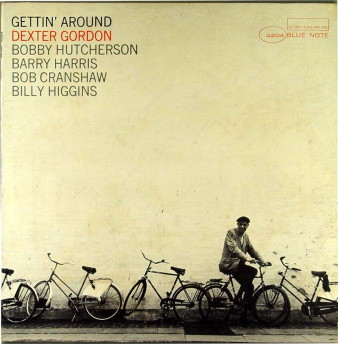
Dexter Gordon - "Gettin' Around" - The Blue Note Years Part 8

 © Copyright ® Steven Cerra, copyright protected; all rights reserved.


“Dexter Gordon is. ol course, the man who first created an authentic bebop style on the tenor saxophone He is also the man who profoundly influenced young John Coltrane (the roots of what became Coltrane's characteristic modality are plainly evident in Dexter's unusual and very personal harmonic accents) and, to a lesser but still significant degree, Sonny Rollins But above and beyond such historical credits. Dexter Gordon is one of the great players in Jazz, a man who makes music that is vital, direct and emotionally satisfying.”

- Dan Morgenstern


Although Dexter Gordon stopped recording for Blue Note after 1965, his relationship with the label didn’t end there as unissued tracks from his 1961 - 1965 contract period found their way into three new Blue Note recordings: 1967, Gettin’ Around [BST-84204]; 1979, Clubhouse [LT 989]; 1980 Landslide [LT-1051]. All three of the latter have been reissued on CD, both domestically and as Japanese imports. Perhaps one can conjecture that the latter two Blue Note albums were released to coincide with his triumphant return to the USA following a 14-year residency in Denmark.


The first of these - Gettin’ Around [CDP 7 46681 2] - was made up of tracks that were recorded in New York on May 28/29, 1965 and feature of group of [then] rising young stars: Bobby Hutcherson [vibes], Barry Harris [piano], Bob Cranshaw [bass] and Billy Higgins [drums].


Hutcherson’s appearance on these dates was particularly noteworthy as can be discerned in the following review by Richard Cook and Brian Morton in their The Penguin Guide to Jazz on CD, 6th Ed.


“One of the most engaging of Gordon's Blue Note recordings, Gettin' Around is also a showcase for the burgeoning talent of Bobby Hutcherson. Though the charts are relatively scant and unchallenging, the standard of performance is very high; Bobby's starburst patterns, executed round Harris's quiet and definite comping, are full of detail and excitement. The material is fairly basic and familiar, with just three Gordon compositions - not much more than blowing themes - tucked away at the end of the album. 'Manha deCarnaval' gets the record off to a breezy start, and the ensembles here are worthy of study; clean-lined, joyous and absolutely exact, yet with the spontaneity of a first take. Frank Foster's 'Shiny Stockings' was a favourite of the time with tenor players, and Dexter milks it enthusiastically.”


Ira Gitler is back to do the liner note honors for Gettin' Around and he offers the following information and insights:


“SINCE 1962 Dexter Gordon has been living in Europe. He has played all over the Continent but his European home has been Copenhagen, and that city's Club Montmartre his main base of operations. We in the United States have not lost contact with him, however, for several reasons. There have been Blue Note albums like Our Man In Paris (BN LP 4146) and One Flight Up ( BN LP 4176), recorded overseas but released internationally. 


Then each year at Christmas, Dexter sends his friends unique, personal holiday greetings. Last year's read, "Santa says, 'Make Glad The Heart'"; the 1965 message was "Santa says; 'Spreading joy in the neighborhood is easy to do and it feels so good!' Somehow you get the idea that Santa in this case is really Dex himself. The feeling that his playing imparts certainly is substantiating evidence.


At the end of 1964 Gordon visited the United States, played engagements on both coasts and in Chicago, and before returning to Europe in June 1965, left us with an LP that makes "glad the heart" and helps to "spread joy in the neighborhood!' He is supported by vibist Bobby Hutcherson, pianist Barry Harris, bassist Bob Cranshaw and drummer Billy Higgings. Support is quite the right word for although Hutcherson and Harris contribute solos, Gordon is the main man here. The others' solos are the condiments for Dex’s longer, meatier statements.


Side 1 is made up of two fairly recent popular songs and one tune that goes back quite a bit farther. Gordon's version of Luis Bonfa's Manha de Carnaval (Morning of the Carnival) from Black Orpheus is a bit slower than this bossa nova is usually played. Dex's sensual, expansive sound and languorous delivery immediately create a cloud to sink into and float on.Talk about being relaxed.


Gordon caresses Anthony Newley's Who Can I Turn To (not to be confused with Alec Wilder's song of the same title) as if he is holding a beautiful woman in his arms. His interplay with Hutcherson after Bobby picks up the melody statement is particularly moving.


On the old hit thatTed Weems mode famous, Heartaches, Dexter demonstrates how a great professional can insinuate a whole feeling just in the way he states the melody. He prepares you in definite but subtle ways for the harder swinging that is to come. The tempo is not that fast but Gordon can generate power at any speed. Hutcherson, showing his earlier Milt Jackson influence, and Harris have short but sweet solos before Dex returns with a clever quasi-quote from Deep In The Heart Of Texas - he has wit to match his heart - and brings everything to a climax with a dancing, delayed ending. Where Elmo Tanner whistled with Weems, Gordon wails with urbane heat.


Side 2 opens with an original by another fine contemporary tenor saxophonist, Frank Foster, While he was a member of the Count Basie orchestra Foster wrote Shiny Stockings and it has become a favorite of many modern musicians. (Pianist Jaki Byard uses it as his theme song.) The groove is an easy-swinging one here with Gordon, Hutcherson and Harris taking a chorus apiece. Dexter doing a reprise, and then out. There is absolutely no strain either in the playing or the listening.


Everybody's Somebody's Fool is a "blues ballad popularized by the first name band that Gordon ever worked with - Lionel Hampton - although it was first recorded in 1949, several years after he had left Hamp. Gordon strikes a wistful, late-hour mood, again bringing his beautiful tone into full play. Harris contributes an appropriately dreamy interlude. When he returns, Dexter makes a reference to Don't Explain - perhaps by design, or by accident.


Dexter's only written contribution to the session is a light, bouncy line called Le Coiffeur* (The Hairdresser). I wonder if he had someone specific in mind when he wrote this, To open his improvisation Gordon makes obvious but effective use of the written line and proceeds to employ rhythmic figures that echo the piece's structure.This adds a sense of unity to the whole track and Hutcherson and Harris stay with the character that has been established.


I think it is evident that the supporting cast was with Dexter all the way in this album. He set the tone and they fell right in with him. Since he is an expatriate it is not often that the New York-based musicians receive a chance to play in his company. Gordon's charm and musical inspiration make his company both delightful and stimulating. With albums such as this Santa Dex is able to disseminate his Christmas messages all year long.”

IRA GITLER


*Very Saxily Yours [ a phrase Dexter uses to close his letters] and Flick of a Trick are two other originals brought to the date and these are included on the CD reissue and the boxed set.


Dan Morgenstern Sessions Notes from the Boxed Set Booklet -


(K) MAY 28,1965


Just a day later, with the same rhythm team, but vibist Bobby Hutcherson taking Hubbard's place. Born in Los Angeles in 1941, Hutcherson became interested in jazz at 15 when he heard Milt Jackson on "Bemsha Swing." He bought a set of vibes, got some musical instruction from pianist Terry Trotter, and vibes pointers from Dave Pike. Work with Charles Lloyd and Curtis Amy preceded his 1 962 arrival in New York with the Billy Mitchell-Al Grey group; In 1963, he joined Jackie McLean's quintet with Grachan Moncur and Tony Williams, recording "One Step Beyond" for Blue Note. He became an important regular at the label, recording with everyone from John Patton to Joe Henderson to Eric Dolphy and Andrew Hill. A master musician, he recorded on his own for the label for more than 20 years.


LE COIFFEUR is a relaxed, playful Dexter original with a French flavor. The tenor-vibes unison works well on the theme statement. Dexter's solo starts with a break that quotes from the theme; he's in a laid-back mood. Hutcherson offers a melodic chorus, and Harris makes a lot happen in his 32 bars.


MANHA DE CARNAVAL was one of the first bossa nova hits, via the film "Black Orpheus." Dexter takes Luis Bonfa's catchy theme slightly slower than the customary—a very deliberate tempo. Tenor and vibes unison again works well. After Dexter's two plaintive choruses, an interlude sets up Hutcherson, who seems very much at home with the tune, and the interlude is repeated to launch Harris. He starts with a single-note line in the bass, adds harmony, and ends with a vamp—a lucid statement.


FLICK OF A TRICK, another Ben Tucker blues, this time at a slower tempo, is highlighted by Dexter's long sermon —he can preach a while! Barry also is deep into the blues, and Hutcherson, his approach to the blues not surprisingly touched by Bags', does some special tremolo things. A straightforward Cranshaw solo precedes the fade out of the theme. This remained in the can until the 1988 CD release of the album.


EVERYBODY'S SOMEBODY'S FOOL was introduced by Little Jimmy Scott on a Lionel Hampton record in 1950 and remained in the singer's


(L) MAY 29,1965

The same cast was reassembled for Dexter's third consecutive day of recording. There would have been no reason to change it since everything was going down muy simpatico.


Onzy Matthews' VERY SAXILY YOURS had been attempted the day before but comes off well here, though it wasn't issued at the time. Dexter starts his solo with a Yankee Doodle break; he's inventive and rocks in rhythm. Bobby and Barry split one, and Dexter takes over the final bridge.


SHINY STOCKINGS, Frank Foster's classic, is taken a hair slower than Count Basie's chosen tempo. Dexter again launches himself with a break, sure footedly. There are pleasant contributions from vibes and piano, and then Dexter takes another helping, enjoying the changes. The opening eight of this piece fit the standard "I Wish I Knew," but the rest is all original.


WHO CAN I TURN TO, the big hit from Anthony Newley's score to ”The Roar Of The Greasepaint—The Smell of the Crowd," was less than a year old when Dexter tackled it. A nice opening—Dexter, rubato, with just Barry, then the others joining in tempo. That tempo is s-l-o-w, but Dex keeps it out by himself, fashioning a fine finale.


HEARTACHES, a 1931 chestnut by Al Hoffman, introduced by Guy Lombardo and resurrected and turned into a hit by Ted Weems (with Elmo Tanner's whistling) in 1947 (he'd also waxed it in 1933,) may seem a surprising choice for Dexter, but he may have encountered the 1961 hit version by the Marcels, or simply liked the non-AABA structure and easy melody, characteristics that lend themselves to the bossa nova treatment he gives it. He comes in swinging after the vamp intro — debonaire, and again breaks into his solo, and again uses the break device for his second chorus. By the third, you can tell he enjoys the melodic-harmonic and rhythmic motion. Hutcherson's turn is underscored by Higgins' punctuations, and for Harris, Hig comes up with rimshots on the afterbeat. Dexter's re-entry is humorous, and then he tags it a la Stitt, getting his kicks and giving us ours, like he always did.”


-DAN MORGENSTERN June 1996


Thursday, July 14, 2022

"Ladies Day" - Billie Holiday by Gary Giddins

 © Copyright ® Steven Cerra, copyright protected; all rights reserved.


As you will note if you quickly peruse the subject headings of past blog features under LABELS in the right-hand column or sidebar of the blog, the editorial staff at JazzProfiles has been remiss about posting features about the iconic Jazz vocalist Billie Holiday.


In order to rectify this omission, we wrote to Gary Giddins and asked his permission to post his seminal essay Ladies Day from Lady Day: The Complete Billie Holiday on Columbia 1933-1944, Columbia/Legacy, 85470-2, July 2001]. He graciously granted permission and the article appears below in its entirety.


The piece is also found in Gary’s Weather Bird: Jazz at the Dawn of the Second Century [Oxford, 2004]. Order information can be located by going here.


After you read the following, I think you will agree with David Rubien of The San Francisco Chronicle when he states that “Giddins’ insights are so compelling and his writing so crisp that matters like past, present and future become moot.”


© -Gary Giddins, copyright protected; all rights reserved; used with the author’s permission.


“How many Billie Holidays are there and which do you prefer? Elated or dour, funny or truculent, sweet or sour, our Lady of Sorrows or 52nd Street's Queen, early Billie or late, Billie of hope or heartache, Billie with Pres or with strings. Lady Day or Lady Nightmare or Lady in Ermine, Lady Be Good, Lady in Red, Lady Luck, Lady Blue, Lady Divine, the Lady who Swings the Band, Lady Mine—crank up the record machine, listen closely, and take your choice. For Billie Holiday is one of those exceptional artists whose work is a perfect tuning fork for our own inclinations. She echoes our emotions, rehabilitates our innocence, cauterizes our nerves.


How she managed so capacious a vision with her slim vocal range and infinite capacity for nurturing demons is a miracle to which generations of interpreters have been and will continue to be drawn. The greatest art never loses its mystery. The better we know hers, the more dreamlike and sensational it seems.


I am inclined to connect her with the equally inscrutable Edgar A. Poe, perhaps because I became mesmerized by both at the same age. What can she and the 19th-century writer have in common, beyond sharing an association with the South; spending critical years in Baltimore and New York; taking to drink and drugs; and dying, derelict, in their forties? For one thing, their power to haunt the soul. Consider that flawless short fiction, "The Fall of the House of Usher,” a story peculiarly remade by the imagination of each reader who, obliged to identify with a deliberately vague narrator, must examine feelings and maladies the narrator discounts as beyond analysis. Holiday, whether singing a stalwart lyric like "I'll Get By" or an insipid one like "What a Little Moonlight Can Do," requires no less rapport. The songs cannot account for the passion she engenders; it's a matter of alchemy. We transform such artists into romantic figures and bring our baggage to them, expecting them to lighten it. And they do!


Asked to choose one visual image to suggest the character of Holiday's sublime Columbia recordings, made between 1933 and 1942 (and in most cases originally issued by Brunswick, Vocalion, and OKeh), I would turn to the casual photography of Denmark's Timme Rosenkrantz. A jazz diehard and scion to a family that left him a title — baron —  but little funds, Rosenkrantz crossed the Atlantic whenever possible, exploring Harlem from the ground up, or down, drinking his way through bars visited by few whites. He was 24 in the late summer of 1935, armed with a camera in the Apollo's back alley, shooting a singer that few people had ever heard of. Only a month earlier, Billie had recorded her first important session, as vocalist with Teddy Wilson, and one selection, "What a Little Moonlight Can Do," was about to break as a jukebox hit. The Dane was clearly enchanted by her: The most famous of the pictures he took captures a radiantly lovely young woman, 20 years old, flashing a direct and perfectly symmetrical smile, arms entwined with those of two musicians, while another kneels before her and a fourth stands behind.


This picture has been reproduced many times, though never as dramatically as in the booklet to Columbia's 1962 three-LP box, Billie Holiday: The Golden Years, where it bleeds over a full two pages, including a wall of lovelorn graffiti. (A Rosenkrantz shot of Billie alone was used on the cover.) It offers us a very different Holiday than the star — gowned in scarlet with a white orchid in her hair — she would quickly become.


In 1935, with her hair brushed back and skin glowing, she is a country girl in a short-sleeve, open-neck, gingham dress with pockets on the skirt. Her figure is, to use a favorite press adjective, buxom. Pigmeat Markham, a comedian who shared an Apollo bill with her the same year, remembered her as "a simple lookin' girl" who didn't know how to do "the things that girls do to pretty up." Yet she appears sexy and sure, happy to be one with the musicians: saxophonists Ben Webster (who played on the Wilson date), to her right, looking off, distracted, and Johnny Russell, to her left; pianist Ram Ramirez, an erstwhile prodigy who would later co-write her signature hit, "Lover Man," in front; and, behind, a man with a guitar who turns out not to be a musician at all, but a stagehand known as Shoebrush.


The camaraderie Rosenkrantz caught characterizes the best of Holiday's early records, made when she was just another musician, waiting her turn and often singing no more than a chorus. Yet her contributions never indicate an obligatory vocal refrain of the sort bandleaders included to sell a lyric. Holiday's choruses are genuine solos. Working in fast company with the greatest players in New York, which is to say the world (Wilson, Webster, Benny Goodman, Roy Eldridge, Bunny Berigan, Artie Shaw, Lester Young, Buck Clayton, Chu Berry, Johnny Hodges, and on), she always holds her own, singing confidently behind the beat with an improvisational bravura that frequently bests them all. By that time, she had endured a childhood of fear and privation far worse than anything Dickens contrived for Little Nell. But unlike Nell, Billie lived to tell her own tale.


Her 1956 memoir, Lady Sings the Blues, opens with one of the most widely quoted passages of its time: "Mom and pop were just a couple of kids when they got married. He was eighteen, she was sixteen, and I was three." In truth, Billie was no writer; the ironic style is the work of "ghost" William Dufty, a journalist and one of her most loyal friends. (Two years later, he wrote the autobiography of Edward G. Robinson, Jr., whose only accomplishments were drunk driving and an attempted suicide, but whose tale starts off with a similar wallop.) In any case, like much of the book — which is well worth reading — it was only slightly true. Mom and Pop were kids when Billie was born, on April 7, 1915, but did not marry. Sadie, at 18, had two years on Clarence Holiday, who abandoned her and the child. As biographer Donald Clarke has shown, Billie was born Eleanora Harris (Sadie's family name), but her mother, whose own parents did not marry, assumed her father's name, Pagan, and Billie grew up in Baltimore as Eleanora Pagan.


Clarence, who went on to play banjo and guitar in prominent bands, played no role in Eleanora's upbringing, except perhaps to draw her, by example, to jazz and to capricious and abusive men. Sadie, with whom she developed a close relationship, was rumored to have run a whorehouse, and often sent her to board with relatives. Eleanora spent her tenth year in charge to the nuns at the House of the Good Shepherd for Colored Girls, where she may have been molested. A year later, she was raped by a neighbor and sent back to the nuns. At 12, she worked in a waterfront brothel, picking up extra change by singing to records. She later claimed her favorites were Bessie Smith and Louis Armstrong. If she never picked up Bessie's devotion to 12-bar blues, she did learn to infuse everything she sang with a blues feeling and tonality. From Louis, she learned style, swing, improvisation. Above all, she recalled, "I wanted Louis Armstrong's feeling."


After moving with her mother to New York, she worked in a whorehouse, did time on Blackwell's Island, and began singing for tips at small Harlem clubs like the Nest, Pod's and Jerry's, the Yeah Man, and Monette's. This was before microphones were common in high-class nightclubs (Bing Crosby had begun popularizing them in 1930, at Hollywood's Coconut Grove), let alone after-hours joints where the performers sashayed from one table to the next, often collecting tips with body parts other than their fingers. Eleanora, who scorned such indignities, learned to project at the same time she learned how to communicate intimately. She changed her name — borrowing Holiday from her father and Billie from actress Billie Dove and, possibly, Clarke suggests, a friend and fellow singer named Billie Haywood.


In 1933, entertainer Monette Moore opened Monette's Supper Club. With her hands full as hostess, she hired Billie to do the singing. In that late-night environment, Billie met a great many musicians and personalities, not least the talent scout, critic, and jazz lover, John Hammond, who had come to see Moore and left raving about Holiday. He, at 22, was a wealthy prude with powerful connections; she, at 18, was a hellion, eking out a living the best she could. Hammond introduced her to Benny Goodman, who briefly dated her, and arranged for her to sing one number at a record session on November 17, 1933. The featured performer that day was the great and imperious Ethel Waters, backed by a Goodman ensemble. The irony was Poe-etic.


Waters had been a Columbia recording star for eight years. This session would end her affiliation with the company and, except for a dozen Decca sides and a superb but little-noted comeback for Bluebird in the late-'30s, wrap up the recording career of one of the most influential singers in American music. After she completed her numbers, the highly competitive Waters listened to Billie make her debut, romping through "Your Mother's Son-in-Law" in an uncharacteristically high key. She was not impressed, and later commented that Holiday sang as though her shoes were too tight. Billie had been unnerved by her until pianist Joe Sullivan advised her to just close her eyes and sing. For years, I wondered about a seemingly incomprehensible line in the lyric—"You don't have to sing like fatso"—until the producer Michael Brooks pointed out that she is actually singing "Bledsoe," as in Jules Bledsoe, who played Joe in the original production of Showboat. Fatso or Bledsoe, her record went nowhere.


Still, on the same day that Ethel — whose great triumphs on the stage and in film were still ahead of her — departed Columbia, Billie's career was inauspiciously launched, at $35. And if the rivalry between those two women led the younger to omit the older from all discussions of her musical influences, we are obliged to stand outside the ropes and credit Waters's unmistakable impact. The 1923 "Ethel Sings 'Em" includes a stanza ("love is like a faucet...") that Billie would make famous in "Fine and Mellow," and the 1928 "My Baby Sure Knows How to Love" bodes Billie's way of inflecting vowels with a waver. Waters's style also anticipates the elocutionary precision with which Billie attacks consonants — for example, the dentalized t's in songs like "Getting Some Fun Out of Life," "Back in Your Own Backyard," and "Swing, Brother, Swing!" ("stop this dit-tle dat-tle") — an articulation that Dinah Washington, in turn, picked up from Billie. One could argue that Waters's influence on Holiday exceeded Bessie Smith's. Her most decisive model, however, remained Louis Armstrong.


Hammond, who contrived to get Billie on another Goodman side in 1933 ("Riffin' the Scotch," with a Johnny Mercer lyric that has nothing to do with the title), did not find the right formula for her until the summer of 1935, when she recorded with a seven-piece pick-up band fronted by Teddy Wilson. Several months earlier, she had sung, without credit, "Saddest Tale," in the Duke Ellington film short, "Symphony in Black," in a scene in which she is knocked down by a lover. Ellington did not, however, hire her for his band. When Wilson first heard her, he was no more impressed than Ellington. Near the end of his life, Wilson conceded that he initially thought of Billie as a gimmick: a girl who sang like Louis — a cute idea, but so what? He soon changed his mind.


The Wilson sessions are among the preeminent glories of recorded jazz, brisk and pointed and incredibly swinging. They were made largely for the jukebox trade, which in the ghastly years of the Depression emerged as the largest single market for records. Yet as brief and spontaneous as they are, these exemplary tracks overflow with detail and invention, rarely wasting a second, with each player obliged to make a personal, identifiable statement in just a few measures. Benny Carter once noted, "It's a pleasure to hear a guy like Ben Webster. He blows a note and you know he's there — and who he is." The great players could do that; they developed individual styles that told you right off who they were and what they were like. Fans did not need an announcer to inform them that a soloist was Webster or Young or Coleman Hawkins. Wilson's sides offered a de facto guide to the era's giants, because Hammond raided the big bands that happened to be playing New York when a session was scheduled, recruiting key players from Basie, Ellington, Goodman, Calloway, and the rest. These sessions remain an  unbeatable primer on the leading soloists and rhythm players of the swing era.


They also offer an unusually rounded thesaurus of American song-writing in the golden age, juxtaposing the gold and the tin. Except for “I Wished on the Moon," the songs at the first session were decidedly second-rate, and they did not get much better over the ensuing year. Yet Holiday, Wilson, and friends readily turned Tin Pan Alley dross into bullion. Of the first 15 songs, three—"I Wished on the Moon," "What a Little Moonlight Can Do," and to a lesser extent, "Miss Brown to You"— became a permanent part of Billie's repertoire. Others endured as classic records. The quality of her material took a dramatic turn for the better in the summer of 1936. At the June 30 date, Billie helped to establish "These Foolish Things" as a standard and revived the 1920s hit, "I Cried for You." She also performed magic with the utterly forgotten "It's Like Reaching for the Moon," confirming the jazz axiom: 'Tain't what you do, it's the way that you do it.


The songs got even better in late-summer, after John Scott Trotter — a former arranger for Hal Kemp who would become famous as Bing Crosby's music director on Kraft Music Hall — was hired as chief of recording for the American Record Corporation, the holding company that controlled Brunswick, Vocalion, Columbia, and other labels through most of the 1930s. Hammond considered Trotter merely a busybody executive. But the fact that Billie immediately recorded the three main songs from Pennies from Heaven, a film Trotter had just finished orchestrating, and was backed at the first session by Bunny Berigan, Trotter's buddy in the Kemp days, suggests that Hammond understated his contribution, perhaps because he resented Trotter's authority. Trotter was undoubtedly a square. Yet during his tenure, Holiday recorded new songs by Porter, Kern, and Berlin, as well as older tunes, like "I Must Have That Man," which, with Berlin's "This Year's Kisses," inaugurated the uncanny bond between Billie and Lester Young, whose tenor saxophone — borrowed from Hammond's favorite orchestra, the Basie band — invariably complements, echoes, spurs, and inspires her in one of the most gratifying, unusual, and far too brief musical collaborations of the past century.


My favorite of the records they made together was generated not by a classic of the songwriter's art, but by one of the dimmest numbers Holiday ever sang, "A Sailboat in the Moonlight," written by Carmen Lombardo and John Jacob Loeb ("Boo-Hoo!" was another of their creations) for the former's brother, Guy. When I first got to know the record, playing it endlessly, I thought it a fine melody, with pretty chord changes, and words that might be corny but didn't seem so bad when Lady Day delivered them. Then I chanced to find the sheet music at a midwestern bazaar; at home, I picked out the melody with one finger and was astonished at how different it was from what Holiday sang. Until that moment, I had not fully gauged how freely imaginative her embellishments could be. By ironing out a phrase here, retarding another there, raising this note, slurring that, she transformed a hopelessly banal and predictable melody into something personal, real, meaningful. When she and Lester "sail away/to Sweetheart Bay," riding the waves side by side, you've got to clamber on board.


Another profound example of her transformative powers comes from her last wartime Columbia session, on February 10, 1942, and an impossible song called, "It's a Sin to Tell a Lie," the subject six years earlier of one of Fats Waller's most extravagant burlesques. "I love you, I love you, 1 love you," he intoned contemptuously. And here comes Billie, declaiming, "I love you, yes I do, I love you," rhythmically pinning every syllable to its post and employing a Lestorian slur on the last "love." Do you believe her? How can you not?


By then, she had become a very different performer, a jazz star of high rank, proudly bearing the nickname, Lady Day, conferred upon her by Young (he called her mother Duchess). She in turn dubbed him Pres: Lester, she said, was to the saxophone what President Roosevelt was to the nation. Their musical association, however, was largely in the past. The very nature of her records had changed. Between 1937 and 1939, she recorded as often under her own name as under Wilson's; after the January 30, 1939, Wilson session, she recorded almost exclusively under her own name. The level of musicianship remained high and her own singing grew increasingly nuanced, but she was no longer one of the guys, waiting her turn. She was every inch a star.


When Lester had appeared on the "I Must Have That Man" session, he was 27, six years older than Billie, yet it was only his third time in a recording studio. His accompaniment was tenderly amorous, sometimes exuberantly so ("Me, Myself and I," "When You're Smiling"), but usually gentle and more delicate than the ardent honking and high-flying fancies he offered followers of Count Basie. The platonic tenderness that sheltered Lester and Billie could not, however, be sustained for long. In all, he appeared on five sessions with her in 1937, not including a couple of Basic broadcasts, five more in 1938, and only one per year between 1939 and 1941. Over time, his alcoholism and her addiction to heroin tore them apart, and though they occasionally shared the stage at Jazz at the Philharmonic concerts, producer Milt Gabler never used him on her Decca sides and producer Norman Granz, who had Lester under contract, never used him on her Clef and Verve records. They were reunited on one serene number in an unforgettable television broadcast, in 1957, and died two years later — Lester on March 15 (his widow prohibited her from singing at the funeral), and Billie on July 17, after nearly two months in a hospital, much of that time with a police guard at her door. She was, as Faulkner famously wrote of one of his own characters, "Doomed and knew it; accepted the doom without either seeking or fleeing it."


Tough as nails yet prone to abuse, Lady had long since become America's Little Sparrow (she and Edith Piaf were born in the same year), perhaps even better known for her woes than her music. And yet she had come a long way on her own terms. In the beginning, she played the Famous Door on 52nd Street for four days, having walked out when the owner told her not to socialize with white customers. At that time she had to contend with stage managers who complained that she sang too slow and with song publishers who griped that she took too many liberties. Her standing took a turn in 1939, working at Barney Josephson's Cafe Society and closing her sets with Abel Meeropol's vivid threnody about a lynching, "Strange Fruit." She returned to the Famous Door as a major draw — treated accordingly — and, ironically, something of an earth mother to white servicemen who spent shore leave listening to her. After recording "Strange Fruit" for Milt Gabler's Commodore, because Hammond wouldn't touch it, Holiday was taken up by some with political agendas. But she had her own reasons for sticking with that song for 20 years, making it her personal anthem, thrusting it in the teeth of people who thought they had come to be amused.


She had toured briefly with Basie and Artie Shaw, leaving the former, she claimed, because Hammond wanted her to sing more blues like Bessie Smith (maybe, maybe not, though Hammond told me a few weeks before his death that he much preferred Bessie), and the latter because of racism. Forget the South: New York's Hotel Lincoln insisted she use the freight elevator and the Old Gold cigarette company would not allow her to broadcast with Shaw's band. She retained her independence and spirit, living the life she chose, singing the music she loved in a style she invented. She did not suffer slights quietly: In 1946, she was signed to appear in her only feature film, with her idol Louis Armstrong, but, cast as a maid, she stormed off the set of New Orleans before it was completed. Melancholy themes had begun to loom over her repertoire, and they increased over time. No longer sailing in the moonlight in a sunbonnet blue and laughing at life, she sang of despair, longing, betrayal: "Gloomy Sunday," "Lover Man," "Travelin' Light," "Good Morning, Heartache," "Detour Ahead," "Don't Explain," "God Bless the Child."


She suffered for love, evidently indulging a masochism that sometimes got out of hand. It also bound her to drugs. In 1941, Holiday married a handsome hustler named Jimmy Monroe and began smoking opium. Then she moved in with trumpet player Joe Guy, who used heroin. She capitulated to an addiction that could not be tempered by a voluntary six-week hospital cure or a judge's 1947 decision to incarcerate her for a year and a day at the Federal Reformatory for Women in Alderson, West Virginia — the result of Billie's decision to plead guilty and not to testify against Guy, with whom she was busted. Guy, a musician of limited abilities, walked. Billie served her time and lost her cabaret card. That meant she could not work anyplace in New York where alcohol was sold, undermining her career and guaranteeing her return to narcotics. There were subsequent arrests and countless tabloid articles that almost always referred to her as "blues singer Billie Holiday."

She took up with a vicious pimp named John Levy (not to be confused with the bassist of that name who often performed with her), and then fulfilled the prophetic lyric of "Riffin' the Scotch": "Swapped the old one for a new one / Now the new one's breaking my heart / I jumped out of the fryin' pan / And right into the fire." Louis McKay was a low-level hoodlum whose one saving grace was that he lacked Levy's unreasoning violence. But he was a relentless exploiter, who squandered her money and used drugs to keep her under control. In 1956, Billie and McKay were busted in Philadelphia, and he convinced her to marry him to prevent her from testifying. That she could see through him, but loved him, is apparent from her desperately scribbled letters, almost always written on hotel stationery and occasionally quoting song lyrics (I have not attempted to replicate Holiday's quirky use of capitals, and have ventured a few guesses about punctuation):


Mr. McKay,

Let's face it you're not my husband. Not even my boyfriend. You have no time for me. Everything is your kids, Mildred or just anything comes before me so I am not important to you in any way. You have even made cracks about [some?] dirty bitches that meant more to you than me. So why don't we come to some kind of understanding. Well you know. Just be my manager until after the Phila story. No I have no one else and don't want anyone. But Louie how much can I take. You're in New York two days and I, your wife, see you five minutes. So just lets be friends and forget it.

Lady


Louis when you left this morning I know you had no more feeling for me so lets get together, lets call this whole thing off. Your not happy with me and I am very unhappy. Thank you for everything you have done for me. Lady Day


This is It


I've had it goodbye


Waited hoped and prayed but nothing goes my way. This is it, so

long. Tried not to see but I am not blind to all the tricks you played

on me. This is it. Oh well you say that I am dumb but how dumb

can you get. This is it This is it This is it This is it. You can't be

mine and someone else's too. What are you trying to do. This is it.

Good bye.


On one occasion Billie had McKay tailed, and what she saw made her "feel sort of cheap and dirty." Had she lived, she undoubtedly would have sent him packing. Instead, he assumed control of her estate, making sure he was portrayed — by Billy Dee Williams, no less — as the romantic and devoted sole love of her life in the appalling movie Lady Sings the Blues, which didn't even use her voice, never mind her story. But then her voice is her story, the only one that counts, the one that can't be distorted by lovers or haters, exploiters or philanthropists, critics or fans. Her enchanted records tell the truth and nothing but the truth — indeed, more truth than most of us knew, if you pay attention to the alternate takes and ponder the risks she took, gliding too high for her range or, touchingly, casting for the right note on which to end. Lady Day at the summit of her art is as glorious now as 60 years ago, an imperishable fixture in the cultural life of America and the world.”


[Lady Day: The Complete Billie Holiday on Columbia 1933-1944,

Columbia/Legacy, July 2001]