Friday, November 18, 2022

The Lee Konitz Nonet

 © Copyright ® Steven Cerra, copyright protected; all rights reserved.                                      


“Throughout a prolific career spanning seven decades Lee Konitz has usually chosen to showcase his talents within the confines of a small ensemble – often a very small ensemble. There are numerous duo recordings with Sal Mosca, Red Mitchell, Hal Galper, Jimmy Rowles and Gil Evans etc. Trios too have frequently been his modus operandi with Sonny Dallas - Nick Stabulas, Dick Katz - Wilbur Little, Harold Danko - Jay Leonhart and Don Friedman - Attila Zoller. All of which made his decision to organize a nine-piece group in the mid-seventies somewhat surprising.


Because of its similar size, the Konitz nonet has sometimes been compared to what became known as the Birth of the Cool ensemble.  Miles’ group with its fragile, almost ethereal textures was essentially a scaled-down version of Claude Thornhill’s orchestra complete with french horn and tuba.  Lee’s nonet with its wide-ranging repertoire was a far more extrovert affair. The instrumentation which was actually suggested by David Berger was also quite different – two trumpets, two trombones (one doubling bass trombone), alto doubling soprano, baritone, piano, bass and drums.


Returning to New York in May 1976 from a short European tour with Warne Marsh, Konitz recorded with Buck Clayton and then Chris Connor before getting together with Jimmy Knepper and David Berger to discuss plans for his nonet. He was living on West 86th Street at the time and Stryker’s which had opened in 1972 was his local club. The nonet started playing there and for the next 18 months or so they appeared quite regularly once or twice a week. The club did not have a piano so Ben Aronov had to bring in an electric instrument. They also performed at the Tin Palace, a little known club in the Bowery. Apparently nobody was paid very much (usually just cab fare) but Lee managed to keep the same core of players throughout the residency. In an interview for Jazz Journal (December 1996) he told me that he could not afford to pay for arrangements but Sy Johnson, Jimmy Knepper, David and Kenny Berger and Sam Burtis were all happy to write for the band without a fee. Kenny Berger recently told me that musicians at the time were willing to donate their services for a worthwhile project because there was still enough decent paying work available elsewhere. Today it would probably be different.

- © -  Gordon Jack/JazzJournal; copyright protected, all rights reserved., used with permission. Jazz Journal June 2015.
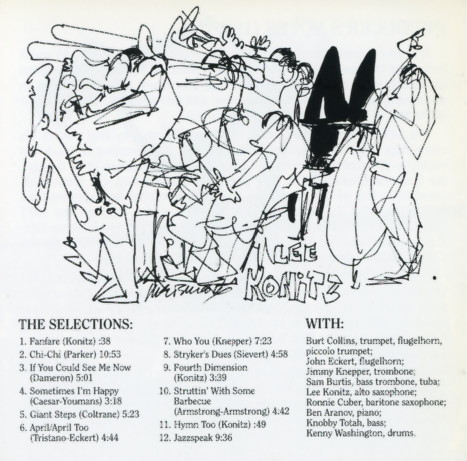


I, too, was surprised to see alto saxophonist performing in the context of this larger group in the mid-to-late 1970s but was delighted to re-discover it as a result of my Cuber Quest [an effort to listen to Ronnie in new surroundings] following the passing of Ronnie Cuber - baritone saxophonist par excellence - on October 7, 2022.


Gordon Jack goes on to say in his JazzJournal piece:


“Their next visit to the recording studio a year later was even more impressive (Chiaroscuro CRD 186). A particular feature of the date is the way famous solos have been orchestrated into many of the selections: - Louis Armstrong‘s 1927 Struttin’ With Some Barbecue; Charlie Parker’s 1953 Chi Chi; Lester Young and Slam Stewart’s 1943 Sometimes I’m Happy and John Coltrane’s 1959 Giant Steps  have all been seamlessly woven into the charts. The leader once said, “A great solo doesn’t care who plays it” - a philosophy probably inspired by his friend and mentor Lennie Tristano who used the study of classic instrumental solos as a teaching aid.  A highlight here is Konitz and Ronnie Cuber performing Coltrane’s choruses in unison on Giant Steps, the harmonic minefield originally inspired by Have You Met Miss Jones?  By now the hugely talented Cuber had replaced Kenny Berger on baritone and after the leader he was the most heavily featured soloist.  His ballad feature If You Could See Me Now is alone worth the price of the CD.”


Acting on Gordon’s advice, I tracked down Lee Konitz Nonet (Chiaroscuro CRD 186) and boy am I glad I did both for the reasons that Gordon mentions regarding Cuber’s magnificent playing, but also because the album is a gem in terms of everyone’s playing on the date and the exquisite small band arrangements written for this instrumentation by Sy Johnson, Jimmy Knepper, David and Kenny Berger and Sam Burtis.


Here’s more information on the recording which is followed by some videos featuring tracks from the album:


 PRODUCER'S NOTES (1977)


“I suspect it would be safe to say that Lee Konitz has worked in as great a variety of instrumental combinations as any jazz musician; at least since Buddy Bolden. There are the solo albums (you know, a real solo album, with no accompaniment at all) duets, trios, quartets, up the line to big bands and a couple with lush string accompaniments. This new record features Lee leading a nonet, a very workable number of instruments, but it is a combination that has been rarely used, particularly with the combination of instruments found here. Sure, there have been bands with nine players. Bennie Moten in 1926, for example, and today there are any number of ensembles with nine musicians, from dreary augmented dixieland bands to the equally dreary jazz/rock variety. But there's not another exceptional nine piece jazz band out there right now, one with great arrangements, in many cases crafted for the instrumentalists in the band. Shades of Ellington.


Lee's nonet has been working in New York for a little over a year at a place uptown called Stryker's. The club lets Lee and his guys play a couple of nights a week (when Lee's not on the road) and Stryker's management should be congratulated for the opportunity they've provided. I'm particularly grateful because the band had a year of rehearsal before it set foot in my studio (and also a record under its belt, on Roulette, which I highly recommend).


In a recent review of the aforementioned record it was suggested the news around town in 1977 was Lee's nonet. I couldn't agree more. It was news because it was not the usual Monday night hand, of which there are a few around town, all playing magnificently, but in many cases, not having a particularly individual stamp, except for the soloists in them. Lee's nonet has an individual stamp, it being an updated, slightly augmented version of the Miles Davis band of the late forties, the one that lasted about ten minutes, but which seemed to influence everyone who had ears. I seem to recall, the alto voice in that hand was a guy named Konitz. Funny coincidence. Perhaps if Miles ever decides to come out of retirement, he should walk up the street to Stryker's and mess around with this group. He'd probably enjoy it and frighten everyone to death.


In any event, this band is special. The arrangements were provided by Sy Johnson and Lee, and for the date they chose a nice mixture of standards and originals. To me the outstanding effort is on Chi-Chi, the old Parker piece. Everyone got cooking pretty good and it ran over about five minutes. This was the first take and Lee thought we ought to have a shorter version. The band did it, keeping strictly to the arrangement. On playback it was apparent the ten minute take was the real one; much in the same way relaxed, extended performances of the Goodman band always sound so much better than the studio versions.


Maybe the next thing will be to record this band live but that will have to wait until next year, when Lee gets back from his European sojourn, plus dates in North Africa and other assorted locations. And who knows, the talk of 1978 will probably still be this nonet.”


And here’s the text of Lee talking about the nonet from the Jazzspeak track that closes the recording:


“Hi, I’m Lee Konitz and I’d like to speak a bit about the history of this band and I would be pleased to talk about the people involved and the idea that motivated this nine-piece band.


I had thought at some point that this would be an opportunity for me to do some writing, some arranging that I hadn’t done too much of before and I spoke to Jimmy Knepper and with David Berger, David is a Duke Ellington scholar, who has been conducting Wynton Marsalis’ Lincoln Center Band for a long time.


Actually David was responsible for suggesting the instrumentation and there was a club across the street from where I live on 86th Street called Stryker’s which allowed the band to work there one or two nights a week for about a year, year and a half.


This is the way you can build a band by meeting every week. No one was paid too much, cab fare maybe and some for drinks.


The people looked forward to playing and never missed those nights. Jimmy Knepper for one, unless there was a great gig. Writers volunteered to contribute music  to the band. I wrote some things, not as much as I was hoping to, but Sy Johnson was one of the main people. He has a facility of writing fast and well and coming to rehearse the music and bringing it back next time all corrected.  Jimmy Knepper wrote some  things, and David Berger and Ronnie Cuber and Kenny Berger and it was a very nice experience for everyone for that year-and-a-half.


And then when the opportunity to play every week kind of subsided, I lost interest in playing the same music over and over again. When we were meeting week after week people were contributing new music which kept it always interesting from that standpoint.


The configuration of the band as you might have heard is two trumpets doubling on flugelhorn, two trombones with Sam Burtis doubling bass trombone, and two saxophones, baritone and me playing the alto and sometimes soprano and three rhythm.


At some point, I thought of adding a tenor to have more of a saxophone section, but I’ve enjoyed this kind of unusual ensemble and the power of the brass section that gives it a big band kind of feeling in a small band setting.


Because of the lack of pay, I thought it was a great opportunity to give everyone a chance to stretch out and play; after playing the arrangement, play some extended solos.


So that was fine and then I realized I was sitting most of the time listening to everyone else play. It got to the point that this was one of the reasons why I gave up the band.  


The other reason was getting eight answering machines every time I called for a rehearsal or a job.


We played two festivals in Belgium and Holland and it cost a fortune to bring the band over.


This album begins with a little Fanfare that I wrote; after the fact, I wished I’d stretched that out a little bit. It was kind of nice.


And then I had written out Charlie Parker’s choruses on Chi-Chi; Jimmy Knepper wrote the arrangement, and the one for If You Could See Me Now.

Tim Morgan, a student of mine, wrote the arrangement on Sometimes I’m Happy and included Lester Young’s solo and Slam Stewart’s solo. Actually that’s Slam’s solo coupled with a tag that Prez played.


Sam Burtis wrote the arrangement of Giant Steps and we play some of Coltrane’s chorus on that. The line by Lennie Tristano was incorporated into April/April Too and then Jimmy Knepper contributed the arrangement on his original Who You.  


Sy Johnson arranged Stryker’s Dues and Fourth Dimension was my chart.


Struttin’ with Some Barbecue is my arranged dedication based around Louie Armstrong’s solo which I wrote out for all the horns that wanted to play it and Hymn Too is another piece I wrote as a closer. 


It’s really a powerful tribute to play a great solo like Louis’ on Struttin’ and use all the different instruments.The same with Charlie Parker’s choruses on Chi-Chi they have the same thing with the full band playing them and giving them a new kind of weight.


I always say that a great solo doesn’t care who plays it.


I have never had any thoughts of resuming this kind of structure because I now realize that my main interest now is in improvising and I need as much opportunity as possible to do that so I prefer to work in duet, trio and quartet situations which is what I’ve been doing since 1977.


Many people had a chance to play in the band and look forward to it. The people in the nonet who wouldn’t miss playing in it unless some big job came along are Jimmy Knepper, Burt Collins and Sam Burtis. The rhythm section had the people in it that changed most frequently.


Unfortunately, Stryker’s didn’t have a real piano so the pianists had to bring in an electric one.


We were fortunate to play at the Vanguard a few times so the piano wasn’t an issue there. In fact, one night, Chick Corea and we had some nice arrangements that Sy Johnson had made of a few of his tunes and I asked Chick to sit in. I had my tape machine with me, but when I pressed the start button it had no batteries! 


Jimmy Knepper had mentioned this young drummer that lived up in Staten Island - Kenny Washington - who I think was 17 at the time.


I said, fine, bring him in.


Jimmy had no doubts; he could be a little bit critical of people but he raved about this guy.


Kenny came in at the age of 17 and read all this music and swung the band just the way you’d like it. He played a little bit loud sometimes and I had mentioned something to him about checking out Mel Lewis and that became a big inspiration for him. 


I might mention that there are 4 CDs of that year-and-a-half of the nonet’s existence. In addition to this one on Chiaroscuro, there’s Live at Laren [Soul Note], Yes, Yes, Nonet [SteepleChase] and The Lee Konitz Nonet [Roulette].


The band obviously was well-documented for that short-period of time.


The fact that the people involved in this project were so enthusiastic to play some creative music may have indicated a lack of activity at the time for some of these musicians.


But I always knew that there was a high degree of interest in the band because there was a long line of interested musicians who wanted to get on the band as subs.


If I had to conjecture how many people made up that nonet over the course of rehearsals and performances during that year-and-a-half, I would have to say that over 90 musicians or 190!


But I was always there!!” 


Wednesday, November 16, 2022

Holy Ghost: The Life and Death of Free Jazz Pioneer Albert Ayler - by Richard Koloda

 © Copyright ® Steven Cerra, copyright protected; all rights reserved


“The opening moments of Ayler's Spiritual Unity (1964) are still shocking and extraordinary (the recording engineer reputedly fled the studio as the music continued), and it is a measure of Ayler's continuing mystique that in 2004 the appearance of Holy Ghost, an extravagant archive of largely unheard material, was greeted with worldwide fascination on its first release. Born in Cleveland, he began working in blues bands on alto sax, touring with Little Walter at 16, before going into the army. On his discharge (he had been stationed in France until 1961), by now playing tenor, he was luckless in finding gigs, and went to Scandinavia, recording for the first time in Stockholm: the contrast between a boppish rhythm section and his braying, tempestuous saxophone is already bizarre. He carried on playing in Stockholm and Copenhagen (where he played with Don Cherry and Cecil Taylor) and went to New York in 1963. His 1964 group with Cherry, Gary Peacock and Sunny Murray was seminal, and it was this band (minus Cherry) that recorded Spiritual Unity. 


His themes were utterly simple, sometimes no more than a bugle-call motif, something which he might have remembered from the army: yet that contrasted with collective improvisations (there were few 'solos' in Ayler's music) which were furious, seemingly inchoate, yet played with shredding virtuosity by all hands - Peacock and Murray seem lit up by Ayler's playing. His brawling tenor sound, full of overtones, multiphonics, a juddering vibrato and passages which appear as close to screaming as any saxophonist has come, can seem like mere madness at first, yet the music coheres soon enough into a thrilling exposition. But it was never popular in Ayler's lifetime: 


Ayler made four albums for ESP-Disk, and a further four for Impulse! were issued in his lifetime, but in 1968, perhaps demoralized by years of poverty and inattention, Ayler went from excoriating free playing to a kind of hippified R&B, with the disastrous New Grass, a decline which included mundane singing and material of - in comparison with what came before - unfathomable banality.


All the so-called energy players who came after him are in Ayler's lineage, but few indeed approach the kind of intensity which this sharp-dressed, soft-spoken man left as his gift to jazz expression.”

- Richard Cook’s Jazz Encyclopedia


“Ayler was never to find a steady audience for his radical music-his group appeared perhaps only three times in 1965 - and, although his albums were well received by the critics, he remained poor. He made no effort to clarify his music for his listeners, actively discouraging musical interpretations of his recordings and instead stressing their social and spiritual issues; the inconsistent and confusing titles to his pieces further obscured his work …. 

Ayler's extraordinary music of the mid-1960s was difficult and controversial. Without losing its identity as jazz, it rejected most ol the conventions of the prevailing bop and free styles. According to Jost (who alone has surveyed his career analytically), Ayler often replaced tempered melody with sweeping flourishes; he combined these "sound-spans" (...) with sudden low-pitched honks and a wide, sentimental vibrato ….


[His] recordings (...) juxtapose difficult collective improvisation and Ayler's simple, rhythmically square, frequently tonal themes. Sometimes these two factors are interrelated, …. More often, however, the brief themes serve as foils for lengthy, exciting improvisations in which the group, avoiding predictable sounds, achieves remarkably varied textures and rhythms ….”

- Barry Kernfeld, ed. The New Grove Dictionary of Jazz


“Albert Ayler wore his spiritual roots on his sleeve. Like Coltrane, he had once donned a military uniform and marched, then later developed a musical vocabulary intertwined with a philosophy of universal understanding and supreme love. Ayler's song titles and gospel-intoned phrasing on alto and tenor saxophone testified as much. Like Coltrane, he had recorded for various small labels (in Ayler's case, very small, and often foreign) before coming to Impulse.


Unlike the music of Impulse's original star [John Coltrane], Ayler's had bypassed bebop and other modern jazz styles, skipping over foreign scales and Eastern sounds to create a wild, emotionally expressive style from more down-home sources: spirituals, blues, even military marches.”

- Ashley Kahn, The House That Trane Built: The Story of Impulse Records


Author Richard Koloda closes the preface to Holy Ghost: The Life and Death of Free Jazz Pioneer Albert Ayler [London: Jawbone Press, 2022] with the following statement: 


“In adding to the wealth of material already out there, the true goal of Holy Ghost is to draw attention away from the circumstances surrounding Ayler's death and bring it sharply back to the legacy he left behind. Doing so demands confronting those who have marginalized, maligned, and spread misinformation about Ayler in order to further their own agendas. He was a character as interesting as any that could have been created by a Hollywood screenwriter. It is hoped the reader will enjoy finding out why, just as much as I enjoyed researching Ayler's life.”


Not being one of those Jazz fans who “... marginalized, maligned, and spread misinformation about Ayler in order to further their own agendas,”

I was also unfortunately one of the many Jazz fans who knew very little about Ayler and his music.


This from someone who, thanks to a friendship with drummer Billy Higgins, was actually in attendance at the Hillcrest Club on Ardmore Avenue in Hollywood, CA during one of the evenings when free jazz maven Ornette Coleman played there in the fall of 1958 in a maiden voyage appearance along with Billy, Don Cherry on trumpet, Paul Bley on piano, and bassist Charlie Haden.


Throughout the 1960s, I kept tabs on Ornette’s developments along with those of Eric Dolphy, John Coltrane, Cecil Taylor, Sun Ra, Richard Abrams, Rahsaan Roland Kirk, Andrew Cyrille, Archie Shepp and the Art Ensemble of Chicago [Lester Bowie, Roscoe Mitchell, Malachi Favors, Famoudou Don Moye] and other free jazz luminaries, but somewhere along the way, Albert Ayler and his music eluded me.


So I approached the preview copy of Mr. Koloda’s Holy Ghost: The Life and Death of Free Jazz Pioneer Albert Ayler with curious delight and excitement as it is always fun to go back and explore the music of a major artist whose music I missed on my journey through the wonderland that was modern Jazz during its halcyon days in the second half of the 20th century.


Twenty years in the making, Mr. Koloda’s research does not disappoint as it brings to light the major facets of Albert Ayler’s short lived career, all of which are well-documented in a detailed bibliography - 19 pages in length! - and copious endnotes. A similar effort with a discography would have also been welcomed, but all of Albert Ayler’s major recordings are listed and annotated in the text.


John Litweiler - who has a penchant for bringing information about relatively obscure tenor saxophonists to light [see his efforts regarding Hank Mobley] - and who has written extensively about the free jazz movement in three books about Ornette Coleman and one about the movement in general [The Freedom Principle: Jazz After 1958] helps place “The Legacy of Albert Ayler” in context with these opening paragraphs from his April 1, 1971 Downbeat article:


“To begin at the beginning. It was Ornette Coleman who revolutionized jazz at the start of the 1960s. It was Coleman with his contemporaries Dolphy, Rollins, Coltrane and Taylor - who determined that the New Music would be a revolution of sensibility; they did not just introduce new techniques into jazz, they opened up the art to a wholly new realm of emotions, discoveries, human statements. 


Albert Ayler was part of the new music’s second wave, as [tenor saxophonist] Joseph Jarman would say. After Coleman and his fellows, an entire generation of slightly younger men whose art was formed under their influence was sure to follow. Among these players, Albert Ayler was the very finest, the truest revolutionary, the one heroically original mind.


At his best Ayler was fully as great as Coltrane, and perhaps even Coleman. All these are familiar statements; his admirers have repeated them for several years now.”


This last statement from the Litweiler Downbeat piece become the point of departure for Mr. Koloda Ayler bio as he makes it his business to use his extensive research to dispel the critics and substantiate not only Ayler’s greatness, but one which, while originally derived from Coleman, Dolphy and Coltrane, ultimate rose to such a state of originality that it influenced all three in return.


In his efforts to establish Albert Ayler’s artistic greatness, Mr. Koloda takes great pains to contend with the following reactions associated with Ayler’s advent on the 1960s Jazz scene:


“Albert Ayler exploded on the scene with a musical style so extreme that observers competed to find suitable metaphors. The poet Ted Joans likened Ayler's tenor saxophone sound to "screaming the word 'FUCK' in Saint Patrick's cathedral on a crowded Easter Sunday." Amiri Baraka described his disarmingly naïve melodies as "coonish churchified chuckle tunes," and critic Dan Morgenstern compared his ensemble to "a Salvation Army band on LSD." 


Ayler's huge sound evoked lusty hysteria. His room-filling timbre, ripe with opulent overtones, sounds as if he is playing two or three notes at a time (multiphonics). His rejection of musical gestures that might link him to conventional jazz offended some and influenced others, ….” [Gary Giddins and Scott DeVeaux Jazz 2009]


As a counterargument to these criticisms and critical remarks, Mr. Koloda offers this description of the evolution of Ayler style:


“In moving toward an increased simplicity, Ayler's music emerged as a combination of naivety and grandiosity. Though the solos strayed from a common theme, they were now subtler and mixed into the flow of the melody. Often criticized for this development, Ayler merely compressed into four years what jazz greats such as Louis Armstrong and Lester Young did over the course of their entire careers ….


And yet his radical evolution was in keeping with similar developments elsewhere in music: Bob Dylan had gone electric; The Beatles had become

sonic pioneers. Just as Ayler changed personnel to accommodate a new style of playing, so did Miles Davis — who would continue to do so for his entire career, keeping up with changing trends regardless of critical concerns. In the lineage of jazz, pop, and rock music, Ayler's choices were nothing out of the ordinary, even if his music was.”


These declarations are not apologias, but rather, Mr. Koloda’s researched arguments which are intended to “set the record straight” or “get in right” in terms of Albert Ayler’s rightful place among the principal figures of the Free Jazz Pantheon and  as such set the tone and tenor of his biography as a whole.


According to Messrs. Giddins and DeVeaux - “The subject of these strong pro and con remarks was born in Cleveland, where he studied alto saxophone for over a decade, beginning at age seven. In his teens, he worked with rhythm and blues bands, then joined the army, at which time he switched to tenor saxophone (he later added soprano as well). 


While stationed in France, Ayler experimented with the tenor's so-called hidden register—the highest pitches, verging on caterwauling tempests that few saxophonists knew how to control. Although he continued to perform awkwardly in the bop idiom for a few years, he felt stifled by the harmonies and rhythms. Sitting in with Cecil Taylor in Copenhagen in 1962 helped to liberate his instincts.


In a span of barely eight years, 1962 to 1970, Ayler went through several stylistic changes, at one point focusing on composition almost to the exclusion of improvisation; one of his groups included a front line of saxophone, violin, and trumpet (his brother Donald), and played waltzes and other works that suggested a fusion of jazz and classical music. In the end, he reluctantly tried to reach the rock audience with a far less imposing flower-power brand of fusion. Its failure exacerbated an already present despondency, and he died, a suicide, at thirty-four.”


Mr. Koloda’s research helps explain the causes behind the “changes” that occurred in Albert Ayler’s progression as a player and composer.


For example [the year is 1966]:


“Seeking more popular appeal, Ayler took on an even simpler style than before, his melodies becoming more composition-oriented, with preplanned themes, harmonies, and tempos. And New York, a city that had long resisted him, offered opportunities for him to try this development out on live audiences.”


So as it progress through Albert Ayler's all-too-brief career, the Koloda’s bio becomes less of a defense and more of an elucidation replete with annotated examples whose aim is to resolve what I think of as the Gary Giddins - Dan Morgenstern Dichotomy as summed up in the following excerpts are contained in an essay entitled Titans of the Tenor in Sean Manning, ed., The Show I’ll Never Forget: 50 Writers Relive Their Most Memorable Concert Going Experience, 2007].


“Ayler's next live appearance was as part of the 'Titans Of The Tenor’ show at Lincoln Center's Philharmonic Hall, February 19, 1966, sharing the bill with an array of saxophonists, among them the veteran Coleman Hawkins, Zoot Sims of the West Coast 'cool school,' his hero Sonny Rollins, and John Coltrane. Despite his best efforts, Coltrane had failed to convince the show's promoters to include the Ayler brothers, so he paid them out of his own funds. 


Now a bona-fide giant in the jazz field, Coltrane made a point of helping talented young players to gain exposure. Though he had recorded albums such as Ascension and Meditations the previous year, neither had yet been released, so the Lincoln Center audience likely expected him to play standards such as 'Chim Chim Cheree,' from his 1965 album The John Coltrane Quartet Plays, and the landmark A Love Supreme, also released in the previous year — but Coltrane astonished them by playing in the style of the music that would appear on the next year's release, Ascension. They should have known things would be different when they saw two drum kits on stage. Bassist Jimmy Garrison was the only member of the quartet to play that night, alongside drummers Rashied Ali and J.C. Moses; pianist (and John's wife) Alice Coltrane; and—the shock of shocks—horn players Albert Ayler, Donald Ayler, Pharaoh Sanders, and Carlos Ward. A tape of their performance may be in the possession of Coltrane's son Ravi, and many of those present still remember that night like it was yesterday, with Blue Note discographer Michael Cuscuna recalling, 'Standing at the apron of the stage, they erupted into a spiritual, frenetic sound that scared me half to death, yet stimulated every aspect of my being. I don't know whether I loved it or hated it, but I knew that I was not indifferent to it, and I knew that I did not understand it."'


Also looking back with years of hindsight, the Village Voice’s Gary Giddins remembered how he 'left the hall angry' and 'in a state of confused elation,' but feeling that 'a door of perception had swung open':


The joyful, terrifying noise lasted about an hour. Except for a snatch of 'My Favorite Things,' melodies were not apparent, though the Rodgers and Hammerstein echo was itself momentous. Coltrane inserted it amid a squalling solo, played with more than a few deep knee-bends, and the shock of recognition elicited an explosion of approval. ... The rhythm section was not a thing apart, providing a swinging foundation, but a collusive force. The collective assault either focused your attention or dispersed it. In the absence of melody and harmonic progressions, it relied on the fever of the players, and while this shattering din could never be the sole future of jazz or of any other kind of music, it could — and, in fact, already did — represent a new way to play and experience music. The sound spread evenly, like the dribblings on a Jackson Pollock, yet the wall-to-wall harangue allowed for plenty of individual details as each player emerged from the ensemble for an Ascension-like salvo .... 


Yes, the saxophonists squealed and screeched, but they found individual ways to squeal and screech. I recall Sanders playing for a long stretch with his fingers splayed outward, never touching the saxophone keys, rendering an unholy and unbroken wail, and Donald Ayler offering little more than listless tremolos spaced within an octave's range. Albert's solo was something else: a hurricane of raw emotion and radiant luster. I had not paid much attention to Albert Aylmer previously, and immediately resolved to make up for it.”


Less convinced was Dan Morgenstern of DownBeat, who hated the whole affair, reserving his deepest disdain for Albert and Donald:


When it came to screaming, however, Sanders met his match in Albert Ayler, whose noises at least had some movement. Squeaking and squealing at lightning speed, he gave a convincing musical impression of a whirling dervish seized by St Vitus dance. Trumpeter Don Ayler came to bat next. Because he played with his horn's bell pointed at the floor, most of his solo was inaudible. ... What was decipherable seemed to be a series of rapid spurts of disjointed notes played with considerable frenzy but little else. ... The Ayler brothers ... fashioned a weird duet, a bit like the screaming contests little children sometimes indulge in; it was scarcely more pleasing to the ear. ... As for Ayler and Sanders, they made a mockery of the use of the term 'titans in the concert's title ... to ride on the reputation of others is deception."


Within the context of the opposing points of view in the Giddins-Morgenstern duality concerning the worth and value of Albert Ayler’s music, Mr. Koloda concurs with the Giddins opinion and his biography is largely an attempt to underscore the importance of Albert’s work as something deserving of a significant place in the history of the Free Jazz Movement during its formative years in the 1960s. 


Mr. Koloda’s style of writing is clear and concise and his exhaustively researched efforts on Albert Ayler’s behalf to redress his reputation are commendable. Ultimately, arguments notwithstanding, as Louis Armstrong once said: “The music either speaks to you or it don’t.”


But, if you, like me are looking for a guidebook to learn about Albert Ayler and his music, you’ve certainly found it in Richard Koloda, Holy Ghost: The Life and Death of Free Jazz Pioneer Albert Ayler [London: Jawbone Press, 2022]


Monday, November 14, 2022

Wynton Kelly: 1931-1971 - Revisiting “A Pure Spirit” [From the Archives]

 © -Steven Cerra, copyright protected; all rights reserved.


“Wynton’s situation … is worth noting as a startling example of the strange irrelevance of merit to fame in Jazz.”
- Orrin Keepnews, Jazz Producer and Writer

“Nothing about his playing seems calculated .. there was just pure joy shining through his conception.”
Bill Evans, Jazz Pianist

Amazingly, given his background, Wynton Kelly is an often overlooked figure in modern Jazz circles.

One would think that a pianist who had worked with Lester Young, Charles Mingus, Dizzy Gillespie’s 1950s big band, Dinah Washington, Miles Davis and Wes Montgomery, let alone with his own trio made-up of Paul Chambers on bass and Jimmy Cobb on drums, would be more widely known and respected.

But such is not the case for Kelly who is sometimes more acknowledged because he has a first name in common with the phenomenal trumpet player and leader of the Lincoln Center Jazz Orchestra – Wynton Marsalis – whose father, Jazz pianist Ellis Marsalis, named him after Kelly.

The editorial staff thought it might be fun to spend some time developing a JazzProfiles feature about Wynton, Kelly that is, as a way of paying tribute to his memory.

In the liner notes that he wrote for Kelly at Midnight, one of the earliest album’s that Wynton made under his own name [VeeJay VJ-03], Nat Hentoff commented:

“Miles Davis was being asked one afternoon for a verbal analysis of Wynton Kelly's musical worth. Miles character­istically scoffed at using such imprecise tools as words to describe what happens in jazz; but finally he said: ‘Wynton's the light for a cigarette. He lights the fire and he keeps it going. Without him there's no smoking.’

Another judicious tribute came from Cannonball Adderley who had worked with Wynton in the Miles Davis band. ‘He's a fine soloist, who does both the subdued things and the swingers very well. Wynton is also the world's great­est accompanist for a soloist. He plays with the soloist all the time, with the chords you choose. He even anticipates your direction.’

Somewhat earlier, I'd been talking to King Curtis, a Texan now in New York and a specialist in rhythm and blues. ‘Wynton worked with me for a while, and naturally I've heard him with Dinah and with Miles. What struck me was that wherever Wynton worked, he fitted in. He's not limited to one kind of playing. With Dinah, he had the taste and supportive power of a superior accompanist. With me, he had the fire and the straightaway swinging my bands have to have. And with Miles, he can be as subtle as Miles requires.’

As is usually the case, Wynton was being discussed enthusiastically by musicians before there was much atten­tion paid him in the public prints. …”


And in another of Wynton’s VeeJay LP’s, Kelly Great [VeeJay VJ-06], Julian “Cannonball” Adderley, the great alto saxophonist and, as noted previously, Wynton’s bandmate in the Davis group, said this about Kelly:

“When Sid McCoy of VeeJay Records asked Frank Strozier (phenomenal young alto saxophonist) who did he wish to play piano on his VeeJay record date, Frank immediately said Wynton Kelly. So answered Bill Henderson and Paul Chambers. It is next to impossible to evaluate the role played by Wynton Kelly in a band, for he has a ‘take charge’ quality in a rhythm section such as a Phil Rizzuto or Eddie Stanky had on a baseball team.

Many jazz listeners are unaware that such intangible qualities as fire and spirit make the margin between greatness and ‘just good’. Leading jazz musicians, such as Dizzy Gillespie and Miles Davis (Wynton's current employer), are cognizant of this fact. A short time ago Miles Davis made an album using another pianist, who at that time was a member of his band, but added Wynton for one selection, explaining, ‘Wynton Kelly is the only pianist who could make that tune get off the ground.’

What does Wynton have that is so different?”

Perhaps the difference lies in what Richard Cook and Brian Morton have described in The Penguin Guide to Jazz on CD, 6th Ed.  as “… his lyrical simplicity or uncomplicated touch… [or] the dynamic bounce to his chording …,” or because, as Cannonball Adderley, asserted: “Wynton combined the strength of pianists Red Garland and Bill Evans, his predecessors with Miles Davis.”

Or maybe this difference lies in the following description of Wynton’s playing by fellow pianist Bill Evans as quoted in Jack Chambers, Milestones:

“When I first him in Dizzy’s big band [in the mid-1950s], his whole thing was so joyful and exuberant, nothing about it seemed calculated. And yet with the clarity of the way he played, you knew that he had put this together in a carefully planned way – but the result was completely without calculation, there was just pure spirit shining through the conception.”


Like Bill, Brian Priestley may have also identified the essence of what made Wynton Kelly so unique as a pianist in the following description of his style in Jazz, The Rough Guide: An Essential Companion to Artists and Albums:

“An important stylist, but largely unrecognized except by fellow pianists, Kelly’s mature style was hinted at in his earliest recordings. He combined boppish lines and blues interpolations with a taut sense of timing quite unlike anyone else except his imitators. The same quality made his equally individual block chording into a particularly dynamic and driving accompanying style that was savored by the many soloists that he backed.”

More about Kelly’s special qualities as a pianist can be found in the following paraphrase from Peter Pettinger’s biography of pianist Bill Evans – How My Heart Sings:

“Evans held Kelly’s bright and sparkling style in high regard since hearing him in Dizzy Gillespie’s big band, responding to Wynton’s particular blend of clarity and exuberance. This reaction was typical of Evans’s appreciation of the work of his fellow pianists; from Oscar Peterson to Cecil Taylor, he was full of admiration for their diverse talents and generous in his praise.”

As detailed in Groovin’ High,  Alyn Shipton’s life of trumpeter Dizzy Gillespie, the unique character of Kelly’s piano style may have been the result of combining years of experience in playing in rhythm and blues bands with a fine Jazz sensibility.

Of his work with his own trio, John A. Tynan had this to say in a Down Beat review:

“It is one of the most cohesive and inventive rhythmic groups in small-band Jazz today.”

Musicians commenting about Wynton’s work on their recordings state: “The presence of Kelly may account for the difference …,” “… the album would not have been excellent without Wynton Kelly’s sterling support,” and “… he is disarmingly pleasant to work with, the very model of a mainstream pianist.”

The Jazz writer and critic, Barbara J. Gardiner closed her insert notes to the 1961 VeeJay 2-CD compilation Wynton Kelly! [VeeJazz-011] with the declaration that “You would expect Wynton Kelly to be comprehensive as well as creative. Hasn’t he always been?”

Although she was referring to the material on these CDs “… tried and proven, mixed in with a bit of the fresh …,” this could also serve as an apt way of describing Wynton’s approach to Jazz piano: wide-ranging and inventive.

One is never far away from the Jazz tradition when listening to Wynton Kelly, but what he plays is himself; he has incorporated his influences into his own musical “personality” and recognizably so. Four [4] bars and you know its him.

Wynton is not a pianist who overwhelms the listener with startling technique or originality of conception.

But what he does offer is playing that is full of joy, funk and a feeling for time that fills the heart with happiness, sets the feet tapping and get the fingers popping the beat.

Wynton Kelly is the pianistic personification of swing, or if you prefer: “smokin’,” “cookin’” or “boppin’.” 

When Wynton plays Jazz piano, you feel it.

Nothing cerebral here in any deep or complicated sense, just – “Clap hands, here comes, Wynton.”

Hear it for yourself in the following tribute to Wynton that features him along with Paul Chambers on bass and Philly Joe Jones. The tune is Winston's original Temperance from Kelly at Midnight [VeeJay-03] .