Showing posts with label lee konitz. Show all posts

Sunday, October 19, 2025

Konitz Meets Mulligan: Lee Konitz and The Gerry Mulligan Quartet

 © Copyright ® Steven Cerra, copyright protected; all rights reserved.


“Gerry Mulligan was also involved in the Birth of the Cool—you had quite a lot of contact with him over your career.

I always thought of him as an ally. He appreciated my playing, and I appreciated his, and especially his writing, very much. I played his arrangements with Claude Thornhill, and Stan  Kenton. The occasions that we had together, they were very fruitful. 


Was he an intuitive player?

Gerry was a great musician, also a great composer and arranger. My favorite playing of his was with the Birth of the Cool. He also recorded a free version of "Lover Man" with me and a trio with Peggy Stern that was very intuitive and really inspired. He was pretty much an intuitive player, but maybe too conscious of making an impression on his audience — and that means functioning other than intuitively.”

- Andy Hamilton, Lee Konitz: Conversations on the Improviser’s Art [2007]


“When the Kenton band was at the Palladium in Los Angeles, Gerry asked me to come and sit in with his quartet at the Haig on our nights off. I loved

the pianoless concept, and I have worked in many similar groups over the years. I had heard stories about Chet not reading, but I was never in a situation to check that out. I had also heard that he didn't know chord changes, but I remember seeing him at a piano, playing changes to tunes, so that wasn't true. On my recordings with the quartet, I actually rejected "Too Marvelous for Words" because it didn't seem to fit into Gerry's context. …  Looking back, Gerry and I didn't play that much together, but he was very encouraging to me in the early days, and I always felt he was an ally. We even got high together for the first time because we had that kind of close relationship.”

- Gordon Jack, Fifties Jazz Talk: An Oral Retrospective [2004]


“While all the other instruments during the great days of bop produced important musicians in addition to the leading representative on the respective horn, the alto saxophone had to wait for the start of the cool era for a considerable figure to emerge: This was Lee Konitz, who came out of the Lennie Tristano school. The abstract, glittering alto lines played by Konitz around the turn of the forties on his own and Lennie Tristano's recordings later became more singable, calmer, and more concrete. Of this change, Lee says that then "I played more than I could hear"... Konitz has absorbed and incorporated into his music many of the jazz elements since then - and some of Coltrane and of free jazz - and yet he has always remained true to himself. He is one of the really great improvisers in jazz.” 

- Joachim Berendt, The Jazz Book [1983] as quoted in Peter Ind, Jazz Visions: Lennie Tristano and His Legacy [2005]


“My [Gerry Mulligan] whole job, because we had left the piano off, was to establish always the sound of the chord progression that was moving through the piece, and to do that with my harmony line in relation to the bass line, which always had to be able to state something basic about the way the rhythm line moved—didn't have to just play roots of the chords that you always had to do on the bottom, but you could move through them in such a way that the implication of the chord was always there. So then, even though it wasn't obvious to the ear and it wasn't spelled out, the impression was there, and what we were doing was giving the impression of chord progression because of the way we were touching on those notes.”

- Gerry Mulligan with Ken Poston, Being Gerry Mulligan: My Life in Music, [2023]


“Most of the more casual generalizations about Lee Konitz - cool, abstract, passionless, untouched by bebop - were last relevant about 40 years ago. A stint in the Stan Kenton band, the musical equivalent of Marine Corps boot camp, toughened up his articulation and led him steadily away from the long, rather diffuse lines of his early years under the influence of Lennie Tristano, towards an altogether more pluralistic and emotionally cadenced approach. Astonishingly, Konitz spent a good many of what should have been his most productive years in relative limbo, teaching when he should have been playing, unrecognized by critics, unsigned by all but small European labels (on which he is, admittedly, prodigal). Despite (or because of) his isolation, Konitz has routinely exposed himself over the years in the most ruthlessly unpredictable musical settings, thriving on any challenge, constantly modifying his direction.” 

- Richard Cook and Brian Morton, The Penguin Guide to Jazz on CD, 6th Edition [2002]


“Stimulation of his colleagues by consistent application of his peregrine personality is very likely the most wicked weapon in Gerry Mulligan’s deadly arsenal. He has played probably in front of more groups that lingered on in a recurring state of instant disintegration behind him than any other major Jazzman. Not that Gerry plans it this way, he just seems to have been possessed rather frequently of or by an impish natural talent for annoying others to an extent that is much more often productive than destructive.


How this quality operated in his work with Lee Konitz, I have no way of knowing but I believe after hearing this record, that someone constructed a small conflagration under Lee when he sat in with Gerry’s quartet at The Haig in Los Angeles on the night of January 25, 1953. And since the expert at artistic arson, Gerry Mulligan, was present, I think we may have solved this minor mystery.”

- Daniel Halperin, original liner notes to Lee Konitz Plays With the Gerry Mulligan Quartet [PJM -406, 1957]


I enjoy combing the Jazz literature to glean new perspectives on something I’m writing about for the blog and such is the case with the lead-in quotations to one of my all time favorite recordings Konitz Meets Mulligan: Lee Konitz and The Gerry Mulligan Quartet [Pacific Jazz LP PJM 406 and Capitol CD CDP 7 46847 2].


Although issued in 1957, the recordings were actually made in 1953 and the playing on them by alto saxophonist Lee Konitz, baritone saxophonist Gerry Mulligan and trumpeter Chet Baker should be considered in the context of the relative newness of the “modern” - as distinct from - the Swing Era style of Jazz exhibited by the 12 tracks that make up the album. The version of Modern Jazz practiced by Konitz, Mulligan, Baker and others on the West Coast during the 1950s is often referred to as the “Cool School.”


Given the relative recency of Modern Jazz, a style that evolved largely during and directly after the close of World War II - an approach which relied on improvising on the harmony of a song rather than the previous Swing Era emphasis on the melody - it is amazing how accomplished the playing by the horns is on this recording. Kudos should also be shared with bassist Carson Smith and drummer Larry drummer for their smooth rhythmic backing, where again, a new, somewhat understated style of keeping the beat and insuring the forward motion - the swing - of the music was required.


Young musicians taking on the challenge of the latest Thing has been a part of the Jazz tradition since its inception, but this Modern Jazz stuff was complicated and it is remarkable how consummate the playing and the music is on this album.


“The Gerry Mulligan Quartet with Chet Baker, despite its prolific recorded output and its impact on jazz and the American public, lasted for less than one year. Ensconced as the house band at The Haig in Los Angeles and able to record at its own discretion for Pacific Jazz (as well as single sessions for two other labels), this revolutionary, pianoless quartet crafted its own repertoire and arrangements and built a solid, prolific legacy.


Midway through its existence, the quartet settled on its finest bassist and drummer, Carson Smith and Larry Bunker respectively. At this junction. Mulligan, who had formed this unit through serendipity, luck and circumstance, sought to expand his musical horizons beyond this foursome, which had been an unexpected and overnight success well beyond the bounds of the usual jazz audience. He assembled and recorded on Capitol Records a tentette that was an outgrowth of the famous Miles Davis Nonet, a group that also recorded for Capitol, and for which Gerry had been a player, composer, arranger and founding member.


Another diversion from the quartet grew out of that group. By January of 1953, when he recorded the tentette. Mulligan felt confident that his quartet was ready to record live at their Los Angeles home The Haig. Dick Bock started bringing down his portable tape recorder to capture the band for possible record releases. One night. Lee Konitz, who was then a member of the confining, pompous, ponderous Stan Kenton Orchestra, came to the club to sit in. Konitz and Mulligan had worked together in 1947 with Claude Thornhill's band and in 1949 and 1950 with Miles Davis’ Birth Of The Cool Nonet. And they would work together again in December of 1957 on a Gerry Mulligan Songbook recording.


The sequence of events in January of 1953 are not clear. The results are that Konitz sat in with the Mulligan quartet at The Haig for a night for six tunes and went into a studio with the quartet for three more tunes and also to the studio at Phil Turetsky's house with Joe Mondragon subbing for Carson Smith for two tunes and an alternate take. Because of liner note information given by producer Dick Bock, it was assumed that these three sessions took place in June of '53. But actually, several of the titles were released months before then. And in June, Konitz was thousands of miles away from Los Angeles earning his living with the Stan Kenton Orchestra.


Regardless of dates, this series of recordings was a major event. Lee Konitz had already become a major voice because of his rigorous training and experience with Lennie Tristano and because of several triumphant record dates that he had led including a version of George Russell's "Ezz-thetic" with Miles Davis. But on these sessions, Lee Konitz excelled and soared with an inspired fluency and lucidity that had never before been fully realized in his work.


Essentially, the Mulligan quartet with Baker provides with its own very distinctive identity a backdrop that highlights and inspires Konitz as the principal soloist. The Haig recordings start off this Compact Disc collection, and they include an previously unissued version of "Bernie's Tune" which was first discovered by and issued on Mosaic Records in 1983. As one might expect, the repertoire here is a set of standards that any professional musician should know. But what they do with it is something else again. The first two titles “Too Marvelous For Words" and "Lover Man" are especially stunning vehicles for Konitz.


"Almost Like Being In Love'.' Mulligan's "Sextet" and "Broadway" are by the same working quartet and Konitz and were recorded at a professional Los Angeles recording studio, while "I Can't Believe That You're In Love With Me" (another Konitz spectacular) and both takes of "Lady Be Good" were done at Phil Turetsky's homemade studio with Joe Mondragon in place of Carson Smith.


It may have been that after several months with Kenton. that Lee Konitz was starved to play some real creative music or it may be that Mulligan's creative atmosphere and Baker's raw. instinctive talent inspired Konitz to greater heights. Whatever the circumstances or motivations, this is one of the finest bodies of work by Lee Konitz, a consistent and immensely creative jazz artist. It is also a testament to the Mulligan-Baker quartet which was as vital and innovative as any New York band of its time.


Now on CD in complete form for the first time is the full encounter between soloist Lee Konitz and the Gerry Mulligan-Chet Baker Quartet. A rare and special musical occasion indeed.”


— Michael Cuscuna


Friday, November 18, 2022

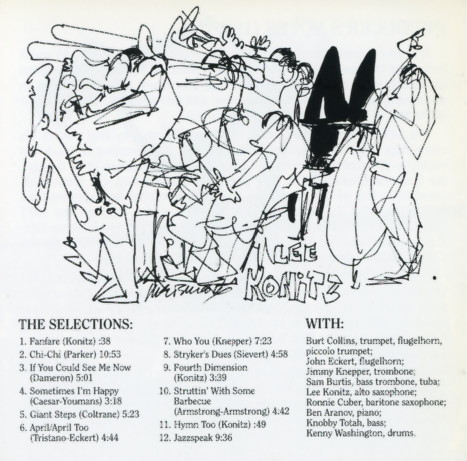
The Lee Konitz Nonet

 © Copyright ® Steven Cerra, copyright protected; all rights reserved.                                      


“Throughout a prolific career spanning seven decades Lee Konitz has usually chosen to showcase his talents within the confines of a small ensemble – often a very small ensemble. There are numerous duo recordings with Sal Mosca, Red Mitchell, Hal Galper, Jimmy Rowles and Gil Evans etc. Trios too have frequently been his modus operandi with Sonny Dallas - Nick Stabulas, Dick Katz - Wilbur Little, Harold Danko - Jay Leonhart and Don Friedman - Attila Zoller. All of which made his decision to organize a nine-piece group in the mid-seventies somewhat surprising.


Because of its similar size, the Konitz nonet has sometimes been compared to what became known as the Birth of the Cool ensemble.  Miles’ group with its fragile, almost ethereal textures was essentially a scaled-down version of Claude Thornhill’s orchestra complete with french horn and tuba.  Lee’s nonet with its wide-ranging repertoire was a far more extrovert affair. The instrumentation which was actually suggested by David Berger was also quite different – two trumpets, two trombones (one doubling bass trombone), alto doubling soprano, baritone, piano, bass and drums.


Returning to New York in May 1976 from a short European tour with Warne Marsh, Konitz recorded with Buck Clayton and then Chris Connor before getting together with Jimmy Knepper and David Berger to discuss plans for his nonet. He was living on West 86th Street at the time and Stryker’s which had opened in 1972 was his local club. The nonet started playing there and for the next 18 months or so they appeared quite regularly once or twice a week. The club did not have a piano so Ben Aronov had to bring in an electric instrument. They also performed at the Tin Palace, a little known club in the Bowery. Apparently nobody was paid very much (usually just cab fare) but Lee managed to keep the same core of players throughout the residency. In an interview for Jazz Journal (December 1996) he told me that he could not afford to pay for arrangements but Sy Johnson, Jimmy Knepper, David and Kenny Berger and Sam Burtis were all happy to write for the band without a fee. Kenny Berger recently told me that musicians at the time were willing to donate their services for a worthwhile project because there was still enough decent paying work available elsewhere. Today it would probably be different.

- © -  Gordon Jack/JazzJournal; copyright protected, all rights reserved., used with permission. Jazz Journal June 2015.


I, too, was surprised to see alto saxophonist performing in the context of this larger group in the mid-to-late 1970s but was delighted to re-discover it as a result of my Cuber Quest [an effort to listen to Ronnie in new surroundings] following the passing of Ronnie Cuber - baritone saxophonist par excellence - on October 7, 2022.


Gordon Jack goes on to say in his JazzJournal piece:


“Their next visit to the recording studio a year later was even more impressive (Chiaroscuro CRD 186). A particular feature of the date is the way famous solos have been orchestrated into many of the selections: - Louis Armstrong‘s 1927 Struttin’ With Some Barbecue; Charlie Parker’s 1953 Chi Chi; Lester Young and Slam Stewart’s 1943 Sometimes I’m Happy and John Coltrane’s 1959 Giant Steps  have all been seamlessly woven into the charts. The leader once said, “A great solo doesn’t care who plays it” - a philosophy probably inspired by his friend and mentor Lennie Tristano who used the study of classic instrumental solos as a teaching aid.  A highlight here is Konitz and Ronnie Cuber performing Coltrane’s choruses in unison on Giant Steps, the harmonic minefield originally inspired by Have You Met Miss Jones?  By now the hugely talented Cuber had replaced Kenny Berger on baritone and after the leader he was the most heavily featured soloist.  His ballad feature If You Could See Me Now is alone worth the price of the CD.”


Acting on Gordon’s advice, I tracked down Lee Konitz Nonet (Chiaroscuro CRD 186) and boy am I glad I did both for the reasons that Gordon mentions regarding Cuber’s magnificent playing, but also because the album is a gem in terms of everyone’s playing on the date and the exquisite small band arrangements written for this instrumentation by Sy Johnson, Jimmy Knepper, David and Kenny Berger and Sam Burtis.


Here’s more information on the recording which is followed by some videos featuring tracks from the album:


 PRODUCER'S NOTES (1977)


“I suspect it would be safe to say that Lee Konitz has worked in as great a variety of instrumental combinations as any jazz musician; at least since Buddy Bolden. There are the solo albums (you know, a real solo album, with no accompaniment at all) duets, trios, quartets, up the line to big bands and a couple with lush string accompaniments. This new record features Lee leading a nonet, a very workable number of instruments, but it is a combination that has been rarely used, particularly with the combination of instruments found here. Sure, there have been bands with nine players. Bennie Moten in 1926, for example, and today there are any number of ensembles with nine musicians, from dreary augmented dixieland bands to the equally dreary jazz/rock variety. But there's not another exceptional nine piece jazz band out there right now, one with great arrangements, in many cases crafted for the instrumentalists in the band. Shades of Ellington.


Lee's nonet has been working in New York for a little over a year at a place uptown called Stryker's. The club lets Lee and his guys play a couple of nights a week (when Lee's not on the road) and Stryker's management should be congratulated for the opportunity they've provided. I'm particularly grateful because the band had a year of rehearsal before it set foot in my studio (and also a record under its belt, on Roulette, which I highly recommend).


In a recent review of the aforementioned record it was suggested the news around town in 1977 was Lee's nonet. I couldn't agree more. It was news because it was not the usual Monday night hand, of which there are a few around town, all playing magnificently, but in many cases, not having a particularly individual stamp, except for the soloists in them. Lee's nonet has an individual stamp, it being an updated, slightly augmented version of the Miles Davis band of the late forties, the one that lasted about ten minutes, but which seemed to influence everyone who had ears. I seem to recall, the alto voice in that hand was a guy named Konitz. Funny coincidence. Perhaps if Miles ever decides to come out of retirement, he should walk up the street to Stryker's and mess around with this group. He'd probably enjoy it and frighten everyone to death.


In any event, this band is special. The arrangements were provided by Sy Johnson and Lee, and for the date they chose a nice mixture of standards and originals. To me the outstanding effort is on Chi-Chi, the old Parker piece. Everyone got cooking pretty good and it ran over about five minutes. This was the first take and Lee thought we ought to have a shorter version. The band did it, keeping strictly to the arrangement. On playback it was apparent the ten minute take was the real one; much in the same way relaxed, extended performances of the Goodman band always sound so much better than the studio versions.


Maybe the next thing will be to record this band live but that will have to wait until next year, when Lee gets back from his European sojourn, plus dates in North Africa and other assorted locations. And who knows, the talk of 1978 will probably still be this nonet.”


And here’s the text of Lee talking about the nonet from the Jazzspeak track that closes the recording:


“Hi, I’m Lee Konitz and I’d like to speak a bit about the history of this band and I would be pleased to talk about the people involved and the idea that motivated this nine-piece band.


I had thought at some point that this would be an opportunity for me to do some writing, some arranging that I hadn’t done too much of before and I spoke to Jimmy Knepper and with David Berger, David is a Duke Ellington scholar, who has been conducting Wynton Marsalis’ Lincoln Center Band for a long time.


Actually David was responsible for suggesting the instrumentation and there was a club across the street from where I live on 86th Street called Stryker’s which allowed the band to work there one or two nights a week for about a year, year and a half.


This is the way you can build a band by meeting every week. No one was paid too much, cab fare maybe and some for drinks.


The people looked forward to playing and never missed those nights. Jimmy Knepper for one, unless there was a great gig. Writers volunteered to contribute music  to the band. I wrote some things, not as much as I was hoping to, but Sy Johnson was one of the main people. He has a facility of writing fast and well and coming to rehearse the music and bringing it back next time all corrected.  Jimmy Knepper wrote some  things, and David Berger and Ronnie Cuber and Kenny Berger and it was a very nice experience for everyone for that year-and-a-half.


And then when the opportunity to play every week kind of subsided, I lost interest in playing the same music over and over again. When we were meeting week after week people were contributing new music which kept it always interesting from that standpoint.


The configuration of the band as you might have heard is two trumpets doubling on flugelhorn, two trombones with Sam Burtis doubling bass trombone, and two saxophones, baritone and me playing the alto and sometimes soprano and three rhythm.


At some point, I thought of adding a tenor to have more of a saxophone section, but I’ve enjoyed this kind of unusual ensemble and the power of the brass section that gives it a big band kind of feeling in a small band setting.


Because of the lack of pay, I thought it was a great opportunity to give everyone a chance to stretch out and play; after playing the arrangement, play some extended solos.


So that was fine and then I realized I was sitting most of the time listening to everyone else play. It got to the point that this was one of the reasons why I gave up the band.  


The other reason was getting eight answering machines every time I called for a rehearsal or a job.


We played two festivals in Belgium and Holland and it cost a fortune to bring the band over.


This album begins with a little Fanfare that I wrote; after the fact, I wished I’d stretched that out a little bit. It was kind of nice.


And then I had written out Charlie Parker’s choruses on Chi-Chi; Jimmy Knepper wrote the arrangement, and the one for If You Could See Me Now.

Tim Morgan, a student of mine, wrote the arrangement on Sometimes I’m Happy and included Lester Young’s solo and Slam Stewart’s solo. Actually that’s Slam’s solo coupled with a tag that Prez played.


Sam Burtis wrote the arrangement of Giant Steps and we play some of Coltrane’s chorus on that. The line by Lennie Tristano was incorporated into April/April Too and then Jimmy Knepper contributed the arrangement on his original Who You.  


Sy Johnson arranged Stryker’s Dues and Fourth Dimension was my chart.


Struttin’ with Some Barbecue is my arranged dedication based around Louie Armstrong’s solo which I wrote out for all the horns that wanted to play it and Hymn Too is another piece I wrote as a closer. 


It’s really a powerful tribute to play a great solo like Louis’ on Struttin’ and use all the different instruments.The same with Charlie Parker’s choruses on Chi-Chi they have the same thing with the full band playing them and giving them a new kind of weight.


I always say that a great solo doesn’t care who plays it.


I have never had any thoughts of resuming this kind of structure because I now realize that my main interest now is in improvising and I need as much opportunity as possible to do that so I prefer to work in duet, trio and quartet situations which is what I’ve been doing since 1977.


Many people had a chance to play in the band and look forward to it. The people in the nonet who wouldn’t miss playing in it unless some big job came along are Jimmy Knepper, Burt Collins and Sam Burtis. The rhythm section had the people in it that changed most frequently.


Unfortunately, Stryker’s didn’t have a real piano so the pianists had to bring in an electric one.


We were fortunate to play at the Vanguard a few times so the piano wasn’t an issue there. In fact, one night, Chick Corea and we had some nice arrangements that Sy Johnson had made of a few of his tunes and I asked Chick to sit in. I had my tape machine with me, but when I pressed the start button it had no batteries! 


Jimmy Knepper had mentioned this young drummer that lived up in Staten Island - Kenny Washington - who I think was 17 at the time.


I said, fine, bring him in.


Jimmy had no doubts; he could be a little bit critical of people but he raved about this guy.


Kenny came in at the age of 17 and read all this music and swung the band just the way you’d like it. He played a little bit loud sometimes and I had mentioned something to him about checking out Mel Lewis and that became a big inspiration for him. 


I might mention that there are 4 CDs of that year-and-a-half of the nonet’s existence. In addition to this one on Chiaroscuro, there’s Live at Laren [Soul Note], Yes, Yes, Nonet [SteepleChase] and The Lee Konitz Nonet [Roulette].


The band obviously was well-documented for that short-period of time.


The fact that the people involved in this project were so enthusiastic to play some creative music may have indicated a lack of activity at the time for some of these musicians.


But I always knew that there was a high degree of interest in the band because there was a long line of interested musicians who wanted to get on the band as subs.


If I had to conjecture how many people made up that nonet over the course of rehearsals and performances during that year-and-a-half, I would have to say that over 90 musicians or 190!


But I was always there!!” 


Tuesday, September 6, 2022

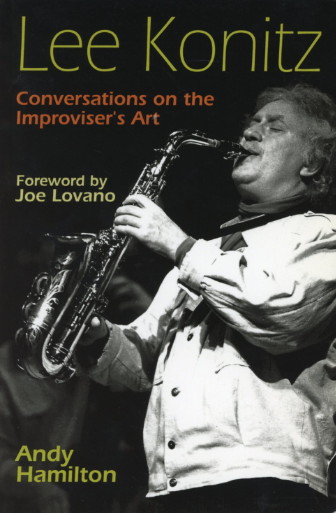
Lee Konitz - "Excerpts from Conversations on the Improvisor's Art" by Andy Hamilton

 © Copyright ® Steven Cerra, copyright protected; all rights reserved.


“That's my way of preparation — to not be prepared. And that takes a lot of preparation!”

—Lee Konitz


"An extraordinary approach to a biography, with the man himself speaking for extended sessions. The main vibration I felt from Lee's words was total honesty, almost to a fault. Konitz shows himself to be an acute observer of the scene, full of wisdom and deep musical insights, relevant to any historical period regardless of style. The asides by noted musicians are beautifully woven throughout the pages. I couldn't put the book down - it is the definition of a living history." 

-David Liebman, saxophonist


The preeminent altoist [perhaps too often] associated with the "cool" school of Jazz, Lee Konitz was one of the few saxophonists of his generation to forge a unique sound independent of the influence of Charlie Parker. 


In the late 1940s, Konitz began his career with the Claude Thornhill band, during which time he came into contact with Miles Davis, with whom he would later work on the legendary Birth of the Cool sessions. 


Konitz is perhaps best known through his association with Lennie Tristano, under whose influence much of his sound evolved, and for his work with Stan Kenton and Warne Marsh. 


His recordings have ranged from cool bop to experimental improvisation and have appeared on such labels as Prestige, Atlantic, Verve, and Polydor. 


Crafted out of numerous interviews between the author and his subject, Lee Konitz - Excerpts from Conversations on the Improvisor's Art [Ann Arbor, MI: The University of Michigan Press, 2007] offers a unique look at the story of Lee Konitz's life and music, detailing Konitz's own insights into his musical education and his experiences with such figures as Miles Davis, Stan Kenton, Warne Marsh, Lennie Tristano, Charles Mingus, Bud Powell, and Bill Evans.


I’ve been around Jazz musicians for most of my adult life, both as a player and as a student of the music, and I’ve always been impressed by those who can verbally articulate the process associated with its main element - improvisation.


Of course, playing Jazz well is the main requirement of a musician, but explaining it well in a narrative format by the musicians themselves is a rare corollary. 


One of the best at doing both was the late alto saxophonist Lee Konitz [1927-2020]. 


This portion of the book’s ongoing interviews with Lee explains what it is like to be within the music as it is being made as compared to what it’s like being outside the music and listening to it. The former is the musician’s perspective while the latter is that of the fan’s.


© Copyright ® Andy Hamilton/University of Michigan Press, copyright protected; all rights reserved.


You've done a lot of duos with pianists. Is that a format you particularly

enjoy?


I do enjoy playing in a duet situation. But a bass and drums trio is the best situation for me, because I don't feel like I have to share the solo space so much, and I can stretch more. It's difficult hearing the chords while in motion, sometimes.


Again, I'll try to visualize the situation on stage, with piano, bass, and drums. I'm usually standing with my back to them, which I don't like. And, since I don't use a microphone and monitor most of the time, they can't hear me face to face. Now, I start to play — without a count-off, frequently — and, one by one, they join me . .. such a nice feeling to hear another sympathetic voice — nothing can compare to this process for me.


So, I hear the bass notes, then the piano plays a chord, and I say — in some part of me — "Wow, what was that?" Not enough time to really put a label on it, so I do the best I can to match that sound. Then the drums enter — great to hear! So now I am listening to myself in relation to three other sounds. "What's the pianist doing now? Interesting, but what can I do to correspond to that nice progression . . . No, that didn't really work — and what's that chord? Ah, that was nice! What is the bass doing now, with the drums? How nice — how can I fit that sound?" And it continues in a most fascinating way, sometimes not really adding up to a "complete, well-structured composition" — but the special feeling of doing it as an ensemble, in front of listeners, makes it an extraordinary undertaking, I think.


I don't know the answer to being able, within the standard song format, to function spontaneously with others. In the so-called free format you are more compelled to hear each other and react, and in some ways it's easier. 

But the same end-product of a good composition is at stake.


If you're playing alone, 100 percent attention is on your creating process, hopefully — when you're in a duo, it's only 50 percent, and 50 percent on the other person, especially if it's a chordal instrument that's so complicated. And my equation goes down to 33.3 percent for a trio, and 25 percent for a quartet. But to get more than a superficial feeling for what the other player is doing, a specific tune-in to the quality of the sounds that he's playing— how do you do it, I ask myself and you? It's almost impossible in motion, and you're supposed to not only hear it, but figure out what the hell it is, and play something that fits it — that's asking an awful lot! That's one of the reasons that I prefer to play without a chordal instrument, but when I do play with it, and the guy is really responding to me, it's an experience that I love. It takes some of the pressure off you, that you could feel in having to deliver a great solo. You're just there in the moment, enjoying it.


Last night [in Paris] the piano player was like a Jamey Aebersold record, he was just comping, keeping time — it had little to do with what  I was doing. 

So a couple of times I signaled for him to lay out. I just wanted to play with the bass player because he was listening to me.


So making music in a group is a compromise between focusing on your own line, and hearing what the others are doing.


It's as much a compromise as trying to have a conversation with another person. It's a test of your ability to communicate. In a situation like last night, where the sounds were so unpleasant sometimes, you just want to not even try any more. But it's a gig, and you're obliged to make the best of it. When the guitarist was playing chords, I never had any sensation of them — I couldn't hear them, I wasn't affected by them at all. But in most situations it's possible to speak and be understood to some extent. 


I guess the occasions when it doesn't feel like a compromise are when it's inspired.


Yes. That's what we all live for. And it happens more than you'd think. 


Do you ever get lost in the changes?


Frequently — especially without a chordal instrument, or if the bass player's really improvising, and not just playing tonics and fifths and whatever. At those times, when I'm cool, I just stop playing, and let him play, and some place he'll give me a clue and I'll come back in. Or else I'll play some and he'll come up to me. I remember playing with a very fine guitar player Ben Monder, and Matt Wilson. I don't know if we decided on tunes ahead of time, or just went into tunes spontaneously, but when we talked about it afterwards, we discovered that very frequently we were playing two different tunes together — and it felt great! Which underlines my feeling that two good strong lines form a counterpoint. It doesn't matter about the key or the chord progression or whatever, especially if the lines are being affected each by each.


Do you prefer playing with a guitarist to a pianist?


Well it depends who it is. But the guitar sound is a little softer, somehow, kind of easier to relate to. The piano would tend to get more complicated, and if the feeling isn't right, it gets in the way. I played a few years ago at a high school in Cologne with [pianist] Frank Wunsch. [The composer] George Crumb was being celebrated at the school, and we were asked to play a couple of pieces at the concert as a duo. Frank started being very busy, and I said, "Give me some space!" He got angry and put his hands on his lap, and after sixteen bars or so I said, "Not so much space!" And they heard me out in the audience and laughed.


Frank is a fine pianist, and we've had some inspired concerts together. He's famous for the waltzes he composes. I call him "the second Johann Strauss"!


There are marvelous pianists out there — Brad Mehldau, Enrico Pieranunzi, Franco D'Andrea, Martial Solal, Barry Harris — and many others that I've enjoyed playing with, especially in a duo format.


Martial Solal is totally unique in his accompaniment, always reacting. There's nothing more inspiring to me than to hear someone react to something I just did, and to tell me that he's interested. Maybe he doesn't love it, but he's interested. I will respond immediately. Whatever I had in mind, I will go in that direction immediately, because he's talking to me.


The independent kind of comping, I hate that! I can do that with Jamey Aebersold records.


This has a bearing on what you were saying about thinking ahead. If you're responding to another player, the amount of thinking ahead has to be limited.


I'm talking about my playing a phrase, and hearing a chord [from the pianist] in the middle of the phrase, or before the phrase even starts, telling me that this is the sound I have to function on. And I say, "Now wait a minute, let me play the phrase, and react to me now. We take turns. I'll be happy to try to react to your little cluster or whatever, but let me play one now. Or, if you don't like what I'm playing, or don't hear what I'm doing, just cool it for a minute." We say "stroll" when we ask the guy to lay out for a little bit. The same for me, ideally: "Nothing to say, don't play!"


Saturday, March 13, 2021

Lee Konitz on John Coltrane

 © Copyright ® Steven Cerra, copyright protected; all rights reserved.


I’m always curious about the reactions of Jazz musicians to one another’s playing and found the following fascinating assessment of John Coltrane by Lee Konitz in Andy Hamilton’s Lee Konitz: Conversations on the Improvisor’s Art [2007].


John Coltrane


Coltrane (1926-67) was stylistically opposed to Konitz in almost every way, and his influence on saxophonists has resulted in some of the empty virtuosity that Konitz disdains, even if Coltrane himself was not guilty of that kind of playing. But still Konitz shows an abiding interest in what the saxophonist was attempting.


Lee Konitz “Coltrane changed the direction of the music, as Bird did, and Ornette —  though he was more adventurous than Bird, and willing to change his approach till the end. He also, like Miles, and all great band leaders, chose the right players to join him. He went through the traditional music pretty thoroughly, then went into modal tonalities, and ate that up. My goodness, he was really sensational with Elvin, McCoy, and Garrison. He was always developing some new kind of vocabulary. I'm thinking of his modal playing, how chromatic that became, before Ascension — I don't really know that later period that well. Other people — and I've done this too — used to accuse him of practicing on the bandstand. He used to take a phrase and just throw it around in all directions — a form of composing.


I had a problem with that music — so much of the same high-intensity dynamic. If the level of intensity doesn't change, the music can become monotonous — even though it was necessary for John's spiritual release. It's evangelical, if you will — for many, he was the Messiah! 


Do you think Coltrane had the compositional approach you described Charlie Parker as having?


“I think it was very worked out, basically. Certainly there was a large, readily available vocabulary, but a great feeling to improvise with the material at hand. He was an inspiration to many young players, for good and not so good.


I didn't really know him. Just to say hello. As I've mentioned, I wasn't hanging out a lot and I didn't get to meet a lot of guys and know them personally, regrettably. The best time for hanging out is on the road; and even then I didn't really party much.”


You've said harsh things about the influence of John Coltrane in terms of learning patterns, to create a high level of excitement at rapid tempos. 


“Well, it's against my temperament to do it. And if I hear it done very well like when Coltrane was really on, it's very special, and I can enjoy that very much. But to hear other people do it in that style, or play Charlie Parker's style, I don't enjoy that much. Where is the real person? Still, I heard that after someone accused him of playing like Bird, Gene Quill held out his horn and said, "Here, you play like Bird!"


Recently I heard Branford Marsalis's group, with Joey Calderazzo, Eric Revis, and Jeff "Tain" Watts, pay tribute to Coltrane by playing their version of A Love Supreme. I think they do a great job of paying homage to John and his group.


Coltrane influenced a lot of players. He changed Art Pepper in midcareer. 


“That was tragic, that influence, I think. I was just listening to a set of five albums of Art Pepper's, and one I made with him was the fifth in the package. Art was not in top form. I was feeling good, but obviously there was trouble there. On the record he made with Warne Marsh years earlier, he played beautifully. Warne really got to him, like he got to me. I never heard the records he made with Miles's rhythm section; they must have been more straight-ahead. I thought his comeback was a disappointment, from the expressionistic stuff I heard. I remember sitting in the Vanguard with Bob Mover—a saxophonist who played with Chet Baker a lot—and we just looked at each other in disbelief, at how ineffective Art was playing with Elvin Jones.


He was getting a lot of attention at that point.


He was a charismatic figure, as well as being a fine saxophone player early on. I appreciated that he tried to make a change. It's very important in the development of a player to take some chances like that. But you've got to make the change definitive. He only went part of the way; his harmonic ability was limited.


Bud Shank heard Phil Woods, and started to blow "hot." I think they were tired of being part of the cool school—they graduated maybe! I’ve tried to play hot when it was time to play hot. But I think maybe they sacrificed some quality along the way. 


You have played [Coltrane’s] "Giant Steps."


“By now, people are more used to it, but at that time it was a very difficult etude. I actually played a version of that with my nine-piece band on Yes, Yes Nonet. Ronnie Cuber, the baritone player, had a solo, and he just flew through the changes. Then it was my turn and I stumbled through them. So I thought about it at home a little bit, and came back the next day and did another take. And I managed to get through. I just don't enjoy running changes that much.” 


Why is it difficult?


“Because each change is two beats long, and the chords are going by really fast. It's an unusual sequence of chords, two beats per chord, in the first eight bars, in a major-dominant sequence moving a major 3rd—as opposed to the usual II-V-I sequence [“two, five, one" chord progression]. I played it in 3/4 time once and just that extra beat helped a lot.”


You have tried to play modal pieces, like "Candlelight Shadows" with Harold Danko. How would you approach those?


“Well, basically trying to express the tonality to begin with, to establish that as clearly as possible. Then, I think, the challenge is to play chromatically on top of that basic tonality — not losing the tonic somehow, returning enough to establish it. So it starts modally, and can develop intervallically and return eventually to resolve to the basic mode.”


Are you imposing chord changes over the modal system? It's said that Cannonball Adderley played Il-V-I's over the modes of Kind of Blue, and many jazz players seem to have played modally in this "impure" way. 


“Modal playing is a very challenging premise. An opportunity to really get into a groove, and stay there, without the underlying melody and harmonies

of a conventional tune guiding you. I’m not a "groove" player — obviously! — and have accepted the restrictions of standard tunes for my way. But hearing Trane and a few others groove is a special experience. He and McCoy really stretched out chromatically. I don't know about "impure"— maybe for a church service!”