Saturday, February 4, 2023

Rob Pronk: The Bebop Years - Studio Sessions 1950-1957 [NJA 2001] - The Netherlands Jazz Archive

 © Copyright ® Steven Cerra, copyright protected; all rights reserved.


Over the years, many venues in Europe recorded performances by visiting American Jazz luminaries during the heyday of the modern version of the music from 1945-1970. Many of these recorded performances have been subsequently released on compact disc, replete with photographs, detailed insert notes and a variety of extra features including bonus tracks and interviews.


Ronnie Scott’s club in London has offered a series of CD releases as has FiniJazz in Italy, Kongreshaus in Zurich, Jazzhaus from Liedenhalle in Stuttgart, the Gitanes - Verve Jazz Paris series, Europe 1 radio programs Musicorama, For Those Who Loved Jazz and live performances at the Olympia Theater and the American in Sweden Series from appearances at the Konserthus in Stockholm.


Many of the German Radio Orchestras such as the North German Broadcasting [NDR] in Hamburg and Hanover, the West German Broadcasting [WDR] in Cologne and the South Western Broadcasting [SWR] in Stuttgart and Baden-Baden-Freiburg have issued recordings on which American Jazz musicians have appeared as guest artists.


Over the past few years, this august group has been joined by the Netherlands Jazz Archive [Nederlands Jazz Archief] which is releasing a superb series of “treasures of Dutch Jazz” that features an impressive roster of both American and Dutch Jazz artists.


You can view the full catalogue by clicking on this link - Netherlands Jazz Archive [Nederlands Jazz Archief]. Unfortunately, not all of the inventory ships outside Europe but you can access international distribution via www.dustygrooves.com and www.jazzmessengers.com.


Thanks to the generosity of producer Frank Jochemsen and Jan Brouwer of the NJA office and help from drummer, band leader and Dutch Jazz Legend Eric Ineke, the editorial staff at JazzProfiles was sent review copies of three of the recordings in this series. We’ve created a continuing feature on the blog to offer more information about each of these CDs.


Let’s begin with Rob Pronk: The Bebop Years - Studio Sessions 1950-1957 [NJA 2001].


As the Jazz author and critic Mike Hennessey has observed on Rob:

“For a man who has written more than 1,200 arrangements for Holland's magnificent Metropole Orchestra, played trumpet in the band of Kurt Edelhagen, piano with Dexter Gordon, Don Byas, Johnny Griffin, Conte Candoli, Frank Rosolino, Zoot Sims and Ake Persson, to name just a few, and written arrangements for recordings by Rob McConnell, Pepper Adams, Hank Jones, Bill Perkins, Benny Carter, Buddy DeFranco, Toots Thielemans, Clark Terry, Lee Konitz, Lew Tabackin, Claudio Roditi, Andy Martin and dozens more, Robert "Rob" Pronk is a musician whose level of recognition falls far short of his talent and accomplishments.”


With Rob Pronk: The Bebop Years, the music on this recording gives the listener the opportunity to understand Rob’s Jazz roots before all of the activity in the above statement by Mike came about. Indeed, in some ways, the music on this archival recording goes a long way toward explaining how and why Rob Pronk was able to accomplish all of these achievements later in his career.


Here are some specifics about the music on this CD from Bert Vuijsje insert notes.


Rob Pronk: The Bebop Years


“The Rob Pronk Sextet played a major role in Dutch jazz in the 1950s. However, the group, featuring Ruud Brink, Jerry van Rooyen, Rob Madna and Dick van der Capellen, never recorded an album. The Dutch Jazz Archive is therefore pleased to fill this gap with this CD: three never previously released sessions from 1957 showcasing the sextet's core, sometimes joined by other top talents such as Herman Schoonderwalt, Harry Verbeke, Toon van Vliet, Ack van Rooyen, Ruud Jacobs and Cees See…..


It is somewhat of a mystery why the Rob Pronk Sextet never made a record, in view of all the positive attention and high praise bestowed on them. In 1955-56 Pronk fulfilled a modest role in the projects Jazz From Holland and Jazz Behind The Dikes. (Two piano trio pieces on Jazz From Holland and two recordings as pianist/arranger for the Dutch All Stars; for Jazz Behind The Dikes he was involved in only two tracks on the third LP of the series, as trumpet player and arranger with the Wessel Ilcken All Stars.) His own sextet, however, never saw the inside of a record company's studio. 


After Rob Pronk's death on 6 July 2012, his personal archive was bequeathed to the Dutch Jazz Archive. Here we found three recording sessions from 1957, which had been located before in the archives of the Wereldomroep (RNW - Radio Netherlands Worldwide). Most of the members of the Rob Pronk Sextet feature prominently in these recordings: in addition to the sextet's leader on trumpet they are the then just 19-year-old Ruud Brink on tenor sax, trumpet player Jerry van Rooyen, pianist Rob Madna, bass players Dick Bezemer and Dick van der Capellen, and Rob Pronk's younger brother Ruud on drums.


They are sometimes complemented or replaced by a number of top talents from the Dutch jazz scene of those days: saxophone players Herman Schoonderwalt, Harry Verbeke and Toon van Vliet, trumpet player Ack van Rooyen, bass player Ruud Jacobs and drummer Cees See. This music has never before been released on record (three of the thirteen tracks were only featured on the LP box Dutch Light Music issued by RNW, which was not commercially available). The bands, successively named Dutch Jazz Combo, Orkest Rob Pronk, and Rob Pronk Combo, actually illustrate - between January and October 1957 - the transition from West Coast Jazz to hard bop, with Al Cohn's East Coast Jazz, much admired by Rob Pronk, as a stepping stone. We at the Dutch Jazz Archive are proud to now make this essential addition to Jazz From Holland and Jazz Behind The Dikes available to jazz aficionados everywhere. Singer Babes Pronk did not take part in these sessions, but we have unearthed a performance by her as well and added it to this CD as a bonus track- In February 1950, Rob Pronk, playing the piano, made two private recordings on acetates, accompanied by bass player Hans Tan and drummer Jan Opgenhaeffen. Boplicity is an instrumental trio piece: I’ll Remember April is sung by the then 20-year-old Babes Pronk. 


The remaining four bonus tracks feature Rob Pronk in prominent American company. These are the very first recordings he made, in Stockholm in 1953, The Boyd Bachman band was on tour there, with Ack and Jerry van Rooyen and Rob Pronk in the trumpet section, and on 23 August 1953 Stan Kenton gave two concerts there. 'I knew all these musicians from their records. Of course, I had to go see them. Ack too, and Jerry as well, I think', Rob Pronk recalled in 2007. Between the two performances ('We had to see both shows, obviously') he met Kenton's trumpet player Conte Candoli. When he and Ack returned to their seats, the Swedish bass player Simon Brehm - also founder/owner of the Karusell record label - approached them. Rob Pronk: 'He says: "After the second show we will be making recordings." And he says: "Ehm, I need a pianist." And Ack said, pointing a thumb at me: "There's one sitting right here." That's how it went. For me it was quite sensational of course, to play with all these stars.'


On 23 August two pieces were recorded by tenorist Zoot Sims, with Rob Pronk on piano and Kenton band members Don Bagley and Stan Levey on bass and drums, respectively. The pieces were I'm In The Mood For Love and Rough Chance On Love, the latter being an improvisation on the chords of the song Taking A Chance On Love. 'Oh, I remember now that Zoot Sims asked: "How does the bridge go?" Ha ha, he didn't know. I had to show him on the piano. "Oh yeah, okay now", Zoot said.' On 25 August there was another session with three trombone players, Frank Rosolino, Bob Burgess and the Swede Ake Persson, and again Don Bagley and Stan Levey. The two titles were Monotones (a blues theme by Persson) and Don't Blame Me. 'We did that last piece in a number of takes, so I had to play an intro each time. Don Bagley said: "Where do you get that from, a different intro each time?" I'll never forget that; that was fun.


'I wasn't intimidated, but I was impressed and stimulated. It's the only way, just play it like you play it, that's what you're there for. I can't even remember if I was getting paid. I guess so, but that aspect was completely irrelevant. Playing with those big stars, that was it.’”


BERT VUIJSJE


Jazz journalist and author of Rita Reys: Lady Jazz (Thomas Rap, Amsterdam. 2004) and Ado Broodboom trompet (In de Knipscheer, Haarlem, 2017). He also wrote the chapter on the Netherlands in The History of European Jazz (Equinox Publishing. Sheffield. UK. 2018).


English translation Leo Reijnen


And here’s the entire piece on Rob by Mike Hennessey from the Jazzmasters of the Netherlands website.


Rob Pronk: Weaver Of Musical Spells -


For a man who has written more than 1,200 arrangements for Holland's magnificent Metropole Orchestra, played trumpet in the band of Kurt Edelhagen, piano with Dexter Gordon, Don Byas, Johnny Griffin, Conte Candoli, Frank Rosolino, Zoot Sims and Ake Persson, to name just a few, and written arrangements for recordings by Rob McConnell, Pepper Adams, Hank Jones, Bill Perkins, Benny Carter, Buddy DeFranco, Toots Thielemans, Clark Terry, Lee Konitz, Lew Tabackin, Claudio Roditi, Andy Martin and dozens more, Robert "Rob" Pronk is a musician whose level of recognition falls far short of his talent and accomplishments.


A self-effacing man with a most appealing sense of humour, which manifests itself from time to time in his charts, Rob Pronk has dedicated himself to Jazz and associated music forms since he gave up studying economics in 1949 to become a professional musician.


Born in Malang, Indonesia, on January 3, 1928, Rob did not have great exposure to Jazz music in early childhood because his father, a railway engineer, was a fan of Charlie Kunz and Victor Sylvester. However, at the age of six he did hear Duke Ellington's "Mood Indigo" on the radio and was immediately hooked.


Rob's mother sang and played a little piano, and it is typical of Pronk that he says: "My mother would hold me in her arms and sing to me and I used to cry. But not because she sang out of tune."


At the age of eight he began taking piano lessons, but they only lasted for six months because the family was constantly on the move. In 1946, Rob had the good fortune to meet Jerry van Rooyen, when he brought a big band to Indonesia to entertain the troops. Says Rob, "Jerry was later to teach me the fundamentals of arranging and I owe him a great debt of gratitude."


In 1947, at the age of 19, Rob moved to Holland, studied economics at Rotterdam University and gained a bachelor's degree. At this stage in his life he was undecided as to whether to pursue a career in economics or become a professional musician. Happily for music, he finally chose the latter option and enrolled at the Royal Conservatory in The Hague where he studied trumpet, piano and theory.


Rob Pronk's first gigs, in 1949, were on a ship in an international student exchange programme. He began by playing drums, then switched to piano. His idols at that time were Duke Ellington, still an uncontested No. 1, Benny Goodman, Artie Shaw and Teddy Wilson.


It was on one of these exchange trips that he spent some days in New York and visited Bop City where he heard the Buddy De Franco Sextet, which included Jimmy Raney, Kenny Drew, Teddy Kotick and Art Taylor. He also had the opportunity to enjoy performances by Louis Armstrong's All Stars and Louis Jordan's Tympany Five.


In the late 1950s, Rob joined the trumpet section of the Kurt Edelhagen Orchestra in Cologne and soon became its principal arranger. During that period he was called upon to write an arrangement of "I Didn't Know What Time It Was" for Benny Carter who was guesting with the band. Says Pronk: "Benny paid me a great compliment. He said that it sounded like a Quincy Jones arrangement. I felt like a king!"


In the 1960s, Pronk subbed for a week on trumpet in the long-established Dutch band, the Ramblers, and it was then that a colleague in the trumpet section, who was house arranger for the Metropole Orchestra, suggested that he should try writing some charts for this illustrious ensemble.


Rob took up the challenge, met it highly impressively, and, went on to contribute more than 1,200 arrangements to the Metropole library. He has derived tremendous satisfaction from his work with the Metropole Orchestra, which he regards as an aggregation which has no parallel anywhere in the world.


Says Rob: "It is a unique ensemble. It is not simply a big band with an added string section. It is a totally integrated unit and it is a tremendous challenge to write for it, but it is also a hugely fulfilling experience."


Pronk says that, aside from the invaluable help he had from Jerry van Rooyen in developing his arranging skills, he learned by trial and error. "And," he says with a smile, "there were many errors".


He cites as his principal hero in the field of arranging, the late Billy May. "For me," says Ron, "he was the arranger. The master. But I also have great admiration for Bill Holman, Al Cohn, Quincy Jones and Gil Evans."


One memory which Rob Pronk treasures above all was his being commissioned to produce and write the arrangements for a Marlene Dietrich album, "Die Neue Marlene", recorded at the EMI Studios in St John's Wood in September 1964. He conducted a 40-piece orchestra which included Kenny Baker, Harry Roche, Bobby Orr, Kenny Clare, Ivor Mairants and Larry Adler.


He also fondly recalls three sessions in Stockholm:


One in 1953 for Carousel, on which he played piano with Zoot Sims, Bob Burgess, Frank Rosolino, Ake Persson, Stan Levey and Don Bagley;


One in 1983 for the Sonet label, "In Goodmans Land", with Georgie Fame, Sylvia Vrethammar and a studio big band, and another for Sonet in 1988 called "String Along With Basie", for which he transcribed Basie charts for four guitars (Rune Gustafsson, George Wadenius, Bob Sylven and Bobbo Andersson) plus bass and drums.


Pronk's spell as principal arranger for the Metropole Orchestra lasted for more than 30 years, his last recording being with trombonist Andy Martin in 1998. In 1975 he was appointed guest conductor with the orchestra, a post he held for 21 years. Last year, the Metropole administration decided to honour him with a tribute concert to which he was able to invite two special guests of his own choosing.


Rob recalls: "The concert was set for June 1, with my old friend John Clayton Jr. conducting the orchestra, and I planned to invite Bill Perkins and Andy Martin. But, unfortunately, Bill's doctors advised him not to do the gig because of his rapidly deteriorating physical condition. I was lucky enough to be able to get Pete Christlieb to deputise for him and he did a great job.


"Bill Perkins died in August last year and his memorial concert at the Union in Los Angeles was a must for me to attend. I had known him since 1964 and I miss him dearly. He was on my first CD with the Metropole Orchestra, "I Wished On The Moon"."


For the tribute concert last June, the Metropole Orchestra compiled a CD of 18 of the Pronk charts they had recorded between 1982 and 1992 which was presented to the 200 guests who attended the event in the Nordring Radio's largest studio.


Says Rob: "I can't tell you how honoured I was to have Pete Christlieb and Andy Martin with us on that occasion. That was a very emotional event and it took me weeks to get both my feet back on the ground."


As well as being an arranger of the utmost versatility, Pronk is immensely resourceful and has an appealingly whimsical streak to his musical nature which asserts itself from time to time. The arrangement of "I'm Just Wild About Harry", which he wrote in 1986 as a feature for the remarkable guitarist Eef Albers with the Metropole Orchestra, is a good example. It is taken at a furious pace and, in the out chorus, there are key changes every four bars in the first 24, from F to Eb to D to Bb to F and then to Eb.


In addition to his arranging activities, Rob Pronk taught arranging and composition for many years at Rotterdam Conservatory. He won the Nordring Radio Prize in 1981 and the Blaupunkt Music Award in 1988.


Johnny Mandel has said of Pronk: "He is truly a weaver of spells. Not only is he able to draw forth moods and textures from an orchestra that I have never heard before, but he also swings his butt off."


And Bill Perkins said, "I believe he ranks with the finest of our modern composer/arranger/conductors."


Says Rob: "When I look back on my 50-plus years as a professional musician, one of the abiding sources of satisfaction for me is that I had the fantastic good fortune to work with so many of the great musicians I idolised back in the 1940s and 1950s.


"One of the greatest moments in my career occurred in June 1991, when Ken Poston of the KLON radio station in Los Angeles put together an orchestra to perform a concert playing arrangements I had written for the Metropole Orchestra. I conducted the orchestra and guest soloists were Dianne Schuur, Buddy de Franco, Art Farmer, Chuck Findley, Gary Foster and Carl Fontana.


"I got the shock of my life when, during one rehearsal, a man walked up to me and introduced himself as Pete Rugulo. He asked to have a look at my charts because he wanted to see how I scored for strings.


"And another great event for me was the presence at the concert of Artie Shaw, then 81-years-old, accompanied by Arnold Schnberg's daughter. He was planning a tour and he asked me if he could use some of my charts. Imagine that! The man I idolized as a teenager wanting to use my arrangements! And the next day, to cap it all, Artie took Buddy DeFranco and me out to dinner."


by Mike Hennessey, pianist, composer, author


Sunday, January 29, 2023

Exploring The Scene with The Poll Winners - Barney, Ray and Shelly

 © -Steven Cerra, copyright protected; all rights reserved.


This post features another recording from our earliest Jazz experiences which the editorial staff at JazzProfiles wanted to commend to you as a reminder, if you’ve heard it before, or as an invitation to move your ears in a different direction, if you’ve not heard it previously.


Actually, this post highlights what is the fourth in a series of albums on Contemporary Records by The Poll Winners and it was issued under the title The Poll Winners Barney Kessel, Shelly Manne and Ray Brown: Exploring the Scene [s-7581; OJCCD 969-2].


Since guitarist Barney Kessel, bassist Ray Brown and drummer Shelly Manne regularly scored high in jazz fans' polls of the day, Contemporary's decision to record them as a trio was commercially impeccable. But they were also a committed musical group too as indicated by the quality of their performances on this disc and their three previous LPs: [1] The Poll Winners [1957, OJCCD 156], The Poll Winners Ride Again [1958 OJCCD-607] and Poll Winners Three [OJC 692].


[There is also a reunion recording from 1975 entitled The Poll Winners/ Straight Ahead OJCCD-409].


As the lead voice in the trio, guitarist Barney Kessel best fits this description from Richard Cook and Brian Morton’s The Penguin Guide to Jazz on CD, 6th Ed.:”The blues he heard as a boy in Oklahoma, the swing he learned on his first band job and the modern sounds of the West Coast school': Nesuhi Ertegun summary of Kessel, written in 1954, still holds as good as any description.  Kessel has often been undervalued as a soloist down the years: the smoothness and accuracy of his playing tend to disguise the underlying weight of the blues which informs his improvising and his albums from the 1950s endure with surprising consistency.”


Along with Paul Chambers and Ron Carter, Ray Brown was probably the most frequently recorded bassist in modern Jazz. His big sound, uncluttered rhythm and tasteful melodic sense developed into bass lines that were among the best in the business.


Shelly Manne’s cool melodicism, restrained dynamism, and sophisticated playing made him one of the finest musicians in modern Jazz - whatever the instrument. Jack Brand in his bio on Shelly called him “the most melodic Jazz drummer who ever lived."


Although not as common as piano-bass-drums Jazz trios, this is one of the best of the guitar-bass-drums version of the trio format even though it existed only for recording purposes.


The always dependable Leonard Feather prepared the liner notes to the original LP and they contain a wealth of background information about the musicians and the music on this album.


“DESPITE THE ELEPHANT ON THE COVER, and in an election year to boot [1960], the polls relevant to the participants in this album are those conducted annually by three leading U.S. magazines with jazz oriented readers: Down Beat, Metronome, and Playboy. Each year for the past four years Barney Kessel, Ray Brown, and Shelly Marine won first place in all three polls as the most popular jazz guitarist, bassist, and drummer. And each year Contemporary has acknowledged the poll results with a new Poll Winners album.


The "scene" explored by Messrs. Kessel, Brown, and Manne in this fourth set of improvisations is, of course, the jazz scene - particularly the scene of the past few years during which their poll winning activities took place. Jazzmen are among the most non-conforming of all non-conformists, and a run-down of the nine selections in this album illustrates the point very well. Their composers are among today's best-known jazz players. Yet what a group of strongly individual personalities they are! They range from ebulliently swinging Erroll Gamer to brilliant, moody Miles Davis, from lyrical Brubeck to the far-out cry of Ornette Coleman, from the subtle sophistication of John Lewis to the blues-rooted Horace Silver, and the gospel-rooted soul jazz of Bobby Timmons. Together, the nine pieces represent a cross-section of today's many-faceted and fascinating jazz world.


CERTAINLY NOT LEAST among the strongly individual talents in that world are Barney Kessel, Ray Brown, and Shelly Manne. Barney has been "on the scene" since the mid-1940s when he played with Artie Shaw, appeared in the movie short Jammin' the Blues, and toured with Jazz at the Philharmonic. He was born in Muskogee, Oklahoma, October 17,1923, was self-taught, and received early encouragement from Charlie Christian. When he arrived in Los Angeles in 1942, he knew no one, and had not one cent in his pockets, yet within a few years he was known internationally. He won the Esquire Silver Award in 1947, first of many accolades to come his way. He has played and recorded with most of the top jazz artists (Oscar Peterson, Charlie Parker, Lester Young, Billie Holiday, etc.) and since 1953, as an exclusive Contemporary artist, has made a number of his own albums. Barney has also been extremely active in motion picture, radio, and TV studio recording. In 1960 he formed his own quartet, and is currently appearing in the nation's leading jazz clubs.


Ray Brown was bom in Pittsburgh, October 13,1926. While not yet twenty he played with Dizzy Gillespie. Much of his playing since 1951 has been with Oscar Peterson's trio -which for a time in '52 - '53 included Barney Kessel. Ray Is generally conceded to be the bassist of the past decade. He received his first award, Esquire's New Star, in 1947 and has won the Down Beat poll every year since 1953. the Metronome poll every years since 1955, and the Playboy poll each year since it began in 1957.


In addition to his playing on Contemporary's three previous albums, Ray has recorded several of his own albums and a great many with Peterson for Verve Records.  He is on the faculty of the Advanced School of Contemporary Music in Toronto, Canada, and lives in nearby Downsview when not on tour.


During the past year, Shelly Manne has been one of the busiest of all jazzmen: leader of his own group, composer of the score for the movie, The Proper Time, impresario of his own jazz club, the Manne Hole in Hollywood, and constantly in demand for studio recording work for motion pictures, TV, and records. Born in New York City, June 11,1920, Shelly's first playing was done there on 52nd Street in the early 1940s. In the twenty years since, he's played with almost every major jazz figure - in small groups and big bands. He won the first of his eleven Down Beat plaques in 1947, the year in which Barney and Ray won their first national awards. Since 1952 he has lived in the San Fernando Valley, near Los Angeles; since 1953 has been an exclusive Contemporary recording artist.


Little Susie is a blues by pianist Ray Bryant, named for his daughter. It was written in 1957, but became popular in 1960 as a single, and is the title song of Bryant's recent trio album (Columbia CL 1449/stereo CS 8244).
The Duke, Dave Brubeck's best-known composition, was written in 1955 as a tribute to Duke Ellington. It was recorded several times by Brubeck's quartet for Columbia. The first version is on Jazz: Red Hot and Cool (CL 699).


So What was conceived by Miles Davis as a setting for an improvised recording by his sextet. It is described by pianist Bill Evans as "a simple figure based on 16 measures of one scale, 8 of another, 8 more of the first." It is on Miles' Kind of Blue (Columbia CL 1355/stereo CS 8163). For the Poll Winners' version, Shelly used two unusual percussion instruments. The lujon is a teakwood box enclosing six tubes of different lengths. On top of each tube is an aluminum plate, which is struck by a mallet producing a marimba-like sound. The lujon is the brainchild of Bill Loughborough of San Francisco, also the inventor of the boo-bam. The second instrument Shelly plays is a mbira, a small, African thumb-piano which is shaken to produce rhythmic sounds; at the same time the thumbs can produce tones by activating light metal strips. The pitch of neither instrument can be controlled; Shelly's "melodic lines" are not intended to be accurate melodically or harmonically. They serve to heighten the primitive intensity of this hypnotic work.


Misty was written by Erroll Garner in the early 1950s, and has been recorded by him several times. It’s a lovely ballad which has achieved a popularity both in and out of jazz. An interesting treatment with piano and orchestra is heard in Garner's Other Voices (Columbia CL 1014).


Doodlin' is by Horace Silver, the pianist-composer. It’s a blues, dates from 1956, and was recorded by Silver for Blue Note on Horace Silver and the Jazz Messengers (BLP 1518).


The Golden Striker is by John Lewis, pianist and musical director of the Modern Jazz Quartet. It comes from Lewis' 1957 original film score for No Sun in Venice. The Golden Striker was inspired by the life-size figures which revolve and strike the hours atop a building near St. Mark's in Venice. (Atlantic 1334/stereo 3D 1334.)


Li’l Darlin' was written in 1957 by ace arranger and trumpet-leader Neal Hefti for Count Basie, and is one of Hefti's own favorites. It is usually associated with Basie who recorded it for Roulette (52003/stereo SR 52003.)


The Blessing is by Omette Coleman, one of his first compositions, recorded by him for Contemporary (M3551/stereo S7551). It was written in 1952 in a park at Fort Worth, Teas at two in the morning, but not recorded until 1958.


This Here by pianist Bobby Timmons, was recorded in 1959 and made popular by Cannonball Adderley's Quintet, of which Timmons was a member. It’s a jazz waltz, which Cannonball describes in his delightfully informal introduction to his recording In San Francisco (Riverside 12-311/stereo 1157) as having "all sorts of properties. Ifs simultaneously a shout and a chant, depending upon whether you know anything about roots of church music and all that kind of stuff. I don't mean, un, Bach chorales and so - that's different, you know what I mean. This is soul, you know what I mean. You know what I mean? (laughter) All right.. It’s really called This Here, however for reasons of soul and description we have corrupted it to become 'dishyere."'


The style and outlook of the nine composers represented are extremely varied, yet the album has its own consistency and unity because Barney, Ray and Shelly have transformed the material at hand, playing it in their own highly personal way, and bringing to it new meanings, new emotional content.


In listening to the three hours of their recorded music now available, one realizes The Poll Winners are not just three jazz stars who get together to record because they won the popularity polls. They have a separate identity as a group. Their ensemble sound is more than the result of the unusual instrumentation, and more than the sum of their strongly individual talents.
Nat Hentoff has described what they do as a "three-way conversation."
Shelly explains: "You know the minute you do something, Barney and Ray are going to pick it up and make something of it. I think this interplay - back and forth - is the most wonderful way to play, it's the kind of playing I really enjoy the most."

- Leonard Feather

Produced by LESTER KOENIG


Cover photo of Manne, Brown, and Kessel by William Claxton. design by Guidi/Tri-Arts. Elephant from the collection of Don Badertscher Antiques. Album front and liner © 1960 Contemporary Records. Inc. Printed in U.S.A.


Friday, January 27, 2023

Rosario Giuliani - Sassofonista Straordinario [alto saxophonist extraordinaire] [From the Archives]

 © -  Steven A. Cerra, copyright protected; all rights reserved.


“The musicianship of Rosario Giuliani is exhilarating.  His total package of performance, composition and improvisation is not so much a breath of fresh air as it is a gale force wind blowing across a landscape littered with Charlie Parker and John Coltrane disciples.  He has a confident, masculine tone that is at once assertive and tender, betraying bit of Julian Adderley and Eric Dolphy.”
- C. Michael Bailey, All About Jazz, Review of Mr. Dodo, Dreyfus Jazz CD [FDM 36636-2]


“The overwhelming immediacy, passion and extraordinary swing in enriched by the surprising maturity with which Rosario handles the most difficult and compelling repertoire.”
- Paolo Piangiarelli, owner-operator, Philology records


“The discovery of Rosario Giuliani by a large audience is a blessing. At 34, this sax player is one of Italy's hidden treasures and his reputation keeps growing there. Swift, lyrical and inspired, endowed with an alto and soprano sound of blazing intensity, that owes as much to Cannonball Adderley or Jackie McLean as it does to Puccini, Giuliani presently shows a bold maturity. As both a sideman and a leader, he has, until now, mostly graced the stages and studios of his native peninsula, astonishing both European and American musicians who crossed his path. For six years now, the Rosario Giuliani quartet has been the laboratory for a personal, genuine, and invigorating vision of the Parker and Coltrane legacy - a crucible of creative and generous musicianship. Following a couple of recordings on small labels, this is his first album on the international scene. With it, the Rome-based reedman is likely to set the record straight, ruffle some feathers in the process, and provide many listeners with the whiff of fresh air they've been waiting for. At last!”
- Thierry Quenum, Rosario Giuliani Quartet: LUGGAGE [Dreyfus Jazz FDM 36618-2]


“I met Rosario Giuliani some years ago (he happened to be part of an orchestra in one of my recording sessions); after hearing him playing I nicknamed him "thousand-notes boy". I realised I had met a young sax virtuoso, perfectly mastering a refined and unexceptionable technique: an authentic improvisator. 

And you know, improvisation is the real essence of jazz. Capable of such personal interpretations (he seems to "live" each theme note by note, interval after interval) whose rigour and coherence I'm pleased to define almost classical, in this CD Rosario succeeds in giving the impression of a live stage, thus shortening distances between players and listeners and, therefore, heating the cold atmosphere usually pervading recording rooms. He has got sufficient charisma to become the catalyst agent of the group, gathering four extraordinary players: Pietro Lussu on piano and keyboards, Fabrizio Bosso on trumpet, Joseph Lepore on double-bass, and Lorenzo Tucci on drums.

Everything is plunged in a magic perception of time, non technical, where notes fly around the executed themes while different signals and sensations follow one another as if they were waving. Giuliani performs such long solos neither schematic nor repetitive. He has got a boundless fantasy and expresses himself playing notes which amplify the basic chords. His music is direct, harsh, delicate, introspective; his phrasing produces somewhere "note storms" His style is an exhausting outline of Parker's, Coltrane's and sometimes Ornette Coleman's musical experiences, filtered by his personal "search for freedom". The result is an harmonically rich music, absolutely charming with its evolved melodies and swing.”
- Gianni Ferrio, Tension [Schema Records SCCD 309]


Italy is the home of clothes that people around the world love to wear; cars they love to drive and an appetizing cuisine that is universally popular.

It is also the home of a number of first rate Jazz alto saxophonists
dating back to the late Massimo Urbani [1957-1993], after whom Italy’s most prestigious Jazz award is named, including Gianluigi Trovesi, Paolo Recchia, Francisco Cafiso, Stefano Di Battista and Rosario Giuliani.


Indeed, if you like your alto playing searing, sensual and sonorous, welcome to the world of Rosario Giuliani. His is an alto tone that is big, biting and burning – all at the same time; it is a sound that totally envelopes the listener.


In addition to Adderley and Dolphy [and perhaps even some ‘early years’ Art Pepper], Giuliani also incorporates a style that is reminiscent of Chris Potter before he moved on to “the big horn,” especially the Potter of Presenting Chris Potter on Criss Cross [CD 1067].


Other alto saxophone contemporaries such as Jesse Davis, Kenny Garrett, Jon Gordon, Vincent Herring, and Jim Snidero, and are also reflected in Giuliani’s style, and yet, despite these acknowledgements, he is very much his own man.


Whether it’s running the changes on finger-poppin’ bop tunes, improvising on modal scales and odd time signatures or finding his way movingly and expressively through ballads, Giuliani enveloping sound is a force and a presence. He has a technical command of the instrument that lets him go wherever he wants to on the horn including employing the dash difficult Paul Desmond device of improvising duets with himself.


Giuliani’s recordings will also provide an opportunity to hear some wonderful rhythm section players frequenting today’s Italian Jazz scene such as pianists Dado Moroni, Pietro Lussu, and Franco D’Andrea; bassists Gianluca Renzi, Jospeh Lepore, Pietro Ciancaglini, Dario Deidda, and Rimi Vignolo; drummers, Lorenzo Tucci, Benjamin Henocq [Swiss/Italian], Massimo Manzi and Marcello Di Leonardo. All of these guys are virtuoso players who can really bring it.


Rosario’s music is a reflection of a young player finding his way through the modern Jazz tradition with straight-ahead, bop-oriented tunes such as Wes Montgomery’s Road Song, re-workings of Ornette Coleman’s The Blessing and Invisible and, as is to be expected from today’s young, reed players, Coltranesque extended adventures such as the original Suite et Poursuite, I, II, III.


Interestingly his tribute to Coltrane album is done as a Duets for Trane in which he an pianist Franco D’Andrea perform on nine Coltrane originals such as Equinox, Central Park West and Like Sonny. There is very little “sheets of sound” to be found anywhere on this recording, but rather, an introspective and original examination of Coltrane’s music by someone whose playing would have made him smile.


Rosario has a lovely way with ballads as can be heard in his sensitive and thoughtful interpretations of Tadd Dameron’s On a Misty Night, Bob Haggart’s What’s New and Michele Petrucciani’s lovely Home.  

Many other slow tunes are given a prominent place on his recordings.  He even put out an early recording devoted entirely to standards such as Skylark, What is This Thing Called Love and Invitation that are interspersed with an original, four-part blues odyssey entitled Blues Connotation. It is his way of showing his conservancy with these musical forms and to pay homage to these strains within the Jazz tradition.


Giuliani is in demand by movie composers such as Morricone, Umilani, and Ortolani and has a CD out entitled Tension that features his interpretation of Jazz themes from Italian movies.


Many of his CD’s are still available via online and retail sellers and collectively represent staggering body of high quality playing. Rosario Giuliani is a player of distinction who makes Jazz, in all its modern manifestations, an exciting adventure.


I recommend him to you without reservation as someone who will reward you many times over should you chose to include him and his associates in your musical vocabulary.


Wednesday, January 25, 2023

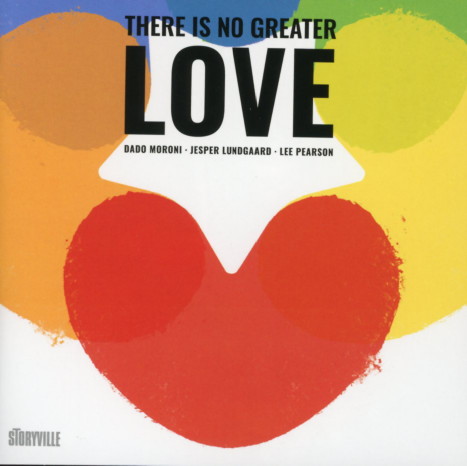
There is No Greater Love - Dado Moroni, Jesper Lundgaard and Lee Pearson

 © Copyright ® Steven Cerra, copyright protected; all rights reserved.


“[Billie] Holiday featured the composition at a Carnegie Hall concert, and over the next several years "There Is No Greater Love" occasionally appeared on bandstands and at studio sessions. But Miles Davis's recording of "There Is No Greater Love" from November 1955 and Sonny Rollins's version from his 1957 trio project Way Out West were more influential than any of these precedents in entrenching this piece in the set lists of modern jazz players.


The song is typically played at a relaxed medium tempo, but adapts easily to other pulses. The melody unfolds with a sense of pleasing inevitability — as is often the case with Isham Jones's compositions, which tend to avoid drama and surprising shifts, instead satisfying the ear with the natural, unaffected way the phrases connect to one another. This holistic quality to "There Is No Greater Love" also allows it to maintain its inner logic even when subjected to radical reworkings.”

- Ted Gioia - The Jazz Standards, A Guide to the Repertoire  [2012]


Every so often a new recording comes along that just unfolds in a rollicking, swinging manner that get my fingers poppin’ and toes tappin,’


Nothing complicated by way of repertoire: some selections from the Great American Songbook and a smattering of tunes that have become Jazz standards that have familiar melodies which make it easy for my ears to follow what’s being improvised over these structures.


Besides their well known melodies, whatever the tempo, each track is played with an insistent beat and creates a forward motion to the rhythm often referred to as Swing.


Also helpful is the fact that the recording was made in performance with an energetic and enthusiastic audience appreciatively urging the musicians along.


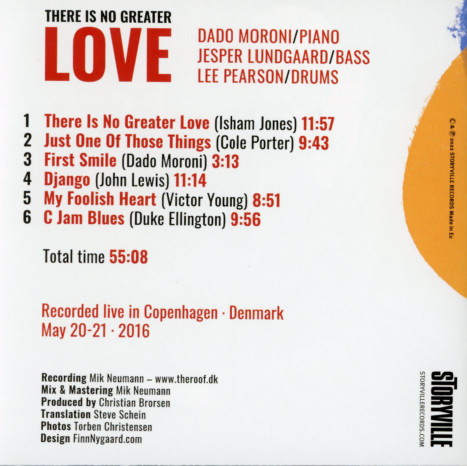
All of which comes together to make for the hour or so of satisfying music which can be found on the recently released Storyville CD There is No Greater Love [1018493].


Recorded live in Copenhagen at the famous jazzhus Montmartre on May 20-21, 2016 the recording features pianist Dado Moroni, bassist Jesper Lundgaard and drummer Lee Pearson.


Here’s more about how this fine recording came about from Christian Brorsen’s insert notes. Christian was the producer and jazzhus Montmartre’s Musical Director from 2011-2016.


“The story behind this recording had its starting point in a series of concerts in honor of Danish bassist Niels-Henning 0rsted Pedersen, who would have been 70 years old in May 2016. NH0P was a virtuoso who took bass playing to a new level, both technically and musically - the importance of which

cannot be overstated in the history of jazz. A crucial period in his career was his collaboration with Oscar Peterson, who admired NH0P for his colossal creative energy and ability to instantly turn any musical idea into reality.


Our challenge was to find musicians capable of captivating an audience with this same musical mastery, pushing music that swings like mad to the brink of what is possible. And Dado Moroni, Jesper Lundgaard and Lee Pearson do precisely that. Listening to this recording, it's hard to believe their total preparation time was a couple of hours on the day of the concert. No rehearsal. Not even a sound check, just three musicians who quickly found a natural compatibility, thanks to decades of training in the great American piano-trio tradition. 


Otherwise, the music speaks for itself. These are three equally gifted musicians who aren't shy about displaying their talent. The music flows effortlessly and is constantly creative - evidence that the band was definitely feeling good that evening. Many thanks to Dado, Jesper and Lee for (re)confirming that as a form of culture, jazz is absolutely alive and well. Also, a big thank-you to Mik Neumann for producing such a fine recording. It's almost like being there - again!


About the Musicians: Jesper Lundgaard (Denmark) was the natural choice as bassist for this trio. With his awesome technique, comprehensive overview and infallible rhythm, he has been a member of Tommy Flanagan, Duke Jordan and Horace Parian's trios, among others. 


A generation younger than Lundgaard, Lee Pearson (USA) was brought up by Hank Jones and Kenny Barron. With his energy and humor, he is capable of igniting any trio. (American drummers seem to have a special knack for this!) 


Pianist Dado Moroni (Italy) has played with NH0P, yet is by no means an Oscar Peterson clone. With his fertile creativity he has adapted elements of Peterson (and other American piano masters) to his own unique style and incorporated them into a "European" context. A spell-binding crowd-pleaser!


  • Christian Brorsen Producer and Jazzhus Montmartre's Musical Director - 2011-2016


We are also fortunate in being able to share with you some of the music from this recording so you can actually hear it rather than just read about it.


Monday, January 23, 2023

Blue Note - 10” BLP’s/Connoisseur Series CD’s [From the Archives]

 © -Steven Cerra, copyright protected; all rights reserved.


"The hardest thing about having a jazz label is that you never have enough money to pay yourself and you don’t have the reserves to grow your business. You take every cent that comes in and put it into pressing-plant money or making new records. There’s no time to sit down and think, or put money aside for anything.”
– Michael Cuscuna [Cook, Blue Note Records: The Biography, p. 186].

For fans of recorded Jazz, a wonderful thing happened in the late 1990’s when Michael Cuscuna – one of the founders and the current head of Mosaic Records – somehow managed to convince the powers-that-be at EMI/Capitol Records to issue a number of the early and largely obscure Blue Note 10” LP’s on compact disc.


Michael has had a life-long interest in Blue Note Records and its founders, Alfred Lion and Francis Wolff, and has been responsible for both producing music for the label in its current form, as well as, reissuing on CD many of the label’s most prestigious 12” LPs which largely includes those made from 1957 until July 1967 when its founder, Alfred Lion, stopped producing recording sessions [Alfred had sold Blue Note to Liberty Records in 1965].

Along with discographer Michael Ruppli, Michael is the author of a definitive listing of every Blue Note recording session in The Blue Note Label [London: Greenwood Press, Revised and Expanded Ed. 2001].


A narrative of the historical evolution of this now iconic label can be found in Richard Cook’s Blue Note Records: The Biography [London: Secker & Warburg, 2001] and on video [both VHS & DVD] in Julius Benedickt’s film: Blue Note: A Story of Modern Jazz.
 
In addition to the distinctive sound of its recordings made possible by Rudy van Gelder’s skills as a recording engineer and the fact that the music was recorded direct-to-disc, it’s unique album cover art is the subject of a fine retrospective by Graham Marsh, Felix Cromey and Glyn Callingham who served as the editors of Blue Note: The Album Cover Art [San Francisco: Chronicle Books, 1991].


Referred to as the Modern Jazz 5000 Series,” Blue Note issued seventy [70] ten-inch LPs before it switched to 1500 series twelve-inch LP’s in 1956.

Of course, the label had been around since 1939 when it issued its first recordings as 78 rpm’s from a series boogie woogie piano dates featuring Albert Ammons and Meade Lux Lewis.

Cook has this to say about the reasons why the label began to look past the 10” format:

“[Alfred] Lion badly needed some kind of hit. Although accurate sales figures for records in this period are difficult to come by, it seems likely that an initial sale of a typical ten-inch set might do no better than one or two thousand copies. After that, catalogue sales might put two or three on that, slowly, or it might not, which would account for the extreme scarcity of the more obscure Blue Note ten-inch pressings to this day. Like any small business that tries to expand in a competitive field, Blue Note needed one successful thing which would cover overheads in a way that would keep their heads above water while they continued to build their catalog.” [p.72]

The point Cook makes about “… the extreme scarcity of the more obscure Blue Note ten-inch pressings…” is all the more reason to celebrate Michael Cuscuna’s liberation of some of these 10” BLP’s to CD because it doesn’t get any more obscure than albums made under the leadership of baritone saxophonist Gil Melle’ and French horn player, Julius Watkins.

The format for these Blue Note digital re-issues was the “Limited Edition Connoisseur 10” Series” which advertised “Two LP’s on One CD.”

When I asked Michael about the rationale behind his choices for the series, he offered this explanation:

“Essentially I picked the 10" LPs that did not carry over into the 12" LP realm and therefore not into the CD realm as of yet. Some like the Herbie Nichols material had already made via the Mosaic and Blue Note boxes and the Elmo Hopes via a CD I did adding the Pacific Jazz material to the 2 BN 10"ers.. And the Lou Mecca never made it even with this effort because I could not find suitable material to put with it. I think that's the only one that didn't get taken care of (The Swinging Swedes, Cool Britons and Vogue material were licensed and there were no longer rights to those.).”

Not all of the artists featured on the Limited Edition Connoisseur 10” Series were little known: tenor saxophonist Frank Foster went on to enjoy a highly celebrated career with Count Basie’s band; pianist George Wallington recorded under his own name for the Prestige label during most of the 1950’s; guitarist Tal Farlow and trumpeter Howard McGhee appear on numerous recordings.

While none of the music on these recordings is earth-shatteringly original, most of it is “easy-on-the-ears,” very well-played and excellently arranged; all of which were characteristically similar to a style of Jazz then contemporaneous on the West Coast.

Although the Limited Edition Connoisseur 10” Series has been discontinued, used copies can still be found and some of these albums have been issued as individual Blue Note CDs.

Also in the late 1990’s, Michael spearheaded the limited release of a number of “West Coast Jazz Classics” and these will be the subject of a future JazzProfiles feature.

Michael Cuscuna is still producing Jazz records and you can visit him at www.mosaicrecords.com/.