Wednesday, March 22, 2023

Nordic Bop - Pekka Pylkkanen and Eric Ineke

 © Copyright ® Steven Cerra, copyright protected; all rights reserved.
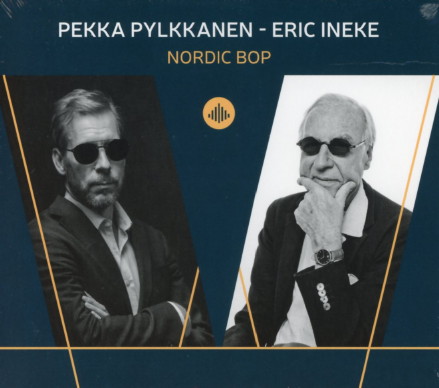


NORDIC BOP

“I am very happy that after all these years we finally have this album finished! We had a great time recording the music (and even now, when working on finalizing it). I'm looking forward to playing with you all again, hopefully in the very near future! I will let Eric tell the story of this album....”

- Pekka Pylkkanen


In 1962, thanks to the efforts of producers Bob Prince and George Avakian, baritone saxophonist Gerry Mulligan and alto saxophonist Paul Desmond recorded an album entitled Two of a Mind for RCA Victor.


The title came to mind [pun intended] with the arrival from drummer Eric Ineke of the Nordic Bop [Challenge CR73542] CD which he recently recorded in Finland with saxophonist Pekka Pylkkanen. On it, Eric and Pekka are joined by pianist Mikael Jacobsson and bassist Heikko Remmel.


“Two of a Mind” is a germane phrase to describe the relationship between Eric and me, not only because we both play drums, but also because we have a deep and abiding interest in the music generally characterized as Bebop. 


Perhaps a more accurate description of the style of Jazz we share a passion for might be straight-ahead Jazz which is supported by a no-nonsense, always swinging, driving beat.


It’s the music we both grew up listening to and it has influenced the way we approach playing drums.  And I daresay, besides his talent as a drummer, it’s another reason why Eric is in such great demand both as a teacher and as a player throughout Europe with younger musicians who want to experience playing Jazz with this kind of time feel.


The heart of it from a drumming perspective is setting down or, if you will, laying down a groove on the ride cymbal which is heavily accented by the hi-hat and creating a driving swing behind the soloist. The emphasis here is accompaniment and not playing a parallel solo behind the horn soloist by keeping up a constant barrage of rhythmic figures all over the drum kit [think Tony Williams and Elvin Jones; not stated in a disrespectful manner].


The straight-ahead time feel can be punctuated with occasionally sticking on the snare drum and/or with bass drum accents, but the point of it all is backing up and supporting the soloist and, where necessary, adding color to the sound of the music with percussion effects.


Having learned his craft by studying the masters such as Kenny Clarke, Max Roach, Art Blakey and Philly Joe Jones, Eric has gone on to become the living embodiment of this approach to Jazz drumming and is constantly in demand in his native Holland throughout Europe as a practitioner of this form of the Jazz drummer’s art.


Since Eric knows I have a predisposition to his preferences he is generous in sharing with me recordings on which he performs that feature like-minded musicians.


Which brings me to Pekka Pylkkanen and Nordic Bop. It arrived a couple of weeks ago and has been on my CD player ever since.


The idea for the recording, the tracks which comprise it and the background of the composers are all spelled out in Eric’s insert notes which are shared below.


But before directing your attention to them, I thought I would share my impressions of the music and the musicians that make up this very fine album.


What initially struck me upon hearing Pekka for the first time is the full searing tone he gets on alto saxophone and the marvelous facility he has that enables him to really get around the instrument. Wails, moans, and cries are all part of his expressive presentation - it’s a sound that is at once rich and penetrating - it reaches you with its fullness.


It’s interesting that the CD should open with alto saxophonist Gigi Gryce’s Nica's Tempo because in some ways Pekka’s orientation on the instrument brings to mind Gigi’s: both are hard-driving, no-nonsense players with a legacy on the instrument that is straight out of Charlie Parker.


And just when you thought you had a handle of Pekka’s approach, he pulls out his soprano sax and completely surprises you with a totally different orientation characterized by a big, wide sound, a hint of a vibrato, and complex harmonics from Coltrane but yet somehow sounding original to him because of the way he puts them together. This all comes forth so beautifully in Pekka's treatment of the Bill Evans classic waltz, Very Early. One could almost wish that his soprano sax interpretation of Denny Zeitlin’s Quiet Now were also on the recording.


And speaking of accompaniment, for one so young, pianist Mikael Jacobsson does a superior job of supporting the soloist with minimal chordal intrusions. During his own solos he rides the rhythm section, leaving lots of space allowing the piano to resonate. His intervallic approach enables him to play more modern sounding improvisations over traditional bebop lines.


Bassist Heikko Remmel is a rock; you never have to “look” for the time, all you have to do is listen to him and there it is encased in a big, booming bass sound. Eric’s unobtrusive style of playing allows the bass to really come through on this recording and it “locks in” nicely to generate a wonderfully “alive” time feel by the rhythm section.


And then, of course, there is Eric holding it all together and pushing things forward in his unrelenting but always tasteful manner. His drums sound wonderful, full of the snap and crackle very reminiscent of the great Roy Haynes and cymbals with pronounced stick clicks that create the propulsive swing that is so characteristic of his drumming.


Everything about this recording merits your attention from the interesting selection of tunes, the intense, yet well-paced improvisations, and the classic, straightforward sense of swing that encapsulates the music and provides it with an energetic drive.
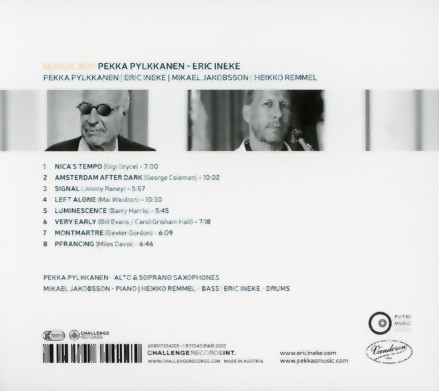


More about the players and the music are contained in the following insert notes by Eric.


“When Pekka Pylkkanen invited me in 2017 to play a couple of concerts with him in Finland and Estonia, I immediately responded with an enthusiastic YES!! Having played together before, I knew the music would be great and swinging! On piano, we had the pleasure of having the wonderful and hard-swinging piano player Mikael Jakobsson from Finland and the young and very talented bass player Heikko Remmel from Tallinn, Estonia.


Pekka got the idea of putting together a repertoire of tunes written by some of the great Jazz legends I played with during my earlier career. During the concerts, we all felt that it worked out really well and that we should at least put some of the repertoire in the can for the right moment to release it on CD.


Well, that moment came five years later. Recorded in this beautiful studio of the Sibelius Academy of the University of the Arts in Helsinki; a real straight-ahead swinging Jazz album finally saw the light. I have a close connection with at least five of the tunes, because I toured in the past with their composers.


'Amsterdam after Dark' is written by the legendary tenor saxophonist George Coleman. I had the pleasure of playing with him for a week in 1974, together with Rob Agerbeek and Rob Langereis, and it was an incredible experience: George was at the top of his game every night. Luckily one of the concerts was recorded and got released years later, on the Blue Jack Label.


'Luminescence' brought me back to the eminent professor of Bop, Mr. Barry Harris. For more than 15 years I backed him up when he came to teach (always for a week) at the Royal Conservatoire of The Hague. One of those concerts was recorded and also released on CD. I have great memories of working with him when we played for a week in St Petersburg in Russia during the White Nights Festival in 2007. Playing with Barry was a true education in Bebop!


'Left Alone' was written by pianist Mai Waldron whom I played with at a festival in Belgium in the nineties with the Ben van den Dungen/Jarmo Hoogendijk Quintet. This very quiet man and profound musician, combined with this furious Hard Bop quintet was an unforgettable experience.


'Montmarte', written by the great Dexter Gordon, brings back to me one of the best experiences of my whole career. In 1972 I got a call from promoter Wim Wigt to go on an almost 3 months tour with this legendary giant together with the Rein de Graaff Trio. I was 25 years old and it was at that moment that I entered the University of Hard Bop!


'Signal' is a very hip and modern-sounding tune written by the legendary and impeccable guitar player Jimmy Raney. He recorded that tune in 1951 with Stan Getz at Storyville in Boston. That recording became a landmark and is still one of my all-time favorite albums! I was thrilled when I received a request from the producer Gerry Teekens in 1977 to play a radio concert in Lausanne with Jimmy and his son Doug Raney. They were on tour, and Jimmy had a serious argument with his drummer back then, whom Jimmy ended up firing, so I was in. 


From the first note we played at the soundcheck, Jimmy gave me a look and smiled at me, and after the concert he told me he really liked my playing very much. That led me to do all his tours in Europe for the 3 consecutive years, as well as the first recording for Criss Cross Records in 1981 (called 'Raney 81’) with his son Doug and the great Danish bass player Jesper Lundgaard. All those great moments with these legendary giants are with me all the time, and I am very happy and thankful that Pekka took this initiative to get this wonderful project together!

Enjoy!”

Eric Ineke


Thursday, March 16, 2023

Saxophone Colossus: The Life and Music of Sonny Rollins by Aidan Levy

 © Copyright ® Steven Cerra, copyright protected; all rights reserved.


"Precise and ravishing descriptions of Rollins' music, 'tireless work ethic,' inspirations, frustrations with the record industry, social and environmental activism, and surprising collaborations." 

—Booklist, starred review


"Meticulously researched... (The] definitive account of a jazz icon." 

—Krkus


"An incredibly deep, well-researched and thoughtfully written biography." —DownBeat


"Aidan Levy's indefatigable research and interviewing process has allowed him to fill Saxophone Colossus with a vast chorus of voices." 

—The Wire


"Sonny Rollins told stories through his horn.  His 'telling,' no matter how intricate or elaborate, was always pure, honest, and vulnerable, while the storyteller himself remained elusive and intangible.  Until now.  In Aidan Levy, Mr. Rollins has found his chronicler, an immensely talented writer whose lyricism, mastery, and dedication to truth matches that of his subject. The result is an opera, a calypso, a magnificent symphony that captures All of Him: Sonny, Newk, Theodore, Wally, Brung Biji, and the one

and only Saxophone Colossus." 

—Robin D. G. Kelley, Thelonious Monk: The Life and Times of an American Original


"Sonny Rollins is the most acclaimed and celebrated jazz musician alive. His fearless creativity and willingness to test his limits are the stuff of legends, as are his modesty, discipline and self-criticism. With deep research and meticulous documentation, Levy, with the aid of Rollins, gives us a revelatory and richer picture of the man and his era. A colossus of a book."

—John Szwed, author of Space Is the Place: The Lives and Times of Sun Ra and So What: The Life of Miles Davis


"In this forensically researched biography of an American hero, the elusive Sonny Rollins stands revealed not only as the great Jazz Maker but a man of profundity and passions. By combining the story of his rise as a Saxophone Colossus with a picture of the Black artist in an age when social progress was not necessarily a given, Levy has produced a memorable book." 

— Val Wilmer, author of As Serious As Your Life: Black Music and the Free Jazz Revolution, 1957-1977


"Aidan Levy has provided the jazz world and beyond an important documentation of one of the greatest musicians of all time. Sonny Rollins spoke his own language through the saxophone—just check out his solo on

'Alfie’! And Saxophone Colossus provides for us in words a portal to deeper understanding of this legendary jazz giant!" 

- Terri Lyne Carrington, Grammy-winning drummer, producer, and composer


It’s almost impossible to overstate the importance of Aidan Levy’s Saxophone Colossus: The Life and Music of Sonny Rollins [New York: Hachette Books, 2022] to the body of Jazz Literature that focuses on the music and its makers, especially in the second half of the 20th century.


The scope and depth of Levy’s work are impressive as every facet of Sonny’s career is examined and well-documented.


As stated in the media release accompanying the book: “His colossal seven-decade career has been well-documented, but the backstage life of the man once called “the only Jazz recluse” has gone largely untold - until now.”


But whether it the familiar milestones of Sonny’s career in terms of the iconic recordings and his significant associations with Jazz luminaries, or his involvement in the civil rights movement, all of which are fully described and discussed, what is especially appealing to the reader is getting to know Sonny Rollins, the man, as well as, the musician.


Context and character unfold in such a way as to bring the human dimensions of Rollins as a performing Jazz artist into clearer focus. The hyperbole, myth and hagiography usually associated with him are pushed aside and what made up the special genius that is Sonny Rollins is revealed.


Here’s more from the media release that accompanied the book.


The long-awaited first full biography of legendary jazz saxophonist and composer Sonny Rollins, chronicling the gripping story of a freedom fighter and spiritual seeker whose life has been as much of a thematic improvisation as his music.


Known as the "Saxophone Colossus," Sonny Rollins is widely considered the greatest living jazz improviser, having won Grammys, the Austrian Cross of Honor, Sweden's Polar Music Prize and a National Medal of Arts from President Barack Obama. He is one of our last links to the golden age of jazz — one of only two remaining musicians pictured in the iconic "Great Day in Harlem" portrait. His colossal seven-decade career has been well documented, but the backstage life of the man once called "the only jazz recluse" has gone largely untold — until now.


Based on more than 200 interviews with Rollins himself, family members, friends, and collaborators, as well as Rollins' extensive personal archive, SAXOPHONE COLOSSUS: The Life and Music of Sonny Rollins (Hachette Books; 12/6/22; S.35; ISBN: 9780306902796) is the comprehensive portrait of this living legend, tireless civil rights activist and environmentalist. 


A child of the Harlem Renaissance, Rollins' precocious talent quickly landed him on the bandstand and in the recording studio with Bud Powell, Thelonious Monk, Charlie Parker, Miles Davis and Diz/y Gillespie, or playing opposite Billie Holiday. He became an icon in his own right, recording fifteen albums as a leader in a staggering three-year span, including Tenor Madness, featuring John Coltrane; Way Out West, which established the pianoless trio; Freedom Suite, the first civil rights-themed album of the hard bop era; A Night at the Village Vanguard, which put the storied jazz venue on the map; and the 1956 classic Saxophone Colossus. With access to unreleased outtakes and hundreds of live tapes dating back to 1950, biographer Aldan Levy takes us into the studio and backstage at pivotal moments throughout jazz history.


In SAXOPHONE COLOSSUS, readers will discover:

•      Interviews with Rollins himself as well as family, friends, and collaborators

•      Rollins' relationships with a veritable who's who of jazz, including Thelonious Monk, Charlie Parker, Miles Davis, Billie Holiday, John Coltrane, Clifford Brown, Max Roach, Betty Carter, and Dizzy Gillespie

•      The making of iconic albums such as Tenor Madness, Freedom Suite, Saxophone Colossus, among others

•      Rollins' harrowing ordeal in the criminal justice system and how he beat his addiction

•      How he used jazz to advance the civil rights movement and promote environmental consciousness


And much, much more...


Aidan Levy is the author of Dirty Blvd: The Life and Music of Lou Reed and editor of Patti Smith on Patti Smith: Interviews and Encounters. A former Leon Levy Center for Biography Fellow, his writing has appeared in The New York Times, The Village Voice, JazzTimes, The Nation and other publications.


You can locate order information by going here.


Wednesday, March 8, 2023

Stu Williamson: A Trumpet Artist [From the Archives]

 © -  Steven A. Cerra, copyright protected; all rights reserved.


A close friend and Jazz buff asked me recently: “When are you going to do a profile on Stu Williamson?”

What a great idea!

But where to begin?

There is hardly anything written about Stu Williamson in the Jazz literature.

After playing a significant role in the 1950s with Stan Kenton’s Orchestra, Howard Rumsey’s Lighthouse Café All-Stars, drummer Shelly Manne’s Quintet and vibraphonist Terry Gibbs’s Dream Band, Stu Williamson seemingly disappeared from the Jazz scene.

During this time, Stu had also recorded with Woody Herman, the Mel Lewis-Pepper Adams Quintet, alto saxophonist Lennie Niehaus’ various groups and pianist Elmo Hope’s quintet, yet, the extent of most of the evaluations about him seem to begin and end in one word – “underrated.”

This about a guy whom Shelly Manne was described as: “A wonderful trumpeter and valve trombonist and an excellent all-round musician. He reads well; he has good time; and a good sound.”

We should all be so lucky!

I mean, what else could a musician put on offer?

I heard Stu play in performance on numerous occasions and he always gassed me.

He had a beautiful, rich, round tone, the ability to create solos that were melodic and full of invention, and enough power and clarity of sound to even play lead in a big band trumpet section every so often [not something that is very common for the trumpet player who holds down the solo chair as Stu often did].


His stint as a member of Shelly Manne & His Men [1954-58] was one of Stu’s more enduing associations. Thankfully his work with Shelly’s group is reflected on three albums for Contemporary Records, all of which have been reissued as CD’s on Original Jazz Classics: [1] Swinging Sounds – Shelly Manne and His Men, Vol. 4 [OJCCD-267-2], [2] Swinging Sounds – Shelly Manne and His Men, Vol. 5 [OJCCD-320-2] and [3] The Gambit: Shelly Manne and His Men, Vol. 7 [OJCCD-1007-2].  

There is also a great compilation of Stu’s recordings that were made under his own name for the Bethlehem label which Fresh Sound has reissued on CD as Stu Williamson Plays [FSR-CD 116].

The title of the Fresh Sound disc says it all: Stu Williamson does indeed – play! – and in such a variety of compositional contexts on these recordings that one truly gains the opportunity to hear and to appreciate his gifts as a trumpeter and valve trombonist.

And what a great series of original compositions by Bill Holman, Johnny Mandel, by his Shelly bandmates – alto saxophonist Charlie Mariano and pianist Russ Freeman – and by legendary guys like Charlie Parker and Sonny Rollins.

Stu never “mails it in” [i.e.: gets lazy]. He’s always working; always playing with a ringing clear tone; always getting the dynamics, just right.  Like the true professional that he was, Williamson paid attention to the smallest detail when playing a composition and does justice to all of them. His consistency of interpretation was remarkable as were his solos with their masterful phrasing and interesting ideas.

It seems that Stu gravitated to the studios in the 1960s along with many other Jazz musicians and ultimately dropped out of music by the end of that decade.

Ours is not to speculate, but whatever the reasons for Stu’s departure from music may have been, I am certainly pleased that he left such a bountiful recorded legacy of his work from the 1950s.

I’ll bet my Jazz buddy is, too.


Monday, March 6, 2023

Guido Basso Obituary by Gordon Jack

 © Copyright ® Steven Cerra, copyright protected; all rights reserved.


“Sometimes great technicians are not warm players. Guido Basso is an outstanding exception.”

- Gene Lees

Gordon Jack is a frequent contributor to the Jazz Journal and a very generous friend in allowing JazzProfiles to re-publish his perceptive and well-researched writings on various topics about Jazz and its makers.


Gordon is the author of Fifties Jazz Talk An Oral Retrospective and he also developed the Gerry Mulligan discography in Raymond Horricks’ book Gerry Mulligan’s Ark.


The following article was published in the February 20, 2023 edition of Jazz Journal. 


For more information and subscriptions please visit www.jazzjournal.co.uk                 


© -Gordon Jack/JazzJournal, copyright protected; all rights reserved; used with the author’s permission.


“Guido Basso was born into an Italian-Canadian family in Montreal, Quebec on 27 September 1937. Beginning at the age of nine he eventually became a child prodigy on the trumpet after studying at the Conservatoire de Musique de Montréal. Vic Damone heard him when he was working with Maury Kaye’s dance band at Toronto’s El Morocco. Thoroughly impressed, he took him on the road with him in 1957/58. He then joined Pearl Bailey and Louie Bellson’s band for an extensive North American tour including recording with them at the Flamingo, Las Vegas. Some of his fellow-sidemen included Juan Tizol, Earl Swope, Herb Geller, Aaron Sachs and Big Nick Nicholas.


In 1960 he settled in Toronto becoming a first-call studio musician on trumpet and flugelhorn. He once said, “You attack the trumpet and make love to the flugelhorn”. He was the musical director for two CBC TV series - Night Cap (1963/67) and Barris And Company (1968/69). In 1969 he co-starred with Peter Appleyard on Mallets & Brass. He also led big bands for CBC’s In The Mood (1971/72) and Bandwagon (1972/73). Beginning in 1975 he organised concerts at Toronto’s Canadian National Exhibition featuring visiting luminaries Like Dizzy Gillespie, Quincy Jones, Woody Herman, Count Basie and Duke Ellington. He also formed a small group with Rob McConnell and Ed Bickert to work in local venues like George’s Spaghetti House and the First Floor club. Equally at home in the jazz, pop and classical fields he went on to become an in-demand session musician playing on more than two hundred albums. He once told Bill King in an interview, “I wanted to be a jazz musician but a better lifestyle won out. I have to be able to afford it to play jazz”.


In 1968 he became one of the galaxy of stars recruited by Rob McConnell for his well-named Boss Brass. Until his last session with the band in 1998 he recorded no less than twenty-nine albums including dates with the HI-Los (1978), Singers Unlimited (1980), Phil Woods (1985) and Mel Torme’ (1986). The McConnell band won three Grammy awards over the years.  Each album is replete with Guido Basso solos and tracks like ‘Greenhouse’, ‘Just One Of Those Things’, ‘Jobim Medley’ ‘The Back Beat’, ‘Love Of My Life’, ‘A Child Is Born’, ‘Sophisticated Lady’ and ‘Close Enough For Love’ are fine examples of his work with the Boss Brass. One of his most outstanding performances with McConnell is ‘Portrait Of Jenny’ from the 1976 Jazz Album which is available on Youtube. He is centre stage for the eight minute duration in an intimate statement of subtlety and lyricism. He can also be heard soloing on two McConnell Tentet CDs: ‘Lush Life’ from the 2000 Just In Time album and ‘Thou Swell’, ‘Always’ and ‘Indian Summer’ from the 2002 Music Of The Twenties CD. ‘Indian Summer’ includes a tribute to the Gil Evans 1958 ‘Summertime’ arrangement and McConnell’s sleeve-note said, “Guido did a killer imitation of Miles”. His Harmon [mute] which he rarely used really clinches it here. After he left the Boss Brass he worked in local clubs and hotels with his own small groups featuring a mix of Jazz and Latin American Music. His final recording was Solstice/Equinox in 2016 with vocalist Diana Panton.


He became a member of the Order of Canada in 1994. The citation said, “He is an advocate of the arts and an inspiration to young musicians. He is generous with his time and talent running workshops and clinics, lending his name and expertise to worthy causes”. As a pillar of the jazz community he received a number of awards over the years: in 2012 he was inducted into the Canadian Music Hall of Fame; in 2016 he received the prestigious Oscar Peterson Award from the Montreal International Jazz Festival; the Canadian Academy of Recording Arts & Sciences awarded him a Juno for his 2003 Turn Out The Stars and another for his 2004 Lost In The Stars albums.


Guido Basso died from natural causes on 13 February 2023. He is survived by Kristin, his wife.  His daughter Mia Basso Noble pre-deceased him in 2013."


Thursday, March 2, 2023

J.J. Johnson Quintet featuring Bobby Jaspar [From the Archives}

 © -  Steven A. Cerra, copyright protected; all rights reserved.


Bobby Jaspar's playing on these recordings is a revelation. Hardly anyone seems to know about these sides. Everyone is familiar with the quintet that J.J. and Kai Winding formed and the sextet that J.J. had with Freddie Hubbard, Clifford Jordan, and Cedar Walton, but these LPs seem to have dropped from sight. J.J.'s arranging skills are on full display and Jaspar gets a rich tone on the flute in addition to displaying a Zoot-like facility on tenor sax. Hank Jones and Tommy Flanagan are their light and lyrical selves and Elvin Jones' playing displays variety and a driving beat instead of the never ending triplets he played behind 'Trane. Wilbur Little’s strong bass lines hold it all together and provide a driving pulse for the band.


JJ. Johnson's great 1956-1957 quintet played modem jazz with authority, imagination, taste and feeling. Its leader was the trombonist of the era, much emulated and admired by his peers. The Belgian-born Jaspar, who had recently won the International Jazz Critics' New Star Award on tenor, proved an ideal foil and a capable modern-mainstream tenor sax and flutist, contributing impressively on both instruments. Flanagan, a superbly swinging pianist, also made an indelible mark on the group, which was graced initially with another bop piano great, Hank Jones, while Little and Elvin Jones' support throughout is admirable. It was an exhilarating band that fully displayed Johnson's well-rounded musicianship.


Fortunately, all of these LPs have been collected on a double CD set and issued as The Complete Recordings of the J.J. Johnson Quintet Featuring Bobby Jaspar. [Fresh Sound FSR CD-538].


JAY JAY JOHNSON QUINTET: JJ. Johnson, trombone; Bobby Jaspar, tenor sax & flute; Hank Jones [on CD 1 #1-7] or Tommy Flanagan [on CD 1 #8-15 & CD 2], piano; Percy Heath [on CD 1 # 1-3] or Wilbur Little [on CD 1 #4-15 & CD 21, bass; Elvin Jones, drums.
Recorded (CD1) in New York, July 24 (#1-3), July 25 (#4-7), July 27 (#8-10), 1956 and January 29 (#11-15), 1957.
Recorded (CD2) in New York, January 31 (#1-4), May 14 (#5- 7), and Live "Cafe Bohemia" New York, February, 1957. 


More details about this exceptional band and these recordings are available in the following original liner notes.


Origina! liner notes from Columbia CL935 - J Is For Jazz


“J. J. Johnson, considered by many to be the originator and leading exponent of the modern jazz trombone style, has until recently been the co-leader, with the extraordinary Kai Winding, of a quintet featuring two trombones with rhythm section. Their work together on Columbia, with their quintet (CL T42) and with a trombone octet (CL 892), is one of the highlights of the Columbia jazz catalog, but is also of a kind which has proven popular with the public at large. The same bids fair to be true with the groups they have just formed independently of one another.


The J. J. Johnson Quintet makes one change in instrumentation, but it is an important one. In Kai's old spot, one finds Bobby Jaspar, tenor saxophonist and flutist extraordinary. Bobby, while new to the American scene, is well known in Europe. As Belgium's leading jazzman, Bobby won critics' awards and public acclaim all over the continent for his fine contemporary-style playing. Now a permanent resident of the United States, this is his debut before the American public. His appearance in this album is by special arrangement with the company for which he records exclusively - Pathe-Marconi, subsidiary of Electrical and Mechanical Industries, Ltd. [EMI or the forerunner of the company that would come to own the iconic Blue Note Records label.]


As these recordings were made on the eve of J J's launching of his new Quintet, it was impossible to line up the same rhythm section for each session. The changes of personnel are as follows: for Angel Eyes, Overdrive, and Undecided, Hank Jones played piano and Percy Heath played bass. On Tumbleweeds, Solar, Never Let Me Go, and Cube Steak, Wilbur Little replaced Heath. The remaining tunes were made with Tommy Flanagan in place of Hank Jones. The drummer throughout was Elvin Jones, Hank's brother.


All the arrangements in this set are by J. J, himself. As usual, he has chosen a repertoire which is anything but overdone, and he has also written three originals. Naptown U.S.A. commemorates his home town of Indianapolis; astute ferreting by the musically minded will also turn up another reason for this association. J. J. can't explain why Indianapolis is known locally as "Naptown," but this Johnson original is anything but sleepy. It Might as Well Be Spring and Never Let Me Go are lovely ballads which gave Bobby Jaspar an opportunity to blend his rich flute tone with J. J.'s trombone; obviously this combination gives the Quintet a distinctive "second round."


Tumbling Tumbleweed is an unexpected vehicle for a jazz group; J. J. explains that the idea occurred to him when he heard a trio in Chicago give it a swinging treatment once, and he has finally had an opportunity to try it out himself, with the fine results which can be heard here, Matt Dennis' Angel Eyes makes a fine dead-slow ballad for the group, and equally tailor-made in a different vein are two bouncy originals from the bop school. Miles Davis' Solar and Charlie Parker's Chasin’ the Bird. Overdrive and Cube Steak are two up-tempo compositions by J. J. which are written especially for this group."                                                    —George Avakian


Original liner notes from Columbia CL1684 Dial JJ5


“Underlying all of J. J. Johnson's musical efforts and reaching a new maturity in the work of his Quintet, is a considerable erudition in jazz forms. But he carries his learning lightly and does not bore us with an archeological study of the dry bones of technique. By the time he puts the show on the road, the ankle bone is connected to the shin bone and the shin bone to the knee bone — and in the aliveness of the music, sometimes jaunty, sometimes serious, you can, if you wish, forget anatomy lessons. Nevertheless, let's review them briefly, for the record.


As Jay's talent matures, and that of the Quintet with it, the parallel of devices used to those employed by small orchestral groups generally, becomes apparent and we see how he has gradually enlarged the area of his musical interests and, in the process, improved upon his superlative craftsmanship, Like the playing of the Modern Jazz Quartet, that of the Quintet recalls a period in concert music, some three centuries ago, when improvisation was commonplace.


All of this began, for Jay, in Indianapolis, Indiana, where he was born on January 22,1924, the oldest of three children (given name, James Louis Johnson). Beginning at about the age of nine, he studied piano for two years with a private teacher, the organist of the church the family attended. His two sisters also studied piano and they often practiced trios and duets together. An interest in jazz was stimulated by teen-age friends, his "buddies" at Crispus Attucks High School in 1937.

"Every Saturday night," said J. J., "my friends and I went to the local dance hall to watch and hear the big bands — Lunceford, Basie, Ellington, Hampton — these were our favorites and we worshipped them. It was then I realized that this would be my life's work." Following that momentous decision, he joined the high school band for beginners. He wanted to play saxophone but the only one available for practice was a baritone, which was not his first choice. Although he studied saxophone, he soon became attracted to trombone and, as he explains it, "My interest and curiosity about the trombone began to increase to the point that I gave up my saxophone studies (1938)."


His father got him a trombone from a pawn-shop and Jay learned to play it in the high school band and orchestra. On Sundays he rehearsed with the YMCA band, playing marches and light concert music. Eventually, his friends at Crispus Attucks — who had formed a small dance orchestra —- invited him to sit in at rehearsals and soon after this he became a regular member of the band, playing for school dances and neighborhood social events. By that time, he recalled, "I had also become interested in arranging and composing, and began to learn both."


When Jay graduated from Crispus Attucks High School in 1941 his parents, understandably, wanted him to go to college. Jay understandably, wanted to join a big band and travel. Well, you can guess the outcome — Jay won them over and joined the ''territory" band led by "Snookum" Russell.


Cool, in its most popular meaning, refers to a tendency towards understatement that one often finds in modern jazz and, in some instances to an extension of bop harmonic innovation in search of bland and cool sounds. Like any other kind of jazz, it can be good or God- awful. (Those in search of further enlightenment might bone up on the role of the trombone in Feather's "The Book of Jazz," a Horizon Press book of this year.) Both periods are now history, the styles having been to some extent assimilated. 

The use of linear rhythmic patterns has perhaps helped to encourage a return to blues intonation (including the use of rich sonorities) though with less use of vibrato, and with various shades of timbre such as funky and hard bop. (The latter refers also to structure.)


As space allows, I'll indicate some of the interesting sounds provided in this album: Teapot In this tempest in a teapot, Jay's terse broken-off phrasing becomes a sort of abrupt angularity that contrasts to his sinuous legato line or, as later in the piece, to the burgeoning of tone when he is blowing and swinging that is the very birth of jazz sound. In Bobby's clipped chorus (on tenor) he demonstrates how to hold a tiger. Tommy Flanagan, who can approach the keyboard with the full power of both hands (as on So Sorry Please) concentrates on treble to make room for the bass of Wilbur Little, moving with such dexterity that, with the drums of Elvin Jones, it seems to cushion the music, This thoroughly satisfying composition concludes with the two horns playing in a dark, almost somber tonality.


Barbados There is an amusingly disciplined use of Latin-American rhythms, followed by rich sonorities as the horns state the theme of this Charlie Parker composition, Jay's chorus has an easy, deftly athletic quality. On this, in contrast to the previous cut, Bobby's tone, though not rough, has more English on it; it is at once lyrical and strong in definition. Tommy, a cool cat, gets off the ground.


In A Little Provincial Town. This quiet mood piece has an almost classical loveliness, especially in the flute chorus, with its delicately interwoven harmonies (and what sounds like deliberate over-blowing, not a casual accomplishment) — and in the subdued, muted trombone.


Cette Chose. Opens with clipped, cool ensemble Jay, playing superbly, sets the scene for Bobby, parts of whose tenor chorus, were it not for the inspiration driving it, would fall into the category of expertising. Melodically it is understatement, conveyed with a controlled intensity of rhythm. In this chorus Bobby — who has considerable versatility of approach — seems to throw lines away. He is like a veteran actor laying booby traps for the ears and, like the veteran actor, he always knows the complete statement. On the chorus that climaxes the time, his tenor jumps like a pneumatic drill on a hot dig.


Blue Haze. This lovely melody by Miles Davis has an unusual and appropriate rhythm introduction. A thoughtful, beautifully-phrased statement by string bass is climaxed by a shattering drum roll, followed by a cymbal rhythm to which the piano adds its voice. Once the introduction is over, the featured instrument (which I described in my notes for "J and K") makes its entry. In his playing of it [valve trombone] Jay, in the quality of his intonation, combines the dignity of concert brass with the guttiness of honky-tonk horn. His fantastic technique on this valve instrument, which enables him to raise it to the dignity of a respected member of the brass family, never is allowed to overshadow his strong sense of music and of melody. Bobby's phrasing on tenor, always assured, is especially enjoyable, and Tommy's piano has a restrained jump.


Love Is Here To Stay. Few jazzmen can touch J. J. in the imaginative lyricism of his swinging: balladry. An old master at this form of the jazz maker's art, he demonstrates it with a long, luxurious chorus, in a warm intonation, that displays the scope of his improvisational talent.


So Sorry Please. Naturally, there are other things to hear, but let's single out the piano for mention. Tommy opens with a full-bodied, two-fisted solo and then, as he assigns the heavy work to the right hand, is paced by Wilbur's articulate bass (in a walking mood) — then there is a return to full piano style in this, a most welcome and generous introduction to the work of Tommy Flanagan.


It Could Happen To You. The introductory flute passages are classic, delicately wrought, as Bobby opens in concert style, then gets off on a winsome jazz frolic. Perhaps indicative of the authority of contemporary jazz technique, there is no hiatus between the two.


Bird Song. This tune is by Thad, one of the Jones boys from Pontiac and Elvin's brother, From the rich sonorities that open it, to the closing bars, there is structural strength and compositional directness. Like Tea Pot, it is a first-rate jazz piece. Toward the close of the exuberant performance Jay plays a quietly explosive chorus, conveyed in an easy, gently deceptive swing. On first listening it sounds like a walk in the park, on second, like a romp and, finally, like a controlled rumpus!


Old Devil Moon. Introductory bars are played in a modified Latin rhythm and in its jingle-jangle (that recalls old fashioned jazz hokum) cymbal comes off its high-hat, so to speak. There follow one of J. J's warm, utterly convincing solos in balladry and a tenor chorus by Bobby that displays a richness of timbre that seems just right for this piece,


This album is another milestone for J. J,, revealing his seriousness, his emotional warmth and his subtle wit and restrained exuberance. He knows the trombone backwards, forwards and inside out and the more one listens to the unobtrusive manner in which he employs a formidable craftsmanship to delineate an improvisation or a variation on theme, the more it grows on one, especially as it is reinforced with an extraordinary beauty of tone and, when occasion calls for it, a quietly sly sense of humor.”                                  -—Charles Edward Smith


Produced for CD release by Jordi Pujol this compilation © & © 2009 by 
Fresh Sound Records.