Showing posts with label eric ineke. Show all posts

Tuesday, January 7, 2025

Swing Street - The Eric Ineke JazzXpress featuring Tineke Postma

 © Copyright ® Steven Cerra, copyright protected; all rights reserved.
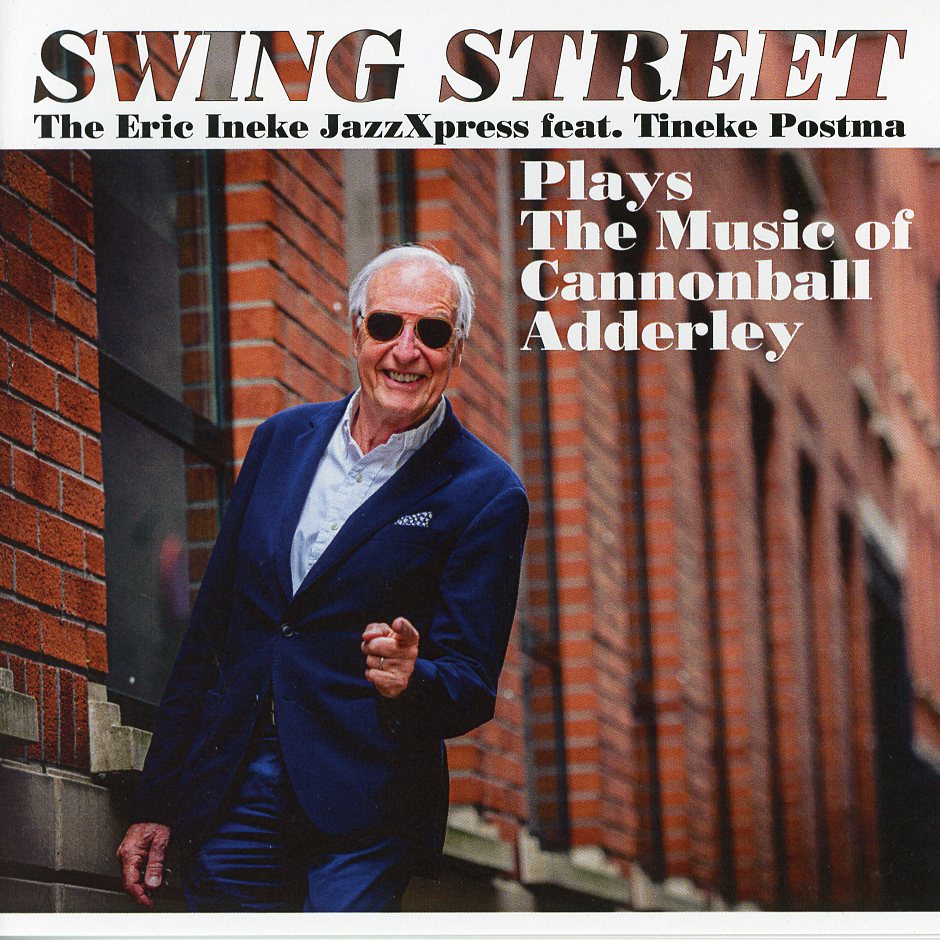

For those of you who like your Jazz served up in a straight-ahead, hard-bop style, then a musical feast celebrating this genre is on hand for you in Swing Street - The Eric Ineke JazzXpress featuring Tineke Postma [Timeless Records CDSJP 495].


For this recording, Eric’s JazzXpress, which turns 20 next year, has added the soprano and alto saxophone talents of Tineke Postma to perform a repertoire of music closely associated with the Cannonball Adderley quintet and sextet of the 1950s and 60s.


In addition to the superb soloing - Eric always leaves plenty of room on his recordings for his players to stretch out - each tune is masterfully arranged to give them a freshness and allow the band to put its own stamp on the material.


While the rhythm section of pianist Rob van Bavel, bassist Marius Beets and Eric on drums have been a part of the group from its inception along with tenor saxophonist Sjoerd Dijkhuizen, trumpeter Nico Schepers is new to the band. Tineke appeared on the group’s CD previous to this one - What Kind of Bird Is This? The Music of Charlie Parker.


This sextet’s configuration is similar to the one that the Adderley Brothers had in place which featured the “soulful brother” Yusef Lateef on tenor sax with a rhythm section of pianist Joe Zawinul, bassist Sam Jones and Louis Hayes on drums.


Regrettably this sextet was short-lived but they did leave us with three albums on Riverside Records: The Cannonball Adderley Sextet in New York Recorded Live at The Village Vanguard [RLP 404, 1962], Jazz Workshop Revisited: Cannonball Adderley Sextet [RM 444, 1963] and the Cannonball Sextet in Europe Riverside LP [RM 499, 1963]


Trombonist J.J. Johnson’s sextet with Freddie Hubbard on trumpet and Clifford Jordan on tenor sax, The Jazztet with a front line of Art Farmer [tp], Benny Golson [ts] and Curtis Fuller [tb] and drummer Art Blakey’s sextet which featured Freddie, Wayne Shorter on tenor and Curtis came into prominence for a brief period from the late 1950s to the mid 1960s. This instrumentation allowed these small groups to create a wide range of textures [sonorities] in their arrangements that produced ensembles with full, rich voicings.


Sadly, the economics of a declining Jazz audience by the mid-1960s made these groups too expensive to book and they were basically phased out, but not before leaving a wealth of terrific music in their wake.


Now, thanks to Eric, Tineke, Sjoerd, Nico, Rob and Marius, you can once again sample Jazz in a sextet configuration which includes new takes on the Cannonball Adderley Sextet Songbook as the band has reimagined each of the eleven original tracks tracks. 
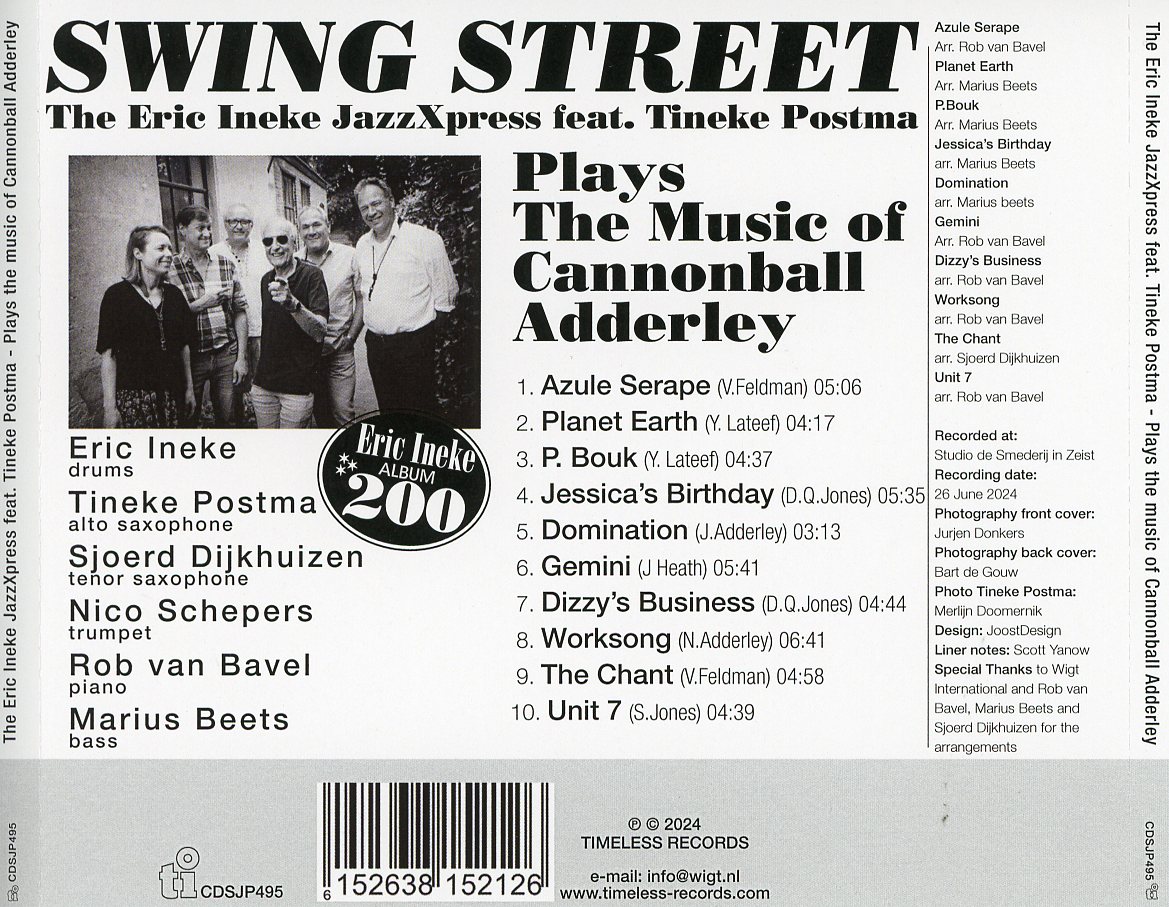


Rob van Bavel does the arranging honors on the opening track, Victor Feldman’s Azule Serape. The London-born pianist, vibraphonist and drummer was with Cannonball from 1960-1961 and contributed a number of compositions to the band’s book. 


On the Cannonball’s live album at The Lighthouse Café in Hermosa Beach California [where Victor was the resident pianist in Howard Rumsey’s All-Stars from 1957-59], Adderley introduces the tune this way: “I've been trying to figure out a long time what this name means for this tune that Victor Feldman wrote for us. This one is called "Azule Serape.” Now he’s from England and I know it's not English. It's something else. "Azule Serape." That’s what the next tune is.”


Rob’s arrangement approaches the tune as a sort of fanfare to open the album in a stirring and energetic manner. After the intro, Eric launches into an Afro-Cuban beat over which the band plays a staccato montuno which evolves into a series of Latin riffs. Rob then commences the melody on piano performing it in its original locked-hand fashion, the band comes in and swings the bridge and the whole thing gets the recording off in a rousing manner. Solos by Sjoerd, Nico, and Rob set the stage for four bar trades with Eric before the band segues the tune into a big finish.


Bassist Marius Beets does the arranging honors on Planet Earth and P. Bouk, both written by Yusef Lateef. The former features Tineke and a fine intervallic solo by Rob showing his interpretive range [think McCoy Tyner].


The latter was released on the 1963 Cannonball Sextet in Europe Riverside LP [RM 499], although it was first recorded by Yusef on his 1961 New Jazz LP - Yusef Lateef Into Something [NJLP 8272]. P. Bouk is an intriguing title and Yusef explains its meaning this way in Nat Hentoff’s notes to the New Jazz album: “It’s kind of an idiomatic language developed in Detroit that refers to a man’s idiom or “bag.” Now I can’t say that this tune sums up what’s in my bag because there is more than one thing in my bag, or rather, there ought to be.” Nat goes on to add: “The ingredients in Yusef’s bag which are primary in this tune is his commanding sense of swing, his gutsy forcefulness and his preference for economical clarity of design.”


Over an opening strummed bass ostinato which is amplified by Rob and Eric, Marius feeds into his arrangement of P. Bouk ingredients from his own “bag” that create a soaring statement of the novel features of the tune and then go on to serve as a launching pad for solos by all of the band members. Oscillating chords establish a vamp for Eric to stretch out over before the band takes the tune out with a full measure of “gusty forcefulness” which would have no doubt pleased Mr. Hentoff.


One thing you can always count on when listening to Eric’s bands is that they always SWING - and that quality is on display in the slow burn the band gives to its interpretation of Quincy Jones’ Jessica Birthday, which is another arrangement by Marius. Jazz played at a slower tempo requires a lot of control because nothing is slurred and everything is stated; clearly enunciated notation. No clichés are on display in the solos by the band members who seem to relish the chance to play out their ideas in a slower rhythmic context. The unison phrasing is clean and articulated which serves to give the slower tempo a nice bounce throughout.


Marius Beets closes out his turn on the arranging chair with a reworking of Oliver Nelson’s arrangement of Cannonball’s original Domination.


Tineke and Marius state the theme to Domination in unison which then relies on a series of countermelodies as contained in the original to set the piece in motion. This is small group orchestration at its finest and everyone had their reading chops on to make this one happen. 


Jimmy Heath’s Gemini, Ernie Wilkins’ Dizzy Business and Nat Adderley’s Work Song comprise the next three tracks; three very distinct tunes which Rob honors with three distinctive arrangements. 


Gemini, Jimmy Heath’s lovely use of a loping 6/8 to waltz time rhythmic pattern, features interesting interludes that Rob has voiced in such a way so as to create a contrast to launch the soloists with Nico, Sjoerd and Rob doing the honors.


Ernie Wilkins’ claim to fame was as a big band arranger and this orientation really shows in the way the melody to Dizzy’s Business is constructed with its punchy phrasing and pulsating rhythmic kicks and licks. An uptempo bash that finds all the band members in fine form, especially Sjoerd who does “the big horn” proud with a take-prisoner solo that is reminiscent of Yusef when he was on the Adderley band. The sextet-as-big-band is on tap on this one.


Next up is Nat Adderley’s Work Song which in later years he would introduce to his audience as “the tune that paid all my bills for a long, long time!” This 16-bar minor blues was one of the most requested tunes in the Adderley’s band repertoire and Rob gives it new life with a refreshing take built around a rubato statement of the melody that makes it even more expressive and emotional.


Marius then sets the tone for the JazzXpress’s interpretation by laying down a driving bass walk over which Tineke’s alto soars before brassman Nico takes over with a vigorous and muscular solo. Sjoerd and Rob get in on the fun before the “van Bavel express” shouts the tune out.


It’s impossible not to have fun playing Nat’s Work Song and this version by the JazzXpress shows why.


Next up is The Chant, another original by Victor Feldman which became the title for the eponymous Sam Jones Riverside album [RLP 9358]. Sam was the first and longest serving bassist with Cannonball’s groups so as you would imagine Sjoerd Dijkhuizen arranged this to feature Marius Beets skillful bass work. Rob joins in after Marius’ solo and the two lock in with Eric to form the driving rhythm section that makes the JazzXpress such a splendid straight-ahead Jazz band. Sjoerd jumps in with a powerful solo until the band returns and takes the tune to a righteous close.


Unit 7 by Sam Jones was Cannon’s closing theme. It’s a 12-bar blues with a bridge which Rob infuses with countermelodies to give the tune a wonderfully crisp sonority. Tineke steps up and steps out with a marvelous solo on alto that’s gotta have Cannonball smiling. Sjoerd follows with some Texas-tenor style phrasing in his solo - what Cannonball describes as a “moan within the tone.” Another fine unison interlude acts as a shout chorus before the band joyfully ends the tune.


As a note in passing, the CD comes with fine booklet notes by the Jazz journalist and historian, Scott Yanow, which provide further insights into the musicians and the music.


Swing Street is the seventh recording in my collection by Eric’s JazzXpress and each one is a gem replete with meticulous musicianship and joyous, swinging Jazz.


As Scott says in his closing remarks: “Swing Street succeeds at paying an affectionate and very musical tribute to the great Cannonball Adderley.”


Do yourself a favor and grab a copy.


You won’t regret it.


Thursday, May 16, 2024

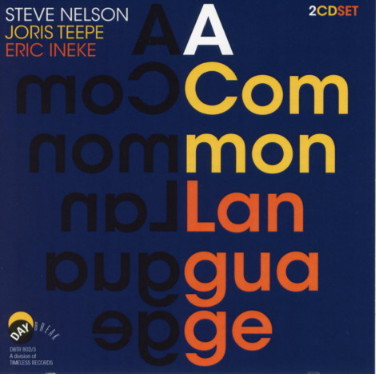
A Common Language - Steve Nelson, Joris Teepe and Eric Ineke

 © Introduction. Copyright ® Steven Cerra, copyright protected; all rights reserved.


“There’s no telling what we’ll play in the second set,” bystanders overheard bassist Joris Teepe say at the CD-release concert of A Common Language by the Steve Nelson Trio at De Pletterij in Haarlem on April 1. Among others, it turned out, they played a lush version of ‘Round Midnight and a gritty jump blues take on Frankie And Johnny, both made up on the spot and not presented on the American vibraphonist’s first album on the Daybreak imprint of Timeless Records.


Steve Nelson, preeminent 69-year-old vibraphonist and past associate of Dave Holland and Mulgrew Miller, is an invitee of ‘Dutch New Yorker’ Teepe, who as artistic advisor of the Prins Claus Conservatorium of Groningen regularly brings his American connections to his home country. The trio is completed by veteran drummer Eric Ineke, pinnacle of Dutch jazz that played with a who’s who in jazz from Dexter Gordon to Jimmy Raney and Eric Alexander to Tineke Postma.


On stage, the quiet and reserved Nelson says: “I like to play with everybody, young and old, but with these guys… (sighs). They are so experienced and know exactly what they are doing.” And then some. It is quite a team, full of interaction and balanced energy. Especially from playing a bit more together the last few years than in the past, the Teepe/Ineke tandem has become particularly tight-knit and flexible, Teepe’s way of making the music breathe quite phenomenal and Ineke’s succinct questioning-and-answering typically steady, dynamic and vivid.”

- François van de Linde, Flophouse Magazine


“Gently swinging, full of interesting elaboration as Nelson goes into the interstices of the tunes to find new nooks and crannies, it's all an easy going but never dull stroll down memory lane spread over 2 CDs. Issued on the Daybreak imprint of venerable Dutch jazz indie, Timeless.” 

- marlbank.net


Every Jazz fan knows the feeling.


The unexpected album. 


A recording which comes along seemingly out of nowhere.


You’re not looking for it but it finds you and absolutely haunts you into repeated listenings.


And with each listening, the music seems to grow on you as you find more and more things about it to entertain you and enchant you.


Holland based drummer Eric Ineke and I have been friends for a while and we have an unspoken bond that allows for me to receive a preview copy of the latest recording that he’s featured on with the hopeful yet, unstated expectation, that I’ll develop a review of it and post it to my JazzProfiles blog. 


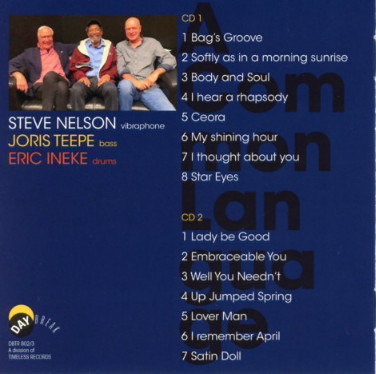
And so it was that Eric engaged Ria Wigt of DayBreak, a division of Timeless Records also based in The Netherlands, to send me a preview copy of the 2CDSet - A Common Language [DBTR 802/3] which features Steve Nelson on vibraphone, Joris Teepe on bass and Eric on drums.


I don’t do this often because I don’t like to use Jazz as a background music while I write - the music deserves to be listened to with my undivided attention - but I put the discs in my CD player while I finished working on a project.


The next thing I knew, the writing project lost my focus as I eagerly awaited the playing of the next track from Nelson-Teepe-Ineke [not a law firm] from A Common Language.


While listening to Steve, Joris and Eric on A Common Language, I was immediately struck by the fact that the use of only three musicians creating music that spanned almost 94 minutes and contained on two audio CDs created an aura of spaciousness.


Such a commodious environment centering on the vibraphone as the lead instrument in a trio can be dangerous and a potential detriment to the quality of the music for as Ted Gioia explains: 


“The vibraphone invites overplaying almost by its very nature. … Unlike a horn player, the vibraphonist is unable to sustain notes for very long, even with the help of vibrato and pedal. The vibes invite overplaying to compensate for such limitations. Added to these difficulties is the fact that … [they are played with] a hitting motion powered by the wrists. With the mastery of a steady drum roll, the aspiring vibraphonist is already capable of flinging out a flurry of notes and, given the repetitive motions used to build up drum technique, the vibes player is tempted to lock into a ‘steady stream’… [of notes]. West Coast Jazz: Modern Jazz in California, 1945-1960, p.103.


Can you imagine what over an hour-and-a-half of a “million-notes-a-minute” vibraphone could have sounded like in this situation?!


Thankfully, Steve approaches the instrument like a horn and allows the music to breathe using a melodic, introspective style that builds off the intensity of the rhythm section to shape his improvised lines.


In allowing the space to prevail, he invites the prodigious talents of bassist Joris Teepe and drummer Eric Ineke to join him in a musical, equal partnership; rightfully so because both have a lot to say on their respective instruments.


Joris has a big, full bass sound that centers the beat while Eric is the perfect accompanist who sets the rhythmic groove and stays out of the way until it's his turn to make a statement. 


This latter quality is one reason why Eric is in such demand as a mainstay of the Dutch Jazz scene with his own Jazzexpress and with visiting dignitaries such as tenor saxophonist Scott Hamilton, as well as, performing all over the European continent with young Jazz horn players who are just coming into their own in the music. 


Because he sets the time in motion and stays in the background, Eric allows the horn players time to think and form their solos without a lot of clatter from the drums pushing and shoving them in directions they may not want to go.


Of course, the other thing Eric does is swing his backside off. He's an irrepressible force who comes to play and you’d better swing as well otherwise he’ll run over you.


While listening to A Common Language I was also struck by a comparison with another vibes-bass-drums recording, this one from 1958 featuring Victor Feldman on vibes, Scott LaFaro on bass and Stan Levey on drums. I am referring, of course, to The Arrival of Victor Feldman [Contemporary C3549; OJC CD 268].


The virtuosity on display on Victor’s maiden voyage recording with LaFaro and Levey is one for the ages and matchless in it own right, but the quality of not overplaying in such a sparse environment and complementing the work of your bandmates in such a way as to allow everyone space to shine is a model available to any musician sensitive enough to absorb these cooperative essences.


And Steve, Joris and Eric “get it” and use a similar format to provide the listener with an alluring musical feast of fifteen Jazz Standard tunes and Great American songs that are presented at a relaxed pace [the average track time is about six minutes and thirty seconds] which provides for a variety of arrangements to be presented over familiar melodies.


There is some vibraphone royalty associated with some of the selections on A Common Language - Lionel Hampton/Oh Lady Be Good, Milt Jackson/Bags Groove, Cal Tjader/Star Eyes, Red Norvo [with Tal Farlow and Charles Mingus]/ I’ll Remember April - but make no mistake, Steve puts his mark on each of the tracks that make up this wonderful recording.


My personal favorite is Lee Morgan’s Ceora: one because I’ve always liked the sound of its intriguing melody and two because Steve makes it even more enjoyable with the caring interpretation he gives it on vibes, an instrument on which I’ve never heard the tune played before.


Other highlights include a spritely version of Monk’s Well, You Needn’t which finds Steve at the height of his inventiveness [you can tell it’s a tune he loves playing on]; a lazy and leisurely romp through Freddie Hubbard’s waltz - Up Jumped Spring, beautiful ballad interpretations of Lover Man, I Thought About You and Body and Soul while another typical vehicle for a ballad - Embraceable You - is played at an unusual medium bounce tempo; a blistering uptempo version of Softly As In A Morning Sunrise


The frequent tempo changes are helpful to both the players and the listener as it enables them to adjust to an altered pace of improvisation, much the same way as it would be if the music were being played in a  Jazz club.


In each of these arrangements, Steve leaves room for Joris Teepe as the “other voice” and Joris is more than equal to the task as he offers a master clinic in how to construct interesting bass solos. When it’s Joris’ turn, there’s no drop off in the quality of improvisation; it’s just stated in bass clef.


Unusual in this day-in-age, Steve approaches the vibes as a two mallet player instead of the more customary four mallets made popular by Gary Burton.


As a result, his emphasis is on creating melody with the harmony implied rather than stated as is often the case with the four mallet style.


And what a stimulating melody player Steve is and to have such a great showcase for it in the double CD A Common Language is DayBreak’s gift to the Jazz World.


Needless to say, A Common Language has since moved from the background to the foreground of my listening regime simply because I can't stop playing the darn thing.


If your taste in Jazz runs to the straight ahead style in the music, you won’t want to miss this one. 


The following video was made at the CD-release concert of A Common Language by the Steve Nelson Trio at De Pletterij in Haarlem on April 1, 2024.


Just a word of caution - the music doesn’t start until the 13th minute.


Tuesday, August 8, 2023

Common Ground - Enrico Le Noci Quartet

 © Copyright ® Steven Cerra, copyright protected; all rights reserved.


Like the harmonica and the accordion, there is a great deal of controversy surrounding the appropriateness of the organ in a Jazz setting: usually Jazz fans either love it or hate it.


I am a big fan of the organ in Jazz, and have been ever since I heard Jimmy Smith’s Hammond B-3 organ performances on his Blue Note recordings from the 1950’s and 60’s. With drummer Donald Bailey as his primary running mate, Jimmy’s recordings involve trios and quartets with sax and guitar that feature Stanley Turrentine, Tina Brooks and Ike Quebec on tenor saxophone and Thornel Schwartz, Kenny Burrell and Quentin Warren on guitar.


Guitarist Wes Montgomery’s earliest recordings on Riverside Records in the early 1960s featured a trio with Melvin Rhyne on Hammond B-3 and Jimmy Cobb on drums.


The ever durable Rhyne would reprise this organ-guitar-drums trio format in a series of recordings he made for Criss Cross in the 1990s with Peter Bernstein on guitar and Kenny Washington on drums.


Peter, of course, has been a long-standing member of a trio made up of Hammond organist Larry Goldings and drummer Bill Stewart that dates back to their college days together in the late 1980s.


And Larry has made some wonderful recordings on the Hammond B-3 as a member of uber guitarist John Scofield’s quartet with tenor saxophonist Joe Lovano and the marvelous Bill Stewart on drums.


Hammond B-3 organist Don Patterson often teamed up with tenor saxophonists Sonny Stitt, Booker Ervin or Junior Cook,, guitarist Pat Martino and drummer Bill James on hard-driving, “boppin’ and burnin’” releases for Prestige Records which have been collectively relabeled today as “Acid Jazz.”


On the West Coast, organist Richard “Groove” Holmes made Pacific Jazz recordings with tenor saxophonist Curtis Amy as well as under his own name for that label that featured tenor saxophonist Gene Edward, guitarist Joe Pass and drummers Lawrence Marable, Jimmy Smith and Billy Higgins.


These are but a few examples of the organ-guitar-drums + sax combo format that has been in place since the advent of the hard bop era of Modern Jazz. Brother Jack McDuff, Johnny “Hammond” Smith, Baby Face Willette - the list is endless for those who employed a similar format.


Not surprisingly, the organ-guitar-drums plus format has even been adopted by some of today’s European Jazz Modernists including French Hammond B-3 organist Eddy Louiss with tenor saxophonist Barney Wilen, guitarist Rene Thomas and drummer Kenny Clarke, Italian tenor saxophonist Max Ionata, who sometimes works in a trio with Hammond B-3 organist Alberto Gurrisi and various Italian drummers, and Dutch alto saxophonist Benjamin Herman who has made some funky “boppin’ and burnin’ recordings with three fellow countrymen, Jesse van Ruller on guitar and Carlos de Wijs on Hammond B-# along with the stellar Martijn Vink on drums and another with Jesse and Larry Goldings and the master groove drummer, Idris Muhammad.


So much for historical context.


For young players, the orchestral qualities of the organ in combination with the electric guitar and the sax opens up the possibilities of a Jazz-Rock fusion which is responsive to the way they hear the music today.


And especially for young guitarists, they can incorporate what they’ve been hearing in Pat Martino, Pat Metheny, John Scofield, Carlos Santana, Jerry Garcia, Eric Claptan and many other “straight-ahead” and “fusion-inspired” players into a Hammond groove which also fits nicely into a number of swinging musical situations.


What is required here is a guitarist who can recognize the beauty of the Hammond groove format and a drummer who can lay it down.


Enter guitarist Enrico Le Noci and master drummer Eric Ineke who are joined on Enrico’s latest recording- Common Ground - by tenor saxophonist Pietro Mirabassi and Hammond organist Arno Krijger in a series of performances that more than do justice to the venerable organ-guitar-drums + sax arrangement. 


Over Eric’s straight-ahead and swinging Jazz drumming, Enrico, who composed all seven of the albums original compositions, is free to use his influences to create on Pied Fries, a contrafact of sorts on Wes Montgomery’s Fried Pies, Arjun’s Blues, a slow blues that beautifully encapsulates the sensual moodiness that the sonority of the organ can create and In The House, a lovely three quarter time melody that’s played at an easy pace that allows everyone to comfortably stretch out.


The sound that Enrico achieves on guitar is clear and clean; his notes and phrases ring true and he doesn’t make mistakes, not an easy thing to do on such a difficult instrument. Pietro's tenor phrasing is infused with Coltranesque harmonic references, as is the case with many young tenor sax players today, but his sound is bold and his style is daring. Arno certainly knows his way around the Hammond organ but he plays it pianistically, more like Melvin Rhyne, without resorting to the orchestral devices for which the instrument is famous, or infamous, depending on your point of view.


Of the remaining four tracks: the title tune, Common Ground features a two-beat shuffle feel, which is almost a trademark for organ-based combos, with Pietro and Enrico playing the line in unison; a fun track from beginning to end.


Night Fears is an exquisitely slow ballad with Enrico’s guitar sound drenched in a country blues twang that elicits a melancholic sonority which Arno enhances with sustained notes and chords on the organ that adds to the mysterious aura of the track. Without question, a potential soundtrack for nightmares and other eerie feelings.


Keys, with its nice bouncy rhythm and simple, straightforward melody is almost a relief by comparison and finds both Enrico and Arno in a reflective mood.


And the closing track - Bright Changes - is a “bright” burner in the best tradition of hard bop swingers which finds everyone at that hard charging best. Its 12 bar blues structure is cleverly arranged by Enrico to give the tune a complexity that makes it interesting to listen to and to play on with Arno and Eric taking it out with 4-bar to 8-bar trades, respectively.


There’s so much to appreciate and enjoy in Enrico’s compositions as they both honor the Jazz tradition that went before them as well as expand them with his superb musicianship, fertile imagination and the inclusion of first-rate musical partners in Pietro, Arno, and of course, master drummer, Eric Ineke.


If you are looking for something new and different to add to your Jazz collection, look no further than Enrico Le Noci’s Common Ground which is available through ZenneZ Records.


Wednesday, March 22, 2023

Nordic Bop - Pekka Pylkkanen and Eric Ineke

 © Copyright ® Steven Cerra, copyright protected; all rights reserved.


NORDIC BOP

“I am very happy that after all these years we finally have this album finished! We had a great time recording the music (and even now, when working on finalizing it). I'm looking forward to playing with you all again, hopefully in the very near future! I will let Eric tell the story of this album....”

- Pekka Pylkkanen


In 1962, thanks to the efforts of producers Bob Prince and George Avakian, baritone saxophonist Gerry Mulligan and alto saxophonist Paul Desmond recorded an album entitled Two of a Mind for RCA Victor.


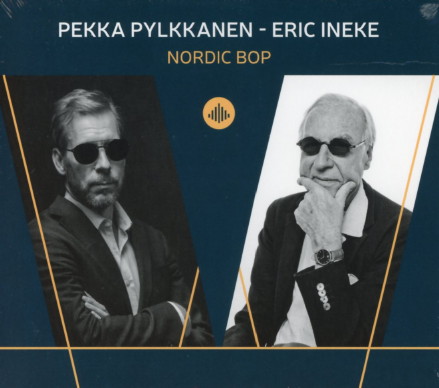
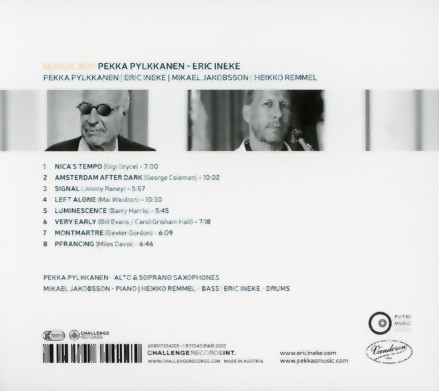
The title came to mind [pun intended] with the arrival from drummer Eric Ineke of the Nordic Bop [Challenge CR73542] CD which he recently recorded in Finland with saxophonist Pekka Pylkkanen. On it, Eric and Pekka are joined by pianist Mikael Jacobsson and bassist Heikko Remmel.


“Two of a Mind” is a germane phrase to describe the relationship between Eric and me, not only because we both play drums, but also because we have a deep and abiding interest in the music generally characterized as Bebop. 


Perhaps a more accurate description of the style of Jazz we share a passion for might be straight-ahead Jazz which is supported by a no-nonsense, always swinging, driving beat.


It’s the music we both grew up listening to and it has influenced the way we approach playing drums.  And I daresay, besides his talent as a drummer, it’s another reason why Eric is in such great demand both as a teacher and as a player throughout Europe with younger musicians who want to experience playing Jazz with this kind of time feel.


The heart of it from a drumming perspective is setting down or, if you will, laying down a groove on the ride cymbal which is heavily accented by the hi-hat and creating a driving swing behind the soloist. The emphasis here is accompaniment and not playing a parallel solo behind the horn soloist by keeping up a constant barrage of rhythmic figures all over the drum kit [think Tony Williams and Elvin Jones; not stated in a disrespectful manner].


The straight-ahead time feel can be punctuated with occasionally sticking on the snare drum and/or with bass drum accents, but the point of it all is backing up and supporting the soloist and, where necessary, adding color to the sound of the music with percussion effects.


Having learned his craft by studying the masters such as Kenny Clarke, Max Roach, Art Blakey and Philly Joe Jones, Eric has gone on to become the living embodiment of this approach to Jazz drumming and is constantly in demand in his native Holland throughout Europe as a practitioner of this form of the Jazz drummer’s art.


Since Eric knows I have a predisposition to his preferences he is generous in sharing with me recordings on which he performs that feature like-minded musicians.


Which brings me to Pekka Pylkkanen and Nordic Bop. It arrived a couple of weeks ago and has been on my CD player ever since.


The idea for the recording, the tracks which comprise it and the background of the composers are all spelled out in Eric’s insert notes which are shared below.


But before directing your attention to them, I thought I would share my impressions of the music and the musicians that make up this very fine album.


What initially struck me upon hearing Pekka for the first time is the full searing tone he gets on alto saxophone and the marvelous facility he has that enables him to really get around the instrument. Wails, moans, and cries are all part of his expressive presentation - it’s a sound that is at once rich and penetrating - it reaches you with its fullness.


It’s interesting that the CD should open with alto saxophonist Gigi Gryce’s Nica's Tempo because in some ways Pekka’s orientation on the instrument brings to mind Gigi’s: both are hard-driving, no-nonsense players with a legacy on the instrument that is straight out of Charlie Parker.


And just when you thought you had a handle of Pekka’s approach, he pulls out his soprano sax and completely surprises you with a totally different orientation characterized by a big, wide sound, a hint of a vibrato, and complex harmonics from Coltrane but yet somehow sounding original to him because of the way he puts them together. This all comes forth so beautifully in Pekka's treatment of the Bill Evans classic waltz, Very Early. One could almost wish that his soprano sax interpretation of Denny Zeitlin’s Quiet Now were also on the recording.


And speaking of accompaniment, for one so young, pianist Mikael Jacobsson does a superior job of supporting the soloist with minimal chordal intrusions. During his own solos he rides the rhythm section, leaving lots of space allowing the piano to resonate. His intervallic approach enables him to play more modern sounding improvisations over traditional bebop lines.


Bassist Heikko Remmel is a rock; you never have to “look” for the time, all you have to do is listen to him and there it is encased in a big, booming bass sound. Eric’s unobtrusive style of playing allows the bass to really come through on this recording and it “locks in” nicely to generate a wonderfully “alive” time feel by the rhythm section.


And then, of course, there is Eric holding it all together and pushing things forward in his unrelenting but always tasteful manner. His drums sound wonderful, full of the snap and crackle very reminiscent of the great Roy Haynes and cymbals with pronounced stick clicks that create the propulsive swing that is so characteristic of his drumming.


Everything about this recording merits your attention from the interesting selection of tunes, the intense, yet well-paced improvisations, and the classic, straightforward sense of swing that encapsulates the music and provides it with an energetic drive.


More about the players and the music are contained in the following insert notes by Eric.


“When Pekka Pylkkanen invited me in 2017 to play a couple of concerts with him in Finland and Estonia, I immediately responded with an enthusiastic YES!! Having played together before, I knew the music would be great and swinging! On piano, we had the pleasure of having the wonderful and hard-swinging piano player Mikael Jakobsson from Finland and the young and very talented bass player Heikko Remmel from Tallinn, Estonia.


Pekka got the idea of putting together a repertoire of tunes written by some of the great Jazz legends I played with during my earlier career. During the concerts, we all felt that it worked out really well and that we should at least put some of the repertoire in the can for the right moment to release it on CD.


Well, that moment came five years later. Recorded in this beautiful studio of the Sibelius Academy of the University of the Arts in Helsinki; a real straight-ahead swinging Jazz album finally saw the light. I have a close connection with at least five of the tunes, because I toured in the past with their composers.


'Amsterdam after Dark' is written by the legendary tenor saxophonist George Coleman. I had the pleasure of playing with him for a week in 1974, together with Rob Agerbeek and Rob Langereis, and it was an incredible experience: George was at the top of his game every night. Luckily one of the concerts was recorded and got released years later, on the Blue Jack Label.


'Luminescence' brought me back to the eminent professor of Bop, Mr. Barry Harris. For more than 15 years I backed him up when he came to teach (always for a week) at the Royal Conservatoire of The Hague. One of those concerts was recorded and also released on CD. I have great memories of working with him when we played for a week in St Petersburg in Russia during the White Nights Festival in 2007. Playing with Barry was a true education in Bebop!


'Left Alone' was written by pianist Mai Waldron whom I played with at a festival in Belgium in the nineties with the Ben van den Dungen/Jarmo Hoogendijk Quintet. This very quiet man and profound musician, combined with this furious Hard Bop quintet was an unforgettable experience.


'Montmarte', written by the great Dexter Gordon, brings back to me one of the best experiences of my whole career. In 1972 I got a call from promoter Wim Wigt to go on an almost 3 months tour with this legendary giant together with the Rein de Graaff Trio. I was 25 years old and it was at that moment that I entered the University of Hard Bop!


'Signal' is a very hip and modern-sounding tune written by the legendary and impeccable guitar player Jimmy Raney. He recorded that tune in 1951 with Stan Getz at Storyville in Boston. That recording became a landmark and is still one of my all-time favorite albums! I was thrilled when I received a request from the producer Gerry Teekens in 1977 to play a radio concert in Lausanne with Jimmy and his son Doug Raney. They were on tour, and Jimmy had a serious argument with his drummer back then, whom Jimmy ended up firing, so I was in. 


From the first note we played at the soundcheck, Jimmy gave me a look and smiled at me, and after the concert he told me he really liked my playing very much. That led me to do all his tours in Europe for the 3 consecutive years, as well as the first recording for Criss Cross Records in 1981 (called 'Raney 81’) with his son Doug and the great Danish bass player Jesper Lundgaard. All those great moments with these legendary giants are with me all the time, and I am very happy and thankful that Pekka took this initiative to get this wonderful project together!

Enjoy!”

Eric Ineke