Wednesday, February 26, 2025

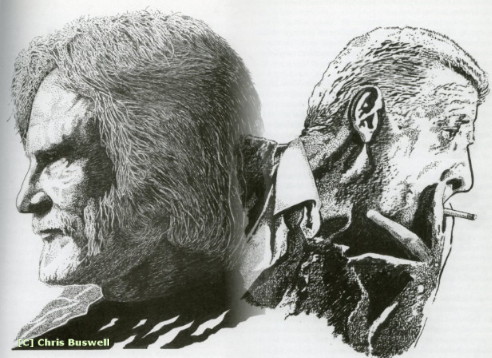
Bill Evans - The 1979 Wayne Enstice - Paul Rubin Interview

© Copyright ® Steven Cerra, copyright protected; all rights reserved.


Bill Evans, one of the foremost jazz pianists of the postbop era, profoundly influenced three generations of keyboard players. Among contemporary jazz's most popular and accessible artists, he had at least fifty albums as a leader and five Grammy Awards to his credit.

When playing, Evans would sit hunched over the keyboard, head parallel to his large hands, glasses dangling precariously off the bridge of his I nose. Combined with the subtly lyric and impressionistic side of his music, his introspective image led to the early criticism that his sense of swing and time were too studied to involve his audiences.

Looking back, it is clear how inaccurate that criticism was. Many of Evans' early recordings as a sideman and a leader exhibit a powerful rhythmic authority, and even his most hushed ballad work rode on a steady inner propulsion. The last half decade of Evans' life saw his music enriched by an even more exuberant drive. This was due in part to changes in his personal life and a deeper confidence in his music but also to the dynamic musical partnerships he formed during that period, particularly with Jack Dejohnette on drums, Eddie Gomez on bass, and the members of his last trio, bassist Marc Johnson and drummer Joe LaBarbera.

Evans' distinctive touch and gorgeous voicings were unmistakable on acoustic or electric piano, inspiring great respect among his contemporaries. Miles Davis reportedly once said, "Bill Evans plays the piano the way it's supposed to be played." Evans drew deeply from the heritage of Western keyboard music, and his expansion of the song form in jazz, wedded to a harmonically rich romanticism, touched pianists as diverse as Keith Jarrett, Chick Corea, Joe Zawinul, George Winston, Herbie Hancock, Marian McPartland, and Paul Bley.

Born in Plainfield, New Jersey, in 1929, Evans began his musical studies at the age of six. After graduating from Southeastern Louisiana College, he worked with a succession of bands, including those fronted by clarinetist Tony Scott, bassist Charles Mingus, and composer George Russell, who first exposed Evans to modal-based jazz.

Evans' debut recording as a leader was New Jazz Conceptions, released by Riverside Records in 1958. However, it was not until his association with Miles Davis—he played with the sextet in 1958 and was then rehired
in 1959 for the historic Kind of Blue recording sessions—that Evans gained international prominence.

In 1959 Evans also established his initial, and many contend his most satisfying, working unit with the late Scott LaFaro on bass and Paul Motian on drums. From its inception, this group displayed an uncanny improvisational rapport and forged the prototype for the "pure" trio in modern jazz. A live recording made at the Village Vanguard in 1961 documents this trio and, in the opinion of some, is Evans' peak accomplishment. Tragically, the glory days of this Evans band were cut short by LaFaro's death in a 1961 car accident. Suffering a profound personal and professional loss, Evans did not record for a year.

In 1962 he returned to the studio with Motian and bassist Chuck Israels, who was a sympathetic improviser in the mold of LaFaro. Evans varied his musical formats to some extent over the next two decades of his life from the occasional large ensemble to a series of duet and solo piano recordings. But until his death in 1980, Evans favored his trios, a setting that enabled him to transcend typical rhythm-section roles and cultivate new levels of interplay among piano, bass, and drums.

Bill Evans' dominance as a pianist has tended to eclipse his achievements as a composer. He left a modest but memorable legacy of jazz tunes, including "Peace Piece," "34 Skidoo," "Show-Type Tune," and perhaps his most inspired melody, the lyrical "Waltz for Debby."

Coming the year before his death in 1980, the following interview is perhaps one of the most candid and comprehensive in terms of his pianism that Bill ever gave in his all-too-brief career and this is probably attributable to the well-prepared, insightful questions put to him by Wayne and Paul.

WE: Bill, if music can be classified as a language, how does your trio approach this musical language to ensure that your message is reaching an audience?

BE: The language of music is sort of a motivic language. It's a developmental language in a sense, and there are just so many subtle ways that it's used in relationship to the form or the phrase or the period or whatever. I would say that I have worked hardest on my music to develop that kind of language. And I want it to come out of a genuine jazz tradition and to be absolutely a musical language as well, and it is something that I've dealt with personally on a very deep basis as much as I can with the music that we play. And to understand it one would have to listen to it correctly.

Now some people might listen to our music as just a series of abstract ideas which are related to nothing except themselves. This isn't really enough. In order to really understand our music and the language that we use, one would have to be aware of always where the music is in relation to the form that is being used in that particular performance or a particular piece. So that might take a little bit of conditioning. However, we do work with popular forms — forms that are felt by people that grow up in this culture — and I don't think it would take too much effort or concentration brought to bear before a person would be able to understand how to listen to our music. And one must really pay attention to it. It can be listened to as music in the background, and one could get an impression that that might be all it is, but really, as I say, in order to appreciate the language, what we're trying to say and the meaning of it, one would have to really know where we are in relationship to the particular thing we're doing.

I mean, I've certainly studied more or less all kinds of approaches to music and opened my mind to them and so on, but I've made the choice for various philosophical and personal reasons to go with the kind of idiomatic and form content that I use. And it can be, as I say, rather abstract if one doesn't tune in to where it's at. But I think the melodic content and harmonic content and even the form content of it all come out of popular music. And the traditional popular forms—not only out of the culture, but I mean really, you know, if we examine classical forms they basically come out of various song forms. Even the symphonic forms are extensions of smaller forms.

So, it's nothing new, but [in] the same way that a person would miss a great deal listening to a symphony if they don't understand the form, they would miss perhaps even more if they don't understand the form with us. But I'm not trying to be hard to understand; that certainly is not my goal as a musician. But of course, having gotten deeper into the music and trying to say more, we have gotten perhaps a little sophisticated. However, we like to feel that if people will make the effort to learn how to listen correctly that they would be rewarded, hopefully. 

WE: Could you elaborate on what is meant by the term song form

BE: Well, of course, there are many different kinds of song forms. The most well known would be an a a b a form in which there are three identical sections: one repeated at the beginning and then repeated again at the end—a a—and then the b as a transitional or opposite or different content that occurs. Strictly speaking, they would be like eight measures each; that makes what we call the thirty-two-bar song form. Now there also are, you might say, a-1 form, which would be sixteen, and sixteen with a slight alteration in the second half; and then there are many different varieties that grow out of this.

Now, most things that I write I find more or less determine their own form out of a conditioning. I have to feel a song form and work some natural changes in it, and I'll be using some extensions and so forth. In fact, I am not even aware of the metric content unless I reexamine what I do. I just really feel the development of it.

So there are many varieties of song form, but when one learns to feel the form, and in listening, to feel the form, as long as it's not a concocted thing, you know, and screwed together somehow, it should be easy to feel. And I just happen to respect forms that come out of history and come out of culture and tradition as something which is substantial and real and which, if one learns to live with them and [they] become part of you, that you can then extend and use these things as organic means to make music.

I respect the American popular song very much and some of the masters that have composed in that form. And it became a means for jazz players to improvise by using a lot of these forms in songs to play off of. And I studied this very hard, analytically and diligently as I was growing, and got deeply enough into it so that I feel it's worthwhile to continue working with it, 'cause there's still explorations that I haven't begun to make yet into handling these things.

PR: As I understand you, you want to make enduring music of classical proportions. But some jazz musicians today seem less bent on classical values than on pursuing sounds and forms that reflect our everyday lives. Are there many current musicians who share your aesthetic? 

BE: I think there are quite a few. But I know that there are people that, as you say, work with the everyday. The way I feel about all those things is everybody has to live with themselves, and I think everybody knows inside the reasons for doing what they're doing. "To each his own" is all I can say. I'm just doing a thing that gives me the greatest pleasure. I made my choice for my own reasons, and I'm willing to live with them, and I live with them pretty happily.

But I think that all that controversy about all those things, I don't know whether it really matters that much or not. Certainly I want something better than the everyday. When I go to any kind of art I look for something very special. I don't look for the person's bathroom noises or anything else. I don't want something everyday. I want something that they've had to really dedicate their lives to protecting, and nurturing, and cultivating, and searching for and bring me something special, you know, 'cause I could hear the everyday or see the everyday just by going out into the world, and I don't consider that to be art.

PR: As you were growing up, what was your exposure to the heritage of Western culture?

BE: Well, I think one of the primary influences that comes to my mind is the conditioning as children to have a great reverence for art. This is something which happens in certain families today. It doesn't seem to happen as much in the schools as it did then. Like, we were presented even in third and fourth grades and fifth and seventh grades, we would have a listening hour where we'd listen to great music. And whether or nor nine out of ten of the kids really tuned in, all of them probably realized that here was something which was being presented with great respect so it must be important even if they didn't tune in. And the ones that did tune in developed that kind of respect.

Also from my family I got it. I think this is basic, in that you respect something which is far out of your sphere; it's not immediately attainable, and placing those artists in the realm of spiritual leaders, great people in history. The trend today is to glorify the mediocre. We'd like to think, it seems like, today that "Gee, if I bought enough electronic equipment and devoted six months of work, I too could be a great musician." But this kind of perspective of really great reverence and respect for something that's considered to be exceptional, then you just naturally devote yourself in a serious way to it. You take it seriously, you won't be satisfied with just superficial things, and I think that has a lot to do with it at bottom, the conditioning that you have towards your goals.

WE: During your formative years, was there a particular person or event that inspired you to become a musician?

BE: I'm sure that happened. The encounters which aren't so glamorous that were important were, for instance, having a wonderful woman as a teacher, rny first teacher, who brought me into music and got me to read music, and therefore [I] developed a great ability to explore music through a superior sight-reading ability, without bringing the whip down as far as a type of approach to music like the scales and arpeggios and heavy technical work which would have, with my temperament at that age, turned me against music.

Other than that, there were, of course, many experiences or perhaps a good teacher here and there. Things that I came across, listening experiences, you know. I can remember, for instance, the 78 album of Petruschka which I got early on in high school as a Christmas present — a requested Christmas present. And just about wearing it out, learning it. That was the kind of music that at that time I hadn't been exposed to, and it just was a tremendous experience to get into that piece. But there were things like that all along the line.

I remember first hearing some of [Darius] Milhaud's polytonality and actually a piece that he may not think too much of — it was an early piece called Suite Provencale — which opened me up to certain things. But there were countless events like that which are all revelations in their own right and inspirational. I don't know, it's such an accumulative thing, you know, the ability to manipulate music in some kind of a comprehensive way. And I've really just kind of dealt with it piece by piece over a long period of time, and it seems that at this point in my idiom I enjoy a certain amount of freedom.

I mean, I've come to the point where I have a great deal of enjoyment playing, whereas for many years it was bringing a great deal of concentration to bear — conscious concentration of technical things, you know, of having to think a great deal — at the same time trying to leave one part of my mind free to just be the expressive part. Now it's more that I can enjoy almost the total expressive part, and I'm thinking only at less-conscious levels about technical things. So I have arrived at that point, which is very enjoyable, but it's taken a tremendous amount of preparatory years and efforts.

PR: Let's turn for a moment to the first trio you fronted that included bassist Scott LaFaro. How would you estimate LaFaro's contribution to modern bass playing, and what role did he play in the development of that first trio?

BE: In my mind Scott LaFaro was responsible in a lot of ways for the expansion of the bass. I think he is acknowledged, at least within musical circles, as being more or less the father or the wellspring of modern bass players. And when we got together I realized that Scott had the conceptual potential, he had the virtuosity, and he had the experience and the musical responsibility, and so forth, to handle the problem of approaching the bass function in jazz, especially with a trio, which is a very pure kind of setup with more freedom.

I thought I could depend on him to approach this, and we just really accepted a conceptual goal which was more conversational, more a thing where, including the drums, where everybody could contribute. They didn't have to play the roles that were more or less assigned by jazz tradition — that you could only walk at this time, that you could only do this at this time, and you could only do this at this time — but rather leave our minds wide open but with responsibility, so that we weren't just going off into space, that we were using that tradition but allowing ourselves to be a little bit more open within it. And of course, with that trio in a space of about two years we tried to work toward that goal with responsibility .. .

The last night that that trio played together [in July, 1961] before the tragedy of Scott being killed in an automobile accident, I think we had worked toward those goals pretty well. We had reached at least a point of some development in it that meant something. Even on the very first record you could hear that we were already working towards that, but I think it got a much more refined and complete thing by the time we had done the last records.

Musicians, you know, in various countries told us that those particular records seem to have had an impact in that they represented this kind of — wasn't like a kind of a break, an iconoclastic thing, you know, where we just rebelled against everything. That wasn't the kind of break it was; it was more like an extension of what had been happening and perhaps more of a completion or something like that.

But anyhow, that was the beginning of it, and that sort of conceptualized the trios that I had after that. I mean, they were more or less modeled on the development that we had made with that trio. And of course, we developed in other ways within those conceptual goals that we had accomplished.

But I might add that — maybe it's a personal thing, you know — I'm also coming into, I think, a new period in the last couple of years or so. But the particular trio I have now with Marc Johnson on bass and Joe LaBarbera on drums is giving me a great deal of pleasure. It has me excited, and [I'm] enjoying myself in a way that — really I can't remember feeling this way since that original trio. So it is kind of really a good feeling, and it's also a marvelous thing to feel that a bassist twenty-five years old, Marc Johnson, can come into my trio with all the abilities and aesthetic and love the music and fit right in emotionally and aesthetically, and Joe LaBarbera who is just a little over thirty, because I'm of another generation, and it's encouraging to me that, you know, that they're interested enough in the music in every way to become a real part of it. 

PR: Could you elaborate on the musical function of each member in your trio?

BE: This is a rather pure group, in that there's just one person really for each function, and then we cross over the other functions. I mean, the drummer is really controlling timbre and various colors and contributions in the rhythm and, you know, the propulsion and other things, maybe just coloring, or whatever. And then you have the bass function primarily in the bass, and then he becomes a solo voice also, and an accompanying voice. And then, of course, I have most of the time the primary voice in the harmonic content. And of course, we all share all these roles in various degrees as we move around. But I don't really define the roles so much, because at this level it's like we all just approach the music, and I expect them to be responsible to the music and not everybody to be just indulging themselves. And we try to dedicate ourselves to the total musical statement, whatever it might be, and try to shape it according to musical ends and not ego ends. 

PR: How do you feel about extended choruses?

BE: I think things get a little lopsided sometimes, when everybody takes seventy choruses. It seems to be justified in certain ways, but to me, it's not just fine in terms of the content or the thing that they're doing — it just stretches it out beyond all dimensions, beyond any kind of emotional shape that's desirable.

If you'll notice, if we play a concert we may do seven, eight, or nine things in the first half. Now, what I try to think of in a set like that is I choose each thing to follow each thing in a way so there's a total pacing to the set. I'm really quite sensitive to that, in that in clubs I won't even predetermine sets, but I have an ability now to pace, let's say, an almost infinite number of combinations of what we do in a way that will generally work out to be a very well-paced set and a very well-shaped set. So that what we're thinking of in terms of individual pieces in effect become almost movements — you might say there will be eight or nine movements in a total work. A set would be like a total work. I'm thinking in terms of the keys and the moods and tempos and all kinds of things, you know— who might be playing a lot on one thing and not much on another. And trying to really shape this thing so that it's an emotional and musical feeling of inevitability in a sense, you know, that one thing moves to another with a sense of purpose.

So I like to feel that we don't work one thing too hard, you know, that before you get feeling like "Gee, they've been on that too long," we move into a change, some sort of a change of mood that is somehow emotionally the next thing that should or could happen that will be satisfying. 

WE: Many active pianists have commented on the impact of your conception on their playing. Are you aware of the influence you have had on other players?

BE: No, it's really difficult for me to see or feel those things. I believe it's true, because it's been said so much, you know, and for so long that I suppose there's some truth in it. I don't look for it, and I don't recognize it as much as — once in a while I seem to catch an inkling of it, but of course, I'm not looking for it.

First of all, I never strived for identity. That's something that just has happened automatically as a result, I think, of just putting things together, tearing things apart and putting it together my own way, and somehow I guess the individual comes through eventually. I suppose I could see where I could be an influence, because I think what I've done is I've put something together which is not eccentric; it's a nice kind of eclectic amalgamation of what has gone down maybe before me or something like that. And I think it's something that a student of music who is talented that's coming up can focus on and draw from. Now somebody like Monk or even Erroll Garner who are great in a sense so stylized, and in the case of Monk even eccentric, that it's sort of very difficult to get into their bag at all or to utilize much of what they've done. You can learn from their spirit more than anything.

So maybe that's one reason why I might have been an influence, and it's something that somebody can pass through also. They can become influenced by it, and they could also just then move through it, because it's not eccentric and it's not so highly stylized, I think. At least that's the way I see it, that it might be attractive for that reason. 

PR: We're surprised to hear that you never strived for identity. Within four bars your sound is unmistakable!

BE: Well, if there is a striving for identity, it's something that's so much a part of my individuality or personality that it's just automatic. I never said, like, "I want to have an identity," in so many words. What I said was "I want to approach musical problems as an individual. I want to build my music from the bottom up, piece by piece, and kind of put it together according to my own way of organizing things. Yet I want it to fit in, but I'm not going to take it in toto from any one place," which is what I did, really. I just have a reason that I arrived at myself for every note I play. Now, I think just as a result of that you probably have an identity — just because you are an individual and you see the problem, and so forth, in your own way. But as far as saying, like, "I'm going to project my personality” or "I'm going to project an image onto music” — a kind of a personality image onto music, which is kind of the way most people think of identity — that was no part of it whatsoever. And I don't think that can be effective.

I think having one's own sound in a sense is the most fundamental kind of identity in music. But it's a very touchy thing how one arrives at that. It has to be something that comes from inside, and it's a long-term process. It's a product of a total personality. Why one person is going to have it and another person isn't, I don't know why exactly. I think sometimes the people I seem to like most as musical artists are people who have had to — they're like late arrivers. Many of them are late arrivers. They've had to work a lot harder in a sense to get facility, to get fluency, and like that. Whereas you see a lot of young talents that have a great deal of fluidity and fluency and facility, and they never really carry it anyplace. Because in a way they're not aware enough of what they're doing.

There are certain artists — Miles Davis is a late arriver in a sense. I mean, he arrived early, but you couldn't just hear his development until he finally really arrived later. And Tony Bennett is another one that's just always worked and dug and tried to improve, and finally, what he does as a straight singer has a kind of a dimension in it and is able to transport the listener way beyond other singers in his category. Or Thad Jones is another one that I can enjoy listening to play. I enjoy listening to players that think for themselves, especially. I mean, you could line up a hundred players that all more or less sound alike, and they're all good players, and I can even enjoy listening to them. But if just one of them thinks for himself, he stands out like a neon sign. And it's so refreshing to hear someone who thinks for himself.

Now at the same time, the danger of a person grabbing a concept like this is that they think thinking for themselves is being eccentric or being rebellious or being — especially of being "different" — and that's not it.


The idea is to try to be real and right in the core, right in the middle, but still be an individual enough to handle the material in your own way. 

PR: So is it fair to say that you consider yourself a late arriver? 

BE: See, I said I was coming into the new period, and it has something to do with this, in that I'm opening up the expressive feeling more. I'm allowing it a little more room, and I think the dimensions are growing, you know, so that the feelings can become a little larger, a little more grand, perhaps, which I don't know makes that much difference. Perhaps those feelings were there all the while, and maybe I'm just going to display them a little bit differently or something.

But yeah, as I say, the early arrivers are always a little suspect to me, although they many times show great facility, and I can enjoy them, but I have generally found that very few of them carry things forward or take things into a new area. Those types of talents generally are very assimilative. They have that ability — some sort of a conglomerate of intuition which just takes and sops up and just sort of comes out, you know, it organizes itself and comes out, but they don't know generally, completely enough, all the constituent things that go into what they do, and therefore, they're not able to really discard and add to in any conscious way, and they're kinda trapped, in a sense, by that facility. 

WE: Let's turn to some of our favorite Bill Evans recordings. "My Funny Valentine" from Undercurrent with guitarist Jim Hall is a knockout. Could you give us some insight into that session?

BE: Sure. Alan Douglas was the producer of that album for United Artists. Monty Kay was managing me at the time, and he said, "I've talked to Jim Hall, and if you guys would like to do an album together, it would be nice. Just pick the rhythm section that you want." And it just occurred to me, knowing Jim's ability, the broad ability that he had, that this might be something we could do without [a] rhythm section, that we might do just together, so we proceeded with that conception. And we did it in one night.

However, Alan Douglas asked, as the producer, that we do all low-key, more ballad-type things, totally. So really what happened was that by the time we had done the rest of the record, aside from "Funny Valentine," we were beginning to feel a little frustrated that we hadn't moved into another mood. And we said, "Look, we just gotta do, you know, something that moves a little more." And we selected "My Funny Valentine," which we played at a very bright tempo, as you know. And I think one of the reasons that it kind of comes to life is that it was the only thing that we did in that mood,

PR: Another favorite is Interplay, with Freddie Hubbard on trumpet. We don't often hear you in the company of horns. Why is that? 

BE: I don't know exactly. Of course, I was concentrating a great deal on the trio and its development. But I like that album myself. I love all the musicians on it, and it was just one of those things we did, I think, in one afternoon. The frameworks were rather loose, just enough to give us something to play off of, and these wonderful players, you know, just made a really good-feeling album out of it. And I still enjoy listening to that album.

But I have done some albums more recently with horns. There are two quintet albums that came out recently. One called Quintessence, with Ray Brown, Philly Joe Jones, and Harold Land on tenor, and Kenny Burrell on guitar. And then there's another quintet album most recently, called Cross-Currents, with Lee Konitz on alto and Warne Marsh on tenor and my trio. And the latest release on Warner Brothers is called Affinity, with Toots Thielemans on harmonica featured most prominently, and Larry Schneider plays tenor and soprano on a few tracks. So it does happen — I do try to vary the output —l ike it'll either be a solo album or perhaps an album with a large orchestra, you know, or a quintet album or trio album. The trio, however, is the fundamental performing group, so that occurs most frequently. But I think there was a stretch where I didn't play with horns for quite a while on record, and I expect I'll make up for that maybe in the future, because I enjoy playing with horns. 

WE: Our last question, Bill. A lot of musicians today disavow the term jazz. Do you?

BE: No, I don't, because it's just most naturally the term that is associated with our kind of music. Unfortunately, for instance, in the Book of Lists, I don't know if you're aware of that book -  it just has lists of various things from the five most humorous letters to "Dear Abby" to the seven tallest mountains in the world or whatever—but [of] the seven words in the English language that elicits the most negative response, one of them is jazz.

It was very discouraging to find this in the Book of Lists. And I think one of the reasons that some people just adopt a more or less pop-oriented name which is not like the Bill Evans Trio, but you know, we might call ourselves the Light Switch or something and then never use the word jazz in association with the music. Surprisingly enough, if you do that you'll probably enjoy a much-greater public acceptance, and it just has a lot to do with the fact that jazz is a categorization that a lot of people do not react positively to. But I don't disavow the word.”

Quincy Jones - Hard Sock Dance [1961]


Checkout the marvelous trades between trumpeters Freddie Hubbard [leads off] and Thad Jones beginning at 0:47 with Bill English on drums booting things along in The Engine Room. Great shout chorus at 2:01. A little masterpiece to brighten your day.

Tuesday, February 25, 2025

Shelly Manne: His Life and Music by Steven A. Cerra Editor

 Hot off the press! The Shelly Manne biography is now available as a paperback and an eBook exclusively on Amazon.


Gerry Mulligan and Stan Kenton - Opposites That Didn't Attract [Excerpts from the Jazz Literature]

 © Copyright ® Steven Cerra, copyright protected; all rights reserved.


“In her biography, Straight Ahead - The Story Of Stan Kenton, Carol Easton refers to a personality clash between Kenton and Mulligan; 'Gerry was pretty fiery in those days, having it out with most people...' Which Stan summed up as follows: 'He (Mulligan) is quite an individualist and I guess I am also, and as much respect as we have for each other, if I had let the orchestra play Mulligan's music exactly the way he wanted it played, it wouldn't have had a Kenton sound to it at all. Gerry declared I never would perform his music any way that he wanted it performed. But, you know, even his (later) big band sounded like a small group, they played like a small group - whereas I think that a big band should sound like a big band, and it should have much strength as well as the soft things.'”

- Quoted in Raymond Horricks, Gerry Mulligan’s Ark [2003]


“No band, no rehearsal hall, no concert stage was ever large enough to contain the combined egos of Stan Kenton and Gerry Mulligan.”

- Carol Easton, Straight Ahead: The Story of Stan Kenton [1973]


“GERRY MULLIGAN By the end of the '40s the thing that was the most disturbing to me was that I could see that the bands, the dance bands, the name bands, were not going to survive. That's what was really upsetting to me. That had more to do with my anxiety about life than anything else. Except that without ever thinking about—1 want to do this or what I want to be in life, man, I never thought about another thing—seriously, other than being a bandleader and writing music for bands. Dance music. So the big band got cut off from its own source, which is dance music. But it's funny because the band kept evolving and getting bigger. Starting in the 20s they would have like four or five horns, and then the stock band got to be two trumpets and a trombone and three saxes. Three or four really. Then in the '30s it got to be four brass and four saxes, three or four rhythm. And then five brass. Then they got smart, and it got to be four trumpets, three bones, and five saxophones. It just kept going. And do you know, part of the thing that really depressed me and I always hated being called West Coast Jazz because to me the influences out of the West Coast in jazz were personified by Stan Kenton's band. 


And Stan's band to me was some kind of way symbolic of the end of the bands as I loved them. It had gotten too big and too pompous. You know, it took itself so seriously. Like just something terribly Wagnerian about it all. Well, I once said, thinking I was being humorous, that Stan is the "Wagner of Jazz" and then realized afterwards—because he had done a thing with the transcriptions of the Wagner pieces, and tried to conduct them—that he really saw himself that way and didn't see any humor in it at all. But I hated what that band stood for because it was like the final evolution of wrongly taken points. The way the band kept growing. And the absolute maximum for any kind of use was the five saxes and the three or four bones and the four trumpets. The main reason . . . there's one you can do with four trumpets you can't do any other way, and that's four-part harmony, which only four trumpets together sound . . . OK. The only function for the fifth trumpet is an alternate player. But Stan's band kept getting bigger and bigger—to five trombones. Now five trombones is the most asinine. 


That's why I didn't like Johnny [Richards'] band [either]. For just that reason. The only one of those bands that I liked at all was Boyd Raeburn's, and that's because Handy and Mandel wrote some interesting things for it. But the rest of the bands were just too preposterous. But Stan's band was just so unmusical to me.”

- Ira Gitler, Swing to Bop: An Oral History of the Transition in Jazz in the 1940s [1985]


The decade of the 1950s didn’t dawn in a particularly auspicious manner for Gerry Mulligan. 


He was scuffling [Musician speak for surviving with difficulty; barely making a living]. 


After associations with the big bands of Gene Krupa, Tommy Tucker, Elliot Lawrence and Claude Thornhill in the 1940s, that decade closed with the demise of Gerry’s cherished big bands.


The association with what was to become known as the Birth of the Cool recordings in the late 1940s, while artistically satisfying, was financially unrewarding for Jeru [Miles’ term for Mulligan].


With little promise of more work, Gerry decided to head west with his friend Gale Madden and seek his fortune in California, a state which, following the close of World War II, was open to all sorts of development and seemed to promise unlimited opportunity.


Although the big bands were vanishing, one that was still standing and growing in popularity was Stan Kenton’s Orchestra.


Based in Los Angeles, CA where it originated in 1941, it seemed a logical first stop for Gerry, as his forte at the time was still primarily composing and writing for big bands.


Having been the principal arranger for his orchestra for many years, with the arrival of Pete Rugolo in the late 1940s, who became and alter ego for Stan similar to the relationship between Billy Strayhorn and Duke Ellington, Kenton became open to working with new arrangers while he concentrated on the commercial aspects of operating his orchestra.


But Stan’s big, brash, bombastic orchestra would prove ultimately to be very unwelcoming to Gerry’s approach to orchestration.


Given the Jazz luminaries both Stan and Gerry would go on to become later in their careers, there is scant information about their working relationship in the Jazz literature. [And I’ve yet to locate a photograph of the two of them during the time they worked together.]


But perusing what little there is, one can’t help but come to the conclusion that they were an odd couple, but musically and in terms of their personalities.  This excerpt from Carol Easton’s Straight Ahead: The Story of Stan Kenton [1973] is an apt description of their relationship.


Swinging is one of those elusive and indefinable terms. Like soul, you know it when you hear it. Swinging implies looseness, freedom, spontaneity and instinctively flawless rhythm.


It has probably been associated with Count Basie as much as with any big bandleader. And Stan has always had a horror of his band's sounding like Basie's—or Duke's, or Woody's, or any other bandleader's. Once he established his own sound, it was straight ahead, letting the critics fall where they may. More than a principle was at stake; to Stan, it was a matter of identity.


But while swinging turns Stan off, jazz players turn him on. And therein lies Stan's (to use Bill Russo's word) dichotomy. He covets their lack of restraint, even while shying away from it. He hires them out of respect for their talents, and lets them wail their hearts out in their solo work. But the arrangements he favors do not swing. And to a jazz player, there is simply no substitute for swinging! So the musicians bitch, and exert varying degrees of pressure in all sorts of subtle, and sometimes not-so-subtle, ways. And Stan has made compromises.


His most notable compromise took place in 1952, when he began buying charts from Gerry Mulligan and Bill Holman— two uncommonly talented, uncompromisingly swinging writers.


No band, no rehearsal hall, no concert stage was ever large enough to contain the combined egos of Stan Kenton and Gerry Mulligan. Perhaps because of his drug habit, which he has since overcome, Mulligan was arrogant, rude, abrasive and rebellious. He frequently made it clear to anybody within earshot that he didn't give a shit about Stan Kenton's music, that he had more musical expertise in his little finger . . . and so on, ad nauseam. He insisted on over rehearsing the band, as though his charts were their sole concern. Stan loved the way he wrote — "Swing House" was one of the band's most popular numbers — but, "If I had let the orchestra play Mulligan's music exactly the way he wanted it played, it wouldn't have had a Kenton sound at all." For his part, Mulligan remembers that Kenton would "tell his drums to play so loud they sounded like they were part of a whole separate band!"”


Similar sentiments of discontent between Stan and Gerry can be found in this excerpt from Bill Dobbins’ Conversations with Bill Holman: Thoughts and Recollections of a Jazz Master [2017].


“B.H. Well, I joined the band in March [1952], and I didn't write much for the band until the end of that year. Aside from Invention, I had written a chart on Star Eyes that had a whole lot of lines in it. Stan played it a few times, but he said, "Holman, that sounds like a merry-go-round."

Both (Laugh.)

B. H. It had all these lines that didn't especially say anything. But they were there, and they worked. But then I should talk about Gerry [Mulligan]. Because he had written eight or ten charts for the band about the time that I joined. That was when he came out from New York to L. A.

B.D. Yeah.

B. H.   Stan didn't like most of'em because they were too light, too happy.

B.D. (Laughs.)

B.H. He called them "Bo Peep music".

B.D. (Laughs.)

B.H. But a few of the dance charts he did play. And I got to study those things and find out what a real arranger does, you know, about form, about changes, how to use the sections, how to use mixed colors, and like that. A lot of people think that I got the linear thing from Gerry, but I didn't. I had it before that. But I did get a lot from him in terms of how you do it.”


After an introductory paragraph which contains a nice overview of Gerry’s time with Stan, the following excerpt from Steven Harris’ The Kenton Kronicles [2000] goes on to include Gerry’s reminiscences of his time on the Kenton Band and his relationship with Stan which was recorded during a Los Angeles Jazz Institute panel discussion in Redondo Beach, CA from October, 1994. 


New to Kenton's writing staff was 24 year-old Gerry Mulligan (1927-96), who hailed from New York City. Aptly nicknamed "Jeru" by Miles Davis (becoming a composition as well for the Birth of the Cool band formed in 1948), Mulligan's scores for Kenton between February and June, 1952 included: Walkin' Shoes, All The Things You Are, Swing House, Limelight, Where Or When, Bweebida-Bobbida, Dancing In The Dark, Too Marvelous for Words and Begin The Beguine. His Young Blood was originally written in 1949 for the Second Herd of Woody Herman, who rarely if ever played it publicly. A superb chart on Night & Day for Kenton (in the author's opinion, the best of the bunch) never got past rehearsal. 


Gerry Mulligan: “When I first got to New York in '45, you could walk down Broadway and there was one rehearsal studio after another. I could spend a whole day going from one band to the other. But that gradually petered out, and the bands had died off. So I picked up and left. I had a friend named Gale Madden and we hitchhiked to Albuquerque, New Mexico, where I had a friend who got me a job for a while. I played with a country & western band for a month or so. Then word came from someplace...next thing I know, one of them tells me, "I'm sorry, but you're not a member of the union." So we picked up and set out for California, where we were heading in the first place. One of the reasons we wound up hitchhiking was because I was owed for some arrangements I had written, and I couldn't collect. If I'd had the money, I would have paid my rent; I would have paid my union dues. The two people in particular were Buddy Rich and Stan Getz.. I had written a whole record date for Stan. Buddy... he eventually paid me; Getz never did.


Gale was a very important friend of Bob Graettinger [who was arranging for Kenton] … she was really responsible for getting Bob writing again, because he was not in very good shape himself. So Stan invited me to write something for the band...it was quite obvious at the rehearsal that Stan didn't like my chart very much, but the musicians liked it...he was stuck with me. I wrote a dozen, maybe fifteen charts for him. Stan used to kick off the tempo of my piece, then he'd kind of stand, leaning on the side of the stage [frowning]. It's funny...I always understood why he was like that, because it was such a different philosophy than what he was either used to, or liked. My things...not any of them had a sledgehammer in them. Stan really liked that, to start out with a sledgehammer and work your way up!


I realized in a way that I hit a low ebb with Stan, because in one arrangement, I had an indication on the drum part that said brushes on cymbals. We started playing this thing...and Stan, all 6'4" of him, jumped in, "No, no, no, no!" We all looked around. I said, "What's the matter?" He said, "We don't use brushes on cymbals in this band; that's faggot music!" I asked, "Stan, how can a musical instrument have any kind of sexual characteristic?" 


Oddly enough, we always had kind of an antagonistic relation to each other, and always liked each other. I liked Stan very much; he was a great guy. He made a lot of really remarkable things happen. One, of course, is that he gave Bob Graettinger an outlet. Had Graettinger lived, I'm convinced that he would be considered one of the outstanding American composers of this century. He was really incredible in his techniques, his control of orchestration and his imagination. Some of the music that Pete Rugolo wrote for the band was just so beautiful, fantastic...and of course, he [Stan] put up with me, so I can't really complain too much.”


Steven Harris concludes this portion of his book on the Kenton-Mulligan relationship with the following anecdote.


“One Kenton band member, requesting anonymity, remembered: "Bob Graettinger and Gerry Mulligan, the two most opposite musical minds you could find, would come to rehearsal wearing unisex clothes. They'd sit together in the same posture and, as though on a given cue, cross their legs from left to right and several minutes later, cross their legs from right to left, and that was the only animate sign from them. They were both unusual people."”


Mulligan’s own words from these excerpts in Chapter 11 “Young Blood - Writing for Stan Kenton in Being Mulligan: My Life in Music, Gerry Mulligan with Ken Poston [2023]:


“They [Gale Madden and Bob Graettinger] were in touch with Stan Kenton, and I wound up getting the opportunity to write for the band, which, even though it wasn't my ideal band or style or anything, I was very glad to have the job to write for them and did my best to try to satisfy Stan as a leader. I wrote a lot of charts for him at that period. I remember the first thing I wrote for him was very contrapuntal. I was trying to do a thing that built an ensemble sound out of all unison contrapuntal lines, and it built up to a nice solid ensemble chorus.


Stan didn't really like it very well, so he said if I rewrote it, he would take it. So I did. I took it and put the tune "Walking Shoes" on the first part and used the out chorus from the piece that was there, and that was all right. But I was always kind of amused by the fact that I felt Stan had kind of gotten stuck with me. He'd had all these various bands that were experimental or the large orchestra with strings, which was the thing he was dealing with when I was first around the band. It was a whole orchestra, and we were always governed by some kind of motivating principle. So this time he was he going to have a band for the musicians. This was going to be a swing band.


The fact that the musicians liked my charts and they enjoyed playing them, he sort of felt obligated to buy them. But he made sure that I understood that the other guys were to do the concert stuff and what I was writing was like the dog work, which was the dance arrangements. It was all right with me because I liked the tunes. I did the best I could with them. I'm not sure how much he liked them. Then I threw in a few originals along the way and he had the idea for me to write a piece called "Young Blood," so I did.


It's funny with that one, though. Gail and I had a little apartment in Hollywood, close to Hollywood Boulevard. It had a big walk-in closet and I had this little sixty-six-key studio upright piano. I wheeled it into the closet and stayed there for three days while I wrote "Young Blood." Just stayed there, man! It was the only arrangement I ever wrote in anger.


And I realized something else, too, because this has happened to me on a number of occasions, where I do something, a piece of music, a composition or arrangement or something, that kind of boils in my head. A sort of incomplete state for a long time, and I'll turn around and rewrite it and come up with something that's altogether different, but based on the original idea.”


Monday, February 24, 2025

“Two of a Mind” - Desmond and Mulligan

© Copyright ® Steven Cerra, copyright protected; all rights reserved.


I’ll always been indebted to Will Thornbury for making possible one of my most favorites Jazz recordings, Erroll Garner’s Concerts By The Sea [Columbia/Sony Entertainment], one of the best selling Jazz albums of all time.

As Will Friedwald explains:

“On Sept. 19, 1955, Garner … performed at Fort Ord, an army base near Carmel, Calif., at the behest of disc jockey and impresario Jimmy Lyons. Martha Glaser, who served as Garner's personal manager for nearly his entire career, happened to be backstage when she noticed a tape recorder running.

As she recalled for the Wall Street Journal last week, it turned out that the show was being taped -- without Garner's knowledge -- by a jazz fan and scholar named Will Thornbury, strictly for the enjoyment of himself and his fellow servicemen. Ms. Glaser told him, "I'll give you copies of every record Erroll ever made, but I can't let you keep that tape." She took it back to New York (carrying it on her lap), where she assembled it into album form, titled it "Concert by the Sea," and then played it for George Avakian, who ran the jazz department at Columbia Records. Garner had actually left Columbia three years earlier, but, as Mr. Avakian recently told the Journal: "I totally flipped over it! I knew that we had to put it out right away."

When Columbia released "Concert by the Sea" a few months later, this early live 12-inch LP was a runaway sensation. It became the No. 1 record of Garner's 30-year career and one of the most popular jazz albums of all time. It's not hard to hear why: From the first notes onward, Garner plays like a man inspired -- on fire, even. He always played with a combination of wit, imagination, amazing technical skill and sheer joy far beyond nearly all of his fellow pianists, but on this particular night he reached a level exceeding his usual Olympian standard.”

Enter Will Thornberry again, this time as the writer of the insert notes to the Paul Desmond – Gerry Mulligan Quartet album Two of A Mind [RCA/Bluebird 0654-2-RB].

Paul Desmond and Gerry Mulligan made two albums together just as their popularity as Jazz artists was beginning to surge; one in 1957 for Verve [314 519 850-2] simply titled Blues in Time: The Gerry Mulligan-Paul Desmond Quartet and the other being to the Paul Desmond – Gerry Mulligan Quartet album Two of A Mind, which was recorded in 1962.

Will went on to become a successful record producer in his own right as well as an excellent writer on the subject of Jazz.

Nat Hentoff, one of the most esteemed of all Jazz authors, wrote the liner notes for the original Verve LP and Harvey Pekar penned the insert notes for the 1993 reissue as a Verve CD.

Taken in combination, Messer’s Thornbury, Hentoff and Pekar, may very well represent the most comprehensive telling of the story of how these two Jazz originals came to record together.

[Just to keep the record straight, there is a 3rd recording involving Mulligan and Desmond which they made in 1972 with Dave Brubeck entitled – We’re All Together Again for the First Time. It was issued on the Atlantic label and I have not read its liner notes.]

Since there is some repetitive background information in the notes that Will, Nat and Harvey wrote, I have edited excerpts together that I hope are not too redundant.

Let’s start with the senior statesman of the group, Nat Hentoff, explaining how the original Blues in Time Mulligan-Desmond recording came about.


© -Nat Hentoff, copyright protected; all rights reserved.

Blues in Time:  Gerry Mulligan Meets Paul Desmond [Verve MGV-8246]

“The idea for this multi-linear playground has been bottled, like an amiably desperate jinni, in Paul Desmond's mind since 1954 when Gerry Mulligan sat in with the Dave Brubeck quartet at Carnegie Hall, and a Tea for Two resulted that convinced both Desmond and Mulligan that their ways of speaking music had what Gerry terms "a natural affinity."

Nothing and no one happened by to release the jinni until the summer of 1957 and the American Jazz Festival at New­port. During a quiet time at those assizes, Desmond again suggested the idea of a record date to Mulligan. There still seemed to be too many obstacles for liberation day to be in sight. There was, for one thorn, the matter of which record label would preserve the union. Desmond was affianced, so to speak, to one company and Mulligan preferred others. There were other problems too, and the conversation appar­ently headed towards inaction.

Norman Granz, who has a collection of bottles from which he has released jinn of this kind (one of them named Ella Fitzgerald) had been a listening bystander at the Desmond-Mulligan colloquy; and a few hours later, offered to do the date himself. He would make a trade with Desmond's com­pany to indemnify them for the loan of Paul (it is increasingly hard in present-day jazz recording to obtain the loan of a player; it is sometimes easier to borrow Kim Novak); and in general, Granz promised to untangle any other difficulties, present and possible.

In August of 1957, the bottle was opened. Mulligan had flown to California with his quartet to play a concert at the Hollywood Bowl. He had also recorded a jam session album for Granz with Stan Getz, Harry Edison, Louis Bellson, and the Oscar Peterson Trio; and at 2 A.M., after this record date, Mulligan and Desmond met for their first session. ‘About all we came in with that was planned,’ notes Desmond, ‘was a list of typewritten tunes. There were some obvious unison things written, one-chorus lines on two short tunes Gerry wrote, but everything else, including the counterpoint was off-the-cuff.’

Desmond and Mulligan are both dour self-critics, and are especially severe on their recorded work. Both, however, are quite pleased with this session. Desmond's explanation of his enjoyment in working with Mulligan is succinctly clear: "He just does all the right things."

‘I'm very proud of several things we did on the date,’ adds Mulligan, ‘like sometimes we're blowing passages in thirds, and they come off. It's a little alarming. And there are also places where Paul comes through very strongly, much more aggressively than he usually plays with Dave. He gets to swing pretty hard at times here in some contrast to the more flowing and lyrical work he does with Dave.’”

Here are some excerpts from Harvey Pekar’s notes to the reissue.


© -Harvey Pekar  copyright protected; all rights reserved.

Reissuing the Gerry Mulligan-Paul Desmond Quartet [Verve 314 519 850-2]

When Mulligan established himself in the L.A. area [in the early 1950’s] he formed a very popular piano-less quartet with trumpeter Chet Baker, bass, and drums. He employs the same format here, with alto saxophonist Paul Desmond substituting for Baker.

Desmond, star soloist of the Brubeck quartet for many years, is a difficult musician to evaluate. His was a fragile but considerable talent that might have been more fully realized outside the context of Brubeck's group. His main influences were Lee Konitz, Lester Young, and possibly Stan Getz. He had a small, pretty, vibrato-less tone; an excellent upper register; and at his best an inventive, lyrical, improvisatory instinct. When not in good form, however, his playing could be cloying and insipid. Mulligan seems to inspire Desmond here; in any event some of Paul's best recorded work is on this disk.

Gerry is inspired as well. He too has been influenced by Lester Young, though he is a more extroverted player than Desmond. His work can be predictable rhythmically and his choice of notes is by modern jazz standards conservative; but melodically he's ceaselessly inventive and he resolves his ideas very well, playing the kind of lines you can memorize and sing. In fact, in listening to this album again, I was surprised and delighted to find how much of it I had memorized. …

Mulligan's playing is so buoyant and infectious — you just know he's having a good time, that everything's working for him. On the slower tunes, …,  he plays with a full-bodied warmth that's hard to resist. Desmond swings harder and plays with more continuity than he usually did with Brubeck. When he uses motivic variation he does it creatively rather than by descending to coyness. The improvised counterpoint here works out very well. Each man listens to the other and reacts, seemingly effortlessly, with appropriate responses.

Kudos also go to Dave Bailey and Joe Benjamin. Their quiet but steady and resilient time-keeping gives Mulligan and Desmond just the kind of accompaniment they need, as the high quality of the saxophonists' work demonstrates.

These musicians were made for each other. July, 1993”

When the 1962 recording Two of A Mind: The Paul Desmond-Gerry Mulligan Quartet [RCA/Bluebird 9654-2 RB] was reissued on CD in 1989, Will Thornberry provided these comprehensive insert notes.


© -Will Thornbury, copyright protected; all rights reserved.

“The Cocoanut Grove is part of the Ambassador Hotel. Freddy Martin used to lead the band there. The hotel grounds are vast; tall palm trees stand like sentries at its edge. Across the street, in 1952, was a bungalow bar called the Haig, where Gerry Mulligan played with his quartet and where Time magazine gave him the most important review of his young career:

...in Los Angeles...a gaunt, hungry-looking young fellow named Gerry Mulligan plays the baritone saxophone....His jazz is rich and even orderly. ..sometimes the polyphony is reminiscent of tailgate blues, sometimes it comes tumbling with bell-over-mouthpiece impromptu.... He has a sleepy face and on the bandstand he keeps
his watery green eyes closed even when listen ing to Trumpeter Chet Baker, opens them only occasionally to glower at customers who are boorish enough to talk against the music....Next Mulligan objective: an enlarged band and a nationwide tour. "I've got to keep moving. I've got to grow."1

Mulligan was hired by the Haig's publicist, Richard Bock, a student attending college on the G. I. Bill.

"I conned the owner...into letting me put in a jam session on the off night," Bock said. "I met Mulligan and hired him as a soloist, then he became the leader of a regular thing. Chet Baker wandered over one night after his gig with Charlie Parker and sat in with Gerry. They hit it off. A few weeks later Red Norvo's trio, the one with Mingus and Tal Farlow, was booked for a month to play five nights a week. Red said 'I don't want the piano on the stand—we don't use piano.' The owner stored the piano in his apartment and we said 'What are you going to do, Mulligan?—you don't have a piano.' And he said 'Well, we can play without one.' He didn't want to lose the gig—at that point he was really scuffling. And so it turned out to be a piano-less quartet."

"After the third week it was magic," Bock continued. "It...gave Chet a freedom that he never would have had... he was able to play almost anything that he thought of and it didn't clash with the piano...he could really go on real flights of imagination.... With Gerry, Chet was forced to be inventive; he was forced to come up with contrapuntal lines—they had that marvelous ability to chase each other and to play what was almost Dixieland or two-part inventions."

"And it went on for months, you know," Bock concluded. "It was the biggest thing that happened on the West Coast at that time. Time magazine covered it and it became a real experience."

"I was overlooked," Paul Desmond was fond of saying, "long before anyone knew who I was." By 1953 Dave Brubeck and Paul Desmond were attracting the same kind of attention as Mulligan and Baker. Brubeck had noticed earlier, while on the road, that stuck between the jazz clubs of the country were colleges. He began to contact some of them for concert bookings and developed an itinerary. The move was an important move for the group: it gave Brubeck the means to develop a generation of listeners and it gave Desmond a chance to meet girls.

Paul Emil Breitenfeld — Desmond came later, the name picked from a phone book—was born in San Francisco in 1924. His father was a theater organist and arranger who talked twelve-year-old Paul into returning the violin that he had brought home from music class at San Francisco Polytechnic High School in favor of a clarinet. Desmond played in the Polytechnic band and edited the school paper. He went into the army in 1943, switched from clarinet to alto, and spent the duration of WW II at the Presidio of San Francisco in the 253rd AGF Band. Dave Brubeck passed through town on his way overseas. "We went out to the band room for a quick session," Desmond said to Nat Hentoff, "[and] started to play the blues in B flat, and the first chord he played was a G major. Knowing absolutely nothing at the time about polytonality I thought he was stark raving mad." Not without reason, Desmond added—Brubeck was "wild haired, ferocious looking, with a pile-driver approach to the piano, and an expression of a surly Sioux. It took...several more listenings before I began to understand what he was up to."

After the war Desmond ran into Brubeck and formed a quartet. "We were making about $50 a night," Desmond told Marian McPartland. "I was splitting it with the guys and paying for the gas, too. That's when I decided I really didn't want to be a leader." Brubeck took over the quartet. Brubeck was studying with Darius Milhaud; he formed an octet comprised of other Milhaud students and Desmond, who was majoring in literature at San Francisco State. In the first six months of 1950, Desmond's only jobs were "two concerts with the octet and a Mexican wedding." Desmond joined the Jack Fina band. Fina, a pianist, had once been with Freddy Martin's orchestra; highlights of his career with Martin had been an adaptation of Tchaikovsky's Piano Concerto, called Tonight We Love, and a boogie-woogie rendition of The Flight of the Bumble Bee. Desmond reached New York City with the band, entertaining thoughts of settling there, but found that "all the guys I talked to wanted my job with Fina." Discouraged, Desmond returned to San Francisco. Brubeck's trio had achieved recognition beyond San Francisco and he decided to form a quartet. He hired Desmond and they never looked back. During 1953 the quartet recorded albums at two colleges, Oberlin and College of the Pacific. Record producer George Avakian signed them to a contract at Columbia Records. Their first release for Columbia was another set of campus recordings, Jazz Goes to College. The album was an immediate success. On November 8, 1954, Dave Brubeck appeared on the cover of Time.

A month before Time's cover story ("Desmond's eyes close, his long fingers glide over his alto's mother-of-pearl keys..."),2 Desmond recorded his first solo album. "It is my custom when listening to playbacks," Desmond wrote, "to cough loudly whenever I hear something coming that I played and don't like, and altho things have improved since the early days —  'Whispering Desmond' they used to call me, up at Sound Recorders — most editing sessions leave me a bit hoarse."3 The album had Desmond's most inspired title, Baroque... But Happy, and "a fond tribute to Gerry Mulligan," called Jeruvian.

"You remember that one," I said.

"Sure," replied Mulligan smiling. "We used to hang out together at all the festivals, hangout a lot — which was not wonderful for my liver. In fact that's how we ended up recording together. Norman Granz was always around and he'd overhear us talking about doing something. Paul would say he'd really like to do a thing with my quartet, only have it be an alto instead of a trumpet, and I'd say 'Sure, that's a great idea.' And then we'd go to another festival and say the same thing. Well, after a few years of that Granz finally said 'Would you stop that? You're driving me crazy! If you're serious about this and l set up a date will you do it?' We said 'Sure. 'So he did and we did."

The record was called Blues in Time.
"Pronounced aahn-teem, I suppose."

"Sure," said Mulligan, "we both like to fool around with words."

Desmond was epigrammatic and pun-loving, Mulligan is a master at anagrams, a composer re-arranger: viz., "I worked out something recently for Duke, except it doesn't work with 'Duke’ -I have to use 'Edward,' Duke's real name. What do you think 'E. Ellington' works out to be?"

"I don't know."

"Gentle Lion."

His masterpiece is his anagram for Gil Evans: Svengali.

Gerald Joseph Mulligan was born in April 1927, in Queens Village, Long Island. His father was a management engineer; Mulligan was the youngest of four brothers and the only one not to enter their father's profession. The family traveled extensively during Mulligan's childhood, living in Ohio, New Jersey, New York, Illinois, Michigan, and Pennsylvania. He showed an early aptitude for music, starting clarinet and turning out his first arrangement at age ten, organizing his first combo in high school, then expanding it into a big band and writing arrangements. When he was fourteen the family moved to Philadelphia: Mulligan switched from clarinet to tenor, and put together another high school dance band. He sold his first professional arrangement to the WCAU Radio house band while still in high school; by the beginning of his senior year he had worked professionally with two local bands, had toured with Tommy Tucker's band as an arranger, had joined WCAU as staff arranger for the Elliot Lawrence Band, and had met and befriended Charlie Parker. Mulligan moved to New York in 1946 and was hired as an arranger by Gene Krupa, for whom he wrote Disk Jockey Jump. The following year he joined Claude Thornhill's band, involving himself in the development of ideas with Thornhill's chief arranger, Gil Evans, that would result in the birth of the classic Miles Davis Nonet, for which he arranged George Wallington's Godchild, and the Mulligan compositions Rocker, Jeru, Venus de Milo, and the much-later released Darn That Dream. By 1951, twenty-four-year-old Mulligan had produced memorable, and in several instances historic, compositions and arrangements. He had also abandoned the clarinet, tenor, and alto in favor of the baritone. Work was scarce that summer, money elusive.

About the time Paul Desmond left Jack Fina, Gerry Mulligan hitchhiked to L.A.
"Most of the albums Paul did apart from Dave were piano-less," I said, "but with a different conception than yours."

"Early on, I was amazed to find out that different horn players listen to different guys in the rhythm section," Mulligan said. "Some guys listen to drummers, some to piano players, but not too many listen to bass players. I always, always listened to the bass line. So when I played with a bass player who was shucking it, it really threw me a curve because I didn't hear anything. But, conversely, when I played with good players — guys with good time but also good melodic sense of the bass line — it would inspire me to better things."

Mulligan's liner notes for his first album for Dick Bock weren't exactly a Manifesto, but they contained concepts that would be discussed throughout the decade:

‘I consider the string bass to be the basis of the sound of the group; the foundation on which the soloist builds his line, the main thread around which the two horns weave their contrapuntal interplay. It is possible with two voices to imply the sound of or impart the feeling of any chord or series of chords. When a piano is used in a group it necessarily plays the dominant role; the horns and bass must tune to it as it cannot tune to them, making it the dominant tonality. The piano's accepted function of constantly stating the chords of the progression makes the solo horn a slave to the whims of the piano player. The soloist is forced to adapt his line to the changes and alterations made by the pianist in the chords of the progression. It is obvious that the bass does not possess as wide a range of volume and dynamic possibilities as the drums or horns. It is therefore necessary to keep the overall volume in proportion to that of the bass in order to achieve an integrated group sound.’

The decade of the 1950s in Los Angeles would begin and end with quartets, Mulligan's and Ornette Coleman's, and the path from one to the other was straight and short.

Desmond listened to piano. He spent seventeen years with Dave Brubeck. "When Dave is playing at his best," he told Hentoff in that 1952 interview, "it's completely live, free improvisation in which you can find all the qualities of the music I love....This sort of playing doesn't happen every night and hasn't happened yet on a record session. Maybe it never will, but it's worth waiting for. When I heard it happening the first time, all the other jazz I had heard and played then seemed pale and trivial by comparison." A few years later, responding to those who suggested the contrary, he said "I never would have made it without Dave. He's amazing harmonically, and he can be a fantastic accompanist. You can play the wrongest note possible in a chord and he can make it sound like the only right one." Away from Brubeck he usually worked with Jim Hall, or later Ed Bickert. He liked the guitar—the instrument once described as a piano you hold in your lap.

Mulligan and Desmond made only three records together: Blues in Time (Verve) in 1957; We’re All Together Again for the First Time, with Dave Brubeck (Atlantic) in 1972; and Two of a Mind, recorded in three sessions during the summer of 1962, exactly ten years to the season from Mulligan's original quartet sessions. "The dates," wrote George Avakian, who co-produced the album with Bob Prince, "always seemed to take place as one principal was unpacking a suitcase and the other was about to catch a plane." Much was expected of the album — "a classic-to-be collaboration by two of the greatest saxophonist of modern jazz," read the original back cover — and musically the expectations were realized.

But summer of 1962 was the season of the Stan Getz/Charlie Byrd recordings of Desafinado and One Note Samba. The Bossa Nova Craze had arrived; record companies, distributors, and promoters thought of little else, and Two of a Mind drowned in the Wave from Brazil.5

"We liked the record," Mulligan said. "We put in a lot of thought to the kind of tunes that would lend themselves to Paul and me playing together — things that would lend themselves to counterpoint playing. We came prepared for more than we thought we'd need. In a studio you never know what's going to work and what isn't."

Stardust evokes Brubeck and Desmond at Oberlin the decade before, when Brubeck and Desmond used as their opening the same descending three-note motif used by Paul and Gerry here 6 ("...prom perennial Stardust is popular with Brubeck and Desmond," wrote Time, "because its stately harmonic progressions flow as smoothly as the Mississippi..."). Desmond overdubbed an additional saxophone line on the last two choruses of The Way You Look Tonight; it and All the Things You Are are classic Jerome Kern, and Two of a Mind comes close. The song was titled by George Avakian as he drove through Central Park. Avakian also likes to fool around with words, has a good memory, and probably an umbrella.

"Judy Holliday walked in during a play back of that part where Paul and I are working through the counterpoint," Mulligan said. "She gave us one of those looks, you know, and said That sounds like the "Blight of the Fumble Bee".'" He laughed. "So that's how that got titled."

"Anything more about Paul?" I asked.

"There always is something to say about him," said Mulligan, "but I miss him, almost more than anything. It's really hard not having someone to talk to. He used to say that. Desmond and I were kids together and it gets to be important to have somebody to talk to you don't have to explain anything to. My wife said it the other day — she said that what finally hit her about this life — for all musicians — it's lonely out there, man! It's lonely out there on the road! Your friends start dying off, you're left bereft. You loose your youthful friends...bereft. He's your childhood friend — that's it! You're alone." Mulligan paused for a moment. "Anyway," he said. "My wife's calling me. We're going to go eat lunch."

The Haig has been gone for years. The Ambassador Hotel with its vast lawn and tall palm trees that stand like sentries and its Cocoanut Grove where Freddy Martin conducted while Jack Fina played Tonight We Love and the boogie-woogie rendition of The Flight of the Bumble Bee has been sold. The new owners recently laid off the staff and shut down the hotel. They plan to tear it down.”

- WILL THORNBURY

Notes and Sources

1. Time, 2/8/53, p. 67.
2. Time, 11/8/53, p. 36.
3. The Paul Desmond Quintet, Fantasy 8082
4.  The Gerry Mulligan Quartet, Pacific Jazz PJLP 1
5. Never at a loss for irony, Desmond and Mulligan persevered. Desmond's next album for RCA was Take Ten, with Jim Hall, and featured four bossa(s)? novas, "which by now," Desmond noted, "I should call bossa antiqua." When Mulligan met Antonio Carlos Jobim, composer of Desafinado and One Note Samba, Jobim told him that the Mulligan quartet had been a prime influence on him and other young Brazilian composers.
6. Jazz at Oberlin, Fantasy 3245