Saturday, February 23, 2019

"Swingin' in Seattle" - Cannonball Adderley Quintet Live at the Penthouse 1966-67

© -Steven Cerra, copyright protected; all rights reserved.  


“The way I saw it, Julian was one of the most completely alive human beings I had ever encountered. Seeing and hearing him on the bandstand, you realized the several things that went to make up that aliveness: he was both figuratively and literally larger than life-sized; he was a multifaceted man and it seemed as if all those facets were constantly in evidence, churning away in front of you; and each aspect of him was consistent with every other part — so that you were automatically convinced that it was totally real and sincere, and you were instantly and permanently charmed.


That last paragraph is the emotional way of saying it; if I try real hard I can be more factual and objective. He was a big man and a joyous man. He was a player and a composer and a leader, and when someone else was soloing he was snapping his fingers and showing his enjoyment, and before and after the band's numbers he talked to the audience. (Not talking at them or just making announcements, but really talking to them and saying things about the music — some serious, some very witty.)


So all that whirlwind of varied activity was always going on when he was on the stand, and it all fitted together, and you never even considered the possibility that it could be an act. Of course it wasn't; it was (to use today's cliche) just Cannon doing his thing; and part of his thing was wanting you to enjoy yourself, and you did.”
- Orrin Keepnews, Jazz Record Producer, Author, Critic


“I'm grateful to have had a role in sharing these wonderful Cannonball Adderley recordings with you. As a child, I often listened to live Penthouse tapes with my father; he filled my head with stories about the Penthouse and the artists who played there. That's how I became obsessed with the music, the era and the club. I hope the release of this album will allow you to experience the magic of Cannonball's performances at the Penthouse and also to feel the excitement of actually being in the audience. As a collector myself, I know how important it is that the packaging and design live up to the source material, and I believe this album does just that.”
CHARLIE PUZZO, JR.
Los Angeles, August 2018


“STEVE GRIGGS: How did the Penthouse broadcasts originate?
JIM WILKE: The station came up with the idea. KING-FM saw itself as a showcase for the lively arts. We played all genres: folk, jazz, classical, plus plays and interviews with authors and painters. Our Penthouse show was really old-school radio — live broadcasts on location. People heard great music played right as they listened in their cars and they'd come to the club to catch the second set.
What was the Penthouse like in the 1960s?
Pioneer Square was undergoing a renaissance. Little places were opening up. There were some boutiques, cafes ...
And the World's Fair
Yes. That generated considerable activity. In 1962, Seattle really got a taste for international-level arts: the London Symphony, great ballet and two major theater companies. When the Penthouse appeared in the midst of all this, the station wanted to do something with them. We talked to the people at the Penthouse. They liked the idea. It became a regular thing. We did over 200 Penthouse shows.” ...


“I am so thrilled at the opportunity to work on what I think is an important archival release with Zev Feldman and his team. Cannonball Adderley's music has had a great impact on me as musician, not only as a saxophonist but as a frontman communicating with the audience. Swingin' in Seattle gives the listener a good idea of what it was like to be in the presence of this great musician at one of his shows. I'm particularly happy we've preserved much of Cannonball's between-tune banter. It makes it feel like you're sitting right there at the Penthouse in the front row. Cannonball's music embodies so many things, not the least of which are fun, joy, passion and swing — all the things I love. It has been an extreme pleasure to work on this release with Zev's team.”
- Cory Weeds, Executive Producer, Reel-to-Reel and Cellarlive


Listening to the music of Cannonball Adderley, particularly as expressed in the quintet [and sometime sextet] he co-led for over 20 years with his brother Nat, who favored the cornet over the trumpet, always makes me feel happy, joyous and free.


Needless to say then that the advent of more of it is always a welcome treat.


So imagine my delight when I learned that “Cannonball Adderley’s lost Seattle tapes [would] come to light on a new label.”


The label in question is Cory Weeds Reel to Real Recordings Ltd which you can locate more information about by visiting them online at www.cellarlive.com.


In this section of the insert notes from the booklet accompanying the CD, Zev Feldman explains how it all came about.


THE TAPE FINDS A HOME


“I first learned about legendary Seattle Jazz DJ Jim Wilke and the collection of recorded broadcasts he made from his weekly radio program on KING-FM, Jazz from the Penthouse, in 2010. At the Resonance label, George Klabin had been in touch with Jim and explored releasing some of his rare tapes, so we got a glimpse into his extraordinary archive, a compendium of performances by a veritable Who's Who of the greatest of jazz artists in the world who happened to come to Seattle to play one of the Pacific Northwest's finest jazz clubs. To verify this, all you need to do is the look at the list of the artists who played there. It's pretty impressive. During the years of 1962 to 1968 Cannonball Adderley performed at the club eight times. You can tell Cannon liked playing at the Penthouse; just listen to the warmth he exudes when he speaks of the club and owner, Charlie Puzzo.


From the moment we heard them, George Klabin and I were always very high on the Cannonball Adderley performances. Thev were some of the very first recordings we seriously considered for Resonance's release of archival material. They captured the band in its prime. Then in 2012, we noticed a newly-issued Cannonball live recording from another company and we decided we didn't want to release more live Cannonball material at the same time. Cannonball's project was relegated to the back burner. We always thought the recordings were great and worthy of release, but the tapes sat there. Then I met a friend who wouldn't stop asking me about them .,,


In the spring of 2016 in Vancouver, I met up with Cory Weeds, a musician who was fascinated by the idea of unearthing previously unheard archival recordings by great jazz artists. Cory wanted to start his own historical jazz label, so we did. Together. Cory asked me about any unreleased tapes that I may know about. I mentioned in passing that George had these great recordings of Cannonball Adderley, and that we had done nothing with them. Something must have really stuck with Cory about this because he kept asking me over and over if we wanted them. Next thing I knew, these would become one of our first new releases on Cory's new label, Reel to Real Recordings.


For this, one of Reel to Real's inaugural releases, I was driven to build one of the greatest packages for Cannonball Adderley in his entire discography, and I was lucky to have at my disposal my design, production and editing team of Burton Yount, Zak Shelby-Szyszko and John Koenig, who have worked with me on numerous, highly acclaimed historical projects for Resonance and other labels.


First we worked with Jim Wilke and Charlie Puzzo, Jr. who provided high-resolution transfers of the original tapes. Then Cory and I selected the material. We personally felt it was important to focus on material from the same band and we reviewed recordings made in 1966 and '67 which had the same lineup: Cannonball and Nat Adderley, Joe Zawinul, Victor Gaskin and Roy McCurdy. Next, we contacted Olga Adderley Chandler, Cannonball's widow and the head of the Julian Adderley Estate. We want to express our gratitude to Mrs. Adderley Chandler for making this project possible. We were able to work with the other musician's families and then embarked on gathering the voices for this release.


Author and Cannonball enthusiast Bill Kopp leads with the main essay putting these recordings into context. Next up, Seattle musician and journalist Steve Griggs discusses these recordings and the club and everything in between with the guy who recorded these performances, KING-FM's Jim Wilke. I then chat with Olga Adderley Chandler to get her thoughts on her late husband, and Cory speaks with the drummer on the recordings, the great Roy McCurdy. Then included we have the next generation voice of an alto player who's clearly been influenced by Cannonball, and actually played in Nat's band, the great Vincent Herring. Lastly, Charlie Puzzo, Jr. shares his thoughts about the club his father ran.


These recordings constitute some of the very best unreleased Cannonball material out there. They speak to Cannonball's genius; they're an everlasting reminder of his greatness. A big part of my job is to find homes for important recordings such as these. Not everyone is up to the task of going through alf the steps it takes, but I'm thankful to have found a passionate partner in Cory Weeds who shares my dedication and vision to do this important work the right way. I want to thank everyone who participated in this project.”
ZEV FELDMAN
Los Angeles. July 2018, co-producer for release with Cory Weeds


I could not locate any officially sanctioned videos or audio-only files, but I did find this YouTube of an earlier performance by Cannon’s group of Jimmy Heath’s Big P, which is the opening track on "Swingin' in Seattle" - Cannonball Adderley Quintet Live at the Penthouse 1966-67.

Thursday, February 21, 2019

Stan Kenton - The Beginning Years

© -Steven Cerra, copyright protected; all rights reserved.


Both Michael Cuscuna and Michael Sparke have given the JazzProfiles editorial staff permission to reproduce the following introductory portion of the insert notes to The Complete Capitol Recordings of Stan Kenton 1943- 1947 [Mosaic MD7-163].


We thought that this would be an fun way to “begin-at-the-beginning” of the development of the many iterations of The Stan Kenton Orchestra.


Subsequent postings will focus on other themes and topics that formed the evolution of the Kenton Band during the approximately four decades of its existence.


© -Mosaic Records/Michael Sparke: copyright protected; all rights reserved; used with permission.


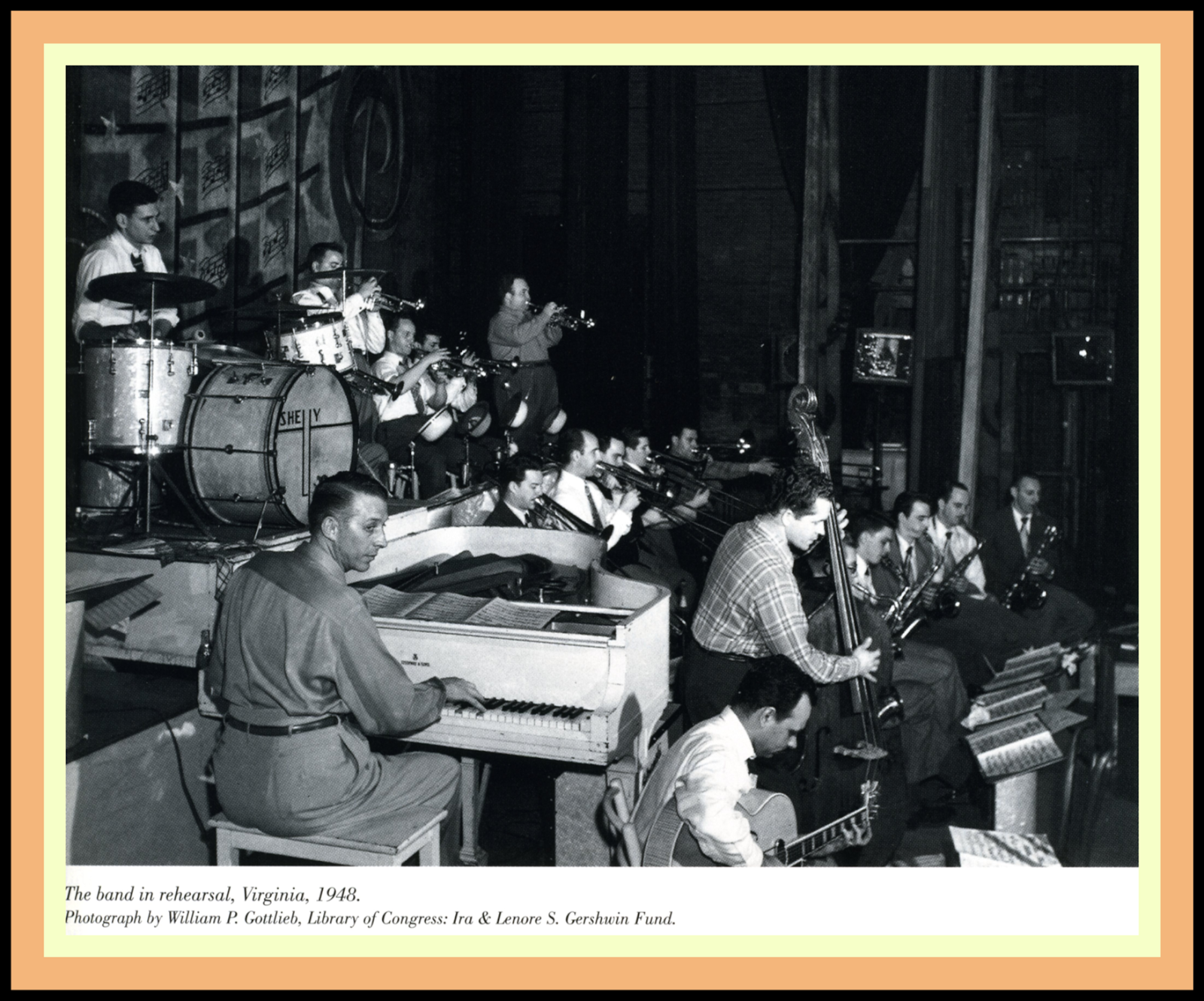
“Stan Kenton always referred to the years when his band was young, the style had not yet been finalized, and its very existence was in jeopardy, as the beginning days. And at the beginning Stan, one of the most successful band leaders of all time, was quite convinced the job was not for him. He wanted a band very much, if only to hear played the library of scores he had written which he felt were new and different and adventurous; but he personally was too tall, too awkward, too tongue-tied to be a leader. His idea was he should play piano and write the music, but someone more capable should front the band for him.


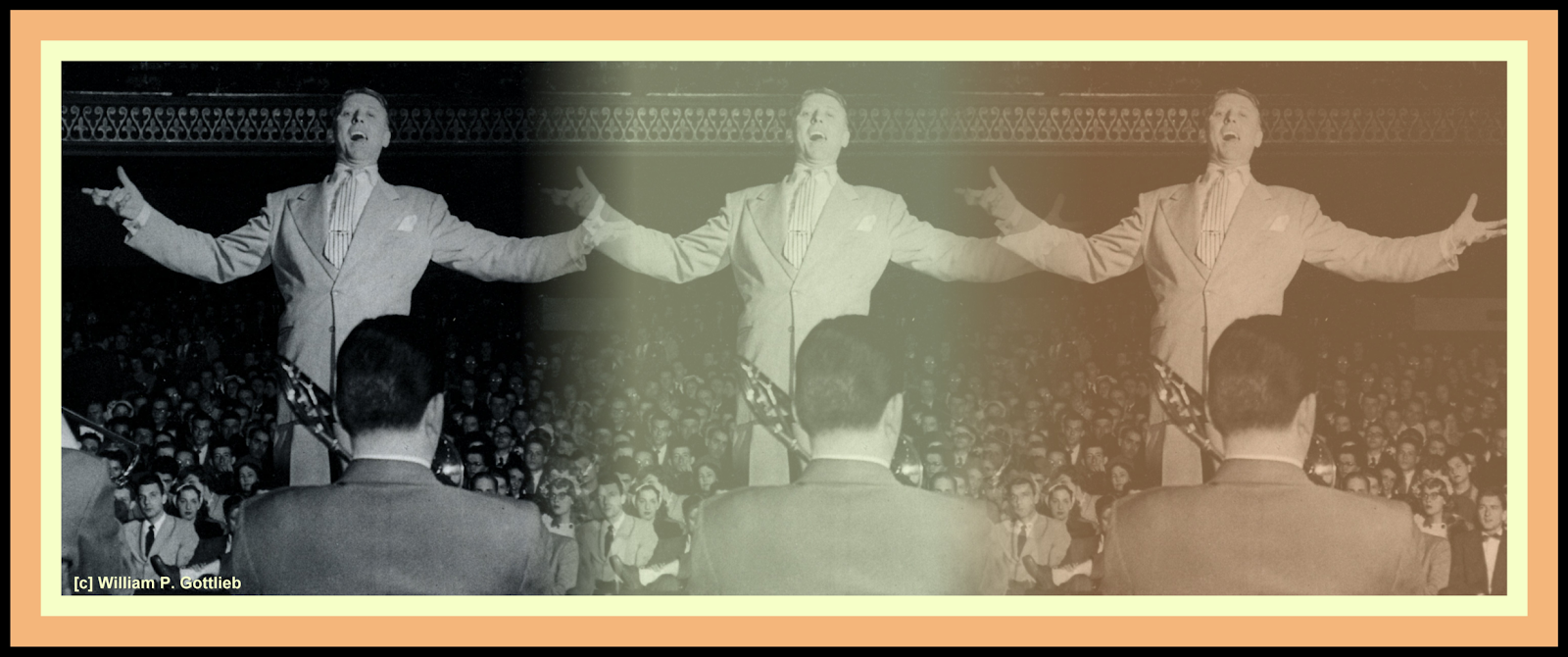
In fact, when Stan conducted, he soon found his infectious enthusiasm, his magnetic personality and sheer physical presence were vital selling points; the Kenton charisma mesmerized his audience, and held them as spellbound as the unorthodox music the band was playing. There had been over a year of workshop rehearsals, test recordings, and more latterly the odd one night stand, before the Kenton orchestra opened its first proper engagement for the summer at the Rendezvous Ballroom in Balboa on June 6, 1941.


It was there that the teenagers of southern California discovered Stan Kenton, and gave him his first taste of success. They identified with his music, and their enthusiasm was reflected in the band's spirit and urged the musicians to greater heights. Stanley gave his all, and demanded as much from every member of the band, who responded with the zeal of men working for a cause, rather than a pay-packet. The sincerity was evident and contagious. As Audree (Coke) Kenton told me, "The Kenton band was so entirely different from anything the kids were used to. It was a totally different sound, and very exciting. Stanley was a dynamic, dramatic conductor. When Stanley got up there, he waved his arms and all but fell off the stage, twice a night. The youngsters responded to this, and what he was giving them was not what they were used to. It was not swing, in the way that Goodman and Shaw were swing; it was something new, and there was a tremendous excitement generated. Part of it was Stanley himself, a lot of it was the music, much of which he had written, and it just knocked the kids out. They had come to dance, but they would end up standing in front of the bandstand, hour after hour."


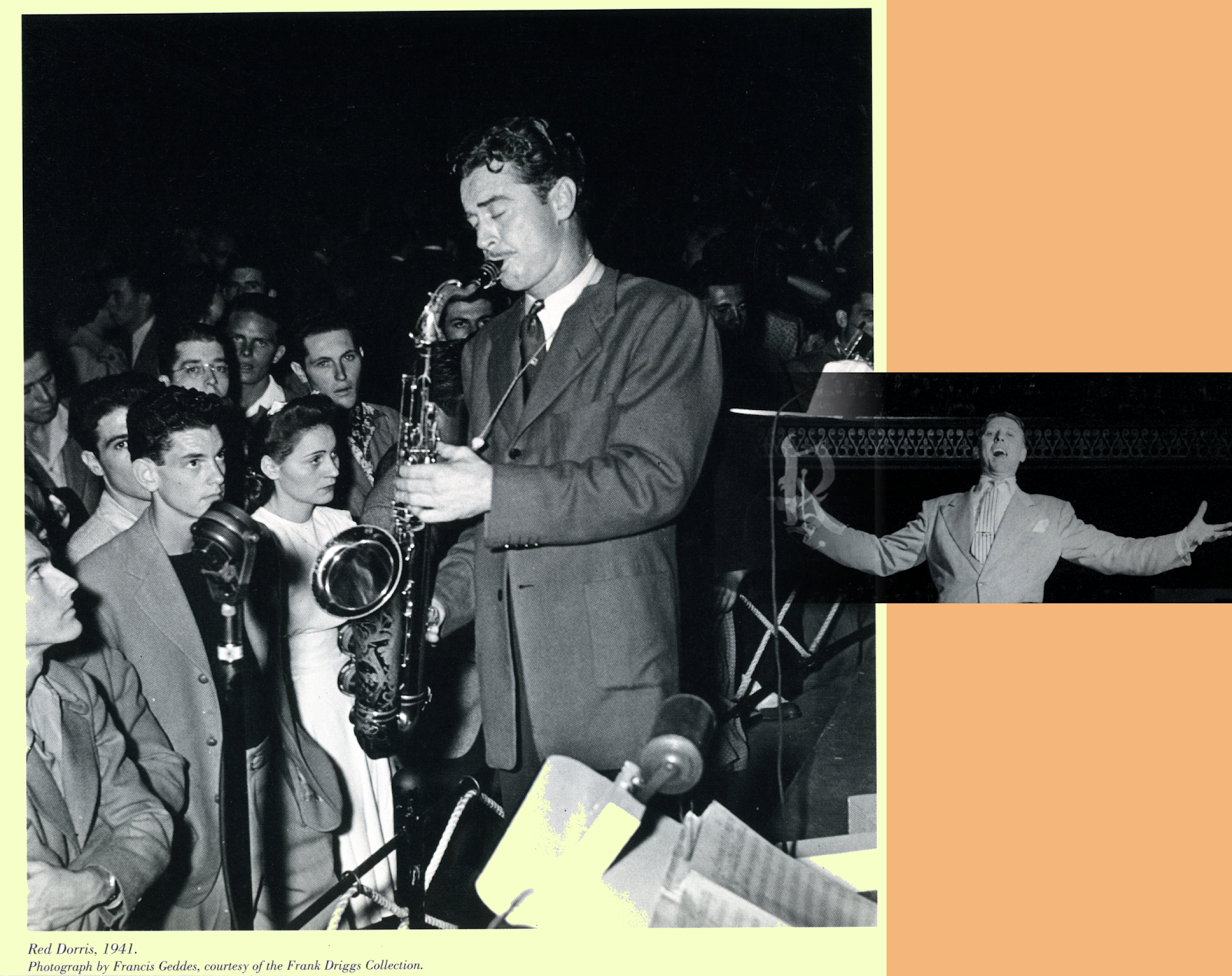
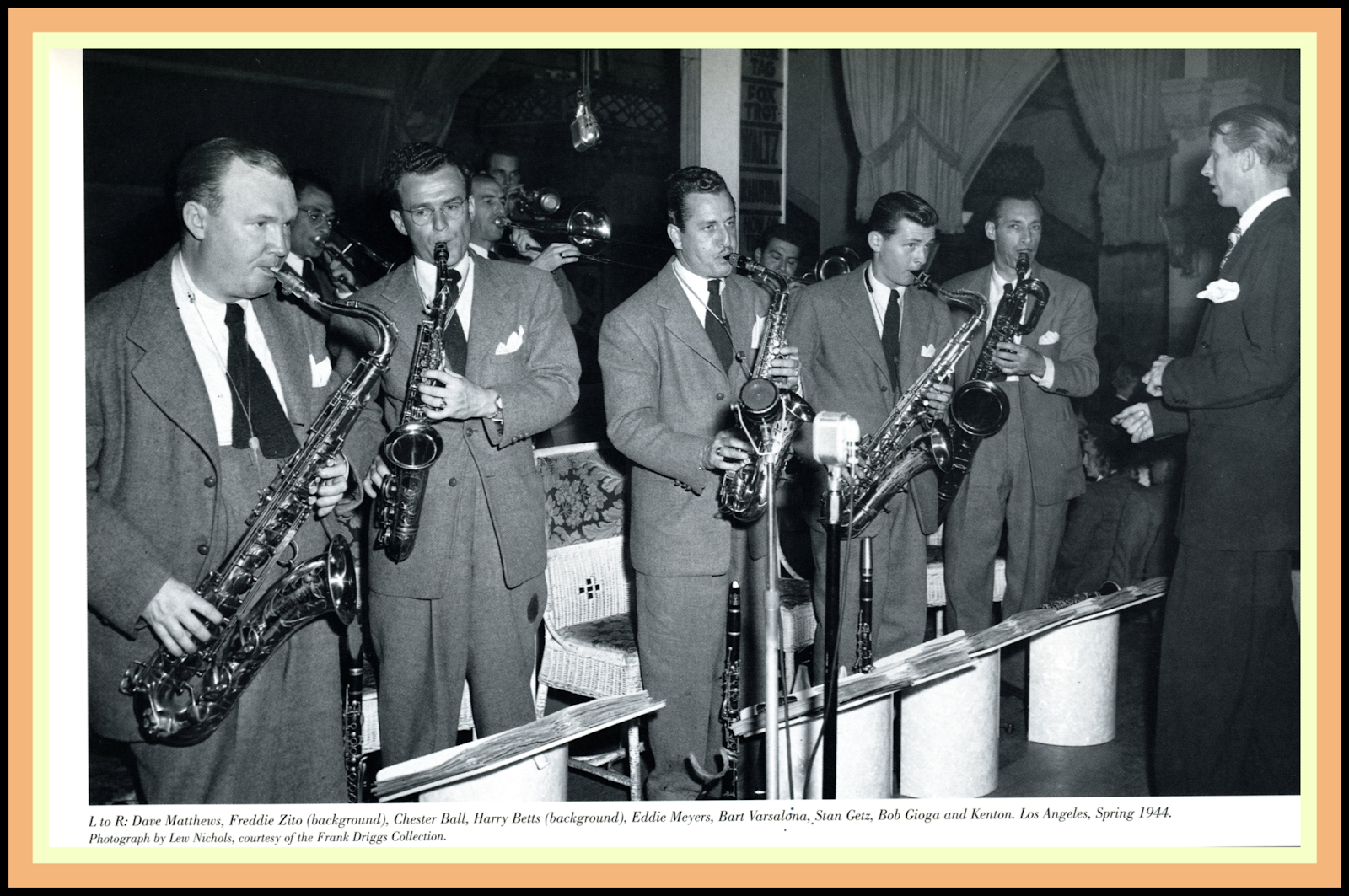
Many of the guys in the band were musicians Stan had enjoyed working with as sidemen in other orchestras (Everett Hoagland, Gus Arnheim, Vido Musso), and whom he knew had similar musical ideals to his own. Key men included Canadian-born trumpet soloist Chico Alvarez, destined to remain a Kenton stalwart for many years; first alto player Jack Ordean, who attracted much favorable attention for his Hodges-inspired saxophone improvisations; tenor saxophone soloist and singer Red Dorris, formerly with Ben Pollack; band manager Bob Gioga, whose baritone anchored the saxophone section until 1953; and bassist Howard Rumsey, who would later lead Lighthouse All Stars.


Every night's performance at the Rendezvous was expertly programmed as Stan explained in a magazine called Band Leaders. "The band was originally designed, through both orchestration and presentation, to thrill as much as possible. I strove for flash and wanted every arrangement, whether slow or fast tempo, to be a production in itself. Everything was written to swing to a driving beat. Spirit and enthusiasm had to predominate at all times. I wanted to play the strongest swing possible and yet to present swing in as elevated a manner as I could. I figured that 11:30 to midnight gave us our high period. Our climax was so complete at that time of night, that had you touched any kid in the audience, I think he would have thrown off sparks!"


The band's style was achieved through the writing of Kenton himself. But as early as 1940 Stan brought in musician-friend Ralph Yaw (who had also arranged for Chick Webb and Cab Galloway) to help ease the burden. Yaw copied the Kenton staccato-style beat and saxophone voicings, commenting, "To my mind, the saxes are treated in the right way for the first time. It really scares me!" Yaw contributed his scores for free because he knew money was tight, and he was happy to write for a band with which he felt so much empathy. During 1941, a young writer named Joe Rizzo also added numerous charts in the Kenton style. "Joe was a young Californian who felt the same way musically as I did," Stan, explained. Even after he was drafted into the army, Rizzo continued to contribute the odd score (I'm Going Mad For A Pad is Joe's), and in later years he became a permanent arranger for the Lawrence Welk TV show.


Despite all the success stories, by no means every night at the Rendezvous was a rave-up. Charles Emge wrote in Down Beat, "It would be an exaggeration to say the band has been a 'sensation.' It's too good to crash through in that manner." And many years later Stan reminisced on CBC radio, "Today we talk about the large crowds that came to Balboa and all the excitement that was created, and honestly, I don't think business was very good that summer. In fact, I remember times when we played that I actually worried about whether the owner of the ballroom was going to come out financially or not."


Nevertheless, the publicity roused led directly to a Decca recording contract. But the first session was a dismal failure, the producer insisting on a toned-down taboo, and three other titles that were cover versions of existing hits, rather than the jazz scores the band was familiar with. Much better were the dozens of sides recorded for radio play by C.P. MacGregor Transcriptions. And on November 25, 1941, Kenton opened to excellent business at the most famed west coast ballroom of them all, the Hollywood Palladium. Count Basic told the story of how one night he invited his musicians traveling to their next job by bus, to listen to a Kenton broadcast from the Palladium. "That," Basic told his bandsmen, "will be the next king!"


Basie was right, but the crown was still several years away. On their first visit to New York in early 1942, Stan's music certainly did not thrill patrons of the Roseland Ballroom, where the band (in the vernacular) "fried an omelette." Everyone knew that Roseland, home of hostesses and strict-tempo dancing, was the wrong spot for the jazz happy Kenton crew, but it was still a major setback when the band was pulled out after only three weeks of an eight-week engagement. Word of the Roseland debacle spread quickly, and when a band hit that sort of trouble it was common practice for other leaders to swoop and pick up sidemen for their own orchestras. Kenton said it was Jimmy Dorsey who personally helped him in New York to keep his outfit together and protected him from being raided for musicians by other bands.


The guys hung in there with Stan until the draft started to hurt, but throughout 1942 the band faced an uncertain future and a daily struggle for survival. It was only Kenton's tenacity and belief in his music that enabled him to carry on in the face of public apathy and war-time adversities. Even the critics were beginning their war of attrition, complaining in particular that the music was too loud and pretentious. (It wasn't until the 1970s that Stan's music in general began to be recognized for its worth by the critical fraternity, something the fans had known all along.)


Stan was forced to make concessions to the song pluggers, and play many of the pop hits of the day, usually sung by Red Dorris or Dolly Mitchell (who replaced Eve Knight in September 1942). But Kenton was determined that even pop tunes were going to be played in a musical way, and brought in a young writer named Charlie Shirley to help him with the arranging chores. Shirley told Pete Venudor, "I was hired by Stan because he was impressed with my work for the Sam Donahue band. Kenton was headed for a lot of radio air time and needed a full complement of current pop arrangements. So I was hired to help ease the pressure on Stan and try to develop a pop style for the band. Stan assured me he'd use anything I came up with in the way of experimental stuff, either pop or jazz. We experimented on the ballads with woodwinds and classic voicings, and I feel I had some influence on the direction Stan swung into after the war. Kenton himself was one of the straightest men I've ever met, a valued friend and a fine leader."


In the summer of 1943, comedian Bob Hope was looking for a new band to replace army-bound Skinnay Ennis, and liked what he heard in the Kenton outfit. Stan for his part was desperately trying to balance the books and knew the security of a year's work with the Hope entourage would ease his financial worries. Nevertheless, if ever there was a musical mismatch, the Kenton/Hope collaboration was it. Even as he was preparing to indulge in the onezy-twozy brand of corn demanded by Frances Langford, Jerry Colonna and Hope himself, Kenton was making statements like, "Out of the swing music of today will evolve an original, modern concert music distinctly American in character." Not on the Bob Hope Show it wasn't! Bob's weekly broadcast was probably the most popular on the air, but the house band received limited exposure, and within weeks Kenton was regretting his acceptance of Hope's contract, even though the alternative might have been no band at all.


Commercially a triumph, musically the Hope association was the nadir of Stan's entire career. But Kenton made clear his beliefs had not changed when he told Down Beat in July 1943, "Sure, I've made concessions that I never thought I'd have to make. It was either that or completely giving up a musical idea that I still think is right. But don't think I've said so long to my so-called idealism — I still think the kind of music we used to play exclusively is the best." And things really started to look up for Stan in the fall, when some record labels made overtures to the Musicians' Union to end the first recording ban, then in progress. As a result, Kenton was approached by Capitol Records, a young Hollywood company whose executives expressed a keen interest in the band's music and whose policy Stan felt to be more in keeping with his own brand of idealism than the more conservative Decca label.


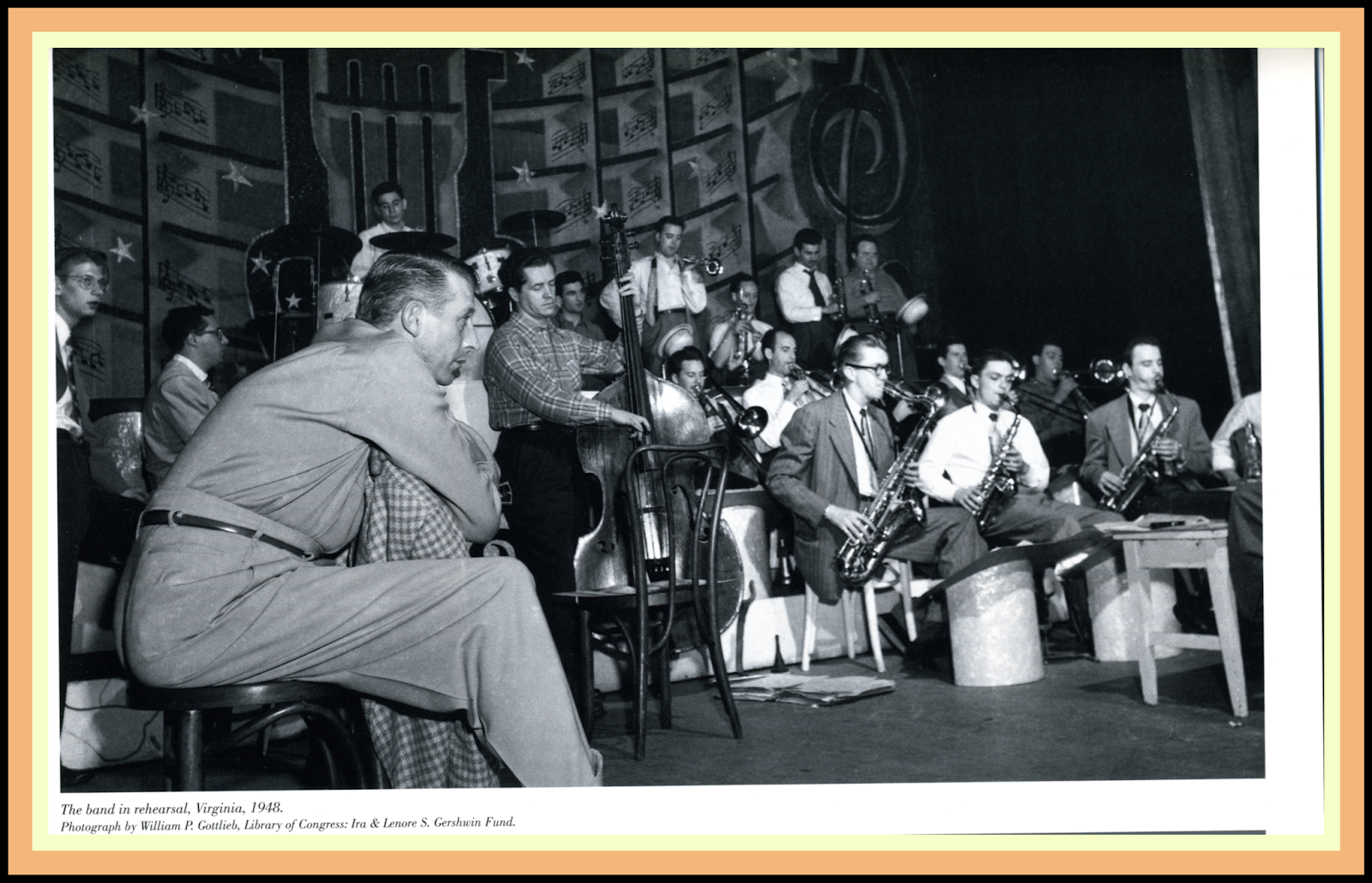
Every Kenton devotee will have his own favorite period from the orchestra's four decades of recorded music. For some it may be the mellophonioum "New Era," for some the Holman/Russo "New Concepts," for others the roaring bands of the 1970s. But for many, the definitive Stan Kenton, the music that above all other epitomizes the sounds that made Kenton distinctive and different, is that of the 1940s, when Stan's reputation had still to be established, and his urge for creativity and experimentation was at its peak. Which is where our musical story in this album begins....”


Tuesday, February 19, 2019

Ken Nordine: 1920-2019

© -Steven A. Cerra, copyright protected; all rights reserved.


“Ken Nordine, yea I know that guy, I heard his voice 1000 times, he's the guy in the hits station that says "go ahead I'll keep an eye on your stuff for you," and you see him the next day walking around town wearing your clothes.


He broadcasts from the boiler room of the Wilmot Hotel with 50,000 watts of power. I know that voice, he's the guy with the pitchfork in your head saying go ahead and jump, and he's the ambulance driver who tells you you're going to pull thru.


He's the guy in the control tower who talked you down in a storm with a hole in your fuselage and both engines on fire.


I heard him barking thru the Rose Alley Carnival strobe as samurai firemen were pulling hose.


Yea he's the dispatcher with the heart of gold, the only guy up this late on the suicide hotline.


Ken Nordine is the real angel sitting on the wire in the tangled matrix of cobwebs that holds the whole attic together.


Yea Ken Nordine, he's the switchboard operator at the Taft Hotel, the only place in town you can get a drink at this hour.


You know Ken Nordine, he's the lite in the icebox, he's the blacksmith on the anvil in your ear.”
-Tom Waits, 1990


“Much more than the creator of Word Jazz, Ken was a true mensch. He gave
back to the community in many ways -- major support for the Chicago jazz
community and the Chicago Film Festival are two that I know about, and
he did it for years. I met him a few times to show him new audio gear
for his home studio, one of the most professional and best equipped in
Chicago. Once I brought him a radically new microphone that was well
suited for recording sound effects, which were quite important to him We
spent a half hour or so together exploring the possibilities. This was
about 35 years ago, so he would have been in his early '60s then, and he
had a very inquiring mind.


After moving to Chicago in 1964, it took me a while to realize Ken
didn't have a single voice, he had many, each distinctively different.
He was a real institution in Chicago broadcasting circles, as well and
in the community at large.
- Jim Brown, audio engineer and sound systems

“Word Jazz has spanned three generations - missed by most, appreciated by the knowing, and awaiting discovery by those with adventurous ears.”
- Irwin Chusid, WFMU, East Orange, NJ


Ken Nordine died on February 16, 2019 and the editorial  staff at JazzProfiles wanted to remember him on these pages with a selection of writings about him and his work. He would have been 99 years of age on April 13, 2019.


The following are Irwin Chusid’s insert notes to the compilation Word Beat CD [Rhino R2 70773] with selections drawn from the Dot Records Word Jazz LPs, which is how many of us first came to know Ken.


These are followed by a story about Ken that appeared in The Chicago Tribune in 1993 that reflects on the later years of his career and the obituary that appeared in the same paper following his passing.


“You can hear Ken Nordine. but you can't see him. In a sense, he's everywhere.


As Jeff Lind pointed out in the Illinois Entertainer: "Nordine would make an excellent subject for one of those American Express commercials — millions have heard his voice on radio and TV  - but virtually no one except his family and business associates would recognize him on the streets."


He's hawked Taster's Choice, Chevrolet, Gallo wines - each, on an estimated 300-400 radio and TV spots a year. You heard him this week and didn't know it.


Commercial voiceovers are what Nordine does for a living. But what does he do for fun? Word Jazz, which he describes as "a thought, followed by a thought, followed by a thought, ad infinitum; a kind of wonder-wandering."


This Rhino collection offers a provocative sampling from Nordine's four volumes of Word Jazz released on Dot Records from 1957-60. With contemporaries like Kerouac, Miles, Lenny Bruce, and Ernie Kovacs, Word Jazz set the stage for the surrealistic mind expansion of the '60s.


Neither strictly jazz nor traditionally musical, Word Jazz explores the nether recesses of one man's whimsical thought processes, a sort of Kafkaesque CAT-scan. Conventional logic leaves the studio, while Absurdity and Humor commandeer the console. The Chicago Reader, in tribute to his "multichannel madness," referred to Nordine as "The Man With the 24-Track Mind."


Plot a map of the Word Jazz kingdom and it would resemble a Candyland game board — if the Mad Hatter wrote the rulebook. There's Adult Kindergarten, where mayors and plastic-awning salesmen hold jam sessions on tabletops and wastebaskets - as therapy. Here's a man, obsessed with Reaching Into In: "...hope grips him by the neck, faith bear-hugs his middle, charity twists against him with toeholds. Three to one isn't fair."


Faces In The Jazzamatazz haunts the Second City's boulevards, "striking matches against the old Chicago midnight," exploring the expressions of hipsters, high rollers, and those "hiccupping home to hangover."


Original Sin and What Time Is It? are fables about "regular guys," whose routines are disrupted, respectively, by mice and an anonymous, persistent 2am phone prankster. In Hunger Is From, Ken goes straight for the refrigerator and never leaves the kitchen: in Down The Drain, he begins with a "sitting down shower" and ends up doing the backstroke in the Caribbean.


During a 1980 interview with Studs Terkel on WFMT in Chicago, Nordine demonstrated Word Jazz's spontaneous evolution: "Suppose I wanted to write a book, an extraordinary book, different from any book ever written. I'd call it Crumple. Each page would be complete in and of itself, and be crumpled and placed in a large cylinder. To read the book, you'd reach in, take out a page, uncrumple and read it, crumple it up, put it back, and take out another. Pages could be read in random order. There could even be suicide notes in it." Add a flute lo this scenario, along with some offbeat trap drums, and - voila! - a Word Jazz is born.


The inventor of this an form was born in Cherokee. Iowa, to Swedish immigrant parents, but his family moved to Chicago when he was four. He remembers that "in my teens. I would talk to people on the phone, and they would tell me I should get into radio because I had a good voice." He enrolled at Northwestern School of Speech, but quit after two weeks ("It was too dull"). Nordine then infiltrated Chicago's WBEZ radio in the '40s; from there, he moved to WBBM (CBS), where he did staff announcing for two years ("under four different names." he admits). When TV became king. Nordine hosted a late-night, one-camera series called Faces In The Window, featuring Gothic readings of Poe, de Maupassant, and Balzac (on commercial television, years before PBS existed).


During the early '50s. he hung out with sidemen Johnny Frigo and Dick Marx (singer Richard's father) at a North Side joint called the Leia Aloha, telling stories and reciting poetry with improvisational jazz accompaniment. "I wasn't a beatnik, though." he stresses. "I was totally isolated from what was happening in San Francisco."


In 1955, he was asked by Randy Wood at Dot Records to narrate the orchestra/chorus rendition of bandleader Billy Vaughn's The Shifting. Whispering Sands, ("It was written by a southern Illinois minister." Ken notes, "and I wanted to correct the grammar.") The single became a Top 5 hit. Impressed with Nordine's thunderous delivery. Wood signed him to a contract. Ken's first Dot LP, Love Words featured melodramatic recitations of standard love songs. "The nicest thing I can say about it." he now recalls, "is that It was a very weak idea." If you happen across a rare copy. Nordine invites you to "sit on it."


Thereafter, he hit a groove: The premier Word Jazz album was followed by Son Of Word Jazz,  Next!, and Volume II released over a four-year span. The vignettes, he explains, were "orally rehearsed, based on an idea, although some were thoroughly scripted." There was. moreover, always room for ad-lib, "the jazz aspect, so you had freedom within the literary changes." Accompaniment was provided by session hoppers like Frigo and Marx, Fred Katz, Paul Horn, Red Holt, and John Asano. Equally important was engineer Jim Cunningham, who employed imaginative (often electronic) sound effects drawn on the musique concrete [which involves using sounds found in nature, distorted in various ways, to create music] of Cage and Stockhausen (check out The Sound Museum).

Though artistically acclaimed and selling respectably,  the LPs weren't big moneymakers (it's doubtful Dot expected them to be), and Nordine continued doing commercials for clients such as Miller Beer and Motorola. Word Jazz made friends in odd places: Fred Astaire and Barrie Chase choreographed a routine to My Baby. Ever the cult figure. Nordine was invited to cameo on Chicago psychedelic band H.P. Lovecraft's second LP ('68) improvising the track "Nothing's Boy."


He made two marginal albums for Phillips: Colors (1968), featuring two dozen 90-second impressionistic monologues on such shades of the rainbow as lavender, russet, azure, and ecru, and Twink ('69), consisting of Nordine reading 34 of Bob Shure's gently absurd dialogues backed hy Dick Campbell's instrumental combo. In '72. the ill-fated Blue Thumb label released a twin-pocket retrospective, How Are Things In Your Town?, the title derived from the tagline of Flibberty Jib, became instantly collectible when the label folded shortly after. Flibberty Jib was subsequently adapted by Levi's for an animated television commercial, narrated by the author and introduced to millions who had never heard the original.


In '78. Nordine incorporated his own private label, Snail Records ("We want things that catch on slowly"). For Snail's first release, he updated the Word Jazz formula and spawned Stare With Your Ears, which was nominated for a Grammy. All the while. Nordine stayed busy and earned a tidy nest egg with commercials and voice over assignments.


In the '80s. the formula not only survived, it thrived. Nordine (through Snail) released the cassette-only Grandson of Word Jazz and Triple Talk. He produced more than 300 half-hour Word Jazz and Now, Nordine programs for National Public Radio. In 1989. he did a short take on Hal Willner's Felliniesque Disney tribute album, Stay Awake, backed by jazz mavericks Bill Frisell and Wayne Horvitz. Willner. a long-time enthusiast (You're Getting Better is one of his favorites), later invited Nordine to appear on his free-form NBC-TV program, Night Music.


Ken attests to being a big fan of Joe Frank's contemporary radio noir program, "Work In Progress," which explores similar psychic terrain (albeit in different ways). Frank describes the parallel as "the feeling that the person doing the talking is alone and reaching out to you, the listener. There's something highly personal in Nordine's attempt to make meaningful contact either through intellect, emotion, or humor. There's also an air of mystery - you don't know this person, but the person is self-revealing."


Ken still does commercials (recently for Murine and Bank Of America), and occasional he sneaks oft lo his summer shack in Spread Eagle, Wisconsin to kickback on the porch, follow fireflies, and wonder-wander. He describes the hamlet as "25 or 30 years behind the times." But then, Nordine has always been a man as comfortable glancing in a rear-view window as in a crystal ball. Word Jazz has spanned three generations - missed by most, appreciated by the knowing, and awaiting discovery by those with adventurous ears.”


Irwin Chusid
WFMU, East Orange, NJ


KEN NORDINE WEAVING HIS YARNS

Dennis Polkow, a Chicago freelance writer CHICAGO TRIBUNE May 9, 1993


Chances are, even if you've never heard of Ken Nordine, you've still heard Ken Nordine.


Nordine has sold any and everything with his voice, reigning as the king of voice-overs for radio and television commercials for over 50 years. The guy could probably sell us swamp land in Siberia if he wanted to, with a basso so


Somewhere during the beatnik era of the mid-'50s, Nordine, a great lover of jazz, decided to experiment with what he dubbed "Word Jazz"-i.e., reading his own poems to improvised music.


Among his earliest and largest fans were some Bay area kids who would a decade later begin a rock group called the Grateful Dead. "Jerry Garcia has renewed my entire career," Nordine candidly told the cheering crowd at the Vic Theater Friday night, largely a combination of New Age types in black and ever faithful tie-dyed Deadheads.


Since several band members performed on Nordine's latest "Devout Catalyst" album on Grateful Dead Records, perhaps they expected one or more of the Dead to make an impromptu appearance, as Nordine had done when the band played the Horizon in March.


Whatever the crowd may have expected, what it got was a master storyteller spinning clever yarns about everything from how he got into radio, to a portrait of a North Side sports bar with a fat bartender named Skinny.


"Can we have some music for the beginning of the universe," bellowed Nordine back to his five-piece band, which included his son, guitarist/keyboardist Kristan Nordine, vocalist Bonnie Herman, harmonica player/keyboardist Howard Levy, trumpeter and bassist Eric Hochberg, and drummer Jim Hines. "Yeah, yeah," said Nordine, responding to the pedal points and impending groove. "That's probably the way it sounded. Close your eyes-unless you're driving."


Despite the "Word Jazz" label, it is not so much Nordine's words that are jazzed - most are scripted - but rather, Nordine's live word paintings are used as a springboard for the musicians to create an appropriate musical texture to surround them, which they all did admirably.”


OBITUARY


Rick Kogan, Chicago Tribune, February 16, 2019.


“Before you read the words written below about the life and times and accomplishments of a man named Ken Nordine, who died Saturday at his North Side home at the age of 98, it would be a good idea for you to listen to whatever you can find at http://www.wordjazz.com.


What you will discover is the one-and-only voice of Ken Nordine, one of the few people in the history of radio to use the medium to its fullest potential, rather than as a forum for blather, confrontation, inanities and noisy nonsense. He made a kind of vocal music as the voice of thousands of commercials and as the force behind a new art form he created and called “word jazz.”


You may never have heard the Ken Nordine name, but there is no doubt you have heard him. He was often referred to simply as “The Voice,” and you will read elsewhere that he possessed “the voice of God.” As complimentary as that may be, it is hyperbole. Nordine’s voice was as distinctive as any, but it also carried a palpable and unforgettable humanity. For the Chicago Blackhawks, he gave voice to these four unforgettable words — “Cold steel on ice” — that remain firmly embedded in local minds.


Those many hockey commercials were crafted by Chicago’s Coudal Partners advertising/marketing firm through the 1990s and into the next century. Kevin Guilfoile, now a successful novelist and screenwriter (castofshadows.net), was intimately involved in the process.


“Working with Ken was a thrill and an inspiration,” Guilfoile said Saturday. “He was a one-of-a-kind master poet, performer and producer — one of those rare people with a brilliant singular vision and also the creative and technical chops to make that vision a reality all by himself. There was something so pure about his art.


“He was also a pleasure to work with. When I heard the news of his death, the first thing I did was call (firm president) Jim Coudal, and Jim said, ‘There was nothing like answering the phone when Ken called.’ That’s so true. Just hearing your name said by that voice could give you chills.”


Nordine was born on April 13, 1920, in Cherokee, Iowa, the son of Theresia and Nore Nordine. His father was an architect/builder, and some of his work sparkled along the lakefront during our 1933-34 World’s Fair. This is where the family settled and where Ken attended what is now Lane Technical College Preparatory High School and the University of Chicago.


He started work in 1938, making $15 a month running a mimeograph machine at the studios of WBEZ, when that radio station programmed exclusively for the public schools. He then moved on to announcing jobs at stations in Florida and Michigan before returning here to become a staff announcer for WBBM-FM and to start making radio commercials.


One writer described his voice as an instrument that "muses and oozes like molten gold."


In 1945, he married Beryl Vaughan, also a talented voice artist on such old radio program as the "Lone Ranger" and, for a time, was a Hollywood actress.


They settled into a home on the North Side and raised three sons.


“My father loved Chicago, deeply,” said his eldest son, Ken Jr., who worked for many years as an engineer and producer alongside his dad. “He was ever turning down opportunities to work in New York or Los Angeles.”


As successful as Nordine’s announcing and commercial work was, he was creatively restless and drawn to more adventurous vocal avenues. One night in 1956, he was reciting the poetry of T.S. Eliot and Edgar Allan Poe for musicians Johnny Frigo and Dick Marx at a Wilson Avenue club called the Lei Aloha. He ran out of poems and started to improvise. Thus was born what he called “word jazz,” a concept that would go on to spawn a dozen record albums, a syndicated radio show and make him a legend.


In 1990, Nordine accepted an invitation from Jerry Garcia and the Grateful Dead to perform with them at a New Year's Eve concert. He would also collaborate with David Bowie, Tom Waits and many others in a late-life career that compelled one writer to call him “an underground hipster for the ages.”


None of this went to his head. “He was just the loveliest guy,” Guilfoile said. “And surprisingly for someone of his generation, he was fascinated with new processes and technology.”


Shortly after celebrating his 85th birthday with a party at the Chicago Yacht Club in 2005, he sat in his home and excitedly showed off his brand-new DVD, his first. It was titled, “The Eye is Never Filled,” a phrase that he remembers his mother saying to him repeatedly when he was very young. He told me then, “This is word jazz in morphing pictures” and described it as something that “looks like it was done under the influence of LSD.”


Nordine lost his wife in 2016 and 18 months ago suffered a stroke. “That kind of inhibited his ability to create,” said Ken Jr. “He was no longer able to use a computer, but he kept modestly active. He just slowed down a bit.
“You hear so much about my dad’s special voice, but the thing was he knew how to use it. He also had such a special mind that enabled him to deconstruct the world and put it back together in the most compelling ways.”


Those ways are still, and ever, available, at wordjazz.com, and he is also survived by sons Kristan, a musician, and Kevin, a filmmaker; 10 grandchildren; and four great-grandchildren. A memorial service is being planned.”