Saturday, November 20, 2021

Keepers of the Flame and Giants by Whitney Balliett

 © Copyright ® Steven Cerra, copyright protected; all rights reserved.

The Boston Globe stated: “Balliett’s genius for pictorial description (which helps make him a gifted writer of profiles) extends to the music itself. No one writes about what they listen to anywhere near as well.”


Although he played drums during his college days and was a member of a band, Whitney was not a studied musician. He had no formal training in theory and harmony so during the 40+ years he wrote Jazz profiles for The New Yorker magazine he had to fall back on his other gifts when describing the music - his gift for “pictorial description.”


In many ways, this made Whitney’s Jazz writings more accessible to the majority of Jazz fans since they, too, for the most part, lacked procedural training in melody, harmony and rhythm - the building blocks of music.


As a result, "Balliett comes as close as any writer on jazz—perhaps on any musical style — to George Bernard Shaw's intention to write so that a deaf person could understand and appreciate his comments. This volume approaches indispensability." Choice reviewing Balliett’s American Musicians.


The editorial staff at JazzProfiles thought it might be fun to share some briefer pieces from the pen of our ideal - Whitney Balliet - to give you an appreciation for his “ … genius for pictorial description.” This is the sixth in a series of six continuously running featuring Whitney’s sui generis pictorially descriptive approach to writing about Jazz which is marked by what Gary Giddins has labeled “writerly attributes: insight, candor, observation, discernment, delineation, style, diligence and purpose.”


These are all drawn from Goodbyes and Other Messages: A Journal of Jazz 1981-1990 [1991]. This is number 6 in a series.


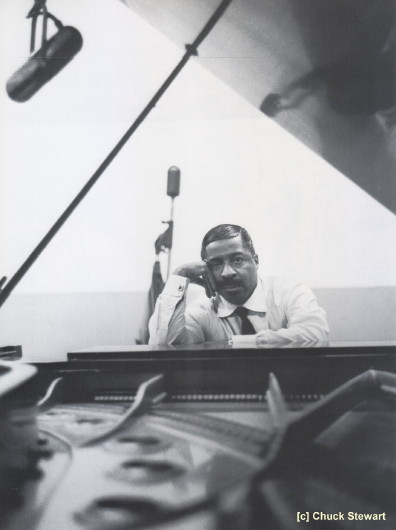
Whitney’s book concludes with chapters that offer a look at what he terms “Keepers of the Flame” in which he includes the sui generis pianist Erroll Garner and “Giants” which offers a wonderful description of vocalist Sarah Vaughan’s unique talents.


As regards, the former, Whitney comments:


“It is surprising that pianists should be the keepers of the flame, for the piano—inflexible and percussive and vibrato-less—does not transmit emotion easily. But jazz pianists, repeatedly beating back the army of broken, out-of-tune pianos which has besieged them since the beginning of the century, have learned how to circumvent the instrument's coldness. By raising and lowering their volume in strategic places, they startle the listener and italicize their phrases. They get vibratolike effects by holding certain notes, and by using the little tremolos that Earl Hines invented. And they place notes, and even chords, in unexpected spots—a rhythmic juggling that creates a fine tension.” 


He then turns to an explanation of how all these devices are in evidence in the playing of Keeper of the Flame, Erroll Garner [who could just as easily be included in the Giants category, too].


“Erroll Garner died in January of 1977, at the age of fifty-three. From the mid-forties, when he first arrived in New York from Pittsburgh, until 1975, when he gave his last public performance, in Chicago, he travelled around the world, obsessed by his music, delighted, inexhaustible, casting his shadow over almost every pianist who heard him, and making his audiences marvel at his ebullience and his melodic invention. Garner, who never learned to read music, could reportedly reproduce the styles of all the great pianists who preceded him, but his own style was inimitable, no matter how often it was copied. He liked to open a number with an ad-lib cadenza, lasting eight or ten bars and giving no indication of what was to come. Then he would drop his volume and go into tempo, his right hand embellishing the melody with behind-the-beat notes broken by offbeat chords, and his left hand keeping strict time with on-the-beat guitarlike chords. He would take the volume up slightly at the bridge and shift into double-time octave chords, lower his volume again, and close the chorus with staccato notes that gave the impression they were wildly trying to break off from the melody they were a part of. The rest of the number would be a constant round of raised and lowered volumes, doubled or halved rhythms, staccato and legato passages, and boiling chordal interludes that wiped his melodic slate clean and prepared the listener for his next surprise. Garner's fast numbers skimmed the earth, and his slow ballads were stately, ceremonious dances.


Garner made countless recordings. Whenever the spirit moved him, he'd rent a studio, summon his bassist and drummer, set down a dozen or more numbers — usually one take apiece. For years, there have been rumors of a trove of unreleased Garner material, and at long last Martha Glaser, his manager and producer, has begun to issue what she believes is the best of it. The first two albums include twenty numbers and are drawn from five different sessions—three in 1961, one in 1964, and one in 1965. The third includes fourteen numbers, set down during one session in 1954. Almost all are prime Garner. (Of course, he had off days. There are missed notes, chords that don't quite land where they should, and endings that don't return to earth.) On the first album, "Easy to Love," he plays a slow, dancing "September Song''; a hustling "My Blue Heaven," its second bridge constructed of an exuberant boppish trumpet line; a "Somebody Loves Me" that includes an even more rakish single-note passage; a medium "As Time Goes By," with a laughing Debussy introduction; and a very fast "Lover Come Back to Me," with a bridge in which his hands invent totally different melodic and rhythmic lines in exhilarating counterpoint.


The second album, "Dancing on the Ceiling," is memorable for a seesawing staccato line in "It Had to Be You"; for a rocking, medium-tempo "After You've Gone," in which Garner takes the breaks — miniature wonders in themselves — and moseys along behind the beat; a strange, slow, rhapsodic gospel blues, "Like Home," played largely with the loud pedal and with heavy, damask chords; and a stomping, new "Ain't Mis-behavin'." 


The third album has at least six marvels. There is an easy "Margie," an unexpectedly fast "Way Down Yonder in New Orleans," and a medium-tempo "Louise," full of delayed notes, and double-time chords. There are a fast, ripping "My Gal Sal," a sly "Too Marvellous For Words," and a virtuosic reshaping of Zez Confrey's brittle 1921 "Kitten on the Keys." Audible on all three albums are the hums, grunts, "myeh's, and "oh-oh"s that Garner uttered as he played, the sounds of a man leaning deliriously into his work.
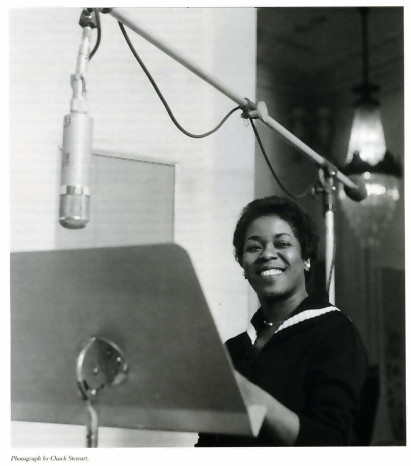

In the chapter on Giants, Whitney includes comments about recent recordings on Verve featuring Art Tatum and an assessment of the techniques that place vocalist Sarah Vaughan in this category.


Virtuosos do not fit easily into jazz. The music revolves around improvisation, and jazz improvisers need only enough technique to play what they hear in their heads. (The drummer Sidney Catlett never considered himself a virtuoso, but he got off certain dazzling snare and cymbal patterns that not even the virtuosic Buddy Rich could match. Catlett's technique was an extension of his imagination; impossible figures popped into his head and instantaneously became real.) Too much technique saps improvisation: it causes floridity and grandstanding, and it tricks audiences into believing that bombast is music. Jazz has harbored two undeniable virtuosos (Rich may have been a third), but no one has ever known quite what to do with them. They are Sarah Vaughan, who died last spring [1990] at the age of sixty-six, and Art Tatum (1909-56), whose final recordings have been issued — with an hour of previously unreleased material — on six compact disks called "Art Tatum: The Complete Pablo Group Masterpieces."


Sarah Vaughan was born in Newark and joined Earl Hines' big band as a singer and second pianist when she was nineteen. She never had any formal training  —she was a bebop baby. Charlie Parker and Dizzy Gillespie were in Hines' band, and so was the singer Billy Eckstine. Vaughan made her first recordings with Eckstine when he formed his own big band in 1944, and a year later she made a small-band record with Parker and Gillespie. By the end of the fifties, she had become a famous singer who moved easily between jazz and popular song. By the end of the sixties, she was a singer of operatic dimensions. She grew to diva proportions, and so did her voice. She had four octaves, each clear and spacious. She sang falsetto, and she could sound like a baritone. She could drop from soprano to baritone in the space of one word. Her low tones were cavernous and her high notes were silver peaks. She had several different vibratos, and when it pleased her she could sing without any vibrato at all. (Think of the Kate Smith singers of the thirties: their vibratos led them.)


In 1980, the composer, conductor, and critic Gunther Schuller introduced Vaughan at a recital she gave at the Smithsonian, and he said that she was "the greatest vocal artist of our century," a hosanna that he immediately complicated by adding that she was "the most creative vocal artist of our time." 


This was true. She was a wonderful embellisher and improviser, who never sang a song the same way twice. She remade her materials — generally, the songs of Rodgers and Hart, the Gershwins, Kern, Porter, and Arlen—in her own image. The cost to the songs was sometimes high. She altered melodic lines and harmonies, mislaid lyrics, and used so much melisma that the words became unintelligible. At her most unfettered, she became a horn singer. Yet her melodic lines were of such complexity and daring that no horn player could have played them. Ultimately, she became a kind of abstract singer, whose materials were inadequate for what she did but were all she had. She could, of course, also sing a song relatively straight. But the richness of her voice was always there, and, no matter how few melodic and harmonic alterations she made, this richness tended to overshadow the song, to lean over it, like a voluptuous woman reading a book.


Vaughan and Art Tatum revelled in their techniques. Vaughan liked to show off her intervals, her perfect pitch, her vibratos, and her range. Tatum liked to show off his touch (the envy of every pianist of the past fifty years), his startling speed, his two-handed runs, and his left hand, which could match his right. As Vaughan and Tatum grew older, they inevitably leaned more and more on their technical tricks. Vaughan shuttled between her registers, held notes so long they took on a life of their own, and pretended she was Joan Sutherland or Paul Robeson. Tatum released harmonic clouds, making his chords sound as if they had fifteen or twenty notes, and connected them with long runs—coils of sound that trapped the listener and freed Tatum of the burden of fresh improvisations. He gave the impression at such times that he was speeding luxuriously through the song; in reality, he was pedalling easily in place. Both Vaughan and Tatum were worshipped by their audiences and by their fellow musicians — for their bravura effects and for their musicianship — and they wore their mantles with a pleased arrogance.”



Friday, November 19, 2021

"Miles" - Whitney Balliett

 © Copyright ® Steven Cerra, copyright protected; all rights reserved.


“He has never been much of a technician, and he has been clever enough to keep his style within his abilities.”


“He also softens his attack with his tone. It is full, but it is not a brass tone, a trumpet tone. It is human sound compressed into trumpet sound. Davis has succeeded in making almost visible the emotions — longing, sadness, pity — that move just beneath his complex surface.”


“Davis's eyes, looking into the middle distance, are cold and furious, as if he were tallying the various imponderables that have kept him from becoming the genius he believes himself to be.”

- Whitney Balliet


The Boston Globe stated: “Balliett’s genius for pictorial description (which helps make him a gifted writer of profiles) extends to the music itself. No one writes about what they listen to anywhere near as well.”


Although he played drums during his college days and was a member of a band, Whitney was not a studied musician. He had no formal training in theory and harmony so during the 40+ years he wrote Jazz profiles for The New Yorker magazine he had to fall back on his other gifts when describing the music - his gift for “pictorial description.”


In many ways, this made Whitney’s Jazz writings more accessible to the majority of Jazz fans since they, too, for the most part, lacked procedural training in melody, harmony and rhythm - the building blocks of music.


As a result, "Balliett comes as close as any writer on jazz—perhaps on any musical style — to George Bernard Shaw's intention to write so that a deaf person could understand and appreciate his comments. This volume approaches indispensability." Choice reviewing Balliett’s American Musicians.


The editorial staff at JazzProfiles thought it might be fun to share some briefer pieces from the pen of our ideal - Whitney Balliet - to give you an appreciation for his “ … genius for pictorial description.” This is the fifth in a series of six continuously running featuring Whitney’s sui generis pictorially descriptive approach to writing about Jazz which is marked by what Gary Giddins has labeled “writerly attributes: insight, candor, observation, discernment, delineation, style, diligence and purpose.”


These are all drawn from Goodbyes and Other Messages: A Journal of Jazz 1981-1990 [1991]. This is number 5 in a series.


Published in 1989, two years before Miles’ death in 1991, this piece is at once an overview of the highlights of Miles career through a parsing of the Miles autobiography that was published in the same year as Whitney’s profile as well as an analysis of why, despite limited gifts as a technician, Davis went on to become such a smashing success in the Jazz World.


“Miles Davis has led a bedevilled life. 


He was born in 1926 in Alton, Illinois, and raised in East St. Louis. He has an older sister, Dorothy, and a younger brother, Vernon. His father was a dentist who eventually retired to a two-hundred-acre farm he owned, in Millstadt, Illinois. His mother was beautiful, stylish and idle. He got on well with his father, but found his mother, whom he loved, possessive, peevish, and heavy-handed. 


He took up the trumpet at ten, and by the time he was in high school he had been given his second trumpet and had met his first idol, Clark Terry. He worked in a local band led by Eddie Randle, then, at eighteen, he suddenly accelerated. He had the first of two children by a woman whom he never married; he graduated from high school; he worked for two weeks in Billy Eckstine's legendary bebop band, with Charlie Parker, Dizzy Gillespie, and Art Blakey; he moved to New York and enrolled in Juilliard; and he began hanging out with Parker and Gillespie and Fats Navarro. A year later, his attractive aura already working, he was on one of the earliest and most famous bebop records ("Billie's Bounce," "Now's the Time"), with Parker, Gillespie, and Max Roach. And he appeared on Fifty-second Street with Parker and Coleman Hawkins. His style, though still hesitant, began to emerge.


In the late forties, inspired by Claude Thornhill's big band, he organized the nonet (among the players Lee Konitz, Gerry Mulligan, Kai Winding, John Lewis, Max Roach) that made the celebrated Capitol album "Birth of the Cool." The nonet's laid-back quality and calm, intricate, deep-red arrangements made it the most adventurous small band since the Ellington small bands and some of the Woody Herman Woodchopper sides of 1946. (The typical small bebop bands of the time were not ensemble groups, like the nonet. They used leaping, tongue-tying unison opening-and-closing collective passages, but the often long solos that came between carried the musical weight.) Davis also began taking drugs. He describes what happened in his new autobiography, Miles (Simon & Schuster): "I lost my sense of discipline, lost my sense of control over my life, and started to drift. It wasn't like I didn't know what was happening to me. I did, but I didn't care anymore. I had such confidence in myself that even when I was losing control I really felt I had everything under control. But your mind can play tricks on you. I guess when I started to hang like I did, it surprised a lot of people who thought I had it all together. It also surprised me." (The book, done with a poet and teacher named Quincy Troupe, is petulant, outspoken, defensive, honeyed, error-filled, and impressionistic — and loaded to the gunwales with four-letter words. Davis uses them more as hammer blows than for their literal meanings, and they soon become a dull barrage, which, for whatever reasons, gradually abates as the book goes along.)


Davis takes pains to point out that he was not alone in his addiction. Many of the best young musicians of the late forties — black and white — became heroin addicts, and he needlessly names them. Here, in the late fifties, is Billie Holiday, one of the most famous victims of this devastating plague: "She was looking real bad by this time, worn out, worn down, and haggard around the face and all. Thin. Mouth sagging at both corners. She was scratching a lot." (There are other eloquent patches in the book, but it is difficult to tell whether they are Davis's or Troupe's doing. Listen to this description of the church music Davis heard early in his life: "We'd be walking on these dark country roads at night and all of a sudden this music would seem to come out of nowhere, out of them spooky-looking trees that everybody said ghosts lived in. Anyway, we'd be on the side of the road — whoever I was with, one of my uncles or my cousin James — and I remember somebody would be playing a guitar the way B. B. King plays. And I remember a man and a woman singing and talking about getting down! Shit, that music was something, especially that woman singing. But I think that kind of stuff stayed with me, you know what I mean? That kind of sound in music, that blues, church, back-road funk kind of thing, that southern, midwestern, rural sound and rhythm.") Davis began stealing and even pimping to support his heroin habit. He was busted on the West Coast. He was busted again when he went home, ostensibly to give up drugs. He quit heroin in 1953, backslid, and quit for good in 1954.


Almost immediately, his professional life turned around. He led two classic recording sessions in 1954. The first consisted simply of two blues, the medium-tempo "Walkin"' and the faster "Blue 'n' Boogie." Each took up one side of a ten-inch LP, and both were played by Davis, Lucky Thompson, f. J. Johnson, Horace Silver, Percy Heath, and Kenny Clarke. Davis's mature style—annunciatory, clipped, vibratoless, singing—dominated both numbers and both recordings. The second recording had three originals and one standard tune, and on hand were Thelonious Monk, Milt Jackson, Heath, and Clarke. (Davis, along with Charles Mingus and Duke Ellington, has always chosen musicians who can both obey and enrich his sometimes abstruse musical designs.) Davis was in a paradoxical mood. Although he loved Monk's playing, he made him lay out behind his solos on three of the numbers. Both recordings were hailed as bellwethers; actually, they marked an enlightened reshaping of the straight-ahead, uncluttered swing of Red Norvo and Count Basie and the trumpeter Joe Thomas. Davis and his men set aside the eccentricities and excesses of bebop (in whose house most of them had been raised) while retaining its broadened harmonic base. A year later, Davis appeared at the second Newport Jazz Festival with a pickup group consisting of Gerry Mulligan, Zoot Sims, Monk, Heath, and Connie Kay — all musicians he had worked with. He played three numbers — open-horn versions of "Hackensack" and "Now's the Time," and a muted, inner-ear "'Round Midnight." His from-the-mountain-top, time-stopping open-horn solos made it clear that Davis, who had been struggling for much of the time since he came East, had arrived. Columbia Records agreed, and before the year was out had signed him to a contract he says was worth three hundred thousand dollars a year. (He stayed with Columbia until 1985, when he went to Warner Brothers Records.) Davis's comments in Miles on the Columbia signing are far from the it's-not-my-fault defensiveness of the artist who has had a windfall: "And yes, going with Columbia did mean more money, but what's wrong with getting paid for what you do and getting paid well? I never saw nothing in poverty and hard times and the blues. I never wanted that for myself. I saw what it really was when I was strung out on heroin, and I didn't want to see it again. As long as I could get what I needed from the white world on my own terms, without selling myself out to all of those people who would love to exploit me, then I was going to go for what I know is real."


Davis had entered his great period. He assembled the first of two working bands, and it included, at various times, John Coltrane, Cannonball Adderley, Red Garland, Bill Evans, Paul Chambers, and Philly Joe Jones. Davis, like Mingus, began experimenting with different kinds of improvisation, and he made the album "Kind of Blue," in which he gave his players modal sketches to work their variations on, and set them loose, one take per number. The results are cool, subtle, edgeless music. Davis was also busy in the Columbia studios making three concerto albums — "Miles Ahead," "Porgy and Bess," and "Sketches of Spain" — in which, accompanied by a big band playing Gil Evans' velvet arrangements, he was the only soloist. (Would that Louis Armstrong had had such cosseting when he was at his height, in 1933!) Davis's second famous small working band arrived in the sixties and had Wayne Shorter, Herbie Hancock, Ron Carter, and Tony Williams. Its repertory moved between mooning, muted ballads and furious up-tempo numbers, in which Davis, always a middle-register player, ventured into the upper regions and used unaccustomed avalanches of notes.


Davis's life since the early sixties has been hill-and-dale. He has been married to and divorced from the dancer Frances Taylor and the actress Cicely Tyson. He has been plagued by medical problems, among them hip operations, a stroke, two broken ankles, pneumonia, and diabetes. From 1975 to 1980, he dropped out. He gave up playing and retired to his house, on West Seventy-seventh Street. Here, brutally, is what he did: "I just took a lot of cocaine (about $500 a day at one point) and fucked all the women I could get into my house. I was also addicted to pills, like Percodan and Seconal, and I was drinking a lot, Heinekens and cognac. ... I didn't go out too often and when I did it was mostly to after-hours places up in Harlem where I just kept on getting high and living from day to day. . . . The house was filthy and real dark and gloomy, like a dungeon." George Butler, of Columbia Records, got Davis back on the track, and he began coming out again in 1981. Since then, he says, he has given up drugs and drinking. He has also given up his house, and now divides his time between Malibu and an apartment on Central Park South.


Although Davis has tinkered endlessly with his music (various types of improvising, odd time signatures, synthesizers, an electric trumpet), his playing, which resides at the still center of all these experiments, has changed little. He has never been much of a technician, and he has been clever enough to keep his style within his abilities. When he came East in the forties, he ignored his limitations, and his solos were sometimes a string of clams. He ignored them again when he had the Shorter-Williams band and began shooting wildly into the upper register, with nerve-racking results. Many people have influenced Davis — Louis Armstrong, Clark Terry, Shorty Baker, Fats Navarro, Ahmad Jamal, Bobby Hackett, Gil Evans, Lester Young, Charlie Parker, and Dizzy Gillespie. Perhaps the heaviest hand on his playing was that of an early teacher who told him never to play with a vibrato, that he'd have plenty of time for a vibrato when he grew old and could no longer control his lip. His no-vibrato attack sometimes gives his playing an abrupt, telegraphic air, but he softens this by using a lot of rests and long notes. He also softens his attack with his tone. It is full, but it is not a brass tone, a trumpet tone. It is human sound compressed into trumpet sound. His solos in the Gil Evans "Sketches of Spain" album have a unique pleading, sorrowing quality. There have been many other players who have got a human sound —  Johnny Hodges, Ben Webster, Red Allen, Pee Wee Russell — but their tonal qualities have never superseded the basic sound of their instruments. Davis has succeeded in making almost visible the emotions — longing, sadness, pity — that move just beneath his complex surface. But his eerie, buttonholing sound is not as common on his recent, synthesizer-controlled recordings, where electronics and odd time signatures dominate the surroundings, and cause him to sound removed and disjointed. The great Davis still resides in his recordings of thirty years ago.


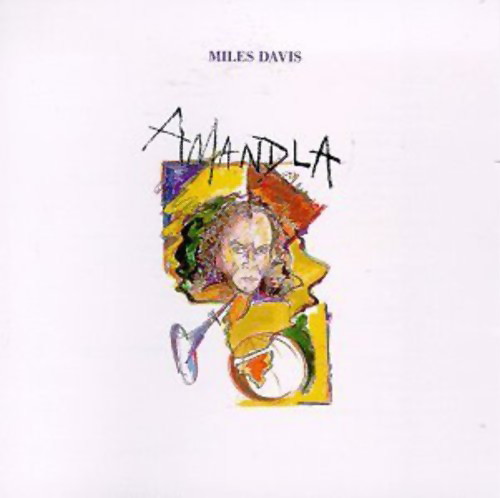
Davis has become a business. On one of his Warner Brothers Records release, "Amandla," he lists his production coordinators, his tour manager, his business manager, and his personal manager. The cover of the album is a semi-abstract self-portrait. (Like such earlier worthies as Pee Wee Russell and George Wettling, Davis has taken up painting.) Beneath Davis's head are the bell of a trumpet and a globe, with the African continent thereon. Davis's eyes, looking into the middle distance, are cold and furious, as if he were tallying the various imponderables that have kept him from becoming the genius he believes himself to be.”


Tuesday, November 16, 2021

Bunny Berigan - Whitney Balliett

 © Copyright ® Steven Cerra, copyright protected; all rights reserved.


“As always, there is Berigan’s incomparable – and irrepressible – swing. … Berigan’s sense of swing was an innate talent, a given talent, a feeling beyond study and calculation, one that Berigan heard in the playing of both Beiderbecke and Armstrong, but which he synthesized into his own personal rhythmic idiom.”


“Berigan’s other great asset was the extraordinary beauty of his tone. Though technically based on perfect breath support, the purity—and amplitude—of his tone was controlled at the moment of emission by his inner ear, as with any great artist renowned for his tone. Berigan could project in his mind and ear a certain sound, and then the physical muscles (embouchure, breathing, fingers) would, in coordination, produce the desired result.”

- Gunther Schuller, The Swing Era


The Boston Globe stated: “Balliett’s genius for pictorial description (which helps make him a gifted writer of profiles) extends to the music itself. No one writes about what they listen to anywhere near as well.”


Although he played drums during his college days and was a member of a band, Whitney was not a studied musician. He had no formal training in theory and harmony so during the 40+ years he wrote Jazz profiles for The New Yorker magazine he had to fall back on his other gifts when describing the music - his gift for “pictorial description.”


In many ways, this made Whitney’s Jazz writings more accessible to the majority of Jazz fans since they, too, for the most part, lacked procedural training in melody, harmony and rhythm - the building blocks of music.


As a result, "Balliett comes as close as any writer on jazz—perhaps on any musical style — to George Bernard Shaw's intention to write so that a deaf person could understand and appreciate his comments. This volume approaches indispensability." Choice reviewing Balliett’s American Musicians.


The editorial staff at JazzProfiles thought it might be fun to share some briefer pieces from the pen of our ideal - Whitney Balliet - to give you an appreciation for his “ … genius for pictorial description.” This is the second in a series of six continuously running featuring Whitney’s sui generis pictorially descriptive approach to writing about Jazz which is marked by what Gary Giddins has labeled “writerly attributes: insight, candor, observation, discernment, delineation, style, diligence and purpose.”


These are all drawn from Goodbyes and Other Messages: A Journal of Jazz 1981-1990 [1991]. This number 2 in a series.


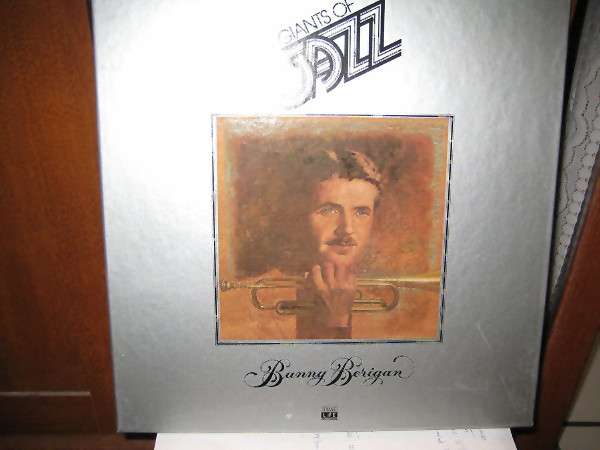
Incidentally used copies of the Time-Life Giants of Jazz Bunny Berigan LPs referenced in this piece can still be found on Amazon, eBay and other online record sellers.


“Louis Armstrong was the first sunburst in jazz — the light a thousand young trumpeters reflected. But two other trumpeters, both less imitable than Armstrong and both suffering from short, damaged careers, were also closely attended. One was Jabbo Smith, and the other was Bix Beiderbecke. These two had an equally evanescent admirer — Bunny Berigan. Out of fashion most of the forty years since his death, Berigan was once revered as a kind of Beiderbecke replacement. But he successfully absorbed both players (along with Armstrong, of course) and constructed his own passionate style.


Born in 1908 in Hilbert, Wisconsin, of a musical Irish-German family, Berigan took up the violin at six, switched to the trumpet at eleven, and had his first professional job when he was thirteen. He never finished high school, and was a full-time musician at eighteen. He moved to New York in 1928, got to know Rex Stewart and the Dorsey brothers, and in 1930 was hired by Hal Kemp. During the next four years, he did studio work, made a great many recordings, and worked for Paul Whiteman. He got married and had children and became a disastrous drinker. 


In 1935, he joined Benny Goodman. Jess Stacy was on piano, and he spoke recently of Berigan: "I worked with Berigan in the Goodman band in 1935 — in fact, travelled across the country with him in Goodman's old Pontiac. He dressed conservatively, and, with his little mustache and his widow's peak and his glasses, he looked like a college professor. He was a wonderful man and an electrifying trumpet player, and he didn't have a conceited bone in his body. He was always kind of not satisfied with his playing. After he took a solo, he'd say, 'I started out great but I ended up in a cloud of shit.' His drinking was awful. We'd stop every hundred miles to get him another bottle of Old Quaker, or some such. Of course, business was so bad until we got to the Coast that it was a panic band, and that didn't help him. We played a dance in Michigan and thirty-five people came  —  all of them musicians. In Denver, we had to play dime-a-dance music, with a waltz every third number. Berigan used to complain about Goodman all the time. Berigan was playing lead trumpet and hot solos, and, finally, every night about eleven, after those difficult Fletcher Henderson arrangements and all the solos, he'd say, 'This is impossible,' and take the last drink — the law-of-diminishing-returns drink — and wipe himself out. We roomed together in Denver, and, what with his drinking and the altitude, he'd wake up at night, his throat dry, thinking he couldn't breathe. He'd tell me, 'I'm dying, I'm dying,' so I'd soak some towels in cold water and wrap them around his head, and that would ease him and he'd go back to sleep saying, 'You saved my life, Jess.' 


I don't know why, but Berigan left the Goodman band while we were at the Palomar in Los Angeles, just after we caught on, and came back to New York, where he had his own little group at the Famous Door, on Fifty-second Street. On the way back from the Coast, Goodman had a long, successful run in Chicago, and when we hit New York we were the top — the biggest thing in American music. I've always wondered if Berigan regretted leaving the band when he did. But he never let on."


Berigan was at his peak during the next couple of years. He recorded with Billie Holiday and Mildred Bailey, and with Tommy Dorsey, Artie Shaw, Johnny Hodges, Fats Waller, and Teddy Wilson. He sat in on a Louis Armstrong date, and one Sunday afternoon he backed Bessie Smith at the Famous Door. In 1937, he put together his own big band. It was spirited and swinging. (The likes of George Auld, George Wettling, Sonny Lee, Dave Tough, Buddy Rich, Joe Bushkin, and Allan Reuss passed through.) But Berigan was a poor businessman, and in 1939 he went bankrupt. His health had deteriorated. He worked briefly for Tommy Dorsey, and put a couple of temporary bands together. He died at the age of thirty-three, in 1942.


One side of Berigan's style was romantic, melodramatic, and garrulous. It had a kind of Irish cast. The other side was blue, emotional, down, funky. He would fool around in his lowest register, playing heavy, resonant notes — gravestone notes. He would play blue note after blue note. Both sides of his style would appear in a single solo. He might start two choruses of the

blues in his down style. He would stay in his low register, growling and circling like a bear. (Only Ruby Braff and Charlie Shavers got the same sound down there.) He would use four or five notes, shaping them into short, reiterated phrases. At the start of his second chorus, he would suddenly jump to a high C or D, go into a flashy descending run, and wing through a couple of large intervals. His vibrato would become noticeable, and his tone would open up. He might dip into his low register at the end of the solo, but he'd finish with a ringing Irish high C. Berigan's execution was almost flawless. 


He was a daring and advanced improviser, who fooled with offbeat and behind-the-beat rhythms and with all sorts of tonal effects. Yet his melodic lines were logical and graceful. There was an outsize quality to all Berigan's playing; he was a three-man trumpet section pressed into one. He dominated every group he was in: on Benny Goodman's recordings of "Sometimes I'm Happy" and "King Porter Stomp" and on Tommy Dorsey's of "Marie'' and "Song of India" his famous solos stand like oaks on a plain. Only Red Allen and Roy Eldridge achieved a similar majesty in their big-band work. (Louis Armstrong's big-band majesty was ready-made; he was often the only soloist.)


Berigan has been brought forward again by a Time-Life "Giants of Jazz" album and by Volume I of the RCA "The Complete Bunny Berigan," which will collect all eighty-nine of the recordings he made with his big band. The Time-Life album contains forty numbers made between 1930 and 1939. The first, a Hal Kemp "Them There Eyes," reveals Berigan as Louis Armstrong, and the last, an all-star "Blue Lou," as himself. Many of the finest numbers in the album were recorded in the mid-thirties with small pickup groups. (Omitted, though, are "Bughouse" and "Blues in E-Flat," done with Red Norvo and Chu Berry, and "Honeysuckle Rose'' and "Blues," done with Fats Waller and Tommy Dorsey.) 


Of particular note are Berigan's long melodic lines on the two Gene Gifford numbers; the three Bud Freeman selections, especially "Keep Smiling at Trouble," where he moves readily back and forth between the two parts of his style,-the growls and low, fat sorrowing notes on "Blues," made with his own group; and the rocking, irresistible way he plays the melody in the first chorus of Irving Berlin's "Let Yourself Go," backed by organ chords and a strong Dave Tough afterbeat. Tough and Berigan galvanized each other. In the Time-Life album, Tough also appears on Dorsey's "Marie'' and "Song of India," set down on one January day in 1937. Berigan's solos in both those numbers possess the eternal resilience that all improvisation aims at but rarely reaches. This quality shines through Berigan's celebrated miniature trumpet concerto "I Can't Get Started." The number, lasting roughly five minutes, begins with a bravura twelve-bar trumpet cadenza played over sustained band chords. Berigan sings a chorus in his pleasant, piping voice. A second, nine-bar cadenza follows, and he launches triumphantly into the melody, ending with a celestial E-flat.


The RCA reissue has thirty-one numbers. The best are "I Can't Get Started," "The Prisoner's Song," "Caravan," "Study in Brown," "Frankie and Johnny," "Mahogany Hall Stomp," and "Swanee River." The rest of the album is given over to songs like "The Lady from Fifth Avenue" and "All Dark People Are Light on Their Feet." Whatever the material, Berigan is everywhere, playing lead trumpet, soloing, filling the air with his serene and muscular poetry.”


Monday, November 15, 2021

"Monk" - Whitney Balliett

 © Copyright ® Steven Cerra, copyright protected; all rights reserved.


The Boston Globe stated: “Balliett’s genius for pictorial description (which helps make him a gifted writer of profiles) extends to the music itself. No one writes about what they listen to anywhere near as well.”


Although he played drums during his college days and was a member of a band, Whitney was not a studied musician. He had no formal training in theory and harmony so during the 40+ years he wrote Jazz profiles for The New Yorker magazine he had to fall back on his other gifts when describing the music - his gift for “pictorial description.”


In many ways, this made Whitney’s Jazz writings more accessible to the majority of Jazz fans since they, too, for the most part, lacked procedural training in melody, harmony and rhythm - the building blocks of music.


As a result, "Balliett comes as close as any writer on jazz—perhaps on any musical style — to George Bernard Shaw's intention to write so that a deaf person could understand and appreciate his comments. This volume approaches indispensability." Choice reviewing Balliett’s American Musicians.


The editorial staff at JazzProfiles thought it might be fun to share some briefer pieces from the pen of our ideal - Whitney Balliet - to give you an appreciation of his “ … genius for pictorial description.” This is the first in a series of six continuously running featuring Whitney’s sui generis pictorially descriptive approach to writing about Jazz which is marked by what Gary Giddins has labeled “writerly attributes: insight, candor, observation, discernment, delineation, style, diligence and purpose.”


These are all drawn from Goodbyes and Other Messages: A Journal of Jazz 1981-1990 [1991].


Monk [Thelonious]


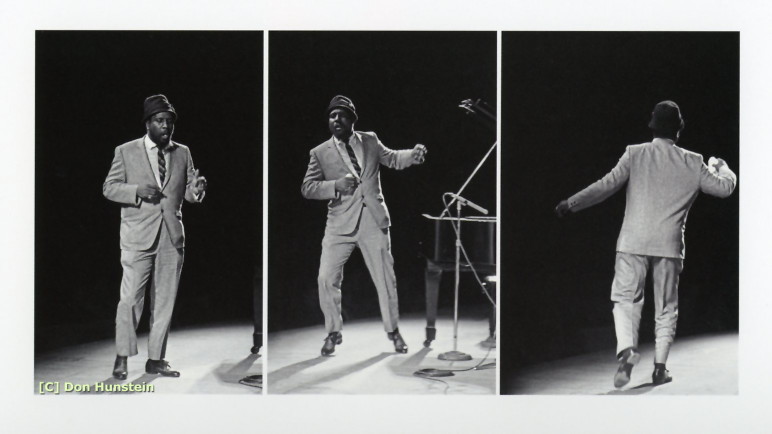
“The pianist and composer Thelonious Monk, who died last week [February 17, 1982], at the age of sixty-four, was an utterly original man who liked to pretend he was an eccentric. Indeed, he used eccentricity as a shield to fend off a world that he frequently found alien, and even hostile. A tall, dark, bearish, inward-shining man, he wore odd hats and dark glasses with bamboo frames when he played. His body moved continuously. At the keyboard, he swayed back and forth and from side to side, his feet flapping like flounders on the floor. While his sidemen soloed, he stood by the piano and danced, turning in slow, genial circles, his elbows out like wings, his knees slightly bent, his fingers snapping on the after-beat. His motions celebrated what he and his musicians played: Watch, these are the shapes of my music. His compositions and his playing were of a piece. His improvisations were molten Monk compositions, and his compositions were frozen Monk improvisations. His medium- and up-tempo tunes are stop-and-go rhythmic structures. Their melodic lines, which often hinge on flatted notes, tend to be spare and direct, but they are written with strangely placed rests and unexpected accents. They move irregularly through sudden intervals and ritards and broken rhythms. His balladlike tunes are altogether different. They are art songs, which move slowly and three-dimensionally. They are carved sound. (Monk's song titles— "Crepuscule with Nellie," "Epistrophy," "Ruby, My Dear," "Well You Needn't," "Rhythm-a-ning," "Hackensack"—are as striking as the songs themselves. But none beat his extraordinary name, Thelonious Sphere Monk, which surpasses such euphonies as Stringfellow Barr and Twyla Tharp.) His improvisations were attempts to disguise his love of melody. He clothed whatever he played with spindly runs, flatted notes, flatted chords, repeated single notes, yawning silences, and zigzag rhythms. Sometimes he pounded the keyboard with his right elbow. His style protected him not only from his love of melody but from his love of the older pianists he grew out of—Duke Ellington and the stride pianists. All peered out from inside his solos, but he let them escape only as parody.


Monk hid behind his music so well that we know little of him. He was brought from North Carolina when he was little, he eventually settled in the West Sixties, and he lived there until his building was torn down. He married the Nellie of his song title, and he had two children, one of whom became a drummer. He began appearing in New York nightclubs around 1940, but he achieved little recognition until the late fifties. (He was often lumped with Charlie Parker and Dizzy Gillespie; however, he did not have much in common with them outside of certain harmonic inventions.) Part of the reason for Monk's slow blooming was his iconoclastic music, and part was the fact that he was unable to perform in New York night clubs from 1951 to 1957 — the time when Charles Mingus and the Modern Jazz Quartet and Gerry Mulligan were becoming famous. (The police had lifted his cabaret card, because he had been found sitting in a car in which narcotics were concealed.) But when he returned to the scene, he suddenly seemed to be everywhere — on record after exceptional record, at concerts and festivals, at the old Five Spot and the Vanguard and the Jazz Gallery. He filled us with his noble, funny, generous music.


Then, in 1973, he vanished again. There were rumors that he was ill and had been taken in by his old friend and mentor the Baroness Nica de Koenigswarter, who lives in a big house in Weehawken, New Jersey. The rumors turned out to be true, and this is what the Baroness had to say about Monk before he died: "No doctor has put his finger on what is wrong with him, and he has had every medical test under the sun. He's not unhappy, and his mind works very well. He knows what is going on in the world, and I don't know how, because he doesn't read the newspapers and he only watches a little telly. He's withdrawn, that's all. It's as though he had gone into retreat. He takes walks several times a week, and Nellie comes over from New York almost every day to cook for him. He began to withdraw in 1973, and he hasn't touched the piano since 1976. He has one twenty or thirty feet from his bed, so to speak, but he never goes near it. When Barry Harris visits, he practices on it, and he'll ask Monk what the correct changes to 'Ruby, My Dear' are, and Monk will tell him. Charlie Rouse, his old tenor saxophonist, came to see him on his birthday the other day, but Monk isn't really interested in seeing anyone. The strange thing is he looks beautiful. He has never said that he won't play the piano again. He suddenly went into this, so maybe he'll suddenly come out." 


But Monk must have known he wouldn't. His last public appearance, at the Newport Jazz Festival of 1976, was painful. His playing was mechanical and uncertain, and, astonishingly, his great Gothic style had fallen away.”


Friday, November 12, 2021

Nat Adderley and Alto Saxophones Players [From the Archives]

 © -  Steven A. Cerra, copyright protected; all rights reserved.


“Julian ‘Cannonball’ Adderley’s enormous personality and untimely death, together with his participation in such legendary dates as Miles’s Kind of Blues, have sanctified his memory …. But brother Nat was a big part of the band they had together from 1959 until Cannonball’s passing in 1975 at the age of 45.

One of the few modern players to have specialized on the cornet, … Nat was always the more incisive soloist, with a bright ringing tone that most obviously drew on the example of Dizzy Gillespie  but in which could be heard a whole raft of influences from Clark Terry to Henry ‘Red’ Allen to the pre-post-modern Miles Davis of the 1950s.”
Richard Cook and Brian Morton, The Penguin Guide to Jazz on CD, 6th Ed.

“Nat Adderley received top billing in the Cannonball Adderley Quintet from 1959 to 1975. Although overshadowed by his brother Julian "Cannonball" Adderley, Nat's own contribution to the band's success was substantial….

Nat contributed to the quintet as both player and composer. He wrote several hits that became jazz standards, including "Work Song," "Sermonette," and "Jive Samba." His instrumental style bears the influence of Clark Terry, Miles Davis, and, in brassier moments, Dizzy Gillespie.

How­ever, Nat's solos are often highly personal in their use of half-valve (slurred) effects, unusual tone color, and a wry sense of humor.

Without him, the quintet would have been an altogether different, and perhaps more somber, band.”
Len Lyons and Don Perlo, Jazz Portraits

Nat Adderley became a bandleader in 1975 without really wanting to ….”
- Orrin Keepnews

As I have mentioned before on these pages, business travel was a constant part of my life, especially during the last two decades of my career.

Most of it was national, some of it was international. Occasionally, and much to my relief, it was local.

One such local trip that I made on a quarterly basis involved visiting a client who owned a business based in Stockton, CA, which is about 80 miles due east of my office in San Francisco.

Since the purpose of these visits involved an early morning meeting with the company’s Board of Trustees, I would usually drive out for dinner with my client the previous evening to discuss the agenda, and then stay the night in a nearby hotel. It was easier than battling the morning traffic and the especially-dangerous morning fog.

A big box bookstore was located in the same complex with the hotel, and as I was restless following dinner, I wandered over to it to kill some time before turning in.

The store carried an extensive display of CD’s [remember those?] and while browsing its collection, I came across some music by Nat Adderley’s group featuring “Vincent Herring,” an alto saxophonist whose name was new to me.

I’d always dug Nat’s playing, the discs were being offered at half price and the “kicker” was that Jimmy Cobb was the drummer on two of the three that I purchased.

Boy, was I in for a treat.

When I returned to the room, I popped one of the CDs into my portable player, put on my ear phones and there went my early night as I stayed up half of it being blown away by Vincent Herring.


Poor Nat; here he was with another fantastic alto sax player.

As was the case with brother Julian, Nat more than held his own, but, man, Vincent Herring was somethin’ else [no pun intended].

As Nat described to Alwyn and Laurie Lewis in his March 1992 interview with them for Cadence Magazine: “Vincent plays Vincent; he has the style of Cannonball’s, but he does not play Cannonball’s licks. And that’s why I like him.” [paraphrased]

Elevating, exciting, electrifying - whatever the best words are to describe Vincent Herring - one thing is certain, you can’t expect to listen to his playing and easily go to sleep, afterwards.

Although a little groggy from lack of sleep, I showed up to the Trustees’ meeting the following morning with a big smile on my face. That and saving the client a good deal of money on their reinsurance placement must have won the day as I was able to renew the contract for one more year.

I owe it all to Nat Adderley, at least, the smile on my face, as if it hadn’t been for him, I most probably wouldn’t have discovered Vincent Herring.

Judge for yourself whether it was a worthwhile finding as Vincent is featured on the audio track to the following video tribute to Nat. Work Song is one of Nat's more famous tunes. David Williams on bass and Jimmy Cobb on drums and Larry Willis does the honors on piano.


Thursday, November 11, 2021

Art Pepper - 1925-1982 And His "Second Career"

 © Copyright ® Steven Cerra, copyright protected; all rights reserved.


"The Second Career" by John Lithweiler originally appeared in the January/February 1998 issue of Coda magazine, and can also be found in Todd Selbert’s The Art Pepper Companion: Writings on a Jazz Original [200] in a slightly revised and expanded version. Its publisher, the Cooper Square Press, still makes Todd’s compilation available.


I’m a big fan of collective writing approaches to an artist’s work as it offers the Jazz listener many different perspectives on a Jazz musician’s rather than the one provided by a biographer, per se.


This is in no way meant to minimize the monumental effort and skill involved in researching and writing a professional biography, but rather, as a way of saying a word or two in defense of the multi author compilation of which, in my opinion, there are two few that focus on Jazz and its makers.


Art Pepper’s career is often viewed as a First Career, which took place from about 1945-1960 and, as John notes, a Second Career that occurred from “ ...the mid-'70s to his death in 1982,” the interregnum between them caused by Pepper’s stints in federal prison due to drug abuse and criminal activity related to it.


Todd’s The Art Pepper Companion offers articles that seem to favor one or the other of these two stages, but rarely both, so, in this regard, it is particularly helpful to someone like me who favors Art’s First Career but has a difficult time coming to terms with his music during the Second Career.


John takes on an attempt to explain the distinctions and relative merits between these two phases in Art Pepper's career - especially the second - through a review of the following later-in-Art’s career recordings:


ART PEPPER

With Duke Jordan in Copenhagen 1981 * Galaxy 2GCD-

8201-2(2-CDset)

ART PEPPER-ZOOT SIMS

Art N' Zoot * Pablo 2310-957-2

ART PEPPER

Tokyo Debut * Galaxy 4201-2


“Was Art Pepper a greater artist during his second career (the mid-'70s to his death in 1982) than during his first career as a mature artist (the 1950s to I960)? Gary Giddins and Laurie Pepper certainly seem to think so, in the expanded 1994 Da Capo edition of the book Straight Life, and moreover, Laurie maintains that Art recorded with more major jazz names during his second career — quite an assertion, considering all those 1950s dates with singers and the likes of Chet Baker, Jimmy Giuffre, Warne Marsh, Hampton Hawes, Red Norvo, the Red Garland Trio, and on and on, including the Kenton band and crowds of ex-Kentonites.


There's no question that Pepper was a different artist in his second career. The wonderful Galaxy recordings have been, up to recently, the best available evidence of that. And now during the 1990s Laurie Pepper has begun leasing, to the Fantasy combine, broadcast recordings of Pepper's second career, material that originally appeared on Japanese and European releases according to Todd Selbert's Pepper discography. The prospect of future issues is a real matter of intrigue, for Art Pepper was billed as a sideman on a number of sessions ostensibly led by Sonny Stitt, Lee Konitz, Jack Sheldon, Milcho Leviev, and others. The purported sidemen on those tend to be Pepper's regular quartet, as in Sheldon's Angel Wings LP (Atlas LA27-1001), which includes 3 originals, 2 by Pepper and one Sheldon-Pepper collaboration. As a matter of fact, Sheldon plays fine lyric trumpet throughout the date, but Pepper, in beautiful form, takes the lion's share of solo space, and the cover photo tells the story: A glum Sheldon, on the right, points to Pepper, center, gloating over all his loot.


What happened to Pepper between his first and second careers? Prison and the Synanon cult, of course, and a much-reported period of obsession with Coltrane that you'd hardly have anticipated from the earlier, distinctively original Pepper, a bop era artist with swing era origins. Terry Martin's 1964 Jazz Monthly essays indicated the opposing pulls of black and white jazz on Pepper's early development, the models of Benny Carter and Lee Konitz (Pepper liked to cite the Lester Young tradition as his principal inspiration), the growth of Pepper's mastery of improvised form and linear flow. Joined by Martin, I heard Pepper for the first time in 1974 at a college jazz band conference, Pepper was teaching clinics for Buffet saxophones in those days; prior to his set, chaperoned by an obviously worried Ken Yohe of Buffet, Pepper showed all the symptoms of stark, paralyzing terror. Yet, joined by trombonist Bill Watrous and accompanied by an uncoordinated student rhythm section, he played excellently and at length.


The differences between the first and second Art Pepper, including the influence of Coltrane, became evident later, when he began touring in clubs and concerts. Pepper liked to draw attention to the differences, by performing, along with his new songs, new versions of his early triumphs. As Martin wrote, one of Pepper's early breakthroughs was his lovely 1951 solo feature on Shorty Rogers' "Over the Rainbow." Of course Sun Ra's satiric solo versions point up for all time the song's inherent emotional dishonesty, with the yearning octave leap that begins and the comforting major thirds and soothing cadences that follow. But Pepper, who played it again and again in his second career, seemed to wish the "Rainbow" fantasy would come true.


In his 1970s and 1980s versions, Pepper liked to open "Over the Rainbow" with an unaccompanied alto intro, beginning with a cascading phrase that had no direct reference to the theme. The version in Art N’ Zoot has his intro in something of a pure form, with variations on that opening phrase notable for fourths and flatted intervals that evade the theme or at best dwell on its yearning qualities. He then interpolates minor notes into his theme variations and this opening solo includes a high, harsh, anguished tone to indicate that Harold Arlen's world is in fact far from his. That high note predicts the harshness (sheets of sound) that begins his second solo and the strained, climactic octave leap. He finds no comfort in the concluding cadence, either, for he creates sheets of sound yet again in the rubato coda. His Copenhagen version develops rather similarly, though after the cascading opening phrase his intro is quite diffuse; this version has the advantage of Duke Jordan's solo, for in contrast to the tormented yearning in Pepper's broken phrases, the pianist creates long lines of flowing bop melody.


On the other hand, there's "Winter Moon," a near-masterpiece in the 1956 Hoagy Carmichael recording: Pepper's opening solo is the plaintive, long-tone, minor-key theme with spare decorations, and the sorrow that emerges from his simple 24 bars is unforgettable. The long Galaxy solo (1980), over a string arrangement intended to dramatize the song's starkness, is itself admirable but sounds melodramatic by contrast One of his very best blues solos is "Las Cuevas De Mario" in the 1960 Smack Up, a marvelous trip through strange melodies and dislocated accents in 5/4 meter; Pepper's 1977 Village Vanguard version by contrast struggles to be coherent. There are the fast, biting, brittle, staccato Pepper solo in the 1960 "Rhythm-A-Ning," ending in an ecstatic chorus of pure accents—surely this is rhythmic virtuosity to rival Charlie Parker—and his Copenhagen "Rhythm-A-Ning" solo, slower but with a similar tension of varied phrase shapes and silences, with sheets of sound erupting in the third chorus and recurring thereafter; Pepper may be preferable in the earlier version, but Duke Jordan's 1981 piano solo, in delightful long lines, all the brightness of Bud Powell without the mania, is quite superior to Wynton Kelly in the earlier.


One more comparison: "Besame Mucho," in which Pepper, in a great 1956 Tampa recording, concentrated a lifetime's tragedy into two wrenching choruses. In his second career he played the minor-key piece often, including a comparatively subdued ballad version in that 1979 Tokyo Galaxy disc. There's a 1978 version not to be missed in Art Pepper Live In Japan Vol. I (Storyville 4128). with squalls of Coltrane like fury in the intro and coda vamps. The Copenhagen version has less dramatic dynamic contrasts but does include strained tones and sheets of sound. These later versions are in considerably more broken phrases than the Tampa "Besame Mucho," and these solos' very length determines that they're more diffuse solos. Admirable though these solos are, they're coarser works that deliberately attempt to evoke the tragedy that grew naturally from the lyric tensions in the early version.


What are the differences between early and late Art Pepper? Like his first master, Benny Carter, his alto sound, always beautiful, acquired a firmer quality over time, and it probably never sounded so brilliant as when Rudy Van Gelder recorded him in that 1979 Elvin Jones Quartet session, originally on a Japanese 45 r.p.m. LP (Evidence CD 22053). His vibrato, always so slow that it was more like a little quaver, widened. The later Pepper played longer solos, of course; now that he was a full-time bandleader, he structured performances on a large scale, and he especially liked routines such as the vamps that often opened and closed his pieces. Necessarily, the forms of his solos, ever a crucial concern with Pepper, also changed. While he was recurrently capable of creating beautiful melodic phrases, the more crucial element of his soloing was tension sustained and developed through fine sensitivity to phrase lengths, accenting, and rests. Slightly off-pitch tones, emphatically bent tones, low register passages became more frequent. High, strained tones, or overtones; multiphonics tones; momentary flurries of 16th notes to end phrases, all appeared, adding further stresses to his lines. All these expressive elements added to the tension of his solos, but then his sheets of sound that became climactic developments of vamps recalled an aspect of Coltrane's cyclic forms, too. Interestingly, Pepper's sheets of sound were not rising chromatic scales, like Coltrane often used, but arpeggios — even at his most extreme his harmonic vocabulary was founded on pro-bop practices.


Altogether, the body of his solos offered the early Art Pepper kinds of tension and phrasing, with more elaborate details and settings. The newest formal element was the one-chord intros and codas, which by their absence of mobile harmony demanded a different approach to shaping solos. That these changes did not, to him, devalue his earlier kind of lyricism was shown by his many clarinet solos and many of his last duets with pianist George Cables. As a generalization, joy, tragedy, pure beauty, and the emotions between them arose from Pepper's lines themselves in the 1950s. The later Pepper often consciously sought to evoke these emotions in his late career, especially in his extended routines. But throughout his career, early as well as late, he was an uncommonly self-aware artist, and his fine care for solo creation led to intimate revelations in both periods.


Tokyo Debut comes from his first tour of Japan (4/5/77), upon which he was accompanied by members of Cal Tjader's rhythm section. Unlike Charlie Parker and most other jazz players of his generation, Pepper had a real affinity for Latin phrasing, fitting accents and phrase lengths to mambo and samba patterns. So the Latin specialties, "Manteca” and two standards from Black Orpheus, in which he joins Tjader's full, quite extroverted band, are thoroughly sparkling. As usual, he played "Straight Life" very fast, at a "KoKo'- like tempo, like a diatonic Parker. Considering that Pepper always denied any direct Parker influence, let's say that his great freedom of accenting surely had affinities with Parker's discoveries. There's a medium-up blues, "The Spirit Is Here," that brilliantly shows Pepper's sense of structure, It begins with a little rift' theme that he varies for a few successive choruses; variations of that riff then pop up in every second chorus that he improvises, resulting in an unusually unified solo.


Art N’ Zoot (9/27/81) has a changing cast of characters including Victor Feldman, Ray Brown, Charlie Haden, Billy Higgins, and Barney Kessel; there's Pepper's solo feature, "Over the Rainbow," and three solo features for Sims plus "Wee" ("I Got Rhythm") and the blues for the saxes together. It's revealing that Sims, with his uplifting swing, meant more to Pepper than Getz, with all his virtuosity, and it's interesting that on this concert Zoot plays a cheerful, rifting "Girl From Ipanema" at a faster tempo than Getz did, with no hint of Getz's melancholy. Alto and tenor open and close the slow blues as duo improvisations, but the remarkable empathy of Pepper, Warne Marsh, and Ted Brown in two 1956 albums is impossible here. Instead, Pepper and Sims provide a more conventional battle-of-the-saxes show; they make interesting contrasts, with the altoist (the bluesier of the pair anyway) interjecting funky phrases and the tenorist swinging with a rude swagger and a sometime broad, dramatic sound that recalls Coleman Hawkins and Ben Webster.


None of these three concert albums is with Pepper's standard rhythm section. Despite all his work with forceful bop pianists, for his own sessions he preferred less aggressive, less distinctive accompanists who supported with simple but hip harmonies and who soloed in pretty melodies, on something less that Pepper's own high creative level; think of the likes of Ronnie Ball, Pete Jolly, Marty Paich, Dolo Coker in earlier years, and later the many tours and recordings with the ingenious Cables. All of which makes the two-disc Copenhagen (7/3/81) especially attractive, for Duke Jordan is truly the costar throughout the program, complementing Pepper's complex self-examinations with their emotional opposite: long lines of melodies that flow inevitably, yet with surprise and delight. Moreover, Jordan's intensity is of Pepper's own quality, so the concert is uncommonly well-sustained — was the altoist, at any other time in his career, matched with another pianist this inspired? Too bad there wasn't more rehearsal time, because I for one would have loved to hear Pepper take on the challenge of excellent, and once-familiar, Jordan themes like "Flight to Jordan" and "Jor-du."


The album has a flying start in the terrific "Blues Montmartre"— Pepper was at his best in up-tempo blues — with the theme generating his developments in early choruses, then riff choruses alternating with melodic choruses, new material alternating with developments of earlier ideas, and exultant sheets of sound by the 18th chorus, an ingeniously structured solo followed by particularly witty Jordan playing. The vocalized elements in "What Is This thing Called Love?" rise to the climax of another especially well-formed alto solo. He generates tension in the vamp intro to the fast "Caravan" by alternating bars of brittle sound with bar-long rests, playing broken phrases that become unsnarled with the accompanying rhythm, all confined in a half-octave in the lower middle register. Not until the theme bridge does he break free, but only briefly, for the punchy, low, minor piano chords call him back to brittle, eventually convoluted phrasing throughout his solo on the chords. There is a driving piano solo, and the vamp alto coda is the finishing development of an extended, harrowing performance.


The ultra-last tempo of "Cherokee" segues into the ultra-slow "Radio Blues"; the tempo extremes finally defeat the musicians. After all the complexities of the preceding selections, the relative respite of "Good Bait" is welcome. It's a lyrical clarinet solo, intense but without strained passages, with early low-register choruses over only bass and drums, then by the fourth chorus higher tones that suggest something of the sound of Lester Young's metal clarinet. The final piece, at the same tempo, is "All the Things You Are," with a perfectly appropriate conclusion: Pepper and Jordan alternating eights and fours, playing off and fulfilling each other's lines and finally pointing up the good musical feelings between the pair. As you'd expect, throughout the 11 songs bassist David Williams and drummer Carl Burnett provide very alive accompaniment.


Pepper obviously believed in Lester Young's dictum that a solo should tell a story. Even without the book Straight Life, you can hear themes of his life in his playing — the affinity for darkness in his minor-key pieces; his quest for ecstasy especially in his ultra-fast-tempo pieces; the broken phrasing that suggests a disrupted consciousness; above all else, the great tension that sustains all of his solos. The quest for beauty is in all of his music and the vocalized techniques of his second career are an almost visceral reflection of the pain involved in his quest. You may hear his phrasing now and then in improvisers like Frank Morgan and Bud Shank, but unlike some songs of, say, Jordan, none of his themes became standards, and by and large Pepper had no more direct influence on his fellow saxophonists than Jelly Roll Morton had on other pianists of his era. The music, the beauty, the intensity were Pepper's story and his alone.”