Showing posts with label Erroll Garner. Show all posts

Saturday, November 20, 2021

Keepers of the Flame and Giants by Whitney Balliett

 © Copyright ® Steven Cerra, copyright protected; all rights reserved.
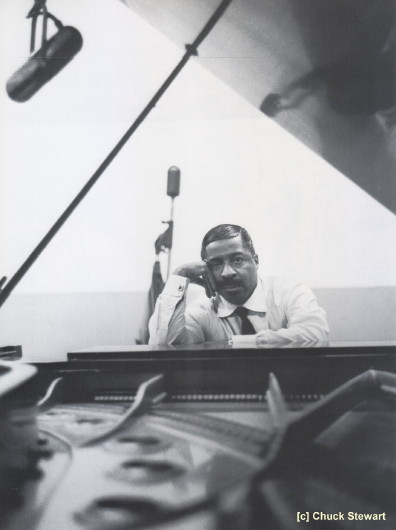

The Boston Globe stated: “Balliett’s genius for pictorial description (which helps make him a gifted writer of profiles) extends to the music itself. No one writes about what they listen to anywhere near as well.”


Although he played drums during his college days and was a member of a band, Whitney was not a studied musician. He had no formal training in theory and harmony so during the 40+ years he wrote Jazz profiles for The New Yorker magazine he had to fall back on his other gifts when describing the music - his gift for “pictorial description.”


In many ways, this made Whitney’s Jazz writings more accessible to the majority of Jazz fans since they, too, for the most part, lacked procedural training in melody, harmony and rhythm - the building blocks of music.


As a result, "Balliett comes as close as any writer on jazz—perhaps on any musical style — to George Bernard Shaw's intention to write so that a deaf person could understand and appreciate his comments. This volume approaches indispensability." Choice reviewing Balliett’s American Musicians.


The editorial staff at JazzProfiles thought it might be fun to share some briefer pieces from the pen of our ideal - Whitney Balliet - to give you an appreciation for his “ … genius for pictorial description.” This is the sixth in a series of six continuously running featuring Whitney’s sui generis pictorially descriptive approach to writing about Jazz which is marked by what Gary Giddins has labeled “writerly attributes: insight, candor, observation, discernment, delineation, style, diligence and purpose.”


These are all drawn from Goodbyes and Other Messages: A Journal of Jazz 1981-1990 [1991]. This is number 6 in a series.


Whitney’s book concludes with chapters that offer a look at what he terms “Keepers of the Flame” in which he includes the sui generis pianist Erroll Garner and “Giants” which offers a wonderful description of vocalist Sarah Vaughan’s unique talents.


As regards, the former, Whitney comments:


“It is surprising that pianists should be the keepers of the flame, for the piano—inflexible and percussive and vibrato-less—does not transmit emotion easily. But jazz pianists, repeatedly beating back the army of broken, out-of-tune pianos which has besieged them since the beginning of the century, have learned how to circumvent the instrument's coldness. By raising and lowering their volume in strategic places, they startle the listener and italicize their phrases. They get vibratolike effects by holding certain notes, and by using the little tremolos that Earl Hines invented. And they place notes, and even chords, in unexpected spots—a rhythmic juggling that creates a fine tension.” 


He then turns to an explanation of how all these devices are in evidence in the playing of Keeper of the Flame, Erroll Garner [who could just as easily be included in the Giants category, too].


“Erroll Garner died in January of 1977, at the age of fifty-three. From the mid-forties, when he first arrived in New York from Pittsburgh, until 1975, when he gave his last public performance, in Chicago, he travelled around the world, obsessed by his music, delighted, inexhaustible, casting his shadow over almost every pianist who heard him, and making his audiences marvel at his ebullience and his melodic invention. Garner, who never learned to read music, could reportedly reproduce the styles of all the great pianists who preceded him, but his own style was inimitable, no matter how often it was copied. He liked to open a number with an ad-lib cadenza, lasting eight or ten bars and giving no indication of what was to come. Then he would drop his volume and go into tempo, his right hand embellishing the melody with behind-the-beat notes broken by offbeat chords, and his left hand keeping strict time with on-the-beat guitarlike chords. He would take the volume up slightly at the bridge and shift into double-time octave chords, lower his volume again, and close the chorus with staccato notes that gave the impression they were wildly trying to break off from the melody they were a part of. The rest of the number would be a constant round of raised and lowered volumes, doubled or halved rhythms, staccato and legato passages, and boiling chordal interludes that wiped his melodic slate clean and prepared the listener for his next surprise. Garner's fast numbers skimmed the earth, and his slow ballads were stately, ceremonious dances.


Garner made countless recordings. Whenever the spirit moved him, he'd rent a studio, summon his bassist and drummer, set down a dozen or more numbers — usually one take apiece. For years, there have been rumors of a trove of unreleased Garner material, and at long last Martha Glaser, his manager and producer, has begun to issue what she believes is the best of it. The first two albums include twenty numbers and are drawn from five different sessions—three in 1961, one in 1964, and one in 1965. The third includes fourteen numbers, set down during one session in 1954. Almost all are prime Garner. (Of course, he had off days. There are missed notes, chords that don't quite land where they should, and endings that don't return to earth.) On the first album, "Easy to Love," he plays a slow, dancing "September Song''; a hustling "My Blue Heaven," its second bridge constructed of an exuberant boppish trumpet line; a "Somebody Loves Me" that includes an even more rakish single-note passage; a medium "As Time Goes By," with a laughing Debussy introduction; and a very fast "Lover Come Back to Me," with a bridge in which his hands invent totally different melodic and rhythmic lines in exhilarating counterpoint.


The second album, "Dancing on the Ceiling," is memorable for a seesawing staccato line in "It Had to Be You"; for a rocking, medium-tempo "After You've Gone," in which Garner takes the breaks — miniature wonders in themselves — and moseys along behind the beat; a strange, slow, rhapsodic gospel blues, "Like Home," played largely with the loud pedal and with heavy, damask chords; and a stomping, new "Ain't Mis-behavin'." 


The third album has at least six marvels. There is an easy "Margie," an unexpectedly fast "Way Down Yonder in New Orleans," and a medium-tempo "Louise," full of delayed notes, and double-time chords. There are a fast, ripping "My Gal Sal," a sly "Too Marvellous For Words," and a virtuosic reshaping of Zez Confrey's brittle 1921 "Kitten on the Keys." Audible on all three albums are the hums, grunts, "myeh's, and "oh-oh"s that Garner uttered as he played, the sounds of a man leaning deliriously into his work.
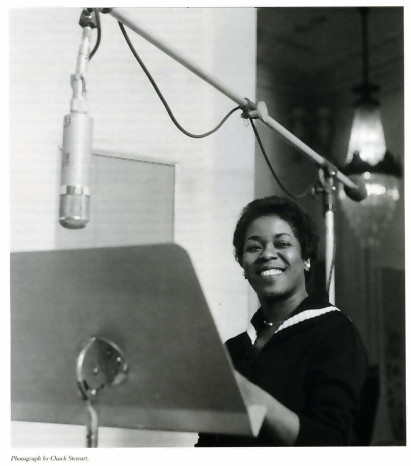

In the chapter on Giants, Whitney includes comments about recent recordings on Verve featuring Art Tatum and an assessment of the techniques that place vocalist Sarah Vaughan in this category.


Virtuosos do not fit easily into jazz. The music revolves around improvisation, and jazz improvisers need only enough technique to play what they hear in their heads. (The drummer Sidney Catlett never considered himself a virtuoso, but he got off certain dazzling snare and cymbal patterns that not even the virtuosic Buddy Rich could match. Catlett's technique was an extension of his imagination; impossible figures popped into his head and instantaneously became real.) Too much technique saps improvisation: it causes floridity and grandstanding, and it tricks audiences into believing that bombast is music. Jazz has harbored two undeniable virtuosos (Rich may have been a third), but no one has ever known quite what to do with them. They are Sarah Vaughan, who died last spring [1990] at the age of sixty-six, and Art Tatum (1909-56), whose final recordings have been issued — with an hour of previously unreleased material — on six compact disks called "Art Tatum: The Complete Pablo Group Masterpieces."


Sarah Vaughan was born in Newark and joined Earl Hines' big band as a singer and second pianist when she was nineteen. She never had any formal training  —she was a bebop baby. Charlie Parker and Dizzy Gillespie were in Hines' band, and so was the singer Billy Eckstine. Vaughan made her first recordings with Eckstine when he formed his own big band in 1944, and a year later she made a small-band record with Parker and Gillespie. By the end of the fifties, she had become a famous singer who moved easily between jazz and popular song. By the end of the sixties, she was a singer of operatic dimensions. She grew to diva proportions, and so did her voice. She had four octaves, each clear and spacious. She sang falsetto, and she could sound like a baritone. She could drop from soprano to baritone in the space of one word. Her low tones were cavernous and her high notes were silver peaks. She had several different vibratos, and when it pleased her she could sing without any vibrato at all. (Think of the Kate Smith singers of the thirties: their vibratos led them.)


In 1980, the composer, conductor, and critic Gunther Schuller introduced Vaughan at a recital she gave at the Smithsonian, and he said that she was "the greatest vocal artist of our century," a hosanna that he immediately complicated by adding that she was "the most creative vocal artist of our time." 


This was true. She was a wonderful embellisher and improviser, who never sang a song the same way twice. She remade her materials — generally, the songs of Rodgers and Hart, the Gershwins, Kern, Porter, and Arlen—in her own image. The cost to the songs was sometimes high. She altered melodic lines and harmonies, mislaid lyrics, and used so much melisma that the words became unintelligible. At her most unfettered, she became a horn singer. Yet her melodic lines were of such complexity and daring that no horn player could have played them. Ultimately, she became a kind of abstract singer, whose materials were inadequate for what she did but were all she had. She could, of course, also sing a song relatively straight. But the richness of her voice was always there, and, no matter how few melodic and harmonic alterations she made, this richness tended to overshadow the song, to lean over it, like a voluptuous woman reading a book.


Vaughan and Art Tatum revelled in their techniques. Vaughan liked to show off her intervals, her perfect pitch, her vibratos, and her range. Tatum liked to show off his touch (the envy of every pianist of the past fifty years), his startling speed, his two-handed runs, and his left hand, which could match his right. As Vaughan and Tatum grew older, they inevitably leaned more and more on their technical tricks. Vaughan shuttled between her registers, held notes so long they took on a life of their own, and pretended she was Joan Sutherland or Paul Robeson. Tatum released harmonic clouds, making his chords sound as if they had fifteen or twenty notes, and connected them with long runs—coils of sound that trapped the listener and freed Tatum of the burden of fresh improvisations. He gave the impression at such times that he was speeding luxuriously through the song; in reality, he was pedalling easily in place. Both Vaughan and Tatum were worshipped by their audiences and by their fellow musicians — for their bravura effects and for their musicianship — and they wore their mantles with a pleased arrogance.”



Tuesday, June 22, 2021

"The Rhythm, Romance, and Joy" of Erroll Garner by John Edward Hasse

 © Copyright ® Steven Cerra, copyright protected; all rights reserved.

Born 100 years ago, the jazz pianist created an exuberant, one-of-a-kind style that continues to garner followers.


The following appeared in the June 17, 2021, print edition of The Wall Street Journal as 'Erroll Garner at 100.'


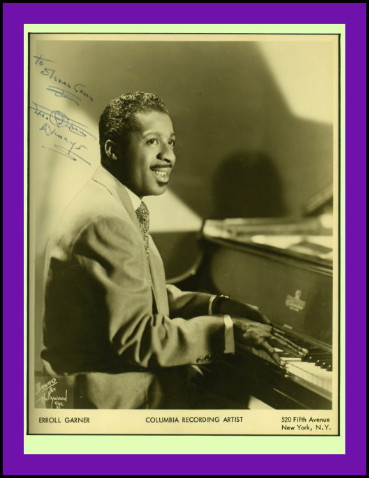
“This week marks the centennial of pianist and composer Erroll Garner, one of the most visible and beloved American pianists of the 1950s and 1960s. A joyful, exuberant and inventive artist, he attracted a large international following of listeners smitten with his readily accessible sound.

Born into a musical family in Pittsburgh, by age 10 he was part of a kid group on radio. Entirely self-taught, Garner joined a line of master jazz pianists associated with that city: Earl “Fatha” Hines, Mary Lou Williams, Billy Strayhorn and Ahmad Jamal. By 1944, Garner was in New York, performing in nightclubs.

Though he never learned to read music, he made no apologies: “Hell, man, nobody can hear you read.” Garner boasted matchless musical memory: He could play a piece after a single listen. Though his stature was diminutive—he would sit on phone books to reach keyboard height—his fingers were long and his handspan wide.

Garner shaped a signature style unlike any other. His ambidexterity and stunning sense of time enabled him not only to render and develop different rhythms in each hand, but also to play his two hands out of sync with one another. Garner often lagged his right hand slightly behind the swinging beat.

Concertizing with his preferred format of bass and drums, he would teasingly improvise a rhapsodic, free-form introduction—prompting the audience to wonder “What’s this tune?”—and even confound his sidemen. In a 1964 performance for the BBC, Garner roams through stride piano, boogie-woogie and a dash of dissonance—seemingly stumping bassist Eddie Calhoun —until, after 62 seconds, he finally breaks into “Honeysuckle Rose.” Such introductions were miniature spontaneous compositions.

Then with the drive of an engine, he’d strike a steady pulse in the left hand, often strumming guitar-like chords, while his right alternated between percussive single notes, chords, and octaves rendered with dazzling precision. His flying virtuosity suggested a third hand. While his ballads could be as flowery as a romantic garden, in pieces such as “I’ll Remember April” from his celebrated album “Concert by the Sea,” he seemed to be playing not a piano, but a full band, replete with solo lines, comments from the brass section, and full ensemble. “I love fullness in the piano,” Garner said. “I want to make it sound like a big band if I can.” In performances such as “Where or When,” from 1962, he employed the entire keyboard from low to high.

He dramatically varied his volume with split-second timing. In noisy nightclubs, drummer Kelly Martin recalled, Garner would play “softer and softer until finally his hands were actually just above the keyboard.” That would shush the loudmouths.

If you watch him in concert, you see a musician at one with his instrument—an extension of his musical mind and ultra-nimble fingers. Enabled by his spatial sense and muscle memory, while playing he might be smiling at his audience or looking at his sidemen instead of at the keys. You can instantly see and feel the wholesale, infectious joy he radiated to his listeners. Like classical musician Glen Gould and jazzmen Keith Jarrett and Bud Powell, Garner was wont to vocalize as he played piano: He emitted a low sound somewhere between grunting and humming.

To compose his nearly 300 pieces, he’d record them and then have another musician transcribe them. His “Misty” became a standard beloved especially by vocalists, for example Johnny Mathis and, in this 1964 concert, Sarah Vaughan. It played a pivotal role in Clint Eastwood’s thriller “Play Misty for Me.”

From 1955, the ebullient “Concert by the Sea,” recorded live in Carmel, Calif., was a masterstroke of marketing and packaging, the title and album cover evoking freshness and relaxation. You have to take “by the Sea” poetically, for the concert took place neither outside nor adjacent to the Pacific Ocean, but in a school auditorium a half-mile away. The album became a record-breaking bestseller. You can see why in this remarkable reading of the Ellington-Tizol standard “Caravan.”

In 1960, Garner and his longtime manager Martha Glaser sued music giant Columbia Records, charging that it didn’t fulfill its agreement to issue new albums and then released older material without Garner’s consent. The upshot was that Garner and Glaser started their own record company, Octave Records, liberating him from corporate control and striking a blow for artists’ rights.

A heavy smoker, Garner contracted lung cancer and died in 1977 at age 55.

In September, to mark his centennial year, Mack Avenue Music Group and Octave Music will issue “Liberation in Swing,” an impressive boxed set of 189 Garner tracks. An accompanying coffee-table book samples his surprising visual art and offers insightful essays by singer Cécile McLorin Salvant, drummer Terri Lynne Carrington and Thelonious Monk biographer Robin D.G. Kelley. This lavish package looks to be a contender for jazz gift of the year.

A century after his birth, Garner’s originality, stunning technique, masterly but accessible musicianship, and disarming ebullience continue to offer generous rewards to attentive listeners.

—Mr. Hasse is curator emeritus of American music at the Smithsonian Institution’s National Museum of American History. His books include “Beyond Category: The Life and Genius of Duke Ellington ” (Da Capo) and “Discover Jazz” (Pearson).


Friday, August 17, 2018

George Shearing on Erroll Garner

© -Steven Cerra, copyright protected; all rights reserved.


- “Young Garner's father was a singer who played several instruments, as did his older brother, Linton. Erroll was an entirely self-taught musician who hit the keys when he was three years old and never did learn how to read music. But he played like no other pianist, and his flamboyant style was a delight to the ears. He would start a ballad with a long, discordant introduction that didn't even hint at the melody to come. At last when he swung into it, his left hand lay down chords like a guitar, keeping up a steady pulse, while his right hand never seemed to catch up, improvising chords or playing octaves that lagged way behind the beat for the rest of the number. Just a pinch of Fats Waller added spice.


I was fascinated by this fellow's joyously swinging piano, and I sought him out while Louis Prima was on. Erroll was anything but happy. He didn't know many people in New York and was downhearted. No one was interested in listening to him—Louis Prima was the showman attraction. And Erroll was only making forty dollars a week!


He told me he thought he'd go home soon, as it seemed nothing was going to happen for him in New York. Somehow, I had to stop him. I invited him home to 7 West 46th Street, showed him my rented Krakaur grand, and once he got started, it was impossible to pry him off the bench. Little did I know at the outset that he had a bad case of asthma and couldn't sleep lying down!” [p. 176]
- Fradley Garner’s superb English adaptation of Timme Rosenkrantz’s Harlem Jazz Adventures: A European Baron’s Memoir, 1934-1969.


“None of my prior experience with recording artists- Erroll Garner included- had prepared me for what happened when Erroll came in to record the session from which this album is produced.


In a business where the hoped-for standard is to complete four three-minute sides in three hours (with innumerable re-takes), and a recording director is ready to break out the champagne and caviar if he's finished half an hour ahead of schedule, Erroll smashed precedent with a performance that can be compared only to running a hundred yards in eight seconds- and with perfect form.


In other words: something that just can't happen. But this time it did. Erroll came into the studio a few minutes after his accompanists had arrived, took off his coat and had a cup of coffee, sat at the piano and noodled a bit, got up and removed his jacket, lit a cigarette, loosened his tie, and one minute past the hour announced he was ready. We hadn't discussed repertoire specifically; I had only told him that I wanted him to record some double-length numbers for long-play release. To give the engineers a chance to check balance, I asked Erroll to play something; anything. He played for a minute or so; the balance was fine, so when he stopped I asked Erroll through the control-room talk-back if he'd like to get started on the first number.


"Ready!" Erroll called.


"Fine," I said. "What's it going to be?"


"I don't know yet," said Erroll. "Just start that tape going."


The saucer-eyed engineers were no more startled than I, but I held back my surprise long enough to ask if Erroll would like me to signal him when he got around the six-minute mark.


"I might not remember to look," he said. "Let's just feel the time; OK?" Wondering what Dr. Einstein might have to say about that concept, I agreed; Erroll struck a couple of chords, nodded a tempo to bassist Wyatt Ruther and drummer Eugene “Fats” Heard, threw me a wink, and pointed to the recording light. I snapped it on, and he swung into an introduction which baffled all of us; what was it going to be? By what telepathy Ruther and Heard knew, I will never understand, but they followed Erroll unerringly into the chorus of Will You Still Be Mine?- a tune which, Erroll explained six minutes and twenty seconds later, they had never played together before.


But we didn't even have to play it back to know that it was a perfect master.


That's how the session went; with complete relaxation and informality, Erroll rattled off 13 numbers, averaging over six minutes each in length, with no rehearsal and no re-takes. Even with a half-hour pause for coffee, we were finished twenty-seven minutes ahead of the three hours of normal studio time-but Erroll had recorded over eighty minutes of music instead of the usual ten or twelve, and with no re-takes or breakdowns. And every minute of his performance was not only usable, but could not have been improved upon. He asked to hear playbacks on two of the numbers, but only listened to a chorus or so of each, before he waved his hand, said "Fine."


As for myself, I was happy with everything the first time 'round and repeated listenings to tests since then has confirmed that my first opinion was right.”
- George Avakian, Liner notes to Columbia 12" LP CL 535


“I never had an influence, for the simple reason that I loved big bands. I think this is where part of my style came from, because I love fullness in the piano. I want to make it sound like a big band if I can. I wasn't influenced by any pianist, because when I came up, I didn't hear too many. We used to have places like the Apollo Theater where you could go and hear big bands. They used to come to Pittsburgh and play at the Stanley Theater. I saw all the great bands. I knew Mary Lou Williams when I was a kid. When Fats Waller came, the piano was so sad that he played organ. I'll never forget how he took that organ, blended in with the band and made it sound like forty-four pieces. That sound was the most fantastic thing! I thought, oh my goodness, how can he do that? That's something new to me. I love Jimmy Lunceford, and I love Duke. Jimmy Lunceford and Count Basie taught me how to keep time. Those two bands really laid that on me, and it was a thrill. I think [Basie’s guitarist] Freddie Green is one of the greatest timekeepers in the world.”
- Erroll Garner to Art Taylor, Notes- and-Tones, Musicians-to-Musicians Interviews


Erroll Garner didn’t talk about Jazz very much. He just played it.  And could he ever bring it.


He wasn’t a particularly good interview. You can go through the Jazz literature, but you are more-than-likely to come away empty-handed if you are looking for an expository about Jazz piano by him as told to a Jazz essayist.  Fortunately, he did talk on occasion with other musicians and one of these musician-to-musician interviews can be found in drummer Arthur Taylor’s Notes- and-Tones.   


In many ways, Erroll Garner was an odd fellow, but “odd” in the unconventional sense of the word - unusual,  peculiar, bizarre, eccentric, unusual. And not in the more outlandish definition of the term such as quirky, zany, wacky, kooky, screwy, and freaky.


You get the sense of his uniqueness from the quotations that precede this introduction and also from the following assessment of his talent by fellow pianist, George Shearing, which is contained in his autobiography - Lullaby of Birdland.


“I first heard Erroll Garner on record in about 1945, and my thoughts about him have never really changed from that moment. I said to myself, "This is an astoundingly original style!"


From the outset, Erroll had a very personalized and highly unusual approach. In many ways, he was the most un-pianistic of all jazz pianists because he treated the instrument as if it were an orchestra, which made him one of a kind. If you're used to hearing records by Art Tatum, Teddy Wilson, or Hank Jones, all of whom treat the piano very legitimately as a piano, you won't hear very much of that in Err oil's playing. It's true that he did use a lot of single-note solos, but they were more than equaled by what I call his "shout" playing, the technique that he used after he'd finished such a solo. Rather than his fingers just cascading up and down the keys, he'd play these big, massive chords, which he used as what big band arrangers call a "shout," just like a huge ensemble of brass and saxophones. He would do that for four or eight bars followed by another four-bar single-note solo, all the time keeping a steady four to the bar with his left hand. It was almost as if he had Basic's guitarist Freddie Green, with his perfect time, kept prisoner inside his left hand. Regardless of how much his right hand lagged behind the beat, that left hand was always the time governor. There's never been another pianist quite like him, and I don't think there ever will be.


I first met Erroll in person after I'd moved to the United States, when he came back to New York from the West Coast, and I was playing opposite him at the Three Deuces on 52nd Street in 1948—a gig which lasted for quite some time. He was leading the Erroll Garner Trio, which was no less a line-up than Erroll on piano, Oscar Pettiford on bass, and J. C. Heard on drums. It was just ridiculous what they did, they were such a tight group.


Perhaps the best estimation of anyone's talent is, firstly, originality, which Erroll had in spades, and secondly, the musical and technical ability to put that originality into practice. His talent wasn't about being able to play everybody else off the stage by mastering their style and then some, but about being himself. It didn't matter to him what kind of piano he was playing — good, bad, indifferent, they were all the same to him — nor did it seem to affect him if the audience was talking. He would just play up a storm.


Nobody else can play the way Erroll Garner did. I try to get close to it from time to time, and I received a nice compliment from Erroll's manager Martha Glaser, when she said that I'm probably the closest. That's good enough for me, because that's all I want to do—be as close as I can when I'm representing his style. I sometimes used to kid my audience by saying that Erroll and I were always being mistaken for each other, which is ludicrous, really, because he was much shorter than I am. But I loved Erroll.

Tuesday, May 1, 2018

Dudley Moore on Why Erroll Garner Is "Easy to Love"

© -  Steven A. Cerra, copyright protected; all rights reserved.


“Passion . . . that's what he had . . . passion. And that's what all great artists have. A sprinkling of the demonic, a yearning for the tender, and a straight line to joy.”


The above and following enthusiastic remarks by the actor (and sometime pianist) Dudley Moore appeared as liner notes for Easy to Love [Emarcy 832 994-2], a 1988 collection of previously unreleased cuts - all recorded in the early sixties — by Erroll Garner.


Moore, a long-time Garner devotee who died in 2002, was renowned as an actor in film, theater, and television. Dudley was also an accomplished musician and composer, at home in both the classical and jazz genres. London-born, Moore began his piano studies at the age of six, and went on to advanced classical studies on piano, organ and violin, and composition and arranging, at Oxford's Magdalen College, where he earned degrees in 1957 and 1958. He later performed with Johnny Dankworth's orchestra, and with his own trio. In the closing years of his life, he appeared as a guest soloist with major symphony orchestras, during breaks in his film schedule.


“Listening to this selection of Garner's recordings was a chilling experience - chilling in the sense that one knows one is listening to an exception — one is listening to a phenomenon. No matter what the rational opinions are, one comes to the conclusion that here is a uniqueness that is almost unbearably strong. They say that certain types of genius are the result of untiring practice and application — terms which of course double to mean enthusiasm or passion — but what exactly Garner had to do to acquire this unique tonal vocabulary is hard to understand completely. Suffice it to say that his persona is streaked in bold and subtle flashes across his music. You didn't have to know the man to feel, what is certainly for one very brief moment in history, a unique singing voice. To achieve this at all on a piano is no mean feat, but it is not the technical aspect of his playing that astonishes, although that is one thing to knock one off one's feet. It is the fact that the technical aspect evaporates in this spectacular contact that is made through a music that is entirely Garner's own.


Mind you, there are parts of Garner that I don't appreciate at all or find particularly remarkable. I don't think his wayward introductions are necessarily an extraordinary feature of his work. Or, that the sentimentality he sometimes allows himself in unabashed ballads is particularly interesting. However, when he plays a ballad with that combination of deep feeling and caressing rhythm, I sag with the burden of gratitude. I may be getting purple with my prose at this point, but what can one do in the face of this gift that is extended to us all. Not everyone knows, realizes, or understands the importance of Erroll Garner. He understood it, I'm sure, but also would probably have been too reticent to admit it. Criticism was sometimes blind to it, although his public acceptance was always gigantic. He once said, "Some people know what life's about and some people don't." The spontaneity and relaxed growth in his music pleads a knowledge of life and I guess if you don't get it, you don't get it.


This does not imply membership in some darkly exclusive club, but merely the futility of describing a feeling. I love music that lives and breathes and encourages life. I hate music that conjures up an apparition of death. That doesn't mean to say that I don't love music that is inspired by requiems or death itself. However, the outcome of even such potentially morbid music has to be joy. The optimism of life, of being alive, of feeling alive, of communication, of love . . . that's what Garner is and what he does for me and will always do for me. That's why I love to try and play like him. His music has got into my veins and I wish that everyone could be as drugged as I am with this particular non-chemical. Long live Garner. I bless that day in 1957 when I heard him for the first time. I shall always treasure the experience and I am able to relive it, listening to this music today. I never met the man to say hello and thank you. I didn't have the nerve to do that, even though I did spend a couple of times in a club close to his arm and at several of his concerts in London. One day he came into a club where I was playing and I was so nervous, - I so wanted to share my love for him and how he had affected me — that my panic allowed me to spill a bottle of Coca-Cola on the middle of the keyboard to the point where all the keys stuck together and I could only play on either side of this sticky log.


Garner brought to the piano an element which I don't think anyone else had previously provided - the element ol sensuality. It was engendered by a true rubato in the sense that Chopin understood - that is, a left hand which is ostensibly regular and a right hand that moves freely against it, "the result of momentary impulse," as the great pianist Josef Hofmann said. (He also maintained, rightfully I think, that . . . "Perfect expression is possibly only under perfect freedom.")


This rubato is a rarity in any music and finds its true fruition in Garner's playing, a smooth, undulating arm that floats and caresses sweetly above a gently pulsing bass. Garner must be one of the very few who can soothe our souls with this most elusive of arts. There's no doubt in my mind that his unique and enlivening rhythmic approach is an irrefutable addition to musical language, nourished as it is by the poignant, passionate, or pagan palette (!) if you'll once again excuse my purple prose ol his harmony.


It is interesting to note that often after a passage or phrase of considerable rubato where the melody notes hit just behind the basic beat, Garner will, in the last couple of bars (generally of an eight-bar phrase), get right on to the beat again not to steady himself like a tightrope walker using the bar, but just because it feels good in the style. I've never known Garner to not to put out a hand to steady himself, as it were. There's never a moment when one says, "Whoops!"


It is extraordinary that this man, who did not read or write music, could have produced such richness of rhythm and harmony, even a latent counterpoint - for his two hands enjoyed the sweetest, cooperative marriage. Jazz can, in one way, resemble painting by numbers. The chordal system that emerged from its roots, which was then enriched by the advent of impressionist harmony, has been organized into a figured bass concept like that of former times (the sixteenth and seventeenth centuries). The result is a system that is relatively easy to learn wherein chordal inversions are left to the individual taste of the pianist, who has the advantage of being able to play more than one note at once. All I can say is, thank God Garner chose the piano as his means of expression, since he would not have been perhaps quite as remarkable on a one-line instrument. We would not have had the glory of the interplay between his two hands or the piquant structure of his chords and textures.


Although Garner seemed to hit a few clankers now and then in terms of melody, these are never really wrong notes so much as moments of intense creativity that have spiralled off. Rhythmically he never fails us and that is probably the most remarkable thing. He really doesn't, not even when he seems to be even remotely strapped by the sheer physical stuff that one encounters on a piano from time to time. Relaxation was of total importance to him. Lesser artists like to mystify us with claims of difficulty. When Garner decides to combine his many colors we are most nobly fed — an infectious notion of rhythm and sensual swing with a flirtatious and coquettish melodic gift, an ability to take us with him into areas of sweet contentment where our heads all bob gently and thankfully like mesmerized turkeys.


It is more than great octave work that he indulged in. It succeeds without apparent effort and he even seems to be trying new things as he plays without being at all perturbed at the prospect of keeping things in rhythm.
Everything is always within the style even when the actual notes may not perhaps be exactly what he wanted. But, then again, everything sounds right because it swings and because his spirit leaps out to us.


His endings almost seem nonchalant, as if to say "I've done this one  - let's get to the next." This spontaneity is paralleled in his almost exclusive love of the first take; his enthusiasm ran hot and he knew he would not be able to give the same spirit out again, whatever notes had hit the floor. This did not mean of course that he was unwilling to play the same tune more than once in quick succession, he could do so, but often chose to do so in different styles and tempos, refreshing the tune each time with new invention.


Garner often seems to bend notes, sliding, as he does, with his right hand from black to white keys. Thus he favors the kevs based on flats, where such opportunities abound, notably the keys of D flat,, E flat,, G flat, A flat,, and B flat, as appear in these selections. The result is melody which has the liquidity of a singer's portamento [sliding from one note to another]. He gives us much succulent ornamentation and gentle repetition of little motifs to gladden the heart. Sometimes, as in "Somebody Loves Me," he slows the tempo down as he digs in with more voluptuous rhythm as the choruses continue. He often jokes with us, as in the staccato-octave opening chorus of "Taking a Chance on Love" with its typical midkeyboard sax-section-like accompanying "woofs." He often plays his own Garner riff, as in "Lover Come Back" or "Easy to Love"; there are quotations from other melodies and often, dotted eighth-notes in the bass which bestride the beat merrily like a child, plonking about in seven-league boots, tugging gaily-fluttering kites gently and playfully in his right hand. And sometimes, he will delay the emergence of the melody as in the reckless beginning of the third chorus of "Somebody Stole My Gal" and then make us grin with his wonderful octave work in the last chorus. These are all expressions of a humor that pervades his work almost constantly -  a humor that is often so much more telling than graver utterances of other jazz performers. Humor is intrinsic to Garner's nature and is a companion to his feeling tor life, to the joy and sensuality of his playing. Humor resides in the flesh of his music in both perky and witty guise.


To my mind, Erroll Garner is probably the most important pianist that I have ever heard and that includes classical pianists. The problems in his music are different from those facing a classical pianist; the answers are complex. He may sort of know what he's going to play to a greater or lesser degree from a vocabulary that expands gently and continuously. But we are always delighted with the freshness and the originality of approach, a desire to communicate. He cultivated his garden wonderfully, completely, roundly. For those people who don't hear or feel his soul, I am sorry. I don't know how one could explain the feeling to anyone. However, I think he speaks to the heart of all of us, even to those who only feel what he says, subconsciously.
In the long run, who cares it his right hand was always lagging at just the perfect point behind the left. In the long run, who cares if his right hand runs were always structurally impeccable; they actually were an infallible feature of his relaxation, plunging us into happiness and wild enthusiasms. The feeling that that particular technique exuded was one of being alive.


In the long run, who cares that his sense of texture was extraordinarily original; it was, more importantly, rich. Who cares that his hands were big and could cover this or that interval with ease; they delighted us with unparalleled, unchangeable octave work. Ultimately all these "things" gave us more pleasure. The technique cannot be separated from the music, but the music is infinitely more important. Passion . . . that's what he had . . . passion. And that's what all great artists have. A sprinkling of the demonic, a yearning for the tender, and a straight line to joy.”


Saturday, March 12, 2016

A Salute to Ed Leimbacher and Erroll Garner

© -Steven Cerra, copyright protected; all rights reserved.


“Sixty years! Hard to believe for this Garner fan, who grabbed the LP when it was "hot off the press" - to coin a phrase. And what a treat it was to listen to that live performance by the master in top form. Though, come to think of it, he never was in less than that. No matter where - within the confines of a nightclub, in a concert hall, at an open-air festival, in a recording studio - you encountered "The Little Man" (as Art Tatum fondly dubbed him - he was 5'4") in action, he would hold you spellbound with the musical magic he could coax from a piano, an instrument he made sound like no player ever had before - or would again.


That sound, that conception, was strictly his own creation. Undeterred by teachers, he made his hands realize what he heard in his head, and that was the sounds and rhythm of a big jazz band. A child of the Swing Era, Garner conceived of the keyboard as a combination of a band's horn and rhythm sections, rolled into a single voice. And his uncanny sense of time, his marvelous touch, and wide-open ears made that conception come alive. Once Garner had taught his fingers to do his bidding, he found such joy in making music that it became contagious. His was, as an album title proclaimed, the most happy piano.”
- Dan Morgenstern, Jazz author, critic and essayist, retired Director of the Jazz Institute at Rutgers University


“Artists look to find a connection; a way in, something that matters. This elusive feeling of belonging, of connecting or not, is the friction that helps us navigate the creative map. Acceptance or the lack thereof is a part of everyday life on and off stage.


“Erroll Garner found acceptance from people who loved great music, including his icons Duke Ellington, Art Tatum, Count Basie, George Shearing, and Ahmad Jamal. He was a sure creative and emotional bet for his audience as well. His audience understood this and showed up to hear him night after night the world over.
In a rare interview recorded directly after his Concert by the Sea performance, Erroll Garner said, "They made me feel like playing.'"


Perhaps he meant his magnificent trio with drummer Denzil DeCosta Best and bassist Eddie Calhoun, or perhaps he meant his audience who witnessed one of the greatest concerts of all time. Either way Garner seemed to be saying it was the collaborative exchange that made the moment possible - that blending between the audience and the musicians. Garner's music is a direct and uncensored experience, honest and immediate, free flowing, clearly delivered, focused with fearless projection. The newly mastered version of Concert by the Sea with 11 new performances (22 performances in all), gives us more than a glimpse into what it might have been like to witness this great artist night after night. "You could never tell what he might do next" were the kinds of responses you heard from his musical collaborators.”
- Geri Allen, Jazz pianist


“Erroll Garner was a true original in the history of Jazz piano. For reasons I do not understand, considering the high respect other contemporaries had for him, Garner seems to have been forgotten by younger Jazz critics and Jazz pianists alike. There was only one Erroll Garner and it would help every Jazz pianist if they paid a little more attention to his talent and creativity.


These sage words from the impresario and pianist George Wein beg the question: why has Erroll Garner, universally regarded as one of the most important pianists in jazz history, attracted so little attention? Teddy Wilson called Garner, "one of the greatest talents there was.... His harmonies were as modern as tomorrow and his conception of jazz exquisite." George Shearing, who admittedly copped his style, wrote in his autobiography, "Nobody else can play the way Erroll Garner did." Ahmad Jamal once said, "anyone that has not been influenced by Erroll has not been in our field.... Fd say he's from the impressionistic school and of the rank of Ravel and Debussy." One of the most venerated and commercially successful jazz musicians of his generation, Garner performed before sold-out concert halls, won nearly every major jazz magazine poll, appeared frequently on TV talk shows, and was featured in The Saturday Evening Post.


Garner's popularity was due in no small part to his intrepid manager and life-long friend, Martha Glaser. ….”
- Robin Kelley, insert notes to The Complete Concert By The Sea


Ed Leimbacher is one of my Internet Jazz buddies.


We’ve never met, which is probably a good thing for the other important people in our respective lives as I’ve a feeling that if we ever did meet in person, we’d probably never stop talking about our common interests in a variety of things to do with popular culture.


Ed is a writer and a very good one. Some of us push words around. Not Ed. He uses words to create stories that you want to read and re-read. You can check out the full sweep of his style of writing by visiting him at his blog - I Witness.


I think that Ed is at his storytelling best when he is writing about Jazz, but that may be my bias showing.


See what you think.


Garnered
January 11, 2016


“It's not much of a stretch to designate pianist Erroll Garner the Rodney Dangerfield of Jazz. From the Forties to--what?--the early Seventies, Garner was praised for the myriad sessions he'd cut for labels large and small--Dial and Blue Note, Mercury/EmArcy and Columbia--and he had (still has) one of the most popular and best-selling albums in Jazz history, his Concert by the Sea, recorded live in Carmel, California, in 1955.


Then his place in Jazz seemed to vanish. The Fusion/Disco/Rock Drums/Death of Jazz era came crashing down, maybe more on Erroll than others. His exuberant, happy piano was ruled fatuous and simplistic, partly because he couldn't read music. (So every session was truly improvised, first note to last.) The style he had devised--long, quizzical, inventive introductions followed by a kind of theme-and-variations dissection of the song, ending (usually) in a percussive, emphatic, slowing-to-a-stop of the music--was finally rejected as more ignorant than original, and his habit of grunting along with the melody sneered at (before Keith Jarrett brought a whole barnyard of ecstatic noises to the recording studio). Because the diminutive, elfin Erroll needed telephone directories to lift him higher on the piano bench, even this quirk was held against him. Yes, he couldn't "get no respect."


Garner died in the Seventies before the digital era and multiple-reissue CD sets brought artists back from Jazz obscurity. But throughout the decades of his eclipse,Concert by the Sea kept selling. I first heard Garner in the early Sixties, another college kid more ignorant than hip, drawn to the bouncy joy of his records, and then I got to see Erroll in action at the Seattle World's Fair. I didn't know anything about Jazz back then, but I had no trouble enjoying Garner at the keyboard; I subsequently learned of his proficiency (able to record enough tracks in one three-hour session to produce three separate 12-inch LongPlay records!), and I even loved his deluxe two-disc set of tunes celebrating Paris and France, many of them played on harpsichord. My vinyl copy of the Carmel concert had to be replaced a couple of times as the years passed, and I finally gave up imagining an expanded issue. But a couple of months ago, without much fanfare, The Complete Concert by the Sea suddenly appeared, 60 years on.


First we must acknowledge the startling largesse of this set - now twice as long as the hallowed original - launching 22 grand excursions instead of the merely wonderful 11 chosen for the classic Concert album. And let no man (no woe-man) beguile you with carping, because the new numbers are just as splendid as the long-familiar eleven. BUT the set now does bump up against a couple of minor matters: a possible surfeit of sufficiency, and (what we might call) the natural order of things. The Complete Concert now takes up two of the three discs, each totaling over 60 minutes in length, so we are farther than ever from the third-of-an-hour sides of the original 12" disc. It is unexpectedly clear that the LP era trained many millions of us His-Master's-Voice, Pavlov's vinyl dogs to live out our lives in 20-minute segments. I guess you could say that these 60-minute CDs are therefore easy to listen to but hard to hear!


Also, recreating the "new" full-length concert rearranged for a chronological placement of tunes, seems to destroy the structured rise-and-fall, the careful build-up to a musical climax, that I believe one can hear in the 11 selections as originally presented. (This arrangement you can hear on Disc Three of the new set. I suppose there must be hundreds of concert albums that silently offer a selection arranged for effectiveness, but being able immediately to compare the two versions I'll bet is uncommon.)


I don't want to belabor the matters mentioned. This three CD set is a veritable feast for sore ears. (As we used to say in Spanish class, Punto final.) Instead, I'm going to end the brief review right here by advising all Garner and Concert by the Sea fans to proceed with abandon rather than caution. What was for 60 years a concise source of piano pleasure has belatedly and amazingly become an embarrassment of riches... even if henceforth I may personally choose to program Disc Three ahead of the other two.”