Checkout the marvelous trades between trumpeters Freddie Hubbard [leads off] and Thad Jones beginning at 0:47 with Bill English on drums booting things along in The Engine Room. Great shout chorus at 2:01. A little masterpiece to brighten your day.
Wednesday, February 26, 2025
Tuesday, February 25, 2025
Gerry Mulligan and Stan Kenton - Opposites That Didn't Attract [Excerpts from the Jazz Literature]
© Copyright ® Steven Cerra, copyright protected; all rights reserved.
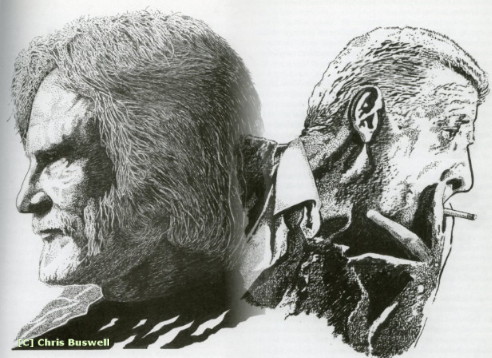
“In her biography, Straight Ahead - The Story Of Stan Kenton, Carol Easton refers to a personality clash between Kenton and Mulligan; 'Gerry was pretty fiery in those days, having it out with most people...' Which Stan summed up as follows: 'He (Mulligan) is quite an individualist and I guess I am also, and as much respect as we have for each other, if I had let the orchestra play Mulligan's music exactly the way he wanted it played, it wouldn't have had a Kenton sound to it at all. Gerry declared I never would perform his music any way that he wanted it performed. But, you know, even his (later) big band sounded like a small group, they played like a small group - whereas I think that a big band should sound like a big band, and it should have much strength as well as the soft things.'”
- Quoted in Raymond Horricks, Gerry Mulligan’s Ark [2003]
“No band, no rehearsal hall, no concert stage was ever large enough to contain the combined egos of Stan Kenton and Gerry Mulligan.”
- Carol Easton, Straight Ahead: The Story of Stan Kenton [1973]
“GERRY MULLIGAN By the end of the '40s the thing that was the most disturbing to me was that I could see that the bands, the dance bands, the name bands, were not going to survive. That's what was really upsetting to me. That had more to do with my anxiety about life than anything else. Except that without ever thinking about—1 want to do this or what I want to be in life, man, I never thought about another thing—seriously, other than being a bandleader and writing music for bands. Dance music. So the big band got cut off from its own source, which is dance music. But it's funny because the band kept evolving and getting bigger. Starting in the 20s they would have like four or five horns, and then the stock band got to be two trumpets and a trombone and three saxes. Three or four really. Then in the '30s it got to be four brass and four saxes, three or four rhythm. And then five brass. Then they got smart, and it got to be four trumpets, three bones, and five saxophones. It just kept going. And do you know, part of the thing that really depressed me and I always hated being called West Coast Jazz because to me the influences out of the West Coast in jazz were personified by Stan Kenton's band.
And Stan's band to me was some kind of way symbolic of the end of the bands as I loved them. It had gotten too big and too pompous. You know, it took itself so seriously. Like just something terribly Wagnerian about it all. Well, I once said, thinking I was being humorous, that Stan is the "Wagner of Jazz" and then realized afterwards—because he had done a thing with the transcriptions of the Wagner pieces, and tried to conduct them—that he really saw himself that way and didn't see any humor in it at all. But I hated what that band stood for because it was like the final evolution of wrongly taken points. The way the band kept growing. And the absolute maximum for any kind of use was the five saxes and the three or four bones and the four trumpets. The main reason . . . there's one you can do with four trumpets you can't do any other way, and that's four-part harmony, which only four trumpets together sound . . . OK. The only function for the fifth trumpet is an alternate player. But Stan's band kept getting bigger and bigger—to five trombones. Now five trombones is the most asinine.
That's why I didn't like Johnny [Richards'] band [either]. For just that reason. The only one of those bands that I liked at all was Boyd Raeburn's, and that's because Handy and Mandel wrote some interesting things for it. But the rest of the bands were just too preposterous. But Stan's band was just so unmusical to me.”
- Ira Gitler, Swing to Bop: An Oral History of the Transition in Jazz in the 1940s [1985]
The decade of the 1950s didn’t dawn in a particularly auspicious manner for Gerry Mulligan.
He was scuffling [Musician speak for surviving with difficulty; barely making a living].
After associations with the big bands of Gene Krupa, Tommy Tucker, Elliot Lawrence and Claude Thornhill in the 1940s, that decade closed with the demise of Gerry’s cherished big bands.
The association with what was to become known as the Birth of the Cool recordings in the late 1940s, while artistically satisfying, was financially unrewarding for Jeru [Miles’ term for Mulligan].
With little promise of more work, Gerry decided to head west with his friend Gale Madden and seek his fortune in California, a state which, following the close of World War II, was open to all sorts of development and seemed to promise unlimited opportunity.
Although the big bands were vanishing, one that was still standing and growing in popularity was Stan Kenton’s Orchestra.
Based in Los Angeles, CA where it originated in 1941, it seemed a logical first stop for Gerry, as his forte at the time was still primarily composing and writing for big bands.
Having been the principal arranger for his orchestra for many years, with the arrival of Pete Rugolo in the late 1940s, who became and alter ego for Stan similar to the relationship between Billy Strayhorn and Duke Ellington, Kenton became open to working with new arrangers while he concentrated on the commercial aspects of operating his orchestra.
But Stan’s big, brash, bombastic orchestra would prove ultimately to be very unwelcoming to Gerry’s approach to orchestration.
Given the Jazz luminaries both Stan and Gerry would go on to become later in their careers, there is scant information about their working relationship in the Jazz literature. [And I’ve yet to locate a photograph of the two of them during the time they worked together.]
But perusing what little there is, one can’t help but come to the conclusion that they were an odd couple, but musically and in terms of their personalities. This excerpt from Carol Easton’s Straight Ahead: The Story of Stan Kenton [1973] is an apt description of their relationship.
“Swinging is one of those elusive and indefinable terms. Like soul, you know it when you hear it. Swinging implies looseness, freedom, spontaneity and instinctively flawless rhythm.
It has probably been associated with Count Basie as much as with any big bandleader. And Stan has always had a horror of his band's sounding like Basie's—or Duke's, or Woody's, or any other bandleader's. Once he established his own sound, it was straight ahead, letting the critics fall where they may. More than a principle was at stake; to Stan, it was a matter of identity.
But while swinging turns Stan off, jazz players turn him on. And therein lies Stan's (to use Bill Russo's word) dichotomy. He covets their lack of restraint, even while shying away from it. He hires them out of respect for their talents, and lets them wail their hearts out in their solo work. But the arrangements he favors do not swing. And to a jazz player, there is simply no substitute for swinging! So the musicians bitch, and exert varying degrees of pressure in all sorts of subtle, and sometimes not-so-subtle, ways. And Stan has made compromises.
His most notable compromise took place in 1952, when he began buying charts from Gerry Mulligan and Bill Holman— two uncommonly talented, uncompromisingly swinging writers.
No band, no rehearsal hall, no concert stage was ever large enough to contain the combined egos of Stan Kenton and Gerry Mulligan. Perhaps because of his drug habit, which he has since overcome, Mulligan was arrogant, rude, abrasive and rebellious. He frequently made it clear to anybody within earshot that he didn't give a shit about Stan Kenton's music, that he had more musical expertise in his little finger . . . and so on, ad nauseam. He insisted on over rehearsing the band, as though his charts were their sole concern. Stan loved the way he wrote — "Swing House" was one of the band's most popular numbers — but, "If I had let the orchestra play Mulligan's music exactly the way he wanted it played, it wouldn't have had a Kenton sound at all." For his part, Mulligan remembers that Kenton would "tell his drums to play so loud they sounded like they were part of a whole separate band!"”
Similar sentiments of discontent between Stan and Gerry can be found in this excerpt from Bill Dobbins’ Conversations with Bill Holman: Thoughts and Recollections of a Jazz Master [2017].
“B.H. Well, I joined the band in March [1952], and I didn't write much for the band until the end of that year. Aside from Invention, I had written a chart on Star Eyes that had a whole lot of lines in it. Stan played it a few times, but he said, "Holman, that sounds like a merry-go-round."
Both (Laugh.)
B. H. It had all these lines that didn't especially say anything. But they were there, and they worked. But then I should talk about Gerry [Mulligan]. Because he had written eight or ten charts for the band about the time that I joined. That was when he came out from New York to L. A.
B.D. Yeah.
B. H. Stan didn't like most of'em because they were too light, too happy.
B.D. (Laughs.)
B.H. He called them "Bo Peep music".
B.D. (Laughs.)
B.H. But a few of the dance charts he did play. And I got to study those things and find out what a real arranger does, you know, about form, about changes, how to use the sections, how to use mixed colors, and like that. A lot of people think that I got the linear thing from Gerry, but I didn't. I had it before that. But I did get a lot from him in terms of how you do it.”
After an introductory paragraph which contains a nice overview of Gerry’s time with Stan, the following excerpt from Steven Harris’ The Kenton Kronicles [2000] goes on to include Gerry’s reminiscences of his time on the Kenton Band and his relationship with Stan which was recorded during a Los Angeles Jazz Institute panel discussion in Redondo Beach, CA from October, 1994.
New to Kenton's writing staff was 24 year-old Gerry Mulligan (1927-96), who hailed from New York City. Aptly nicknamed "Jeru" by Miles Davis (becoming a composition as well for the Birth of the Cool band formed in 1948), Mulligan's scores for Kenton between February and June, 1952 included: Walkin' Shoes, All The Things You Are, Swing House, Limelight, Where Or When, Bweebida-Bobbida, Dancing In The Dark, Too Marvelous for Words and Begin The Beguine. His Young Blood was originally written in 1949 for the Second Herd of Woody Herman, who rarely if ever played it publicly. A superb chart on Night & Day for Kenton (in the author's opinion, the best of the bunch) never got past rehearsal.
Gerry Mulligan: “When I first got to New York in '45, you could walk down Broadway and there was one rehearsal studio after another. I could spend a whole day going from one band to the other. But that gradually petered out, and the bands had died off. So I picked up and left. I had a friend named Gale Madden and we hitchhiked to Albuquerque, New Mexico, where I had a friend who got me a job for a while. I played with a country & western band for a month or so. Then word came from someplace...next thing I know, one of them tells me, "I'm sorry, but you're not a member of the union." So we picked up and set out for California, where we were heading in the first place. One of the reasons we wound up hitchhiking was because I was owed for some arrangements I had written, and I couldn't collect. If I'd had the money, I would have paid my rent; I would have paid my union dues. The two people in particular were Buddy Rich and Stan Getz.. I had written a whole record date for Stan. Buddy... he eventually paid me; Getz never did.
Gale was a very important friend of Bob Graettinger [who was arranging for Kenton] … she was really responsible for getting Bob writing again, because he was not in very good shape himself. So Stan invited me to write something for the band...it was quite obvious at the rehearsal that Stan didn't like my chart very much, but the musicians liked it...he was stuck with me. I wrote a dozen, maybe fifteen charts for him. Stan used to kick off the tempo of my piece, then he'd kind of stand, leaning on the side of the stage [frowning]. It's funny...I always understood why he was like that, because it was such a different philosophy than what he was either used to, or liked. My things...not any of them had a sledgehammer in them. Stan really liked that, to start out with a sledgehammer and work your way up!
I realized in a way that I hit a low ebb with Stan, because in one arrangement, I had an indication on the drum part that said brushes on cymbals. We started playing this thing...and Stan, all 6'4" of him, jumped in, "No, no, no, no!" We all looked around. I said, "What's the matter?" He said, "We don't use brushes on cymbals in this band; that's faggot music!" I asked, "Stan, how can a musical instrument have any kind of sexual characteristic?"
Oddly enough, we always had kind of an antagonistic relation to each other, and always liked each other. I liked Stan very much; he was a great guy. He made a lot of really remarkable things happen. One, of course, is that he gave Bob Graettinger an outlet. Had Graettinger lived, I'm convinced that he would be considered one of the outstanding American composers of this century. He was really incredible in his techniques, his control of orchestration and his imagination. Some of the music that Pete Rugolo wrote for the band was just so beautiful, fantastic...and of course, he [Stan] put up with me, so I can't really complain too much.”
Steven Harris concludes this portion of his book on the Kenton-Mulligan relationship with the following anecdote.
“One Kenton band member, requesting anonymity, remembered: "Bob Graettinger and Gerry Mulligan, the two most opposite musical minds you could find, would come to rehearsal wearing unisex clothes. They'd sit together in the same posture and, as though on a given cue, cross their legs from left to right and several minutes later, cross their legs from right to left, and that was the only animate sign from them. They were both unusual people."”
Mulligan’s own words from these excerpts in Chapter 11 “Young Blood - Writing for Stan Kenton in Being Mulligan: My Life in Music, Gerry Mulligan with Ken Poston [2023]:
“They [Gale Madden and Bob Graettinger] were in touch with Stan Kenton, and I wound up getting the opportunity to write for the band, which, even though it wasn't my ideal band or style or anything, I was very glad to have the job to write for them and did my best to try to satisfy Stan as a leader. I wrote a lot of charts for him at that period. I remember the first thing I wrote for him was very contrapuntal. I was trying to do a thing that built an ensemble sound out of all unison contrapuntal lines, and it built up to a nice solid ensemble chorus.
Stan didn't really like it very well, so he said if I rewrote it, he would take it. So I did. I took it and put the tune "Walking Shoes" on the first part and used the out chorus from the piece that was there, and that was all right. But I was always kind of amused by the fact that I felt Stan had kind of gotten stuck with me. He'd had all these various bands that were experimental or the large orchestra with strings, which was the thing he was dealing with when I was first around the band. It was a whole orchestra, and we were always governed by some kind of motivating principle. So this time he was he going to have a band for the musicians. This was going to be a swing band.
The fact that the musicians liked my charts and they enjoyed playing them, he sort of felt obligated to buy them. But he made sure that I understood that the other guys were to do the concert stuff and what I was writing was like the dog work, which was the dance arrangements. It was all right with me because I liked the tunes. I did the best I could with them. I'm not sure how much he liked them. Then I threw in a few originals along the way and he had the idea for me to write a piece called "Young Blood," so I did.
It's funny with that one, though. Gail and I had a little apartment in Hollywood, close to Hollywood Boulevard. It had a big walk-in closet and I had this little sixty-six-key studio upright piano. I wheeled it into the closet and stayed there for three days while I wrote "Young Blood." Just stayed there, man! It was the only arrangement I ever wrote in anger.
And I realized something else, too, because this has happened to me on a number of occasions, where I do something, a piece of music, a composition or arrangement or something, that kind of boils in my head. A sort of incomplete state for a long time, and I'll turn around and rewrite it and come up with something that's altogether different, but based on the original idea.”
Monday, February 24, 2025
“Two of a Mind” - Desmond and Mulligan
© Copyright ® Steven Cerra, copyright protected; all rights reserved.

I’ll always been
indebted to Will Thornbury for making possible one of my most favorites Jazz
recordings, Erroll Garner’s Concerts By The Sea [Columbia/Sony
Entertainment], one of the best selling Jazz albums of all time.
As Will Friedwald
explains:
“On Sept.
19, 1955 , Garner …
performed at Fort Ord Carmel , Calif.
As she recalled
for the Wall Street Journal last week, it turned out that the show was
being taped -- without Garner's knowledge -- by a jazz fan and scholar named Will
Thornbury, strictly for the enjoyment of himself and his fellow
servicemen. Ms. Glaser told him, "I'll give you copies of every record
Erroll ever made, but I can't let you keep that tape." She took it back to
New York Columbia
When Columbia
Enter Will
Thornberry again, this time as the writer of the insert notes to the Paul
Desmond – Gerry Mulligan Quartet album Two of A Mind [RCA/Bluebird 0654-2-RB].
Paul Desmond and
Gerry Mulligan made two albums together just as their popularity as Jazz
artists was beginning to surge; one in 1957 for Verve [314 519 850-2] simply
titled Blues in Time: The Gerry Mulligan-Paul Desmond Quartet and
the other being to the Paul Desmond – Gerry Mulligan Quartet album Two
of A Mind, which was recorded in 1962.
Will went on to
become a successful record producer in his own right as well as an excellent
writer on the subject of Jazz.
Nat Hentoff, one
of the most esteemed of all Jazz authors, wrote the liner notes for the
original Verve LP and Harvey Pekar penned the insert notes for the 1993 reissue
as a Verve CD.
Taken in
combination, Messer’s Thornbury, Hentoff and Pekar, may very well represent
the most comprehensive telling of the story of how these two Jazz originals
came to record together.
[Just to keep the
record straight, there is a 3rd recording involving Mulligan and
Desmond which they made in 1972 with Dave Brubeck entitled – We’re All Together Again for the
First Time. It was issued on the Atlantic label and I have not read
its liner notes.]
Since there is
some repetitive background information in the notes that Will, Nat and Harvey
Let’s start with
the senior statesman of the group, Nat Hentoff, explaining how the original Blues
in Time Mulligan-Desmond recording came about.

© -Nat Hentoff, copyright protected; all
rights reserved.
Blues in Time: Gerry Mulligan Meets Paul Desmond [Verve MGV-8246]
“The idea for this
multi-linear playground has been bottled, like an amiably desperate jinni, in
Paul Desmond's mind since 1954 when Gerry Mulligan sat in with the Dave Brubeck quartet at Carnegie Hall, and a
Tea for Two resulted that convinced both Desmond and Mulligan that their ways
of speaking music had what Gerry terms "a natural affinity."
Nothing and no one
happened by to release the jinni until the summer of 1957 and the American Jazz
Festival at Newport
Norman Granz, who
has a collection of bottles from which he has released jinn of this kind (one
of them named Ella Fitzgerald) had been a listening bystander at the
Desmond-Mulligan colloquy; and a few hours later, offered to do the date
himself. He would make a trade with Desmond's company to indemnify them for
the loan of Paul (it is increasingly hard in present-day jazz recording to
obtain the loan of a player; it is sometimes easier to borrow Kim Novak); and
in general, Granz promised to untangle any other difficulties, present and
possible.
In August of 1957,
the bottle was opened. Mulligan had flown to California 2 A.M. , after this record date, Mulligan and
Desmond met for their first session. ‘About all we came in with that was
planned,’ notes Desmond, ‘was a list of typewritten tunes. There were some
obvious unison things written, one-chorus lines on two short tunes Gerry wrote,
but everything else, including the counterpoint was off-the-cuff.’
Desmond and
Mulligan are both dour self-critics, and are especially severe on their
recorded work. Both, however, are quite pleased with this session. Desmond's
explanation of his enjoyment in working with Mulligan is succinctly clear:
"He just does all the right things."
‘I'm very proud of
several things we did on the date,’ adds Mulligan, ‘like sometimes we're
blowing passages in thirds, and they come off. It's a little alarming. And
there are also places where Paul comes through very strongly, much more
aggressively than he usually plays with Dave . He gets to swing pretty hard at times
here in some contrast to the more flowing and lyrical work he does with Dave .’”
Here are some
excerpts from Harvey Pekar’s notes to the reissue.

© -Harvey Pekar copyright protected; all rights reserved.
Reissuing the Gerry
Mulligan-Paul Desmond Quartet [Verve 314 519 850-2]
When Mulligan
established himself in the L.A.
Desmond, star
soloist of the Brubeck quartet for many years, is a difficult musician to
evaluate. His was a fragile but considerable talent that might have been more
fully realized outside the context of Brubeck's group. His main influences were
Lee Konitz, Lester Young, and possibly Stan Getz. He had a small, pretty,
vibrato-less tone; an excellent upper register; and at his best an inventive,
lyrical, improvisatory instinct. When not in good form, however, his playing
could be cloying and insipid. Mulligan seems to inspire Desmond here; in any
event some of Paul's best recorded work is on this disk.
Gerry is inspired
as well. He too has been influenced by Lester Young, though he is a more
extroverted player than Desmond. His work can be predictable rhythmically and
his choice of notes is by modern jazz standards conservative; but melodically
he's ceaselessly inventive and he resolves his ideas very well, playing the
kind of lines you can memorize and sing. In fact, in listening to this album
again, I was surprised and delighted to find how much of it I had memorized. …
Mulligan's playing
is so buoyant and infectious — you just know he's having a good time, that
everything's working for him. On the slower tunes, …, he plays with a full-bodied warmth that's hard
to resist. Desmond swings harder and plays with more continuity than he usually
did with Brubeck. When he uses motivic variation he does it creatively rather
than by descending to coyness. The improvised counterpoint here works out very
well. Each man listens to the other and reacts, seemingly effortlessly, with
appropriate responses.
Kudos also go to Dave Bailey and Joe Benjamin. Their quiet but
steady and resilient time-keeping gives Mulligan and Desmond just the kind of
accompaniment they need, as the high quality of the saxophonists' work
demonstrates.
These musicians
were made for each other. July, 1993”
When the 1962
recording Two of A Mind: The Paul Desmond-Gerry Mulligan Quartet [RCA/Bluebird
9654-2 RB] was reissued on CD in 1989, Will Thornberry provided these
comprehensive insert notes.

© -Will Thornbury, copyright protected; all
rights reserved.
“The Cocoanut
Grove is part of the Ambassador Hotel. Freddy Martin used to lead the band
there. The hotel grounds are vast; tall palm trees stand like sentries at its
edge. Across the street, in 1952, was a bungalow bar called the Haig, where Gerry
Mulligan played with his quartet and where Time magazine gave him the most
important review of his young career:
...in Los Angeles
his watery green eyes closed even when
listen ing to Trumpeter Chet Baker, opens them only occasionally to glower at
customers who are boorish enough to talk against the music....Next Mulligan
objective: an enlarged band and a nationwide tour. "I've got to keep
moving. I've got to grow."1
Mulligan was hired
by the Haig's publicist, Richard Bock, a student attending college on the G. I.
Bill.
"I conned the
owner...into letting me put in a jam session on the off night," Bock said.
"I met Mulligan and hired him as a soloist, then he became the leader of a
regular thing. Chet Baker wandered over one night after his gig with Charlie
Parker and sat in with Gerry. They hit it off. A few weeks later Red Norvo's
trio, the one with Mingus and Tal Farlow, was booked for a month to play five
nights a week. Red said 'I don't want the piano on the stand—we don't use
piano.' The owner stored the piano in his apartment and we said 'What are you
going to do, Mulligan?—you don't have a piano.' And he said 'Well, we can play
without one.' He didn't want to lose the gig—at that point he was really
scuffling. And so it turned out to be a piano-less quartet."
"After the
third week it was magic," Bock continued. "It...gave Chet a freedom
that he never would have had... he was able to play almost anything that he
thought of and it didn't clash with the piano...he could really go on real
flights of imagination.... With Gerry, Chet was forced to be inventive; he was
forced to come up with contrapuntal lines—they had that marvelous ability to
chase each other and to play what was almost Dixieland or two-part
inventions."
"And it went
on for months, you know," Bock concluded. "It was the biggest thing
that happened on the West Coast at that time. Time magazine covered it
and it became a real experience."
"I was
overlooked," Paul Desmond was fond of saying, "long before anyone
knew who I was." By 1953 Dave Brubeck and Paul Desmond were attracting the same kind of
attention as Mulligan and Baker. Brubeck had noticed earlier, while on the
road, that stuck between the jazz clubs of the country were colleges. He began
to contact some of them for concert bookings and developed an itinerary. The
move was an important move for the group: it gave Brubeck the means to develop
a generation of listeners and it gave Desmond a chance to meet girls.
Paul Emil Breitenfeld
— Desmond came later, the name picked from a phone book—was born in San Francisco San Francisco Polytechnic High School Dave Brubeck passed through town on his way
overseas. "We went out to the band room for a quick session," Desmond
said to Nat Hentoff, "[and] started to play the blues in B flat, and the
first chord he played was a G major. Knowing absolutely nothing at the time
about polytonality I thought he was stark raving mad." Not without reason,
Desmond added—Brubeck was "wild haired, ferocious looking, with a
pile-driver approach to the piano, and an expression of a surly Sioux. It took...several
more listenings before I began to understand what he was up to."
After the war
Desmond ran into Brubeck and formed a quartet. "We were making about $50 a
night," Desmond told Marian McPartland. "I was splitting it with the
guys and paying for the gas, too. That's when I decided I really didn't want to
be a leader." Brubeck took over the quartet. Brubeck was studying with
Darius Milhaud; he formed an octet comprised of other Milhaud students and
Desmond, who was majoring in literature at San Francisco State New York City San Francisco San
Francisco Columbia November
8, 1954 , Dave Brubeck appeared on the cover of Time.
A month before Time's
cover story ("Desmond's eyes close, his long fingers glide over his alto's
mother-of-pearl keys..."),2 Desmond recorded his first solo album.
"It is my custom when listening to playbacks," Desmond wrote,
"to cough loudly whenever I hear something coming that I played and don't
like, and altho things have improved since the early days — 'Whispering Desmond' they used to call me, up
at Sound Recorders — most editing sessions leave me a bit hoarse."3 The
album had Desmond's most inspired title, Baroque...
But Happy, and "a fond tribute to Gerry Mulligan," called Jeruvian.
"You remember
that one," I said.
"Sure,"
replied Mulligan smiling. "We used to hang out together at all the festivals,
hangout a lot — which was not wonderful for my liver. In fact that's how we
ended up recording together. Norman Granz was always around and he'd overhear
us talking about doing something. Paul would say he'd really like to do a thing
with my quartet, only have it be an alto instead of a trumpet, and I'd say
'Sure, that's a great idea.' And then we'd go to another festival and say the
same thing. Well, after a few years of that Granz finally said 'Would you stop that?
You're driving me crazy! If you're
serious about this and l set up a date will you do it?' We said 'Sure. 'So he
did and we did."
The record was
called Blues in Time.
"Pronounced
aahn-teem, I suppose."
"Sure,"
said Mulligan, "we both like to fool around with words."
Desmond was
epigrammatic and pun-loving, Mulligan is a master at anagrams, a composer re-arranger: viz., "I worked out something recently for Duke, except it
doesn't work with 'Duke’ -I have to use 'Edward,' Duke's real name. What do you
think 'E. Ellington' works out to be?"
"I don't
know."
"Gentle Lion."
His masterpiece is
his anagram for Gil Evans: Svengali.
Gerald Joseph
Mulligan was born in April 1927, in Queens Village Long Island . His father was a management engineer; Mulligan was the youngest
of four brothers and the only one not to enter their father's profession. The
family traveled extensively during Mulligan's childhood, living in Ohio New Jersey New York , Illinois Michigan Pennsylvania Philadelphia New York
About the time
Paul Desmond left Jack Fina, Gerry Mulligan hitchhiked to L.A.
"Most of the
albums Paul did apart from Dave were piano-less," I said, "but with a different
conception than yours."
"Early on, I
was amazed to find out that different horn players listen to different guys in
the rhythm section," Mulligan said. "Some guys listen to drummers,
some to piano players, but not too many listen to bass players. I always, always listened to the bass line. So
when I played with a bass player who was shucking it, it really threw me a
curve because I didn't hear anything. But, conversely, when I played with good
players — guys with good time but also good melodic sense of the bass line — it
would inspire me to better things."
Mulligan's liner
notes for his first album for Dick Bock weren't exactly a Manifesto, but they
contained concepts that would be discussed throughout the decade:
‘I consider the string bass to be the basis
of the sound of the group; the foundation on which the soloist builds his line,
the main thread around which the two horns weave their contrapuntal interplay.
It is possible with two voices to imply the sound of or impart the feeling of
any chord or series of chords. When a piano is used in a group it necessarily
plays the dominant role; the horns and bass must tune to it as it cannot tune
to them, making it the dominant tonality. The piano's accepted function of
constantly stating the chords of the progression makes the solo horn a slave to
the whims of the piano player. The soloist is forced to adapt his line to the
changes and alterations made by the pianist in the chords of the progression.
It is obvious that the bass does not possess as wide a range of volume and
dynamic possibilities as the drums or horns. It is therefore necessary to keep
the overall volume in proportion to that of the bass in order to achieve an
integrated group sound.’
The decade of the
1950s in Los
Angeles
Desmond listened
to piano. He spent seventeen years with Dave Brubeck. "When Dave is playing at his best," he told
Hentoff in that 1952 interview, "it's completely live, free improvisation
in which you can find all the qualities of the music I love....This sort of
playing doesn't happen every night and hasn't happened yet on a record session.
Maybe it never will, but it's worth waiting for. When I heard it happening the first
time, all the other jazz I had heard and played then seemed pale and trivial by
comparison." A few years later, responding to those who suggested the
contrary, he said "I never would have made it without Dave . He's amazing harmonically, and he can be
a fantastic accompanist. You can play the wrongest note possible in a chord and
he can make it sound like the only right one." Away from Brubeck he
usually worked with Jim Hall, or later Ed Bickert. He liked the guitar—the
instrument once described as a piano you hold in your lap.
Mulligan and
Desmond made only three records together: Blues in Time (Verve) in 1957; We’re
All Together Again for the First Time, with Dave Brubeck (Atlantic ) in 1972; and Two of a Mind, recorded
in three sessions during the summer of 1962, exactly ten years to the season
from Mulligan's original quartet sessions. "The dates," wrote George
Avakian, who co-produced the album with Bob Prince, "always seemed to take
place as one principal was unpacking a suitcase and the other was about to
catch a plane." Much was expected of the album — "a classic-to-be
collaboration by two of the greatest saxophonist of modern jazz," read the
original back cover — and musically the expectations were realized.
But summer of 1962
was the season of the Stan Getz/Charlie Byrd recordings of Desafinado and One Note Samba.
The Bossa Nova Craze had arrived; record companies, distributors, and promoters
thought of little else, and Two of a Mind drowned in the Wave
from Brazil.5
"We liked the
record," Mulligan said. "We put in a lot of thought to the kind of
tunes that would lend themselves to Paul and me playing together — things that
would lend themselves to counterpoint playing. We came prepared for more than
we thought we'd need. In a studio you never know what's going to work and what
isn't."
Stardust evokes Brubeck and Desmond at Oberlin the decade before,
when Brubeck and Desmond used as their opening the same descending three-note
motif used by Paul and Gerry here 6 ("...prom perennial Stardust is popular with Brubeck and
Desmond," wrote Time, "because its stately
harmonic progressions flow as smoothly as the Mississippi..."). Desmond
overdubbed an additional saxophone line on the last two choruses of The Way You Look Tonight; it and All the Things You Are are classic
Jerome Kern, and Two of a Mind comes
close. The song was titled by George Avakian as he drove through Central Park . Avakian also likes to fool around with
words, has a good memory, and probably an umbrella.
"Judy
Holliday walked in during a play back of that part where Paul and I are working
through the counterpoint," Mulligan said. "She gave us one of those
looks, you know, and said That sounds like the "Blight of the Fumble Bee".'" He laughed. "So that's
how that got titled."
"Anything
more about Paul?" I asked.
"There always
is something to say about him," said Mulligan, "but I miss him, almost more than anything.
It's really hard not having someone to talk to. He used to say that. Desmond and
I were kids together and it gets to be important to have somebody to talk to
you don't have to explain anything to. My wife said it the other day — she said
that what finally hit her about this life — for all musicians — it's lonely out
there, man! It's lonely out there on the road! Your friends start dying off,
you're left bereft. You loose your youthful friends...bereft. He's your
childhood friend — that's it! You're alone." Mulligan paused for a moment.
"Anyway," he said. "My wife's calling me. We're going to go eat
lunch."
The Haig has been
gone for years. The Ambassador Hotel with its vast lawn and tall palm trees that
stand like sentries and its Cocoanut Grove where Freddy Martin conducted while
Jack Fina played Tonight We Love and
the boogie-woogie rendition of The Flight
of the Bumble Bee has been sold. The new owners recently laid off the staff
and shut down the hotel. They plan to tear it down.”
- WILL THORNBURY
Notes and Sources
1. Time,
2/8/53 ,
p. 67.
2. Time,
11/8/53 ,
p. 36.
3. The
Paul Desmond Quintet, Fantasy 8082
4. The Gerry Mulligan Quartet, Pacific
Jazz PJLP 1
5. Never at a loss
for irony, Desmond and Mulligan persevered. Desmond's next album for RCA was Take
Ten, with Jim Hall, and featured four bossa(s)? novas, "which by
now," Desmond noted, "I should call bossa antiqua." When
Mulligan met Antonio Carlos Jobim, composer of Desafinado and One Note Samba,
Jobim told him that the Mulligan quartet had been a prime influence on him and
other young Brazilian composers.
6. Jazz
at Oberlin, Fantasy 3245
Saturday, February 22, 2025
Half and Half - Cal Tjader featuring Paul Horn
This tune is from Paul Horn's Something Blue LP and has two introductions: [1] features Cal's vibes out-of-tempo improvising on two chords over Lennie Hewitt's piano and [2] features Paul Horn's in-tempo alto sax playing a 12-bar line over a 6/8 Latin rhythm section. The tune consists of three phrases - the first a 12-bar phrase in 4/4 [eight bars of ensemble, four bar of drum solo by the Latin rhythm section], an eight bar ensemble in 6/8 and a final eight bars in 4/4. The solos by Paul and Lonnie follow the 12 bar, 8 bar, 8 bar format.
When he taught it to us, Paul explained that the title comes from the fact that the drum half completes the ensemble/solo half of the tune.
Our quintet played this at the 1962 Intercollegiate Jazz Festival at The Lighthouse. I was 'the Latin Rhythm Section.'

Friday, February 21, 2025
John Lewis Kansas City Breaks
Tracks:
1 Django 00:00
2 Sacha's March 06:11
3 Lyonhead 12:49
4 Winter Tale 18:18
5 Valeria 22:25
6 D&E 29:35
7 Kansas City Breaks 39:06
8 Milano 46:04
Credits
Bass – Marc Johnson
Drums – Shelly Manne
Flute – Frank Wess
Guitar – Howard Collins
Liner Notes – Dan Morgenstern
Piano – John Lewis
Producer – Ken Glancy
Violin – Joe Kennedy, Jr.
Recorded at CBS Recording Studios, New York City, May 25-26, 1982.
Subscribe to:
Posts (Atom)