Wednesday, December 3, 2025

Ronnie Cuber - New York States Of Mind & Isn't She Lovely 1984

Wynton Kelly × Kelly At Midnite - Happy [Belated} Birthday to Wynton Kelly

Wynton Kelly - "A Happy Feeling"

© -Steven Cerra, copyright protected; all rights reserved.


Of the late pianist Wynton Kelly [1931-1971], Richard Cook and Brian Morton in their Penguin Guide to Jazz on CD, 6th Ed. have written: “His chording [comping or accompaniment] behind a soloist has a gentle but dynamic bounce. He never does anything to startle a listener, but he has a bright, swinging, communicative style that always appeals. He deserves wider recognition.”

And so the following piece about Wynton by Gene Lees in an effort to promote this wider recognition.

“If they gave awards for unpretentiousness, Wynton Kelly would win a large loving cup. The stocky pianist, just entering his fourth year in the rhythm section of the Miles Davis quintet-turned-sextet, has the distinction of being about the most unobtrusive pianist in jazz, while at the same time inspiring an enormous professional admiration.

If being imitated is the mark of having arrived, Kelly has arrived. His ebullient approach to solos has seeped into the playing of a wide variety of pianists, and he has written the very definition of good comping.

"Wynton," said Voice of America jazz commentator Willis Conover, one of the many persons who has tried (with middling success) to pin down verbally the nature of Kelly and his music, "has a marvelous go-to-hell attitude. Like the Miles Davis attitude turned active, and with humor added."

Not that there is a hint of antagonism in Kelly or his playing. "He always projects a happy feeling, regardless of the tempo," said trombonist J. J. Johnson, currently a co-worker of Kelly's in the Davis group. But there is a disinclination to overwhelm the listener. Kelly seems content to let the listener come to him.

"Wynton has by no means shown all the things he can do," commented Bill Evans, a forerunner of Kelly's with Miles. (First there was Red Garland, then Evans, who in turn was succeeded by Kelly.)

"For one thing," Evans continued, "Wynton is a fine accompanist. I heard him first with Dinah Washington, and immediately I felt an affinity for his playing.

"He has a wonderful technique, and he gets a true piano sound out of the instrument. He approaches the instrument legitimately and, although I don't know his training background, I know that if someone else hasn't disciplined him, he has disciplined himself.

"I can hear in his mind that he's broad enough to be able to play solo — that is, unaccompanied by rhythm section — but I like him in a rhythm section so much that I'm not sure I'd want him to do it."

After a moment's reflection, Evans added, "Wynton and I approach jazz essentially the same way.

"Wynton is an eclectic, not in the cheap way, but in the sense of copying the spirit and not the letter of the things he has liked."

The man who elicits this musicianly admiration was born in Brooklyn in 1931. Like his friend Oscar Peterson, Kelly has West Indian parents. When the two meet, they will sometimes slip into a West Indian patois that leaves them laughing and other musicians staring in confusion.

Kelly started playing piano at the age of 4. "I didn't have much formal study," he said.

"I went to Music and Art High School and Metropolitan Vocational. They wouldn't give us piano, so I fooled around with the bass and studied theory.

"I used to work around Brooklyn with Ray Abrams, the tenor player, and his brother Lee, the drummer, and also Cecil Payne, Ahmad Abdul-Malik, and Ernie Henry. We all came up together.

"One of the first bands I worked with was Hot Lips Page's. Then I went with Lockjaw Davis for about a year. After that I did a stint with the Three Blazes. Then Dinah Washington. I worked for Dizzy Gillespie too. I was between Dinah and Dizzy for years."

Kelly joined the Miles Davis group in the early part of 1959. It was then that the public really began to be aware of him, not only as a soloist but as a pulsing rhythm-section player. Though he has recorded six albums on his own —"three for Vee Jay, two for Riverside, and one I made in 1950 when I was 19 that doesn't even count" — it is nonetheless for his work in the Davis unit that he is best known.

If the Kelly style is not an obtrusive one — not a style that one hears once and ever afterwards recognizes — it has its curious distinctiveness. There is in it a highly personal ease and lightness, an infectious, casually bouncing quality to which one rapidly becomes attached.

"He never," J. J. Johnson said, "lets his technical facility, which he has plenty of, dominate. The swing is the thing with Wynton."

As an accompanist for horns, Kelly is the ne plus ultra of skilled, meaningful, and yet non interfering comping. "He does all the right things at the right times," Johnson said.

Kelly loves to comp. "In fact," he said, "at one time I didn't like to solo. I'd just like to get a groove going and never solo.

"The first pianist I admired for comping was Clyde Hart, and later Bud Powell.
"The way you comp varies from group to group. Some guys will leave a lot of space open for you to fill, like Miles. Others won't. And so you have to use your discretion. In general, I like to stay out of a man's way. But you have to judge it by the situation. I did some things with Dizzy I wouldn't do with Dinah, and things I did with them that I wouldn't do with Miles.

"It's good to sit down and hear how other guys comp and then learn to do it yourself."

Kelly's tastes among pianists are predictably broad. An incomplete list of his preferences includes:

Oscar Peterson —"First of all, he's tasty. And he knows the instrument very well."

Erroll Garner —"He's a hell of a stylist, and he's very versatile."

Bud Powell —"I respect Bud as one of the main figures in starting modern jazz piano."

Bill Evans — "For beauty. That's all I can say. He also knows the instrument very well. He's one of the prettiest piano players I've heard in a long time."

Phineas Newborn—"We were in the Army together, bunk to bunk. He's a genius."

Walter Bishop Jr.—"I've liked him since I was a kid."

McCoy Tyner — "He's a serious-minded musician. I like his style, and he fits well with the other instruments in Coltrane's group."

Unlike most pianists who come to prominence in someone else's group, Kelly has no pressing urge to form a group of his own.

"It's in the back of my mind," he said. "But not now.”

Source - January 3, 1963 edition of Downbeat Magazine.


Sunday, November 30, 2025

Cal Tjader - The 1957 Downbeat Interview
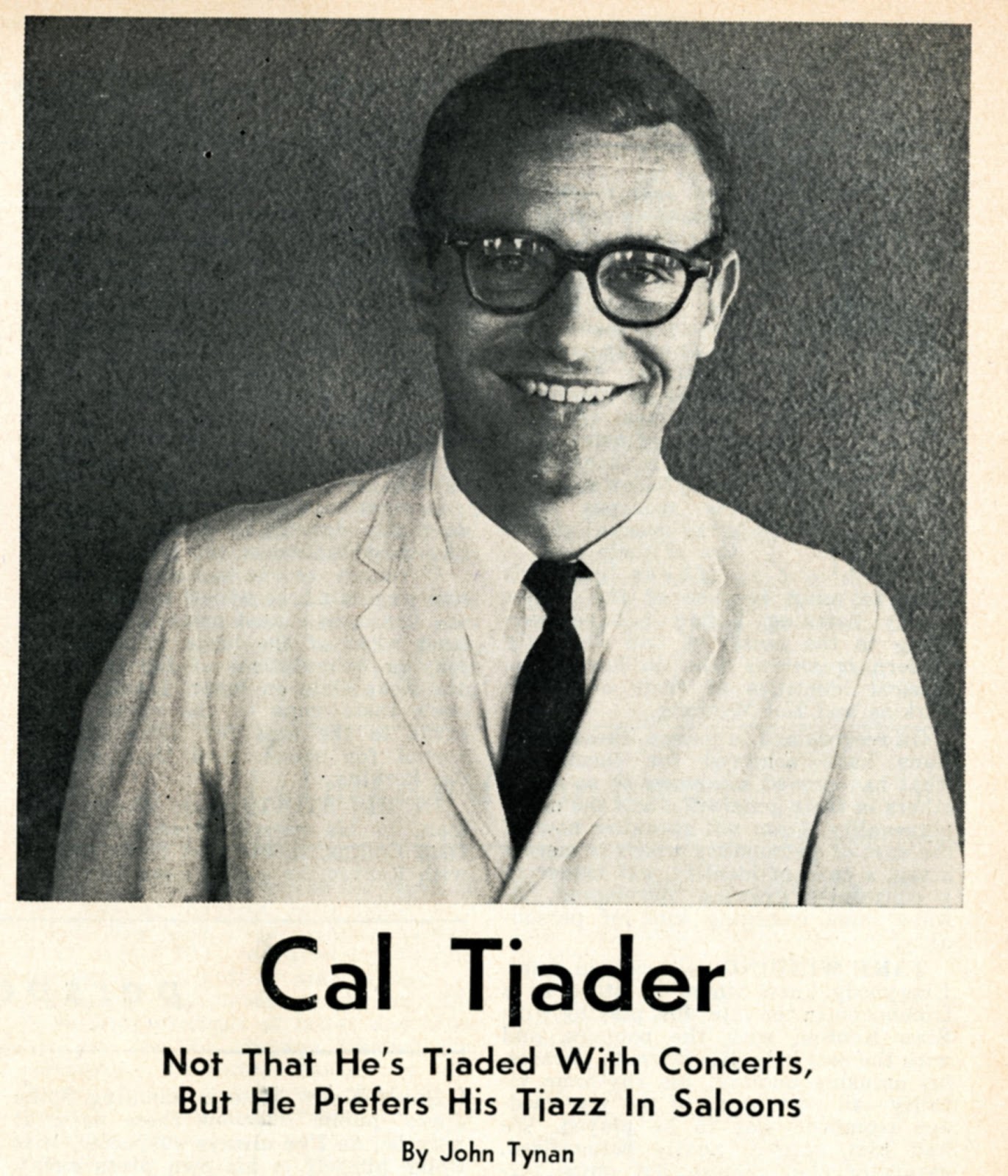


© Copyright ® Steven Cerra, copyright protected; all rights reserved.


Lately, I’ve been on a vibraphonist and percussionist Cal Tjader “jag” - [for those who may not be aware, the “T” is silent in his last name and it's pronounced “Jader”].


The dictionary definition of “jag” that I am referring to is “to be completely unrestrained” in the sense of listening to all the music I can lay my hands on regarding certain artists and checking the Jazz literature to see what I can find to form a piece about him/her that I can put up on my page - these include insert notes.


Here’s one of the earliest features in the Jazz literature on Cal in which he discusses his approach to Jazz and how it developed. It took place a few years after he took on  the leadership of his own quintet following stints with Dave Brubeck and George Shearing,


The interview was published in the September 5, 1957 edition of Downbeat by John Tynan who its West Coast editor.


“So far as Cal Tjader is concerned he hopes “they never take Jazz out of the saloons.”


Not that he overindulges. But he doesn't believe the same mood and unfettered spirit for the music can prevail in a more formal environment.
"Not too long ago," explained the 32-year-old Missourian, "the quintet played a couple of weeks in the Los Angeles Jazz Concert hall. Now this was a formal, concert-type presentation of jazz. But you know something? I wouldn't care for it as a steady diet. It just wouldn't make it for me. You get a little lazy, and the groove isn't there when you play to an audience of sitters and listeners. Of course, I do want people to listen to us—but relaxed, not too deliberate. In a club, the audience and the band can let their hair down."


ONE POSSIBLE reason Tjader places so much stock in a thoroughly relaxed audience could be that his group plays a lot of dances, principally in the Los Angeles area, in Spanish-speaking communities.


"I like people to dance to the Latin stuff," he said emphatically. "At one of our dances in the Sombrero ballroom, for example, you can play a montuna, and everybody is responsive to it. Of course, in clubs you have to gear it more to the listener; but to me this is much more rewarding than playing to row-upon-row of concert listeners.


"And when you feel that you can just play to a dancing audience, there's an emotional kick - the pressure's off. It gives me a real boot when one of the dancers will come to the stand and say with real sincerity, 'Ey, I sure like your progressive mambo, man.’” Tjader's fresh face brightened in one of his frequent grins.


Leader of his own quintet for the last 3 ½  years, since he left the George Shearing group early in 1954, the vibist-drummer was born Callen Radcliffe Tjader Jr. in St. Louis, Mo., 1925.


COMING FROM A musical show business family (his father was a dancer with the Duncan Sisters, playing the Orpheum vaudeville circuit when Cal was born; his mother a student concert pianist), it was a small surprise that at 2 Cal already was a piano pupil of his mother. This was in 1927 when the family moved to San Mateo, Calif., where his parents opened a dance studio.


After an introduction to drums in high school, Cal joined the navy in 1943. Upon discharge three years later, he enrolled in San Francisco State college, majoring in music and education. Latching onto an old set of vibes, he began teaching himself to play the instrument and was shortly sitting in with local groups around the bay area.


In 1948, while still a student, Tjader met Dave Brubeck, who then was studying at Mills college. With bassist Ron Crotty, he joined Brubeck to form the original trio led by the piano man.


Three years later, in 1951, he left to form his own quartet in San Francisco.
In 1953, Cal disbanded to join Shearing on vibes.


"One of the chief compensations of being with Shearing," he said, "was that back east I got to hear a lot of Machito, Tito Puente, and Noro Morales. 
Those bands had a tremendous effect on me. Immediately I wanted to reorganize a small combo along the same lines, only with more jazz feeling incorporated in the Latin format."


THE FRUITION OF this desire was in the formation of his first so-called mambo quintet in 1954. A booking at San Francisco's Macumba got the group off to a good start.


In addition to its six-month stint at the club, the first albums on Fantasy quickly established the quintet as a new unit to be reckoned with in concerts and clubs on the west coast. Today, according to Fantasy's Sol Weiss, Tjader is the label's biggest seller. In 1955, after a nationwide tour, Cal won new star laurels in Down Beat's Jazz Critics poll for his performance on vibes.
In June,1956,he radically reorganized his "mambo quintet." In effect, this entailed his dropping the mambo tag and placing the emphasis on jazz appeal.


It took about a month before he crystallized a new concept for the group; when he began taking bookings again, it was a predominantly jazz quintet that hit the road.


THE PRIMARY REASON for this change, according to Tjader, is that "Latin has its definite limitations, especially from the standpoint of improvisation. It's like a hypnotic groove. First you set the rhythmic pattern, then the melodic formulae follow — until pretty soon you realize there's not much real music invention happening.


"See, the Latin percussionist's conception of time is very straight, rigid," he elaborated. "It's not really loose like it has to be for jazz. That's why there's nothing more of a drag than having Latin percussionists sit in with a jazz group. Generally they seem to lack that loose, free rhythmic way of blowing. But on the other hand, you can take a jazz number like Bernie's Tune, for instance, and adapt it to Latin treatment, still preserving the flavor of both styles of music."


These days, Cal is not so much concerned with preserving Jazz feeling within a Latin context as he is with blowing straight Jazz in an identifying manner. 


As collaborators to this end, he can count on Vince Guaraldi, former Woody Herman piano man; Eugene Wright, bassist who played with many varieties of groups from Count Basie to Sarah Vaughan; and his steady versatile drummer, Al Torre. Then, to widen the appeal of every set, Latin percussionist Louis Kant contributes to several numbers in the Ritmo Caliente vein.


On the subject of an identifying sound, Cal is a stickler. “If you can get a real sound of your own, it’s half the battle,” he insists. “In fact, I believe a group sound is more important to make a band go over than the individual improvising talents of its members.”


“Of course, I realize that most groups starting out today will have to sound like some other existing units. This can’t be helped, but it doesn’t mean they still can’t play worthwhile Jazz.”


“It takes time to evolve a sound of your own. Look at the Modern Jazz Quartet: they were working for perhaps three years before they caught on and really got their identifying sound. For us the Latin thing worked. But there’s no law that says we had to stick to it. I think we’ve proved by now that we can make it with straight Jazz.”


With his breakthrough into chi chi haunt [stylish setting] of Hollywoodiana, Ciro’s on the Sunset Strip, Cal sees no reason why the quintet shouldn’t play similar rooms throughout the nation. As he views it, it boils down to living up to your responsibilities to an audience.


“You don’t necessarily have to be smiling all the time,” he explains. “You’re trying to sell Jazz right? Then you have to have a responsible presentation.The MJQ appeals admirably there. They’ve got a freedom in their individual playing, but as a group they’re disciplined. This is the most important thing, I believe.”


The vibist drummer, a well-scrubbed Joe-College type in a searsucker, has much to say regarding Jazz rooms. While a lot of this is unprintable, much of it is praise for happy rooms that are conducive to playing.


He rates San Francisco’s Blackhawk as one of these. Another of these he considers as an ideal room is Zucca’s Cottage in Pasadena, CA. 


“One more thing,” he added emphatically. In every contract that a band signs when it takes a club engagement, there should be a specific clause that the piano should be tuned to A440 [440 Hz, which serves as a tuning standard for the musical note of A above middle C].”


“Well,” he said with a wistful smile, “club owners being what they are, maybe that’s a lot to expect.”


Thursday, November 27, 2025

LATIN ESCAPADE - George Shearing

© -Steven Cerra, copyright protected; all rights reserved.


Sometimes I wonder if fans of Jazz who grew-up listening to the music in the analog era realize how fortunate we are that so much of it has been reissued in digital CD and Mp3 formats.

Since Jazz, in general, accounts for less than 3% of all recordings sold, it is amazing how much of it has been subsequently released in digital configurations.

Although not all of my favorite LPs have been included in this transition, fortunately, over time, most have and I for one am very grateful for the convenience of having some of the more obscure among these in a digital conversion.

One such album is Latin Escapade [Capitol T737] which features pianist George Shearing and his quintet. In addition to George, the quintet is made up of a guitarist, vibraphonist, bassist and drummer. Although these are all instruments that must be struck or plucked, George’s group has managed to achieve one of the more beautiful and easily identifiable sounds in Jazz.


The uniqueness of “the Shearing Sound” comes from the way the group states the melody of each tune. This is formed by Shearing playing blocked chords around the notes of the melody with each hand an octave apart and the vibes playing in unison up an octave from the piano’s right hand and the guitar playing in unison down and octave from the piano’s left hand. 

When hearing "The Shearing Sound," essentially the listener is experiencing a melody that is harmonized into four-parts in which Shearing's upper melody note is doubled on vibes and the lower note is doubled on guitar.

You can hear this four octave span quite distinctly on every track of Latin Escapade. Each of the album’s twelve [12] tracks is less than 3.30 minutes.

Here are some YouTube videos that will provide you with a Shearing Sound sampling of the music from the album. 


Along with vibraphonist Cal Tjader, who had occupied the vibes chair in George’s quintet before forming his own combo, Shearing was one of the earliest adapters of Latin rhythms in a small group setting.  Many of his 1950’s album contained Latin Jazz tracks or were thematically based on Latin Jazz themes as was the case with Latin Escapade.

George developed such a deep interest in Latin rhythms that he went so far as to  insert a segment in his club sets or concert performances that highlighted tunes with a Latin-flavor. During these Latin features, Shearing would augment his quintet with conga drums and timbales with the Jazz drummer in the group playing various Latin percussion instruments, thus creating the instrumentation for authentic Afro-Cuban rhythms. 

Of course, George was always a very commercial-minded musician [in other words, he liked to eat regularly and pay his rent on time] and it certainly didn’t escape his attention that dancing to the [then, newly-introduced] Mambo rhythm was a craze that swept the US in the 1950’s.

Hence, the following Mambo with Me cut from Latin Escapade


The long-playing record provided Jazz groups with room to “stretch-out” take longer solos] and it was not uncommon for Jazz LP’s to have 2 or 3 tracks per side that produced 18-20 minutes of music per side.

During his career [1919-2011], Shearing did make some LP’s with fewer cuts per side, especially with the quintet in performance, but he made many more with the more commercial or popular music format of 12 tracks per LP.

Although Latin Escapade belongs in the latter category, its finely crafted and well-executed arrangements, while easy on the ear, are anything but commercial.

With none lasting longer than 3:35 minutes, each of the album’s twelve tracks is a miniature musical masterpiece. 

George is the only soloist and during his solos he reveals a thorough familiarity with Latin Jazz piano stylings; particularly the heavy use of riffs and “montuno” [repetitive refrain.

All of these qualities are reflected in this YouTube which uses vintage postcards of Cuba from the University of Miami’s collection and Mi Musica Es Para Ti [“My Music is For You”] from the from the album as its audio track.


George has always had an ear for pretty melodies. He can swing hard, too, but his affinity for appealing airs results in a healthy variety of ballads on all of his recordings. He always arranges his treatment of such tunes very artfully so as to further enhance their beauty and, in many cases, their romantic or alluring aura.

At a time in the 1950’s and 60’s when AM radio in Southern California still offered programs that specialized in “mood music,” it was not uncommon to hear a Shearing Sound ballad treatment during one of these late night broadcasts.

One such example of Shearing charming way with a ballad can be found on his Latin Escapade interpretation of Ray Gilbert and Osvaldo Farres’ haunting Without You that serves as the audio track to this You Tube commemorating The Shearing Sound.


Over the years, in addition to leading his marvelous quintet, George performed with Nat King Cole, Peggy Lee, Mel Torme and a host of other vocalists. including, toward the end of his career, guitarist and vocalist, John Pizzarelli.

In addition to the recordings that he has made with these artists, George has a substantial discography under his own name – none better than Latin Escapade [1956].

After sampling the music on this album, we hope you will agree.

Tuesday, November 25, 2025

Gerry Mulligan, 'Rebirth of the Cool' - 1991

 © Copyright ® Steven Cerra, copyright protected; all rights reserved.


“When the seminal gatherings for the Miles Davis Orchestra first took place in 1947, Gil Evans was the old man at thirty-five; Miles Davis was twenty-one; and Gerry Mulligan was still only twenty years old.  He had already contributed excellent arrangements to the Elliot Lawrence and Gene Krupa bands, and, as has been mentioned earlier, one of his charts, "Disc Jockey Jump," had become a hit after having been recorded by the Gene Krupa Orchestra.  Even at that early age Mulligan was circulating among the best of the swing and modern musicians, including Charlie Parker.  Both his performing talent and his precocious genius were clearly recognized by his colleagues.


Mulligan, like Evans, gained his compositional skills and arranging craft not at a college or conservatory but on his own, for he left high school for the road. His performance abilities as the premiere baritone saxophone soloist are well known by most jazz fans, but it is a lesser known fact that he was also a truly versatile single-reed instrumentalist, playing other saxophones as well as the clarinet at a remarkably high professional level. ….


Of the twelve numbers recorded by the Miles Davis Orchestra for Capitol Records in 1949 and 1950, the largest number—six—were arranged by Mulligan, three were composed by him, and he also played on all the tracks. In addition, he composed and arranged another piece for the band, ")oost at the Roost." On the basis of these accomplishments, he must be credited as a major architect of the Miles Davis nonet and as a founding father of the style and movement called cool jazz. In the immediate period after these recordings, he, like Miles Davis, faced a difficult time artistically and financially, and in 1951 he hitchhiked from New York to California while seeking greater opportunities in jazz.  His chance soon came, just as did Davis's, but these two men, who remained friends over the years, followed dissimilar musical paths from this point on.”

  • Frank Tirro, The Birth of the Cool of Miles Davis and His Associates [2009]


“The phrase ‘jazz repertory’ has many definitions and dimensions. Perhaps the most basic is: the study, preservation and performance of the many diverse musical styles in jazz. In recent years, the phrase most often applies to big bands and jazz ensembles performing classic and new music written for reeds, brass, and rhythm section in various sizes and combinations.” 

- Jeffrey Sultanoff, Bill Kirchner, ed., The Oxford Companion to Jazz [p.512]


“There has been some rewriting of the history books on behalf of Mulligan and pianist/arranger John Lewis vis-a-vis the original Birth Of The Cool. Mulligan is on record as feeling that the project was subsequently hijacked in Miles Davis's name. Though Miles 'cracked the whip', it was Lewis, Gil Evans and Mulligan who gave the music its distinctive profile. In 1991, Mulligan approached Miles regarding a plan to re-record the famous numbers, which were originally released as 78s and only afterwards given their famous title. Unfortunately, Miles died before the plan could be taken any further, and the eventual session featured regular stand-in Roney in the trumpet part. With Phil Woods in for Lee Konitz, the latter-day sessions have a crispness and boppish force that the original cuts rather lacked. Dave Grusin's and Larry Rosen's production is ultra-sharp  …. An interesting retake on a still-misunderstood experiment, Re-Birth sounds perfectly valid on its own terms.”

  • Richard Cook and Brian Morton, The Penguin Guide to Jazz on CD, 6th Ed.


Interestingly, the first decade of Gerry’s career ended with his major involvement in what collectively came to be famously known as The Birth of the Cool recordings. The last year of his career began with recordings that he labeled The Rebirth of the Cool. 


Whatever the back story or, if you will, motivation, Gerry’s enduring friendship with Dave Grusin, co-owner of GRP Records along with Larry Rosen, resulted in a four-decades-later make-over of the 1949 Birth of the Cool recordings with some additions and subtractions in both the compositions and the personnel.


As explained in the commentary that opens this piece, Gerry had approached Miles Davis about a reunion to produce a new and different version of the original recordings. Of course, we can only surmise how this revisit by two of the principals associated with the original recordings might have turned out, but in a way, Miles’ ultimate declination and subsequent death brought forth other possibilities.


As Richard Cook and Brian Morton note - “Phil Woods in for Lee Konitz, the latter-day sessions have a crispness and boppish force that the original cuts rather lacked. Dave Grusin's and Larry Rosen's production is ultra-sharp  …. An interesting retake on a still-misunderstood experiment, Re-Birth sounds perfectly valid on its own terms.”


And David Badham in the 1992 November edition of Jazz Journal was pleased to note “ … that this reprise of Miles Davis's landmark session was 38 percent longer than the original. Almost exactly 43 years after the original Move date for Capitol, these come up absolutely fresh and vital, and quite as good as anything produced since in this vein. Personally, I have always regarded the original sessions as Gerry Mulligan’s not Miles Davis’s since he arranged seven of the 12 numbers and was by far the most impressive solo voice! If anything he is even better now, so I wel­come this issue wholeheartedly.”


More information about how and why The Rebirth of the Cool came about is contained in these liner notes by Leonard Feather that accompanied the GRP CD [GRD-9679].


“It all began in a basement room behind a Chinese laundry on West 55th Street in New York. Gil Evans, who lived there in the late 1940s, was a magnet for some of the forward-looking musicians of the day: Charlie Parker ("Bird"], the composers Gerry Mulligan, John Lewis, George Russell and John Carisi, saxophonist Lee Konitz, and, of course, Miles Davis.


"Everyone seemed to gravitate to Gil's place," Gerry Mulligan recalls. "We all influenced one another, and Bird influenced us all."


Bebop had brought startling innovations to jazz. Gerry, Miles, Gil and others foresaw the possibility of a new dimension that would allow an orchestral vision integrating bop's characteristics with written elements.


As Gerry pointed out, "We wanted the arrangers to have useful orchestral colors to work with, at the same time retaining the lightness and freedom of a small band." After much deliberation, this is the instrumentation Gil and Gerry decided on.


"One of the things that made it practical to use instruments such as tuba and French horn in the ensemble was that there were players who were already trying to adapt their instruments to a new approach. When Gil first told me about Bill Barber, he said Bill liked to transcribe Lester Young solos for tuba!"


Much of the inspiration stemmed from the Claude Thornhill Orchestra, to whose library both Evans and Mulligan had contributed. In fact, it was Gil who brought the, then, 19 year old Mulligan into the Thornhill orbit.

But it was Miles Davis who, as Gerry explained it, "...put the theories to work, called the rehearsals, hired the halls, and generally cracked the whip."


Move, Jeru, Godchild and Budo were recorded January 21, 1949, and were released as two 78s. Venus de Milo, Boplicity, Israel and Rouge were cut three months later, and the final session in March of 1950 yielded Moon Dreams, Deception, Rocker and Darn That Dream. In 1954, eight of the tunes were released on a 10 inch LP. Three years later a 12 inch LP, with all 11 instrumentals (omitting the vocal Darn That Dream), appeared under the Birth of the Cool title by which the sessions have been known ever since.


In the summer of 1991, in Rotterdam, Gerry told Miles he was planning to play the music again. Miles, who was very enthusiastic about the concert at the Montreux Festival two weeks before, (where he had played many of the great works Gil Evans had written for him, with an orchestra assembled by Quincy Jones), said to let him know when it was going to be. and maybe he would do it. Sadly, it was not to be.


With Miles' death the decision to find a suitable trumpet for this demanding role resulted in the selection of Wallace Roney, whose career had reached a high point when he joined Miles in an historic duet at the Montreux concert. Thus he was a logical choice for the "Re-Birth" project.


Gerry says, "He really understands something about Miles' melodic sense. He did some astounding melodic things on this album."


Gerry and Bill Barber were on all three of the original sessions, and John Lewis was on the last two. Gerry recalls, "John was Ella Fitzgerald's accompanist and it was just our bad luck that Ella was scheduled to record the same day as our first session!"


Lee Konitz, who was on all the early sessions, was originally scheduled to join the "Re-Birth" recording, but due to previous commitments that had him on the other side of the globe, it was impossible to get everybody together at the same place at the same time. "When Lee asked me who was going to take his place on alto, and I told him Phil Woods would like to do it, Lee laughed and said, 'I think you just invented the 'Birth of the Hot!"'


Gerry went on to say, "Phil told me he'd always wanted to play this music, so it was like a dream come true for him. He plays some absolutely fantastic solos and adds a great spirit to the whole project!"


Rounding out the "Re-Birth" group are trombonist Dave Bargeron and French hornist Dave Clark, both of whom were associated with Gil Evans in later years.


Gerry called on old friend and colleague Mel Torme to sing Darn That Dream, the one vocal in the collection. "Mel was happy to do this," Gerry says. "He always loved this instrumentation, and later on, my Tentet. In fact, he made an album with a similar instrumentation and we've talked for years about doing an album together along similar lines, which we'll get  around to eventually. When I told him we were doing this, he was eager to take part."


As these notes go to press, Gerry is planning a tour of the summer festivals with his Tentet, the instrumentation presented here, plus the addition of another trumpet and a clarinet. "We're introducing the band at the Ravinia Festival in Chicago (where Gerry is currently Artistic Director of their "Jazz in June" series), at the Anson Ford Amphitheatre in Los Angeles, and Carnegie Hall in New York.


The Birth of the Cool concept (which, in fact, was by no means as cool as the name implied!) lives on, some 40 years after Miles and Gil and Gerry and their fellow dreamers put their innovative ideas on record. It might well be added that the cool was not reborn, since for anyone who recalls its pristine

glory, it never really went away!”

-Leonard Feather

And here is an in performance review of the music by John Pareles that appeared in the June 30, 1992 NY Times 

Review/Jazz Festival; From Gerry Mulligan, 'Rebirth of the Cool'


“Each jazz era finds its own ancestors. Now that many musicians and audiences are turning toward music that prizes structure as well as solos, it's appropriate that Gerry Mulligan has decided to revive the arrangements he wrote and played with the Miles Davis Nonet more than 40 years ago. The music was collected in 1957 on an album titled "Birth of the Cool," and on Friday night Mr. Mulligan and a "tentet" (the nonet's lineup plus an extra trumpeter and saxophonist) performed at Carnegie Hall for a JVC Jazz Festival concert called "Rebirth of the Cool."


At the end of the 1940's, Davis, Gil Evans, Mr. Mulligan and other musicians were looking for a next step after be-bop, which had depended on small groups and extensive solos. They wanted to create ensemble arrangements that would reflect the convoluted harmonies and whiplash rhythms that be-bop had wrought. With Davis as leader, they assembled a nine-piece group that played a few club dates between 1948 and 1950, to a largely indifferent response among nonmusicians. But the recordings, made in 1949 and 1950, have endured. Musicians including Mr. Mulligan and another member of both the original nonet and the current tentet, the alto saxophonist Lee Konitz, have both worked with similar groups in the intervening decades. The tentet also included Bill Barber, another nonet member, on tuba.


For "Rebirth of the Cool," which preceded a European tour by the tentet, Mr. Mulligan followed an established jazz-repertory approach. He used the original arrangements and tempos while adding new solos, some of them variants on the recorded ones.


The two sets covered half the "Birth of the Cool" album, including Johnny Carisi's modal blues "Israel," Mr. Mulligan's arrangements of George Wallington's "Godchild" and his own "Jeru," Evans's arrangements of Chubby MacGregor's and Johnny Mercer's "Moon Dreams" and Davis's "Boplicity," and John Lewis's arrangements of Bud Powell's and Miles Davis's "Budo" and Denzil Best's "Move." The concert also included pieces from Mr. Mulligan's own repertory, among them "Blueport" by Art Farmer, the tentet trumpeter who had the unenviable task of taking on Mr. Davis's solos.


Jazz repertory can bring to life compositions that were muffled by the limitations of early recording. But the "Birth of the Cool" recordings are relatively recent, and the tentet had Carnegie Hall's acoustics to contend with. The hall makes trouble for amplified music, even at the relatively restrained volume of the tentet. Compared with the intimate recordings, much of the detail of the arrangements was smudged.


Even so, a new chance to hear the music was welcome. Mr. Mulligan and Mr. Konitz were both in fine form, Mr. Mulligan gruff and swaggering on baritone saxophone, Mr. Konitz leisurely and oblique on alto. And even after 42 years, the arrangements remain enigmatic, a corrective to the brassy extroversion of the big-band era. They use saw-toothed lines and close, dense harmonies, often played by instruments clustered in the low and middle registers (and thickened with French horn and tuba); they mull over the tunes, occasionally opening up to let a soloist step forward. The Evans arrangements are oddest of all, wrapping gauzy timbres around dissonances few other arrangers would even try, much less get away with.


For an encore, the tentet played "Satin Doll," and its relaxed symmetry was a reminder of all that the "Birth of the Cool" had willfully and gracefully sidestepped. The tentet also included Rob McConnell on valve trombone, Mike Mossman (who took some pointed solos) on trumpet, Ken Soderblum on saxophone and clarinet, Bob Routch on French horn, Ted Rosenthal on piano, Dean Johnson on bass and Ron Vincent on drums.”


Finally, the following was from a time when Jazz, if it got mentioned at all in a major newspaper, got mentioned briefly. Hats off to Zan Stewart for trying.

Pop, Jazz Reviews : Mulligan Breathes Life Into Old Work at Ford

BY ZAN STEWART

JUNE 22, 1992 LA Times

“Gerry Mulligan’s performance with an 11-piece band before a sell-out crowd at the John Anson Ford Theatre on Saturday proved once again that a contemporary airing can breathe an amazing amount of life into a work composed long ago.

The renowned baritone saxophonist and composer went back 40 years, reviving selections transcribed from the memorable 1949 and 1950 “Birth of the Cool” sessions led by Miles Davis, and which Mulligan recently re-recorded. On those sessions, Davis, along with Mulligan and others, examined be-bop-based material with a fresh sound, pitting the higher timbres of trumpet and alto sax against such low brass as trombone, French horn and tuba.

Mulligan’s aggregation, which included such esteemed jazzmen as trumpeter Art Farmer and alto saxophonist Lee Konitz, duplicated the instrumentation of the originals, except for the addition of an extra trumpet and a tenor sax-clarinet part. The band’s vibrant renditions of such well-preserved items as “Godchild,” “Boplicity” and “Moon Dreams” clearly demonstrated that these are not simply museum pieces, that they indeed have lasting power.

“Jeru” was distinctive for its dynamic climax, where the brass and reed sections tossed snappy lines back and forth. “Israel” began with the melody rendered by the low brass, then came the piercing brightness of trumpet and alto sax. Gil Evans’ dramatic arrangement of the oozingly slow “Moon Dreams” ended with a wall of soft sound, where instruments darted in and out, changing the work’s timbral color. The soloists were first-rate. Farmer’s ingenuity was quietly breathtaking as he took a series of brief phrases and strung them together into complex wholes. Konitz applied his one-of-a-kind sound, seemingly flat but really full of juice, to stretched-out notes and relaxed phrases that ran counter to the bubbling rhythm of a tune such as “Israel.” Mulligan swung with vitality and accessibility.”