Showing posts with label Dave Stryker. Show all posts

Tuesday, January 19, 2021

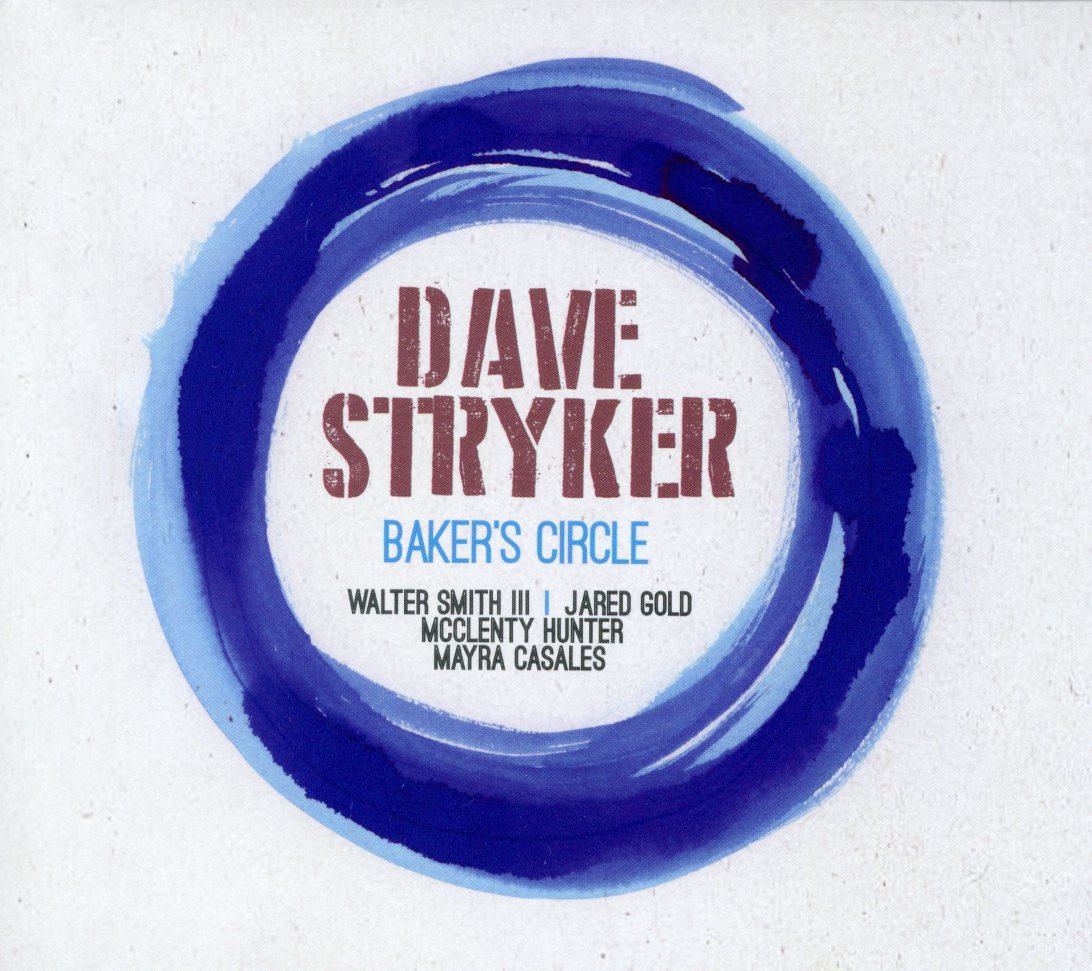
Dave Stryker - Baker's Circle

 © Copyright ® Steven Cerra, copyright protected; all rights reserved.


“RAY BROWN once defined a bassist's greatest assets as "good time, good intonation, and a big sound." While agreeing that this is a solid, workable definition, Bill Crow would add another factor.


"If you have those qualities," he explained, "and don't find out how to relate them to the musicians you're playing with, you'll still not be contributing much to the group. That may seem like a simple-minded statement of something everyone should know, but it's surprising how often poor contact between musicians is the principal difficulty in playing well together.


Bill Crow made those comments in a 1963 Downbeat interview and guitarist, composer and bandleader Dave Stryker has taken the caveats contained in them to heart by always putting together bands that work well as a unit because the individual members listen to one another and play as a group.


Dave Stryker has been around the music business for a long time and it shows in many aspects of his latest recording [if truth be told - in all his recordings] - from the other musicians associated with the project, to the song or tune selection, arrangement and track placement.


On Dave Stryker Baker’s Circle [Strikezone 8821], he’s given the music and the way it is performed on it a lot of thought which is not only drawn from his professionalism but also from his experience.


Dave does what Dave does best - he’s a straight ahead groove merchant: he just plants his feet and brings it, one compelling rhythmic chorus after another. He rides the rhythm section the way a master surfer rides the wave; always in the curl allowing the tidal current to propel him forward.


Nothing in Dave’s music is forced or strained and before you know it, it engulfs you in what Duke Ellington referred to as - “The Feeling of Jazz” - a feeling of elation and well-being complimented by warm emotions and generous helpings of finger-popings and foot tappings.


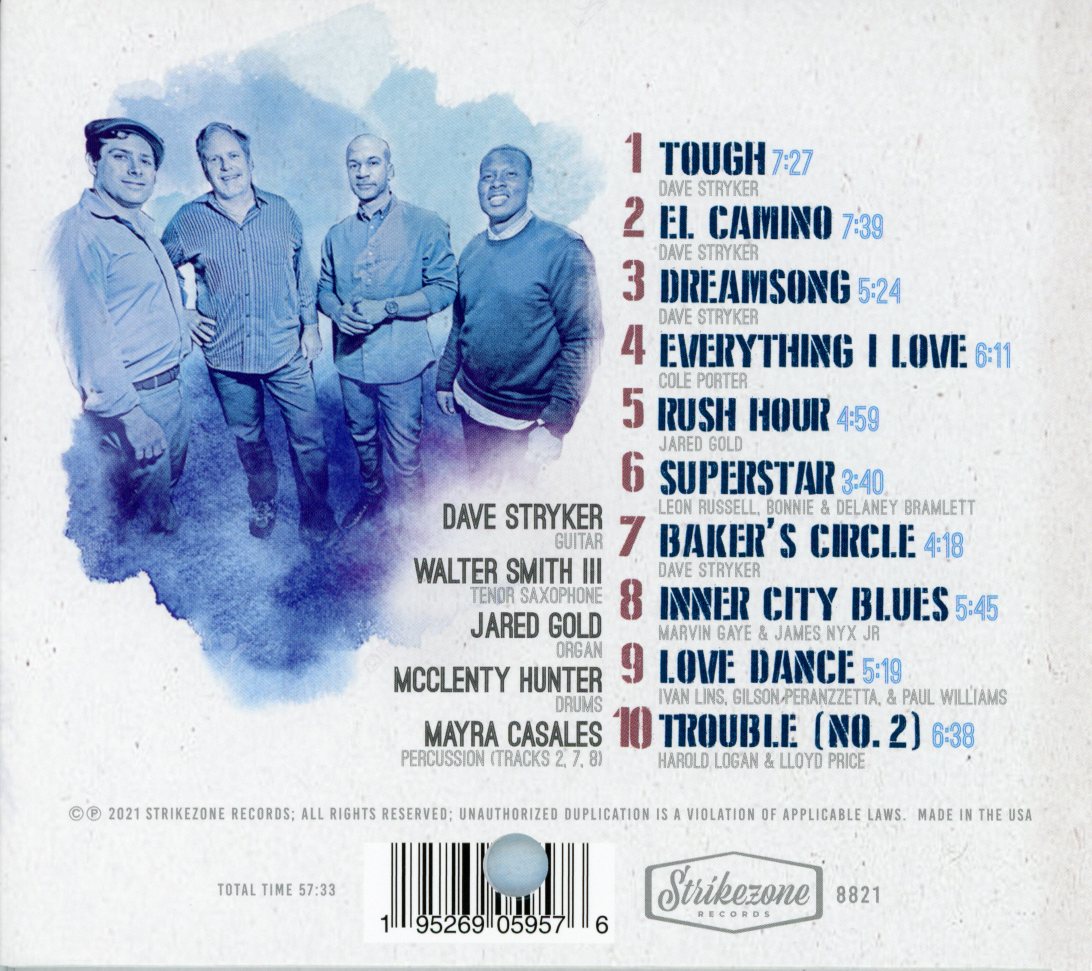
Helping to generate The grooves on Dave Stryker Baker’s Circle are some old friends - Jared Gold on organ and McClenty Hunter on drums. They are joined by two new associates - Walter Smith III on tenor saxophone and percussionist Mayra Casales who infuses Latin Jazz rhythms on three tracks.


Jared plays a pivotal role in the music as his comping adds rhythmic riffs but he can also join Dave and Walter as a third “voice” in enhancing both the melody and the harmony. Jared also provides some funky bass lines that add grease to McClenty’s engine room as his drums propel the music forward.


Dave puts all of these musical elements to good use in developing fresh takes on standards such as Cole Porter’s Everything I Love, Leon Russell’s Superstar and Marvin Gaye’s Inner City Blues, as well as, the four originals he brought to the date one of which - Baker’s Circle - also serves as the name for the recording.


Jared Gold’s Rush Hour, Ivan Lins’ Love Dance and Harold Logan and Lloyd Price’s rhythm and blues workhorse Trouble [No. 2] - a tip-of-the-hat to the late tenor saxophonist and Dave’s old boss Stanley Turrentine - complete this musicfest of jammin’ sounds and grooves.


Trouble [No. 2] is the last of the ten tracks and it could be said of it that it was placed so to end the party - because that’s what this record is - a party, a celebration, a bash. It also features a magnificent introduction to the tenor sax playing of Walter Smith III who channels some of Stanley Turrentine along with Joe Lovano and a hint of Tina Brooks while adding a big dash of his own voice to what has to be the most refreshing tenor saxophone sound heard on a Jazz recording in recent memory.


All of this made possible by Dave Stryker’s musicianship and experience which he brings to bear to create a recording that has a play through quality about it: the ten tracks just flow nicely one-to-the-other, stopping here for a little chop-busting, there for a new take on a standard, and everywhere for surprises. And when it's over, you can’t wait to listen to the whole thing again.


Above all, this group jells as a band that plays TOGETHER and the proof of it is everywhere apparent in Dave Stryker Baker’s Circle.


Jim Eigo of Promotional Jazz Services is handling the PR for the CD and he sent along the following media release for the CD which is due out on March 5, 2021. If you want the music sooner it’s available now via this link to bandcamp.


“After last year's successful big band outing, Blue Soul, guitarist Dave Stryker is back with his hard-driving, deep-grooving B3 organ group on his new recording—Baker's Circle. With the addition of cutting-edge tenor player Walter Smith III, Baker's Circle features Stryker's originals as well as a couple Eight Track gems and a tip of the hat to his former boss Stanley Turrentine. Along with Smith III, this fresh recording features Dave's working band of Jared Gold on organ and McClenty Hunter on drums and adds Cuban percussionist Mayra Casales to three tracks as well.


Baker's Circle starts with three Stryker originals. The hard-hitting "Tough" leads off with exciting sobs by the whole band. Casales’ congas join in on the latin groove of "El Camino" followed by the bluesy 7/4 of "Dreamsong." Cole Porter's "Everything I Love" is a medium swinger after which Gold's burning "Rush Hour" shows why Walter Smith III is considered one of the best of his generation. And Dave adds his Eight Track fingerprint to Leon Russell's "Superstar" and Marvin Gaye's "Inner City Blues."


Says Stryker: "Composer and educator David Baker was in my corner from the time I met him at a jazz camp when I was 17 till he hired me to take over as guitar professor at Indiana University a few years ago. I used to see him standing outside the Music School on a circular drive waiting for his wife Lida to pick him up. I named the song ‘Baker's Circle' in his memory."


Baker's Circle closes with "Trouble (No. 2)," a grooving shuffle originally recorded by Stryker's former boss, the great Stanley Turrentine. This caps a diverse program that showcases Stryker at his best — modern playing with the groove and soul that comes from years of experience.”


Saturday, July 8, 2017

Dave Stryker - "Strykin' Ahead"

© -Steven Cerra, copyright protected; all rights reserved.


On his Live at the Blue Note CD, Paquito D’Rivera, introduces the band members to the audience with a particular emphasis on the diverse regions in The Americas that they hail from and then going on to compare this diversity of the band to “The United Nations.”

When the audience snickers at the comparison, Paquito jumps up and shouts: “Yeah, but this band works” which then has the audience audibly ROFL.

It is a funny line, but every time I get a new CD by Dave Stryker, or a notification of a forthcoming club date by his band, or read a write-up about a concert appearance by Dave’s group I think of Paquito’s line - “Yeah, but this band works.”

And why not?

If you have chops like Dave’s; his musical sensibilities; his uncanny ability to put together interesting instrumentations; his skill at selecting just the right band mates to make Jazz with; wouldn’t you want to work all the time, too?

It becomes like anything you’re good at; you want to do it as often as possible but occasionally vary the context to keep it from getting stale.

The following insert notes by Ted Panken provides a context for the new recording as well as fine write-ups on the musicians and the music on the date.

It also underscores a lot of feelings that I share about Dave such as the statement that he is a “... an in-the-moment improviser with deep roots in the tradition who knows how to push the envelope without damaging the contents and “... his long-standing practice of presenting originals and reharmonized standards from the jazz and show music songbooks.”

“The notion of moving forward by triangulating a space between creative and pragmatic imperatives is a consistent thread throughout Dave Striker's four decades in the jazz business, not least on Strykin' Ahead, his 28th CD as a leader. Stryker augments his working trio of Jared Gold on organ and McClenty Hunter on drums with vibraphone player Steve Nelson, all on-board for a second go-round after their stellar contributions to last year's Eight-Track II.

Like the leader, Nelson is a preternaturally flexible and in-the-moment improviser with deep roots in the tradition who knows how to push the envelope without damaging the contents. Stryker internalized those imperatives on a 1984-1986 run win Brother Jack McDuff, and he received further invaluable training in the art of musical communication during a decade on the road with Stanley Turrentine, to whom he paid homage on the 2015 release Don't Mess With Mister T.

In contrast to his Eight Track II conception of putting his spin on pop hits of his formative years, Stryker returns to his long-standing practice of presenting originals and reharmonized standards from the jazz and show music songbooks. "Shadowboxing" is a burning 14-bar minor bhes; his well-considered chordal variations on Wayne Shorter's "Footprints" proceed to a simmering 5/4 figure. Next is "New You" (a stimulating Stryker contrafact of the oft-played "There Will Never Be Another You"). He personalizes Billy Strayhorn's "Passion Flower," set to Hunter's insinuating bossa nova-funk groove. The title track "Strykin’ Ahead" has a Cadillac-racing-down-the-freeway-feel; he imbues the lovely melody of "Who Can I Turn To" with the full measure of his plush, inviting tone.

That Stryker knows his Albert King is evident on the slow-drag "Blues Down Deep," which evokes wee-hours third sets in the inner city grills and lounges of Stryker's apprentice years. He knows his bebop, too. On Clifford Brown's "Joy Spring," the solo flights over Stryker's "modernized" progressions transpire over Hunter's drum-bass beats and crisp, medium-up four-on-the cymbal; on the chop-busting "Donna Lee," all members springboard off a churchy vamp and Hunter's funk-infused swing.

"I've always wanted to write vehicles that are fun and interesting to blow over," Stryker says. "Trying to come up with a beautiful melody that lasts is very fulfilling. Writing is a big part of my voice in this music." Stryker is too modest to say that his voice is also a big part of jazz, to which he's devoted a career marked by consistent application of the values that he espouses. But that's all right — I'll say it for him.

The following video features Dave, Steve, Jared and McClenty of Clifford Brown’s Joy Spring replete with some new harmonies for this old Jazz standard.

Friday, September 2, 2016

Dave Stryker - Eight Track II

© -Steven Cerra, copyright protected; all rights reserved.


The editorial staff at JazzProfiles has always been a big fan of guitarist Dave Stryker. In many ways, we see him as the epitome of the working Jazz musician, one who is constantly reinventing himself to keep his music interesting.

Over the span of his career, he has keep this interest factor up through a high level of creativity expressed with different instrumentation in his working groups and by using different themes from which he selects new music to arrange and improvise on.

Lately, the instrumentation has consisted of a quartet made up of Dave’s guitar, either Stefon Harris’ or Steve Nelson’s vibes, Jared Gold’s Hammond B-3 organ and McClenty Hunter’s drums.

As to a theme, lately, Dave continues to pursue Jazz interpretations of music from the eight track cassette era from the mid-1960’s to the late 1970’s.

His latest CD releases today - September 2, 2016 - and we thought we’d help celebrate the occasion by posting to these pages the following excerpts from Bill Milkowski insert notes to Eight Track II.

The recording is available through CD Baby, Amazon and iTunes or by visiting Dave at his website: www.davestryker.com.

“A bevy of artists from Wes Montgomery and George Benson to Freddie Hubbard, Buddy Rich and Count Basie have had their way with Beatles tunes and other pop fare. But Stryker put his own personal spin on Eight Track and now continues that successful formula on Eight Track II, his 27th recording as a leader.

"A lot of people like hearing these tunes that they grew up with,”  says the guitarist, who remembers playing some of these 70s staples on the 8-track console in his '69 GMC van with shag carpeting back in his youthful days in Omaha, Nebraska. "It brings people in and they'll go with you when they hear a tune that they recognize. But the challenge, always, is to find that I can do my thing to, improvise and play as creatively and musically as I would on any jazz standard. And I enjoy the challenge."


Four years after moving from Omaha to New York in 1980, Stryker began playing on the organ circuit with bluesy Hammond B-3 organ master Jack McDuff, who had seen such great guitarists as George Benson, Pat Martino, Grant Green and Billy Rogers pass through the ranks of his band. So dealing in that earthy B-3 format on Eight Track and Eight Track II is like returning home for Stryker, But 30 years later, the guitarist's six-string expression has deepened while his blues and bop chops remain razor sharp.

I'm very grateful that I had the opportunity to play with masters like McDuff and Stanley Turrentine, guys who played that style and just had it in their blood, There's nothing like being able to guys like that. Now I try to play my own way and I stretch things a little bit. It’s still in the pocket but I feel like I’m trying to have my own take on things with this new group."

Returning from Eight Track are Stryker's right-hand man Gold on B-3 and
the exciting young Hunter on drums. Special guest this time out is vibraphonist Nelson, a longtime member of Dave Holland's quintet and big band who has also played and recorded with such giants as Jackie McLean, Kenny Barron, Johnny Griffin, George Shearing and Mulgrew Miller. "Steve is a cat and a very soulful player," says Stryker. "I really like what he did on this album,"

The intrepid quartet kicks off Eight Track II with the Isley Brothers3 anti-war protest song "Harvest for the World," which they handle as a vibrant shuffle with some hip re-harmonizations. Stryker's warm-toned flow of notes is mirrored by Nelson's glistening vibes on the catchy head. The guitarist takes his time building an impressive solo, which is brimming with double-timed flurries and blues-soaked lines.

Their take on Marvin Gaye's anthemic What's Going On title track of his 1971 song cycle addressing drug abuse, poverty and the Vietnam War - themes that still resonate with relevancy today - opens with a delicate balladic intro featuring vibes and guitar in unison, As they fall into the familiar theme, rendered here in 6/8, Stryker 'sings' the melody through his axe before developing that motif through the course of his probing solo. Nelson explores in introspective fashion on his vibes solo and Gold pushes the envelope on his own dextrous solo as Stryker comps pianistically behind him. The band to a 4/4 for the last minute of the piece, giving the listener a little jolt

Another Gaye staple, 1972's Trouble Man, is given an earthy shuffle-swing treatment. Nelson channels his inner Bobby Hutcherson on his envelope-pushing solo here while Stryker remains firmly rooted in a blues 'n hard bop bag, summoning up some Wes-like octaves along the way.

A mellow rendition of John Barry's evocative Midnight Cowboy, the Grammy-winning instrumental theme from the 1989 movie of the same name, features nice octaves work and extrapolation by Stryker. Nelson's luminous solo is underscored by McClenty's supple brushwork and Gold's luxurious B-3 cushion.

Stretching the rules a bit, Stryker next leaps out of the 70s and into the early '80s for a killer uptempo swing version of Prince's 1984 hit, When Doves Cry. Fueled by McClenty's rapid-fire ride cymbal work and Gold's unerring walking Stryker's cooking here, while both Nelson and Gold bring some heat of their own with incendiary solos. Hunter adds an exhilarating drum solo to put an exclamation point on this burner.


A gentle reading of Stevie Wonder's Send One Your Love showcases Stryker's lyrical side while the quartet digs into The Temptations' Can't Get Next to You with visceral intensity, spurred on by Hunter's muscular backbeat "That's what I love about McClenty," says Stryker. "He can swing but he's got a serious too, and he can slam!" Gold delivers the kind of solo here that harkens back to the golden days of the organ lounges. “I played with McDuff, I got to play with Jimmy Smith and Dr. Lonnie Smith, and they were all masters,” says Stryker,"but of the new generation, Jared is my man. His harmony is heavy. His lines are not the typical thing you hear from organ players. I think he's special,"

Their rendition of The Zombie's Time of the Season is handled as a cool shuffle swing number with the guitar-vibes combo and Gold's hip, syncopated basslines percolating underneath. Stryker lets it rip in his solo here and is followed by Gold and Nelson, who each turn in dazzling solos.The three exchange eights with Hunter at the tag in classic bop fashion.

A driving rendition of Stevie Wonder's Signed Seal Delivered features one of Stryker's most inspired solos on the record. From that dynamic number, they slide into the alluring James Ingram ballad One Hundred Ways, handled with relaxed soulfulness by the crew.

They close with a tough shuffle-swing rendition of Cream's Sunshine of Your Love that sounds like something Stryker might have played with McDuff up at Dude's Lounge in Harlem back in the day. Everyone gets a taste on this foot-stomping finale. "I have a long history with that song," says the guitarist, "I actually played it as a solo guitar piece in my 6th grade talent show!"

These nostalgic 70s anthems are deeply ingrained in Stryker's consciousness. And the earthy feel of the organ quartet sound is imbedded deep in his bones after 30 years of playing on the scene. He successfully, joyfully combined the two on Eight Track II.

Bill Milkowski is a regular contributor to Down Beat and Jazziz magazines. He is also the author of JACO: The Extraordinary and Tragic Life of Jaco Pastorius and the co-author of Here and Now: The Autobiography of Pat Martino.

Here’s an audio-only version of Sunshine of Your Love the will give you a taste of what’s on offer in Dave’s Eight Track II.