Showing posts with label Rahsaan Roland Kirk. Show all posts

Monday, January 3, 2022

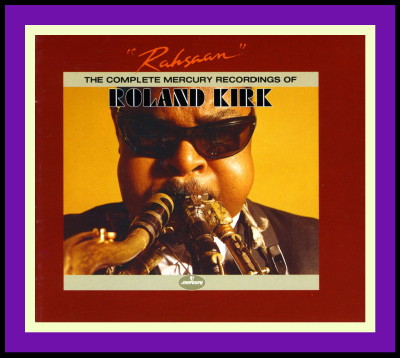
Rahsaan: The Complete Mercury Recordings of Roland Kirk

 © Copyright ® Steven Cerra, copyright protected; all rights reserved.

"He spent much of his time listening to earlier music. Rahsaan could have lectured on the history of jazz for a year without any notes," fan/friend Les Scher claimed.


When he wasn't educating audiences on the history of the music, Roland was busy playing it. Bill McLarney recalled seeing Kirk sit in with drummer Duke Hyde's group one night in Detroit. "He played an entire set of Lester Young tunes completely on the tenor, manzello, stritch, or nose flute. It was really something."


The traditional side of Mingus's music resurfaced the following year when his band featured, for three months, multireed player Roland Kirk (later known as Rahsaan Roland Kirk). Kirk was an ideal partner for Mingus. A stellar soloist, he could play with authenticity and forcefulness in any jazz style, from trad to free, and on a host of instruments—not just conventional saxes and clarinets but pawnshop oddities such as manzello, stritch, siren whistle, and nose flute. Kirk's arsenal of effects was seemingly endless, ranging from circular breathing to playing three horns at once. This versatility came, in time, to be a curse. Had he focused on a single instrument, he would have been acknowledged as a master. Instead he was too often dismissed as little more than a jazz novelty act. While with Mingus, Kirk invigorated the 1961 Oh Yeah release with a handful of penetrating solos, including an extraordinary "old-timey" outing on "Eat That Chicken." A dozen years later, Kirk rejoined Mingus for a Carnegie Hall concert and stole the show with his sly maneuvering inside and outside the chord changes. The small body of recordings featuring these two jazz masters in tandem is a cause for much idle speculation as to what might have been had they collaborated more often.

- Ted Gioia, The History of Jazz, 3rd Ed.


“I can honestly say that Rahsaan changed my life. When I first saw him perform in the 1970s, it was the greatest thing I’d ever seen. It was immediately after the release of Prepare Thyself to Deal with a Miracle, and it was like watching a hurricane on stage. The energy was far heavier than anything I was seeing in the punk rock world. Yet it took you somewhere. The contrast of anger and beauty was incredibly affecting: it had a healing effect. Within ten minutes, he would go from a screamfest to the most beautiful version of All Blues played on the nose flute to Creole Love Song on two woodwinds imitating the Ellington Band. After a Kirk set, I would feel like I had taken a long journey, and it left you with hope. This is what I always believed that music could do, and I became obsessed with him. His records lived up to his live shows, yet they were all different. From an album done almost by himself to a collaboration with [vocalist] Al Hibbler, each record was an event. It was no mistake that I sought out his producer [Joel Dorn] and found a place blending into the wallpaper at the studio - anything just to be present.”

- Hal Willner, record producer


Given the recent posting about the second edition of John Kruth’s biography of Rahsaan Roland Kirk -  Bright Moments - The Life and Legacy of Rahsaan Roland Kirk - 2nd Ed., I thought I would follow with a recommendation as to a starting point for delving into Rahsaan's complicated discography, which, as you would imagine, is studded with tons of bootlegs [most of which have awful audio].


After a moment’s reflection, it was fairly easy to recommend a series of Rahsaan recordings that he made for Mercury from 1961-1965 which have been issued as a boxed set with booklet notes by the esteemed Jazz scholar, Dan Morgenstern.


In other words, why not begin at the beginning of Roland Kirk’s recording career with Rahsaan: The Complete Mercury Recordings of Roland Kirk [10 CDs 846 630-2]?


All of Rahsaan’s recordings represent him in a formative stage of development in the sense that he was constantly reinventing himself through his attraction to and discovery of new sounds. He had an insatiable appetite for incorporating into his music everything and anything that stimulated his musical antennae.


That being said, these early Mercury recordings are less complicated by comparison to what was to come; there aren’t as many layers of sound to work through [although, believe me, there are still plenty], so what comes forward is a pure almost unadulterated Rahsaan, something that the uninitiated can get their ears around.


They also more clearly reveal Rahsaan’s close relationship with the Jazz tradition - the past -  if you will, while his later recordings are more reflective of the current trends in the music.


For as John Kruth has observed:


“In an age when most artists and musicians defined their individuality by rebelling against the past, Roland Kirk embraced it as a sparkling, bottomless well of inspiration. He believed wholeheartedly in order to further the music, you had to study where it came from. To Rahsaan, the past was not some looming albatross that overshadowed or threatened his creativity, but a precious flame that, if tended, would continue to burn brightly and guide all musicians on to greater realms of expression.


People are quick to condemn what they don't understand and Rahsaan Roland Kirk, during his short life, provoked more than his fair share of wrath. Confounded critics and astonished audiences who couldn't comprehend his unique gift frequently accused him of "gimmickry."”


Dan Morgenstern annotates each of the ten discs in the boxed set as to track selection, personnel and relevant information after providing the following introduction the the compilation:


ROLAND KIRK

by DAN MORGENSTERN

Director, Institute of Jazz Studies, Rutgers


“Roland Kirk — or Rahsaan, as he preferred to be called in his later years — was a unique phenomenon in the history of music. To be sure, he was not the first to play several instruments simultaneously, Wilbur Sweatman, a pioneer of early jazz, played three clarinets at once, and so did Ross Gorman (known for the opening clarinet glissando on the first recording of "Rhapsody in Blue") and Fess Williams, But these men used it as a showmanship trick, not for creative purposes. In that respect, Kirk came first, and his few emulators and imitators have not been serious competition.


Moreover, that was just one aspect of Kirk's total tonal personality. He mastered every instrument he played, and had his own approach to all of them. And every note he played or sang swung to the hilt. His imagination and energy were awesome, and he channeled all he had in him into his music. When he wasn't playing, he listened — to music of all kinds, to the sounds of nature, to everything around him. When he wasn't making or listening to music, he talked about it, and when he slept, he dreamed about it — the idea of playing more than one instrument at a time came to him in a dream, he claimed. Of course he also had time for other things — women, children (he loved them, most of all his own), and good food and drink, which he consumed prodigiously. But in a lifetime of knowing musicians and lovers of music, I have never met anyone so totally involved in the world of sound as Rahsaan Roland Kirk.


“I had the good fortune to get to know him well and hear him often, in many different settings. Our friendship solidified on the 'phone. I was then doing a weekly radio show focused on jazz history, and Roland was an avid listener. He'd call to ask where he could get certain records I'd played, and if they were unavailable, I'd make a tape for him. He had a marvelous record collection that reflected his consuming interest in jazz history — indeed in all music worth hearing. He never limited his horizon to what was "in" or fashionable, and his playing reflected his deep understanding of the music's past, present and future.


In the 1960s, when the performances on this marvellous compilation were recorded, it was not "in” to be so open in one's approach. Those were the days of innovation above all, of "the new thing" in jazz, of strident arguments and rude dismissals  —  by musicians and critics  —  of everything that didn't fit the party line. Today almost everyone in jazz pays lip service to history (and more and more young musicians actually know at least some of that history), but in those days, Roland stood out, and he often stuck his neck out as well. He knew all about the music, and he felt responsible for it. He was a kind of living repository of the jazz tradition, as well as a fearless experimenter and traveler into uncharted territory.


He could — and did — play with anyone and hold his own. I've heard him jam with New Orleans veterans (on clarinet), free musicians (mostly on tenor), and everything in between. He never sounded out of place. Yet his playing never descended to the level of accommodation, imitation or clever pastiche. He felt every note he played. And those who called him a musical trickstar or a circus act had better watch out — he could blow them off the bandstand with just one of his horns. Fortunately, there were a hundred fans for every detractor, and they included many musicians: from Harry Carney, the first to ever tell me about Roland, whom he'd met in Cleveland, to Ramsey Lewis, who brought him to the attention of Cadet Records (for whom he made his second LP in 1960, assumed by many to be his first, which was actually done in 1956, for King) and Quincy Jones, who signed him with Mercury and became one of his biggest boosters.


The four years Roland spent with Mercury resulted in some of his finest recorded music. There would be many good things after 1965, mainly for Atlantic, and even his final efforts (he lived from 1935 to 1977), made after he'd miraculously recovered from the stroke he suffered in the fall of 1975, are well worth hearing. But for Roland in his straight-ahead prime, surrounded by famous and not-so-famous sidemen who give him wonderful support in a variety of stimulating settings, the Mercury years stand out.


Brought together here for the first time, and amplified by some splendid previously unissued performances, these musical riches are a fitting tribute to a musician whose "live" impact was so great that it has tended to overshadow his recorded legacy. It is to be hoped that this set will attract new listeners to Rahsaan's unique and brilliantly coloured world of sounds and feelings. To those of us who knew him, it serves as a potent and welcome reminder of his greatness. As is always the case with "Boxman" [Kiyoshi] Koyama's projects, this was a labor of love. It is the result of careful and thorough archival research, expert restoration and presentation — everything a major reissue project should be, but seldom is. Rahsaan, who was a perfectionist, would have been very pleased and proud.”



Saturday, January 1, 2022

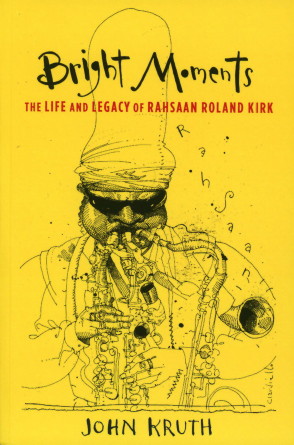
Bright Moments - The Life and Legacy of Rahsaan Roland Kirk - 2nd Ed. by John Kruth

 © Copyright ® Steven Cerra, copyright protected; all rights reserved.


“I can honestly say that Rahsaan changed my life. When I first saw him in the ‘70s [Rahsaan died in 1977, he was only 41 years old], it was the greatest thing I’d ever seen … It was like watching a hurricane on stage. The energy was far heavier than anything I was seeing in the punk rock world. Yet it took you somewhere. The contrast of anger and beauty was incredibly affecting; it had a healing effect. … After a Kirk set, I would feel that I had taken a long journey, and it left you with hope.  This is what I always believed music could do, and I became obsessed with him. His records lived up to his live shows, yet they were all different.”

- Joel Dorn, producer, record executive, impresario 


“No one who experienced him in performance can forget the sight: a stocky blind man swaying precariously back and forth on the lip of a bandstand, dressed in a yellow jumpsuit, his face implacable behind black wraparounds, blowing dissonant counterpoint on three saxo­phones of varying lengths, while other instruments, some of his own invention, dangled from his shoulders, neck, ears, and, on occasion, his nose. Talk about one-man bands.”


“By now [Roland’s 1960 Chess LP Introducing Roland Kirk], Kirk had his basic ar­senal. In addition to tenor, he played an obsolete cousin to the soprano sax that he called a manzello, a straightened alto with modified keys that he called a stritch, a siren, a whistle, and a conventional flute. He found the manzello and stritch in the basement of an old instrument store and taught himself to finger two saxophones while using the third as a drone. In this way, he could play a variety of reed-section voicings and accom­pany his own solos with stop-time chords.”


“Kirk rejected the total immersion in protracted improvisation preached in Ornette Coleman's Free Jazz and John Coltrane's "Chasin' the Trane," but he did embody a prophetic refusal to relinquish the lusty pleasures of big bands (albeit a one-man version), swing, lilting waltzes, and nostalgic ballads, all of which he made aggressively new.”

- Gary Giddins, Visions of Jazz


Sometimes it takes the editorial staff at JazzProfiles awhile to catch up to important Jazz stuff.


In this case, I am specifically referring to Bright Moments - The Life and Legacy of Rahsaan Roland Kirk - 2nd Ed. by John Kruth. The current edition was published in 2021, but the original edition was published in 2000 and I completely missed it. Fortunately, this brilliant biography didn’t manage to elude me for a second time.


It was masterfully reviewed upon its initial run by Jazz Jerry Musician, one of my favorite blog destinations, and this treatment also included an exclusive interview with the author John Kruth which you can locate by going here.


Rahsaan Roland Kirk [RRK] was a Jazz World unto himself. 


If, as Louis Armstrong said, “Jazz is who you are,” then the music of Rahsaan Roland Kirk was a pure reflection of his eclectic, eccentric and exuberant personality. 


In fairness, none of these descriptors do justice to Rahsaan for he was ineffable – beyond words.


But while this may be the case in terms of the best way to describe his music, RRK’s all-too-brief life [he died at the age of 41 from a second stroke] is well documented in Bright Moments - The Life and Legacy of Rahsaan Roland Kirk - 2nd Ed.


John Kruth’s book is an easy to read story about a fascinating man. It’s written in a prose style that engages the reader in its narrative from the outset.


Here are some reviewer comments about Kruth’s RRF Bio as taken from the back of the book’s dust jacket:


PRAISE FOR JOHN KRUTH'S FIRST BOOK

BRIGHT MOMENT - The Life and Legacy of Rahsaan Roland Kirk

"Neither poverty, blindness nor sickness could keep Rahsaan Roland Kirk from his music. But he wasn't merely a musician for music's sake. He was an activist who insisted that Black Classical Music be respected. John Kruth's remarkable book belongs on the book shelf of every serious Jazz fan."

—Ishmael Reed, author of "Mumbo Jumbo"


"Fun, insightful, well-researched, and inspirational... an incredibly accessible biography of a complex individual of staggering genius."

—Jerry Jazz Musician


"This engaging biography about an often-neglected talent will be welcomed by general readers as well as jazz scholars."

—Library Journal


"A persuasive case that the saxophonist deserves to be reevaluated for greatness in the larger continuum of music development."

—Billboard Magazine


"Illuminates the one-and-only Rahsaan Roland Kirk from the outside, with a series of voices that pop like photographic flash bulbs." 

-Howard Mandel, The Wire (UK)


"Like the best portraiture, Bright Moments has the spirit of its subject. It's swirling with fire, humor, audacity and surprise."

—David Hajdu, author of "Lush Life"


"Kruth has tackled one of the most fascinating figures in modern jazz and told his story in vivid detail. His research is formidable, his writing is fresh and exciting, and his enthusiasm is irresistible. Finally, someone has written a book on a jazz artist that matches the fun and verve of the music itself!"

—Ted Gioia, author of "The History of Jazz"


"Magical. John Kruth is a fantastic writer!"

—Jim Jarmusch


And here’s the Introduction followed by the first page of the first chapter to entice you into securing your own copy of Bright Moments - The Life and Legacy of Rahsaan Roland Kirk - 2nd Ed.

INTRODUCTION


“No matter how or when you discover Rahsaan Roland Kirk, hearing his music for the first time is always a memorable and startling experience. Over the years I can count on one hand (and perhaps a couple of fingers) how often my world has been shaken by a blast of stellar music that came from out of the blue and illuminated my brain like a hydrogen flash. Like the rest of my generation, witnessing the Beatles on The Ed Sullivan Show had an immense impact on me. Within moments my dreams of playing third base for the New York Yankees vanished and from that point on my relationship with my father was never quite the same again.


A year or two later I sat alone in my sister's room playing Bob Dylan's "The Lonesome Death of Hattie Carroll" over and over again on her pink and white Magnavox, hating the song's heartless killer William Zanzinger like I never hated anyone before, except for maybe Lee Harvey Oswald.


Then came the Rolling Stones on The Ed Sullivan Show. That thick-lipped lascivious gargoyle Mick Jagger defiantly crowed "Let's Spend the Night Together" while Brian Jones (the first multi-instrumentalist this suburban white boy ever heard) hammered the piano keys, sneering out from under a hat that looked like a swirling silver spaceship that had just landed on his head.


Not long after I witnessed the Doors down the Jersey shore. The leather-clad "Lizard King" screamed "This is the end!" and I dove into the abyss with them, headfirst. That night I sat paralyzed on my parent's manicured lawn, unable to go back in the house, knowing nothing would ever be the same again. A few months later I found myself literally hiding, crouched behind the sofa at my friend Frank's house as the Jimi Hendrix Experience melted the walls of his parent's living room. His mother cooking spaghetti in the kitchen, screamed hysterically, "Frank! Please turn down that infernal racket!"


Then came the 5000 Pound Man. The first time I heard Rahsaan I was at a friend's house when an entrancing sound drew me to his older brother's bedroom. The ice-cold tone of somebody blowin' blues on the flute sent shivers down my spine. I pushed the door open and popped my head in. "Wow!" I gushed. "Is that the new Tull album, man?" Meanwhile, Rahsaan's haunted rendition of Bill Withers lonely opus "Ain't No Sunshine" played on. My friend's big brother gave me a dry-up-and-blow-away glare as he scaled the album cover at me. It had this black-on-black hard-to-see picture of a big black guy on the front with a strange name, playing a saxophone.


"No you idiot! It's not the new Tull album! This is the guy he ripped off!" he snarled. I stared at the album cover in total disbelief. "But this guy doesn't have long hair or anything. Like I'm sure Jethro Tull would copy him!" I replied. Then my friend's older brother, Scott, dropped the needle on a track called "Which Way Is It Going," a hyper-boogie rock 'n' rollin' flute extrapolation, just to watch the look of shock wash over my face. I couldn't believe my ears! For the last four years I'd been listening to Jethro Tull, believing Ian Anderson was the reincarnation of Lord Krishna. Now before my eyes, my false idol was instantly toppled over, falling face down in the dirt. I flipped over the cover and studied the picture of this weird looking dude with two wooden flutes all stuck together with masking tape shoved in his mouth. His cheeks were all puffed out and his sunglasses had fallen down over the end of his nose. And if that wasn't freaky enough, he was dressed in a shiny black patent leather jumpsuit with a dancing lion embroidered over his heart. Then I looked at the name of the album. "Hey! They didn't even spell Blackness right!" I protested, referring to its title (B-l-a-c-k-n-u-s-s). 


Suddenly "One Nation" burst through the speakers with a screaming sax and Princess Patience Burton (the eccentric wife of Ron, Kirk's pianist) singing some strange, snaky Asian blues a la Yoko Ono. At that moment, I just couldn't field the curve ball life was throwing at me. I dashed out of the room, out of the house, and all the way home. That was my introduction to Rahsaan Roland Kirk.


Then a year later, in 1973,I was driving my dad's Buick into New York City, listening to WRVR when I got an earful of "Bright Moments," Pulling up to the tollbooth at the Lincoln Tunnel, I was enthralled by Kirk's hilarious rap about "sharing the same ice cream dish with your favorite love and having to take her in your arms to get it other way." He laughed at how fortunate he was "not to have to look in magazines'' in order to learn about what some people call love. Suddenly I realized this rapping pied piper Svengali was about to vanish into oblivion the moment I entered the gaping carbon-smudged mouth of that ugly old tunnel. I had to know who was doing all that talking. So, I pulled over and stopped in the breakdown lane. Rahsaan hadn't even played a note yet and I knew something seriously brilliant was on the way. Then the flute poured through my dashboard speaker, cold and delicious... like mercury or ice cream.


I was experiencing my first "Bright Moment'' when suddenly there came a loud, hard, sobering knock on my window. The man in blue was standing there, wanting to know what the trouble was. "No trouble at all officer," I told him, floating on the Bella Donna clouds of melody and joy. I explained to the officer that there was something very important on the radio that I had to hear and if I drove off into the tunnel, I'd surely lose the signal. I promised I'd be gone in just a minute or two. But the fuzz couldn't have cared less and insisted I move the car immediately! I rolled up the window and pulled up about ten or twelve feet. That flute was dancing across the keys of that piano like Bojangles Robinson sliding down a long golden banister with a nose full of blow on Mardi Gras Day while somebody kept clanging a triangle like it was dinnertime at the New York Philharmonic chuck wagon. Then came another knock on my window and the party was over. Just as I reached the tunnel, I heard the DJ say, "Bright Moments! That was Rahsaan Roland Kir..."


1.

THE REVENGE OF THE 5OOO LB. MAN


"Hang it up, take it down, hang it up, take it down. 

Don't misinterpret it for no clown, because it's the straight-ahead truth going down."

-RRK


“It's easy to see how most people got the wrong idea when it came to Rahsaan Roland Kirk. He just didn't fit very neatly into anyone's concept of reality. It's not everyday someone like him comes careening down the pike, glowing with the pure spark of originality.


At the height of his powers, "Rahsaan" as he later became known, stood on the edge of the bandstand, rocking in rhythm, eyes hidden mysteriously behind a pair of wrap-around shades. Decked out like a psychedelic African shaman in a striped dashiki, sweat busting from every pore, Kirk played three saxophones simultaneously.


He was truly a sight to behold with his nostrils flaring like a mad bull and his cheeks puffed-out like a monstrous chipmunk, pumping air continuously into a strange array of instruments that hung from his body like crazy plumbing or tangled octopus tentacles, all stuck together with masking tape.


The uninitiated often felt they had witnessed a supernatural one-man Vaudevillian freak show. Perhaps in comparison to the cool understatement of Miles Davis or the tuxedoed elegance of the Modern Jazz Quartet, they had. But from this unlikely mass of auditory armor Kirk coaxed and evoked the entire history of jazz (or "Black Classical Music" as he preferred calling it).”


Monday, February 10, 2020

Rahsaan Roland Kirk – The Ineffable

© -Steven A. Cerra, copyright protected; all rights reserved.


“… Rahsaan Roland Kirk … [used] circus like multi-instrument playing to foment his own version of an improvisational revolution.”
- Don Heckman, in Bill Kirchner, ed., The Oxford Companion to Jazz, 
[p. 610]

If, as Louis Armstrong said, “Jazz is who you are,” then the music of Rahsaan Roland Kirk was a pure reflection of his eclectic, eccentric and exuberant personality. 

In fairness, none of these descriptors do justice to Rahsaan for he was ineffable – beyond words.

Blind from infancy, his musical achievements were stunning in their complexity.

Perhaps the most apt representation of Rahsaan Roland Kirk is that he was a Force of Nature.

As is often the case with such larger-than-life personalities, his strengths could also be his weaknesses.

“A stellar soloist, … [Kirk] could play with authenticity and forcefulness in any jazz style, from trad to free, and on a host of instruments—not just conventional saxes and clarinets but pawnshop oddities such as manzello, stritch, siren whistle, and nose flute. Kirk's arsenal of ef­fects was seemingly endless, ranging from circular breathing to playing three horns at once. This versatility came, in time, to be a curse. Had he focused on one or two instruments, he would have been acknowledged as a master. Instead he was too of­ten dismissed as little more than a jazz novelty act.”  - Ted Gioia, The History of Jazz, p. 329

The view of Kirk as a significant innovator is one that is widely supported by a large number of notable Jazz musicians and writers as evidenced by the following anecdote involving the late, alto saxophonist, Paul Desmond as told by Doug Ramsey:

“Taking in one incredible jam session in the ballroom of the Royal Orleans Hotel [during the 1969 New Orleans Jazz Festival], we witnessed Roland Kirk surpassing himself in one of the most inspired soprano sax solos either of us had ever heard. Kirk used Alphonse Picou's traditional chorus from "High Society" as the basis of a fantastic series of variations that went on chorus after chorus. We were spellbound by the intensity and humor of it and Paul announced that henceforth he would be an unreserved Roland Kirk fan even unto gongs and whistles.” Jazz Matters, [p.151].

It isn’t easy to listen to Rahsaan Roland Kirk’s music.

You really have to want to and you have to work at it.

It’s complicated and sometimes it’s harsh and full of distress – very often, it does not lay easy on the ears.

“Kirk’s playing is all over the place from haunting blues derived themes to polytonal appendages; he executes difficult tempos with quite astonishing dexterity; he moves across chords with a bizarre, crablike motion; a heavy, sometimes massive sound, often vocalized and multiphonic; Kirk is Kirk and it would be a mistake to expect smoothly crafted Jazz. [paraphrase]”
- Richard Cook & Brian Morton, The Penguin Guide to Jazz on CD

Fortunately, for those who are inclined to take-on the challenge that is Rahsaan, much of his music has been collected in two anthologies: [1] Rahsaan: The Complete Mercury Recordings of Roland Kirk [10 CDs, Polygram 846-630-2] and [2] Does Your House Have Lions? [2 CDs Atlantic Rhino R2 71406].


The Mercury compendium contains as an added benefit, a comprehensive treatment of the formative years of Kirk’s career and the defining characteristics of his early music by Dan Morgenstern, the Director of the Institute for Jazz Studies at Rutgers University.

In their Penguin Guide to Jazz on CD, Richard Cook and Brian Morton said of Morgenstern’s notes that they “… afford unparalleled detail on perhaps the most significant phase of Kirk’s career.”

Here are the opening paragraphs from Dan’s extensive insert notes.

“Roland Kirk — or Rahsaan, as he preferred to be called in his later years — was a unique phenomenon in the history of music. To be sure, he was not the first to play several instruments simultaneously, Wilbur Sweatman, a pioneer of early jazz, played three clarinets at once, and so did Ross Gorman (known for the opening clarinet glissando on the first recording of "Rhap­sody in Blue") and Fess Williams. But these men used it as a showmanship trick, not for creative purposes. In that respect, Kirk came first, and his few emulators and imitators have not been serious competition.

Moreover, that was just one aspect of Kirk's total tonal personality. He mastered every instru­ment he played, and had his own approach to all of them. And every note he played or sang swung to the hilt. His imagination and energy were awesome, and he channeled all he had in him into his music. 
When he wasn't playing, he listened — to music of all kinds, to the sounds of nature, to everything around him.

When he wasn't making or listening to music, he talked about it, and when he slept, he dreamed about it — the idea of playing more than one instru­ment at a time came to him in a dream, he claimed. Of course he also had time for other things — women, children (he loved them, most of all his own), and good food and drink, which he consumed prodigiously. But in a lifetime of knowing musicians and lovers of music, I have never met anyone so totally involved in the world of sound as Rahsaan Roland Kirk.

…. He never limited his horizon to what was "in" or fashionable, and his playing reflected his deep understanding of the music's past, present and future.”


The title given to the later, Atlantic anthology is explained in the following story by its producer, Joel Dorn:

“One day in the late 1960’s, I was on the phone with Rahsaan and mentioned to him that just that day I had bought a house. He responded by asking: ‘Does your house have lions?’ I said: ‘What?’ He said: ‘Lions you know like in front of a museum or the post office. You know, concrete lions. Get a house with lions.'” – May, 1993

Joel goes on to add:

“I can honestly say that Rahsaan changed my life. When I first saw him in the ‘70s [Rahsaan died in 1977, he was only 41 years old], it was the greatest thing I’d ever seen … it was like watching a hurricane on stage. The energy was far heavier than anything I was seeing in the punk rock world. Yet it took you somewhere. The contrast of anger and beauty was incredibly affecting; it had a healing effect. … After a Kirk set, I would feel that I had taken a long journey, and it left you with hope.  This is what I always believed music could do, and I became obsessed with him. His records lived up to his live shows, yet they were all different.”

In addition to the writings of Dan Morgenstern and Joel Dorn, Garry Giddins lends his literary gifts and encyclopedic knowledge of Jazz to an excellent profile on Rahsaan Roland Kirk which you can locate on pages 431- 436 of his seminal Visions of Jazz.

Gary’s essay is entitled Rahsaan Roland Kirk (One-Man Band) and here are some excerpts:


“No one who experienced him in performance can forget the sight: a stocky blind man swaying precariously back and forth on the lip of a bandstand, dressed in a yellow jump suit, his face implacable behind black wraparounds, blowing dissonant counterpoint on three saxo­phones of varying lengths, while other instruments, some of his own invention, dangled from his shoulders, neck, ears, and, on occasion, his nose. Talk about one-man bands.”

“By now [Roland’s 1960 Chess LP Introducing Roland Kirk] , Kirk had his basic ar­senal. In addition to tenor, he played an obsolete cousin to the soprano sax that he called a manzello, a straightened alto with modified keys that he called a stritch, a siren, a whistle, and, a conventional flute. He found the manzello and stritch in the basement of an old instrument store and taught himself to finger two saxophones while using the third as a drone. In this way, he could play a variety of reed-section voicings and accom­pany his own solos with stop-time chords.”

“Kirk rejected the total immersion in protracted improvisation preached in Ornette Coleman's Free Jazz and John Coltrane's "Chasin' the Trane," but he did embody a prophetic refusal to relinquish the lusty pleasures of big bands (albeit a one-man version), swing, lilting waltzes, and nostalgic ballads, all of which he made aggressively new.”

Rahsaan Roland Kirk was a Jazz World unto himself. 

You are sure to be exhilarated when you step into it, but don’t forget to breathe as it’s like nothing you’ve ever experienced before.

Wednesday, August 7, 2019

Rahsaan Roland Kirk - "Spring Will Be A Little Late This Year"

© -Steven Cerra, copyright protected; all rights reserved.


Certainly the most unusual recording artist I ever encountered was Roland Kirk, who later added “Rahsaan” to his name. Shortly after I joined Argo, Ramsey Lewis told me he had recently heard a remarkable player in Louisville and had told him if he was ever in Chicago to be sure to look me up.


It was perhaps a month later that the receptionist rang me and said there was a man named Roland Kirk in the lobby to see me. I went there and was met by an extraordinary sight: there stood a man in dark glasses, raggedly dressed and carrying a white cane. Beside him was an old golf bag with two wheels attached that allowed it to be pulled. In it were some strange horns that looked like reed instruments. Over his shoulder in a separate cloth bag was a tenor sax. He was alone.


I greeted him, brought him into the office, and he produced an LP he had recorded some time previous for a small label in the Midwest. I played it and was immediately taken by his extraordinary ability to play several instruments at the same time and with great jazz feel. Kirk told me that he and his rhythm section had driven to Chicago to look for a gig and to take a chance that I would record him. I would and did. We got a contract signed, a recording date was set, and the resulting album was issued as “Introducing Roland Kirk”.


My next album with him would be for Mercury. Shortly after “Introducing” was issued I was rehired by them to direct their jazz program, and with agreement from Argo, I was able to take Roland with me.


Our first Mercury album, done in New York, was titled “We Free Kings,” and became the album that really brought Kirk to the attention of disc jockeys, jazz fans and musicians. It was his growling, moaning, utterly unique flute playing on one track that created all the attention.


After the first take on a yet-unnamed blues, a friend of mine, Phil Moore, the noted vocal coach, drew Roland aside before we did take 2 and quietly suggested to him that he further personalize his performance by thinking of it as a story and giving it continuity. What resulted was an extraordinary and ground-breaking solo that culminated in Kirk growling an impassioned “You did it, you did it,” thereby creating the tune’s title and making Roland suddenly well-known.


Kirk’s refusal to let blindness keep him from trying almost anything that appealed to him made for some interesting situations. My favorite was the time I picked him up at his motel to take him to a recording date. He got into my car, but before I could turn the key to get started he asked, “Can I drive?” I just looked at him as if he was insane. “How the hell can you drive?” I asked.


“Just tell me what’s ahead and I’ll be ok,” he said.


I told him no.


A recent re-reading of this anecdote by our late, friend Jack Tracy, the Jazz record producer, writer and editor, brought us back to 10 CD boxed set of Rahsaan: The Complete Mercury Recordings of Roland Kirk [Mercury 846 630-2], which, in turn, led us to Gary Giddins’ review of the boxed set in his essay, Rahsaan Roland Kirk (One Man Band), Visions of Jazz: The First Century [New York: Oxford University Press, 1998, pp. 431-436] from which the following excerpts are drawn.


“Roland Kirk could have been renown had he done nothing else but play tenor saxophone….”


“No one who experienced him in performance can forget the sight: a stocky blind man swaying precariously back and forth on the lip of a bandstand, dressed in a yellow jump suit, his face implacable behind black wraparounds, blowing dissonant counterpoint on three saxophones of varying lengths, while other instruments, some of his own invention, dangled from his shoulders, neck, ears, and, on occasion, his nose. Talk about one-man bands. ….”


Kirk's persona, musical and otherwise, came into focus during four highly creative years, 1961-65, when he was signed to Mercury Records. The story is traceable on a ten-CD cube, Rahsaan: The Complete Mercury Recordings of Roland Kirk, complete with a sorry denouement in which his flair for showmanship encourages the label to lead him down the garden path of commercial excess. In 1961, Kirk was a twenty-five-year-old phenomenon who appeared to have too much fun playing at a time when solemnity was big.


“Born in 1936 in Ohio, Kirk was fundamentally a bebopper. Educated at the Ohio State School for the Blind, he was playing professionally at fifteen. Five years later, he made his first recording for King, a characteristic brew of blues and ballads on tenor sax only. Albums for Argo (with Ira Sullivan) and Prestige (with Jack McDuff) followed and, incidentally, suggest some confusion about the early attempts to pigeonhole him: bluesman, modernist, funkmeister? By now, Kirk had his basic arsenal. In addition to tenor, he played an obsolete cousin to the soprano sax that he called a manzello, a straightened alto with modified keys that he called a stritch, a siren, a whistle, and, a conventional flute. He found the manzello and stritch in the basement of an old instrument store and taught himself to finger two saxophones while using the third as a drone. In this way, he could play a variety of reed-section voicings and accompany his own solos with stop-time chords. …”


A particularly worthy find among the previously unissued material in the Mercury cube is a ridiculously greased  and tortuous trip through Spring Will Be A Little Late This Year.  Maybe it was too much for the label back then.”


Here’s a video montage featuring many of Rahsaan’s LP and CD covers with the very same Spring Will Be A Little Late This Year as the audio track.  “Too much” in the complementary sense of the phrase comes to mind when I listen to Rahsaan’s performance on this track.


See what you think.


[Joining Rahsaan are Hank Jones on piano, Art Davis on bass and Charlie Persip on drums.]


Tuesday, July 2, 2013

Rahsaan Roland Kirk - The Ineffable [From The Archives]

Thanks to the largesse of the Copyright Gods, the editorial staff at JazzProfiles was recently allowed to once again use the video that forms the closing tribute to Rahsaan, so we thought we'd celebrate this event by re-posting this piece.


“… Rahsaan Roland Kirk … [used] circus like multi-instrument playing to foment his own version of an improvisational revolution.”
- Don Heckman, in Bill Kirchner, ed., The Oxford Companion to Jazz, 
[p. 610]

© -Steven A. Cerra, copyright protected; all rights reserved.

If, as Louis Armstrong said, “Jazz is who you are,” then the music of Rahsaan Roland Kirk was a pure reflection of his eclectic, eccentric and exuberant personality. 

In fairness, none of these descriptors do justice to Rahsaan for he was ineffable – beyond words.

Blind from infancy, his musical achievements were stunning in their complexity.

Perhaps the most apt representation of Rahsaan Roland Kirk is that he was a Force of Nature.

As is often the case with such larger-than-life personalities, his strengths could also be his weaknesses.

“A stellar soloist, … [Kirk] could play with authenticity and forcefulness in any jazz style, from trad to free, and on a host of instruments—not just conventional saxes and clarinets but pawnshop oddities such as manzello, stritch, siren whistle, and nose flute. Kirk's arsenal of ef­fects was seemingly endless, ranging from circular breathing to playing three horns at once. This versatility came, in time, to be a curse. Had he focused on one or two instruments, he would have been acknowledged as a master. Instead he was too of­ten dismissed as little more than a jazz novelty act.”  - Ted GioiaThe History of Jazz, p. 329

The view of Kirk as a significant innovator is one that is widely supported by a large number of notable Jazz musicians and writers as evidenced by the following anecdote involving the late, alto saxophonist, Paul Desmond as told by Doug Ramsey:

“Taking in one incredible jam session in the ballroom of the Royal Orleans Hotel [during the 1969 New Orleans Jazz Festival], we witnessed Roland Kirk surpassing himself in one of the most inspired soprano sax solos either of us had ever heard. Kirk used Alphonse Picou's traditional chorus from "High Society" as the basis of a fantastic series of variations that went on chorus after chorus. We were spellbound by the intensity and humor of it and Paul announced that henceforth he would be an unreserved Roland Kirk fan even unto gongs and whistles.” Jazz Matters, [p.151].

It isn’t easy to listen to Rahsaan Roland Kirk’s music.

You really have to want to and you have to work at it.

It’s complicated and sometimes it’s harsh and full of distress – very often, it does not lay easy on the ears.

“Kirk’s playing is all over the place from haunting blues derived themes to polytonal appendages; he executes difficult tempos with quite astonishing dexterity; he moves across chords with a bizarre, crablike motion; a heavy, sometimes massive sound, often vocalized and multiphonic; Kirk is Kirk and it would be a mistake to expect smoothly crafted Jazz. [paraphrase]”
- Richard Cook & Brian Morton, The Penguin Guide to Jazz on CD

Fortunately, for those who are inclined to take-on the challenge that is Rahsaan, much of his music has been collected in two anthologies: [1] Rahsaan: The Complete Mercury Recordings of Roland Kirk [10 CDs, Polygram 846-630-2] and [2] Does Your House Have Lions? [2 CDs Atlantic Rhino R2 71406].


The Mercury compendium contains as an added benefit, a comprehensive treatment of the formative years of Kirk’s career and the defining characteristics of his early music by Dan Morgenstern, the Director of the Institute for Jazz Studies at Rutgers University.

In their Penguin Guide to Jazz on CD, Richard Cook and Brian Morton said of Morgenstern’s notes that they “… afford unparalleled detail on perhaps the most significant phase of Kirk’s career.”

Here are the opening paragraphs from Dan’s extensive insert notes.

“Roland Kirk — or Rahsaan, as he preferred to be called in his later years — was a unique phenomenon in the history of music. To be sure, he was not the first to play several instruments simultaneously, Wilbur Sweatman, a pioneer of early jazz, played three clarinets at once, and so did Ross Gorman (known for the opening clarinet glissando on the first recording of "Rhap­sody in Blue") and Fess Williams. But these men used it as a showmanship trick, not for creative purposes. In that respect, Kirk came first, and his few emulators and imitators have not been serious competition.

Moreover, that was just one aspect of Kirk's total tonal personality. He mastered every instru­ment he played, and had his own approach to all of them. And every note he played or sang swung to the hilt. His imagination and energy were awesome, and he channeled all he had in him into his music. 
When he wasn't playing, he listened — to music of all kinds, to the sounds of nature, to everything around him.

When he wasn't making or listening to music, he talked about it, and when he slept, he dreamed about it — the idea of playing more than one instru­ment at a time came to him in a dream, he claimed. Of course he also had time for other things — women, children (he loved them, most of all his own), and good food and drink, which he consumed prodigiously. But in a lifetime of knowing musicians and lovers of music, I have never met anyone so totally involved in the world of sound as Rahsaan Roland Kirk.

…. He never limited his horizon to what was "in" or fashionable, and his playing reflected his deep understanding of the music's past, present and future.”


The title given to the later, Atlantic anthology is explained in the following story by its producer, Joel Dorn:

“One day in the late 1960’s, I was on the phone with Rahsaan and mentioned to him that just that day I had bought a house. He responded by asking: ‘Does your house have lions?’ I said: ‘What?’ He said: ‘Lions you know like in front of a museum or the post office. You know, concrete lions. Get a house with lions.'” – May, 1993

Joel goes on to add:

“I can honestly say that Rahsaan changed my life. When I first saw him in the ‘70s [Rahsaan died in 1977, he was only 41 years old], it was the greatest thing I’d ever seen … it was like watching a hurricane on stage. The energy was far heavier than anything I was seeing in the punk rock world. Yet it took you somewhere. The contrast of anger and beauty was incredibly affecting; it had a healing effect. … After a Kirk set, I would feel that I had taken a long journey, and it left you with hope.  This is what I always believed music could do, and I became obsessed with him. His records lived up to his live shows, yet they were all different.”

In addition to the writings of Dan Morgenstern and Joel Dorn, Garry Giddins lends his literary gifts and encyclopedic knowledge of Jazz to an excellent profile on Rahsaan Roland Kirk which you can locate on pages 431- 436 of his seminal Visions of Jazz.

Gary’s essay is entitled Rahsaan Roland Kirk (One-Man Band) and here are some excerpts:


“No one who experienced him in performance can forget the sight: a stocky blind man swaying precariously back and forth on the lip of a bandstand, dressed in a yellow jump suit, his face implacable behind black wraparounds, blowing dissonant counterpoint on three saxo­phones of varying lengths, while other instruments, some of his own invention, dangled from his shoulders, neck, ears, and, on occasion, his nose. Talk about one-man bands.”

“By now [Roland’s 1960 Chess LP Introducing Roland Kirk] , Kirk had his basic ar­senal. In addition to tenor, he played an obsolete cousin to the soprano sax that he called a manzello, a straightened alto with modified keys that he called a stritch, a siren, a whistle, and, a conventional flute. He found the manzello and stritch in the basement of an old instrument store and taught himself to finger two saxophones while using the third as a drone. In this way, he could play a variety of reed-section voicings and accom­pany his own solos with stop-time chords.”

“Kirk rejected the total immersion in protracted improvisation preached in Ornette Coleman's Free Jazz and John Coltrane's "Chasin' the Trane," but he did embody a prophetic refusal to relinquish the lusty pleasures of big bands (albeit a one-man version), swing, lilting waltzes, and nostalgic ballads, all of which he made aggressively new.”

Rahsaan Roland Kirk was a Jazz World onto himself. 

You are sure to be exhilarated when you step into it, but don’t forget to breathe as it’s like nothing you’ve ever experienced before.

The following video tribute to Rahsaan provides a mere sample, at best.