Showing posts with label Veryl Oakland. Show all posts

Thursday, March 10, 2022

Pat Martino - Calm Before the Storm - Veryl Oakland

 © Copyright ® Steven Cerra, copyright protected; all rights reserved.


This piece on guitarist Pat Martino who passed away in November, 2021 at the age of 77 is from photographer/essayist Veryl Oakland’s exquisite work Jazz in Available Light: Illuminating the Jazz Greats from the 1960s, ‘70s and ‘80s.


You can find more background about the book as well as order information via this link to an earlier posting on Veryl’s book on these pages.


True to the northern California geographic area denoted in his last name, Veryl photographed Jazz musicians primarily at the Berkeley Jazz Festival, the Monterey Jazz Festival and at various clubs in the San Francisco area like Keystone Korner.


Although from Philadelphia and an East Coast cat during most of his playing days, guitarist Pat Martino signed with southern California based Warner Brothers Music in the 1970s and the record label brought him to California to promote his recordings which is when Veryl had the opportunity to take the commercial photographs that populate this post. 


The in-performance photos date back to the 1967 inaugural Berkeley Jazz Festival when Veryl first heard Pat as a member of saxophonist John Handy’s group along with Bobby Hutchinson on vibes, Albert “Sparky” Stinson on bass and Doug Sides on drums.
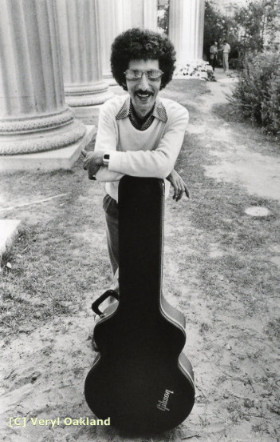


Pat Martino - Calm Before the Storm - San Francisco, CA


Among Martino's many peers was guitarist John Abercrombie, who offered the following testimony in Pat's autobiography about the first time he saw him performing with organist Jack McDuff: "That night, Pat came on the bandstand... playing a black Les Paul Custom guitar. We knew the guitar was like carrying a Buick on the stage—it was so heavy. And Pat was such a frail tittle guy. So when we saw this young, very thin little guy walking up to the bandstand with this heavy guitar... our reaction was, 'Oh, man this can't be the guitar player! Who is this? 'So we were all chuckling. And then, he started to play and we ceased chuckling. Because he just floored everybody in the club. I never heard anything like that... it was the constant stream of eighth notes and his amazing time, his feeling that was so perfect."
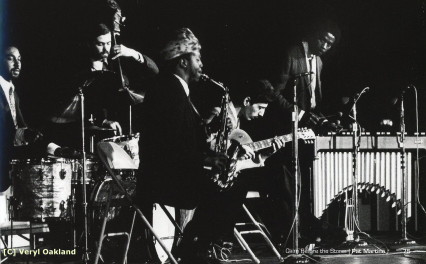


SAN FRANCISCO, CALIFORNIA


“Every once in a while, I wonder what it might be like to reach out to the man again... to reconnect, and possibly even relive those enjoyable moments we had together that late 1976 weekend in San Francisco. After all, I was sharing the afternoon with one of a handful of my all-time favorite jazz guitarists, Pat Martino.

But, of course, that could never have happened. Even if it had been one of his greatest experiences ever, Pat wouldn't remember me or our afternoon together. That's because just a few years after our visit—in 1980— Martino's lifelong, but misdiagnosed, struggle with AVM (arteriovenous malformation) would culminate in a brain aneurysm and near-death.


Life for Pat Martino would have to start all over again.


The guitarist was four years younger than me, just a skinny kid in his early twenties, when I first saw him perform with alto saxophonist John Handy and vibraphonist Bobby Hutcherson at the inaugural University of California, Berkeley Jazz Festival in 1967. Despite clearly being the youngest, smallest person onstage, he caught the audience by surprise when he took one solo, weaving together a meticulous flow of blistering eighth-note phrases. It was amazing.


Handy recalled those times, saying, "He was a tiny guy, but he played big music. He could play his little ass off, man."


Every time I witnessed Martino's future performances, he did things that were totally surprising, even revelatory. He never disappointed.


When we met for our photo session that afternoon at the Palace of Fine Arts, Pat was joined by his newest pianist, Berklee College of Music alum Delmar Brown. The two were in the midst of an international tour promoting their Warner Brothers release, Joyous Lake, which would become one of the finer jazz/fusion recordings from that period. The guitarist was jovial and upbeat our whole time together. It was obvious that Pat Martino was enjoying the fruits of his ever-expanding career.


It was only many years later, following his miraculous surgery, that I learned the details of Martino's life-altering course through his revealing autobiography, Here and Now! The Autobiography of Pat Martino. In it, Pat chronicled how he overcame the devastating effects of memory loss, depression, anxiety, and overwhelming negativity throughout an arduous recovery period. I discovered how it took years for him to re-learn his art and re-emerge as one of today's most vibrant and inspiring performers.


It occurs to me that all of us in the jazz community have been truly blessed, given a second chance to see and hear two highly productive — and beyond talented — walking miracles: Pat Martino and Quincy Jones, who also survived a brain aneurysm and surgery in 1974. Both escaped near-death and just kept on contributing, kept on creating some of the greatest music for us all to enjoy.”


PAT MARTINO (Pat Azzara)

guitar, composer 

Born: August 25,1944

Died: November 1, 2021


Friday, July 19, 2019

Louie Bellson and Tony Williams - Mutual Admiration

© Copyright ® Steven Cerra, copyright protected; all rights reserved.


This feature is from Veryl Oakland’s annotated series of his photographs in his book Jazz in Available Light and you can locate order information and more features from this compilation by visiting him on his website.


Sadly the story about the friendship between Louie and Tony and the high regard they had for one another despite their different approaches to drums is one that Ken Burns missed in his documentary about Jazz.


Instead, Burns preferred to -in the parlance of the times -  play the race card.


Here’s the accompanying text from Veryl’s piece about Louie and Tony - “Seemingly about as mismatched as two percussionists can be.”


“Berkeley, California


From a distance, it appeared to be a chance encounter: there, just off-stage at the 1978 Berkeley Jazz Festival, stood the wise sage and the young buck sharing a warm embrace.


Of course, both were drummers, so it wasn't exactly a revelation. After all, battery mates of every stripe have lots in common. But for any casual observer looking on, Louie Bellson and Tony Williams — born practically a generation apart — were seemingly about as mismatched as two percussionists could be.


It was only natural that their influences, tastes, and actual performance artistry would be dissimilar. Bellson made his bones solidly backing some of the most popular big bands of the swing era, particularly the Duke Ellington Orchestra, which adhered to the written scores. Williams, who represented the changing free/fusion period of jazz music styles, was the powerhouse teenage upstart hand-picked by Miles Davis for his second great quintet from the mid-1960s.


The longer I stood there watching, I realized there was nothing accidental about this meeting. The two continued to carry on a purposeful dialogue, thoughtfully engaging one another. Here were a couple of really close friends getting together once again to talk shop and share meaningful times.


Instead of concentrating on their differences, I began to think of the many attributes that made these artists such close musical soulmates: the pair, uniquely blessed with astonishing technique, shared the commonality of perfect time; both were astute listeners who always complemented their respective band members; and perhaps most importantly, the duo took special pride in being complete musicians, highly regarded for their considerable skills as serious composers and arrangers. Their respective leaders paid them the highest compliment by frequently playing, and recording, their works.


It was some time later, after reading his book, Louie Bellson Honors 12 Super Drummers: Their Time Was The Greatest, that I discovered just how strong of a bond existed between these two craftsmen. Bellson, who had helped revitalize the Ellington band in 1951, by prominently being featured center stage as the first percussionist to use two bass drums in his setup, talked about one of his initial encounters with the youngster.


Because Tony recognized that many other drummers — both in jazz, as well as in rock bands — were suddenly following in Bellson's footsteps, he remarked, "I'm getting two bass drums."


Louie, who considered Williams a natural player and a true original, told Tony, "Don't do it. You don't need it."


The elder time-keeper, who was a keen observer of new talent arriving on the scene, assured Tony that his playing style was unique and didn't require any equipment tampering. He was quick to rave about Williams being one of his personal favorites of all time. "Tony Williams gave us all a new approach to the drum set — a stylist who can swing hard and solo with great imagination."”


Top: Drummer Tony Williams unleashes a torrent of sound.

Bottom: Louie Bellson, leading his own big band, with guitarist Joe Pass looking on.


LOUIE PAUL BELLSON (Luigi Paulino Alfredo Francesco Antonio Balassoni)
drums, composer, leader, educator Born:July 6, 1924 Died: February 14, 2009


T1LLMON ANTHONY (Tony) WILLIAMS
drums, composer
Born: December 12, 1945
Died: February 23,1997


Thursday, January 3, 2019

Veryl Oakland - "Jazz in Available Light"

© -Steven Cerra, copyright protected; all rights reserved.


Another of the holiday gifts received by the editorial staff at JazzProfiles is Very Oakland’s Jazz in Available Light and while we prepare a blog feature about this magnificent set of Jazz photographers here’s a preview of coming attractions from Phillip Lutz which appeared in the December 2008 edition of Downbeat with you.

REDISCOVERED PHOTO TREASURES

“From   the 1960s  through the  '80s, Very! Oakland wielded his camera the same way an improviser might his axe — snapping photos of jazz musicians in the moment, with only his wits, experience and the stimulation of his environment to guide him.

The photos, an invaluable contribution to the history of jazz, were stored in what seemed like a secure spot in Oakland's home in Sacramento, California. Then, in 1990, a flood engulfed the home, damaging priceless negatives and prints.

"I had pretty much written the whole thing off as a lost cause," Oakland said. "It took me 20 years to get out of the funk."

But that he did. In 2010, with the encouragement of his daughter, he began the painstaking work of sifting through what remained. In the process, he discovered a treasure trove of salvageable material that he has compiled in a beautiful, 9- by 12-inch coffee-table book titled Jazz in Available Light (Schiffer) www.schifferbooks.com

The hefty tome, for which Quincy Jones wrote the foreword, contains 340 black-and-white photos, strikingly displayed with accompanying text by Oakland. All the photographs were shot using natural light, lending them an improvisatory quality that, given the art form that is the book's subject, strengthens their impact.


The artists are depicted engaging in a variety of activities — Joe Zawinul sawing limbs off a tree, Joe Henderson peering through a telescope - in or near their California homes. Even more revealing are the photos that document musicians in the act of creation. Among those shots, some of the earliest — when Oakland himself was new to the process and coming at it with a fresh eye — seem particularly illuminating. Among those early pictures, one each of Rahsaan Roland Kirk and Bill Evans stand out.

At a Sunday matinee in April 1967, Oakland caught the charismatic Kirk at San Francisco's Jazz Workshop. As usual, Kirk was playing multiple horns — often simultaneously — and creating a spectacle that the camera loved, though on that afternoon, the light at the North Beach club was unpredictable. Oakland recalled that he did not have the highest expectations for the photos.

But when he saw them, he was moved — so much so that, on a whim, he sent several rolls of film to DownBeat, which used a shot for the cover of its May 18, 1967, issue. The sale to DownBeat yielded Oakland's first paycheck for his photography. The magazine cover — depicting Kirk blowing into three mouthpieces—is reproduced in the book.

Two years later, in April 1969, Oakland had another pivotal experience, this time with Evans at Bear's Lair, an intimate basement room at the University of California, Berkeley. By the late '60s, jazz fans were accustomed to seeing Evans hunched over the keys and profile shots of the pianist in such a position were legion.

What happened next produced a shot that will be far less familiar. In the confines of the small room, Oakland said, the creative tension attendant to Evans' pianistic restraint had become intense. Armed with a telephoto lens, Oakland moved to the rear of the space and, facing Evans' back, began snapping just as the pianist's head disappeared from view. One remarkable shot — an illusory image of a headless torso playing a piano — suggests a man literally being absorbed by his instrument.

"It gave me the shivers," Oakland said.

His ability to find the telling moment in disparate subjects indicates a capacity for genuine empathy. That capacity is nowhere more evident than in the book's epilogue. In it, Oakland discusses Phineas Newborn Jr., a prodigious pianist who suffered from mental illness and died penniless. In a 1975 shot taken at Los Angeles' Shrine Auditorium, Newborn, with a joyless gaze, stares straight into Oakland's lens. To Newborn's left is organist Jimmy Smith in an ebullient mood, hoisting a can of beer above his head.

The image will haunt many readers, but could draw new attention to Newborn's work. "It gives me an opportunity to reinvigorate his standing with a lot of people," Oakland said.

This book, it's fair to say, might do the same for Oakland.”                                  —Phillip Lutz

Veryl has a dynamite blog which you can locate by going here.