This is one of Benny Golson's more famous compositions, but it was not composed to be played as a fast bossa nova. That was down to guitarist Pat Martino's genius.
According to Ted Gioia in his seminal The Jazz Standards, "The melody starts out with an insistent three-note-phrase ... but immediately moves into variations and elaborations on it. This reflect a recurring tension in Golson's compositional style, which wants to embrace the familiar riffs of swing and bop, but seems to be more eager to push them aside as soon as possible and enter into a Jazz equivalent of the development of sonata form. Where other composers might opt to repeat, he prefers to manipulate. This is more than a matter of melody but is also reflected in the underlying harmonies. The modulations start almost immediately, and the second eight bars are already in a different key."
In my opinion, one would be hard-pressed to find a better guitar Jazz solo than the one Pat plays on this version of Benny Golson's "Along Came Betty."
Recently, I’ve been spending a lot of time with the music of the late guitarist Pat Martino who died on November 1, 2021.
Pat and I have been “together” for over fifty years: he as a preeminent Jazz guitarist and me as his admiring fan.
In searching for the beginning of our long “association,” I traced it back to the 1967 Prestige recording entitled Strings! [P-7547; OJCCD 223-2]. I’d heard a track on the local FM Jazz station and Pat’s playing completely blew me away.
On Strings!,he is backed by Joe Farrell on tenor sax and flute with Cedar Walton on piano, Ben Tucker on bass and Walter Perkins on drums. I knew the rhythm section quite well but Joe was new to me and his playing on this album - like Pat's - was a revelation.
Also revealing were Mark Gardner liner notes which met the standards of the time by providing a historical context for Pat’s place in the development of the Jazz guitar, details about Pat’s background [he was only 23 years old when this album was recorded and yet had already accomplished a great deal] and an a description of each of the tunes on the LP, the solo order and some personal observations about the qualities of each performance.
Sometimes, I feel that Mark gets a little carried away searching for adjectives to describe the playing of the musicians on each track, but overall, I think his comments and observations are spot on and greatly enhance the listener’s experience.
Fifty plus years later, in an age when information about a musician or a recording can be obtained almost instantaneously with the click of a mouse, I can’t emphasize too strongly how invaluable these liner notes were at the time as an illuminating source about Jazz and its makers.
“Since Charlie Christian first plugged in his amplifier and revolutionized jazz guitar in the late 1930s, each subsequent decade has witnessed the emergence of a handful of new string stylists. Barney Kessel. Jimmy Raney, Billy Bauer, Chuck Wayne and Oscar Moore were the dominant voices of the 'forties. And in the 'fifties Tal Farlow really came into his own to be followed by Jim Hall, Kenny Burrell, Johnny Smith and Wes Montgomery. The 'sixties in turn have produced Grant Green, Bola Sete, Gabor Szabo, George Benson and now Pat Martino. To bracket Martino with the foregoing list of great jazz plectrists warrants some weighty evidence in his favour. After all he is only twenty-three years old and the enclosed sides are the first real jazz sides to be released under his leadership. Which is precisely where the proof of my assertion lies — within this album. It is quite plainly demonstrated on all five tracks that Pat Martino has already conceived a style of his own.
To arrive at a personal mode of expression so young requires more than heavy chops and good taste, it calls for imagination, the sifting of one's emotional and intellectual resources into an abstract form with discipline. The guitarist has passed through this inner process of self-realization which is essential for every artist before he can begin to create works of lasting importance. Pat is not a 'natural talent' because no such thing exists. He has had to work and work hard to get where he is. As alto saxophonist Sonny Criss remarked recently, 'A lot of people say that Bird was a born genius. That's wrong. He wasn't born with anything except the ability to breathe. Unless you really apply yourself nothing's ever going to happen.' What has happened to Martino, a young man with an exciting future ahead, is the result of the sort of application Sonny spoke of.
But the drive to seek originality did not always grip Pat. 'When I first went on the road at the age of fifteen with guys like Willis Jackson, Red Holloway and Sleepy Henderson I wasn't concerned about being creative. It was just a job to me and I was infatuated with the traveling. What really made me realize this attitude would not fulfill me was a four-month period I spent working with Sonny Stitt. Sonny is such an inspiration and every night on the stand was a challenge. Suddenly I knew I had to meet that challenge.'
Pat was born in Philadelphia on August 25, 1944. Philly has cradled several important guitarists including Thornel Schwartz, Perry Lopez, Billy Bean and Dennis Sandole. The latter two were influences on Martino, 'I used to listen to Billy a lot and loved what he played. Dennis Sandole, who is a wonderful composer, helped me to see the road I wanted to take.' But the first jazz guitarist he heard was Johnny Smith who made some records with Stan Getz which found their way into the Martino household. Pat's father, a singer, encouraged his son to get a guitar. 'I was kind of pushed into it really but once I had the instrument it fascinated me. A cousin of mine who is a guitarist gave me some tips.'
While teaching himself the rudiments of music, Pat was frequently taken along by his father to the Red Hill Inn to hear people like Red Rodney, Johnny Smith, Art Blakey, local boy Lee Morgan, Johnny Collins and John Coltrane. Later he jammed with many of these men and others such as James Moody, Benny Golson, Art Farmer and Jim Hall. 'Philly sure is a beautiful town to study in,' says Pat.
After the stints with Holloway, Henderson and Stitt, Martino had a spell in the Lloyd Price band. 'That was interesting because Jimmy Heath was on tenor and did some of the arrangements and Melba Liston also contributed charts for the band. Jimmy is a very underestimated writer and I'm grateful to him for his encouragement. He urged me to write at that time.’
Pat also played in the Willis Jackson group and his earliest recordings with Jackson are on Prestige. Then I was using my family name which is Azzara. My father always worked under the name Martino and I eventually adopted it too. My dad is Arabian in descent and my mother is Italian, incidentally.'
For the next couple of years Pat toured with 'all the organists-Jimmy Smith, Jack McDuff. Jimmy McGriff. Don Patterson. Groove Holmes, Trudy Pitts and others. ‘Much as I dig the combination of guitar and organ it gets to be rather confining after a while. It's more or less one groove all the time.'
In 1966, Martino, weary of constant travel, returned to Philly to take stock of his progress and resume his studies with the Sandole brothers. A comfortable living was there for him in local record, radio and television studios. But the sojourn didn't last long. Over on the West Coast alto saxophonist John Handy had just lost his guitarist Jerry Hahn. Howard Johnson, the tuba player, recommended Martino to Handy as a replacement. A call came through to the studio where Pat was working and Handy on the other end and he asked: “Can you get on the next plane to L.A.?” Ten hours later, Martino walked onto the platform at the University of California as a member of the John Handy Quintet. ‘John had never heard me play. There were no charts so it was a bit of an ordeal. Pat survived. And he values the eight months experience with Handy, Bobby Hutcherson, Albert Stinson and Doug Sides. 'I respect John and what he is trying to do but as the group developed I found that our musical aims were different so we went our own separate ways.'
Martino recorded with Handy for Columbia but as with all his previous disc experience (except for a date with alto saxophonist Eric Kloss on Prestige) he disliked his own contributions. ‘I've never been happy with any of my solos on record until the session with Eric.' Like this album, the Kloss date was taped in the snug atmosphere of Richard Alderson's mid Manhattan studio and Don Schlitten was the producer. ‘Don and Dick are an ideal team to work for because they make everyone feel relaxed’ notes Pat. ‘I’ve been on many recordings that I would rather forget. They were mismanaged efforts.’
Thus far Martino has not enjoyed many good breaks. Some of his original compositions were waxed by Red Holloway for Motown in 1963. They were never released. Strictly speaking his first album should have been issued several years ago. He cut sides for Vanguard with two different rhythm sections - Tommy Flanagan with Ron Carter and Tony Williams; George Tucker and Oliver Jackson. They were not released either. Pat remembers the date with Tucker for a particular reason: it was the bassist's last recorded work. He died from a cerebral hemorrhage the following day. 'George and I had been friends for a long time and I really wanted to make music with him. We only ever did get that one chance. When I heard of his death I couldn’t believe it. I wandered into a church somewhere that night and spent eight hours thinking about the tragedy of it.'
Pat was beginning to wonder if he ever would receive another chance when Don Schlitten stepped into the picture. As an indication of Schlitten's awareness of young and neglected talent it is worth noting that only a couple of weeks before recording Pat he recorded Tal Farlow who had not made an LP for eight years. Listen to him on Sonny Criss' Up, Up And Away (PR 7530). 'I don't want to be limited to the role of guitarist. I do want to compose and grow artistically and have my music accepted without making concessions,' states Pat. With Prestige he is getting the opportunity to achieve these goals. Certainly the Martino Quintet makes no concessions - except to good music - and four of the compositions here are by Pat.
When we met a couple of days before the session Pat said: I’m very excited about it. Joe Farrell is always a gas and it will be nice working with Cedar Walton, a pianist I have a great admiration for. I’ve recorded with Ben Tucker before and he is beautiful. At that stage the drummer hadn’t been fixed. Don suggested Walter Perkins and everybody was happy with the choice. The five got together to make Strings! on a warm day in late September, 1967.
The proceedings went off without a hitch or hassle and the Alderson microphones (which the engineer picks so carefully to suit the character of each instrument) captured a bumper harvest of vibrant sounds, shot through with strength and sincerity.
Martino's four colleagues have all appeared on Prestige previously. Joe Farrell, whose flute work is contrastingly delicate as his tenor solos are robust, comes from Chicago where he was born 30 years ago. His early tenor influences were Johnny Griffin and Stan Getz. Later he listened profitably to Bird, Dexter Gordon, Sonny Stitt, Sonny Rollins and John Coltrane. Which is not to suggest that his playing is a mélange of other styles. If you've heard him once Joe's easy to recognize. He took up flute in 1955 and continues to make progress on this 'horn,’ not to mention soprano sax. Farrell worked with Maynard Ferguson, Tito Rodriguez, Jaki Byard and Charlie Mingus in the Sixties and for the last couple of years has been a spark plug of the Thad Jones-Mel Lewis Band. And there is fine Farrell on The Jaki Byard Quartet/Live! Volumes 1 & 2 (PR 7419, PR 7477) and Dizzy Recce's Asia Minor (Prestige/ New Jazz 8274).
Cedar Walton is deservedly 'house pianist' for Prestige. His own album Cedar! (PR 7519) was one of the real ear-openers of 1967 and his flexibility is such that he can easily adapt to most contexts and the needs of a great variety of soloists. On Prestige he has backed Sonny Criss, Teddy Edwards, Eric Kloss, Houston Person and many others. A tasty ‘comper,’ Cedar is a consistently interesting soloist and he was at the top of his game on this one.
The ubiquitous bassist Ben Tucker, from Nashville, Tennessee, is one of the unsung masters of the big fiddle. But fellow musicians know his true worth which is why he is always in demand for session work. I could fill this sleeve with the names of leaders who have employed him. Warne Marsh, Art Pepper, the late Carl Perkins, Billy Taylor and Herbie Mann were among them. Ben’s large tone and nimble walking has enhanced Prestige dates by Eric Kloss and Teddy Edwards.
Walter Perkins, like Joe Farrell, is a native of the Windy City. At one time, he fronted an excellent group the MJT+3 and he has propelled lots of combos - Ahmad Jamal, Art Farmer & Jim Hall, Lucky Thompson, Errol Garner, Sonny Rollins, Teddy Wilson etc.— during a productive career. He played a vital part in Booker Ervin's Prestige debut album Exultation! (PR 7293) and was present on one of Lucky Thompson’s releases, Happy Days Are Here Again (PR 7394). Walter is a steady and unobtrusive percussionist.
A forty eight-bar Martino structure, Strings! opens the set on a lifting note Cedar states the little pattern in the bass that runs right through the piece. The rhythm (helped by two guests handling Latin percussion for such was the spontaneous party feel of the session) is an insinuating, hypnotic one - and very danceable. Joe (on flute) weaves in and out of the theme statement artfully. Pat has the floor to himself and he shapes a wonderful solo that has every element - suspense, surprise, logic continuity and depth. You will detect his respect for Wes Montgomery. But the name written on the music is unmistakably Martino.
Minority, a durable Gigi Gryce composition first recorded by the saxophonist with the late Clifford Brown in 1953, signals an acceleration of mood and tempo. Pat and Joe (tenor) burn up the thirty bar melody. And Farrell is off at the starting flag and into a boiling solo of seven dynamic choruses. With the rhythm section up tight behind him, Joe gives one of his best performances on record to date. If his wailing fails to get your adrenalin working — call a doctor. Pat takes the next five and does he ever go! Dig the way he latches onto one phrase to raise the tension. Cedar follows with six flowing choruses and to conclude a Minority that earns a majority of points Joe and Pat ‘peck’ the final measures in simultaneous improvisation - and harmony.
Lean Years, the second Martino chart, refers to tough times in the past. But don’t look for self-pity or sentimentality in this performance but rather the determined fight and victory over adversity. There is a menacing atmosphere laid down by Pat in the tune’s opening thirty-two bar section but on the sixteen-bar modal bridge Joe and Pat bring a surging release indicating the hope ahead. The last twelve measures telescope the original theme. Joe again leads the solo order with more virile blowing . Cedar follows and Pat has the final potent say. The suspended rhythm is superbly carried by Ben Tucker while Walter Perkins is ever alert and tasteful.
The very beautiful Mom paints a placid picture that is an eloquent tribute to the lady concerned. This particularly melodic example of Pat’s writing shows how well he has learned from Dennis Sandole. Martino and Farrell (flute) treat the delicate tune with great sensitivity and Pat has a deliciously serene solo.
As we started, so we close - in a Latin bag. Pat on this occasion pulls out a swinging, swaying jazz rhumba — Querido. The beat is irresistible, as conceived by Walter Perkins. The tune is simple and this whole south of the border sortie turns out to be a happy gas. Pat, Cedar and Joe (flute) all dance some and catch that carefree fiesta spirit.
Pat Martino knows where his music is heading. ‘I want my music to be accepted, naturally. But rather than sell out, I would rather quit. I don't want any part of the so-called new thing. If economics dictated that I had to play that stuff or nothing I would sooner become a butcher or a baker. I have ideas for writing for sixteen or seventeen guitars. The possibilities of that sound have never been fully explored and I've already experimented by multi-tracking by myself. You know the guitar is possibly the most abused instrument in music which is sad when you think it is probably the most beautiful. I would like to help restore its dignity.'
With this LP that task of loving restoration is handsomely begun. And jazz lovers in this instance will be glad there are strings attached to the singing guitar of Mr. Martino.”
This piece on guitarist Pat Martino who passed away in November, 2021 at the age of 77 is from photographer/essayist Veryl Oakland’s exquisite work Jazz in Available Light: Illuminating the Jazz Greats from the 1960s, ‘70s and ‘80s.
You can find more background about the book as well as order information via this link to an earlier posting on Veryl’s book on these pages.
True to the northern California geographic area denoted in his last name, Veryl photographed Jazz musicians primarily at the Berkeley Jazz Festival, the Monterey Jazz Festival and at various clubs in the San Francisco area like Keystone Korner.
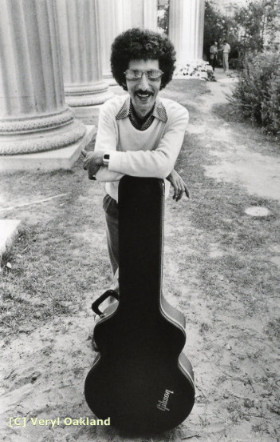
Although from Philadelphia and an East Coast cat during most of his playing days, guitarist Pat Martino signed with southern California based Warner Brothers Music in the 1970s and the record label brought him to California to promote his recordings which is when Veryl had the opportunity to take the commercial photographs that populate this post.
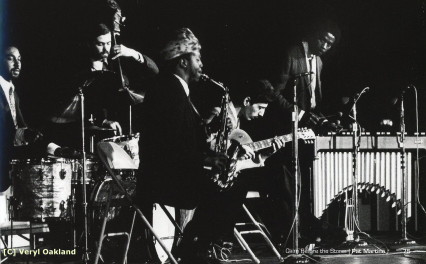
The in-performance photos date back to the 1967 inaugural Berkeley Jazz Festival when Veryl first heard Pat as a member of saxophonist John Handy’s group along with Bobby Hutchinson on vibes, Albert “Sparky” Stinson on bass and Doug Sides on drums.
Pat Martino - Calm Before the Storm - San Francisco, CA
Among Martino's many peers was guitarist John Abercrombie, who offered the following testimony in Pat's autobiography about the first time he saw him performing with organist Jack McDuff: "That night, Pat came on the bandstand... playing a black Les Paul Custom guitar. We knew the guitar was like carrying a Buick on the stage—it was so heavy. And Pat was such a frail tittle guy. So when we saw this young, very thin little guy walking up to the bandstand with this heavy guitar... our reaction was, 'Oh, man this can't be the guitar player! Who is this? 'So we were all chuckling. And then, he started to play and we ceased chuckling. Because he just floored everybody in the club. I never heard anything like that... it was the constant stream of eighth notes and his amazing time, his feeling that was so perfect."
SAN FRANCISCO, CALIFORNIA
“Every once in a while, I wonder what it might be like to reach out to the man again... to reconnect, and possibly even relive those enjoyable moments we had together that late 1976 weekend in San Francisco. After all, I was sharing the afternoon with one of a handful of my all-time favorite jazz guitarists, Pat Martino.
But, of course, that could never have happened. Even if it had been one of his greatest experiences ever, Pat wouldn't remember me or our afternoon together. That's because just a few years after our visit—in 1980— Martino's lifelong, but misdiagnosed, struggle with AVM (arteriovenous malformation) would culminate in a brain aneurysm and near-death.
Life for Pat Martino would have to start all over again.
The guitarist was four years younger than me, just a skinny kid in his early twenties, when I first saw him perform with alto saxophonist John Handy and vibraphonist Bobby Hutcherson at the inaugural University of California, Berkeley Jazz Festival in 1967. Despite clearly being the youngest, smallest person onstage, he caught the audience by surprise when he took one solo, weaving together a meticulous flow of blistering eighth-note phrases. It was amazing.
Handy recalled those times, saying, "He was a tiny guy, but he played big music. He could play his little ass off, man."
Every time I witnessed Martino's future performances, he did things that were totally surprising, even revelatory. He never disappointed.
When we met for our photo session that afternoon at the Palace of Fine Arts, Pat was joined by his newest pianist, Berklee College of Music alum Delmar Brown. The two were in the midst of an international tour promoting their Warner Brothers release, Joyous Lake, which would become one of the finer jazz/fusion recordings from that period. The guitarist was jovial and upbeat our whole time together. It was obvious that Pat Martino was enjoying the fruits of his ever-expanding career.
It was only many years later, following his miraculous surgery, that I learned the details of Martino's life-altering course through his revealing autobiography, Here and Now! The Autobiography of Pat Martino. In it, Pat chronicled how he overcame the devastating effects of memory loss, depression, anxiety, and overwhelming negativity throughout an arduous recovery period. I discovered how it took years for him to re-learn his art and re-emerge as one of today's most vibrant and inspiring performers.
It occurs to me that all of us in the jazz community have been truly blessed, given a second chance to see and hear two highly productive — and beyond talented — walking miracles: Pat Martino and Quincy Jones, who also survived a brain aneurysm and surgery in 1974. Both escaped near-death and just kept on contributing, kept on creating some of the greatest music for us all to enjoy.”
“The guitar has its own mystique. The most ancient of instruments, it is the most pervasive in contemporary music. Those who mastered its mysteries have discovered unlimited application for the guitar’s acoustic and electric personalities.”
- Gary Giddins
“[Pat Martino]… is a guitarist who can rework simple material into sustained improvisations of elegant and accessible fire; even when he plays licks, they sound plausibly exciting.
Although seldom recognized as an influence, he has been a distinctive and resourceful figure in Jazz guitar for many years, and his fine technique and determination have inspired many players.”
- Richard Cook & Brian Morton, The Penguin Guide to Jazz on CD, 6th Ed.
“Pat Martino plays more than just notes. He plays his personality, his insights. Of Pat it can be honestly stated that his style is immediately recognizable.”
- Kent Hazen
There’s a modern adage which states: “You never get a second chance to make a first impression.”
When it came to the impression he made on Les Paul, a superb technical player and one of creators of the modern electric guitar sound, if would seem that Pat Martino didn’t need a second chance:
“Some years ago I was playing an engagement in Atlantic City and a young lad, accompanied by his parents, came backstage to meet me and request my autograph. When the lad said he was learning guitar I handed him mine and asked that he play something. Well, what came out of that guitar was unbelievable. "Learning," he said!!! The thought that entered my mind at the time was that perhaps I should take lessons from him ... his dexterity and cleanliness were amazing and his picking style was absolutely unique. He held his pick as one would hold a demitasse. Pinky extended, very polite.
The politeness disappeared when pick met string as what happened then was not timid but very definite. As is obvious, I was very impressed and the memory of this lad stuck with me. Although I lost track of him I figured that sooner or later I was bound to hear of him again. All that talent was not to be buried in obscurity.
Several years later I began hearing reports of a young guitarist playing in the New York area who was really scaring other musicians with his ability and musicianship. I tracked him down to a club in Harlem, and aside from the fact that the reports of his being a great guitarist were not exaggerated, I found that this was the same lad who had visited me in Atlantic City.
Now grown up, and with the extra years of practice and experience, he had grown into a musical giant. His name was Pat Martino. (As a side-note, a prominent guitarist told me recently that on his first visit to New York he had gone to the Harlem club where Pat was appearing. His thought at the time was that if Pat represented the type of competition he faced — and Pat not even well known — how was he to surpass or even equal that as well as enduring the other obstacles facing a proposed career in music.) …
Listen to … [his] music and be your own judge but it you happen to a guitarist don't be discouraged. Don't slash your wrists and pray for a decent burial; just practice a lot and perhaps someday someone (possibly Pat) will be writing liner notes for you.” [Les Paul, June, 1970, liner notes to Desperado, Prestige PR 7795; OJCCD 397]
Pat made a similar, first impression on Dan Morgenstern, a Jazz literary luminary who just recently retired as the Director of the Institute for jazz at Rutgers University:
“Pat Martino is a bad cat. ...
He is an original, his own man, and his abilities are extraordinary from both a strictly playing and general musical standpoint: great speed; marvelous articulation no matter how fast the fingers fly; an ear for harmony that feeds ideas to those fingers at a speed to match; a sense of form that imposes order on all that facility; a singing tone, and tremendous swing …. [Insert notes to Pat Martino Live, Muse 5026]
Or how about the impression Pat made on the distinguished Jazz author and critic, Gary Giddins.
“[The late Jazz trumpeter and bandleader] Red Rodney once described artistic progress like this: ‘You go along and then all of a sudden, bump, you rise to another plateau, and you work real hard and then, bump, you rise to another one.’
Pat Martino’s talent rises to a new plateau regularly and thanks to his prolific recording career, those bumps have been captured on an imposing series of discs. His records are not only consistent; they evolve one to the next. …
Perhaps the first thing one responds to in Pat’s music is commitment. He plays like he means it.
One aspect of his style consists of multi-noted patterns, plucked with tremendous facility (and time) over the harmonic contour. The notes are never throwaways; the patterns take on their own mesmerizing force, serving to advance the pieces as judiciously as the melodic variations of which Pat is a master. ….
Pat has very clearly honed his immense technique closely to what he most personally wants to express. His music is private, but richly communicative; it commands attention with its integrity – it does not call attention to itself with excessive volume or gimmicks.
Pat Martino doesn’t have time to jive, he’s a musician.” [Liner notes to Pat Martino/Consciousness Muse LP 5039; paragraphing modified]
And Mark Gardner, the accomplished Jazz author and journalist, was also duly impressed by his first experience with Pat when he wrote these comments and observations about he and his music in the liner notes to Pat Martino: Strings! [Prestige 7547]:
“Since Charlie Christian first plugged in his amplifier and revolutionized jazz guitar in the late 1930s each subsequent decade has witnessed the emergence of a handful of new string stylists. Barney Kessel, Jimmy Raney, Billy Bauer, Chuck Wayne and Oscar Moore were the dominant voices of the 'forties.
And in the 'fifties Tal Farlow really came into his own to be followed by Jim Hall, Kenny Burrell, Johnny Smith and Wes Montgomery. The 'sixties in turn have produced Grant Green, Bola Sete, Gabor Szabo, George Benson and now Pat Martino.
To bracket Martino with the foregoing list of great jazz plectrists warrants some weighty evidence in his favor. After all he is only twenty-three years old and the enclosed sides are the first real jazz sides to be released under his leadership. Which is precisely where the proof of my assertion lies— within this album.
It is quite plainly demonstrated on all five tracks that Pat Martino has already conceived a style of his own. To arrive at a personal mode of expression so young requires more than heavy chops and good taste, it calls for imagination, the sifting of one's emotional and intellectual resources into an abstract form with discipline. The guitarist has passed through this inner process of self-realization which is essential for every artist before he can begin to create works of lasting importance. Pat is not a 'natural talent' because no such thing exists. He has had to work and work hard to get where he is.
As alto saxophonist Sonny Criss remarked recently, 'A lot of people say that Bird was a born genius. That's wrong. He wasn't born with anything except the ability to breathe. Unless you really apply yourself nothing's ever going to happen.'
What has happened to Martino, a young man with an exciting future ahead, is the result of the sort of application Sonny spoke of.”
Here’s a video tribute to Pat on which he plays Benny Golson’s Jazz standard, Along Came Betty, accompanied by Eddie Green on electric piano, Tyrone brown on bass and Sherman Ferguson on drums. If you haven’t heard Pat play guitar before, perhaps your first impression will match that of Les Paul, Gary Giddins, Dan Morgenstern, and Mark Gardner. If so, you’d be in very good company, indeed.
1949 was an important year for Jazz. Miles, Gil and Jeru released The Birth of the Cool Recordings, Charlie Parker appeared at Carnegie Hall and bassist Howard Rumsey instituted a continuing Jazz policy at the Lighthouse Cafe in Hermosa Beach, Ca.
It was also the year that Bob Weinstock founded Prestige Records and it has been going strong ever since as a record label dedicated to Jazz and its makers.
Prestige Records is celebrating its 66th anniversary this year and the editorial staff at JazzProfiles thought it would call attention to this fact by reproducing this essay about the label by Thomas Staudter which first appeared in Downbeat magazine [10/2014]
“While a cynic might call the celebration just another exercise in nostalgia, scholars and longtime fans of the label are well aware of how important its heyday was to the evolution of jazz. Prestige offered to listeners numerous treasures from many of the all-time best practitioners of the improviser's art, and over the span of a more than 1,000 recordings stand works that define the modern jazz era, as well as the deep grooving soul-jazz sub-genre and other styles.
The Concord Music Group, which took control of the Prestige Records catalog with its purchase of Fantasy Records in 2004, is commemorating the label's rich history with a special, multifaceted rollout of music and special events. For starters, Concord will make its popular Rudy Van Gelder Remasters series—which was inaugurated in 2006 and saw the reissue on CD of more than 60 albums originally recorded by the legendary sound engineer—downloadable as high-resolution digital releases.
Also, 16 classic albums are being re-released on Prestige, including three from Miles Davis, two from John Coltrane (and Red Garland Quintet's Soul Junction, which the saxophonist plays on), Thelonious Monk Trio, Mose Allison Sings, Sonny Rollins' Plus 4, Eric Dolphy's At the Five Spot, Vol. 1, Charles Earland's Black Talk! and Jackie McLean's 4, 5 And 6. By the end of the year, Concord will have 35 Prestige titles out as vinyl LPs.
Additionally, Concord has created a series of online videos produced by Bret Primack to salute Prestige's anniversary, putting the focus on artists like Davis, Monk, the Modern Jazz Quartet, Gene Ammons and Paul Chambers by utilizing on-camera interviews with various musicians (including Sonny Rollins, Gerald Clayton and Helen Sung) as well as music industry experts. Taken as a whole, the videos present a wide perspective on Prestige's importance in the history of jazz as well as entertaining glimpses at the inner workings of the label and how the recordings were made.
"When you think of the classic recordings of jazz, you'll find a big chunk of them are in the Prestige catalog," said Nick Phillips, vice president of catalog development and A&R for Concord Music Group. "There are only a handful of other labels that can say this. In terms of complexity and purpose, you could argue that many of the recordings were just blowing sessions, but a certain excitement can be found in those situations nonetheless. The musicians felt comfortable working with Rudy, and he was able to make everyone sound great on record. It was a unique situation. Rudy set the standard for jazz recordings that others continue to chase today. It's remarkable that you can listen to Prestige albums from the 1950s and 1960s and be struck by how vibrant and fresh they still sound."
A roll call of the artists who appeared regularly on Prestige during the label's first two years of existence underscores why their documentation remains an essential part of the jazz canon: Stan Getz, James Moody, Max Roach, JJ. Johnson, Zoot Sims, Wardell Gray and Sonny Stitt. In many cases, the Prestige dates were these artists' first studio sessions as leaders.
The narrative history of Prestige Records and its founding by Bob Weinstock in 1949 has been widely recounted. Certain elements of this story come across today as quaint and harken back to a time when driven, obsessive personalities, swept up by a passion for music, could help change the course of the music business.
Weinstock (1928-2006) grew up in Manhattan. When he was just 8 years old, a trip to a local flea market resulted in an armload of jazz discs bought for pennies apiece—and an abiding interest in the intersection of culture and commerce. In his teens Weinstock bought and sold recordings through magazine advertisements before finally renting space in the Jazz Record Center on 47th Street, near the Metropole jazz club, with the support of his family. Friendships with many of the jazz artists who frequented his store led him to start his own label, New Jazz.
The first recording released on New Jazz was cut on Jan. 11,1949, and featured a quintet led by pianist Lennie Tristano with saxophonist Lee Konitz, who was later promoted to co-leader when the album (catalog number PRLP 101) came out. The following year Weinstock, now operating as Prestige Records out of an office on West 50th Street in Manhattan, amped up his release schedule with a bevy of great dates led by saxophonists, along with music licensed from French and Swedish labels. As his catalog increased, Weinstock, the son of a shoe salesman, traveled around the country to promote his recordings at record stores and radio stations.
The first Prestige Records releases cut in Manhattan utilized various recording facilities, but in 1954 Weinstock began to rely on Van Gelder's recording studio, originally located in the living room of his parents' home in Hackensack, New Jersey, and already being booked for sessions by the Blue Note and Savoy labels. Thelonious Monk and Miles Davis were early visitors to the studio on behalf of Prestige, cutting Monk (which included the tune "Hackensack") and Bags' Groove there, respectively, and before long Weinstock was booking Van Gelder's studio every Friday for recording dates. Van Gelder had worked full-time as an optometrist, but a youthful interest in radio and sound technology spurred him to discover and acquire the best new recording equipment available recording equipment available.
"Recording my neighbors escalated into recording jazz musicians," Van Gelder recalled in a recent interview with DownBeat. "I was recording musicians who had heard about me and came to Hackensack so I could record them. The quality of the recordings became known to professional musicians, and I transitioned to recording professionally. During that time there were only three major record companies: RCA, Columbia and Decca. Bob Weinstock, a music lover like myself, wanted to record albums that could compete sound-wise with the majors. I felt that now I had a mission: to allow small private labels to sound as good as the three big labels. That was my goal from then on."
Recording equipment was expensive, and the technology was such that each of the major record companies had their own way of doing things. Van Gelder found other recording engineers were reluctant to reveal their methods to outsiders. "Recording techniques were secrets," he said. "Someone once said, 'If there was a fire, they wouldn't even let the firemen in.' I remember that clearly. I guess some of that rubbed off on me."
Through the 1950s Van Gelder recorded some of the most memorable jazz albums of all time, including Cookin’ With The Miles Davis Quintet, Rollins' Saxophone Colossus and Coltrane's Soultrane and the Modern Jazz Quartet's Concorde. In 1959 he moved his recording studio to a new home in Englewood Cliffs, New Jersey, and Weinstock moved his operation to an office in nearby Bergenfield. The working relationship between label owner and engineer remained harmonious until the end, in 1972, when Weinstock sold Prestige and its catalog—which included the subsidiary labels Swingsville, New Jazz (which had been revived in 1958), Bluesville and Moodsville — to Fantasy and retired to Florida to focus on his other passion, buying and trading stocks.
"I was in awe of the musicians who were coming to me," Van Gelder recalled. "I opened the door one day, and there was Coleman Hawkins! Bob would call me and say we were going to record Miles Davis on Thursday afternoon. John Lewis of the Modern Jazz Quartet didn't like my piano, so I had to go into New York to record him on someone else's piano. John was right, too. Most of the musicians in the beginning were kind of suspicious of me, not sure whether I could do the job.
"I had the feeling that what I was doing was important — more important than the politics of the time or anything else that was going on," continued Van Gelder. "Working for Bob Weinstock was really fun. He was laid-back. Instead of directing the musicians, he let the sessions flow wherever the musicians took it. As a result, there were plenty of laughs, and we all had a good time."
Among the jazz giants who owe a debt to Van Gelder is Pat Martino. "In time, I was able to establish a personal rapport with Rudy based on my familiarity from working with him," said the guitarist-composer, who first recorded at Van Gelder's Englewood Cliff’s studio as a sideman on Willis Jackson's Grease 'AT Gravy album in 1963. When it came time for Martino to cut his own solo debut for Prestige in 1967, working with Van Gelder was preordained, and the result was El Hombre, a smoking soul-jazz showcase that is also part of Concord's LP reissue program. "The respect demanded by Rudy's presence was formidable," Martino noted. "You were never to touch the microphones or the recording equipment. I adhered to those requests, as did other musicians. Recording for Prestige was an achievement in that era."
—Thomas Staudter
The following video salute to Prestige Records on its 66th anniversary features pianist Red Garland's quintet with Donald Byrd, trumpet, John Coltrane, tenor sax, George Joyner, bass and Art Taylor drums performing "Birks Works."