Showing posts with label Wynton Kelly. Show all posts

Wednesday, December 3, 2025

Wynton Kelly - "A Happy Feeling"

© -Steven Cerra, copyright protected; all rights reserved.


Of the late pianist Wynton Kelly [1931-1971], Richard Cook and Brian Morton in their Penguin Guide to Jazz on CD, 6th Ed. have written: “His chording [comping or accompaniment] behind a soloist has a gentle but dynamic bounce. He never does anything to startle a listener, but he has a bright, swinging, communicative style that always appeals. He deserves wider recognition.”

And so the following piece about Wynton by Gene Lees in an effort to promote this wider recognition.

“If they gave awards for unpretentiousness, Wynton Kelly would win a large loving cup. The stocky pianist, just entering his fourth year in the rhythm section of the Miles Davis quintet-turned-sextet, has the distinction of being about the most unobtrusive pianist in jazz, while at the same time inspiring an enormous professional admiration.

If being imitated is the mark of having arrived, Kelly has arrived. His ebullient approach to solos has seeped into the playing of a wide variety of pianists, and he has written the very definition of good comping.

"Wynton," said Voice of America jazz commentator Willis Conover, one of the many persons who has tried (with middling success) to pin down verbally the nature of Kelly and his music, "has a marvelous go-to-hell attitude. Like the Miles Davis attitude turned active, and with humor added."

Not that there is a hint of antagonism in Kelly or his playing. "He always projects a happy feeling, regardless of the tempo," said trombonist J. J. Johnson, currently a co-worker of Kelly's in the Davis group. But there is a disinclination to overwhelm the listener. Kelly seems content to let the listener come to him.

"Wynton has by no means shown all the things he can do," commented Bill Evans, a forerunner of Kelly's with Miles. (First there was Red Garland, then Evans, who in turn was succeeded by Kelly.)

"For one thing," Evans continued, "Wynton is a fine accompanist. I heard him first with Dinah Washington, and immediately I felt an affinity for his playing.

"He has a wonderful technique, and he gets a true piano sound out of the instrument. He approaches the instrument legitimately and, although I don't know his training background, I know that if someone else hasn't disciplined him, he has disciplined himself.

"I can hear in his mind that he's broad enough to be able to play solo — that is, unaccompanied by rhythm section — but I like him in a rhythm section so much that I'm not sure I'd want him to do it."

After a moment's reflection, Evans added, "Wynton and I approach jazz essentially the same way.

"Wynton is an eclectic, not in the cheap way, but in the sense of copying the spirit and not the letter of the things he has liked."

The man who elicits this musicianly admiration was born in Brooklyn in 1931. Like his friend Oscar Peterson, Kelly has West Indian parents. When the two meet, they will sometimes slip into a West Indian patois that leaves them laughing and other musicians staring in confusion.

Kelly started playing piano at the age of 4. "I didn't have much formal study," he said.

"I went to Music and Art High School and Metropolitan Vocational. They wouldn't give us piano, so I fooled around with the bass and studied theory.

"I used to work around Brooklyn with Ray Abrams, the tenor player, and his brother Lee, the drummer, and also Cecil Payne, Ahmad Abdul-Malik, and Ernie Henry. We all came up together.

"One of the first bands I worked with was Hot Lips Page's. Then I went with Lockjaw Davis for about a year. After that I did a stint with the Three Blazes. Then Dinah Washington. I worked for Dizzy Gillespie too. I was between Dinah and Dizzy for years."

Kelly joined the Miles Davis group in the early part of 1959. It was then that the public really began to be aware of him, not only as a soloist but as a pulsing rhythm-section player. Though he has recorded six albums on his own —"three for Vee Jay, two for Riverside, and one I made in 1950 when I was 19 that doesn't even count" — it is nonetheless for his work in the Davis unit that he is best known.

If the Kelly style is not an obtrusive one — not a style that one hears once and ever afterwards recognizes — it has its curious distinctiveness. There is in it a highly personal ease and lightness, an infectious, casually bouncing quality to which one rapidly becomes attached.

"He never," J. J. Johnson said, "lets his technical facility, which he has plenty of, dominate. The swing is the thing with Wynton."

As an accompanist for horns, Kelly is the ne plus ultra of skilled, meaningful, and yet non interfering comping. "He does all the right things at the right times," Johnson said.

Kelly loves to comp. "In fact," he said, "at one time I didn't like to solo. I'd just like to get a groove going and never solo.

"The first pianist I admired for comping was Clyde Hart, and later Bud Powell.
"The way you comp varies from group to group. Some guys will leave a lot of space open for you to fill, like Miles. Others won't. And so you have to use your discretion. In general, I like to stay out of a man's way. But you have to judge it by the situation. I did some things with Dizzy I wouldn't do with Dinah, and things I did with them that I wouldn't do with Miles.

"It's good to sit down and hear how other guys comp and then learn to do it yourself."

Kelly's tastes among pianists are predictably broad. An incomplete list of his preferences includes:

Oscar Peterson —"First of all, he's tasty. And he knows the instrument very well."

Erroll Garner —"He's a hell of a stylist, and he's very versatile."

Bud Powell —"I respect Bud as one of the main figures in starting modern jazz piano."

Bill Evans — "For beauty. That's all I can say. He also knows the instrument very well. He's one of the prettiest piano players I've heard in a long time."

Phineas Newborn—"We were in the Army together, bunk to bunk. He's a genius."

Walter Bishop Jr.—"I've liked him since I was a kid."

McCoy Tyner — "He's a serious-minded musician. I like his style, and he fits well with the other instruments in Coltrane's group."

Unlike most pianists who come to prominence in someone else's group, Kelly has no pressing urge to form a group of his own.

"It's in the back of my mind," he said. "But not now.”

Source - January 3, 1963 edition of Downbeat Magazine.


Thursday, November 23, 2023

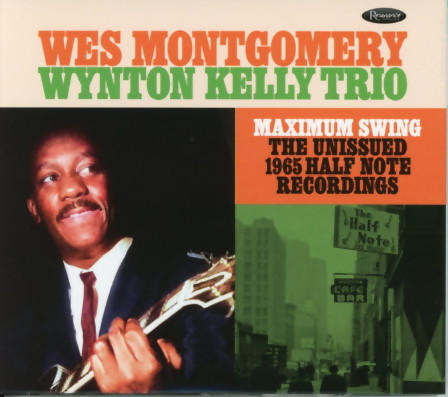
11/24/2023 Record Day - Wes Montgomery and Wynton Kelly - Maximum Swing

 © Copyright ® Steven Cerra, copyright protected; all rights reserved.


As noted in earlier features about  Cal Tjader: Catch The Groove - Live at the Penthouse 1963-1967 and "Ahmad Jamal - Live at The Penthouse 1966-68" [DDJD -006], “Black Friday” - November 24, 2023 - is a day to celebrate new releases, especially those involving the resurgent interest in vinyl editions with CDs of these albums generally following a few weeks later.


Since I’ve been the fortunate recipient of preview copies of new Jazz 

recordings by some of these accomplished Jazz legends to be released on the upcoming Record Store day, I thought it might be fun and helpful to share the information on the media releases which accompanied them to make you aware of what could be the cause of a lessening balance in your bank account come November 24th!


From Ann Braithwaite/Braithwaite & Katz Communications


WES MONTGOMERY AND WYNTON KELLY SMOKE AGAIN ON MAXIMUM SWING, NEW LIVE ARCHIVAL TREASURE DUE FROM RESONANCE RECORDS AS THREE-LP RSD BLACK FRIDAY EXCLUSIVE ON NOVEMBER 24, 2023


Resonance Celebrates Wes Montgomery's Centennial with First Legitimate Release of Hard-Hitting 1965 Dates at New York's Half Note, Site of a Storied Meeting Between the Guitarist and Pianist, Arrives on CD and Digitally Dec. 1


Deluxe Package Features a Comprehensive Essay by Jazz Historian Bill Milkowski, Remembrances from Ron Carter, Herbie Hancock, Bill Frisell, Mike Stern and Marcus Miller, and Previously Unseen Photos by Raymond Ross


Three Newly Curated "Wes Montgomery on Resonance" Digital Streaming Compilations Also Available on All Streaming Platforms


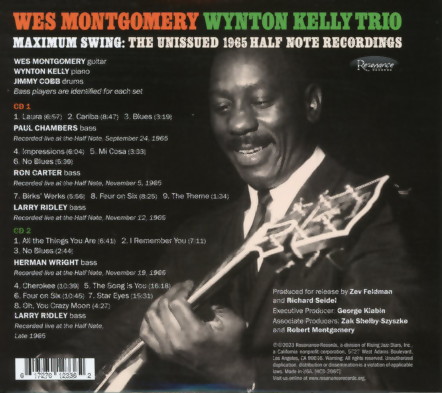
Resonance Records will observe the centennial of Wes Montgomery's birth on RSD Black Friday with the November 24, 2023 release of Maximum Swing, a collection of live performances — never previously released officially — by the guitarist and pianist Wynton Kelly's trio captured at New York's Half Note in 1965. The album will be issued as a two-CD set and digitally on December 1. RSD Black Friday releases will be available at independent record stores on Friday, November 24lh (visit recordstoreday.com for more information and to find nearby stores).


The limited edition three-LP set was mastered for 180-gram vinyl by Matthew Lutthans, captures a series of dates at the Manhattan club that were recorded in the wake of the famed Montgomery-Kelly date released by Verve Records as Smokin' at the Half Note. Unlike that classic recording, on which two June 1965 performances at the titular venue were augmented by three studio performances cut that September, the new set is 100% live.


Produced by Resonance co-president Zev Feldman — "the Jazz Detective," who was named producer of the year in DownBeat magazine's 2022 and 2023 critics' polls — and Richard Seidel, Grammy-winning, long-time Verve Records A&R/Producer executive — Maximum Swing features Kelly's working trio with bassist Paul Chambers and drummer Jimmy Cobb, whose work with the keyboardist dated back to the historic 1959 dates for Miles Davis' incomparable Kind of Blue. On some selections, Chambers' slot is taken by guests Ron Carter, Larry Ridley, and Herman Wright; an unidentified bassist sits in on five expansive tracks from late 1965 unearthed by Japanese Wes Montgomery discographer/archivist Yoshio Tokui.


The package includes a comprehensive essay about Montgomery and Kelly's Half Note collaborations by historian Bill Milkowski; remembrances by Carter and pianist Herbie Hancock, both of whom worked with the guitarist early in their careers; the great guitarists Bill Frisell and Mike Stern; and bassist Marcus Miller, who is Wynton Kelly's second cousin. Never-before-seen photos from the Half Note by Raymond Ross complete the collection.


Maximum Swing is Resonance's seventh Montgomery title, produced with the full cooperation of the musician's estate. Among the releases is 2017's Smokin' in Seattle, a live date recorded in 1966 at the intimate club the Penthouse in the titular city.


Feldman says of the new release, "Without question, the music here constitutes some of the most extended, elastic and SWINGING Wes Montgomery performances ever recorded. The greater part of these performances were originally aired on radio broadcasts hosted by Alan Grant for his WABC-FM radio show Portraits in Jazz. We hear Wes doing things he hasn't done on other recordings before, particularly all the extended solos he plays, where he stretches out far more than on his other recordings, even his other live recordings. Maximum Swing captures the vibrancy of the experience of hearing Wes live in this period."


Milkowski writes, "Wes's relaxed sense of rhythm and tempo, his melodic and harmonic intuition and cleanly articulated ideas were simply phenomenal, and even more exhilarating in a live setting, as we hear on these smokin’ tracks from the Half Note. And with amiable emcee Grant engaging the guitar great in casual banter during his intros and outros of the tunes - - it all blends with the sound of glasses clinking, the murmurs from audience members during and between songs, and enthusiastic applause at the end of tunes to create the feeling of really being there that eventful night at the Half Note."


Recalling his unanticipated stint subbing for Chambers behind Montgomery, Carter — the bassist in Miles Davis's Second Great Quintet — says, "There was not a lot of time to rehearse. I remember there were no music stands and I was trying to figure out how to hold the music up for the songs I didn't know; still it felt good to walk into a situation with the great Jimmy Cobb, the fabulous Wynton Kelly and this smashing guitar player Wes Montgomery. I knew of Jimmy from early on. I knew who they all were. I had known them from records and had contact with them occasionally in the course of various gigs and record dates, but to walk into that meeting place with all those guys and perform with them live on stage was astonishing for me. There were other guys they could have called for this sub gig, but I got chosen. No one in the band complained."


Hancock observes, "When he played in clubs and concerts, Wes seemed to go back to what he was playing at the beginning, which was more straight-ahead jazz, and as you can hear on these recordings, Wynton Kelly was the perfect partner for that. Wes and Wynton sure could both play the blues and in that jazz style of blues playing. It was funky, yet it balanced the technical side of jazz playing and sophisticated harmonization." Like a legion of other guitarists who acknowledged the influence of Montgomery's unique, trailblazing style-among them George Benson, Pat Martino, John Scofield, John Abercrombie, Lee Ritenour, Emily Remler, and Pat Metheny — Frisell and Stern offer kudos to the guitar great.


"Wes's music is so accessible," Frisell says. "There's so much joy in it, but then there's so much depth. It's just like he invented this whole thing. That's what's so inspiring to me — how he took everything around him and constructed his own world. Then he was able to show it to us in such a clear way. That thing you can't really describe, but you just feel the wonder."


"I love that on these recordings we hear Wes stretching out," says Stern. "He didn't get to do that on his studio records, or even the live ones like the original Smokin' at the Half Note. It's amazing how much he can keep your interest. It just keeps building. He built every solo. And in some ways, some ballads stayed in the same beautiful place. Maybe he didn't play as long, but when it was some blues or just swinging on something, some tune, 'All the Things You Are,' he just tore it up. And on this record, it was killing."


Summing up Kelly's contributions, both to Montgomery's live attack and his contribution to jazz, Miller says, "Of course, you hear everybody talk about how joyful his playing was. The way he swung was really joyful. I feel connected to him also because he had an extensive R&B background. He played on some R&B hits. Wynton probably learned a lot about grooving from that and you can hear that in his playing. He always found a way to throw the blues in there. And he always found a way to really, really make it swing."


Feldman writes of his label's latest landmark contribution to Montgomery's towering catalog, "At Resonance, working on these projects has been extremely rewarding for me personally, of course, but more importantly, it's allowed us to participate in casting light on Wes Montgomery's monumental stature in the history of jazz in general and jazz guitar in particular. I cannot begin to fully express the importance of his legacy.


Wes Montgomery on Resonance Digital Streaming Compilations


Another part of Resonance's celebration of Wes Montgomery's Centennial, the producers of Maximum Swing — Zev Feldman and Richard Seidel — have curated a series of themed digital compilations culled from the label's catalog of acclaimed archival Montgomery releases: Wes Montgomery Plays Ballads, Wes Montgomery Plays The Blues, and Wes Montgomery Plays The Great American Songbook. The three compilations will be available on all streaming platforms on Friday, September 8th.


Monday, November 14, 2022

Wynton Kelly: 1931-1971 - Revisiting “A Pure Spirit” [From the Archives]

 © -Steven Cerra, copyright protected; all rights reserved.


“Wynton’s situation … is worth noting as a startling example of the strange irrelevance of merit to fame in Jazz.”
- Orrin Keepnews, Jazz Producer and Writer

“Nothing about his playing seems calculated .. there was just pure joy shining through his conception.”
Bill Evans, Jazz Pianist

Amazingly, given his background, Wynton Kelly is an often overlooked figure in modern Jazz circles.

One would think that a pianist who had worked with Lester Young, Charles Mingus, Dizzy Gillespie’s 1950s big band, Dinah Washington, Miles Davis and Wes Montgomery, let alone with his own trio made-up of Paul Chambers on bass and Jimmy Cobb on drums, would be more widely known and respected.

But such is not the case for Kelly who is sometimes more acknowledged because he has a first name in common with the phenomenal trumpet player and leader of the Lincoln Center Jazz Orchestra – Wynton Marsalis – whose father, Jazz pianist Ellis Marsalis, named him after Kelly.

The editorial staff thought it might be fun to spend some time developing a JazzProfiles feature about Wynton, Kelly that is, as a way of paying tribute to his memory.

In the liner notes that he wrote for Kelly at Midnight, one of the earliest album’s that Wynton made under his own name [VeeJay VJ-03], Nat Hentoff commented:

“Miles Davis was being asked one afternoon for a verbal analysis of Wynton Kelly's musical worth. Miles character­istically scoffed at using such imprecise tools as words to describe what happens in jazz; but finally he said: ‘Wynton's the light for a cigarette. He lights the fire and he keeps it going. Without him there's no smoking.’

Another judicious tribute came from Cannonball Adderley who had worked with Wynton in the Miles Davis band. ‘He's a fine soloist, who does both the subdued things and the swingers very well. Wynton is also the world's great­est accompanist for a soloist. He plays with the soloist all the time, with the chords you choose. He even anticipates your direction.’

Somewhat earlier, I'd been talking to King Curtis, a Texan now in New York and a specialist in rhythm and blues. ‘Wynton worked with me for a while, and naturally I've heard him with Dinah and with Miles. What struck me was that wherever Wynton worked, he fitted in. He's not limited to one kind of playing. With Dinah, he had the taste and supportive power of a superior accompanist. With me, he had the fire and the straightaway swinging my bands have to have. And with Miles, he can be as subtle as Miles requires.’

As is usually the case, Wynton was being discussed enthusiastically by musicians before there was much atten­tion paid him in the public prints. …”


And in another of Wynton’s VeeJay LP’s, Kelly Great [VeeJay VJ-06], Julian “Cannonball” Adderley, the great alto saxophonist and, as noted previously, Wynton’s bandmate in the Davis group, said this about Kelly:

“When Sid McCoy of VeeJay Records asked Frank Strozier (phenomenal young alto saxophonist) who did he wish to play piano on his VeeJay record date, Frank immediately said Wynton Kelly. So answered Bill Henderson and Paul Chambers. It is next to impossible to evaluate the role played by Wynton Kelly in a band, for he has a ‘take charge’ quality in a rhythm section such as a Phil Rizzuto or Eddie Stanky had on a baseball team.

Many jazz listeners are unaware that such intangible qualities as fire and spirit make the margin between greatness and ‘just good’. Leading jazz musicians, such as Dizzy Gillespie and Miles Davis (Wynton's current employer), are cognizant of this fact. A short time ago Miles Davis made an album using another pianist, who at that time was a member of his band, but added Wynton for one selection, explaining, ‘Wynton Kelly is the only pianist who could make that tune get off the ground.’

What does Wynton have that is so different?”

Perhaps the difference lies in what Richard Cook and Brian Morton have described in The Penguin Guide to Jazz on CD, 6th Ed.  as “… his lyrical simplicity or uncomplicated touch… [or] the dynamic bounce to his chording …,” or because, as Cannonball Adderley, asserted: “Wynton combined the strength of pianists Red Garland and Bill Evans, his predecessors with Miles Davis.”

Or maybe this difference lies in the following description of Wynton’s playing by fellow pianist Bill Evans as quoted in Jack Chambers, Milestones:

“When I first him in Dizzy’s big band [in the mid-1950s], his whole thing was so joyful and exuberant, nothing about it seemed calculated. And yet with the clarity of the way he played, you knew that he had put this together in a carefully planned way – but the result was completely without calculation, there was just pure spirit shining through the conception.”


Like Bill, Brian Priestley may have also identified the essence of what made Wynton Kelly so unique as a pianist in the following description of his style in Jazz, The Rough Guide: An Essential Companion to Artists and Albums:

“An important stylist, but largely unrecognized except by fellow pianists, Kelly’s mature style was hinted at in his earliest recordings. He combined boppish lines and blues interpolations with a taut sense of timing quite unlike anyone else except his imitators. The same quality made his equally individual block chording into a particularly dynamic and driving accompanying style that was savored by the many soloists that he backed.”

More about Kelly’s special qualities as a pianist can be found in the following paraphrase from Peter Pettinger’s biography of pianist Bill Evans – How My Heart Sings:

“Evans held Kelly’s bright and sparkling style in high regard since hearing him in Dizzy Gillespie’s big band, responding to Wynton’s particular blend of clarity and exuberance. This reaction was typical of Evans’s appreciation of the work of his fellow pianists; from Oscar Peterson to Cecil Taylor, he was full of admiration for their diverse talents and generous in his praise.”

As detailed in Groovin’ High,  Alyn Shipton’s life of trumpeter Dizzy Gillespie, the unique character of Kelly’s piano style may have been the result of combining years of experience in playing in rhythm and blues bands with a fine Jazz sensibility.

Of his work with his own trio, John A. Tynan had this to say in a Down Beat review:

“It is one of the most cohesive and inventive rhythmic groups in small-band Jazz today.”

Musicians commenting about Wynton’s work on their recordings state: “The presence of Kelly may account for the difference …,” “… the album would not have been excellent without Wynton Kelly’s sterling support,” and “… he is disarmingly pleasant to work with, the very model of a mainstream pianist.”

The Jazz writer and critic, Barbara J. Gardiner closed her insert notes to the 1961 VeeJay 2-CD compilation Wynton Kelly! [VeeJazz-011] with the declaration that “You would expect Wynton Kelly to be comprehensive as well as creative. Hasn’t he always been?”

Although she was referring to the material on these CDs “… tried and proven, mixed in with a bit of the fresh …,” this could also serve as an apt way of describing Wynton’s approach to Jazz piano: wide-ranging and inventive.

One is never far away from the Jazz tradition when listening to Wynton Kelly, but what he plays is himself; he has incorporated his influences into his own musical “personality” and recognizably so. Four [4] bars and you know its him.

Wynton is not a pianist who overwhelms the listener with startling technique or originality of conception.

But what he does offer is playing that is full of joy, funk and a feeling for time that fills the heart with happiness, sets the feet tapping and get the fingers popping the beat.

Wynton Kelly is the pianistic personification of swing, or if you prefer: “smokin’,” “cookin’” or “boppin’.” 

When Wynton plays Jazz piano, you feel it.

Nothing cerebral here in any deep or complicated sense, just – “Clap hands, here comes, Wynton.”

Hear it for yourself in the following tribute to Wynton that features him along with Paul Chambers on bass and Philly Joe Jones. The tune is Winston's original Temperance from Kelly at Midnight [VeeJay-03] .


Thursday, October 10, 2019

Wynton Kelly: 1931-1971 - “A Pure Spirit”


“Wynton’s situation … is worth noting as a startling example of the strange irrelevance of merit to fame in Jazz.”
- Orrin Keepnews, Jazz Producer and Writer

“Nothing about his playing seems calculated .. there was just pure joy shining through his conception.”
Bill Evans, Jazz Pianist

© -Steven Cerra, copyright protected; all rights reserved.

Amazingly, given his background, Wynton Kelly is an often overlooked figure in modern Jazz circles.

One would think that a pianist who had worked with Lester Young, Charles Mingus, Dizzy Gillespie’s 1950s big band, Dinah Washington, Miles Davis and Wes Montgomery, let alone with his own trio made-up of Paul Chambers on bass and Jimmy Cobb on drums, would be more widely known and respected.

But such is not the case for Kelly who is sometimes more acknowledged because he has a first name in common with the phenomenal trumpet player and leader of the Lincoln Center Jazz Orchestra – Wynton Marsalis – whose father, Jazz pianist Ellis Marsalis, named him after Kelly.

The editorial staff thought it might be fun to spend some time developing a JazzProfiles feature about Wynton, Kelly that is, as a way of paying tribute to his memory.

In the liner notes that he wrote for Kelly at Midnight, one of the earliest album’s that Wynton made under his own name [VeeJay VJ-03], Nat Hentoff commented:

“Miles Davis was being asked one afternoon for a verbal analysis of Wynton Kelly's musical worth. Miles character­istically scoffed at using such imprecise tools as words to describe what happens in jazz; but finally he said: ‘Wynton's the light for a cigarette. He lights the fire and he keeps it going. Without him there's no smoking.’

Another judicious tribute came from Cannonball Adderley who had worked with Wynton in the Miles Davis band. ‘He's a fine soloist, who does both the subdued things and the swingers very well. Wynton is also the world's great­est accompanist for a soloist. He plays with the soloist all the time, with the chords you choose. He even anticipates your direction.’

Somewhat earlier, I'd been talking to King Curtis, a Texan now in New York and a specialist in rhythm and blues. ‘Wynton worked with me for a while, and naturally I've heard him with Dinah and with Miles. What struck me was that wherever Wynton worked, he fitted in. He's not limited to one kind of playing. With Dinah, he had the taste and supportive power of a superior accompanist. With me, he had the fire and the straightaway swinging my bands have to have. And with Miles, he can be as subtle as Miles requires.’

As is usually the case, Wynton was being discussed enthusiastically by musicians before there was much atten­tion paid him in the public prints. …”


And in another of Wynton’s VeeJay LP’s, Kelly Great [VeeJay VJ-06], Julian “Cannonball” Adderley, the great alto saxophonist and, as noted previously, Wynton’s bandmate in the Davis group, said this about Kelly:

“When Sid McCoy of VeeJay Records asked Frank Strozier (phenomenal young alto saxophonist) who did he wish to play piano on his VeeJay record date, Frank immediately said Wynton Kelly. So answered Bill Henderson and Paul Chambers. It is next to impossible to evaluate the role played by Wynton Kelly in a band, for he has a ‘take charge’ quality in a rhythm section such as a Phil Rizzuto or Eddie Stanky had on a baseball team.

Many jazz listeners are unaware that such intangible qualities as fire and spirit make the margin between greatness and ‘just good’. Leading jazz musicians, such as Dizzy Gillespie and Miles Davis (Wynton's current employer), are cognizant of this fact. A short time ago Miles Davis made an album using another pianist, who at that time was a member of his band, but added Wynton for one selection, explaining, ‘Wynton Kelly is the only pianist who could make that tune get off the ground.’

What does Wynton have that is so different?”

Perhaps the difference lies in what Richard Cook and Brian Morton have described in The Penguin Guide to Jazz on CD, 6th Ed.  as “… his lyrical simplicity or uncomplicated touch… [or] the dynamic bounce to his chording …,” or because, as Cannonball Adderley, asserted: “Wynton combined the strength of pianists Red Garland and Bill Evans, his predecessors with Miles Davis.”

Or maybe this difference lies in the following description of Wynton’s playing by fellow pianist Bill Evans as quoted in Jack Chambers, Milestones:

“When I first him in Dizzy’s big band [in the mid-1950s], his whole thing was so joyful and exuberant, nothing about it seemed calculated. And yet with the clarity of the way he played, you knew that he had put this together in a carefully planned way – but the result was completely without calculation, there was just pure spirit shining through the conception.”


Like Bill, Brian Priestley may have also identified the essence of what made Wynton Kelly so unique as a pianist in the following description of his style in Jazz, The Rough Guide: An Essential Companion to Artists and Albums:

“An important stylist, but largely unrecognized except by fellow pianists, Kelly’s mature style was hinted at in his earliest recordings. He combined boppish lines and blues interpolations with a taut sense of timing quite unlike anyone else except his imitators. The same quality made his equally individual block chording into a particularly dynamic and driving accompanying style that was savored by the many soloists that he backed.”

More about Kelly’s special qualities as a pianist can be found in the following paraphrase from Peter Pettinger’s biography of pianist Bill Evans – How My Heart Sings:

“Evans held Kelly’s bright and sparkling style in high regard since hearing him in Dizzy Gillespie’s big band, responding to Wynton’s particular blend of clarity and exuberance. This reaction was typical of Evans’s appreciation of the work of his fellow pianists; from Oscar Peterson to Cecil Taylor, he was full of admiration for their diverse talents and generous in his praise.”

As detailed in Groovin’ High,  Alyn Shipton’s life of trumpeter Dizzy Gillespie, the unique character of Kelly’s piano style may have been the result of combining years of experience in playing in rhythm and blues bands with a fine Jazz sensibility.

Of his work with his own trio, John A. Tynan had this to say in a Down Beat review:

“It is one of the most cohesive and inventive rhythmic groups in small-band Jazz today.”

Musicians commenting about Wynton’s work on their recordings state: “The presence of Kelly may account for the difference …,” “… the album would not have been excellent without Wynton Kelly’s sterling support,” and “… he is disarmingly pleasant to work with, the very model of a mainstream pianist.”

The Jazz writer and critic, Barbara J. Gardiner closed her insert notes to the 1961 VeeJay 2-CD compilation Wynton Kelly! [VeeJazz-011] with the declaration that “You would expect Wynton Kelly to be comprehensive as well as creative. Hasn’t he always been?”

Although she was referring to the material on these CDs “… tried and proven, mixed in with a bit of the fresh …,” this could also serve as an apt way of describing Wynton’s approach to Jazz piano: wide-ranging and inventive.

One is never far away from the Jazz tradition when listening to Wynton Kelly, but what he plays is himself; he has incorporated his influences into his own musical “personality” and recognizably so. Four [4] bars and you know its him.

Wynton is not a pianist who overwhelms the listener with startling technique or originality of conception.

But what he does offer is playing that is full of joy, funk and a feeling for time that fills the heart with happiness, sets the feet tapping and get the fingers popping the beat.

Wynton Kelly is the pianistic personification of swing, or if you prefer: “smokin’,” “cookin’” or “boppin’.” 

When Wynton plays Jazz piano, you feel it.

Nothing cerebral here in any deep or complicated sense, just – “Clap hands, here comes, Wynton.”

Hear it for yourself in the following tribute to Wynton that features him along with Paul Chambers on bass and Philly Joe Jones. The tune is Rudolph Stevenson’s On Stage” from Kelly at Midnight [VeeJay-03] and it displays vintage performances by all three members of one of the greatest rhythm sections in modern Jazz history.

Friday, April 21, 2017

Wes Montgomery / Wynton Kelly Trio Smokin' in Seattle: Live at the Penthouse (1966)

© -Steven Cerra, copyright protected; all rights reserved.


Michael Bloom of Michael Bloom Media Relations is handling the public relations for the latest in Resonance Records continuing series of recently discovered classic recordings by Jazz Masters from halcyon days gone by and he sent along this information about:

Wes Montgomery / Wynton Kelly Trio Smokin' in Seattle: Live at the Penthouse (1966)

Previously unreleased live sets featuring jazz guitar icon Wes Montgomery with piano legend Wynton Kelly’s Trio featuring bassist Ron McClure & drummer Jimmy Cobb Recorded at Seattle’s Prestigious Jazz Club, the Penthouse, on April 14 and 21, 1966


Includes extensive book of liner notes featuring rare photos, essays by guitar icon Pat Metheny, Seattle Times writer Paul de Barros, producer Zev Feldman, original recording engineer Jim Wilke, plus interviews with Jimmy Cobb, NEA Jazz Master Kenny Barron and more.


Deluxe Limited Edition LP Released Exclusively for Record Store Day (April 22, 2017)


And Deluxe CD & Digital Editions Available on May 19, 2017


Los Angeles, CA (March 13, 2017)- Resonance Records is proud to announce the release of Wes Montgomery with the Wynton Kelly Trio - Smokin' in Seattle: Live at the Penthouse (1966) captured live at the Penthouse jazz club in Seattle, WA on April 14 and 21, 1966. Smokin' in Seattle marks the third commercially released live album of guitar icon Wes Montgomery with piano legend Wynton Kelly, recorded only seven months after their classic 1965 live album Smokin' at the Half Note, notably referred to by Pat Metheny as "the absolute greatest jazz guitar album ever made." Wynton's dynamic trio features the solid rhythm section of bassist Ron McClure -who took the place of long-time trio bassist Paul Chambers, then joined Charles Lloyd's "classic quartet" with Keith Jarrett and Jack DeJohnette following this stint with Wes and Wynton - and the legendary drummer Jimmy Cobb, an NEA Jazz Master most well-known for Miles Davis's Kind of Blue, Sketches of Spain and Someday My Prince Will Come albums.


Available on May 19, 2017 as a Deluxe CD and digital format, this archival treasure includes an extensive liner note book featuring rare photos by Lee Tanner, Chuck Stewart, Tom Copi, Joe Alpert and others; essays by guitar icon Pat Metheny, Seattle Times writer Paul de Barros, producer Zev Feldman, original recording engineer and Seattle Radio DJ Jim Wilke , and Ron McClure; plus interviews with Jimmy Cobb and NEA Jazz Master Kenny Barron.


Located in the heart of Seattle's historic district in Pioneer Square,the Penthouse jazz club was opened in 1962 by Charles Puzzo, Sr., and quickly became a destination for iconic jazz talents such as John Coltrane, Oscar Peterson, Stan Getz and The Three Sounds to name a few. Well-known radio personality,Jim Wilke, developed a working relationship with this legendary club, which in turn allowed him to air live broadcasts from the club every Thursday night using state-of-the-art equipment of that era. His weekly radio show, Jazz from the Penthouse, aired on Seattle's NPR affiliate, KING FM from 1962 through 1968, and has never been rebroadcast. When executive producer George Klabin learned of these recordings, he couldn't believe his good fortune to come across this thrilling 1960s material of Wes Montgomery with Wynton Kelly.


Producer Zev Feldman says, "The association between Wes Montgomery and Wynton Kelly is a critical part of the Montgomery legacy. Resonance has been releasing only the guitar icon's material from the 1950s thus far, so it's very exciting for us to be moving into Wes's 1960s discography with this incredible addition to the Montgomery canon from a cherished era. It's also the only known recording known of Wes and Ron McClure together, which I think is also cause for celebration. As usual, we've gathered all the rights to make it official and have created a dynamic package worthy of this timeless music."


"The experience of playing with those guys was like being baptized," says Ron McClure in his liner notes essay. "The music was joyous. It was buoyant. It was happy; positive - like they were as people."


By the time the 1966 Wes Montgomery with the Wynton Kelly Trio gig rolled around, Wes was on top of his game. His album Goin' Out of My Head (Verve) had shot up the Billboard R&B charts to No. 12, and within a year, the album would garner a 1967 GRAMMY® Award and sell nearly a million copies. At the ripe age of 43, Wes was at the pinnacle of his career. And just one year later, he would no longer be with us.


Wynton Kelly first collaborated with Wes Montgomery in 1962 with their album Full House (Riverside), also with Jimmy Cobb on drums (McClure joined Wynton Kelly's trio a few years later in 1965, replacing Paul Chambers), followed by the legendary Smokin' at the Half Note . And now we have Smokin' in Seattle, a new chapter in the storied collaboration of these two jazz giants.


Modern day jazz guitar icon Pat Metheny writes, "The news that another example of that band in action had surfaced was headline news for those of us in the hard-core Wes community. The incredible revelations contained in Resonance's previous releases of Wes's early work have been thrilling. This release adds yet another dimension to the almost impossibly brief ten years that Wes was the jazz world's most renowned guitarist, particularly to completists like me who want to hang on to and cherish every note Wes played."


This 10-track album is indeed a "smokin'" musical exchange between Wynton and Wes, swinging with fire-cracker energy. The Wynton Kelly trio opened each set of the 9-night engagement with a couple of tunes before Wes joined them on stage. The album opens with "There Is No Greater Love," an upbeat rendition of Isham Jones's well known jazz standard. Wynton glides through seven choruses filled with his trademark lyrical legato lines, with bluesy twists and turns along the way. His joyous playing is apparent from the start. In an interview with Kenny Baron included in the liner notes, he says, "Wynton was kind of in a class by himself. His touch, his feeling, his sense of time, sense of rhythm… For me it was just very, very unique." Often underappreciated as a player, despite his years with Miles Davis, Wynton remains an iconic figure, for jazz fans and next generation of jazz players.


"It's easy to hear why these two musicians relished playing together. Bluesy, soulful, linear swingers whose solos burst forward with natural, unpretentious vigor...," describes Paul de Barros in his essay. About Wes's spritely tune "Jingles," de Barros adds, "Montgomery comes out the gate loaded for bear, executing a slithering glide up the fretboard that elicits a cry of astonished approval from someone in the crowd." Wes and Wynton's playful banter continues with Wes's compositions "Blues in F" and "West Coast Blues," mixed in with Blue Mitchell's swinging bebop tune "Sir John" and Antonio Carlos Jobim's bossa nova "O Morro Não Tem Vez." The album finishes the musical journey with Sonny Rollin's "Oleo."

Jimmy Cobb remembers the band fondly, "Wes was a nice guy, man. He was a very comedic kind of guy. Like he would say funny things and do funny things…But he was a sweet guy. Wynton was also a sweet guy. So we all got along together pretty good. And the playing was exceptional for the four of us."


With the support and friendship of the Puzzo family and Jim Wilke, Resonance is proud to bring this remarkable, previously unknown recording to the public, now the second release in a series of Resonance releases recorded at the Penthouse, following the 2016 album, The Three Sounds featuring Gene Harris - Groovin' Hard: Live at the Penthouse 1964-1968 .


Previous Wes Montgomery releases on the Resonance label include rare historical discoveries from Wes captured in the 1950's, before his ascension to icon status -Echoes of Indiana Avenue (2012),In the Beginning (2015) and One Night in Indy (2016). The label is thrilled to add Wynton Kelly to their musical library and give him the royal treatment he so deserves.
The limited-edition, hand-numbered LP pressing on 180-gram black vinyl will be released exclusively for Record Store Day's event on April 22, 2017. The LP version has been mastered by the legendary Bernie Grundman at Bernie Grundman Mastering and pressed at Record Technology, Inc. (RTI), and features the same liner note material as the CD version.


Personnel:
Wes Montgomery – guitar*
Wynton Kelly – piano
Ron McClure – bass
Jimmy Cobb – drums

Track Listing:
  • There Is No Greater Love (7:56)
  • Not a Tear (6:29)
  • *Jingles (4:31)
  • *What's New (4:51)
  • *Blues in F (2:44)*
  • Sir John (8:10)
  • If You Could See Me Now (5:54)
  • *West Coast Blues (3:56)
  • *O Morro Não Tem Vez (6:15)
  • *Oleo (2:08)
You can located order information by visiting www.resonancerecords.org.