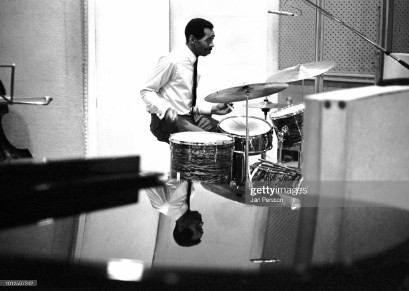
Showing posts with label philly joe jones. Show all posts

Tuesday, October 10, 2023

Philly Joe Jones - Live at Birdland - Fresh Sound FSR-CD 1139

 © Copyright ® Steven Cerra, copyright protected; all rights reserved.


“For most people the name of Philly Joe Jones immediately conjures up the classic Miles Davis Quintet/ Sextet of the mid-fifties, that oddly assorted collection of great individuals in which a driving, potentially overpowering rhythm-section was perfectly balanced against the musings of Miles and the still-searching Coltrane. To some people, it may bring to mind Miles's comment: "I wouldn't care if he (Philly Joe) came on the bandstand in his B.V.Ds, and with one arm, just so long as he was there." And I believe it was the late Wynton Kelly who said that, after Joe left the Davis group, his replacement Jimmy Cobb had to suffer Miles telling him repeatedly, in his typically tactful manner, "My favourite drummer is Philly Joe Jones."”

- Brian Priestley, insert notes to Philly Joe Jones: Mo’Joe [Black Lion BLCD760154]


Hi Steve,
Thanks for posting the Philly JJ CD. I hope your readers enjoy these recordings as much as I do. I have had these broadcast tapes from Boris Rose in my archive for over 30 years. I always thought that its quality was not enough to be released commercially. Finally, a few months ago I listened to them again, and I realized how important they were to better understand Philly JJ's career, and to be able to listen to him live, where he found the freedom as a drum master that he had not always achieved in the studio. Despite the shortcomings of the recordings, the result after an arduous restoration work, I think has been worth it, and the true fans of Philly Joe will be happy.
There were two possible options, save the recordings or share them, I chose the second.-You can include this text if you think it is appropriate
Best, Jordi

Radio broadcasts can be problematic and the ones from January 5, 1962 [there is some evidence to support the date of 1.5.1963], February 24, 1962, and March 3, 1962 that form the content for the newly-released Philly Joe Jones Sextet and Quintet Live at Birdland [Fresh Sound FSR-CD 1139] could serve as case studies for the pros and cons of using them as source materials for new, commercial recordings. [For order information go here.]


In this case, the plus side is the ability to hear the iconic drummer Philly Joe Jones at the height of his powers leading exciting small groups with his old running mate Elmo Hope on piano in a rhythm section was bassist Larry Ridley and a host of energetic newcomers to the Jazz scene including trumpeter Dizzy Reece, alto saxophonist Sonny Red, tenor saxophonists John Gilmore and Roland Alexander. The somewhat more experienced Bill Hardman assumes the trumpet chair on the February and March dates.


The downside is the less-than-desirable audio quality which requires some contending with but is worth the effort given the stimulating music produced at these in performance sessions.


In those days, it was unusual but not uncommon for drummers to head up small combos, witness Art Blakey’s Jazz Messengers and the various quartets and quintets led by drummer Max Roach. But these groups were permanent with fixed personnel and club and concert touring schedules whereas Philly Joe was so busy recording with everyone on the New York Jazz scene from c. 1955-1965 that he didn’t have time to head-up a regular group and market it to various venues in NYC and elsewhere in the country.


Unfortunately, too, due to the expense and the relative newness of the technology associated with them, on site recordings, although growing in number, were still relatively uncommon, especially for a pick-up band; one put together expressly for an engagement such as the bands that Philly JJ headed up at Birdland and which feature on this Fresh Sound recording.


Given the somewhat small discography with Philly JJ as leader, these Birdland-based radio broadcasts make a welcome addition to that catalog.


As a note in passing, although it’s listed as I Remember Clifford, Track Two is actually I Can’t Get Started. 


“PHILLY JOE JONES (1923-1985) carried his birthplace as part of his name throughout most of his jazz career in order to avoid confusion with the former Basie star drummer, Jo Jones, who was his first influence.


After performing alongside many of the top names in modern jazz, Joe started gaining widespread recognition for his contributions to Miles Davis's quintet and sextet during 1955-1958.


However, due to his forward-thinking concepts, Philly Joe may well be considered the most controversial drummer in jazz history. At first, Joe's fast-paced and busy intricacies seemed to defeat the ears of critics, but over time they began to recognize and value his approach. The amendment was given a boost, obviously, by Miles Davis's unstinting support.


Typical is Whitney Balliett's praise in an April 1959, New Yorker article, calling Philly "revolutionary," and "a master of silence, dynamics and surprise," and describing his solos as "careful, remarkably graduated structures, full of surprises, varied timbres and good old-fashioned emotion."


By 1962, having solidified his reputation, Philly Joe's foremost aspiration was to lead his own group in live shows whenever the opportunity presented itself.


This compilation unveils previously unreleased recordings from 1962, each capturing the essence of two live radio broadcasts held at New York's Birdland, hosted by the celebrated jazz disc jockey "Symphony Sid" Torin. Throughout these performances, Philly Joe seamlessly melded with a group of musicians who wholeheartedly entrusted their musical journey to his leadership. This synergy resulted in two solid gatherings, elevated by the strong solo contributions of the horn players, highlighted by several compelling solos by Elmo Hope, a piano player who left too few samples of his hard-bop chops, and enriched by Philly Joe's fiercely distinctive style as both a solo drummer and an exceptionally invigorating section player.


Philly Joe's intricate style reverberates through a whole generation of jazz drummers, leaving an indelible mark on their work.


PHILLY JOE JONES was born on July 15, 1923, in Philadelphia, Pennsylvania, and was the youngest of nine children born to Lewis and Amelia Jones. Sadly, Joe's father passed away when he was just about a year old. His mother had to take on work as a domestic to support the family, and amidst these circumstances, Joe's upbringing took shape.


Raised in a racially segregated black neighborhood, Joe's childhood was marked by the supportive care of his sister and brothers. Determined to overcome adversity, Joe found himself contributing to the family's income at a remarkably young age— working as a shoeshine boy, early testimony to his work ethic and resilience.


As he grew up, with the guidance of his mother, he embarked on piano lessons — a modest yet pivotal stride that formed the bedrock of his musical talent. The shift to drums marked a fundamental turning point, driven mainly by his own determination and initiative. His initial artistic leanings even took him to tap dancing before the drums emerged as his passion. "I started playing the drums when I was about nine years old," he reminisces, encapsulating the inception of a musical odyssey that would span his entire lifetime. Even though he underwent formal training for a period, he was primarily self-taught. His unique style came from absorbing the rhythms of other drummers during gatherings in his childhood.


His first drumming influence was his namesake. "Jo Jones was merely a heck of an influence on me when I was a kid. But my mind used to go past Jo Jones because at the same time, the Savoy was hollering, and Chick Webb was playing. Chick was the drummer I used to listen to. I'd be listening to these broadcasts, and my mother used to really holler at me because I kept the radio on all night! I memorized the tune, it's in my mind right now, I could hum the tune the way he played it. I used to listen to the drum solos that he played in between."


At the age of 17, Joe left Central High School, and voluntarily enlisted in the Army on February 24, 1941. Throughout the wartime period, he served as a military policeman until his discharge three years later. By the summer of 1944, back in Philadelphia, he became part of the Public Transportation Company, notably becoming the first black trolley driver in Philadelphia.


"When I completed my service," Joe explained, "I became a streetcar driver. During that time. I managed to save up and purchase my very first drum set. I took them down to the cellar where I lived and practiced relentlessly until I believed I was prepared to make my debut on the scene."


"I was still working on the streetcar during the day and playing drums at night," Joe reminisced. "Eventually, the club owner I worked for decided to offer us a gig for an entire year. After around six months there, I left my streetcar job behind. I decided to take the leap into a professional music career and stay in the music industry. I was earning a decent income at that point. I continued down that path until I grew weary of Philadelphia. I sensed I was ready for New York, so I packed my bags and made the move."


"I left Philadelphia in 1947 and came to New York to live because during and before those years. Max (Roach] and Art [Blakey] used to come to Philly, and I'd be working in the clubs when they came to town, and I idolized them. They used to say, 'Why don't you come to New York?'... I loved Max and Art, and I wanted to be with them, and I couldn't because I was in Philly, so I used to buy a train ticket. I used to commute from Philly to New York and go to Max's house on Monroe St. in Brooklyn."


"When I got to New York, I became a part of the Joe Morris rhythm and blues band alongside Johnny Griffin, Elmo Hope, and Percy Heath. It was an eight-piece ensemble. We toured extensively across the country, covering destinations from Key West to Maine, all the way to California. I remained with the band for around three or four years. During that period, Joe Morris enjoyed numerous chart-topping hits. Back then, having a number-one hit on the charts wasn't as common as it is today; however, Joe Morris had three or four hits simultaneously. He was making good money because he worked all the time," recounted Joe. Morris's hits, now largely forgotten, included rhythmic tunes called "Chop Chop" and "Punch & Judy."


After long stints on the road, Joe was part of the star-studded but short-lived Tadd Dameron orchestra of the early 1950s but was having difficulty reading the charts. "My reading ability was fairly good at that time, but it wasn't up to par like it should have been. I knew I was going to get a lot of heavy dates with some complex music involved, so I went to Cozy Cole and started studying. He really opened my eyes to my faults and showed me how to develop strength in my hands. He was very demanding . Primarily, he helped me improve my reading, and I've never had any problems with it since."


While Joe was taking lessons, he heard some of the biggest stars in the drumming world, like Dave Tough and his idol Sid Catlett. "I learned most of my brush work from him. Sid Catlett used to sit down and teach me the things I wanted to know. He was one of the most exquisite drummers of all time. I wanted to shape myself in that way and be capable of performing in trios, bands, and small groups."


Around this time, Joe's drug addiction began to consume his life. Tenor saxophonist Jimmy Heath, his roommate and closest friend in New York, remembered Joe's apartment as a place where addicted musicians gathered. "Miles (Davis], [Sonny] Rollins, and everyone else who had been playing was coming to Philly Joe's. We were all in a tight-knit group." During these early 'junkie years,' Joe became the drummer for New York's Café Society. In this capacity, he performed with bebop greats like Charlie Parker and Dizzy Gillespie. He also played a few gigs at the Down Beat Club in 1952, providing him with the chance to perform alongside Miles Davis, Lee Konitz, and Zoot Sims for the first time.


Joe also spent a significant portion of 1953 working as a member of Tadd Dameron's groups. Despite Joe's often disruptive reputation as a drug addict, his positive reputation as a drummer was also growing rapidly. The year 1953 would prove to be pivotal, as he finally ascended to the highest echelons of the jazz community. On January 30, 1953, at WOR Studios in NYC, he took part in his first recording for Prestige. This recording date featured luminaries such as Charlie Parker on saxophone. Miles Davis on trumpet, Walter Bishop Jr. on piano, and Jimmy's brother Percy Heath on bass.


The group would record three compositions that day, and those recordings would become legendary: "Compulsion," "Serpent's Tooth," and "Round Midnight."


Regarding the recording titled "Serpent's Tooth," author Jack Chambers states, ".. .the bop melody played over a medium tempo offers lots of opportunity for assertive drumming. Jones punctuates the phrases of the melody and the solos with resounding accents and yet somehow manages to remain integral and unobtrusive as well. He shows a rare combination of aggression and sensitivity." The recordings from this session would later be released under Miles Davis's name on an album called Collector's Items.


Joe now found himself working consistently with the likes of Tony Scott Quartet at Minton's and the Kai Winding Septet at Birdland, He began using "Philly" as part of his name, an emblem of his growing stature. Clarinetist Tony Scott advocated personally to Duke Ellington that Philly Joe Jones would be an outstanding choice to succeed Louie Bellson, who left the band in February 1953. Scott remembered an audition for the drummer took place at the Bandbox club in New York: "Joe came in on a Tuesday and auditioned. All the older cats in the band, like Harry Carney, Russell Procope, and Hilton Jefferson, turned around and looked at him. Joe played the hell out of the Ellington things and was really swinging. He was hired to come in on Thursday, but he didn't show. He'd gone home to Philadelphia and was arrested. The police were wrong. It was a false arrest, a mistaken identity thing. But Joe was in jail for a couple of days and couldn't make the gig. When he came back to New York, it was too late."


About that same period, Joe recounted, "I participated in an album alongside Lou Donaldson. Clifford Brown, Percy Heath, and Elmo Hope. That project truly kick-started my career in the recording industry. Following that, I began receiving numerous offers for recording sessions." This marked a significant milestone for Joe as it was his debut recording for Blue Note Records. Just nine days later, Joe contributed to Elmo Hope's trio recording for the label, with bassist Percy Heath.


In 1954, Joe embarked on a tour with Tadd Dameron's band during the early part of the year. Upon returning to New York, he reconnected with his friend Miles Davis, who was also dealing with addiction. Following this reunion, Miles started involving Joe in all of his performances. Joe remarked. "Miles Davis was the only band I ever left New York to go on the road with." Throughout that year, Joe refrained from recording due to his struggles with drug problems.


In 1955, Joe's musical journey took him on various paths. He played and recorded with the Ray Bryant Trio, the Art Farmer Quintet, and the Howard McGhee Quintet. Soon after, he became a pivotal part of the first Miles Davis Quintet, alongside John Coltrane, Red Garland, and Paul Chambers. Their collaborative journey began with their debut recording on October 27,1955.


In 1956, alongside his tours with Miles, Joe found himself immersed in recording sessions. He collaborated with the Paul Chambers Quartet, which included John Coltrane, Additionally, he contributed to recordings with Serge Chaloff, Bennie Green, Elmo Hope, Red Garland, Sonny Rollins, Phil Woods, Jackie McLean, Kenny Drew, Phineas Newborn, Lee Morgan, and Tadd Dameron, as well as with Miles's quintet. From then on, he maintained a continuous and intense relationship with recording studios, becoming increasingly sought after for his distinctive drumming style.


In January 1957, the Miles quintet set off for California, kicking off a series of performances from January 4 to 17 at the Jazz City club in Hollywood.

Following these Jazz City concerts, Philly Joe immediately participated in three recording sessions in Los Angeles during January 1957. The first session was with alto saxophonist Art Pepper, with his regular rhythm partners Red Garland on piano and Paul Chambers on bass. This collaboration resulted in the album Art Pepper Meets the Rhythm Section, a title that underscored the formidable reputation Miles's rhythm section had earned among musicians.


The second session involved French horn player John Graas, and the third was led by Paul Chambers. These sessions also featured renowned West Coast musicians including Bill Perkins, Jack Montrose, and Paul Moer. For the third session, Joe covered for drummer Mel Lewis, who was unable to participate on the second recording day. Following these recordings, the quintet headed to San Francisco, where they opened at the Black Hawk on the 22nd for a week.


Having collaborated with a myriad of iconic figures in modern jazz between 1957 and 1960 — including Clark Terry, Herbie Mann, Hank Mobley, John Coltrane, Sonny Rollins, Lee Morgan, Ernie Henry, Sonny Clark, Kenny Drew, Red Rodney, Warne Marsh, Wynton Kelly, Johnny Griffin, Thelonious Monk, Jimmy Smith, Red Garland, Bud Powell, Cannonball Adderley, Blue Mitchell, Chet Baker, Art Blakey, Benny Golson, Bill Evans, Kenny Dorham, Paul Chambers, Art Farmer, Freddie Hubbard, as well as the Miles Davis Quintet and Sextet, and his own groups — Philly Joe enjoyed widespread recognition. His contributions graced nearly a hundred albums between 1955 and 1960. making him arguably the most recorded American drummer across genres during that era. This rich musical tapestry ultimately led to his well-deserved worldwide acclaim.


Initially, Joe's fast-paced and intricate style intrigued his fellow musicians but still seemed to perplex the critics' ears. Nevertheless, as time passed, even the critics began to recognize and value his approach. The change can be seen in the acclaim from Whitney Balliett in an April 1959 article in The New Yorker, where he hails Philly as "revolutionary "and "a master of silence, dynamics, and surprise." Balliett goes on to characterize Joe's solos as "meticulously crafted compositions, filled with unexpected turns, varied tones, and sincere, heartfelt emotion.


Amid this evolving perception, Philly Joe reflects, "The most incredible experience of my life was with Miles, no doubt about it... I can never deny that - the most incredible experience of my life aside from the few times I collaborated with Charlie, meaning Charlie Parker. Working with Miles energized me because I knew that he gained all his insights from Charlie."


In 1960, as the dynamics of his musical journey continued to unfold, Philly Joe pointed out, "In Miles' group, he wouldn't allow me to play almost anything I felt like playing. He used to keep a tight rein on me. When I was with Miles, I was a sideman, and there were limitations to what I could do. He would guide me to play certain things and restrict me. preventing me from progressing. I believe that a drummer should be able to experiment on stage without disrupting the rhythm or bothering others; it's beneficial and helps you grow. However, Miles wouldn't let me experiment too freely because he thought it would interfere with the flow. In my own band, I have the freedom to experiment as I see fit, because it's my group! With my own band, I feel more liberated. If I sense something, I can delve into it. There were times with Miles when I had ideas that could have been quite spectacular, but I held back because I was afraid he would reprimand me."


Leonard Feather remarked about Philly Joe in March 1962 in Down Beat: "He might very well be the most controversial drummer in the history of jazz. During his tenure with Miles Davis last October at the Renaissance in Hollywood, I heard him praised more highly (for his extraordinary rhythmic complexity and unique solo and section work) and denounced more vehemently (for allegedly overpowering the rhythm section and the rest of the sextet!) than any other percussionist currently playing."


Despite occasional remarks concerning his volume or taste, not a single listener ever cast doubt upon his skill and technique. Philly Joe wasn't solely a brilliant drummer, but also a fairly proficient pianist (owing to early childhood lessons from his mother), a skilled composer, and an ardent student of the lineage of jazz percussion.


Philly emerged as a leading figure among the drummers who championed a role extending beyond mere timekeeping. The influence of his intricate style resonated across the endeavors of an entire generation of budding drummers, leaving an enduring imprint on their work.


While he indeed proved to be an imposing force when the tempo surged, Joe also demonstrated a considerably broader range of dynamics and nuances than those attributing him the label of a 'machine gunner' might imply. He stood as the foremost driving force behind a horn soloist ever to be heard. His style carries a truly distinctive power, and in his role as a drum soloist, he showcased a striking degree of originality. A genuine master of polyrhythms. he effortlessly hinted at and melded with the fundamental underlying rhythmic foundation. This ability to combine power and musicality was something Joe himself acknowledged: "Drums can be loud AND musical. I notice the public will accept them that way," he said. "But if a drummer is loud and NOT musical, he won't be accepted."

Expounding on his views, Joe believed, "Tricks are all right in their place. It looks very good with those sticks being twirled in your hands, but you should keep on the drums. You're supposed to be playing the drums and drums can be played with the bass drum, snare drum and ONE cymbal. I don't like to resort to tricks," he adds. "I try to do some things with the cymbal, but I want to do them in rhythm. It's a trick, but you hear it. I think you can do anything that has showmanship toil as long as you let the people hear it and don't play pantomime drums! Twirl the sticks and that's a trick you don't hear it!"


By 1962, Joe had firmly established himself as a leading figure in the world of jazz, attaining the coveted "star" status conferred by Miles Davis. Joe now enjoyed the liberating ability to select his performances and personnel on recordings, devoid of financial pressures. At the forefront of his aspirations was the ambition to lead his own group in live shows whenever the opportunity presented itself.


This compilation unveils previously unreleased recordings from 1962, each capturing the essence of two live radio broadcasts held at the renowned Birdland Club. These broadcasts were graciously presented by the celebrated jazz disc jockey "Symphony Sid." Throughout these performances, Philly Joe seamlessly melded with a group of musicians who wholeheartedly entrusted their musical journey to his leadership. This synergy resulted in two solid gatherings, elevated by Joe's fiercely distinctive style as both a solo drummer and an exceptionally invigorating section player.


Significantly, these performances highlight the presence of Joe's longtime friend, Elmo Hope, on the piano, with his dynamic mastery resonating through every note. On the tenor sax, John Gilmore's contribution within the first ensemble stands out; he masterfully balanced robust feeling with gentle subtlety, occasionally igniting moments of intense, almost blistering fervor. Trumpeters Dizzy Reece and Bill Hardman infused the performances with passion and fire, delivering notable solo work that ranges from good to excellent. Altoist Sonny Red's playing resonates with captivating emotion, consistently intriguing the listener. The full-toned tenor player Roland Alexander effortlessly swings and maintains continuity across medium and fast tempos. In company with Philly Joe, bassist Larry Ridley's ingenious work significantly enriches the overall potency of these performances.


While the sound quality of these historic recordings may not reach optimal standards, the depth of the music and the energy with which it was performed showcase the unwavering unity that Philly Joe sought to cultivate within his ensembles.


Philly Joe was among the American jazz musicians who explored opportunities in Europe. From late 1967 to 1972, he resided in London and Paris, engaging in performances and recordings alongside musicians like Archie Shepp, Mai Waldron, and Hank Mobley. Between 1967 and 1969, he also taught at a specialized school in Hampstead, London, although the Musicians' Union prevented him from further work in the UK. His 1968 album. Mo'Joe, also known as Trailways Express, was recorded in London with local musicians including Peter King, Harold McNair, Mike Pyne, Kenny Wheeler, and others.


Subsequently, Jones embarked on tours with Bill Evans in 1976 and 1978, leaving a resonating imprint in their musical collaborations. His presence also graced Galaxy recordings between 1977 and 1979, and he engaged in fruitful collaborations with Red Garland, showcasing his versatility.


In a pivotal turn in 1981, he became a driving force behind the inception of the Dameronia group, a musical collective passionately devoted to the compositions of Tadd Dameron. Jones nurtured and led the ensemble, infusing it with his distinctive rhythm and musical vision. Tragically, Jones' life was cut short on August 30, 1985, when he succumbed to a heart attack at 62, leaving a void in the world of jazz that continues to be felt.”

Notes compiled by Jordi Pujol.


Recordings captured from two different radio broadcasts live at Birdland.

hosted by jazz disc jockey 'Symphony Sid' Torin. Produced for CD release by Jordi Pujol This compilation © & <E> 2023 by Fresh Sound Records.


The song on this video is actually I Can't Started.


Saturday, November 26, 2022

Philly Joe Jones (1980) by Larry Kart

 © Copyright ® Steven Cerra, copyright protected; all rights reserved.


“Philly Joe Jones, a leading modern-jazz drummer, died of a heart attack Friday, August 30, 1985 at his home in Philadelphia. He was 62 years old.

Mr. Jones was a hard-hitting drummer who gave a spacious sense of swing to his ensembles. His combination of deep-toned tom-tom and bass drums with subtle swirls of cross-rhythm on cymbals was widely imitated. He was a member of the trumpeter Miles Davis's influential mid-1950's quintet, with the bassist Paul Chambers, the pianist Red Garland and the saxophonist John Coltrane.


Joseph Rudolph Jones adopted the name Philly Joe to distinguish him from the pioneering jazz drummer Jo Jones.” 

Jon Pareles, 9.3. 1985  NY Times Obit


“Born Joseph Rudolph Jones, Philly Joe Jones was an exciting, explosive drummer and his influence on modern jazz is legendary.


Considered a superb timekeeper, Philly Joe Jones’ techniques are studied by jazz students throughout the world. Whether his influence was through subtle technique or hard-driving aggression, Philly Joe was versatile, often playing on a minimal drum kit, and adapting his drumming style to create many moods and sounds. His contribution to some of the most important jazz recordings in history elevated the role of drumming in modern jazz and changed the course of jazz music forever.”

- Philadelphia Music Alliance, Walk-of-Fame


W. A. Brower: [“Following a demonstration on the drum set} - That last segment of the drum solo you just played - after the cymbal potion - seemed to flow out of the creative use of rudiments [there are 26 major drum exercises that fall under this classification]. Is this something you got out of studying with Cozy Cole, that real strong rudiments foundation that allows you to branch off like that.


Philly J.J.: “Yeah, that’s Cole’s idea of how you should be a rudimental drummer - they help you in developing your hands. It’ll help you develop your mind, too - as long as you know all the rudiments. Like I said earlier, it’s like a bag of tricks that you can reach into when you need them.” So if it’s something I want to say, I can use the rudiments to say it. Most drummers who don’t know anything about rudiments have a hard time saying what they want to say. It’s just a conversation. Most of the great drummers are rudimental drummers, you know. All the great ones I know went through the rudiments. That don’t mean you have to sound like a boy scout when you play them. And you can make them sound - I can make them do anything I want to.”

- W. A. Brower, June 10, 1985 interview with Philly Joe Jones, Howard University Oral History Project; transcript of audio track of a video tape recorded in the studios of WHMM-TV on the campus of Howard University 


“This thesis explores the life of drummer “Philly” Joseph Rudolf Jones, one of jazz’s most renowned, unknown figures. As the drummer for the Miles Davis Quintet/Sextet and a later incarnation of the Bill Evans Trio, Joe achieved worldwide fame and success. Yet, his life story has always been told in the footnotes of the towering figures he performed with: John Coltrane, Bud Powell, Charlie Parker, Thelonious Monk, etc. Jazz history books recognize Joe’s contributions and nearly all provide a space, albeit a small one, to recognize his accomplishments.” 

- Dustin E. Mallory, Jonesin’: The Life and Music of Phily Joe Jones, Rutgers University Graduate School, May 2013, Thesis Director, Dr. Lewis Porter. Here’s a link to the entire thesis.


By way of introduction, Philly Joe Jones was one of the greatest of the hard boppers. His contributions to the art of jazz drumming are immeasurable. He was a virtuoso with a pair of brushes, and a genius at turning the rudiments into fluent musical ideas. 


More than any of his peers, it was Philly Joe’s time feel that defined the idea of swing in the 1950s. In retrospect, he would prove to be the strongest link in the chain between Max Roach, Art Blakey, and Roy Haynes, and the Elvin Jones/Tony Williams school that was soon to emerge.


The editorial staff at JazzProfiles has previously written extensively about Philly in some of the earliest feature for the blog dating back to 2008 and you can find them via these links: The Wonder of Philly Joe Jones, Part 1 and The Wonder of Philly Joe Jones, Part 2.


In the coming weeks, we plan to bring up additional feature about Philly Joe Jones on these pages to build the archive links so as to create a centralized point of  information about this outstanding musician.


In this regard, the following  essay on Philly JJ  can be found in Larry’s Jazz in Search of Itself [New Haven: Yale University Press, 2004]. We asked Larry for his consent to post it to the blog and he very kindly said “Yes.”


At its conclusion you’ll find some YouTubes with audio tracks that exemplify Philly Joe Jones’ unique style of Jazz drumming.


© -  Larry Kart: copyright protected; all rights reserved; used with the author’s permission.


“THERE are drummers who have had a greater influence on the course of modern jazz — Max Roach, Elvin Jones, and Tony Williams come to mind. And there are others who have more successfully parlayed their skills into commercial gain. But, from the first moment I heard him, back in 1955 with Miles Davis, no drummer has given me greater pleasure than Philly Joe Jones.


For one thing, Jones has the rare distinction of having invented a new concept of swing — one that may seem to have been superseded by later developments but one that is, in fact, as timelessly beautiful as the concept of time laid down by jazz's first great percussionist. Baby Dodds. Until Jones came along, jazz rhythm had become increasingly fluid, achieving in the cymbal-oriented work of Roach and Kenny Clarke a remarkable gliding ease. But Jones disrupted that evolution by switching the emphasis back to his snare drum, which chattered away like a machine gun, creating a stiff-legged, irresistibly compulsive drive that, as Miles Davis once said, "could make a dead man walk."


A fairly high volume level usually went along with that style, which obscured one of Jones's key virtues — the remarkable delicacy and precision of his playing. Listening to him is like watching someone weave lace out of barbed wire, as every accent, no matter how angular or explosive, becomes part of an exquisitely balanced design. In that sense Jones resembles a great dancer more than he does other drummers, and the ways in which he introduces the maximum amount of rhythmic obliqueness while still retaining his cool make him one of the most intriguingly graceful jazz percussionists. His left hand — the one controlling the stick that attacks the snare drum — is a study in itself, as it opens and closes, loosens and tightens with the rapidity of a snake's tongue. And often that always functional litheness will

ripple through his entire body, leaving him frozen for an instant in a pose Fred Astaire would have admired.


But of course it is the sounds Jones produces that matter most, and here he is unique, too. The tonal range he gets out of his kit is unusually compact when compared, for example, to Roach's tympanilike spectrum of timbres, and he seems to be constantly striving for a "back-to-basics" effect. It's a dry, all-rhythm approach to drumming that could support a jazz soloist of any era, and it certainly suits the band (tenorman Charles Bowen, pianist Sid Simmons, and bassist Andy McGee) that Jones is leading now. And even though neither Bowen nor Simmons is in the same class as the men Jones once played behind (John Coltrane, Sonny Rollins, and Bud Powell, to name a few), their relative ordinariness is not disturbing because it allows one to concentrate that much more on the masterly patterns of a masterly drummer.


Philly Joe Jones died in 1985.”


Monday, November 14, 2022

Wynton Kelly: 1931-1971 - Revisiting “A Pure Spirit” [From the Archives]

 © -Steven Cerra, copyright protected; all rights reserved.


“Wynton’s situation … is worth noting as a startling example of the strange irrelevance of merit to fame in Jazz.”
- Orrin Keepnews, Jazz Producer and Writer

“Nothing about his playing seems calculated .. there was just pure joy shining through his conception.”
Bill Evans, Jazz Pianist

Amazingly, given his background, Wynton Kelly is an often overlooked figure in modern Jazz circles.

One would think that a pianist who had worked with Lester Young, Charles Mingus, Dizzy Gillespie’s 1950s big band, Dinah Washington, Miles Davis and Wes Montgomery, let alone with his own trio made-up of Paul Chambers on bass and Jimmy Cobb on drums, would be more widely known and respected.

But such is not the case for Kelly who is sometimes more acknowledged because he has a first name in common with the phenomenal trumpet player and leader of the Lincoln Center Jazz Orchestra – Wynton Marsalis – whose father, Jazz pianist Ellis Marsalis, named him after Kelly.

The editorial staff thought it might be fun to spend some time developing a JazzProfiles feature about Wynton, Kelly that is, as a way of paying tribute to his memory.

In the liner notes that he wrote for Kelly at Midnight, one of the earliest album’s that Wynton made under his own name [VeeJay VJ-03], Nat Hentoff commented:

“Miles Davis was being asked one afternoon for a verbal analysis of Wynton Kelly's musical worth. Miles character­istically scoffed at using such imprecise tools as words to describe what happens in jazz; but finally he said: ‘Wynton's the light for a cigarette. He lights the fire and he keeps it going. Without him there's no smoking.’

Another judicious tribute came from Cannonball Adderley who had worked with Wynton in the Miles Davis band. ‘He's a fine soloist, who does both the subdued things and the swingers very well. Wynton is also the world's great­est accompanist for a soloist. He plays with the soloist all the time, with the chords you choose. He even anticipates your direction.’

Somewhat earlier, I'd been talking to King Curtis, a Texan now in New York and a specialist in rhythm and blues. ‘Wynton worked with me for a while, and naturally I've heard him with Dinah and with Miles. What struck me was that wherever Wynton worked, he fitted in. He's not limited to one kind of playing. With Dinah, he had the taste and supportive power of a superior accompanist. With me, he had the fire and the straightaway swinging my bands have to have. And with Miles, he can be as subtle as Miles requires.’

As is usually the case, Wynton was being discussed enthusiastically by musicians before there was much atten­tion paid him in the public prints. …”


And in another of Wynton’s VeeJay LP’s, Kelly Great [VeeJay VJ-06], Julian “Cannonball” Adderley, the great alto saxophonist and, as noted previously, Wynton’s bandmate in the Davis group, said this about Kelly:

“When Sid McCoy of VeeJay Records asked Frank Strozier (phenomenal young alto saxophonist) who did he wish to play piano on his VeeJay record date, Frank immediately said Wynton Kelly. So answered Bill Henderson and Paul Chambers. It is next to impossible to evaluate the role played by Wynton Kelly in a band, for he has a ‘take charge’ quality in a rhythm section such as a Phil Rizzuto or Eddie Stanky had on a baseball team.

Many jazz listeners are unaware that such intangible qualities as fire and spirit make the margin between greatness and ‘just good’. Leading jazz musicians, such as Dizzy Gillespie and Miles Davis (Wynton's current employer), are cognizant of this fact. A short time ago Miles Davis made an album using another pianist, who at that time was a member of his band, but added Wynton for one selection, explaining, ‘Wynton Kelly is the only pianist who could make that tune get off the ground.’

What does Wynton have that is so different?”

Perhaps the difference lies in what Richard Cook and Brian Morton have described in The Penguin Guide to Jazz on CD, 6th Ed.  as “… his lyrical simplicity or uncomplicated touch… [or] the dynamic bounce to his chording …,” or because, as Cannonball Adderley, asserted: “Wynton combined the strength of pianists Red Garland and Bill Evans, his predecessors with Miles Davis.”

Or maybe this difference lies in the following description of Wynton’s playing by fellow pianist Bill Evans as quoted in Jack Chambers, Milestones:

“When I first him in Dizzy’s big band [in the mid-1950s], his whole thing was so joyful and exuberant, nothing about it seemed calculated. And yet with the clarity of the way he played, you knew that he had put this together in a carefully planned way – but the result was completely without calculation, there was just pure spirit shining through the conception.”


Like Bill, Brian Priestley may have also identified the essence of what made Wynton Kelly so unique as a pianist in the following description of his style in Jazz, The Rough Guide: An Essential Companion to Artists and Albums:

“An important stylist, but largely unrecognized except by fellow pianists, Kelly’s mature style was hinted at in his earliest recordings. He combined boppish lines and blues interpolations with a taut sense of timing quite unlike anyone else except his imitators. The same quality made his equally individual block chording into a particularly dynamic and driving accompanying style that was savored by the many soloists that he backed.”

More about Kelly’s special qualities as a pianist can be found in the following paraphrase from Peter Pettinger’s biography of pianist Bill Evans – How My Heart Sings:

“Evans held Kelly’s bright and sparkling style in high regard since hearing him in Dizzy Gillespie’s big band, responding to Wynton’s particular blend of clarity and exuberance. This reaction was typical of Evans’s appreciation of the work of his fellow pianists; from Oscar Peterson to Cecil Taylor, he was full of admiration for their diverse talents and generous in his praise.”

As detailed in Groovin’ High,  Alyn Shipton’s life of trumpeter Dizzy Gillespie, the unique character of Kelly’s piano style may have been the result of combining years of experience in playing in rhythm and blues bands with a fine Jazz sensibility.

Of his work with his own trio, John A. Tynan had this to say in a Down Beat review:

“It is one of the most cohesive and inventive rhythmic groups in small-band Jazz today.”

Musicians commenting about Wynton’s work on their recordings state: “The presence of Kelly may account for the difference …,” “… the album would not have been excellent without Wynton Kelly’s sterling support,” and “… he is disarmingly pleasant to work with, the very model of a mainstream pianist.”

The Jazz writer and critic, Barbara J. Gardiner closed her insert notes to the 1961 VeeJay 2-CD compilation Wynton Kelly! [VeeJazz-011] with the declaration that “You would expect Wynton Kelly to be comprehensive as well as creative. Hasn’t he always been?”

Although she was referring to the material on these CDs “… tried and proven, mixed in with a bit of the fresh …,” this could also serve as an apt way of describing Wynton’s approach to Jazz piano: wide-ranging and inventive.

One is never far away from the Jazz tradition when listening to Wynton Kelly, but what he plays is himself; he has incorporated his influences into his own musical “personality” and recognizably so. Four [4] bars and you know its him.

Wynton is not a pianist who overwhelms the listener with startling technique or originality of conception.

But what he does offer is playing that is full of joy, funk and a feeling for time that fills the heart with happiness, sets the feet tapping and get the fingers popping the beat.

Wynton Kelly is the pianistic personification of swing, or if you prefer: “smokin’,” “cookin’” or “boppin’.” 

When Wynton plays Jazz piano, you feel it.

Nothing cerebral here in any deep or complicated sense, just – “Clap hands, here comes, Wynton.”

Hear it for yourself in the following tribute to Wynton that features him along with Paul Chambers on bass and Philly Joe Jones. The tune is Winston's original Temperance from Kelly at Midnight [VeeJay-03] .


Friday, November 13, 2020

Elvin Jones and Philly Joe Jones by Bobby Jaspar

© -Steven Cerra, copyright protected; all rights reserved.


“We know that the creative daring of Kenny Clarke originated an evolution in rhythmic concepts in jazz. This process, starting at the beginning of the war, was carried on by the contribution of great drummers like Max Roach and Art Blakey. However, during the past few years, it seemed that the reaction in rhythmic ideas that came with the "cool school had led to a rejection of some of the most exciting innovations of these men. I can now say, after my trip to the United States, that this view is not justified.

The "Basie tradition", modified by innovations of the "bop" movement, apparently holds the central place in contemporary jazz; several important drummers, like Chico Hamilton and Connie Kay, remain faithful to classical ideas based on symmetry. At the same time other drummers have appeared who are carrying on the evolution where their predecessors stopped. Two young drummers particularly impressed me when I heard them in person (their records of the past few years have shown their real worth only in a very imperfect way, especially the boldness of their conception).

They are Philly Joe Jones and Elvin Jones. Though they have the same last name, the two musicians are not related: Philly Joe, as his name implies, comes from Philadelphia; Elvin is the younger brother of Hank and Thad Jones. Bobby Jaspar who played with both, in groups led by Miles Davis and Jay Jay Johnson, gives us here his thoughts on the importance of their contributions…..”
- Andre Hodeir, a musician composer and author who in 1954 founded and became the director of Jazz Groupe de Paris of which Bobby Jaspar was a member.

Tenor saxophonist and flutist Bobby Jaspar [1926-1963] was born in Liege, Belgium. Jaspar made his name in Paris in the 1950s, and he moved to the USA when he married vocalist Blossom Dearie. His most famous associations were with a quintet he co-led with trombonist J.J. Johnson and a brief spell in Miles Davis’ group in 1957. He died in 1963 following complications from heart surgery.

While some of his discography has been reissued on CD, unfortunately Bobby has become a largely forgotten figure.

This article was reprinted from JazzHot by permission of Charles Delaunay, the directing editor of the magazine, in The Jazz Review, Vol. 2, No. 2, February, 1958.

It is unusual from a number of perspectives, not the least of which was Jaspar’s early recognition of how Elvin Jones and Philly Joe Jones continued and yet changed the direction of modern Jazz drumming from the way it was played by Kenny Clarke, Max Roach and Art Blakey.

I find it especially interesting to consider Bobby’s remarks about Elvin Jones’ playing considering that Elvin’s tenure with John Coltrane’s iconic quartet was still about four years in the future at the time of this writing in 1958.

The article is also somewhat unique in that one does not often encounter pieces written by hornmen describing in detail what it feels like to play in front of a particular drummer.

For example, many observers noted that Philly Joe Jones played too loud and too busily when he was a member of Miles’ quintet in the mid 1950’s prompting Davis to remark: “I like his fire.” Not particularly loquacious, but I guess one could say, descriptive to a point.

Fortunately for those who prefer to dig a little deeper, Bobby does set forth many interesting observations in the following essay on Elvin and Philly.


“Years ago, I wrote an enthusiastic letter to a friend about a drummer, John Ward, an emulator of Kenny Clarke and Max Roach, who particularly impressed me then. After trying to describe his playing unsuccessfully I resorted to a little drawing. The drawing showed a little car moving straight along at a constant speed, symbolizing the constant tempo, and mounted on top of this car, a smaller car that rolled back and forth. The movements of the second car represent a secondary rhythm superimposed on the basic beat represented by the motion of the first car. I now return to this drawing to describe the playing' of the two drummers who recently have impressed me the most: Elvin Jones and Philly Joe Jones. The first time I played with Elvin Jones I found it hard to understand what he was doing. He played so many strange overlapping rhythms that I found it hard to hear the basic tempo. I thought that he was in poor form, and just couldn't keep time. A talk with the bass player reinforced my opinion, for he told me that he had the greatest difficulty in playing with Elvin too. (That was during the earliest days of the J. J. Johnson quintet.) Then, little by little, I began to understand the mysteries of Elvin's playing, so different from the metronomic ideas of Frank Isola and his school, and of other drummers I knew and understood. Then the drawing of the two little cars, which I had forgotten, came back to mind.

I came to the conclusion that what Elvin was doing was really the continuation and development of the principles that Kenny Clarke and Max Roach had pioneered. Since then, working with him every day, I have had the chance to learn to appreciate Elvin. I have never tired of his complex and highly stimulating playing. The basic tempo is there once and for all; it never varies throughout a performance (obviously this should always be so ; but sometimes it seems to disappear almost completely.) There is the basic metronomic pulse which each musician must register sub-consciously (symbolized by the constant speed of the larger car). Over this beat is grafted a series of rhythms so complex that they are almost impossible for me to write out. These rhythms (like the movements of the smaller car) create a sort of secondary or tertiary tempo. At times, playing with Philly or Elvin Jones, the whole band seems to be speeding up or slowing down in an astonishing way, when actually this is not so, since the basic tempo hasn't changed at all. While playing with J. J. Johnson's quintet, Elvin, Wilbur Little, and Tommy Flanagan were able to develop a collective feeling for rhythm and for section playing. It was marvelous to hear them accompanying a slow blues, for example.


At a certain point (in the second or third chorus of a solo) they will double the time in a very gradual and subtle way. (See musical example.) At the double tempo, the bassist plays a line of triplets mixed with notes played on the beat, the pianist plays off-beat chords, and the drummer plays a series of fast triplets and semiquavers on the ride cymbal: the polyrhythm of the three instruments implies the basic tempo of the blues, doubled but creates enormous excitement and allows the soloist great freedom in improvising. After a roll on the snare, the band goes back to the original tempo, having reached an indescribable pitch of excitement. Elvin Jones uses triplets freely, but he seldom uses the high-hat to mark a regular or symmetrical beat. The accent on the weak beat often disappears entirely, to be replaced by complicated cross-rhythms on the ride cymbal reinforced by the familiar snare drum accents of modern drumming. I must especially emphasize the absence of the afterbeat accent on the high-hat. When one is not used to its absence, one feels a sensation of freedom, as though floating in a void with no point of reference.

Actually this kind of freedom is a trademark of the greatest jazzmen. Charlie Parker carried this kind of floating on top of the time the farthest, I think"; and the great soloists at their best moments seem completely free of the alternation of "strong-weak, strong-weak" that some people mistakenly call swing. At up tempo Elvin follows the same methods. At up tempos though, whether through intention or through flaws of technique, Elvin sometimes creates a rhythmic climate that cannot be sustained (at least when he drowns out the bass in volume).

From that point of view, Philly Joe seems to be the better drummer of this school. I know of few soloists in New York who can improvise freely in front of Elvin at up tempo without falling off the stand. I suppose that Elvin will simplify his style in the end, but apparently he is still discovering new possibilities every day and looking toward wider horizons. This concept of drumming, as I said, comes directly from Kenny Clarke, Max Roach, and Art Blakey. Elvin Jones and Philly Joe Jones seem to me worthy successors in the tradition. Upon the innovations of their predecessors they have elaborated this kind of polyrhythm to a sometimes unbelievable degree.

Their playing is only now beginning to win the recognition it deserves among musicians in New York. This previous lack of enthusiasm is not hard to understand. It's much easier for a soloist to be backed by a comfortable metronome who hammers the tempo into your head and gives you constant sign-posts! Few musicians of the Basie-Lester school can get used to such complicated rhythms.

Stan Getz has become fascinated by Elvin's playing, though, and it has been a revelation for me to hear these two musicians playing together. Getz has spoken appreciatively of this school of drumming, but he has had trouble finding a bass player strong and steady enough to hold his place in the fierceness of Elvin's attack. At fast tempos Getz sometimes has to stop playing for awhile and listen to the temporary confusion of the rhythm section. I have often had the same trouble with Elvin: the tension would build to a point where I had trouble finishing my choruses; I would begin trembling with internal excitement, but completely unable to tell where we were any longer . . . That is obviously a situation to be avoided .

But I am sure that Elvin will eventually master this lack of precision which is luckily caused by nothing more serious than over-enthusiasm. We often forget that syncopation is the essence of jazz rhythm. The famous phrase "syncopated rhythm" has become a cliche we laugh at. There was a time in Paris when we tried to play as exactly on the beat as we could. We then believed that swing could be achieved by placing notes with mathematical accuracy, by steady time, and strong pulsation with heavily accented afterbeats. How could we have been misled by such foolishness? I have found the same misconceptions in some lifeless bands in New York, where the least rhythmic freedom raises the eyebrows of the musicians. They have the expression of a clerk who finds his ink-stand out of place one morning.

The idea of tempo should be a more general one, an idea that each player should have firmly once and for all at the beginning of a performance. The rhythm will have changed often and in many ways. Elvin will deliberately put himself into the most dangerous situation for a soloist—where he must find a way out by increasingly risky and always spontaneous improvising. Apparently, to do that, one needs perfect time, a sort of internal metronome in the "hypothalamus". American musicians have an expression for this; they say "He always knows where one is." Elvin Jones has a very powerful style, based on complete independence of all four limbs and an enormous volume of sound (probably the biggest sound of any drummer I know, which doesn't make him any easier to play with!) His cymbal sound is especially individual. He is very interested in African music. He knows that's the source of polyrhythms, and constantly listens to recordings of African tribal music. (After all, didn't Blakey take a trip to the Congo and come back raving about his exciting musical experiences?) Philly Joe Jones is Elvin's spiritual father in some ways. I have talked more of Elvin because I know his work better. Elvin still has some distance to go to match Philly Joe's mastery, but I am sure we have some happy surprises in store for us.

We often speak of jazz as "an artistic expression of a racial emancipation." I am not qualified to discuss such problems, though I face them every day; but it is certainly true that jazz is the most original art-form to have come out of the United States. That is not to say that we have no right to create an original and valid form of jazz in Europe, but it does seem to me that jazz is a protest, a relentless revolution. The moment that jazz is played without some sort of sense of liberation, it loses all meaning. This tradition of liberation, of revolt against the symmetry of the tempo in this case, I have found to the highest degree in Elvin Jones and Philly Joe Jones.”