Showing posts with label bill perkins. Show all posts

Saturday, July 5, 2025

Bill Perkins - The Gordon Jack Interview [With Revisions and Additions]

 Copyright ® Steven Cerra, copyright protected; all rights reserved.


"Nobody could have been luckier" than to play with Herman and Kenton, Perkins told the Los Angeles Times."Though they were both very different, they were both forward-looking and never told you how to play. Stan especially gave me a “feeling of worth" -- a sense that "being a jazz musician was something of great value."
- Bill Perkins to Leonard Feather


Gordon Jack is a frequent contributor to the Jazz Journal and a very generous friend in allowing JazzProfiles to re-publish of his insightful and discerning writings on these pages.


Gordon is the author of Fifties Jazz Talk An Oral Retrospective and he also developed the Gerry Mulligan discography in Raymond Horricks’ book Gerry Mulligan’s Ark.


The following article was first published in Jazz Journal August 2001. Based in the UK, Gordon uses English spelling.


For more information and subscriptions please visit www.jazzjournal.co.uk


© -Gordon Jack/JazzJournal, copyright protected; all rights reserved; used with the author’s permission.


This interview with Bill Perkins took place at the 1999 "Stan Kenton Rendezvous" in Egham, England. He reminisced about Kenton and Woody Herman as well as colleagues like Dave Madden and Steve White, who are almost forgotten today. He was also quite happy to discuss the dramatic stylistic change that occurred in his playing during the early eighties.


“I was born on July 22,1924, in San Francisco, and my first big-time job was around 1951, when I worked with Desi Arnaz and Lucille Ball. He was a fiery Latin type who would punch first and ask questions later, so it was quite an experience, because I was pretty green. Lucille, of course, was a great comedienne, but Desi had a lot more to do with their success than he has been credited with. He was a brilliant man and the brains behind I Love Lucy. Later that year, thanks to Shorty Rogers, I joined Woody Herman. Shorty was often my benefactor, because he also recommended me to Stan Kenton, although I didn't know it at the time —I had to find out from someone else.


I took Phil Urso's place with Woody and showed up at the L.A. Palladium still wet behind the ears and scared to death. He put up with me for a long time, so he must have figured I would amount to something, and God bless him for that. Jack Dulong, who has since passed away, was the lead tenor, and he was a lovely player, although he didn't get much solo space with the band. He also played baritone and later on became a copyist in the studios for many years. Don Fagerquist. Doug Mettome, and Dick Collins were in the trumpet section, and they were just remarkable. Don was also an outstanding lead player, and Carl Saunders, who plays with me in Bill Holman's band, idolizes him.


Woody disbanded around Christmas 1953 and Dave Madden, for whom I had a great regard and respect, eventually took my place.1 He and his partner. Gail, were a couple at the time, and they were really avant-garde in every way. Dave and I had been to the Westlake School of Music together with Bob
Graettinger, and I was very impressed with the sound he got from his old Conn. I recommended him to Woody, which turned out to be a mistake, because he'd changed his approach and become pretty far out. Today his playing would be fascinating, but everyone was in that "Stan Getz" groove at the time, and I don't think Woody was too pleased with him.1


I was very lucky to be part of the Stan Kenton band, which I joined after I left Herman. Dave Schildkraut, who was a personal favorite, was on alto along with Charlie Mariano. One of our concert tours featured both Charlie Parker and Lee Konitz as guests, which was a great experience for me. still a pretty dumb kid. Anyway the player Bird liked the best was Davey. who was a complete original, and he played tenor well, too. although in a totally different way. We got along beautifully, but he was a worrier, always bugged with himself. I felt privileged to be playing Bob Graettinger's music with Stan, and I try to dispel the myth created by those who only know "City of Glass." He was not like a monkey with a brush tied to its tail, producing something that is subsequently sold as modern art. I really appreciate that piece now, although at the time I didn't know what to make of it. When we were at Westlake. he wrote every type of music and wrote it well, and whether you like "City of Glass" or not, he knew exactly what he was doing. I like it because I enjoy twentieth-century composers, and boy, was he a twentieth-century composer!


While I was with Kenton, Mel Lewis was my roommate, and he was one of my dearest friends. Times have changed, but he was one of the great big band drummers, and everyone got a little from Mel, just as he did from people like Tiny Kahn. He was the most unselfish drummer I've ever heard, though his personality was about as abrasive as sixty-grit sandpaper. He didn't bother me because I used to pull the pillow over my head and just go to sleep! Inside, though, he was very kind hearted and he played for you. He worked out much better in New York than in the L.A. studios, where you have to keep your mouth shut and do what you're told; individualists don't really make it in L.A. I wish I could have played in the band he had with Thad Jones, because the writing gave it a small band feel, which I like.


Towards the end of the fifties, Kenton decided to drop one of the altos and add a tuba and two French horns. Being the first tenor with a four-man sax section, I became in essence the second alto. That was great for my chops, especially with Charlie Mariano on lead, because he plays like there is no tomorrow, but it was tough competing with all that brass. The conventional sax section has been around for a long time with good reason, but Stan wanted a different sound. Not wanting to stand still, he was always looking for a new approach, but it made things very difficult for us. We kept telling him that we wanted another saxophone, so he got a second baritone, which we needed like a hole in the head, because it made the band even more bottom heavy. While I was with him I also worked in local L.A. clubs with Bob Gordon in George Redman's little group, and we also tried to get Bob on the Kenton band. He was the "Zoot Sims" of the baritone but was tragically killed in a car crash in 1955. He was a marvelously ebullient player and a really neat guy to be around, but he could get pretty down on himself if he thought he wasn't playing well.2


Another legendary guy from those days was Steve White, who played clarinet, all the saxes, and he sang as well. On tenor, which was his primary instrument, he sounded like Lester Young, and I mean the real Lester from the late thirties recordings, when Prez was awesome. That's the way Steve played, just a complete natural. He was a real character, and there have been a lot of stories about him, which are all true! I remember staying on Hymie Gunkler's powerboat after a New Year's Eve gig. when I had been working with Murray McEachern's band on Catalina Island. We were woken up around 3 a.m. by the sound of a baritone coming from Avalon Harbor, which turned out to be Steve playing alone on the pier. Unfortunately, he stumbled and the baritone went over the side into the ocean, but he managed to fish it out the next day. He lives in San Fernando Valley and still plays, as far as I know. Stu Williamson, who died in 1991, is someone else who is forgotten today, which is a tragedy because he was a remarkable soloist. He was a gentle man and a real sweetheart, as is his brother Claude, who I'm glad to say is playing again quite beautifully.


Al Cohn and Zoot Sims have always been heroes of mine, and along with Richie Kamuca. I recorded with Al in 1955.3  I tended more towards Al, I suppose, because his mournful sound appealed to my personality, whereas Zoot was always so happy in his playing. Everybody knows Al had a great sense of humor, but Zoot could be pretty funny, too. Stan Getz once said to him, "Al prefers your playing to mine," and Zoot replied. "Don't you?"


I recorded with John Lewis in 1956, and that was a marvelous experience, because he had heard me play and knew exactly what my pluses and minuses were.4 I have always been grateful to John for arranging that date with Dick Bock and for making it so easy for me, just like falling off a log. Afterwards, when I went out into the real world. I found that record dates were not usually like that; they don't set them up just for you. Later that same year, I did an album with Richie Kamuca and Art Pepper, and one of the titles was my arrangement of "All of Me."5 I remember saying on the sleevenote that for all the effort I put into that chart, I could have had an original. Unfortunately you can't copyright an orchestration, which is something a lot of people regret, and that's why Bill Holman writes so many originals now. Jimmy Rowles played on that date, and he was another hero of mine, because he was a towering giant of individuality. A single bar on a record is enough for me to recognize him, which isn't easy on a piano. His daughter Stacy is a beautiful flugelhorn player, and I would love to do an album with her. She doesn't work much because she is dedicated to jazz music, and she is a girl on top of that, which is two strikes against her right there!


What a fine player Art Pepper was, and what a writer. People who remember his playing today have probably forgotten what beautiful lines he wrote. We were not close, so I didn't see him that often, but many years later we used to rehearse at my house, along with David Angel. That's when I really appreciated him, because when you are older, you stop focussing on yourself quite so much, and whatever chair Art played, alto or tenor, he always gave his part such life. Everybody around him responded to that, and Bob Cooper, whose tenor I have today, was the same sort of guy. Players like that can sit in the section and just lift you up. Towards the end of Art's life he could hear all the new stuff going on around him, and I think he felt left out. If he had lived, he would have assimilated the avant-garde things, and with his genius for playing, the results would have been priceless. I like guys that can add change to what they already have.


In the mid fifties I often worked with Lennie Niehaus at Jazz City and the Tiffany, and Hampton Hawes sometimes played with us. At the time I was usually bugged with myself too much and worried about my own playing, but in recent years I've begun to appreciate just how good some of these people were, which is the only advantage from growing old I suppose. Hampton was marvelous, and I only wish I could play with him now. He had his problems, like a lot of others, but he was a very nice and gentle man. It's funny, but when I listen to the album I made with him and Bud Shank in 1956, I wonder where I got all that energy.6


In the early sixties I played quite a lot with Marty Paich in his Dek-tette, and I really loved him. He did a lot for my career, and just like Bill Holman, he never wrote a note in haste or turned out a schlock bar. He was an old bebop piano player, but he was so dedicated and intense, he became a martinet on the podium. That could be misunderstood, but he thought it was the best way to get discipline. I was on a few albums with Marty and Mel Torme, and almost until he died, Mel's singing was right on the money. He was one of the best in-tune singers ever, just a paragon of excellence, although he sometimes forgot lyrics towards the end. but then, I forget a lot of stuff too! He was also a good arranger and drummer, but for my personal taste I prefer baritone singers like Joe Williams, because I don't care for high-pitched voices so much. You can't take anything away from Mel, though, because he started it all. influencing groups like the Hi-Lo's with his own Mel-Tones. He was a very exacting guy, but you can accept a lot from someone who can sing like that, with his intonation.


While I was working with Marty Paich, I was also playing in Terry Gibbs' Dream Band with one of my all-time favorite musicians. Joe Maini, on lead
alto. Sadly, through his own fault, very few people are aware of him today, but those who played with him will never forget him. Along with Lanny Morgan he was the greatest, most dynamic jazz-oriented lead alto I ever played with. He was also a wonderful soloist who didn't get much exposure, but every now and then some young player will say, "I heard a solo by this guy Joe Maini which was terrific." He was a larger than life character who would do anything without fear, living life on the edge, just a great person to be around and someone who could light the room up.


During the sixties I worked mostly in the studios, and I was on some Frank Sinatra singles like "Strangers in the Night," which is best forgotten. Chuck Berghofer was on that, and he also did Nancy's hit, "These Boots Are Made for Walking." and we are never going to let him forget that! Sinatra of course was a pro, none of this twenty-take business. By the time he had done three, that was it and you'd better be right, too. It was always an experience with him. because he would have a big entourage with lots of attractive girls in the studio. I remember once seeing a beautiful lady standing by herself, looking very quiet and lonely. She smiled at me. and it was Marilyn Monroe.


In the early days of Supersax, they rehearsed in my garage, and we were casting around, looking for a second tenor. Med Flory may deny this (and he's bigger than me!) but I recall him saying, "Warne Marsh is available but he doesn't play so good." Anyway. Warne joined the group, and one night Med turned him loose on "Cherokee" and the rest is history, because after about six choruses it was obvious just how good Warne really was. Supersax was hard to play with, and there wasn't much solo room for the saxes, but I had to leave anyway, because of my studio commitments. I don't do studio dates anymore, as I have retired, except for playing jazz.


In the early eighties I started changing my approach because I felt I had to do something else. I'm not ashamed of my previous style and sound, but I wanted to move on, even if it was sideways, and jazz is all about being able to adapt, otherwise you become stagnant. Of course you can't change overnight, and at first it was painful and I didn't play well. I remember in 1983 when Zoot Sims and I were touring Switzerland with Woody's band. I was already striking out in a new direction, and sometimes really striking out. Zoot. though, was very nice and supportive to me. Hopefully things have smoothed out a little, because you have to be true to yourself; you can't be another person. In recent years I have started to play the baritone, and I've been very influenced by Pepper Adams, although I don't have his technique, because he was a monster. He was a true original, and even when he was with Kenton, he was such a radical player that he really turned me around. He's still the daddy of guys like Gary Smulyan and Nick Brignola, who are wonderful players, incidentally. Pepper grew up in Detroit with Tommy Flanagan, and this may surprise you, but their playing is very similar. I know it's hard to equate the baritone and piano, but their lines are very close, and it was [pianist] Frank Strazzeri who pointed it out to me.


I currently play with a marvelous young trumpeter. John Daversa, whose father, Jay, played with Stan Kenton. Everyone in the band is about half my age, and I keep handing in my resignation but he won't accept it. John's writing is fascinating because he uses a lot of mixed meters, which makes things interesting. I have to admit, though, that I'm tired of playing in big bands, although I make an exception for Bill Holman, who is an absolute genius. I play second alto with him and it is tough music, but he has given me a chance to learn the book and kindly given me solo space. Some of today's bands are so regimented, almost Kentonian, whereas I prefer bands that are loose, like Duke Ellington's was. Part of the problem is the college system, where Stan performed an invaluable service in his desire to educate, but there is now a tendency to discipline music too much. I'm tired of playing regimented music, and that was the only aspect of Stan's band that became burdensome. A lot of the stuff we did with him sounded better than it played. I'll tell you that. With Bill's band, not only do the charts sound great but they play great as well.


What must be respected, however, is that Stan Kenton always looked forward, often at great financial hazard to himself. They were totally different personalities, but Woody Herman was just the same, and that's what makes them heroes.”


Four years after this interview took place. Bill Perkins died on August 9th, 2003. A memorial was held for him at the Local 47 Musicians' Union on Vine Street in Los Angeles, where a packed crowd heard, among other attractions, Bill Holman's big band.
NOTES

1.  Dave Madden's career with Woody Herman seems to have lasted for about three months in 1954. He left after the band played the Hollywood Palladium in September and was replaced by Richie Kamuca. He went on to play with Jerry Gray. Si Zentner, and Harry James.
2.  Bob Gordon did a studio recording with the Kenton band in 1954 but, unfortunately, did not solo.
3.  Al Cohn, The Brothers. RCA Victor LPM 1162.
4.  John Lewis. Grand Encounter. Pacific Jazz CDP 7 456 592.
5.  Bill Perkins, Just Friends. LAE 12088 (subsequently issued in Japan on Toshiba TOCJ 5427).
6.  Bud Shank/Bill Perkins. Pacific Jazz CDP 7243 4 93159 2 1.


Monday, July 12, 2021

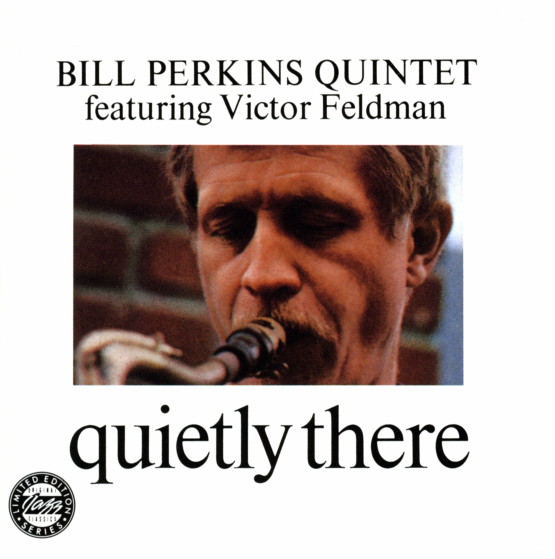
Quietly There - The Bill Perkins Quintet Plays the Music of Johnny Mandel

 © Copyright ® Steven Cerra, copyright protected; all rights reserved.


*** Quietly There

Original Jazz Classics OJC 1776 Perkins [ts, fl. bcl; Victor Feldman (p, org, vib); John Pisano (g); Red Mitchell (b); Larry Bunker (d). 11/1966.


“This was one of only two sessions that the veteran West Coast reedman made under his own name in the 1960s. Genile, pretty, but closely thought out, this is easy-listening jazz as it could be at its best. The nine tracks are all Johnny Mandel compositions, and Perkins devises a different setting for each one, some decidedly odd: baritone sax and organ for Groover Wailin’, for instance, which mainly proves that Feldman was no good as an organist. But Perkins's grey, marshy tone makes a charming matter of The Shining Sea, the flute-and-vibes treatment of A Time For Love is ideal, and tempos and textures are subtly varied throughout. A welcome reissue of a little known record.”

- Richard Cook and Brian Morton, The Penguin Guide to Jazz on CD, 6th Ed.


I'm not sure what the exact connection was between this recording, which was made in 1966 for Riverside Records [and which I thought went out of business in 1963], Impulse Records, and Ed Michel, but perhaps some relatedness can be derived from the following paragraph from Ashley Kahn, The House That Trane Built: The Story of Impulse Records [2006]:


“ENTER MICHEL


Ed Michel came to ABC in the late spring of '69 after years of both playing and recording music in the Los Angeles area. He had been bassist in the house band at the Ash Grove folk club, then was recruited by the Pacific Jazz label, where he learned all aspects of record production. Moving to New York City, he furthered his jazz studio experience as a production assistant for Orrin Keepnews at Riverside Records.”


However it came about, it’s great to have more Jazz interpretations of the music of Johnny Mandel, one of the greatest melody writers of all time. 


In addition to their pedigree as performing Jazz artists, Perk, Vic, John, Red and Larry were all very much a part of the Los Angeles studio scene in the 1960s [and beyond] and no doubt played on some of the original scores that Johnny wrote for films when he was coming of age in the business during this decade.


All speculation aside, Johnny’s music is beautifully interpreted by all concerned and it is a shame that the recording has not had a wider circulation.


“Memo to Ed Michel, Impulse Records Dear Ed,


I love you for asking me to write notes for this album, but they aren't getting written. I'm stuck listening, thinking up terms such as "panoramas of talent" and other extravagances that don't read well. Could I make a speech about it somewhere instead of notes? No?


Then start with Johnny Mandel, who wrote all the tunes. The album captures a broad view of him. Johnny put in his acne years with people like Joe Venuti, Woody Herman, Count Basie. He loved the hard, big band sound that blew hair back off the foreheads of people who sat too close to the brass section. That Mandel phase comes through in young tunes such as Groover Wailin’, Something Different, and the inside jazz favorite, Keester Parade. Johnny turned lyrical later when he took the long walk from Arranger to Filmscore Composer, writing such melodic gems as The Americanization of Emily; The Shining Sea ("The Russians Are Coming"); and Quietly There ("Harper"). Two inclusions here are interesting in terms of Johnny Mandel's long range perspective: Just a Child—an early ballad that bears the promise of his later lyricism—and Sure As You're Born (from "Harper")—an up-tempo tune of the later period which leans pleasantly backward into the composer's big band roots.


A friend of mine said an interesting thing recently while listening to a Johnny Mandel song on the car radio: "His music doesn't make me sad, it just makes me want to cry." In the end, the value  of music is just this: that it moves you. That's why Johnny Mandel's music is important.


So much for the frame. On to the characters in the painting. Bill Perkins is one of the first jazz players that ever turned me on. The tune was Yesterdays, from a Stan Kenton album that helped make adolescence endurable on nights when everything hurt. I still find Perkins' rich, mournful tone unforgettable. How brilliant of you, Ed Michel, to have Perkins headline the group on these particular tunes. The sweet, sad, Perkins tone I love flows out in Johnny's loveliest ballads. The Shining Sea (my favorite on the album, with Perkins playing tenor sax) and A Time For Love. Perkins changes flavors by changing reed instruments, tempos, length of space between notes from one tune to the next. But what impresses is the center of the man's playing, the unchanged feeling that he loves to play.


Britain's Vic Feldman plays so many instruments so well that it's hard to keep up. He even plays organ here, a rare event (Sure As You're Born). I marvel at the fragility he reaches on ballads, but like his companions, Vic swings hard when it's time, his dynamic range equaling his versatility.


(Ed, are you still with me? I know you like short liner notes, but I can't make it. What do I say—"Here's a great little album, folks. Pick it up on your way to the cleaners and do your soul a good turn. Sincerely yours.")


John Pisano loved doing the album because he got a chance to play classical guitar as well as electric, and there aren't many such opportunities anymore. The classical guitar is a reflective instrument. Some of these tunes almost demand it. Pisano and Perkins get into a pretty effect on Emily, Pisano's single guitar line doubling Perkin's bass clarinet line on melody.


Both Larry Bunker and Red Mitchell have the happy facility of rhythmic appropriateness. What the tune calls for is what they give it. Both are superb players, ready to plant time or elaborate upon it, but beyond ego trips which distract lesser rhythm players. For me, no one understands the art of playing with brushes better than Larry Bunker.


Every time a knowing record buyer's collection seems more or less complete, an album like this shows up and requires purchase and appreciation. Isn't that nice? But here comes The Shining Sea again. I want to finish this so I can give it my full attention. Words seem dry next to music.”


Final note to music lovers:


Winter's coming. You'll need this album.”


Morgan Ames


Notes reproduced from the original album liner.


Thursday, June 20, 2019

Bill Perkins Obituary - Steve Voce

© -Steven Cerra, copyright protected; all rights reserved.


BILL PERKINS has been the subject of three previous posts on these pages, including a lengthy interview that Steve Voce prepared for JazzJournal.


The following obituary written by Steve for The Independent contains additional information about Bill and his career which we wanted to represent on these pages for archival purposes and because “Perk,”as one of the great tenor saxophonists of the second half of the 20th century, is deserving of recognition by a broader audience than he received in his lifetime because he was resident in southern California and confined his playing to clubs, concerts and studiowork in the greater Los Angeles area.


And, of course, too, more writings by Steve Voce the esteemed author, critic and broadcaster, are always welcomed on these pages.


 “ ‘I’m a born follower,’ said Bill Perkins, when I asked him why he didn’t lead a regular band of his own. By that time, in the mid-Eighties, he had rightly come to eminence as one of the great jazz tenor saxophone soloists.


 He was also a master musician and the picture of him, with three pairs of glasses hanging round his neck, switching dexterously between his various instruments as he sight read complex parts and played creative solos, stays vividly in the memory.
 
He was always a shy man, never happy with his own playing and restlessly exploring the music of Sonny Rollins and the East Coast progressives. Born on the West Coast, he lived most of his life there, but turned his back on the local product.


 “The guys on the East Coast played a harder kind of Bebop. There was a sort of palm tree gentleness about the music we played out here. I think there’s something about Los Angeles that’s not conducive to intense high level playing. There’s an intensity about New York, perhaps the proximity of human bodies. Everyone’s struggling. In Los Angeles there are more neuroses.”


 The style that so rightly made him famous was, like that of Stan Getz, Bob Cooper, Zoot Sims and others, based on the playing of Lester Young in the Thirties. During the Sixties ‘Perk’ moved abruptly from his Young base and presented the world with an angular, jagged style drawn from his listenings to Sonny Rollins and John Coltrane. But his audience clung on to his earlier style, and he took few of them with him as he moved forward. Nonetheless, he was still in continuous demand for jazz festivals and tours. He was so universally popular as a person that his audience ruefully accepted what they regarded as his aberrations.


   Although chronically unsuited to the limelight, Perkins was articulate, a great speaker on conference panels, and firm in his beliefs and recollections.


 Unusually for a musician his background was in technical engineering. He was a brilliant sound engineer who qualified at CalTech – almost certainly the only professional jazz musician who came from that source.


  A handsome, well-built boy with blue eyes and blonde hair, Perkins had started playing the clarinet, switching to the tenor saxophone when he was 15.


 “Benny Goodman was the first musician I was hooked on,” he told me. “When I persuaded my mother to buy me an old Buescher tenor, that was the end of the clarinet for me. But it came back to haunt me and later, when I had to play clarinet and all the other instruments required of a studio player, I wished I’d kept it up as a kid. Clarinet technique is much more difficult than saxophone.” Later he became adept on the clarinet, flute and soprano and baritone saxophones as well as the tenor.   


His father was a mining engineer who traveled where his work took him. As a boy he was raised first in Chile, then, after his father died in the early Thirties, in Santa Barbara. Perkins looked, wrote Alun Morgan, “the archetype of a Southern California boy destined for the beach. He was determined to become an electrical engineer, and engineering would be a parallel career even as he gained fame as a jazz artist.”


 After his service in the US Navy during World War II Perkins took advantage of the GI Bill to qualify in electrical engineering in 1945. He also studied at the Westlake College of Music in Los Angeles, where he gained his degree in 1949. The following year he decided to become a professional jazz musician. His rise was rapid.


 He worked first with Jerry Wald’s band. He was at home one Saturday night when the phone rang. The caller claimed to be Woody Herman’s manager. The Herman band, he said, was playing at the Hollywood Palladium and, in the middle of the performance, which was being broadcast live, Herman had fired his main tenor sax soloist. Could Perkins get down there at once and complete the gig? Perkins thought the call was a hoax, but went anyway and hastily joined the band on stage with his tenor. Almost immediately a scowling Herman pointed at him to take the solo on “Perdido” and his career as a jazz star was under way.


 Perkins shared the tenor solos in the band with Richie Kamuca. “I wanted nothing more than to be able to swing like Richie did,” Perkins told me, “and he said he wanted nothing more than to play ballads like I did.”  Whilst with Herman, whom he joined in May 1951, Perkins made several classic records including most notably “Ill Wind”. He followed Kamuca into the Stan Kenton orchestra in November 1953, returning to Herman the following spring and then a year later going back to Kenton.


 Whilst with Kenton many beautiful settings were written for his tenor saxophone solos by Bill Holman and Bill Russo. “Yesterdays” probably became his best known recording and was demanded at all Kenton’s concerts. Kenton brought the band to Britain for the first time in 1956, and Perkins remained particularly popular here for the rest of his career.


 It was at this point that Perkins began making innumerable albums of West Coast jazz that became classics. Whilst with Kenton and Herman he also recorded regularly as a member of Shorty Rogers’ Giants, with his solo making the trumpeter’s “Blues For Brando” a substantial hit for both of them.  Some of Perkins finest playing of the period was on a 1956 quintet album with John Lewis, pianist in the Modern Jazz Quartet entitled Two Degrees East, Three Degrees West.


  Perkins kept his career as an engineer going until 1969 when he gave up touring to become a studio musician, joining the band for the “Tonight” television show under Doc Severinsen. He stayed in this job until 1992, fitting his jazz jobs around it.


 But studio work was not without problems.


 “My studio work has diminished a great deal,” he told me in 1987.
“The inroads of the synthesizers and the computer music machines are such that anyone who is economics minded can do an entire television score with only the synthesizers. That’s even got into the movies.” Perkins went with the tide and invented and patented an interface between saxophone and synthesizer in which the Yamaha Company expressed interest.


 Perkins worked in the film studios as well, where his most notable experience was working under Duke Ellington for the soundtrack of Assault on A Queen (1966). In the middle Seventies he played baritone sax with the Toshiko Akiyoshi-Lew Tabackin Big Band and returned to Herman for occasional guest solo spots. During the middle Eighties he toured the world with a Shorty Rogers group and in 1986, on one of his visits to Britain, toured with a quintet he co-led with the British tenorist Tommy Whittle. In 1991 Perkins recorded under his own name with a big band designed to recall the spirit of rather than to copy the Woody Herman band.


  By this time his health began to collapse, and he spent the rest of his life still playing, but battling four separate cancers. In 1992 he was operated on for lung cancer. One of his hips collapsed, but he was still regularly to be seen carrying his four or five instruments around in their cases. I asked to help take them into our hotel when he played at Egham in 1998 at one of the many Kenton reunion events in which he starred, but he cheerfully refused.


 Last year Perkins led a recreation of the Shorty Rogers Giants at a Burbank festival and in May this year appeared at a similar festival.


 Despite nine operations on his throat he was, as recently as two or three weeks ago still practicing, when he bought a new clarinet, determined to start playing again.
Steve Voce


William Reese Perkins, saxophone and woodwind player: born San Francisco, 22 July 1924 ; twice married (one son, one daughter); died Sherman Oaks, California 9 August 2003.”


Tuesday, June 11, 2019

Al Cohn and "The Brothers"

© -  Steven A. Cerra, copyright protected; all rights reserved.


“Cohn had a broad, heavy tone; he played in an uncomplicated style, employing regular phrase lengths and idiomatic bop figures.”
- Leroy Ostransky, The New Grove Encyclopedia of Jazz


“Cohn was the consummate jazz professional His arrangements me foursquare and unpretentious and his saxophone-playing a model of' order and accuracy. He was perhaps never more completely himself than as one of the Four Brothers, the legendary Woody Herman saxophone section. Later in life, though, his soloing took on a philosophical authority, unexciting but deeply satisfying.”
- Richard Cook and Brian Morton, The Penguin Guide to Jazz on CD, 6th Ed.


“Cohn was a swinging, modern Basie-oriented arranger and a tenor saxophonist of the Lester Young School. … Underrated by the public, his playing was always admired by his contemporaries for its structure, sound and swing.”
- Leonard Feather and Ira Gitler, The Encyclopedia of Jazz.


While working on a more extended piece about tenor saxophonist and composer-arranger Al Cohn, the editorial staff at JazzProfiles wanted to celebrate his memory with a brief recapitulation of some of the highlights of his career.  


Influenced by the vibratoless, "cool" sound of Lester Young, Cohn was greatly admired for his playing, especially with Woody Herman's band of the late 1940s and in tandem with tenorist Zoot Sims during the 1950s and 1960s. Cohn was also an accomplished arranger of both jazz and commercial music.


Born in 1925, Cohn grew up in Brooklyn listening to musicals by Irving Berlin and Cole Porter. He took piano and clarinet lessons, but had no serious interest in music until his early teens, when he heard Benny Goodman and Lester Young. Cohn had little formal training on the tenor, but he did play it in his high school band. He also arranged for the band by transcribing big-band charts from recordings.


Cohn first worked for Joe Marsala (1943) and then for Georgie Auld's band (1943—46), where he began composing and arranging in earnest. After brief stints with Buddy Rich and Alvino Rey, Cohn replaced Herbie Steward in Woody Herman's Second Herd (1948—49). He became part of the "Four Brothers" sax sound with Sims, Stan Getz, and Serge Chaloff— all of whom had developed personal interpretations of Lester Young's sound. Cohn contributed two standards to the Herman book, "The Goof and I" and "Music To Dance To"


Limited to brief solo parts, Cohn left Herman's group to work for Charlie Ventura and Artie Shaw. During the early 1950s, he recorded as a leader (The Progressive Al Cohn, Savoy) and began a long career as an arranger for television, working for Sid Caesar, Ernie Kovacs, and The Hit Parade and other shows.


In 1957 Cohn and Sims fronted a respected band that was known through its performances at the Half Note in New York. The Cohn-Sims band, with personnel changes, remained intact until 1969. Their music remained cool, well ordered, and lyrical. During the early 1970s, Cohn was active in Hollywood studios as an arranger and played the sax solos in the film Lenny, about the life of comedian Lenny Bruce.


He also returned to collaborations with Sims (Body and Soul, Muse). In 1976 Cohn's jazz reputation was revived by a series of albums for Don Schlitten's Xanadu label (Play It Now, Al Cohn's America, True Blue, and others). He later appeared in small groups with his son Joe, a guitarist (Overtones, Concord Jazz).


Cohn died of cancer in 1988 at the age of sixty-two.


When the celebrated tenor saxophonist Stan Getz was asked who his favorite tenor saxophonist was, he would often reply: “My sound; Zoot Sims’ swing; Al Cohn’s ideas.”


The meaning of Stan’s quotation speaks for itself, but perhaps, it also implies what I’ve always thought about Al’s playing and that is he played his solos like a composer which was his fundamental strength.


As to the title of this piece, Al had Many “brothers” including Stan Getz, Zoot Sims, Jimmy Giuffre, Allen Eager, Bob Cooper, Bill Holman, Dave Pell, and a host of other tenor saxophonists who played in the manner of Lester Young’s “cool style,” but two of my favorites from Prez’s tenor sax school are Bill Perkins and Richie Kamuca.


Fortunately for me and for lots of other Jazz fans, the “complete sessions” that Al, Bill and Richie recorded for RCA along with some previously unreleased tracks from June 24th and June 25th, 1955 sessions have been gathered onto a CD entitled The Brothers: Cohn, Perkins and Kamuca [RCA BMG 74321477922].


The following video tribute features Al, Bill and Richie on Bill Potts’ Hags from the June 25, 1955 date along with Jimmy Raney on guitar, Hank Jones on piano, John Beal on bass and Chuck Flores on drums.