Gary Foster, the distinguished alto saxophonist, flutist and all-round good guy, sent along this photo of he and tenor saxophonist, Warne Marsh.
As usual, the point of his generosity was not to emphasize himself, but rather, to add to my collection of photographs of drummer Larry Bunker, whom you can see behind Gary and Warne, along with bassist, Chuck Domanico.
The photograph was taken in November, 1968 at the Pilgrimage Theater, located in the Hollywood Hills, during a performance by the all too short-lived big band led by pianist-keyboardist and composer-arranger, Clare Fischer.
Clare, Gary and Warne are all adept interpreters of a style of Jazz closely associated with the late pianist, Lennie Tristano [1919-1978]. Lennie favored an approach to Jazz that emphasized long, flowing and linear improvisations with a very harmonic orientation.
Lennie was always looking for ways to improvise Jazz that expressed emotion more directly and were not hung up in skill.
In his hands, tunes such as All of Me, Out of Nowhere and What is This Things CalledLove were just points-of-departure; vehicles for developing and expressing what the late, esteemed Jazz author Barry Ulanov once termed “ harmonic-motivic propulsion.”
There’s much, much more to be said about Lennie’s approach to Jazz and one has to be careful about oversimplifications regarding such a complex subject.
For the purposes of this blog feature, what can be said with some degree of certainty is that Warne Marsh had a long association with Lennie and made recordings with Tristano in the 1950s on which his tenor sax playing is featured along with Lee Konitz, the legendary alto saxophonist.
Lennie’s approach to Jazz was often dismissed in some critical circles for being too cerebral, too cool [read “cold”] and lacking in emotional intensity.
To my ears, I have always thought that Warne found kindred Tristano-school spirits in Gary Foster and Clare Fischer when he moved to Hollywood from New York.
Not surprisingly, then, given their mutual orientation, Clare, Gary and Warne became friends, made a number of recordings together, and performed as a group in local Jazz clubs such as Donte's in North Hollywood and the Ice House in Pasadena, CA.
Other Los Angeles based musicians including pianist Alan Broadbent and tenor saxophonist Pete Christlieb also joined in on the fun of creating Jazz that in many ways served as a tribute to Lennie’s legacy.
For about three years at the close of the 1960’s, Clare translated Lennie’s approach into a roaring big band that featured some of the monster musicians who frequented the West Coast Jazz scene and Los Angeles recordings studios at that time.
The following video features Clare’s big band arrangement of Tristano’s Lennie’s Pennies. The tune is based on “Pennies From Heaven” but altered to be in minor. Be sure and checkout what a formidable big band rhythm section Bunker and Domanico form on this track.
"The 1964-'65 period is one of the richest in Bill's trio work. Granted, his work with bassist Scotty LaFaro from 1959 to 1961 was even more interactive, especially on Scotty's part, while Larry Bunker's brilliance in our trio has been largely overlooked. The integration of our trio was exceptional. The finesse of the ensemble playing and the intensity of Bill's expressive concentration— the way he combined his searing intellect and, at that point in his work, his need to communicate his emotional connection to the music through his playing—had reached a pinnacle."
- Bassist Chuck Israels as told to Marc Myers [Emphasis mine]
“When I joined Bill's trio, I was already aligned with his aesthetic world. What Bill was doing wasn't new to me. I was already in some fantasy, an internal fantasy, looking for and expecting that someday, I'd find music like that. When I heard Bill, instead of thinking, this was something new that I'd never imagined before, it was more as if I heard something that I'd imagined, but not in such a concrete way. He was the guy who was playing a kind of music that I thought might be possible, but he actually did it.
Bill's dynamics, nuances of touch, rhythmic variety were far beyond most jazz players' rhythmic language. All of those things simply entered into Bill's playing in ways that didn't seem to occur in a natural way to other jazz musicians. With Bill, you didn't notice they were there, they fit in so smoothly. I learned a lot about rhythmic overlays, cross-rhythms and multiple meters happening at once and how rhythmically vital that was. Larry Bunker said Bill was the most rhythmically inventive musician he ever heard. And I agree.
Before straying too far from the context that brought this delightful recording into existence, I thought you might like to read how it came about and, equally important, why Zev Feldman, its Producer, has assumed the role of a modern day Orrin Keepnews, Bill’s champion at Riverside Records at the outset of his career, in bringing to life important recordings by this legendary artist for Jazz fans of all ages to appreciate and enjoy.
THE TALE CONTINUES
“It's been an honor for me to work closely with the Bill Evans Estate over the past 13 years. This is the 11th release I've produced, working together with Bill Evans's son, Evan Evans. It's been tremendously exciting to see Bill's legacy passed along to another generation. His music transcends age. It's gratifying to see more and more people — both young and old — discovering his music. I'm proud to be a part of that discovery process.
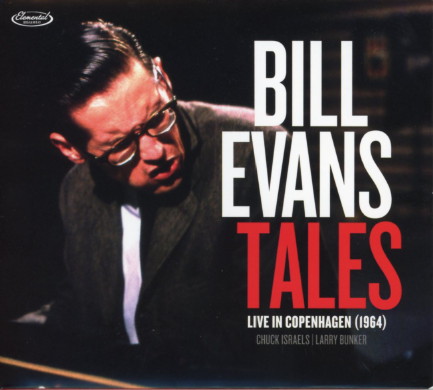
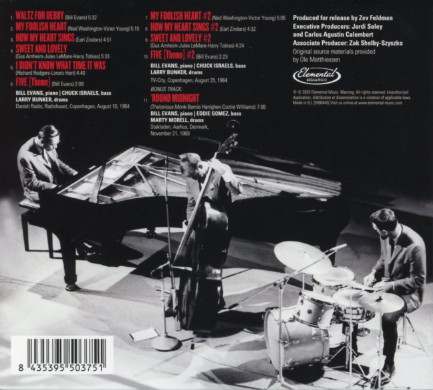
In the Winter of 2022, I was contacted by my dear colleagues at Elemental Music, Carlos Agustin Calembert and Jordi Soley, about a collection of previously unissued live recordings of Bill Evans taped between 1965-1969 in Denmark. In April of 2023, we released Treasures: Solo, Trio and Orchestra Recordings from Denmark (1965-1969) in 3-LP and 2-CD editions, but what we weren't able to include in that collection was a separate recording that was very important and which is being brought to you with this release, Tales: Live in Copenhagen (1964). It captures Evans with bassist Chuck Israels and drummer Larry Bunker performing for Danish Radio in performances recorded at the Radiohuset on August 10th and on August 25th 1964 at TV-City in Copenhagen. There is also a bonus track, a November 21,1969 live recording of "'Round Midnight" from Studenterhus Aarhus in Starkladen, Denmark, that wasn't included in the Treasures release.
These 11 tracks are glorious; a gift for all of us to relish these many decades after Bill's physical departure from this earth. It's thrilling for me to see these recordings come out, extending a welcoming hand to jazz fans who are just exploring Bill Evans's music for the first time. Tales is a wonderful document that captures the spirit, essence and beauty of what Evans was all about.” - Zev Feldman
For me, this is a particularly welcomed recording because it features music by one of the least appreciated editions of the Bill Evans Trio; ironically, one that has to rank among the highest in terms of its overall level of musicianship.
Since his roughly 10 years association with Bill, both generally on the New York Jazz scene of the late 1950s and specifically as the bassist in his trio from about 1961-1967, Chuck has developed into one of the most instructive and eloquent writers on Bill’s music and the musicological elements that made it so unique. He has also gone on to become a premier educator and a composer-arranger of orchestral Jazz works. You can find out more about Chuck, his background, and his current activities by visiting his website.
Chuck played with Bill immediately following the death of iconic bassist Scott LaFaro and the long tenure of another Jazz master, bassist Eddie Gomez. This intermittent period found Bill in a searching mode both personally and professionally and as a result, he wasn’t always at his very best. As the other melodic and harmonic voice in the trio, Chuck deserves far more recognition for holding it together than he ever received.
Also contributing to both the high degree of musicianship of this particular version of the Bill Evans trio while not receiving the recognition he deserved for his contributions was drummer Larry Bunker about whom Chuck states:
“Larry Bunker was an extraordinary musician There was a transparency to the sound of Larry's playing. Larry was like a race car driver in terms of finesse. He was a very well-trained musician with impeccable hearing. He understood everything going on more than I did. I was embarrassed that the drummer knew more than I did at that time. I've since developed my musical, technical understanding to the point where it's a lot better now, but I was just a kid then. And here was this drummer, a few years older than I was, but boy, he would sit at the piano before Bill came in and say, "Hey, Chuck, is this what Bill plays?" and he would play stuff that sounded great. I couldn't have done that. He was so wonderfully inventive, so wonderfully integrated into the rhythm Bill developed. He made enormous contributions to my way of thinking.”
Larry could do it all: he played drums in Gerry Mulligan’s quartet featuring Chet Baker and was the first drummer in Jeru’s sextet and tentette; he was the first call drummer for trumpeter Shorty Rogers’ quintet; played vibes for Henry Mancini on the scores of many of the Peter Gunn TV shows; was the drummer in Maynard Ferguson original big band; replaced Mel Lewis in Terry Gibbs’ Big Band when Mel went east to join Gerry Mulligan’s Concert Jazz Band; was the original drummer in Clare Fischer’s Big Band. He even played piano in one version of alto saxophonist Art Pepper’s quartet.
Unfortunately, many of Larry's activities took place away from the “national” Jazz press which, at the time, was focused on the New York Jazz scene.
His skills as a drummer, percussionist and vibraphonist and his abilities to read and interpret music made him a first call, “A” lister among those brokers responsible for contracting musicians for work in the Hollywood recording studios.
Frankly he gave up a small fortune as a studio musician during the three or so years that he was on Bill’s trio.
Perhaps one reason why this version of Bill’s trio didn’t receive more recognition was due to the fact that it issued so few recordings.
Bill Evans at Shelly’s Manne Hole in Hollywood, CA, Bill’s last recording on Riverside, was recorded in May, 1963 and not released until 1966. The trio was represented on Verve’s Trio ‘65 which was recorded in February of that year. In between, Verve released a number of tracks on The Bill Evans Trio Live that were recorded on July 7 and 9, 1964 in performance at The Trident Club in Sausalito, CA several years after they were recorded when Bill’s contract with them was up because Bill did not approve of the music that was recorded during this engagement.
From a recorded history standpoint, this is not much to show from a trio made up of three paragons of Jazz on their respective instruments.
Neil Tesser offer’s this perspective on the July, 1964 performances in his notes to the Verve Boxed Set of Bill’s recordings:
“With Chuck Israels in the bass chair, this is what the Evans trio sounded like on a typical night. Evans did not approve this for release at the time, but Verve issued an LP from the session several years later (once Evans's contract was up). Listening to it now, one wonders why Evans didn't like it.
Israels speculates that there may have been drug-related changes in Evans's health at that time "This was an erratic period, and there were a couple of nights when he was absolutely unable to play.... [A]nd he may have [been] distracted by those problems and then didn't want to hear whatever [it was] in the recordings that reminded him of that. But I think the date is quite representative of the group's music, and Larry Bunker, as usual, plays like some kind of percussion angel."
More surprising in retrospect is the critical furor the album generated. John S. Wilson gave it three stars in down beat, opening his review with,
"The more I hear of Evans, the more I become convinced that the propagation of the Evans mystique must be one of the major con jobs of recent years."
The August 12 and 26, 1965 issues of down beat include numerous responses. Probably the most entertaining was from Charles C. Sords of Pittsburgh:
“Let me convey my congratulations to John S. Wilson who, with one stroke of his typewriter, has established himself as the most knowledgeable critic in jazz with his discovery of the great Bill Evans hoax. In one brief review, Wilson has exposed the large group of musicians and critics who think that Evans is a pianist of great originality, subtlety, and taste, as a bunch of tin-eared idiots.”
Aside from all of this wordplay among the critics, the great tragedy for all of us who knew what a brilliant trio Bill, Chuck and Larry formed was that the records of this trio that were issued hardly did justice to it. During their appearances at Shelly's Manne Hole [which was ten minutes away from my home], I practically lived there and left each night absolutely giddy from the level of musicianship that was on display. A musician friend who accompanied me on one occasion said as we were on our way home: “OK, you can exhale now!”
With all of this by way of background, Bill Evans Tales: Live in Copenhagen (1964) becomes even more significant because with it we finally have a chance to listen to these three magnificent musicians at their very best! [Chuck Israels elaborates further on why this is the case in his notes which follow.]
For as Marc Myers comments in his superb notes:
“You're holding in your hands the earliest known recording of Bill Evans performing in Europe. Recorded in the summer of 1964 during his first tour abroad with a trio, these 10 previously unreleased tracks were captured in Copenhagen, Denmark, with Chuck Israels on bass and Larry Bunker on drums. The tracks also are remarkable for being among the very finest works by this ensemble.”
And when you do “hold this recording in your hands,” you do so with a beautifully prepared six-pack that includes outstanding artwork, a bevy of first rate photographs of Bill, Chuck and Larry by Jan Persson, detailed insert notes by Marc Myers, Chuck Israels and Brandyn Bunker, Larry’s second wife, and tray plates containing information about each track and specific acknowledgments of all those who contributed to producing and making the recording.
In other words, another top-of-the-line, first-rate Zev Feldman production.
A special note of gratitude goes out to Jordi Soley and Carlos Agustin Calembert who provided the funding for the project.
Nothing beats listening to the music on a recording to form your own impressions of it.
Words can only go so far in describing it, but the written expression of those who performed the music can also enhance our appreciation of an album.
Bill and Larry are no longer with us but Chuck Israels is and he wrote this wonderful tribute to his time with both of them during the formative years of his career.
THE RHYTHM, THE RHYTHM AND THE RHYTHM
CHUCK ISRAELS REMEMBERS BILL EVANS
I met Bill Evans in June of 1957. Gunther Schuller produced a Third-Stream concert at Brandeis University, where I was a student. I was playing with an extraordinarily good, professional-level trio of students — Steve Kuhn {who was a student at Harvard) and Ernie Wise (who later played with Bill and me. and was a student at Massachusetts School of Art). We'd been working in Boston, where we'd played concerts accompanying Stan Getz, Coleman Hawkins and others-It was completely unexpected in those days to find a professional-level trio of college students playing as well as we were playing. Musicians from New York, including Bill, would come to Brandeis for a week or so and would have meals at the student union and they'd find us there playing. That was when Bill first heard me.
Back then, I'd known about Scott LaFaro and met him once. Later, when Scotty heard me play, we became friends. I was at the Village Vanguard on that Sunday afternoon when those famous recordings were made with the trio, with Bill and Paul Motian and Scott.
Joe Benjamin, the bass player, also heard me play at Brandeis and used to send me jobs subbing for him. It was on one of those jobs working for Jerome Robbins's ballet company, Ballet U.S.A., in Europe. My friend, Paula Robison, a flutist who was a student at Juilliard (and who for many years has been celebrated internationally in classical music circles), knew Scott. Paula wrote me during my tour with Ballet U.S.A. in July of '61 and told me that Scotty
had died in an automobile accident. The tour lasted through the middle of October. I had the sense that I was probably the person Bill would call to replace Scotty and in fact, that's what happened. I got back from that tour and Paula said, "Here, call Bill," and I started to work with Bill and Paul Motian in November of 1961.
Scott was more of a virtuoso on the bass than I was. And I think his relationship with Bill was more competitive than mine. Scott thought of himself — and not incorrectly — as a more developed musician than I was when I joined Bill. My approach was simply to fit in. Most of that was pretty easy because Scott's approach and mine were fairly similar. We both played with a more varied rhythmic approach than had been the standard on the bass until then, although we weren't the only ones doing that.
The thinking when I started with Bill was, you can play quarter notes, you can play half notes, you can play dotted quarters and quarter-note triplets and you can play anything that fits the pulse and that makes a good counterpoint with the melody. You can make it all feel rhythmically propulsive and swinging, so why be restricted when music really doesn't need to be that restricted?
Even though Scotty's approach and mine were similar, Scotty had a busier sense of dialogue with Bill than I had. I was perfectly comfortable — more than comfortable — to do what I was doing. I didn't feel restricted at all. I was just so glad to be part of Bill's musical design: the texture of how that trio worked; how Bill planned the music; how he set it up so that you could fit yourself in with personal expression and freedom to find nuances and details that occurred to you. Bill would leave room for that to happen. I wasn't pushing as hard as Scotty was. I loved being in that trio. There have been few musical circumstances — maybe not any — that have felt quite like playing in the trio, especially with Larry.
There was a lot more space playing with Bill than with other people, more room for the bass. It's different from what it felt like to play with Bud Powell or Bobby Timmons in their trios. It was wonderful to play with Bobby Timmons. He was a terrific player and I was glad to be playing with Bobby and Ben Riley, both of whom I liked personally and I liked their playing. But what made that music work, didn't have as much variety as what made Bill's music work. I didn't waste a lot of energy thinking about what it was that I wasn't playing, because I was fitting in with Bobby's music. Once you're involved in the immediate experience, the absolute newness of playing in a good jazz band, there isn't a lot of room to think about what it is that you can't do. It's a specific kind of music that you have to fit in. The music draws you in a particular direction. Bobby Timmons's music drew me in a particular direction. Bud Powell's music was the basis for all of us. I had a great time being exposed to him, but unfortunately, by the time I played with him — and I played with him quite a bit in Paris in 1959 — he was really a shell of his former self. It wasn't as exciting and immediately creative as his earlier periods had been. Still, I consider myself lucky to have had a chance to play with him and with Kenny Clarke, who was a marvelous drummer.
Bill didn't play bass notes with his left hand most of the time. He mainly played the middle voices of chords with his left hand. He largely omitted the bass part. He'd sketch out for me what the bass parts should be and I'd play them. He'd take care of the middle and upper voices so I wasn't duplicating the same notes in the piano part. Bobby's and Bud's left-hand voicings included the bass notes most of the time. Bill was different. There was more space in Bill's playing.
Larry Bunker was an extraordinary musician. There was a transparency to the sound of Larry's playing. Larry was like a race car driver in terms of finesse. He was a very well-trained musician with impeccable hearing. He understood everything going on more than I did. I was embarrassed that the drummer knew more than I did at that lime. I've since developed my musical, technical understanding to the point where it's a lot better now, but I was just a kid then. And here was this drummer, a few years older than I was, but boy, he would sit at the piano before Bill came in and say, "Hey, Chuck, is this what Bill plays?" and he would play stuff that sounded great. I couldn't have done that. He was so wonderfully inventive, so wonderfully integrated into the rhythm Bill developed. He made enormous contributions to my way of thinking.
Listening to these recordings and comparing them to the records that came out earlier of the same material, I think these are better. There's a simple reason: They came later. For instance, when we recorded "How My Heart Sings" in the studio, it was one of the first times we played it. By the time these Danish recordings were made, we had played that piece over and over and over again. All of the music here were pieces we played night after night. You might think you'd get tired of a tune, but if it's a good piece, you become re-interested in it each time you play it. There's a new audience, a different circumstance and you play it with insight you've gained from playing it 20 or 30 or 40 or 50 times before. You know all the ins and outs of it, all the little side streets and back alleys that are hidden inside the music. And can take advantage of them in ways that don't occur to you when you first learn the piece.
As I listened to these recordings, they're really satisfying to me because I hear us at a level of comfort and understanding of what we're doing. That brings a great deal of freedom and expressive possibilities. We could skirt danger a little closer because we knew we had a grip on these things. There's a lot of risk that only comes when you're confident you'll be able to ski within the slalom gates. You'll get close to the edge, but you won't miss the gate. All in all, I think these are very high-level performances.
When I joined Bill's trio, I was already aligned with his aesthetic world. What Bill was doing wasn't new to me. I was already in some fantasy, an internal fantasy, looking for and expecting that someday, I'd find music like that. When I heard Bill, instead of thinking, this was something new that I'd never imagined before, it was more as if I heard something that I'd imagined, but not in such a concrete way. He was the guy who was playing a kind of music that I thought might be possible, but he actually did it.
Playing with Bill was important in shaping my musical life in the years that followed. I'm not looking for a revolutionary way of playing. I just want to play my music better and better; with some slight expansion perhaps. I like instrumental colors, I like writing for bands, I like creating slightly larger ensembles that have the same kind of interactive conversational contrapuntal musical textures that were in Bill's trio. What's it done for me? It's shown me the way, it's clarified for me how to get to a place I've always wanted to go.
Bill and I both had training in classical music. A lot of that discipline was completely applicable to our jazz playing. Neither of us was calculated about that. Bill's dynamics, nuances of touch, rhythmic variety were far beyond most jazz players' rhythmic language. All of those things simply entered into Bill's playing in ways that didn't seem to occur in a natural way to other jazz musicians. With Bill, you didn't notice they were there, they fit in so smoothly. I learned a lot about rhythmic overlays, cross-rhythms and multiple meters happening at once and how rhythmically vital that was. Larry Bunker said Bill was the most rhythmically inventive musician he ever heard. And I agree.
Whereas many jazz pianists' rhythm playing is pretty much all eighth notes, Bill's grooves were eighth notes and quarter-note triplets and triplets and triplets again and triplets divided in duples and duple eighth notes divided and assembled in groups of threes. And that's only really a simple, wildly oversimplified description of Bill's rhythmic vocabulary.
Bill's rhythmic approach was powerfully intellectual on the one hand, but so beautifully played and so integral to the way he thought and felt about music that I never experienced it as some kind of mathematical trick. But oh boy, does it sound interesting. And I always intuitively understood what he was doing. That was what made it possible for me to be the right bass player for him when Scotty died and Bill needed somebody. He certainly needed somebody who understood his rhythm. And while I was perhaps underprepared to understand the harmony and some other things about his music, I understood the rhythm and the way he wanted to have a complimentary, contrapuntal bass part in his trio. That part was so natural for me that I spent three months traveling around Europe thinking, "Well, I'll probably get back; I'll probably have this job." It might have been arrogant, but it turned out to be right. It's the rhythm, the rhythm and the rhythm — in that order — that made it possible.
I think the most interesting things about Bill are in his music, It may be interesting to know about any artist's personality away from their art, but what he's left us is his playing and the design he had for a jazz trio. It was unique and wonderful. There aren't many things I've done in my life that I can listen to over and over and over again with the same level of satisfaction that I get listening to the work Bill gave me the opportunity to do with him. And Larry was a big part of that too, because he was an absolute brilliant participant in that music.”
Excerpted from an interview with Chuck Israels conducted by Zev Feldman on November 16,2021
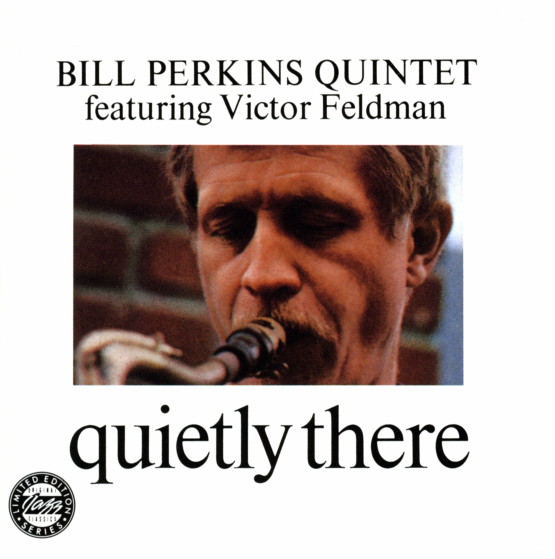
Original Jazz Classics OJC 1776 Perkins [ts, fl. bcl; Victor Feldman (p, org, vib); John Pisano (g); Red Mitchell (b); Larry Bunker (d). 11/1966.
“This was one of only two sessions that the veteran West Coast reedman made under his own name in the 1960s. Genile, pretty, but closely thought out, this is easy-listening jazz as it could be at its best. The nine tracks are all Johnny Mandel compositions, and Perkins devises a different setting for each one, some decidedly odd: baritone sax and organ for Groover Wailin’, for instance, which mainly proves that Feldman was no good as an organist. But Perkins's grey, marshy tone makes a charming matter of The Shining Sea, the flute-and-vibes treatment of A Time For Love is ideal, and tempos and textures are subtly varied throughout. A welcome reissue of a little known record.”
- Richard Cook and Brian Morton, The Penguin Guide to Jazz on CD, 6th Ed.
I'm not sure what the exact connection was between this recording, which was made in 1966 for Riverside Records [and which I thought went out of business in 1963], Impulse Records, and Ed Michel, but perhaps some relatedness can be derived from the following paragraph from Ashley Kahn, The House That Trane Built: The Story of Impulse Records [2006]:
“ENTER MICHEL
Ed Michel came to ABC in the late spring of '69 after years of both playing and recording music in the Los Angeles area. He had been bassist in the house band at the Ash Grove folk club, then was recruited by the Pacific Jazz label, where he learned all aspects of record production. Moving to New York City, he furthered his jazz studio experience as a production assistant for Orrin Keepnews at Riverside Records.”
However it came about, it’s great to have more Jazz interpretations of the music of Johnny Mandel, one of the greatest melody writers of all time.
In addition to their pedigree as performing Jazz artists, Perk, Vic, John, Red and Larry were all very much a part of the Los Angeles studio scene in the 1960s [and beyond] and no doubt played on some of the original scores that Johnny wrote for films when he was coming of age in the business during this decade.
All speculation aside, Johnny’s music is beautifully interpreted by all concerned and it is a shame that the recording has not had a wider circulation.
“Memo to Ed Michel, Impulse Records Dear Ed,
I love you for asking me to write notes for this album, but they aren't getting written. I'm stuck listening, thinking up terms such as "panoramas of talent" and other extravagances that don't read well. Could I make a speech about it somewhere instead of notes? No?
Then start with Johnny Mandel, who wrote all the tunes. The album captures a broad view of him. Johnny put in his acne years with people like Joe Venuti, Woody Herman, Count Basie. He loved the hard, big band sound that blew hair back off the foreheads of people who sat too close to the brass section. That Mandel phase comes through in young tunes such as Groover Wailin’, Something Different, and the inside jazz favorite, Keester Parade. Johnny turned lyrical later when he took the long walk from Arranger to Filmscore Composer, writing such melodic gems as The Americanization of Emily; The Shining Sea ("The Russians Are Coming"); and Quietly There ("Harper"). Two inclusions here are interesting in terms of Johnny Mandel's long range perspective: Just a Child—an early ballad that bears the promise of his later lyricism—and Sure As You're Born (from "Harper")—an up-tempo tune of the later period which leans pleasantly backward into the composer's big band roots.
A friend of mine said an interesting thing recently while listening to a Johnny Mandel song on the car radio: "His music doesn't make me sad, it just makes me want to cry." In the end, the value of music is just this: that it moves you. That's why Johnny Mandel's music is important.
So much for the frame. On to the characters in the painting. Bill Perkins is one of the first jazz players that ever turned me on. The tune was Yesterdays, from a Stan Kenton album that helped make adolescence endurable on nights when everything hurt. I still find Perkins' rich, mournful tone unforgettable. How brilliant of you, Ed Michel, to have Perkins headline the group on these particular tunes. The sweet, sad, Perkins tone I love flows out in Johnny's loveliest ballads. The Shining Sea (my favorite on the album, with Perkins playing tenor sax) and A Time For Love. Perkins changes flavors by changing reed instruments, tempos, length of space between notes from one tune to the next. But what impresses is the center of the man's playing, the unchanged feeling that he loves to play.
Britain's Vic Feldman plays so many instruments so well that it's hard to keep up. He even plays organ here, a rare event (Sure As You're Born). I marvel at the fragility he reaches on ballads, but like his companions, Vic swings hard when it's time, his dynamic range equaling his versatility.
(Ed, are you still with me? I know you like short liner notes, but I can't make it. What do I say—"Here's a great little album, folks. Pick it up on your way to the cleaners and do your soul a good turn. Sincerely yours.")
John Pisano loved doing the album because he got a chance to play classical guitar as well as electric, and there aren't many such opportunities anymore. The classical guitar is a reflective instrument. Some of these tunes almost demand it. Pisano and Perkins get into a pretty effect on Emily, Pisano's single guitar line doubling Perkin's bass clarinet line on melody.
Both Larry Bunker and Red Mitchell have the happy facility of rhythmic appropriateness. What the tune calls for is what they give it. Both are superb players, ready to plant time or elaborate upon it, but beyond ego trips which distract lesser rhythm players. For me, no one understands the art of playing with brushes better than Larry Bunker.
Every time a knowing record buyer's collection seems more or less complete, an album like this shows up and requires purchase and appreciation. Isn't that nice? But here comes The Shining Sea again. I want to finish this so I can give it my full attention. Words seem dry next to music.”
During my playing days, I sometimes thought that the only reason there was a tuxedo hanging in my closet was so that I could wear it to the society band gigs I often played at the Cocoanut Grove Super Club in The Ambassador Hotel. [The same holds true for the white dinner jacket that kept the tux company.]
For a while, it seemed I played in those schmaltzy bands at “The Grove” [as it was then called] on a weekly basis. Good thing, too, as the money that I made from playing this corny music came in handy when the rent was due or when I wanted to eat on a regular basis and it also subsidized my Jazz gigs [some of which offered little more than free brews and gas money].
And it wasn’t only me “grinning and bearing it” as I smiled while I Tip-toed Through The Tulips or got bleary-eyed while Smoke Gets In Your Eyes; at one time or another I think I may have played in society bands that were made up of some of the best Jazz and studio musicians in Los Angeles. One night the sax section was Charlie Kennedy on alto, Bob Hardaway and Bob Cooper on tenor and Ronnie Lang on baritone sax! Did I say that the pay for enduring this form of musical torture was good? Well, the company often was, too, even if the music was a drag.
Located on Wilshire Boulevard, only a few miles west of downtown Los Angeles, The Cocoanut Grove was my favorite place to work a society band gig because of its sumptuous decor and the palatial scale of the place. The place was a throwback to Hollywood’s old celebrity days.
The hotel and the super club were set back from the street and had the usual, huge Los Angeles parking lot that acted as a buffer from the noise from the traffic.
Occasionally, during the break between sets, I would stretch my legs by wandering along the driveway until I came to the palm tree-lined sidewalk. Directly across the street at the intersection of Kenmore and Wilshire was a boarded-up hut-like building that was once the home of The Haig, the Jazz club where the famous Gerry Mulligan Quartet featuring trumpeter Chet Baker first played in 1952.
I would look across the street and try to imagine what it must have sounded like to have been at The Haig when, as Ted Gioia recounts in his definitive study on the subject of West Coast Jazz: Modern Jazz in California, 1945-1960:
“In the spring of 1952, baritonist Mulligan secured a regular Monday night job at the Haig, a small Los Angeles jazz club on Wilshire Boulevard. From the outside the Haig appeared an unlikely place to launch a major jazz career. This free-standing converted bungalow looked more like a modest residence than a major nightclub. The building was surrounded by a picket fence, shrubbery, and an assortment of palm trees. The only indication that this idyllic hideaway housed a commercial establishment came from the towering sign: "THE HAIG DINNERS COCKTAILS." The club's location, of course, overcame any limitations in its facade: Down the street was the celebrated Brown Derby, a much-touted restaurant where movie stars obligingly came to watch the tourists dine; across the street stood the luxurious Ambassador Hotel, which, sixteen years later, would become infamous as the site of Robert Kennedy's assassination.
In 1952, the Ambassador was better known for housing the Cocoanut Grove, one of Los Angeles's priciest nightclubs. All these landmark establishments are now gone, but in their day they ranked among the most glamorous locations in Southern California. The Haig could boast neither the spaciousness nor ritzy clientele of the Cocoanut Grove or the Derby — its capacity was less than a hundred — but owner John Bennett had developed the club's reputation by featuring some of the finest jazz bands of the day. Even before the Baker-Mulligan success, popular artists such as Red Norvo and Erroll Garner had played the club, and soon, inspired by the new band's rapid rise to fame, the Haig would rank with the Lighthouse as the major springboard for West Coast jazz talent. A list of the groups that would debut at the Haig reads almost like a Who's Who of West Coast jazz in the mid-1950s; it includes, in addition to the Mulligan-Baker ensemble, Shorty Rogers and his Giants, the Laurindo Almeida/Bud Shank Quartet, the Hampton Hawes Trio with Red Mitchell, and the Bud Shank Quartet with Claude Williamson.
Baker had been sitting in with Mulligan's group at the club's regular jam sessions. The much-praised rapport between the two musicians was not immediately apparent, but with each performance their mutual chemistry grew…..
Much of the publicity surrounding the Mulligan Quartet stemmed from the absence of a pianist. The jazz journals frequently referred to it as the "pianoless quartet," as if the group were more noteworthy for what it lacked than for what it did. Today the omission of a harmony instrument does not sound unusual, and other virtues of this group are more salient: its effective use of counterpoint, its understated rhythm section, its melodic clarity, and its willingness to take chances. Not since the days of New Orleans ensemble playing had the individual members of a small combo been so willing to merge their personal sounds into a cohesive whole. These characteristics, rightly or wrongly, became viewed by the jazz public as trademarks of West Coast jazz.” [pp. 172 and 174]
In the modern Jazz era, portable recording equipment found its way into lofts, parties and nightclubs as Jazz fans illicitly preserved the sounds of their favorite artists on what today are known as bootleg recordings.
Gerry and Chet’s appearance at The Haig led to founding of Pacific Jazz Records by Richard Bock and the photographer William Claxton in 1952
But what did you do if you were a fan of the group and no recordings of their work had as yet been issued commercially?
Perhaps, the following the amateur recordings that were made of Jeru and Chettie at The Haig in 1952 would have to tide you over until the real thing came along, that is if you were lucky enough to have them.
The soundtrack for the following video offers two examples of amateur recordings that were made at The Haig in 1952 when bassist Carson Smith and drummer Larry Bunker joined Jeru and Chettie for a typical set at the club. The tunes are Move and My Funny Valentine.