Showing posts with label eric ineke Jazzxpress. Show all posts

Tuesday, January 7, 2025

Swing Street - The Eric Ineke JazzXpress featuring Tineke Postma

 © Copyright ® Steven Cerra, copyright protected; all rights reserved.
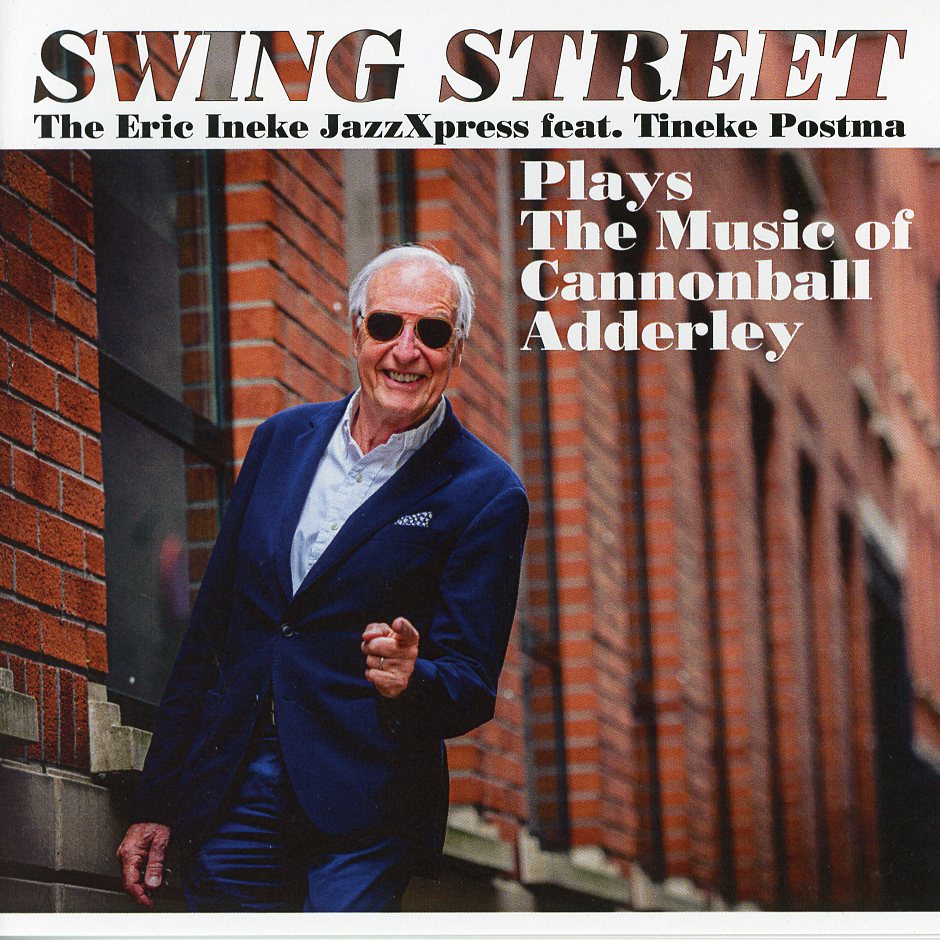

For those of you who like your Jazz served up in a straight-ahead, hard-bop style, then a musical feast celebrating this genre is on hand for you in Swing Street - The Eric Ineke JazzXpress featuring Tineke Postma [Timeless Records CDSJP 495].


For this recording, Eric’s JazzXpress, which turns 20 next year, has added the soprano and alto saxophone talents of Tineke Postma to perform a repertoire of music closely associated with the Cannonball Adderley quintet and sextet of the 1950s and 60s.


In addition to the superb soloing - Eric always leaves plenty of room on his recordings for his players to stretch out - each tune is masterfully arranged to give them a freshness and allow the band to put its own stamp on the material.


While the rhythm section of pianist Rob van Bavel, bassist Marius Beets and Eric on drums have been a part of the group from its inception along with tenor saxophonist Sjoerd Dijkhuizen, trumpeter Nico Schepers is new to the band. Tineke appeared on the group’s CD previous to this one - What Kind of Bird Is This? The Music of Charlie Parker.


This sextet’s configuration is similar to the one that the Adderley Brothers had in place which featured the “soulful brother” Yusef Lateef on tenor sax with a rhythm section of pianist Joe Zawinul, bassist Sam Jones and Louis Hayes on drums.


Regrettably this sextet was short-lived but they did leave us with three albums on Riverside Records: The Cannonball Adderley Sextet in New York Recorded Live at The Village Vanguard [RLP 404, 1962], Jazz Workshop Revisited: Cannonball Adderley Sextet [RM 444, 1963] and the Cannonball Sextet in Europe Riverside LP [RM 499, 1963]


Trombonist J.J. Johnson’s sextet with Freddie Hubbard on trumpet and Clifford Jordan on tenor sax, The Jazztet with a front line of Art Farmer [tp], Benny Golson [ts] and Curtis Fuller [tb] and drummer Art Blakey’s sextet which featured Freddie, Wayne Shorter on tenor and Curtis came into prominence for a brief period from the late 1950s to the mid 1960s. This instrumentation allowed these small groups to create a wide range of textures [sonorities] in their arrangements that produced ensembles with full, rich voicings.


Sadly, the economics of a declining Jazz audience by the mid-1960s made these groups too expensive to book and they were basically phased out, but not before leaving a wealth of terrific music in their wake.


Now, thanks to Eric, Tineke, Sjoerd, Nico, Rob and Marius, you can once again sample Jazz in a sextet configuration which includes new takes on the Cannonball Adderley Sextet Songbook as the band has reimagined each of the eleven original tracks tracks. 
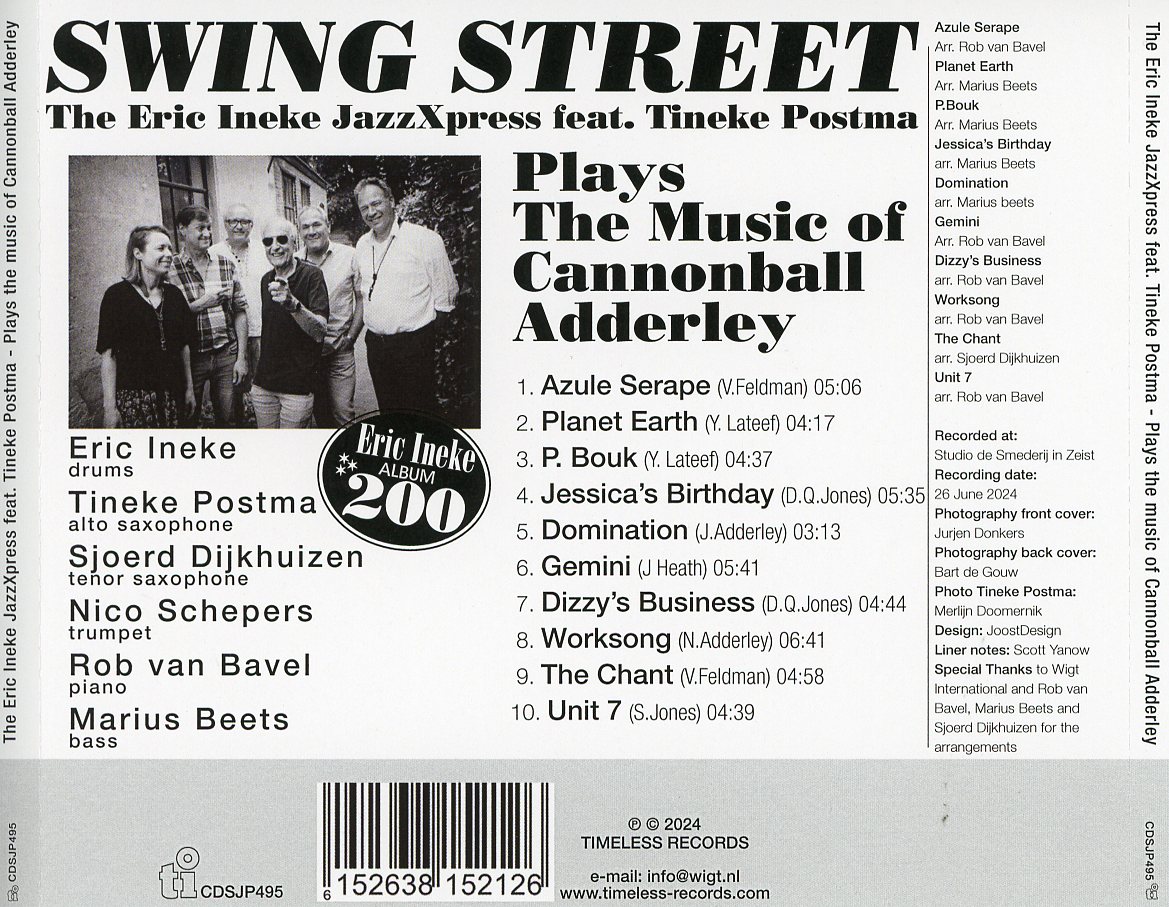


Rob van Bavel does the arranging honors on the opening track, Victor Feldman’s Azule Serape. The London-born pianist, vibraphonist and drummer was with Cannonball from 1960-1961 and contributed a number of compositions to the band’s book. 


On the Cannonball’s live album at The Lighthouse Café in Hermosa Beach California [where Victor was the resident pianist in Howard Rumsey’s All-Stars from 1957-59], Adderley introduces the tune this way: “I've been trying to figure out a long time what this name means for this tune that Victor Feldman wrote for us. This one is called "Azule Serape.” Now he’s from England and I know it's not English. It's something else. "Azule Serape." That’s what the next tune is.”


Rob’s arrangement approaches the tune as a sort of fanfare to open the album in a stirring and energetic manner. After the intro, Eric launches into an Afro-Cuban beat over which the band plays a staccato montuno which evolves into a series of Latin riffs. Rob then commences the melody on piano performing it in its original locked-hand fashion, the band comes in and swings the bridge and the whole thing gets the recording off in a rousing manner. Solos by Sjoerd, Nico, and Rob set the stage for four bar trades with Eric before the band segues the tune into a big finish.


Bassist Marius Beets does the arranging honors on Planet Earth and P. Bouk, both written by Yusef Lateef. The former features Tineke and a fine intervallic solo by Rob showing his interpretive range [think McCoy Tyner].


The latter was released on the 1963 Cannonball Sextet in Europe Riverside LP [RM 499], although it was first recorded by Yusef on his 1961 New Jazz LP - Yusef Lateef Into Something [NJLP 8272]. P. Bouk is an intriguing title and Yusef explains its meaning this way in Nat Hentoff’s notes to the New Jazz album: “It’s kind of an idiomatic language developed in Detroit that refers to a man’s idiom or “bag.” Now I can’t say that this tune sums up what’s in my bag because there is more than one thing in my bag, or rather, there ought to be.” Nat goes on to add: “The ingredients in Yusef’s bag which are primary in this tune is his commanding sense of swing, his gutsy forcefulness and his preference for economical clarity of design.”


Over an opening strummed bass ostinato which is amplified by Rob and Eric, Marius feeds into his arrangement of P. Bouk ingredients from his own “bag” that create a soaring statement of the novel features of the tune and then go on to serve as a launching pad for solos by all of the band members. Oscillating chords establish a vamp for Eric to stretch out over before the band takes the tune out with a full measure of “gusty forcefulness” which would have no doubt pleased Mr. Hentoff.


One thing you can always count on when listening to Eric’s bands is that they always SWING - and that quality is on display in the slow burn the band gives to its interpretation of Quincy Jones’ Jessica Birthday, which is another arrangement by Marius. Jazz played at a slower tempo requires a lot of control because nothing is slurred and everything is stated; clearly enunciated notation. No clichés are on display in the solos by the band members who seem to relish the chance to play out their ideas in a slower rhythmic context. The unison phrasing is clean and articulated which serves to give the slower tempo a nice bounce throughout.


Marius Beets closes out his turn on the arranging chair with a reworking of Oliver Nelson’s arrangement of Cannonball’s original Domination.


Tineke and Marius state the theme to Domination in unison which then relies on a series of countermelodies as contained in the original to set the piece in motion. This is small group orchestration at its finest and everyone had their reading chops on to make this one happen. 


Jimmy Heath’s Gemini, Ernie Wilkins’ Dizzy Business and Nat Adderley’s Work Song comprise the next three tracks; three very distinct tunes which Rob honors with three distinctive arrangements. 


Gemini, Jimmy Heath’s lovely use of a loping 6/8 to waltz time rhythmic pattern, features interesting interludes that Rob has voiced in such a way so as to create a contrast to launch the soloists with Nico, Sjoerd and Rob doing the honors.


Ernie Wilkins’ claim to fame was as a big band arranger and this orientation really shows in the way the melody to Dizzy’s Business is constructed with its punchy phrasing and pulsating rhythmic kicks and licks. An uptempo bash that finds all the band members in fine form, especially Sjoerd who does “the big horn” proud with a take-prisoner solo that is reminiscent of Yusef when he was on the Adderley band. The sextet-as-big-band is on tap on this one.


Next up is Nat Adderley’s Work Song which in later years he would introduce to his audience as “the tune that paid all my bills for a long, long time!” This 16-bar minor blues was one of the most requested tunes in the Adderley’s band repertoire and Rob gives it new life with a refreshing take built around a rubato statement of the melody that makes it even more expressive and emotional.


Marius then sets the tone for the JazzXpress’s interpretation by laying down a driving bass walk over which Tineke’s alto soars before brassman Nico takes over with a vigorous and muscular solo. Sjoerd and Rob get in on the fun before the “van Bavel express” shouts the tune out.


It’s impossible not to have fun playing Nat’s Work Song and this version by the JazzXpress shows why.


Next up is The Chant, another original by Victor Feldman which became the title for the eponymous Sam Jones Riverside album [RLP 9358]. Sam was the first and longest serving bassist with Cannonball’s groups so as you would imagine Sjoerd Dijkhuizen arranged this to feature Marius Beets skillful bass work. Rob joins in after Marius’ solo and the two lock in with Eric to form the driving rhythm section that makes the JazzXpress such a splendid straight-ahead Jazz band. Sjoerd jumps in with a powerful solo until the band returns and takes the tune to a righteous close.


Unit 7 by Sam Jones was Cannon’s closing theme. It’s a 12-bar blues with a bridge which Rob infuses with countermelodies to give the tune a wonderfully crisp sonority. Tineke steps up and steps out with a marvelous solo on alto that’s gotta have Cannonball smiling. Sjoerd follows with some Texas-tenor style phrasing in his solo - what Cannonball describes as a “moan within the tone.” Another fine unison interlude acts as a shout chorus before the band joyfully ends the tune.


As a note in passing, the CD comes with fine booklet notes by the Jazz journalist and historian, Scott Yanow, which provide further insights into the musicians and the music.


Swing Street is the seventh recording in my collection by Eric’s JazzXpress and each one is a gem replete with meticulous musicianship and joyous, swinging Jazz.


As Scott says in his closing remarks: “Swing Street succeeds at paying an affectionate and very musical tribute to the great Cannonball Adderley.”


Do yourself a favor and grab a copy.


You won’t regret it.


Monday, October 17, 2016

"Dexternity" - A Tribute to Dexter Gordon by Eric Ineke and the JazzXpress

© -Steven Cerra, copyright protected; all rights reserved.


I realize that Jazz is blessed with a Pantheon of Tenor Saxophone Gods that include the likes of Coleman Hawkins, Lester Young, Zoot Sims, Stan Getz, Sonny Rollins and John Coltrane, but let me tell you that when Dexter Gordon planted his feet and decided to bring it, he was one incredible tenor saxophone player. From every perspective - tone, sound, ideas, feel, time, swing - Dex was a master player.

Jazz is not about rating; Jazz is not about ranking; Jazz is not about contests and polls.

But if I had to select one tenor saxophonist to take with me to the proverbial desert island, I would run to find my copy of Dexter Gordon: The Complete Blue Note Sixties Sessions. Figuratively and literally, the music on these recordings is an example of a time when Giants Ruled The Jazz World and one of them was named “Dexter Gordon.”
- The editorial staff at JazzProfiles

To my ears, the quintessential sound of modern Jazz is a quintet fronted by trumpet and tenor sax and backed by a piano-bass-drums rhythm section.

[Of course, I could be persuaded to consider a trumpet and alto sax front line if these were occupied by Donald Byrd and Phil Woods or Stu Williamson and Charlie Mariano, respectively. And then there’s the quintet that Donald led with baritone saxophonist Pepper Adams …. What am I getting myself into here?]

When it comes to the tenor saxophone portion of the trumpet + tenor saxophone equation, my thoughts often turn to the Blue Note Recordings that the late, Dexter Gordon made in the early 1960s with Freddie Hubbard in the trumpet chair. Talk about fireworks!

Because of those Blue Note recordings, many Jazz fans are not aware that Dexter was a Westcoaster before he became prominent on the East Coast. Of course, later in his career he would secure more international fame as a result of his long residence in Europe.

Before he relocated to New York City, I got to meet Dexter during his tenure as a member of the quartet appearing in Jack Gelber’s play The Connection when we were introduced by a friend that we had in common - drummer, Stan Levey. At the time of this meeting, Dexter was anything but the laconic and languid personality he adopted in his later life. He had recently overcome some personal issues and was bursting with energy as was reflected in the quips and barbs which he traded freely with Stan, whom he greeted as something akin to a long-lost brother. “Lord Stanley, my Man!”

[I have reposted my earlier piece on Dexter’s appearance in The Connection at the Ivar Theater in Hollywood to the side bar of the blog as an accompaniment to this feature].

Jazz is continually evolving and, as such, doesn’t provide too many opportunities these days to hear the music in my favorite quintet format featuring a trumpet and tenor sax front line.

Imagine my delight, then, when drummer Eric Ineke contacted me from his base in The Netherlands to share with me that his working group - The JazzXpress - had just released a new CD featuring ten [10] original compositions by none other than Dexter Gordon!!

It gets even better because Eric’s JazzXpress is fronted by … you guessed it … Ric Mol on trumpet and Sjoerd Dijkhuizen on tenor saxophone, both of whom are more than ably supported by a rhythm section of Rob van Bavel on piano, Marius Beets on bass and, of course, the grand master himself, Eric Ineke on drums. All of the arrangements were done by Marius, Rob and Sjoerd with Marius pulling it all together at the chief recording engineer, mixer and master-maker.

The CD is entitled Dexternity [Daybreak DBCHR 75225] and it is available from Challenge Records via this link and as an audio CD from Amazon and CD Universe.

Along with the music, Eric sent along a wealth of information about how the recording came into existence written by both he and by Maxine Gordon who was instrumental in developing the recording as a tribute to her late husband.

Since I couldn’t improve upon them, I thought I would present these annotation “as is” and follow them with my own contribution to this piece in the form of a video tribute to Dexter featuring the Mrs. Minniver track from the Dexternity CD.


DEXTERNITY - THE MUSIC OF DEXTER GORDON
The new album of The Eric Ineke JazzXpress on Challenge/Daybreak Records

Back in 2014  Dexter  Gordon's widow, Maxine Gordon, contacted Eric Ineke and asked him if she could interview him for the book she is currently writing about her late husband.  Some months later they met at a hotel in Amsterdam where Eric told her about the many concerts he played with Dexter back in the 1970's. Together with pianist Rein de Graaff and bass player Henk Haverhoek they formed one of the regular rhythm sections behind Dexter when he was living in Copenhagen and touring Europe.

In 1972 Dexter recorded a live album entitled All Souls with the Rob Agerbeek Trio that also features Eric on drums. On his 1977 European tour, Eric accompanied him together with Tete Montoliu from Spain on piano and Rob Langereis, also from The Netherlands, on bass.

Last year [2015] Maxine Gordon invited Eric to join her during a special night at the Conservatory of Amsterdam where the 1986 movie Round Midnight was displayed. The movie stars Dexter Gordon, Herbie Hancock, Wayne Shorter and many other jazz legends. That night Eric told her about his plan to record an album that pays tribute to the musical legacy of her husband.

She responded with much enthusiasm so he decided to ask her to write the liner notes. While working on Dexter's biography in Paris a few weeks later she wrote the liner notes for the album, Dexternity, which we now proudly present to you.

Dexternity is the seventh studio album of the Eric Ineke JazzXpress. The band consists of five of The Netherlands' top jazz musicians: Rob van Bavel on piano, Rik Mol on trumpet, Sjoerd Dijkhuizen on tenor saxophone, Marius Beets on bass and Eric Ineke on drums. Earlier albums feature American vocalist Deborah Brown on vocals and Benjamin Herman on alto saxophone.

A historic recording of Dexter Gordon, Eric Ineke, Rein de Graaff and Henk Haverhoek, is to be released on LP on Gearbox Records (England) on November 4. It was recorded live at Societeit Heemskerk for Dutch national radio (VPRO) on November 3,1972, right after a two month tour of Dexter and the trio through Europe. The album is named after one of Dexter’s own compositions that was on the set list that night: Fried Bananas. Maxine Gordon wrote the liner notes for this album as well.

For more information about Eric Ineke's career, upcoming gigs and releases, visit www.ericineke.com

Contact: ericinekeiazzxpress@gmail.com


ERIC INEKE JAZZXPRESS - DEXTERNITY by Maxine Gordon

“When Dexter Gordon arrived in London in 1962 to play at Ronnie Scott's Club, he had no plans to remain in Europe as long as he did. As he liked to say, "I came for one gig in London and when I looked up it was 14 years later." Dexter eventually settled in Copenhagen where he rode a bicycle, bought a house, got married, had a son, and performed for months at a time at Jazzhus Montmartre.

But he didn't stay exclusively in Denmark. He traveled to France, to Germany, to Italy, to Spain, to Portugal, to Switzerland, to Luxembourg, to Belgium, to Austria, to Switzerland, to Sweden, to Norway, to Finland and very often to Holland. There was a booking agent in the town of Wageningen, named Wim Wigt who could find a gig for Dexter and his Dutch band in the smallest venues in the country and neighboring countries as well.

Normally when Dexter toured in Europe it was as a solo musician picking up local rhythm sections in each city along the way. But in Holland, he had a "working band" with Rein de Graaff on piano, Henk Haverhoek on bass and Eric Ineke on drums.

On October 12,1972, Dexter wrote to friends in Copenhagen from Liege, Belgium. He writes: ‘Dear Folks, This is 'den gamle rejsemusiker' [the old traveling musician] letting the folks back home know that I'm O.K and am defending the colors! This tour is quite fantastic; we are traveling through Holland, Germany, Luxembourg, Beige and France! It's six weeks, no 7 weeks and I'm getting rich! Anyway, it's very well organized and seems to be a success. For the most part I'm working with the same group... Hope everything is in order. Love, Absalon (Gordonsen).’

In the Netherlands, Wim Wigt managed to find gigs in Hilversum, Leiden, Veendam, Venlo, Zwolle, Den Haag, Heemskerk, Amsterdam, De Woude, Rotterdam, and Enschede. When Dexter would tell people about all the towns he had played in during his time in Holland, they were incredulous. He would tell them that there were jazz lovers in all these places in a country the size of the state of Maryland.

When a band travels together and eats meals together and works this often, they get to know each other in a very special way. They know their habits and moods and they learn to play together when they have this rare opportunity to be in such close proximity for these weeks. The music improves every night and with Dexter, we can be sure that he found a way to communicate what he expected from the rhythm section.

Dexter had a particular idea of what he wanted to hear and if he wasn't comfortable with the band, he would definitely let them know. Dexter had very kind words about his "Dutch band" and how serious they were about the music and how much they cared about the musicians from the States who came to Europe to play.

[Drummer] Eric Ineke spoke about Dexter in an interview in 2014 in Amsterdam. "With Dexter, I had communication right away. Dexter had a way of telling you things in a very nice way. In the car, when we were driving, he'd say, 'Eric, can you...' He thought that if he told me some things to do in the music, it would get even better. I remember all of one thing that was right on stage. It was Germany and we were playing a ballad. I got out the brushes, but I used to have my brushes a little smaller for fast playing, it was easier than the other way. So I played a ballad. And Dexter was doing this thing with his ear, and on the ear like he couldn't hear me! And he was looking at my brushes, and he said, on stage, 'Eric! Open up those m*****f***ers!' (laughter). When Eric Ineke talks about the time with Dexter, he remembers many things Dexter said to him and he smiles at the memories of those days.

This tribute CD that Eric Ineke has organized includes some of Dexter's signature compositions including Fried Bananas, The Panther (composed in tribute to the Black Panthers), Tivoli, Boston Bernie, Sticky Wicket, Soy Califa, Mrs. Minniver, and Cheese Cake. They have also included the classic Body and Soul in honor of Dexter and the composition that "must" be played every night, according to Dexter Gordon. We are very grateful to Eric Ineke for never forgetting his time with Dexter and for honoring him with this lovely recording. We can be sure that Dexter would be very pleased indeed. Dank u wel.”

Maxine Gordon. President,

The Dexter Gordon Society www.dextergordon.org


SOME AFTERTHOUGHTS ABOUT A GIANT - ERIC INEKE

“After more than 40 years the time had come for me to do a tribute to one of the masters of Bebop and certainly one of my teachers: Mr Dexter Gordon, one of the giants of the tenor saxophone. The year was 1972 and I was 24 years old when I was given the opportunity to play my first gig with him, thanks to promoter Wim Wigt.

It was the beginning of a 2 month tour through The Netherlands, Belgium and Germany as a member of the trio of bebop master, pianist Rein de Graaff with Henk Haverhoek on bass. For all three of us it was one of the greatest learning experiences you can get. Dexter knew what he wanted. It was also the first time in my life that I experienced what it is to play with a soloist whose way of phrasing is behind the beat. I just had to stay right on top and the magic worked.....For me playing with Dexter was a lesson in sound and swing.

Since that tour in 1972, I worked on and off with Dexter until 1977. I have great memories of the concert at the Amsterdam Concertgebouw in 1973 when we were the supporting act for singer Dionne Warwick. In that same year Rein, Henk and I flew with Dexter to Italy to perform at the famous Pescara Jazz Festival on the same bill with Miles Davis (with Keith Jarrett and David Liebman) and Horace Silver (with the Brecker Brothers).

I can't forget our only radio performance together with the great Gene Ammons for Dutch Public Radio. The concert we did in The Hague (as far as I remember it was above a laundry), the place was packed and Dexter was in top form. The piano player was Rob Agerbeek, subbing for Rein who was not available due to other obligations. Luckily that concert was recorded and released on a double LP called All Souls (Yes, it was on November 2nd, 1972, All Souls Day) now unfortunately out of print.....

The last tour I did with Dexter was in 1977, after he made his glorious comeback in New York. He still had this obligation to Wim Wigt before he went back to the USA. Wim hired the great Spanish piano player Tete Montoliu, Rob Langereis on bass and me to do a week long tour in Holland and Germany. I wish I could do it all over again.

The last time Dexter and I met was in 1983 during the North Sea Festival where he performed with his great quartet. I just finished my own performance in another room and ran up the stairs to catch Dexter backstage. The show was already over and Dexter was on his way to the hotel. He was already near the door at the end of this long corridor. I called out his name, he turned around, he smiled and yelled out loud: "Ineke, S.O.S, Same Old Shit!!".

Thank you so much Dexter for giving me the experience of a lifetime!”

Eric Ineke


Friday, September 5, 2014

"Cruisin'" with The Eric Ineke JazzXpress

© -  Steven A. Cerra, copyright protected; all rights reserved.


“In 2006, Eric Ineke's JazzXpress came about. "While driving to a gig with David Liebman in Antwerp, Belgium, Dave said it was about time I started my own hard bop group. 'You should do this, and ask some good youngsters.' That night, Marius Beets was on bass and tenor saxophonist Sjoerd Dijkhuizen came by. Marius said: This is what we've been waiting for!' Sjoerd immediately asked if he could be part of it. Of course he could!"

For the piano chair Eric asked Rob van Bavel, with whom he had developed 'a great rhythmic rapport' after they both had been part of the Piet Noordijk Quartet and the high-energy Jarmo Hoogendijk/Ben van den Dungen Quintet. Young trumpet sensation Rik Mol - just 22 while I'm writing this - was recommended by his former teacher Jarmo Hoogendijk, who had to retire from stage because of a lip injury.

The band's name was made up by Eric's fellow musicians. "They decided that my name should be part of it, and they invented the word Xpress, with the capital X. It looks good on jazz club and festival posters."”
- Jeroen de Valk, Jazz writer and critic


It is always a treat when drummer Eric Ineke “pays a visit” to the editorial staff at JazzProfiles; no mean feat considering that he lives in Holland.


Such “visits” usually take the form of him sending me a copy of the latest CD by his group - “The Eric Ineke JazzXpress” -  and this one proved no exception as the group’s new CD Cruisin’ arrived via the mail.

Issued on the DayBreak subsidiary of Challenge Records, Cruisin’ [DBCHR 74588] is available through Amazon, Challenge Records via this link and on Eric’s website which you can locate here.


Both Challenge and Eric’s site are also excellence sources of information about other recordings by the JazzXpress.


If you’ve not had the opportunity to listen to their music, you are missing out on one of the finest straight-ahead groups on today’s Jazz scene.


Much like the late drummer Art Blakey of Jazz Messenger fame, Eric’s JazzXpress provides a Jazz bridge to help young players cross into the mainstream style of Jazz often referred to as hard bop.


Hard bop is an intricate style of modern Jazz. You have to pay your dues to play it well and it is very important to have someone coach you along to find its subtleties and nuances.


Because of his long years of experience in performing with many of the greatest exponents of hard bop school, Eric is the perfect guide for the JazzXpress’ relatively young players although bassist Marius Beets has been around long enough to merit consideration as “second-in-command” in a leadership role.


In addition to being the perfect bassist to complement Eric’s quietly insistent drumming [with Eric and Marius driving the beat, you best move along or get out the way] Marius showcases his considerable talents as a composer by writing three of the seven tunes on Cruisin’.  He also served as recording engineer for the date and handled all of the mixing, editing and mastering.


After a brief hiatus from the JazzXpress, the young trumpeter Rik Mol returns to the quintet and makes his presence felt with his sparkling sound, his wonderful front line work with tenor saxophonist Sjoerd Dijkhuizen and his inventive improvisations.


Rik brings fire and passion to the trumpet chair; close your eyes and you can hear shades of Red Rodney, Blue Mitchell and Carmel Jones. His horn can pop and be explosive or sound fine and mellow. His lines are fluid and full of his own ideas.


Eric also put Rik to work composing the opener for the session - Oak City - an uptempo burner that’s propelled by a rhythmic vamp laid down by the piano, bass and drums. The trumpet and tenor pick up the vamp and play it as a tag that pianist Rob van Bavel solos over to take the tune out.


Eric enlists van Bavel into the composition corps, too, and Rob responds with Just A Tune For You which is based on “rhythm changes.” According to Ted Gioia in The Jazz Standards:  “This is the granddaddy of jazz tunes. "I Got Rhythm" stands out as the perennial favorite of jam session participants, time-honored and battle-tested. Styles and tendencies may go in and out of favor, but this song never falls out of fashion. Indeed, so familiar is its structure and progression that musicians don't even need to mention the title in full—the bandleader just calls out "rhythm changes" and counts in a tempo. Usually the fastest one of the evening.” [p. 167]


Here, Just A Tune For You is played at a medium tempo and the famous song’s chords make it a comfortable vehicle for everyone to shine on including Eric who limits his say to some tasty four-bar-drum-solos. These days, it seems that long drum solos are the standard on Jazz recordings but, in my opinion, most Jazz fans don’t know how to listen to them and most Jazz drummers don’t know how to play them [construct them].


Eric has always led by example from the drum chair. Say what you have to say, but don’t overstay you’re welcome. There’s always a next solo and another after that. Keep the flow of the swing in place and remember the primary role of a drummer is to be “the heartbeat of Jazz.”


When Eric does take an extended solo, he takes it as his turn with a chorus as is the case on The End of An Affair. He stays so true to the tune’s theme that you can sing the melody while he plays his solo. No bombastic drumming here.


As the first call drummer for visiting and expatriate American Jazz musicians on the European Jazz scene, Eric had a long working relationship with tenor saxophonist Johnny Griffin. Johnny had a technique second to none on the tenor saxophone [on any instrument for that matter] and he was a monster on up tempo tunes. But as if often the case with a lot of cats who can really bring it, Johnny could tear your heart out on a ballad. His beautiful phrasing on a slow tune almost made it sound as though he was singing lyrics through his horn.


On Cruisin’, tenor saxophonist Sjoerd Dijkhuizen picks up on Griffin’s expressive way with a ballad with his rendering of Johnny’s When We Were One. Sjoerd’s tone is so rich and “full of juice” that it really gets the attention it deserves in the context of this beautiful ballad. Rik Mol shows up on the tune’s bridge with muted trumpet and van Bavel comps the chords in a slow and deliberate manner, almost as though he were accompanying a vocalist.


And surprise, surprise; when Sjoerd begins his solo, Eric and Marius stay in time instead of doubling it. The full sonority of Sjoerd’s gorgeous tone on the instrument gets to ring through on this memorable performance. Does anyone play Jazz at this tempo anymore? Eric Ineke’s JazzXpress does and in so doing, it makes When We Were One one of the highlights of the recording.


But for all his lightness on ballads, Sjoerd’s also gets a big blustery sound on the big horn that has all the dynamism and drive that one comes to expect of the tenor sax in a hard bop combo. Sjoerd comes to play; no one is pushing this dude off the bandstand.


In many ways, the “secret ingredient” or “special sauce” of Eric Ineke JazzXpress is pianist Rob van Bavel. The piano chair plays a pivotal role in a Jazz quintet. It becomes third “voice” with the horns; either in unison or in harmony; either in bass clef or in treble. While it may not be distinctly heard as such, when the piano phrases the lines with the horns, it can provide a bottom or a top and thus make the music sound fuller.


The piano takes a turn at soloing, but while the others are soloing, it is the only instrument capable of feeding full chords in accompaniment.


The piano is also a percussive instrument and as such is expected to be an integral part of the rhythm section.


So many ways to be intrusive and yet so many ways to make a contribution to the music.


It is a mark of Rob van Bavel’s maturity as a musician and the quality of his musicianship that he is able to perform all these roles so well in the JazzXpress while making it sound so effortless.


From any standpoint, Cruisin’ by Eric Ineke’s JazzXpress is one of the recorded Jazz highlights of the year.


Eric wrote the following insert notes for the recording in which he gives his take on the music.


© -  Eric Ineke, copyright protected; all rights reserved.


“Since I started the JazzXpress in 2006, eight years have gone by, and here we proudly present our sixth CD. We have managed to keep the same lineup almost the whole time, except for a short period when our stellar trumpeter Rik Mol was replaced by Rodolfo Fereira Neves, a fine young talented player in his own right.
When Rik came back in, the band got a new spirit and all the engines got retuned, as you can hear on his catchy "Oak City." The vibe is a Silverish one, which I love so much. Playing with the impeccable Ronnie Cuber recently got me back into Horace Silver's music all over again.


The eastern-flavored "Seven on the Rigter Scale" was written by Marius Beets, and inspired by some of the wonderful Dutch tenor player Simon Rigter's harmonic inventions. It opens with the composer's free bass solo, then launches into a camel groove evoking the days of Lawrence of Arabia. Sjoerd Dijkhuizen gets a fat sound on bass clarinet and Rik Mol plays a great solo on muted trumpet.


Marius's "The End of the Affair" is an uptempo burner based on the chords of a well-known standard, and inspired by Graham Greene's novel. (I didn't know the book, got curious about it, and recently found it in London in Hatchard's elegant bookstore.)


Cole Porter's "Night and Day" is a duet for pianist Rob van Bavel and me. I got the idea to do it from a recording we both made back in 1993 as members of the legendary Ben van den Dungen/Jarmo Hoogendijk Quintet. Rob's great rhythmic and harmonic approach is a springboard for my own playing here. In his solo he emulates Bill Evans's improvisation on the version he recorded with Stan Getz, which is a hell of a compliment to Bill Evans. We did it in one take at 10 a.m.


Johnny Griffin's haunting ballad "When We Were One" is a feature for our exquisite tenor man Sjoerd Dijkhuizen, who plays the melody with his heart on his sleeve. It's a fitting tribute to John Arnold Griffin III, who was a one-of-a-kind out of an era when jazz musicians were real characters, the kind we deeply miss these days.


Rob van Bavel's "Just A Tune for You" is his take on "I Got Rhythm" chords and fits the band like a glove; everyone gets to solo.


Marius Beets's "What Is This" is as hardbop as you can get, flying by on familiar changes. On the last tune, the remix "Cruisin'," the band sails into the 21st century. Marius did a great job on this one, and you can party on down with it as long as you want.


After 50 years in the jazz business, I feel still like a kid, and I'm very proud and grateful to be surrounded by such great musicians who keep kicking my ass.

Many thanks also to my longtime producer Fred Dubiez, who always gives me so much support.”


Eric lneke, May 2014”


The following video montage features the Eric Ineke JazzXpress performing Rik Mol’s “Oak City” the opening track on Cruisin’ [Daybreak DBCHR 74588]