Showing posts with label marius beets. Show all posts

Tuesday, January 7, 2025

Swing Street - The Eric Ineke JazzXpress featuring Tineke Postma

 © Copyright ® Steven Cerra, copyright protected; all rights reserved.
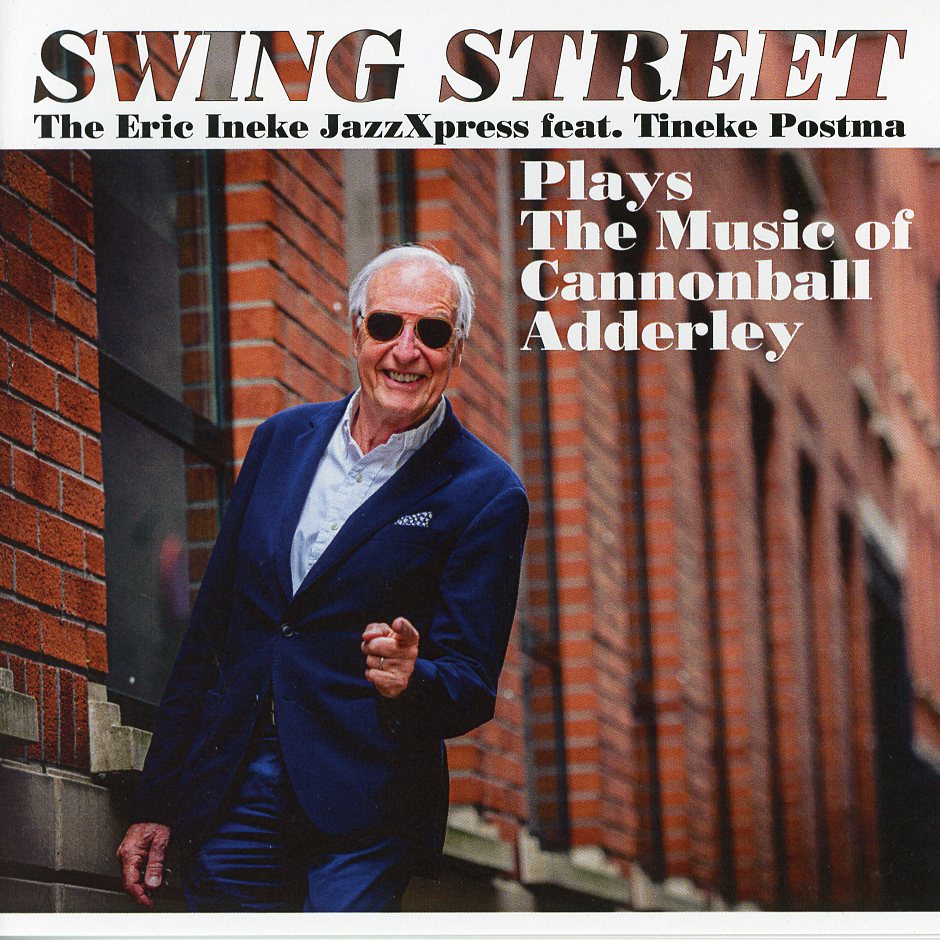

For those of you who like your Jazz served up in a straight-ahead, hard-bop style, then a musical feast celebrating this genre is on hand for you in Swing Street - The Eric Ineke JazzXpress featuring Tineke Postma [Timeless Records CDSJP 495].


For this recording, Eric’s JazzXpress, which turns 20 next year, has added the soprano and alto saxophone talents of Tineke Postma to perform a repertoire of music closely associated with the Cannonball Adderley quintet and sextet of the 1950s and 60s.


In addition to the superb soloing - Eric always leaves plenty of room on his recordings for his players to stretch out - each tune is masterfully arranged to give them a freshness and allow the band to put its own stamp on the material.


While the rhythm section of pianist Rob van Bavel, bassist Marius Beets and Eric on drums have been a part of the group from its inception along with tenor saxophonist Sjoerd Dijkhuizen, trumpeter Nico Schepers is new to the band. Tineke appeared on the group’s CD previous to this one - What Kind of Bird Is This? The Music of Charlie Parker.


This sextet’s configuration is similar to the one that the Adderley Brothers had in place which featured the “soulful brother” Yusef Lateef on tenor sax with a rhythm section of pianist Joe Zawinul, bassist Sam Jones and Louis Hayes on drums.


Regrettably this sextet was short-lived but they did leave us with three albums on Riverside Records: The Cannonball Adderley Sextet in New York Recorded Live at The Village Vanguard [RLP 404, 1962], Jazz Workshop Revisited: Cannonball Adderley Sextet [RM 444, 1963] and the Cannonball Sextet in Europe Riverside LP [RM 499, 1963]


Trombonist J.J. Johnson’s sextet with Freddie Hubbard on trumpet and Clifford Jordan on tenor sax, The Jazztet with a front line of Art Farmer [tp], Benny Golson [ts] and Curtis Fuller [tb] and drummer Art Blakey’s sextet which featured Freddie, Wayne Shorter on tenor and Curtis came into prominence for a brief period from the late 1950s to the mid 1960s. This instrumentation allowed these small groups to create a wide range of textures [sonorities] in their arrangements that produced ensembles with full, rich voicings.


Sadly, the economics of a declining Jazz audience by the mid-1960s made these groups too expensive to book and they were basically phased out, but not before leaving a wealth of terrific music in their wake.


Now, thanks to Eric, Tineke, Sjoerd, Nico, Rob and Marius, you can once again sample Jazz in a sextet configuration which includes new takes on the Cannonball Adderley Sextet Songbook as the band has reimagined each of the eleven original tracks tracks. 
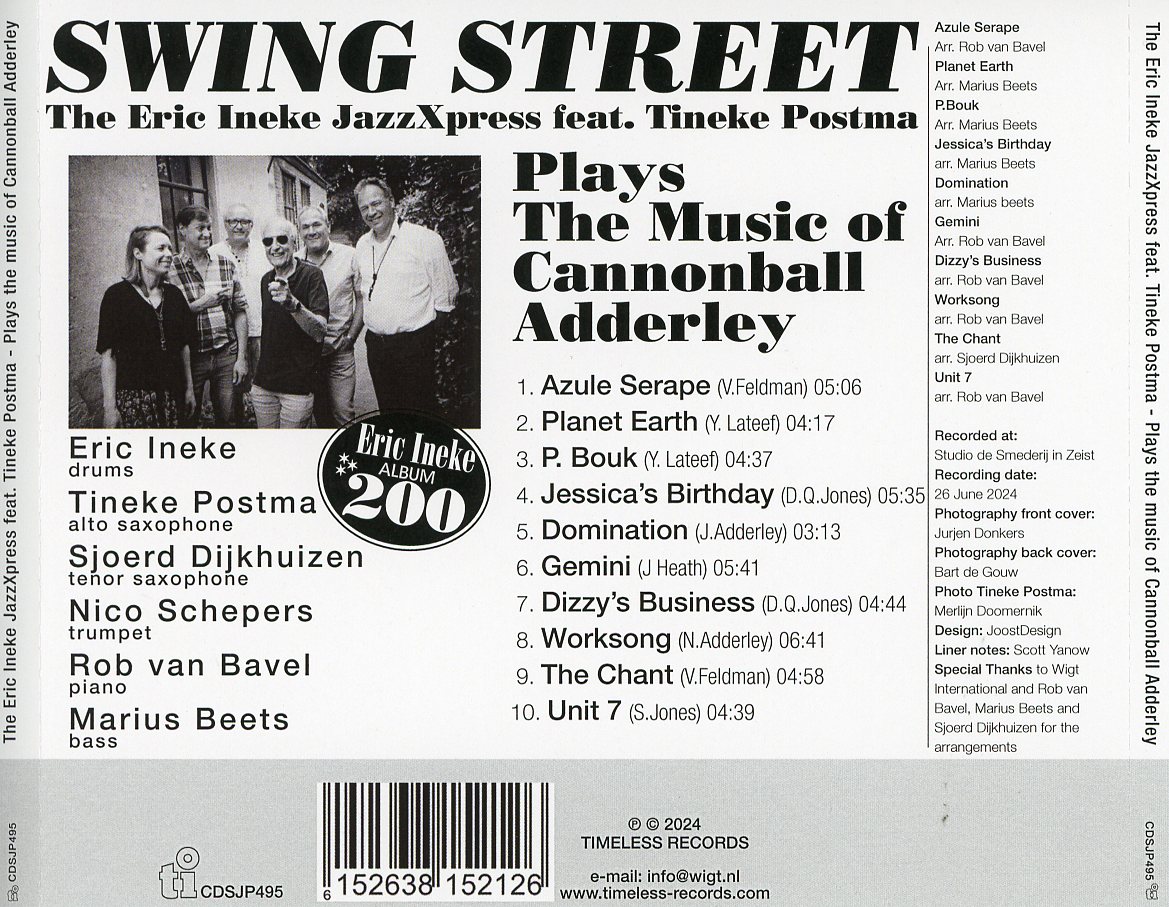


Rob van Bavel does the arranging honors on the opening track, Victor Feldman’s Azule Serape. The London-born pianist, vibraphonist and drummer was with Cannonball from 1960-1961 and contributed a number of compositions to the band’s book. 


On the Cannonball’s live album at The Lighthouse Café in Hermosa Beach California [where Victor was the resident pianist in Howard Rumsey’s All-Stars from 1957-59], Adderley introduces the tune this way: “I've been trying to figure out a long time what this name means for this tune that Victor Feldman wrote for us. This one is called "Azule Serape.” Now he’s from England and I know it's not English. It's something else. "Azule Serape." That’s what the next tune is.”


Rob’s arrangement approaches the tune as a sort of fanfare to open the album in a stirring and energetic manner. After the intro, Eric launches into an Afro-Cuban beat over which the band plays a staccato montuno which evolves into a series of Latin riffs. Rob then commences the melody on piano performing it in its original locked-hand fashion, the band comes in and swings the bridge and the whole thing gets the recording off in a rousing manner. Solos by Sjoerd, Nico, and Rob set the stage for four bar trades with Eric before the band segues the tune into a big finish.


Bassist Marius Beets does the arranging honors on Planet Earth and P. Bouk, both written by Yusef Lateef. The former features Tineke and a fine intervallic solo by Rob showing his interpretive range [think McCoy Tyner].


The latter was released on the 1963 Cannonball Sextet in Europe Riverside LP [RM 499], although it was first recorded by Yusef on his 1961 New Jazz LP - Yusef Lateef Into Something [NJLP 8272]. P. Bouk is an intriguing title and Yusef explains its meaning this way in Nat Hentoff’s notes to the New Jazz album: “It’s kind of an idiomatic language developed in Detroit that refers to a man’s idiom or “bag.” Now I can’t say that this tune sums up what’s in my bag because there is more than one thing in my bag, or rather, there ought to be.” Nat goes on to add: “The ingredients in Yusef’s bag which are primary in this tune is his commanding sense of swing, his gutsy forcefulness and his preference for economical clarity of design.”


Over an opening strummed bass ostinato which is amplified by Rob and Eric, Marius feeds into his arrangement of P. Bouk ingredients from his own “bag” that create a soaring statement of the novel features of the tune and then go on to serve as a launching pad for solos by all of the band members. Oscillating chords establish a vamp for Eric to stretch out over before the band takes the tune out with a full measure of “gusty forcefulness” which would have no doubt pleased Mr. Hentoff.


One thing you can always count on when listening to Eric’s bands is that they always SWING - and that quality is on display in the slow burn the band gives to its interpretation of Quincy Jones’ Jessica Birthday, which is another arrangement by Marius. Jazz played at a slower tempo requires a lot of control because nothing is slurred and everything is stated; clearly enunciated notation. No clichés are on display in the solos by the band members who seem to relish the chance to play out their ideas in a slower rhythmic context. The unison phrasing is clean and articulated which serves to give the slower tempo a nice bounce throughout.


Marius Beets closes out his turn on the arranging chair with a reworking of Oliver Nelson’s arrangement of Cannonball’s original Domination.


Tineke and Marius state the theme to Domination in unison which then relies on a series of countermelodies as contained in the original to set the piece in motion. This is small group orchestration at its finest and everyone had their reading chops on to make this one happen. 


Jimmy Heath’s Gemini, Ernie Wilkins’ Dizzy Business and Nat Adderley’s Work Song comprise the next three tracks; three very distinct tunes which Rob honors with three distinctive arrangements. 


Gemini, Jimmy Heath’s lovely use of a loping 6/8 to waltz time rhythmic pattern, features interesting interludes that Rob has voiced in such a way so as to create a contrast to launch the soloists with Nico, Sjoerd and Rob doing the honors.


Ernie Wilkins’ claim to fame was as a big band arranger and this orientation really shows in the way the melody to Dizzy’s Business is constructed with its punchy phrasing and pulsating rhythmic kicks and licks. An uptempo bash that finds all the band members in fine form, especially Sjoerd who does “the big horn” proud with a take-prisoner solo that is reminiscent of Yusef when he was on the Adderley band. The sextet-as-big-band is on tap on this one.


Next up is Nat Adderley’s Work Song which in later years he would introduce to his audience as “the tune that paid all my bills for a long, long time!” This 16-bar minor blues was one of the most requested tunes in the Adderley’s band repertoire and Rob gives it new life with a refreshing take built around a rubato statement of the melody that makes it even more expressive and emotional.


Marius then sets the tone for the JazzXpress’s interpretation by laying down a driving bass walk over which Tineke’s alto soars before brassman Nico takes over with a vigorous and muscular solo. Sjoerd and Rob get in on the fun before the “van Bavel express” shouts the tune out.


It’s impossible not to have fun playing Nat’s Work Song and this version by the JazzXpress shows why.


Next up is The Chant, another original by Victor Feldman which became the title for the eponymous Sam Jones Riverside album [RLP 9358]. Sam was the first and longest serving bassist with Cannonball’s groups so as you would imagine Sjoerd Dijkhuizen arranged this to feature Marius Beets skillful bass work. Rob joins in after Marius’ solo and the two lock in with Eric to form the driving rhythm section that makes the JazzXpress such a splendid straight-ahead Jazz band. Sjoerd jumps in with a powerful solo until the band returns and takes the tune to a righteous close.


Unit 7 by Sam Jones was Cannon’s closing theme. It’s a 12-bar blues with a bridge which Rob infuses with countermelodies to give the tune a wonderfully crisp sonority. Tineke steps up and steps out with a marvelous solo on alto that’s gotta have Cannonball smiling. Sjoerd follows with some Texas-tenor style phrasing in his solo - what Cannonball describes as a “moan within the tone.” Another fine unison interlude acts as a shout chorus before the band joyfully ends the tune.


As a note in passing, the CD comes with fine booklet notes by the Jazz journalist and historian, Scott Yanow, which provide further insights into the musicians and the music.


Swing Street is the seventh recording in my collection by Eric’s JazzXpress and each one is a gem replete with meticulous musicianship and joyous, swinging Jazz.


As Scott says in his closing remarks: “Swing Street succeeds at paying an affectionate and very musical tribute to the great Cannonball Adderley.”


Do yourself a favor and grab a copy.


You won’t regret it.


Sunday, February 6, 2022

CuberQuest - Ronnie Cuber "Meets The Beets Brothers" [From the Archives]

 © -  Steven A. Cerra - copyright protected; all rights reserved.


Ronnie Cuber was born in New York in 1941. Ronald Edward Cuber made his debut in the late 1950’s in trombonist and music educator’s Marshall Brown's Newport Youth Band at the Newport Jazz Festival. Locating the above photograph of the band in a 1959 edition of Down Beat prompted me to revisit Ronnie’s career and his music.


In the following decades Ronnie worked with Jazz and Latin Jazz masters like Slide Hampton, Maynard Ferguson, George Benson, Lionel Hampton, Woody Herman, Barry Harris, Lonnie Liston Smith, Eddie Palmier! and Lee Konitz. Over the years, Ronnie Cuber earned a reputation as one of the best baritone saxophonists in Jazz  and is often mentioned along with Gerry Mulligan, Nick Brignola and Pepper Adams as being among the best players on that instrument.


Cuber not only received recognition for his achievements on baritone sax, but also as an excellent flute and clarinet player.


In 1976 he joined the legendary Frank Zappa, along with Jazz funk luminaries Michael and Randy Brecker. He appeared on dozens of pop recordings as a sideman, meeting the needs of artists like Aretha Franklin, Eric Clapton. Paul Simon, Bette Middler, Chaka Khan and many more. During the eighties he was a member or the Saturday Night Live Band.


Nowadays, Ronnie Cuber continues to be one of the busiest baritone saxophonists on the contemporary Jazz scene working with the prestigious Mingus Big Band and Horace Silver, as well as touring worldwide with artists like Steve Gadd and Joey DeFrancesco.


In an interview Ronnie gave for the insert notes to his 2009 Maxanter CD Infra-Rae: Ronnie Cuber Meets the Beets Brothers [75967] he was asked:
“You have always played different styles of music like jazz, pop and Latin. Do you recommend young players to do the same.”


To which Ronnie replied: "Yes, I recommend it. There's all kinds of stuff happening. It seems to melt down into the jazz scene. Like in the 1970s with what Joe Zawinul and Weather Report did. It became the norm.  When l am writing music, I also use different style elements. I play all kinds of different music.”


And when Ronnie was asked: “What is your opinion of contemporary Jazz,” he answered:

"Smooth Jazz has developed to a point where it is definitely more listenable than it was some years ago. The musicianship is much higher in groups like Fourplay with Bob James and Everette Harp. But while it is very good, it still doesn't compare to the people I was raised on: Hank Mobley, Art Farmer, Horace Silver, Rav Charles, Art Blakey. Count Basie and Dizzy Gillespie."


Recorded in The Netherlands in 2009, Infra-Rae: Ronnie Cuber Meets the Beets Brothers shows the then 68-years-of-age Cuber more than holding his own with the likes of the much younger Beets [pronounced “Bates”] Brothers: Alexander on tenor sax, Peter on piano and Marius on bass. The drummer on the date is Eric Ineke and here’s a portion of what Eric has to say about Ronnie in his autobiography Eric Ineke The Ultimate Sideman [Pincio Uitgeverij, 2014, The Netherlands]:


“RONNIE CUBER


The first time I played with Ronnie was in 1977 and I was totally blown away by the sound, swing, phrasing and energy produced by this man. He is like Hank Mobley on baritone, a small wonder if you realise that he started out on tenor. The phrasing, just a little behind the beat so typically Mobley and, also like Hank, a very emotional player. His timing is awesome and he plays with such an authority. … He burns right from the start and he is so strong that he gets you where he wants you to be, Hardcore Be-bop. The drummer has to play on top but relaxed. You have to follow him; he is not following you, although he wants interaction. If he wants to burn, you’d better be there, otherwise he is losing you.”


The following audio-only digital music file features Ronnie and the Beets Brothers’ blistering interpretation of Hank Mobley’s Infra-Rae.


Thursday, August 19, 2021

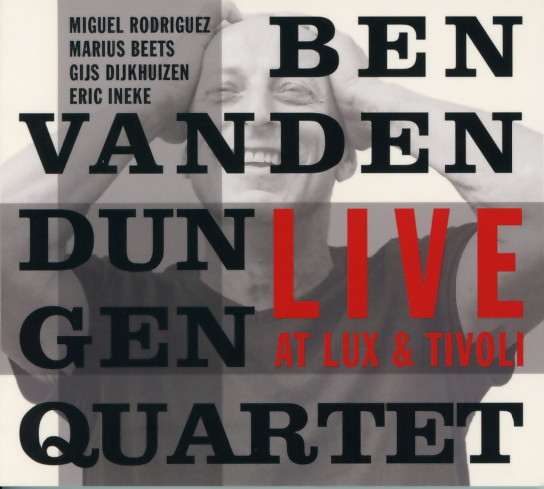
Ben van den Dungen: Live At Lux & Tivoli

 © Copyright ® Steven Cerra, copyright protected; all rights reserved.


“With great pleasure and pride we present the new album of the Ben van den Dungen Quartet ”Live At Lux & Tivoli.” The album was recorded during two (livestream) concerts at the Lux Theater in Nijmegen and Tivoli Vredenburg in Utrecht. These concerts were part of the ”Tribute To John Coltrane” tour, with which the Ben van den Dungen Quartet has already played more than 50 concerts at various festivals and venues throughout the country.


The repertoire of the CD consists of songs inspired by classical works of the legendary jazz saxophonist John Coltrane. Familiar works that you might already know plus the twist of the Ben van den Dungen Quartet.

- The Jazz and Worldmusic Agency


“The first records that blew me away when I was trying to learn to play the saxophone were the Miles Davis Quintet's recordings of the two albums Cookin' and Relaxin'. The saxophone player in that band was John Coltrane. Those recordings - and Coltrane's playing on it - were a big influence on my initial development and the rest of my musical life. There were of course many other players that inspired me as well. In fact, all prominent figures in jazz history did. However, those recordings of Miles were, for me, the start of it all. John Coltrane has always continually inspired me, especially his sound and never-ending devotion to the music.


This is the fourth album of my quartet. It is not meant as a tribute per se, but rather it captures a moment in time where I found myself wanting to dive deeper into the music and heritage of John Coltrane. This album consists of two live performances of my band at LUX in Nijmegen and Tivoli in Utrecht, located in the Netherlands. It captures the essence of jazz: music being created in the moment.

Thank you to SENA PERFORMERS for making this recording possible.”

- Ben van den Dungen


For many years, being able to play on the compositions of the late John Coltrane was akin to a litmus test marking the arrival, in the sense of having made it, to an elite level as a improvising Jazz tenor saxophonist. This ascension [my apologies to those more familiar with the Coltrane canon] has to do with the degree of difficulty that must be mastered in order to play Coltrane changes as advanced harmonic substitutions used in jazz improvisation.


Put more technically, Coltrane changes (Coltrane Matrix or cycle, also known as chromatic third relations and multi-tonic changes) are a harmonic progression variation using substitute chords over common jazz chord progressions. 


In his seminal book on the subject of The Jazz Standards: A Guide to the Repertoire [2012], Ted Gioia explains how these “Coltrane changes” are at work in his examination of two of John’s more famous compositions: Giant Steps and Moment’s Notice.


Giant Steps


Composed by John Coltrane


"Giant Steps," first recorded by John Coltrane for his 1959 Atlantic album of the same name, quickly became famous in jazz circles —but more as an obstacle course than a favored jam session tune. The song "Cherokee" had played a similar role for the boppers of the early 1940s, weeding out the wannabes not ready for the demands of modern jazz. Think of "Giant Steps" as "Cherokee" on steroids.


“True, "Giant Steps'' was not as revolutionary as some of the more avant-garde offerings of the day. Coltrane's song stayed in 4/4 time, followed a i6-bar form, and did not veer outside the conventional boundaries of tonality. The chord progression borrowed many elements used previously by jazz players — listen to Richard Rodgers's bridge to the 1937 standard "Have You Met Miss Jones?" for an important predecessor. Yet at Coltrane's brisk tempo and with a few of his own ingenious harmonic twists added to the mix, this musical steeplechase presented a stiff challenge to an unprepared soloist, circa 1959.


Ah, Coltrane was quite prepared (...). The saxophone titan, for his part, had developed some handy improvisational patterns to employ on the song, most notably a repeated phrase that draws on the opening four notes of the pentatonic scale. Coltrane relies on this motif repeatedly in his solo, and close study of his improvisation reveals a certain rote quality to it.”


Moment's Notice


Composed by John Coltrane


“Did John Coltrane think that casual listeners would notice that all 12 notes of our well-tempered scale show up as roots during the first 16 bars? Probably not. But he did know that the saxophonists who followed in his wake — no small crew, that — would be painfully aware of how quickly the chords were flashing by, and how unusual the harmonic landscape was in comparison with other songs of the day.


No, it's not as taxing as "Giant Steps," the obstacle course that Coltrane would launch on the world two years later, but "Moment's Notice" is still luxuriating in the harmonic maximalism that characterized this stage in the tenorist's evolution. Almost any melodic phrase or scale you rely on for soloing over bar one is unlikely to work for bar two — and this unsettling discontinuity continues for most of the song. Shortly before the final turnaround, Coltrane lets the improviser relax for a brief spell with only one chord change per bar blocking the road ahead. But this is merely time for a deep breath before the form returns to the top, and the battle begins all over again.


So it's a good workout, the musical equivalent of a full circuit around the Nautilus gym.”


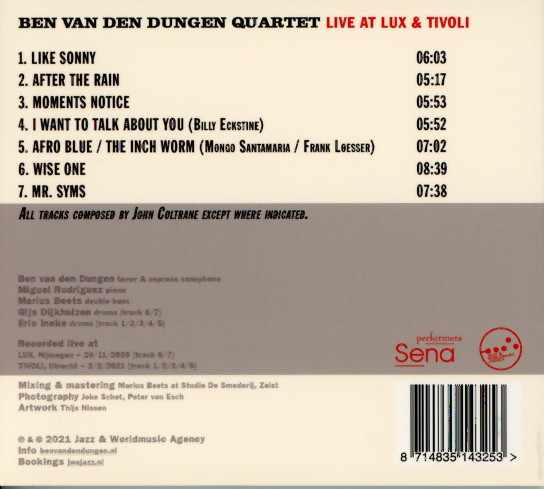
Which brings me to tenor saxophonist Ben van den Dungen’s new CD Ben van den Dungen Quartet ”Live At Lux & Tivoli” on which Moment’s Notice features as the third track.


[Ben does not play Giant Steps on any of his recent quartet CD’s but he did perform it in 1988 as a member of Nueva Manteca on their Varadero Blues album and I have included a YouTube link to it at the conclusion of this piece.]


This a a prepared album in that Ben, along with pianist, Miguel Rodriquez, bassist Marius Beets, and drummer Eric Ineke [with Gijs Dijkhuizen, Ben’s regular drummer, in on tracks 6 & 7] have taken the time to create arrangements for each of the tunes and songs. In other words, it’s not a blowing session; a great deal of thought, planning and preparation has gone into the making of this recording and its shows in the consistently high level of creativity the music attains.


The other welcomed dimension is that it’s music is performed before an audience which always seems to give Jazz a special magic as the energy that the audience brings is transferred to the musicians which results in the quality of the music being kicked up a notch.


Although, five of the seven tracks are devoted to compositions by John Coltrane, it’s a varied program with ballads After the Rain, and I Thought About You, medium tempo cookers Wise One and Mr. Syms interspersed between up tempo burners such as Like Sonny, Moment’s Notice, and Afro Blue [which cleverly has Frank Loesser’s The Inch Worm added as a tag].


Throughout, the listener can revel in Ben’s big, bold and bountiful sound for in his hands, the tenor is appropriately named The Big Horn. While Coltrane chromatics, harmonics and chord substitutions are everywhere apparent in his playing, Ben never gets away from a powerful and primary swing in his soloing. He drives the music forward with a pulsating sense of urgency.


And while, for obvious reasons, ‘Trane is always a presence in Ben’s approach, you also hear a lot of Sonny Rollins, Dexter Gordon, and some occasional Johnny Griffin flights of fancy in some of the fast runs he incorporates into his playing. Ben is the real deal; he comes to play.


Throughout he is aided and abetted by a driving rhythm section of Miguel Rodriguez, Marius Beets and Grand Jazz Master Eric Ineke whose classic straight-ahead drumming is featured on two choruses of Moment’s Notice. 


Miguel, Marius and Gijs Dijkhuizen have been with Ben on Ciao City [2013], A Night at the Club [2014] and 2 Sessions [2017] and have evolved into a very cohesive rhythm section, as well as, individually defined voices on their respective instruments.


In terms of the Dutch Jazz scene, Rodriquez is the relative newcomer in the mix, but he plays with a maturity well beyond his years, both as an effective accompanist and as a soloist whose inventions bubble over with seemingly endless ideas. As usual, Marius is his usual immoveable self: keeping time, framing the chords and contributing masterful solos on Wise One and Mr. Syms. And one wouldn’t have to look too far to find the next “Eric Ineke” in Dutch Jazz circles as drummer Gijs Dijkhuizen will ably fill that role.


Ben’s albums are always satisfying as the music on them quickly brings the listener into an atmosphere filled with the essence of swinging and sonorous Jazz. He envelops you in his music; it’s like he gives you the musical equivalent of a big bear hug. 


Van den Dungen Jazz is exciting, adventurous and burning with intensity.


If, as Louis Armstrong says, “Jazz is who you are'' - then the music on Ben van den Dungen Quartet ”Live At Lux & Tivoli” will leave you in no doubt as to who Ben van den Dungen is - one, monster Jazz tenor saxophonist!


You can sample this music on the Jazz and Worldmusic Agency website and locate order information by going here.


Sunday, December 8, 2019

Doug in Holland with Marius and Eric

© Copyright ® Steven Cerra, copyright protected; all rights reserved.


I recently reviewed new CDs by baritone saxophone greats Ronnie Cuber and Gary Smulyan on which they are accompanied by only bass and drums.


Now comes tenor saxophonist Doug Webb in Holland: The Doug Webb Trio [Challenge DBCHR 75228] on which the Los Angeles-based reed and woodwind is joined by two talented and skillful Jazz musicians who reside in Holland: bassist Marius Beets [pronounced “Bates”] and legendary drummer, Eric Ineke.


This combination of tenor sax, bass and drums immediately brought to mind shades of Sonny Rollins at the Village Vanguard with bassist Wilbur Ware and drummer Elvin Jones.


The challenge with horn-bass-drums becomes one of how do you keep 50 minutes of Jazz without chordal players - pianists and guitarists - interesting for the listener while at the same time guarding against a sameness settling in because of the limited instrumentation?


A number of factors are at work on this recording to maximize the former while minimizing the latter, among them:

- Three mature and accomplished Jazz soloists who have a lot to say in their solos and say it well: Webb with his Zoot Sims swing and Warne Marsh melodic and harmonic sensibilities all wrapped in a big Dexter Gordon sound; Marius with his meaty, booming bass sound and gift for framing the chords harmony with a precise choice of notes; Eric with his relentless drive, refreshingly alternating between sticks and brushes and creating 4 and 8 bar trades and occasional choruses that are musical and not just a display of drum technique

- Constructing arrangements around each tune, some featuring the bass in unison with the tenor, and creating a variety of tempos, riffs and interludes that keeps the listener engaged.

- Blend four original compositions with three Jazz Standards and three songs from the Great American Songbook to create a program of melodies that are at once familiar and explorative

- Creating an in-the-room sound so that the intimacy of three instruments is not lost acoustically while at the same time, helping to bring the listener into the music [here, a nod to another of Marius’ skills as he also served as the recording engineer for the project].


As was the case with the recent baritone sax, bass and drums CDs by Ronnie Cuber and Gary Smulyan, one soon realize how brave and bold musicians have to be to perform in these nowhere-to-hide formats.


But Jazz has always been about risk-taking; good Jazz, anyway.


I mean, who wants to hear the same tried-and-true licks played over and over again, ad infinitum, ad nauseum? 


On Doug Webb in Holland: The Doug Webb Trio [Challenge DBCHR 75228], Doug, Marius and Eric step up, put their maturity and experience into play, and produce consistently interesting and exciting music that’s fun to listen to and full of what Duke Ellington referred to as “the feeling of Jazz.” 


© Copyright ® Scott Yanow, copyright protected; all rights reserved.


Here’s more background about the musicians and the music from Scott Yanow’s always informative insert notes to the CD:


“A maior saxophonist for decades who has mastered virtually every reed instrument from sopranino to contrabass sax and all types of flutes and clarinets, Doug Webb is best known for his tenor playing. He has appeared in a countless number of settings, working with Horace Silver, Freddie Hubbard, Stanley Clarke, Quincy Jones, the Doc Severinsen Big Band, and as a longtime member of the Bill Holman Orchestra in addition to recording for hundreds of films and television programs. But to hear him at his best, listen to Doug Webb with small jazz combos where he can really stretch out, such as the one featured on this release.


In 2015, Doug Webb toured Holland with veteran pianist Rein de Graaff's trio which included bassist Marius Beets and drummer Eric Ineke. "We did an extensive tour," remembers Doug, "something like 13 concerts in 14 days. 
In 2018 I returned to play a gig, pick up a contra alto flute and a subcontrabass flute from world renowned flute maker Eva Kingma and record with Marius and Eric."


Playing with a pianoless trio presents some challenges that Doug Webb clearly enjoys. "I always like playing in this type of trio, I have much more freedom than in a larger group and I can play with a lot more energy to fill in the space. In college I played in pianoless trios all of the time and a big influence at the time was George Garzone and his group The Fringe. Eric Ineke is a great swinging drummer while Marius Beets is a wonderful bass player who adds a great deal to the music." Ineke, who has worked with Rein de Graaff for 35 years, has recorded along the way with such notables as Dave Liebman. Al Cohn. Barry Harris, George Coleman, Dexter Gordon and Ben Webster. He leads the Eric Ineke JazzXpress which has made many recordings for the Daybreak label. Marius Beets played with his siblings as the Beets Brothers and has worked with Rita Reys. Johnny Griffin, James Moody. Gary Bartz, Deborah Brown, Houston Person, Dave Liebman and many Dutch groups including the Metropole Orchestra and his own Powerhouse Big Band.


Doug Webb In Holland was recorded in 3,5 hours with nearly all of the released selections being the first take. "This album has standards, bebop tunes and a few originals that are mostly based on familiar chord changes. I simply picked out good tunes, many of which I had not recorded before."


The program begins with Doug's "254 W. 82nd Street," an original named after his mother's former address. The medium-tempo piece features the tenor-saxophonist stretching out over the driving bass and stimulating drums, giving his own take on the John Coltrane tradition. "Subconscious Lee." the classic Lee Konitz line based on "What Is This Thing Called Love," has Doug taking a solo worthy of Konitz or Warne Marsh. Here, as on many of the performances, Beets and Ineke take short solos that perfectly build off of Doug's ideas.


"Delilah" is a beautiful Victor Young composition that was immortalized in jazz by Clifford Brown's 1954 recording although Doug best remembers a live version with Eric Dolphy on bass clarinet and Coltrane on soprano. The bass and drum patterns uplift the new rendition that has Doug adding his own feelings and fresh ideas to the haunting melody. "Invitation" can be considered this generation's "Body And Soul" in that it is a song that nearly every tenor-saxophonist loves to play. Doug and his trio perform a cooking version filled with inventive ideas. Following "Invitation" is "Alexico." a soulful boogaloo blues that combines the words Alex (Doug's wife) and Mexico where they often take vacations. The catchy number is quite infectious.


"Ornithology," composed by trumpeter Benny Harris and made famous by Charlie Parker, features a unison melody by tenor and bass, and some swinging bebop statements including one of the best bass solos of the date. Doug Webb plays the melody of "Spring Can Really Hang You Up The Most" beautifully and tastefully adds some variations without leaving the memorable theme behind. He whips through a hot version of his "These Things" (based on "All The Things You Are"), digs deep into the still-modern chord changes of Cole Porter's "Get Out Of Town," and concludes this memorable set by performing his "Lunar Eclipse," an original based on a tune he wrote earlier called "Lunar" which in turn is based on the standard "Solar,"


The saxophonist sums up the session this way: "I try to do something a bit different on each recording that I make. I'm particularly excited about the performances on this record." Listeners will feel the same way about the spontaneous and inspired playing featured throughout Doug Webb In Holland.”


Scott Yanow
(Jazz journalist/historian and author of 11 books including The Great Jazz Guitarists and Jazz On Record 1917-76)