© -Steven Cerra, copyright protected; all rights reserved.

I recently received the following correspondence from Michael Owen concerning the status of his Julie London book project and I thought it might be fun to share it with you as a blog feature of sorts.
“Dear Steve,
Good news! The final manuscript of my book - currently entitled Go Slow: The Life of Julie London - is due to Chicago Review Press next Friday. The title's taken from a song she recorded in 1957 that she said summed up her style. Are you familiar with it?
Thanks for being in touch with me early on the process. I really appreciate how willing people were to provide me with contacts and information. It all went into the mix - successfully, I hope.
Although it's not set in stone, the book's scheduled for spring/summer 2017 release. As a preview, I've attached an essay I was asked to write on Julie's 1955 recording of Cry Me a River, which was added to the Library of Congress’ Recording Registry earlier this year. The essay was recently posted online.
Feel free to pass this along to anyone you think might be interested in the subject. The more the merrier!
I hope you're doing well.
All the best,
Michael”
By way of background, “Michael Owen is an archivist, writer, researcher, and librarian. A Consulting Archivist to the Ira and Leonore Gershwin Trusts, he is also the webmaster at www.gershwin.com, and the Managing Editor of Words Without Music, a publication of the Trusts. He is a member of the Editorial Board of the George and Ira Gershwin Critical Edition. A historian of popular music and culture, he is currently completing a biography of Julie London. He lives in the San Francisco Bay Area with his wife and their cat.”
Cry Me a River – Julie London (1955)
Added to the National Registry: 2015 Essay by Michael Owen (guest post)*
Julie London
An unknown song...an unknown singer...an unknown label. Not an ideal combination for a hit record.
Julie London was born Nancy Gayle Peck in Santa Rosa, California, in 1926. As a child, London was surrounded by music. Her parents were singers who often performed on the radio and at nightclubs in San Bernardino, California, and she soaked up songs and a relaxed vocal style that matured into a uniquely throaty purr as she reached adulthood.
At the age of sixteen, London was discovered by an agent who spotted her running an elevator at an upscale men’s clothing store on Hollywood Boulevard. She appeared in 11 movies during the 1940s and 1950s--among them supporting roles opposite Edward G. Robinson and Gary Cooper --but with little success, and retired at the age of 25 to raise a family with her husband, actor Jack Webb (“Dragnet”).
After the couple’s divorce two years later, London intended to resume her acting career, when fate arrived in the person of songwriter Bobby Troup (“Route 66”).
Troup encouraged London to sing professionally from the moment they met. The natural, unaffected qualities in her voice set her apart from other female vocalists of the day, he reasoned, and would help her regain a footing in show business.
While London often sang around the house--she described herself as a “living room singer”--with friends who gathered around her piano at the end of the evening, she had no interest in singing for her supper. Undeterred by her fierce reluctance, Troup’s contacts in the music business soon brought London a booking-- without an audition--at a small Hollywood nightclub in the summer of 1955. Accompanied solely by the influential jazz guitarist Barney Kessel and double-bassist Ray Leatherwood, who succeeded Ralph Peña midway through the engagement, London’s intimate performances of standards from the Great American Songbook were immediately successful among the Hollywood cognoscenti.
Two weeks of shows became ten. One night, Troup sent Si Waronker, the owner of a new Los Angeles-based independent record label, to see London perform. Impressed by the uniquely- individual sound London made with just guitar and bass, and the visceral effect her physical presence had on audiences, Waronker signed her as one of the first artists on Liberty Records.
“Cry Me a River,” the song that cemented London’s reputation, came out of the blue and was a last-minute addition to her first recording sessions. Arthur Hamilton, a high school boyfriend of London’s, had been working as a songwriter for the production company of her ex-husband, Jack Webb. (She had helped Hamilton land the job.) In 1955, Webb was making “Pete Kelly’s Blues,” a movie set in the 1920s with appearances by singers Peggy Lee and Ella Fitzgerald. The lyrics for one of Hamilton’s songs intended for Fitzgerald included the word “plebeian,” which Webb told the songwriter no one would believe her singing. Hamilton was unwilling to change the word. Webb dropped the number from the picture.
A few nights later, Hamilton played the song for London at her house. She immediately fell in love with its haunting melody and coolly defiant lyrics, hearing echoes of her troubled relationship with Webb. Hamilton said “yes” when London asked if she could record it. As with all of the arrangements for London’s early performances, “Cry Me a River” was very quickly sketched out in a head arrangement by the singer and her accompanists. Guitarist Barney Kessel and bass player Ray Leatherwood had never heard or seen the music to “Cry Me a River” when London suggested it in the last few minutes of a recording session at Western Recorders. It would be the one new song added to the collection of standards taken from her nightclub act that had already been laid down. Captured in just a few takes, Kessel’s chords and Leatherwood’s descending bass introduction set the stage for London’s coolly-detached performance that kept the slow pace of Hamilton’s original and allowed his lyrics to come through with the precision they required.
Test pressings of the album were sent to disc jockeys around the country, and they found “Cry Me a River” as intriguing and unique as its singer did. The whispered, murmured sound of “Cry Me a River” was unlike anything they’d heard in recent years. London’s soft-sell approach, and the understated quality of the record, was a sharp contrast to contemporary hits such as “Love Is a Many-Splendored Thing” and “I Hear You Knockin’.”
Liberty Records released the song as a single in Fall of 1955. Aided by television appearances on Perry Como’s popular variety program and Steve Allen’s “Tonight” show, “Cry Me a River” began an unlikely five month run on the pop singles chart. It was Liberty’s first hit and the company had difficulty fulfilling the demand for orders from record distributors. The release of London’s first album, “Julie Is Her Name,” which topped industry charts, soon followed.
London had rejected the idea of recording her first record in front of a live audience, rightly judging that her “thimbleful of voice” would be drowned out by the clattering of dishes and conversation. Audio engineer John Neal recognized that London lacked the ability to project her voice, and asked her to move in as closely as she could to the sensitive Telefunken microphone, which accurately captured the intimate sound of London’s breathing on the recording tape. The addition of a subtle echo gave a near three-dimensional presence to her voice that encouraged listeners to come ever closer to their speakers.
Shocked by her unexpected success, London’s New York nightclub debut in January 1956 was another major milestone, and her appearance in the hit movie musical “The Girl Can’t Help It,” in which she sang “Cry Me a River” as an ethereal presence haunting actor Tom Ewell, helped cement her relationship to the song. London remade the song, complete with strings and a tinkling cocktail piano, for a 1959 single. For the remainder of a career that took her around the world, from nightclubs in Rio de Janeiro to Tokyo, to a long series of engagements at the Tropicana Hotel in Las Vegas, London sang to audiences that could never get enough of her first hit. “Cry Me a River” is now a standard and has been covered by many artists in a wealth of diverse styles. Barbra Streisand included the song on her 1963 debut album, while Ray Charles and Joe Cocker delivered soulful renditions in 1964 and 1970, respectively. In 1993, it was released as the first single by the lounge revival act Combustible Edison, and was returned to its roots by Canadian jazz/pop vocalist Diana Krall eight years later.
But there can only be one first recording, one chance to make something of nothing. Although Julie London released more than 350 recordings during her career as a singer (1955-1981), “Cry Me a River”–-with its subtle, and uniquely-suitable, guitar and bass accompaniment--remains her most popular, a signature tune that set a standard few have ever equaled.”
*The views expressed in this essay are those of the author and do not necessarily represent the views of the Library of Congress.


 Listening to the three tracks by the Jay and Kay Quintet on this LP, I “met” J.J. Johnson for the first time and it was love-at-bass-clef on my part. I had heard Kai Winding earlier on some Stan Kenton 78’s that a friend loaned me, but it was a new experience for me to hear his big, open sound in a small group setting.
 Here’s what Günter Schuller has to say about the Kenton trombones and Kai Winding:
 Although the section’s personnel changed often over the decades, it retained its astonishing stylistic consistency, not only because of stalwarts such as Milt Bernhart and Bob Fitzpatrick held long tenures in the orchestra, but because incoming players, such as Bob Burgess and Frank Rosolino and a host of others, were expected to fit into the by-then-famous Kenton brass sound.” [op. cit., p. 637; paragraphing modified].
 A few years later, when my family moved to Southern California, I was introduced to the other half of my preferred Jazz trombone tandem when I visited The Lighthouse Café in Hermosa Beach, CA and I heard the inimitable Frank Rosolino perform as part of Howard Rumsey’s Lighthouse All-Stars [LHAS].
 “As the BOP REVOLUTION spread, solo instruments other than the trumpet, alto sax, and piano began to echo the doctrines of Parker and Gillespie. The trombone, largely a rhythm instrument in the dawn of jazz before it was granted true solo privileges, had never been played in the swift, extremely legato, eighth-note style that J.J. Johnson introduced in the mid-forties. Since that time there have been few new trombonists who haven’t shown some manifestation of Johnson's style in their playing.
 But what I did know was how much I enjoyed listening to the sound that both J.J. and Frank produced on the trombone.
 More background about the development of Frank’s incredible facility on trombone can be found in the following from Ted Gioia, although the source for the citation changes to his West Coast Jazz, Modern Jazz in California: 1945-1960 [New York: Oxford University Press, 1992]:
 What an album! I still have the original LP and it is a miracle that it plays given the number of times a needle has cut through the vinyl.
 This recording is a composite snapshot of everything that was going on in the Jazz world of its time [1960/61] from the modal sounds of Miles’ Kind of Blue to the hard bop infusion of gospel and blues into bebop, to the ¾ time craze and minor harmonies preferred by the “My Favorite Things” John Coltrane quartet to the next generation of up-and-coming, front line soloists as represented by Hubbard, Jordan, Walton and Heath.
 As Teo Macero points out in the liner notes to the LP, “When J.J. finished composing In Walked Horace, he exclaimed, ‘Look what I’ve done! It’s Horace Silver.’” The medium tempo tune is based on “Rhythm Changes” and contains the total surprise of Clifford Jordan taking over in the middle of a Freddie Hubbard chorus and continuing it as though nothing had happen! J.J.’s “solo” on the tune consists of trading 8’s, then 4’s, then 2’s and then 1’s with Tootie Heath before Cedar ends the soloing with one of his perfectly crafted solos based on evenly spaced eight-note phrases with more than their share of funk.
 The best summary one could offer for J.J.’s music and playing on J.J. Inc. is contained in Steve Turre’s closing insert notes paragraph:
 In the late 1950’s, listening to Frank Rosolino play trombone night after night at the Lighthouse, and later at other venues in and around Hollywood, was an experience I’ll never forget. The man was a phenomenally inventive instrumentalist.
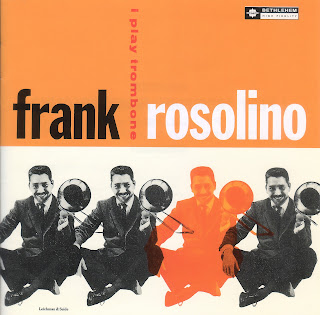 and the Russ Garcia arranged Four Horns and a Lush Life [BCP-46; released as a Japanese CD by Toshiba-EMI, TOCJ-62052],
 Although I did not own any of them at the time, I was even fortunate enough to hear some of the 10” and 12” LP’s that Frank recorded for Capitol under the “Kenton Presents Jazz” banner all of which have been collected and subsequently released as Mosaic Records MD4-185:
 With outstanding arrangements by Bill Holman, trumpeter Sam Noto and alto saxophonist Charlie Mariano joining Frank on the front line and a brilliant rhythm section of Pete Jolly [p], Max Bennett [b] and Mel Lewis [d], it is regrettable that these recordings didn’t have a wider distribution thus giving Frank a greater national exposure.
 Love for Sale opens the album with the melody played behind Stan Levey’s 6/8 Latin figure that resolves into a wickedly fast, double-timed 4/4 bridge. The blowing takes place in a slower, medium tempo and Frank’s and Harold Land’s solos "… establish immediately that this is a tough, no-holds-barred blowing session” [Leonard Feather’s liner notes].
 Many years later, after all of the East Coast versus West Coast nonsense had died down, I saw J.J. [who had, by then, been in Hollywood for a number of years writing for TV and the movies] sitting with Frank at Donte’s, a Jazz club and musicians hang-out in North Hollywood, CA. It was early in the evening before the set began and the two were having a quiet dinner together.
