Saturday, September 7, 2019

Gary Smulyan - "Alternative Contrafacts"

© Copyright ® Steven Cerra, copyright protected; all rights reserved.


In its simplest form, a contrafact is a musical composition consisting of a new melody overlaid on a familiar harmonic structure.

Put another way a contrafact is the use of borrowed chord progressions.

Songs that are frequent candidates for such alterations are Gershwin’s I’ve Got Rhythm, Jerome Kern’s All the Things You Are, and Johnny Green’s Out of Nowhere.

The list is endless.

With the coming of Bebop in the early 1940s, the use of contrafacts really kicked into high gear because alto saxophonist Charlie Parker, trumpeter Dizzy Gillespie and other pioneers of the music emphasized the harmonies in the chords to a song as the basis for their improvisations whereas Swing Era soloists generally employed variations on the melodies.

The Beboppers went so far as to use substituted harmonies to alter the original chord progressions which consequently altered the logic upon which their improvised solos was based.

Many of these early Bebop combos were quintets with trumpet and saxophone forming the front-line which was backed by a piano-bass-drums rhythm section. The chords were “fed” to the horns by the pianist in the form of “comping” [short for accompaniment], with the bass player creating lines that outline the harmony while also working with the drummer to create a groove or a feel as a metronomic pulse to help keep the music flowing.

But altering the music with different emphasis on the musical elements was just one way that Jazz changed the manner in which it was played.

Over the course of its history, jazz has also evolved by adding some instruments and dropping others. For example, Count Basie’s classic swing rhythm section consisted of piano, guitar, bass, and drums. The bop revolution dropped the guitar, retaining it only as an occasional solo instrument.

Joe Goldberg commented in his Jazz Masters of the 1950s:  “In 1952, Gerry Mulligan, who has always had an affinity with several different eras of jazz, took the piano back out, and the result was the Gerry Mulligan Quartet, one of the most highly successful small groups of the fifties.

Mulligan …  wrote in the notes to his first Pacific Jazz LP - ‘To have an instrument with the tremendous capabilities of the piano reduced to the role of crutch for the solo horn was unthinkable ... I consider the string bass to be the basis of the sound of the group, the foundation on which the solo builds his line , the main thread around which the two horns weave their contrapuntal interplay. It is possible with two voices to imply the sound or impart the feeling of any chord or series of chords as Bach shows us so thoroughly and enjoyably in his inventions.

‘When a piano is used in a group it necessarily plays the dominant role; the horns and bass must tune to it as it cannot tune to them, making it the dominant tonality. The piano's accepted function of constantly stating the chords of the progression makes the solo horn a slave to the whims of the piano player. The soloist is forced to adapt his line to the changes and alterations made by the pianist in the chords of the progression,

‘It is obvious that the bass does not possess as wide a range of volume and dynamic possibilities as the drums and horns. It is therefore necessary to keep the overall volume in proportion to that of the bass in order to achieve an integrated group sound."

By 1959, the pendulum of taste had swung so far that the English critic Max Harrison could say of Mulligan's once-revered quartet that "its instrumentation threw emphasis on clear melodic expression and simple rhythmic construction. The resulting lack of tension was another attraction. Whereas artists like Tatum or Parker compel our attention with the hectic complexity of their work, the somewhat detached relaxation of the Mulligan Quartet entertains and even intrigues the listener without unduly involving him. Thus, audiences who failed to respond to the uncompromising attitude of bop or the Davis 1948 band were able, in listening to the Quartet, to congratulate themselves on their advanced taste while really experiencing quite straightforward music. . . . The air of rather smart disillusionment that surrounds interpretations like Funny Valentine would also be sympathetic to superficially sophisticated audiences."

As the legendary bassist Charles Mingus succinctly said - “You have to improvise on something” - and these contrafacts with their original and/or substituted chord progressions became the format of choice for Bebop and much of the mainstream modern Jazz that followed it.

On Alternative Contrafacts  [Steeplechase SCCD31844], Gary Smulyan takes melodic substitutions and instrumentation reduction one step further by limiting the instrumentation to baritone saxophone, string bass and drums.

As a result, there is so much space that you can almost hear the music breathe.

The uncluttered atmosphere also lends itself to a very close interaction between the players: Gary on baritone sax, David Wong on bass and Rodney Green listen to one another very intently and inspire each other.

Neil Tesser and Gary define the specific meaning of “alternative contrafact and more about the music on this CD in the following insert notes. Oh, and by the way, as you will soon read, Gary’s done this sort of thing before!

“You've heard of "alternative facts." But Alternative Contrafacts?

"It's not political," Gary Smulyan says, the words tumbling out with his customary energy. "It's meant to be humorous. I've just always loved contrafacts" - which, despite what that word seems to indicate, are actually not "contra" to the truth.

In music, the word "contrafact" refers to a new melody line that follows the chords and structure of an existing composition. This methodology dominated the bebop years, when musicians regularly superimposed complex melodies on such workhorse chord progressions as Indiana (which became Miles Davis's Donna Lee), or What Is This Thing Called Love? (most famously recast as Hot House); I Got Rhythm underlies a bookful of jazz tunes. These variations allowed the boppers to inject their ideas on melody, harmony, and rhythm into familiar designs; not incidentally, it also spared them from paying royalties to the original composers, since by law, only melodies not chord progressions can be copyrighted.

So a contrafact is, literally, an "alternative" to the underlying composition, and contrafacts constitute hundreds and possibly thousands of jazz melodies from the bop years to the present. But this takes us back to the original question: what's an "alternative contrafact"?

Well, for every well-known contrafact, you can find plenty more that, for whatever reason, never gained traction among musicians. "There are so many of them that were recorded just once and then disappeared. Some of them were never played on gigs; some were composed and recorded for the sole purpose of documenting them" speculates Smulyan, who has been fascinated by this cornucopia of material for decades. He has made it a goal to corral as many as possible of the more obscure examples - the alternatives to Hot House and Donna Lee, among the scores of other tunes that lent themselves to these reworkings.

For listeners with an ear for old standards, Smulyan posits a game of sorts: Try to figure out the underlying tune without referring to the rest of this essay.The instrumentation on this disc makes that harder than you'd think. Smulyan's trio features neither piano nor guitar - the instruments that would normally outline the chords, which would make it easier to identify the original tune once the improvising begins. But for a clue, here's a list of the originals that inspired these contrafacts: Yesterdays, A Foggy Day, Love Me Or Leave Me, Strike Up The Band, Out Of Nowhere, Dinah, Lady Be Good, and Get Happy. (Mix and match.)

You've likely encountered few of the songs Smulyan has gathered for this collection. He readily admits that they're "really obscure"-even more so than on his two previous forays into arcane contrafacts, Hidden Treasures (2006) and More Treasures (2007) "But it's been an interesting project to resurrect them" he points out. I could make 20 records like this; it's fun just finding the recordings of all these things."

He's had help.

In 1970, a pianist and psychiatrist named Maurice "Reese" Markewich literally wrote the book on contrafacts when he published a now unavailable volume titled Bibliography Of Jazz And Pop Tunes Sharing The Chord Progressions Of Other Compositions. Smulyan stumbled across this book in the 1990s, and soon spent considerable time with Dr. Markewich, visiting him in an office filled with "folders and folders of sheet music and lead sheets." As Smulyan explains, "This has become my little reference book "- but one that he can't recommend to friends, since he has never unearthed another copy.

In the Bibliography, you can turn to any page with the heading of a familiar standard and find a list of the contrafacts based upon it. In addition to the well-known, it includes hundreds of tunes that, true to Smulyan's description, "were recorded just once and then disappeared." It has proved so valuable to his ongoing excavation of alternative contrafacts that Smulyan dedicates this album to Markewich (as well as to the memory of his mother Sonia).

You might wonder why it matters to have yet another contrafact to, say, Green Dolphin Street. After all, if the soloing takes place on the same chord structure as all the other Dolphin contrafacts, what's the big deal? But as Smulyan points out - and then demonstrates throughout this disc - savvy improvisers don't simply run through the melody and toss it away. "Very often, the melody is a springboard for how you improvise on that song. It can become a sort of reference point for the solo." In other words, the best players can take a cue from something in the contrafact - a phrase, a rhythmic motif, the alternate chords implied by the melody - and incorporate it as they spin their variations. And this trio comprises some of the very best players.

David Wong owns a light but authoritative touch that distinguishes his solo passages (bowed or plucked) and especially the understated solidity of his time; his stand-alone accompaniment to Smulyan on the opening passage of Deep People offers a good example. On drums, Rodney Green employs an array of consistently inventive rhythmic materials, from the hard-bop pulse of the opening track, to the lovely brush work of Moodamorphosis, to the Latin drive of On The Minute.  As for Smulyan, his mastery of his instrument brooks no doubt, and he puts it to the service of a fiery, intense imagination - just as he has on the dozen albums under his own name and in the big bands he has so ably anchored, including Woody Herman's Young Thundering Herd, the Vanguard Jazz Orchestra, and the Mingus Big Band. Many of us consider him the leading baritone saxophonist of his generation - he just keeps racking up those poll victories - and in the context of this freewheeling trio, you can hear why.

As for the tunes themselves:

Vodka, by pianist Mal Waldron - first recorded by a sextet that paired tenor saxists John Coltrane and Paul Quinichette - is based on Yesterdays by Jerome Kern. Three of these contrafacts refigure songs by George and Ira Gershwin: Jimmy Giuffre's beguiling Deep People (based on A Foggy Day), Paul Chambers's Tale Of The Fingers (from Strike Up The Band), and Moodamorphosis, based on Lady Be Good, written by bop composer Gil Fuller and trumpeter Dave Burns for a James Moody recording date in 1948. The witty saxophonist-arranger Al Cohn used the Depression-Era anthem Get Happy as the foundation for Cohn Pone; of similar vintage is the romantic (You Came Along From) Out Of Nowhere, written by Johnny Green, and transformed by trumpeter Ted Curson into Ahma See Ya on a 1961 album entitled Horn Of Plenty. The American expatriate trumpeter John Eardley appended On The Minute to the framework of Love Me Or Leave Me, a Broadway hit from 1928 by the team of Donaldson and Kahn. Even older is Dinah, written by Harry Akst in 1925; in 1958, Coleman Hawkins wrote a new melody, then reversed the original title to come up with Hanid. The remaining track here, I've Changed, derives from the 1941 torcher You've Changed by Bill Carey and Carl Fischer. It’s not a true contrafact in the sense that it begins with Smulyan's solo, instead of a written melody line to replace the original; I doubt anyone will complain.

All of this would be merely academic if not for the luminous performances throughout. Nearly two decades into the 21st century, cries of "fake news" and "alternative facts" have done a pretty good job of muddying up the public discourse.”


Friday, September 6, 2019

Dizzy's Big Band


© -  Steven A. Cerra, copyright protected; all rights reserved.


There are two things that the editorial staff at JazzProfiles has a well-developed fondness for: [1] Dizzy Gillespie’s Big Band in all its manifestations over the years and [2] Gene Lees’ writings about Jazz in their varied forms and issuances over the years. 

With the exception of listening to Dizzy’s big band itself, the next best thing is reading what Gene has to say about it and its significance in the World of Jazz.

Fortunately for us, the concert discussed in Gene’s piece was saved to record, first as an LP by the impresario Gene Norman for his Crescendo Label and subsequently as a CD when it was released along with some tracks from an early concert in Paris as Vogue VG 655612.

Before Gene’s passing in April 2010, he granted his permission to reproduce this piece about Dizzy’s Big Band from one of the earliest editions of his Jazzletter [June 15, 1983 Vol. 2 No. 11].

The photos that populate Gene’s essay and the video at its conclusion have been added.

In the interest of accuracy, the concert by Diz’s band at the Pasadena Civic Auditorium did not take place in 1949, but rather, on July 26, 1948. This correction is corroborated by the fact that Chano Pozo died in 1948.

© Copyright protected; all rights reserved

“I never saw Dizzy Gillespie's big band, and what could be heard of it on records left me frustrated. Many musicians contend that it was one of the greatest of all the bands, and some say the greatest. Most recordings of it, however, seem like faded photographs of a dream. Tape was only coming into general use and stereo was ten years in the future.

One recent evening I had dinner with Gene Norman. Afterwards we repaired to the house high above the Sunset Strip (and a few blocks from Woody Herman's house) where he has lived for more than thirty years. Below us Los Angeles stretched far in the dark, a carpet of lights much more striking than it seemed in those movies of my high school days wherein the hero took the girl to one of the roads above the city to neck in a convertible and tell her Something Important. It was in fact during those days that so many of us were first listening to Dizzy.

We settled in the studio office Gene has at one end of his house. There was only one low lamp in the room; the city was a picture in a wide window. Gene played test pressings of some albums he was about to release on his Crescendo label, including one by the Philippine pianist Bobby Enriquez, who had just finished touring for six months with Dizzy.


Gene asked if I'd heard the LP derived from the 1949 concert by Dizzy's big band that he had produced at the Pasadena Civic Auditorium. Not that I know of, I said. Gene got a copy of the album from a shelf and cracked the shrink wrap. He said it was one of the records listed in Len Lyons' book, The 101 Greatest Jazz Albums. In an interview published in the May, 1983, issue of Keyboard, Joe Zawinul too called it one of the greatest of all jazz albums.

And it is. It belongs in the library of everyone who loves jazz and assuredly in every school where jazz is taught. Despite a hissy surface from the acetate discs on which it was originally recorded, despite some wayward balances and other shortcomings in sound, it is a vital representation of the Dizzy Gillespie big band. It brings the legend to life.

The band had everything, laughter and swing and invention and vitality, an incredible fire and an exquisite balance of abandon and control. It is almost beyond belief that traditionalists could have found this music nihilistic or anti-social or sullen or nervous; it is filled with youth and joy and exuberance. The boppers were accused of indifference to the audience; yet Dizzy was (and still is) accused of catering to it. "If making people laugh makes them more receptive to my music," he said to me more than twenty years ago, "then I'm going to do it." Had he not been so brilliant a musician, and of course had all other factors been equal, he could have been one of the great clowns, in a class with Buster Keaton and Laurel and Hardy. Not unlike Jack Benny, he can walk onstage, look around with a mock gravity and an apprehension that expresses all our suspicions of strangers and the unknown, and reduce an audience almost immediately to laughter - and submission.

The antics in the album indicate that the whole band had taken the cue from its leader. There are sudden unison vocal outbursts, even in a ballad such as Round About Midnight. They're funny and rehearsed. So far as the theory that bop killed the big bands is concerned, the Pasadena Civic concert was a sell-out, partly due to the promotion done by Gene Norman, then a young disc jockey. (He had offered free admission to those who turned up looking like Dizzy, in horn-rimmed glasses, goatee, and beret. A hundred young men had done so.)


In point of fact, only a few of the bands really embraced bop. Woody Herman's was one. Bop became largely a music of quintets. Dizzy's was, really, the only flat-out all-bop big band. It featured no singers of current ballads, it played for listeners instead of dancers. Every man in the band was a disciple, including James Moody on tenor, Ernie Henry on alto, and Cecil Payne on baritone. If, as Artie Shaw insists, it is almost impossible for anyone who was not young in the 1920s to conceive of Louis Armstrong's originality and his impact on musicians, it may be impossible for anyone not young in the 1940s to perceive the impact of Gillespie and Parker. The surprising thing is how many musicians had by 1949 assimilated their conception and approach, enough that Dizzy was able to put together this band and there were of course many more like them out there somewhere. All the men in the band are echoes of Dizzy, but by no means pale echoes, as Cecil Payne proves in bopping away with prodigious facility on Stay On It, a tune by Count Basic and Tadd Dameron. Dameron and Gil Fuller are credited as the arrangers of this band. But Dizzy's thinking infuses the writing.

Also in the band was Chano Pozo, the Cuban percussionist who was murdered not long after this concert. (Gene Norman believes this was his last recorded performance.) Here again we see the breadth of Dizzy's vision, his role in the Afro-Cuban infusion into jazz and later, his part in importing Brazilian samba, all of it a reaching back to an African past to shape the music's future. Just as elements of Elizabethan balladry were preserved in comparative purity in the Appalachian hills until the highways came punching through, patterns of pure African percussion survived in Cuban backwaters, at least until Castro's drive for universal literacy. Dizzy perceived the importance of this and, among other things, hired Chano Pozo at a time when few could see what that music had to do with jazz. Pozo is heard to powerful effect on Manteca, which is Spanish for lard or butter and slang in Cuba for pot.

Because of what Dizzy became, it is too easy to forget what he was when this band, with a trumpet section playing bravura unison passages perfectly in his style, came into being. Dizzy was thirty-two when he led it, and he already had a substantial body of achievement behind him. Let's not get too excited about his youth. Mozart was dead at thirty-six, Charlie Christian and Scott LaFaro in their early twenties. Nonetheless, Dizzy was a young man at the time. And the most remarkable musician in the band was its leader.


The Gillespie- Parker revolution has been assimilated into American music. As Dizzy has pointed out, you hear its traces in television commercials. Dizzy himself is one of those who assimilated the innovations, thereby conforming to a common life pattern: major scientists, such as Einstein and Heisenberg, spend the rest of their lives working out implications of discoveries made in their twenties. This is not to suggest that he has been static. Far from it. A couple of years ago, he changed his embouchure and talked to friends with a neophyte's enthusiasm about its effects on his playing. One effect is a great expansion of his tone. This from a man of sixty-five. Clark Terry and Plas Johnson and I sat listening to him at Monterey a year ago, in a state of awe. "He's still the master," Clark said. He plays now with a great secure wisdom, one of the giants of Twentieth Century music, an Olympian figure, really. A way to catch a sideways glance at his brilliance is found in this album in the scat-vocal track Ool-Ya-Koo. Yes it's funny, yes it's clownish. But just as his musical invention is luxuriant, so is his abstraction of language. In a perfect onomatopoeic evocation of his own playing, he flings out sounds and syllables unknown to English and probably every other language, entirely free of inhibition or any trace of desire to have them "make sense". You find yourself wondering how that mind works, how the man's neuro-muscular system has been put into such responsive touch with the incorporeal inner self. There is something of Zen archery in Dizzy's perfect communion with his own body.

His playing and singing are ecstatic, the root of which, as Rollo Mays points out in The Courage to Create, is ‘ex-stasis’ - to stand out from: to be, as Mays puts it, ‘freed from the usual split between subject and object which is a perpetual dichotomy in most human activity.’

He says, ‘Ecstasy is the accurate term for the intensity of conscious that occurs in the creative act. But it is not to be thought of merely as a Bacchic 'letting go'; it involves the total person, with the subconscious and unconscious acting in unity with the conscious. It is not, thus, irrational; it is, rather, suprarational. It brings intellectual, volitional, and emotional functions into play all together.’

And there you have Dizzy's playing on that stage in Pasadena. In his journey from thirty-two to sixty-five, something has been gained and something lost. This is not an evasive way of saying that his playing is not as good as it was. On the contrary, it is far better now. But something is gone, something that is of the intemperate time of youth. His playing had a madcap abandon, a total lack of caution. He had energy to burn and he burned it, squandered it, a magnificent wastrel. The band was the brilliant final flower of the era, and it is fortunate that recording equipment was running on that evening in Pasadena nearly thirty-five years ago.

As Manteca, the last track of the album, ended, the twenty-seven-year-old disc jockey who produced that concert, now sixty-one and white haired, sighed. ‘Those were great days,’ Gene Norman said.”


Wednesday, September 4, 2019

Richard Crawford's Gershwin's Biography "Summertime" as Reviewed by Ted Gioia

© Copyright ® Steven Cerra, copyright protected; all rights reserved.


“The life of a beloved American composer reflected through his music, writings, and letters.

New York City native and gifted pianist George Gershwin blossomed as an accompanist before his talent as a songwriter opened the way to Broadway, where he fashioned his own brand of American music. He composed a long run of musical comedies, many with his brother Ira as lyricist, but his aspirations reached beyond commercial success.

A lifetime learner, Gershwin was able to appeal to listeners on both sides of the purported popular-classical divide. In 1924―when he was just twenty-five―he bridged that gap with his first instrumental composition, Rhapsody in Blue, an instant classic premiered by Paul Whiteman’s jazz orchestra, as the anchor of a concert entitled “An Experiment in Modern Music.”

From that time forward his work as a composer, pianist, and citizen of the Jazz Age made him in some circles a leader on America’s musical scene. The late 1920s found him extending the range of the shows he scored to include the United Kingdom, and he published several articles to reveal his thinking about a range of musical matters. Moreover, having polished his skills as an orchestrator, he pushed boundaries again in 1935 with the groundbreaking folk opera, Porgy and Bess―his magnum opus.

Gershwin’s talent and warmth made him a presence in New York’s musical and social circles (and linked him romantically with pianist-composer Kay Swift). In 1936 he and Ira moved west to write songs for Hollywood. Their work was cut short, however, when George developed a brain tumor and died at thirty-eight, a beloved American artist.

Drawing extensively from letters and contemporaneous accounts, acclaimed music historian Richard Crawford traces the arc of Gershwin’s remarkable life, seamlessly blending colorful anecdotes with a discussion of Gershwin’s unforgettable oeuvre. His days on earth were limited to the summertime of life. But the spirit and inventive vitality of the music he left behind lives on.
8 pages of photographs.”
- W.W. Norton & Co. Media Release

Ted Gioia writing in the Wall Street Journal Aug. 30, 2019
“George Gershwin ’s reputation as a composer is still going strong 100 years after he emerged on the music scene, but probably not in the way he envisioned. Sheet-music sales don’t generate much income nowadays, and Broadway has almost become a Disney theme park, but Gershwin calls the tune in other, unexpected places. You will hear his melodies everywhere from Starbucks playlists to United Airlines flight-safety videos. In fact, it’s hard to think of another musician from the 1920s who looms so large over the broader culture. Consider the following news stories.
Lady Gaga, who often plays Gershwin’s songs in concert, recently confirmed her breakup with her ex-fiancé by singing Gershwin’s 1926 hit “Someone to Watch Over Me.” She told the audience: “Last time I sang this song, I had a ring on my finger, so it’ll be different this time.”
A few weeks earlier, the Hungarian State Opera in Budapest made headlines when 15 members of its almost entirely white cast claimed that they self-identified as African-Americans—in an attempt to get permission from the Gershwin estate to mount a performance of the folk opera “Porgy and Bess,” which the estate has insisted be staged with black performers.
Around that same time, the Gershwin estate announced a new publishing deal and hinted at the possible release of 300 previously unheard songs, having tested the waters by allowing Brian Wilson of the Beach Boys to complete two unfinished compositions.
Given this flurry of activity, the timing is perfect for a new George Gershwin biography. Richard Crawford, a retired professor of American music at the University of Michigan, has obliged with his enthusiastic “Summertime: George Gershwin’s Life in Music.”
Mr. Crawford is perhaps best known for his scholarship on early American sacred music, but he started out as a jazz saxophonist and has long nurtured a special interest in Gershwin. By his own account, he has been planning this project since he retired from teaching in 2003 and turned his attention to “the American composer whose life in music had come to intrigue me the most.”
Of course, there’s no shortage of previous books on Gershwin. The earliest biography, “George Gershwin: A Study in American Music,” was published back in 1931 to coincide with the composer’s 33rd birthday. Two dozen more have appeared since, along with various musicological studies, sheet-music compilations and other works.
My personal relationship with Gershwin’s music goes back to my teenage years, when I first started performing his music on the piano. Since that time, I’ve learned from many experts, but I’ve come to value three books especially. Howard Pollack’s “George Gershwin: His Life and Work,” published in 2006, clocks in at almost 900 pages and stands out from the pack for its intelligence and depth. Ira Gershwin, the composer’s brother and frequent lyricist, left us a charming 1959 volume titled “Lyrics on Several Occasions,” a gossipy and insightful guide to their collaborations. Finally, I’ve consulted the chapter on Gershwin in Alec Wilder ’s seminal “American Popular Song” (1972) so many times that my copy is falling to pieces (perhaps the ultimate testimony to a beloved book).
Mr. Crawford’s new book doesn’t displace any of these. And even he agrees that some readers might wonder “what justifies the appearance of a new Gershwin biography.” He aims to secure a place in this sprawling literature by offering a genial account, around half the size of Mr. Pollack’s magnum opus, that demonstrates his passion for Gershwin on almost every page.
The life is certainly an inspiring rags-to-riches story. Gershwin (1898- 1937), the son of Russian Jewish immigrants, was raised in a chaotic, devil-may-care environment. Mr. Crawford tells us that the composer’s parents lived in 28 different residences in New York before Gershwin was out of his teens. In this tumult, just having access to a piano was a major achievement. But when an instrument finally arrived in the family household, around the time of Gershwin’s 14th birthday, the precocious youngster already knew how to play it—at least according to family legend. The surprise, in Mr. Crawford’s words, was not simply that the boy could play “but that his playing was good enough to sound like vaudeville.”
From this moment onward, Gershwin seemed to dazzle everyone he met with his talent and potential. A letter from Gershwin’s piano teacher Charles Hambitzer, written shortly after he started giving the youngster lessons, offers our first prediction of the glories to come: “The boy is a genius, without a doubt.” Gershwin would later make a similar impression on luminaries of the music establishment, from songwriter Irving Berlin to serialist composer Arnold Schoenberg. Everyone, it seemed, was a Gershwin fan.
The young composer’s extroverted personality and natural charm helped in his rapid ascent. At parties, he would make his way to the piano whenever one was handy. Songwriter Kay Swift recalled people jumping from their seats and rushing to the keyboard to listen. “It was extraordinary; it really was,” she later recounted. “I’ve never seen anything like it.”
Alas, the life of this remarkable artist is all too brief. Gershwin enjoyed his first hit with “Swanee,” an anthem to the Deep South written over the course of 10 minutes during a Manhattan bus ride, when he was only 21. Just five years later, he shook up the classical-music establishment with his ambitious “Rhapsody in Blue,” which merged jazz, blues, Tin Pan Alley melodies and the classical tradition into one iconoclastic 15-minute package. He followed this up with 13 years of whirlwind activity—more concert works, “Porgy and Bess,” Broadway hits, Hollywood films, frequent touring and interviews, and the constant party performances—before he died, after a sudden illness, at age 38.
No one in the history of American music has achieved so much in so little time. In 500 pages, Mr. Crawford offers rich details of this life in music. He builds his book around the key works in the Gershwin canon, describing each Broadway show and composition and gauging the reaction of contemporaries and critics. No Gershwin scholar has done a better job of digging into newspaper reviews and magazine articles from the 1920s and 1930s, culling quotes and commentary and providing an almost week-by-week study of how the composer made his mark on American cultural life.
And few musicians of the era generated more press coverage than Gershwin. When his “Rhapsody in Blue” made its debut, the New York Times announced the arrival of a composer who was destined “to say something personally and racially important to the world.” More cautious in tone, the New York World suggested that Gershwin “may yet bring jazz out of the kitchen.” On the other extreme, the Tribune heard “unadventuresome conformity.”
Mr. Crawford skillfully navigates through the disputes stirred up by Gershwin’s ascendancy, but there are curious gaps in this book. His lack of interest in Gershwin’s posthumous legacy is extreme by any measure. After describing the immediate aftermath of the composer’s death, Mr. Crawford wraps up his 500-page book in just two paragraphs. It’s almost as if Gershwin’s influence on the cultural landscape over the next 80 years is deemed unworthy of inclusion.
So if you want to know why the Gershwin estate continues to prevent any reissue or public showing of the star-studded Hollywood film version of “Porgy and Bess” (1959), you won’t find it here. In fact, there’s no reference to the movie at all. If you want to know how Ella Fitzgerald created a jazz classic with her “Ella Fitzgerald Sings the George and Ira Gershwin Song Book,” you will need to consult another book. Even worse, none of the modern interpreters of Gershwin songs, whether Frank Sinatra or Willie Nelson or Lady Gaga, are so much as mentioned in Mr. Crawford’s account.
Even in the current day, jazz musicians rely heavily on what they call “rhythm changes”—their adaptation of harmonies Gershwin introduced in his 1930 song “I Got Rhythm.” These serve as the bedrock of much of the jazz repertoire. But you will learn very little about this vibrant tradition in these pages, where it is given only cursory attention. Even stranger is Mr. Crawford’s lack of interest in Gershwin’s complicated relationship to the jazz music of his own time. I find it puzzling that Gershwin allegedly legitimized jazz as serious music with the success of “Rhapsody in Blue” in 1924 but that not a single jazz musician was able to benefit from this crossover success.
You might think that Duke Ellington or James P. Johnson or some other jazz star would have also been embraced as a composer of symphonic music. But the door opened for Gershwin and quickly shut behind him. We can hardly blame Gershwin for this—he was, after all, an ardent champion of his favorite jazz musicians—yet it remains an important matter and isn’t dealt with anywhere in these pages. Ellington refused Gershwin’s request to collaborate on songs, according to clarinetist Barney Bigard, and there’s good reason to believe that Duke resented the opportunity that his rival had been given to stage “Porgy and Bess.” (Gershwin, for his part, proved that he could imitate the Ellington sound in the film staging of one of his last songs, “Slap That Bass.”) But Mr. Crawford seems unaware that there might have been any tension between these two towering figures of American music.
The final gap in this book is perhaps the most striking of all. In the current environment, many readers will view George Gershwin’s ascendancy as a major jazz figure and the creator of a famous opera drawing on African-American themes as problematic. Should a white composer get so much credit for black artistry? I believe that Gershwin can be defended against these charges and that our culture was greatly enriched by his immersion in the jazz idiom. Mr. Crawford might have been the perfect person to mount such a defense. He clearly loves Gershwin’s music and has studied the larger context of American music at a deep level. But he doesn’t even touch on these issues.
Instead, Mr. Crawford devotes a third of his work to plot synopses of Gershwin stage productions and films. Each scene and most of the *significant characters are painstakingly described. In a typical Gershwin stage production, however, George wrote the music and Ira supplied the lyrics, but neither of them created the plot or characters. Many readers will be puzzled by Mr. Crawford’s insistence on providing lavish details of even failed Gershwin shows while leaving so many larger issues unaddressed.
The result is a lopsided biography that has momentary highlights but fails to do justice to one of our greatest composers. Perhaps Mr. Crawford felt that the best way to defend his subject was to pass over the controversies and complications, but Gershwin deserves better. We still need a book that makes a strong case for this towering figure’s relevance in our own time. For now, you might get a better sense of Gershwin’s enduring genius simply listening to the songs playing at a nearby Starbucks.”
—Mr. Gioia writes on music, literature and popular culture. His latest book, “Music: A Subversive History,” will be published in October.

SUMMERTIME

By Richard Crawford 
Norton, 592 pages, $39.95


Sunday, September 1, 2019

Bella Napoli - Gary Smulyan and Dominic Chianese

'A voglio bene...
'A voglio bene assaje!


"Dicitencello Vuie!


See Inside Jazz Great Dave Brubeck's Groovy Connecticut Home

© Copyright ® Steven Cerra, copyright protected; all rights reserved.


In the early 1960s, the bandleader moved from California to a modernist masterpiece in the woods of Connecticut. 

by WENDY GOODMAN AUG 28, 2019

“Dave and Iola Brubeck were already living in one masterpiece of modern design when they started thinking about building a second. It was the 1950s, and the jazz legend was touring constantly with his band, the Dave Brubeck Quartet. “The whole group would pile into my dad’s Kaiser Vagabond, drive across the country, and play, play, play,” says the couple’s third son, Chris Brubeck.

Most of the gigs were on the East Coast, which meant Dave was away from his home in Oakland, California, for weeks at a time. “Mom and Dad started this exercise, ‘What if we lived on the East Coast? How much more time would you have at home with your family?’” The answer: a lot.

In 1961 they bought a steep lot overlooking two streams in Wilton, Connecticut, and asked Beverley David Thorne, the architect who had built their Oakland home, to design a house that would make the most of the topography. Thorne had faced a similar challenge at the couple’s precipitous and rocky California property, where he used metal I-beams to cantilever the structure out over the slope.

Heartwood House, as it was named, had sweeping views of San Francisco Bay and was lauded for its dramatic exterior. Bethlehem Steel featured “Dave Brubeck and his ‘Tree House’ ” in an advertisement touting the strength of its beams. Ed Sullivan filmed the quartet in the living room for a segment on his show.

Thorne had been part of the 1945 Case Study Houses program, which enlisted architects after World War II to design family homes using inexpensive, widely available materials. His Case House Number 26, a long rectangle with a glass wall that looked out over a hillside in San Rafael, California, was admired but did not garner a lot of attention.

The Brubecks’ Oakland house, however, made Thorne famous—though not necessarily happy. He had little interest in working for the high-profile clients who began calling. He moved to Hawaii and dropped David from his name and began going by his given name, Beverley. But Thorne had struck up a friendship with the Brubecks (they met in 1949, when Brubeck was performing in Oakland at the Burma Lounge), and he gladly agreed to take on the new project.

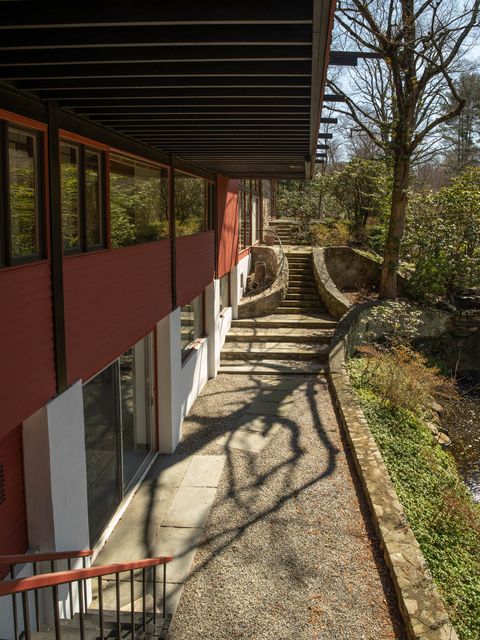
Along with the streams, the Wilton property had views of a pond, a waterfall, and expanses of open and wooded terrain. As he had done in California, Thorne used glass, steel, and natural stone to create a structure that immerses its inhabitants in the surrounding landscape. The kitchen, dining room, laundry, and guest bedroom are on the top floor; the living room is down half a level; a half level below that is the music studio and other bedrooms.

“It’s very unassuming from the roadside,” says Robert Parisot, an architect who grew up nearby and whose father, the cellist Aldo Parisot, was friends with the Brubecks. “On the top level, it’s just this wall, an entrance. It’s really a place that is about transition, once you get inside.”

Dave Brubeck was an amalgam of various American dreams: a cowboy who became a jazz legend who was also a devoted family man. He grew up riding horses on a cattle ranch where his father was a manager, and he studied veterinary medicine and music at the College of the Pacific, which is where he met his wife, Iola ­Whitlock, a lyricist with whom he had six children.
The couple worked on numerous projects together, including The Real Ambassadors, a musical about race relations that Dave recorded with Louis Armstrong soon after the Brubecks moved east.

“My parents felt guilty about leaving California,” Chris says. “They were both second-generation Californians, and they missed Oakland. At first it was, ‘Well, we’re going to live there for a few years.’” But the plan they hatched back in Oakland worked exceptionally well. Dave was home more often. And the music studio Thorne designed off the living room was where some of America’s greatest jazz compositions were created. Dave died in 2012 and Iola in 2014, but their children have kept the house the way it was when their parents moved in.

Architects of Thorne’s generation liked to talk about bringing the outdoors inside. At the Wilton house, Chris says, this happened both aesthetically and literally. His father would practice piano for hours every day, and the music would attract curious neighbors, including, for a spell, a wild animal. “When Dad was in his eighties, a fox would come and sit on the flagstones just beyond the sliding door by the piano and listen to him play.””

This story appears in the September 2019 issue of Town & Country. 


ANOTHER VIEW OF THE HOUSEDave Brubeck died in 2012 and his wife Iola in 2014, but their children have kept the house the way it was when their parents moved in.Larry Lederman