Tuesday, June 16, 2020

Bud Freeman - Unheralded and Too Often Overlooked

© Copyright ® Steven Cerra, copyright protected; all rights reserved.
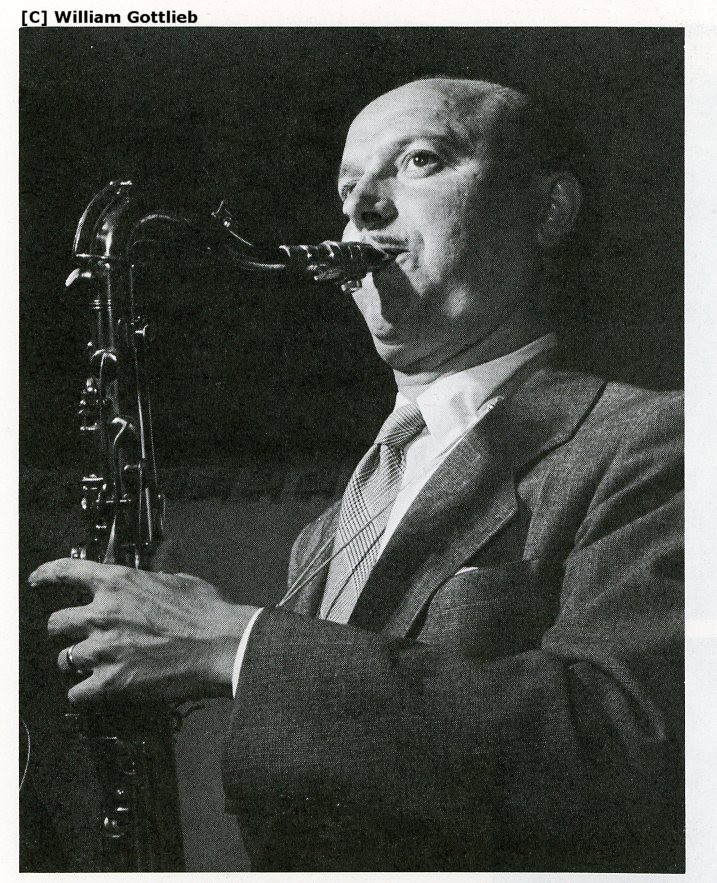
“One of the legendary Austin High School Gang, the elegant Chicagoan, was the first significant tenor saxophonist, a lighter but certainly not pallid Coleman Hawkins. It was a long career, and Freeman continued to sound like no one but himself right to the end. The Eel was a classic performance, almost a novelty tune, but at the same time bespeaking a brilliant improvisational talent.”
- Richard Cook and Brian Morton, The Penguin Guide to Jazz on CD, 6th Ed.

“Bud Freeman [1906-1991] grew up in Chicago and in the early 1920’s was a member of the Austin High School Gang [Bud on C-Melody Sax, Frank Teschemacher, Alto Sax, Jimmy McPartland, trumpet, Jim Lanigan, piano, and Dick McPartland, banjo. When they played at the nearby Lewis Institute, Dave Tough joined in on drums and Dick moved to bass].
By 1930, Bud had formed an original, unmannered style of tenor sax, free of “novelty” effects and with a distinctive Jazz timbre; as the first white saxophonist to do this he is often compared with his black contemporary Coleman Hawkins.
He founded an all-star band called the Summa Cum Laude Orchestra which recorded for Bluebird and Decca in the late 1930s.
Although Freeman’s approach to playing remained essentially unchanged throughout his career, he has constantly refined his style.”
- James Dapogny, in Barry Kernfeld, ed., The New Grove Dictionary of Jazz

“ … there was a time in American music when there were just about two ways of playing jazz tenor saxophone, Coleman Hawkins's way or Bud Freeman's way. (Both men, however, pay respects to Prince Robinson as a predecessor.) … [Even after] the arrival of Lester Young in 1936 …”
- Martin Williams, Jazz In Its Time

“I did like Bud Freeman. Nobody played like him. That’s what knocked me out.”
- Lester Young [describing how he “... tried to get the sound of a C-melody sax on tenor sax”] to Nat Hentoff in The Jazz Makers

Thanks to a friend in England who hipped me to the Bud Freeman 1939-1940 Classic CD [Classic 811] reissue of recordings made by Bud Freeman’s Summa Cum Laude Orchestra, I was able to work backwards and get to know more about Bud, a rather unheralded and often overlooked, titan of the tenor saxophone.

And body am I’m glad I did.

This guy can play.


The esteemed critic Martin Williams [1924-1992] refers to him as “The Needed Individual” and explains the reasons why in the following essay on Bud from his Jazz In Its Time [Oxford]

“In the spring of 1968, tenor saxophonist Lawrence "Bud" Freeman was announcing his full recovery from an automobile accident which had resulted in multiple fractures of the rib cage. His physician, who had at first warned Freeman that it might be more than a year before he could play again, had pronounced him fully recovered within six months. Playing the saxophone, Freeman reported to Jack Bradley in Down Beat, feels "better than ever. I feel freer . . . I've never practiced this much in my life."

One might say that the practicing paid off, whether he really needed it or not, because Bud Freeman is now involved in one of the most interesting projects of his career as a featured player with the Yank Lawson-Bob Haggart ensemble which has the marvelous name, "The World's Greatest Jazz Band."

Freeman's continuing presence on the jazz scene is, or should be, a reminder that there was a time in American music when there were just about two ways of playing jazz tenor saxophone, Coleman Hawkins's way or Bud Freeman's way. (Both men, however, pay respects to Prince Robinson as a predecessor.) Even with the arrival of Lester Young in 1936, and the growing maturity of several of Hawkins's "pupils," there was still Bud Freeman and his progeny. That progeny is still there. And so is Freeman.
The story of Bud Freeman as a charter member of the Austin High School "gang" of young Chicagoans is a standard part of jazz literature. There were cornetist Jimmy McPartland and his guitarist brother Dick, [piano and] bass-player Jim Lanigan, clarinetist Frank Teschemacher — these actually went to Austin. The other "Chicagoans” including drummer Dave Tough [Lewis Institute] and pianist Joe Sullivan [Chicago Conservatory], did not.

It all began when a group of these youngsters happened to play an early 1922 recording by the New Orleans Rhythm Kings in a record shop. "I'll tell you," Jimmy McPartland has reported, "we went out of our minds. Everybody flipped. It was wonderful so we put others on. . . . We stayed there from about three in the afternoon until eight at night, just listening to those records one after another, over and over again."

Soon the group of high schoolers became, as Freeman put it to Ira Gitler, "a group of guys who would have nothing to do with anything but good jazz."
Tough, who had been taking professional jobs since he was about fifteen, was "the first to introduce me to jazz as played by the real players, and that was the old King Oliver Band." It featured a young Louis Armstrong on second coronet. Freeman and his young friends became, as Dick Hadlock puts it in Jazz Masters of the Twenties, self-conscious students of jazz for whom the music was "a challenging art that required deep thought and study."

Freeman, perhaps out of admiration for Jack Pettis of the New Orleans Rhythm Kings, first took up C-melody saxophone, and the results by his own admission were not good. "I couldn't play anything. I could play one note." 
And McPartland, whose family was musical, has reported that "Bud Freeman was the only guy that had not had any training, consequently he was slow picking up the music . . . Tesch used to get disgusted with him and say, 'Let's throw that bum out.' But I said, 'No, no, no, don't. He's coming on, he's playing'."

The "coming on" was perhaps slow but it was sure. And it was built on a perceptive taste. "I was influenced by Louis, Beiderbecke, Bessie Smith, Ethel Waters, Buster Bailey, Fats Waller, James P. Johnson, Earl Hines — by drummers - Dave Tough ... I was greatly influenced by jazz dancers."

By late 1928, a maturing Freeman, now on tenor sax and fresh from a Paris trip with Dave Tough, had made some recordings under his own name, the recently-reissued Crazeology and Can't, Help Lovin' Dat Man. And by 1935, after several years of work with leaders like Roger Wolfe Kahn, Ben Pollack, and Red Nichols, Bud Freeman had become a featured member of Tommy Dorsey's band. "Tommy naturally had to feature what he did, which was a sweet, melodic trombone, but he did really have a great love for jazz . . . if a guy could play, he would really let him 'go.' "

The big bands, in Freeman's opinion, "needed individualists — they needed stars. Certainly, leaders might have had trouble with some of us, but we believed what we were doing, we grew up with jazz, felt strongly about our music and each of us developed in his own way, becoming both distinct individuals and soloists."

From Dorsey, Freedman went with Benny Goodman in 1938. And from Goodman, he returned to small group jazz with his own ensemble called the Summa Cum Laude Orchestra (in honor of the Austin High past), featuring Max Kaminsky's cornet, Pee Wee Russell's clarinet, Eddie Condon's guitar, and Dave Tough's drums. This ensemble, in Hadlock's opinion, "developed into one of the most cohesive small bands of its time."

Then the entire unit quit night-club work to join Swingin' the Dream, a musical version of A Midsummer Night's Dream, and the show lasted only a couple of weeks after its Broadway opening. However, Freeman found more work for his group at home in Chicago, again in New York, and in an expanded, eighteen-piece version, on the road.

Back in Chicago for a rest and a visit, Freeman found himself with enough offers to keep himself busy, and he eventually ended up leading a kind of house band at the Sherman Hotel. "The owner . . . asked me if I could get a band in 17 hours. I called up eighteen men, rehearsed all night, and opened with a big review in the Panther Room." Bud Freeman spent most of World War II as a member of the Army's Special Services in the Aleutians. On his return to civilian life, he worked for a while as house leader for the newly formed Majestic Record Company in New York. When the company failed, he returned to free-lancing.


In 1953, Freeman was back in New York after a tour of Chile and Peru, and a failed marriage. He was anxious to get to work again, but he had lost confidence in his playing. However, he was acquainted with some of modernist Lennie Tristano's recordings, thought him brilliant, and knew that he did some teaching. Freeman studied with Tristano for about three months, and, wisely, the pianist did not attempt to change Freeman's style but was able to help him re-learn his own way of playing. "He did give me terrific confidence," says the saxophonist. "He seemed to like what I was doing ... I had to do what is me, what I honestly can say was my own playing." Freeman then returned to the small groups which were his first inspiration and first love. He became a member of: George Wein's Newport All Stars, with time off for other projects, including a European tour. More recently he joined the remarkable Lawson-Haggard World's Greatest Jazzband.

This energetic organization, which also boasts veterans like Billy Butterfield on trumpet, Lou McGarity and Carl Fontana on trombones, Bob Wilber on clarinet, and Ralph Sutton on piano, explains its billing by saying it is a jazz band whereas the other medium and large ensembles, with all due respect, are swing bands. Its repertoire, on the other hand, is up-to-date, and may feature Freeman on a quasi-Dixieland arrangement of, let us say, Up, Up, and Away or Mrs. Robinson.

Duly confident though he is, Bud Freeman still approaches each appearance with the kind of sound apprehension that a dedicated and sensitive improvising musician may be expected to show. On the road, he likes to reach his destination a day ahead and rest up, if possible. And before he performs, Freeman will probably complain that he doesn't feel well, has a cold, is tired, or whatever, and then goes out and plays his head off with the same genuine enthusiasm he has had since his twenties.

"I am interested in the individual," he says, returning to a favorite theme. "If he is sincere, I can see he's sincere." And, looking back, he added to Ira Gitler, "People responsible for jazz were individuals. If a musician believes in a thing, then the public will believe in it." (1969)

Let’s close this brief look at a musician who deserves to be remember with all of the Jazz greats of the tenor saxophone with these insert notes by Anatol Schenker to the 1995 Classics reissues of 1939-1940 performances by Bud’s Summa Cum Laude Orchestra and his Famous Chicagoans which included Jack Teagarden on trombone.


The music on this CD, played by Bud Freeman's regular band of the time, was coined "Nicksieland Jazz" by columnist Ralph Gleason after the night club in Greenwich Village where the Summa Cum Laude Orchestra appeared regularly. Its style differs considerably from the recordings it tried to imitate, those made by the Chicagoans in the late twenties. Although influenced by Bix Beiderbecke and Frank Teschemacher, Bud's band manages to merge those older concepts with current big-band swing, causing John Hammond to conclude in 1940 that "here is a combination of all the great forces in modern jazz".

Lawrence "Bud" Freeman was born in Chicago, Illinois, on April 13, 1906. He received his first tuition on "C"-melody saxophone from Jimmy McPartland's father, a music teacher. Freeman was among the founder members of the "Austin High School Gang". After extensive practice and a lot of playing with his early musical friends, Freeman joined the "second" Wolverines band (after Bix Beiderbecke's departure), which appeared in the Chicago area in 1926. He also worked with many other leaders, including Art Kassel and Herb Carlin. After his first important recordings with Eddie Condon (see Classics 742), Bud joined the Ben Pollack Orchestra.

Following an engagement in New York and a first brief trip to Europe, he then toured with the Red Nichols band. After short spells with various bandleaders in Chicago, in 1935 he signed up with the Ray Noble Orchestra. Bud next played in Tommy Dorsey's band for nearly two years, then worked with Benny Goodman for about eight months in 1938. 

In 1939, he formed his own "Summa Cum Laude" Orchestra, which cut a number of highly successful records and appeared at "Kelly's Stable" in New York, He managed to keep the group together until the summer of 1940. Freeman then played in Joe Marsala's group, as well as continuing to work intermittently with Eddie Condon. In 1943, he was drafted and fronted a service band in Maryland as well as on the Aleutian Islands. After demobilisation in 1945, Bud played at Eddie Condon's own night-club. In the late forties and early fifties, he undertook frequent engagements in South America, including residencies in Rio, Peru and Chile.

He later also visited Europe on dozens of occasions, often on tours organized by pianist-impresario George Wein. In 1969, Bud joined the "World's Greatest Jazz Band". Then he lived in London for many years, but returned to the U.S. in the late seventies. After decades of travelling, Bud Freeman died in his native Chicago on March 16,1991, 

This second volume of the complete recordings of Bud Freeman under his own name, presented in chronological order, includes all sessions by his Summa Cum Laude Orchestra. The first date for Bluebird may well be the most impressive. 

Bud's fierce playing on his showcase, "The Eel", followed by an equally fine contribution from Max Kaminsky's muted trumpet, is truly outstanding. "Easy To Get", more modern than most of the subsequent sides by Bud's group, generates enormous swing. Now recording for Decca, the ensemble is in particularly impressive form on "As Long As I Live", The next eight compositions are closely associated with mid-twenties recordings by the "Wolverines". The closing session for Columbia is a gem. Jack Teagarden's addition to the band for these tracks proved a felicitous decision, the trombonist having rarely played or sung better than on these magnificent cuts. The rhythm section is driven by the astounding Dave Tough, at his best on "47th And State". Great music throughout!”

Monday, June 15, 2020

Barney Kessel with Shelly Manne & Ray Brown - Foreign Intrigue

BARNEY KESSEL, SHELLY MANNE & RAY BROWN=POLL WINNERS THREE - Soft Winds

Barney, Ray and Shelly [From the Archives]

© -Steven Cerra, copyright protected; all rights reserved.


Guitarist Barney Kessel, bassist Ray Brown and drummer Shelly Manne helped me to come of age in Jazz.

Initially through the series of “Poll Winners” recordings they made under the auspices of Les Koenig at Contemporary Records and later through professional associations and personal friendships, Barney, Ray and Shelly made endearing and enduring impressions on me and on my life.

Here are some thoughts about what made Barney, Ray and Shelly such special players and people as excerpted from Nat Hentoff’s insert notes to The Poll Winners [Contemporary S-7535; OJCCD-156-2].

© -Nat Hentoff, copyright protected; all rights reserved.


The reason for the alfresco exuberance of the Maypole wielders on the cover of this album is that all three won all three of the major American jazz popularity polls for 1956 — Down Beat, Metronome and Playboy.

While the election to these non-posthumous Valhalla’s is evidently quite gratifying, I expect that these three musicians are also deeply heartened by the sure knowledge that this re­spect and appreciation for their skills and souls is shared by the most exacting of all jazz audiences, their fellow jazzmen. Barney, Shelly and Ray cut through the lines of style, age and temperament. They are dug by jazzmen of all persuasions, because they in turn have not limited themselves to any one county of jazz. They're in place almost anywhere in the whole pleasure dome. …

Barney's strength, blues-blood, and sensitivity to others' musical needs as well as his own. Shelly's command of the drum as a thorough instrument, not just as a time-keeping device; his presence when needed as a third voice and the unobtrusiveness of his presence when that quality too is required. Ray for the fullness, firmness and tightness of his voice; his power, which propels when it's only suggested; and the flame, like his colleagues', of the perennial ‘amateur de jazz.’

The music in this set is primarily conversational, and it is conversation between three spirits with much in common in terms of life-view and way of living as well as music.

It is a conversation between experts whose knowledge has gone so far that they can never now regard themselves as experts, knowing not what they'll discover next time they talk.

And it's a conversation essentially for kicks, the kicks that come best and most frequently when you talk with your peers and are thereby in no need to worry whether your quick allusion will be picked up or whether you'll goof a spiral reference. It's not often that we amateurs, literally as well as French-figuratively, have a chance to hear this much of this kind of talk.”


Sunday, June 14, 2020

Wes Montgomery on Resonance Records

© Copyright ® Steven Cerra, copyright protected; all rights reserved.


When I was working on the recent blog feature - “How the Rhythm Section Got Its Name,” which was derived from Jerry Coker’s excellent book, How to Listen to Jazz [Jamey Absersold Jazz], I came across the following reference by Jerry about the late guitarist Wes Montgomery [1923-1968] and it immediately sent me back to the pre Verve, A&M and CTI recordings he made in the 1960s which ensured his fame and fortune [relative terms when it comes to a Jazz artist].


Since I had already covered the three organ-guitar trio recordings that Wes made for Orrin Keepnews in 1962-1963 and also put up a feature by Orrin in which Keepnews describes his friendship with Wes and what made his artistry so special, I sought out the six recordings that Resonance Records issued that really begin at the beginning, so to speak, when Wes was living and performing in Indianapolis in the late 1950s.


But before turning to Wes on Resonance, here’s the quotation about Wes and his significance as a Jazz guitarist that put the development of this feature in motion [ I have italicized it to distinguish it from my comments].


“The great master of jazz guitar, Wes Montgomery, was a self-taught player with a bittersweet career. Wes played with the Lionel Hampton Orchestra in the forties, and though already a very accomplished player and ripe for stardom, he returned to his home, Indianapolis, to live a more conventional and stable family life. It took him away from national exposure before he could rise to early fame, but the people in the Indianapolis area, especially the jazz musicians, were intensely aware of his mastery. Wes and his two
brothers, Monk (bass) and Buddy (piano), teamed up with Pookie Johnson (tenor) and Sonny Johnson (drums) to form a quintet that was legendary, performing for many years at the Turf Bar. It ranked among the finest jazz groups ever assembled. Individually, every player was an excellent soloist, and as an ensemble, their repertoire (mostly originals) was enormous, yet full of complexities in the arrangements, which were all played from memory. It was a perfect example of a group of self-taught players whose music nonetheless was expertly crafted and stylistically abreast (or ahead of) the times.


Wes Montgomery's improvising style was revelatory, especially in terms of building a solo to a point of climax, which he accomplished by playing the guitar in different ways (in themselves innovative). The first part of his solo, perhaps the first chorus or two, would be played as most players do, that is, in a single melodic line. Then in the middle of the solo, Wes would begin playing in octaves (two notes that are eight scale steps apart, bearing the same letter name but in different registers), which he could do at about the same speed as other guitarists would play single lines. Incidentally, most guitarists today will, at times, play in octaves in the manner invented by Montgomery. Then, in the next stage of his solo, Wes enlarged the octaves into tightly-compressed chords that moved in a melodic fashion, which harmonized his melodies. Finally, the compacted chords would open up into very full, widely spaced chords. By combining the various textures (single line, octaves, tight chords, and open chords), in their particular order, his solo would grow in intensity throughout its length, and the solo acquired an acute sense of order. Montgomery's sense of form also extended itself into the weaving of his melodies, each melodic fragment getting repeated, developed, and played in variations.


Suddenly, around 1959, Wes was rediscovered by the rest of the world, almost overnight, resulting in many semi-pop albums, in which Wes played tunes like "Goin' Out Of My Head" in octaves and little else. For those who knew him well musically, it was frustrating that he finally gained deserved recognition and economic reward for his genius, but at the expense of much of his musical greatness. Wes Montgomery died just a few years after his rediscovery.”


Where I’m going with this piece is to try and underscore the magnitude of the accomplishment and the gift to Jazz fans represented in the six Resonance Recordings described below.


To begin with, Executive Producer George Klabin, Producer Zev Feldman and their associates at Resonance are carrying on the tradition of the independent Jazz Record Producer which has its roots in the first Jazz recordings ever produced dating back to 1917.


Subsequently, operating out of the New York City record store from which his label drew its name, Milt Gabler formalized the role of the independent record producer with the creation of Commodore Records in 1938. In the 1940’s and 50’s, impresario Norman Granz used his Jazz at the Philharmonic concerts and artist management firm [Oscar Peterson, Ella Fitzgerald, etc] as a springboard to launch Clef and Norgan which he later merged into Verve Records.


In the 1950s, Richard Bock at Pacific Jazz and Les Koenig with Contemporary Records were matched on the East Coast by Alfred Lion and Francis Wolff at Blue Note, Bob Weinstock at Prestige and Orrin Keepnews at Riverside as independent record labels that produced high quality Jazz recordings funded from personal investment and record sales.


This is just a representative list, and a limited one at that, but the point is Jazz as we know it has been so poorly documented for most of its existed that Jazz fans everywhere owe a debt of gratitude to these pioneering independent producers for the repository of recorded Jazz that they left for us and future generations to savor.


These independent Jazz record producers provided additional dimensions to the music with photographs by such artists as Herman Leonard Gijon Mili William Claxton , illustrations by David Stone Martin, Reid Miles, and Robert Guidi/Tri Arts and informative and educational liner notes by Nat Hentoff, Ira Gitler and Leonard Feather - to cite just a few examples.


[Budgets were so lean at Riverside that Orrin oftentimes worked, not only as a producer, but also as a co-recording engineer, photographer and liner note writer for many of his albums. Under some less sparse conditions, he would later go on to found Landmark and Milestone Records. I guess once bitten by this independent record producer bug, it’s difficult to get it out of your system.]


Of course, most Jazz performances wind up in the etherworld - the music is played and then disappears - which is all-the-more the reason why we should be grateful to these independent entrepreneurs for immortalizing some of this music in recorded formats which also gives it a timeless quality.


During the big band swing era from about 1935-1945 and the modern Jazz era that followed circa 1945-70, when Jazz was still a music with a fairly large popular following, the major recording labels like RCA, Columbia and Decca had the clout to market and sell enough recordings to help make some artists a commercial success.


One of these was Wes Montgomery who had a number of “hit” [a relative term in Jazz] recordings in the 1960s for Verve, A&M and CTI before his untimely death on June 15, 1968 of a heart attack. He was only forty-five years old.


Thanks to the three, trios albums for Riverside and with other artists with whom he appeared on that label, we are fortunate to have a narrow yet unfettered view of Wes the performing Jazz artist.


But for those who want an expanded view of the pre-commercialized Wes, there’s only one place to go and that’s to the Resonance Records catalogue of six recordings which feature Wes in a variety of in-performance settings with groups and musicians based in and around his home town of Indianapolis. 


With each of these Wes on Resonance recordings, Executive Producer George Klabin, Producer Zev Feldman and their marvelous team of associates have really taken things to the next level in terms of quality of sound [George along with Fran Gala engineer and master the recordings], the almost work-of-art way in which the music is packaged, offering it, in some cases, in both digital and analogue formats, and in every case gathering a slew of never-before-seen photographs, all wrapped in beautifully designed Burton Yount insert booklets which contain interviews and commentaries conducted and written by a who’s who of Jazz notables including, Ashley Kahn, Bill Milkowski, Duncan Schiedt, Quincy Jones, Peter Townsend, Paul De Barros, Jim Wilke, Alain Tercinet, Dan Morgenstern, Dr. David Baker, Michael Cuscuna, Jamey Abersold, Lewis Porter, and John Edward Hasse, among others.


Observations about what it was like to work with Wes are also included by surviving family members Buddy and Monk Montgomery; some of the musicians who appeared on these recordings including pianist Harold Mabern, drummers Jimmy Cobb and Walter Perkins, and bassists Ron McClure and Bob Cranshaw; musicians who reflect on Wes’ influence on their own music including guitarists George Benson, Pat Martino, John Scofield and Russell Malone, pianists David Hazeltine and Michael Weiss, and bassist Jay Leonhart.


Executive producer Zev Feldman sets the tone for each release with an opening, behind-the-scenes introduction of how each of his discoveries came about; and believe me, these Wes Resonance issues involve a quest on his part.


I mean, can you imagine the smiles going on in Independent Record Producers Heaven from this outpouring of conscientious, creative and caring effort from the Resonance Team on behalf of a - wait for it - Jazz musician?


If you have a serious interest in the music, then you owe it to yourself to consider adding these Resonance Wes Montgomery recordings to your collection by a musician who, along with Django Reinhardt and Charlie Christian, changed the sound and the style of the Jazz guitar forever.


Fortunately, you can read more about these recordings and sample the music on them via the annotations contained on the Resonance Records website. Just click on the link below each album cover to be redirected.


Saturday, June 13, 2020

Miles Davis - Winning Respect First, and then, Fame and Fortune

© Copyright ® Steven Cerra, copyright protected; all rights reserved.


Beginning  in 1955, Miles became the fashion plate of jazz, and that is his most significant contribution of all. Miles has set the tone of jazz for more than thirty years, being partly or entirely responsible for virtually every nuance that has changed the sound of jazz since 1945!  No one, not even Armstrong or Parker, has accomplished such a feat. 
- Jerry Coker, How to Listen to Jazz


Here’s a point of view about Miles that you don’t often see referenced and a deeper examination of it as represented in this piece might also help explain some of the reasons for Miles’ surliness during and after he achieved success as a Jazz artist. 


The following is drawn from Barabara Gardner, The Enigma of Miles Davis [January 7, 1960 downbeat], Jerry Coker, How to Listen to Jazz, and Jack Chambers, Milestones: The Music and Times of Miles Davis.


MILES DAVIS (1926-1991)


“Miles Davis' career is one of the most fascinating and unique stories in all of jazz history. He has been a well-known jazz figure for many years, but the reasons for his unparalleled success are very different from, say, Armstrong's or Parker's. Miles didn't take the jazz world by storm in a smashing debut, although his career began at age 20 as a member of the Parker Quintet. Many musicians wondered why Bird selected him to be in his illustrious group. The younger set of trumpet players who felt that Bird must have known what he was doing blindly went about imitating young Miles. But very few of them knew the exact nature of Miles' musical gift, and so they imitated him in the most superficial manner, taking to playing with a dead, flat sound, and developing a technique that could be called "studied sloppiness." They draped their fingers languidly over the trumpet valves, so that they weren't using the more controlled tips of the fingers, and they did what they could to look and sound totally relaxed at all times. Indeed, if you weren't listening very carefully, you might have agreed with his imitators in their superficial assessment, whether or not you liked his playing. 


Miles did sound unusually relaxed (even when he wasn't), he played without a vibrato, had a relatively dead (but fat and pretty at times) sound, and used quick, short grace notes* before longer notes that created an effect that some might have thought to be sloppiness. [Grace notes are very short notes, usually a semitone below the note to follow, rhythmically placed as close to the next note as possible.] He wasn't considered, by many trumpet players, to have much instrumental ability either. His range was quite small, his sound was unpolished and small, he seemed to have flat intonation, and he didn't show much finger agility. [Keep in mind that Bird played extremely sharp, which inexplicable trail may have caused Miles to sound flatter than he really was.


Miles had to win his audience with a style that was unfamiliar (as he didn't sound like anyone before him), a technique that was questionable to many, and a personality that wasn't exactly out of Dale Carnegie [The author of How To Win Friends and Influence People.] Miles was notorious for turning his back to an audience, walking offstage when he wasn't playing (while the performance continued), and being cool to interviewers.


An audience of the forties didn't have to put up with that, because there were players around like Dizzy Gillespie and Louis Armstrong, with their musical and personal dynamism. But the few musicians and listeners who refused to believe that Bird's selection of Miles was haphazard or mistaken searched for Miles' true musical qualities and found them to be ample, though not in the same areas mentioned thus far. Through Miles, they discovered purity, economy, originality, and lyricism in music. But that was only the beginning. He became an astute judge of talent, fostering the musical growth of many young players, relatively unknown at the time, who became giants while playing in Miles' groups. Such a list would include John Coltrane, Chick Corea, Ron Carter, Tony Williams, Herbie Hancock, George Coleman, Airto Moreira, Paul Chambers, Wayne Shorter, Red Garland, Philly Joe Jones, Joe Zawinul, John McLaughlin, Wynton Kelly, Jimmy Cobb, and Bennie Maupin!


Those who were not convinced of Davis' musical strengths in 1945, when he was playing with Parker, became convinced eventually, nonetheless. They were convened by recordings like the semi-big band of 1949-1950 (Birth of the Cool) or Walkin’  (1954), or Round Midnight (1957), or one of the third stream [combing Jazz with Classical music] albums with Gil Evans, like Sketches of Spain (1960). Sooner or later, he won them over.


Perhaps the turning point in Miles’ career, one that paved the way for him to win the respect that led to the Columbia Records contract which resulted in his subsequent fame and fortune occurred primarily as a result of his appearance at the 1955 Newport Jazz Festival.


Jack Chambers describes the background and the even itself this way in his seminal biography Milestones: The Music and Times of Miles Davis:


The public image of Miles Davis was refracted, like an object catching the sun in a clouded pool. He was regarded as inconsistent and undependable, but the addiction that had made him that way was now cured, His records showed him struggling technically and playing indifferently, but he had recently recorded music that was both technically proficient and passionately stated. He was considered by even the well-informed fans as a figure from jazz's recent past, but he was actively working at a new aesthetic and surrounding himself with important new sidemen. The gap between the public image and the reality narrowed almost overnight.


The setting, improbable though it must have seemed, was Newport, Rhode Island, a small New England city that John Hammond, himself a Vanderbilt, calls "one of the snob communities of this fair land." The occasion was the first annual Newport Jazz Festival, which was inaugurated there in the first week of July 1955. (There had been a two-day trial run the previous summer that never gets counted in the official history of the event.) The impetus for bringing jazz musicians to fashionable Newport for a week-long series of matinee and evening concerts came from Elaine and Louis Lorillard, patrons of the arts who had been involved for years with a summer program of concerts by the New York Philharmonic in Newport. They were interested in extending the community's involvement by adding a series of jazz concerts. As their producer for the jazz festival they chose George Wein, a piano player from Boston who showed unmistakeable entrepreneurial instincts in mounting concerts in Boston, managing and eventually buying jazz clubs there, and producing records for his own small label, called Storyville, which was also the name of his best-known club. Wein organized the Newport Jazz Festival in the first years simply by presenting the best known big and small jazz bands as headliners and filling in the gaps with either lesser-known bands or with all-star groups playing jam sessions.


In 1955, the headliners included the big bands of Count Basie and Woody Herman and the small bands of Dave Brubeck and Louis Armstrong. The all-star-group lined up to play at the closing concert, between Basie and Brubeck, were made up of Zoot Sims, Gerry Mulligan, Thelonious Monk, Percy Heath, and Connie Kay. Shortly before the festival began, too late to list him in the program for the closing concert, Miles Davis was added. Perhaps someone noticed that the group for that evening lacked a brass instrument; perhaps Davis, who needed both the work and the exposure, appealed to Wein or one of his acquaintances on the festival board to include him; or perhaps someone who knew about the clash between Monk and Davis the previous Christmas eve thought that their presence together might create a newsworthy situation. Davis arrived to take his turn with the all stars and when he was finished he was suddenly one of the most talked-about and sought-out jazz musicians in the country.


The protocol for the jam session that evening followed the familiar format. The rhythm section started off, and then the horns were added to the rhythm players one by one, until all of them were on the stage. Monk opened with Heath and Kay supporting him on Hackensack, and then Mulligan joined them, and then Sims, and finally Davis. "Within the ranks of the professional critics, there was not too much notice taken when he joined the group on stage," Bill Coss, the editor of Metronome magazine, remembers. "Professional listeners are blase’, especially when an artist is as unpredictable as Miles; unpredictable, that is, in terms of the relationship between what he can do and what he will do." The group continued with Now's the Time, dedicated to Parker's memory, but it was Davis's muted solo on Round about Midnight that brought the audience to its feet. "On this night at Newport," Coss continues, "Miles was superb, brilliantly absorbing, as if he were both the moth and the probing, savage light on which an immolation was to take place. Perhaps that's making it too dramatic, but it's my purely subjective feeling about the few minutes during which he played. And over-dramatic or not, whatever Miles did was provoking enough to send one major record label executive scurrying about in search of him after the performance was over. And dramatic enough to include Miles in all the columns written about the Festival, as one of the few soloists who lived up to critical expectations." Those expectations had been deflated by the discrepancy between his recent work and the level at which he was working when the critics last took notice. As Andre Hodeir put it: "Miles Davis's 'comeback' at the 1955 Newport Jazz Festival was hailed as a major event precisely because the halo of glory attached to his name a few years earlier had managed to survive a period of temporary neglect." Davis felt the same about it, but he put it more succinctly. "What's all the fuss?" he asked. "I always play that way."


Davis's career began to blossom again after Newport. Not all of his sudden activity resulted from his Newport coup. He was already scheduled to record with Charles Mingus soon after Newport. He was also busy organizing his own quintet for a debut engagement at the Cafe Bohemia in Greenwich Village; the Bohemia date was being treated as a trial run, and if the audiences turned out in large enough numbers Davis was ready to book the quintet into jazz clubs in other cities in the fall. All the Newport publicity did was sharpen the public's respect for Davis's current music, practically guaranteeing the turnout of press and fans for at least his opening night at the Bohemia. After that, it would be up to him to keep them coming back.”


In fact Miles did improve over the years, both as a trumpet player and an improviser. His sound became large, fat, and expressive. His range expanded enormously and he utilized it more of the time for variety and impact. His control of the horn developed to the point that in Saeta (Sketches of Spain) Miles exhibits his ability to slide evenly from one pitch to another without a mechanical break in sound, to color the qualities of individual notes of the phrase in very expressive ways, to have sustained notes sail upward (doit) or downward(fall-off) at the very end, and to create a sort of sobbing sound that alludes to the Spanish singer on the balcony above a solemn, religious parade, singing of the agonies of the Crucifixion. [Saeta is an unaccompanied Andalusian song of lamentation or penitence sung during the religious procession of Good Friday. This spontaneous outburst of religious feeling probably had its roots in the recitation of psalms under the influence of liturgical music.]


His technique, in terms of speed and agility, also became more pronounced. There were increases in melodic form, shaping of phrases, rhythmic diversity, conviction, angularity, and even some humor in his improvisations. He also changed or modified his style several times. Trumpet players who would imitate Miles have to remain flexible and abreast of his most recent output, because Miles is never standing still. 


He has become the fashion plate of jazz, and that is his most significant contribution of all. Miles has set the tone of jazz for more than thirty years, being partly or entirely responsible for virtually every nuance that has changed the sound of jazz since 1945!  No one, not even Armstrong or Parker, has accomplished such a feat. 


Consider the changes he has brought about. They include instrumentation (accessory percussion, bass clarinet, electric keyboards, synthesizer, electronic gadgetry, and the use of multiple keyboards), new players (already listed), style (the merging of jazz with rock, be-bop, free-form, third stream), and countless other innovations (use of coloristic devices, side-slipping, outside playing, longer solos and selections, and the reversal of horn and rhythm section function, as in Nefertiti). Miles has almost single-handedly kept jazz in a state of continuous change and evolution from 1945 to the present.


Because Miles has a complex, ever-changing style, it was necessary, while describing him, to integrate our appreciative criteria (sound, technique, time, etc.) into that description. The only criterion not covered was his use of tonal materials. It was mentioned that he used economy, side-slipping, outside playing, and the like, which gives some indications, but little was said about his note choices, which are vital to his musical thrust. Even in 1945, Miles was already hearing with a uniquely discriminating ear. There was a certain purity about it (and still is) that told the listener that Miles wasn't going to play anything in a redundant, insincere, wasteful manner. Every note had to pass inspection in the mind, in the ear, and in his musical taste buds. If he heard nothing, momentarily, he played nothing, waiting for a better idea. He could not be hurried or forced to play anything that did not measure to up his standards. 


If one had the opportunity to study very carefully a progression on which Miles was to improvise subsequently, and if that person were to circle the very best notes available in each chord or scale, crossing out all notes which would have little effect, the version played by Miles would probably include only those better notes, except that he would probably hear a few that weren't circled or crossed out.


Another distinction, with regard to Davis' note choices, is that he doesn't bother to harmonically justify a note that is already known to be richly effective, even if it is remote from the basic sound of the given chord. To explain, suppose a player decides to play a raised-9 against a certain chord. Most players would precede or embellish such a remote, colorful note with a few other tones (like 3 and 7, for example) that would clarify, aurally, the relationship of the raised-9 to the more fundamental notes of the chord. But Miles is likely, under the same circumstances, simply to play the raised-9 by itself or juxtapose it with a fundamental note that is perhaps a semitone away (like the 3rd of the chord, which when placed in the same octave as the raised-9th, would be a semitone higher), or even introduce one or two other remote, colorful notes along with the raised-9, not bothering to justify those, either! In other words, Miles will play it, but he won't explain it. That's the listener's problem.”


Perhaps the ten-year gap from his ascendancy as a 20-year aspirant at the side of Charlie Parker until his coming out as a more complete and competent player at the 1955 Newport Jazz Festival would later become a source of resentment for Miles because he was disparaged by some for not arriving on the scene in a fully formed manner such as Pops, Duke or Bird.


Sometimes it just takes what it takes to achieve greatness and perhaps Miles’ struggles during the 10 year period from 1945-1955 helped make him the dominating player, band leader and musical trend setter he eventually became.


Who can say for certain?


But if Miles was lost during the ten year period in question, he was definitely making good time - you dig?


With a vast catalogue and a style that’s ever changing, no single selection, no single selection can truly represent, I am particularly fond of Saeta from the Sketches of Spain Columbia album arranged by Gil Evans for the haunting and poignant sound that Miles gets from his horn. When you hear Miles on this tune, you understand what Gil meant when he said: “Miles changed the sound of the trumpet.”