Thursday, September 24, 2020

Mulgrew Miller: “Living in the Shadows of Giants”


© -Steven Cerra, copyright protected; all rights reserved.


“Don’t cross a bridge to get home or to work:” I guess the expression contains more than a hint of caution and admonition, especially if you’ve lived some time in the San Francisco Bay area and seen the nightmarish traffic back-ups a closed bridge can cause on the local, television news.

Thankfully, I never experienced such a delay in all the years I lived and worked in San Francisco,

But I sure caught a taste of what such an experience would be like as I was headed north back to the Oakland, CA airport to catch a return flight to my relocated home in southern California following some business appointments in the Silicon Valley.

A major accident on the Bay Bridge between San Francisco and Oakland had caused a traffic back-up so serious that it extended south on US 880 to about 10 miles below the airport.

The was no alternative and plenty of later flights so I just relaxed and turned on the FM-Jazz station while I waited things out in the rental car that was crawling along at death-defying speed of 3 MPH.

The radio broadcast that I tuned into was an interview with pianist Mulgrew Miller who was appearing through the upcoming weekend with his trio at Yoshi’s Jazz Club located on a portion of the waterfront which the City of Oakland had reclaimed from surplus shipping docks and refurbished into a lovely commercial-cum-residential area.

I knew of Mulgrew’s work through recordings he had made during his long association with drummer Tony Williams’ quintet in the 1980s and 1990s, but I had never heard him play in person.

He sounded very warm and cordial during the radio interview and I thought, “Well, at the rate things are going with the crawling traffic, maybe I’ll just book into a local hotel and catch one of Mulgrew’s sets at Yoshi’s.”

Of all the remarks Mulgrew made during the exchange with the interviewer, one stayed with me: “It’s tough to get any recognition as a Jazz musician today because we are living in the shadow of Giants.”

This is not verbatim, but earlier in his talk, Mulgrew had said that many of the pianists  during the bebop era, for example Al Haig, Joe Albany, Dodo Marmarosa, John Lewis, and even some pianists during the later hard bop era like Sonny Clark, Horace Silver and Walter Bishop, Jr., were not original stylists.

They basically played in the manner of Bud Powell and gained a certain measure of recognition and approval for being able to do so.

But musicians like himself, who continue in this bebop piano tradition and perhaps add some of the newer influences like Ahmad Jamal, McCoy Tyner or Keith Jarrett to their approach get little respect because we are not “… the next Bud Powell or Art Tatum or Bill Evans.”

“Why? Not all of us can be giants like Bud and Art or Charlie Parker and Dizzy Gillespie. We are doing our part to keep the Jazz tradition alive and even move it forward a little, but we get little respect for what we do accomplish and put down for what we don’t.”


None of this was conveyed with animosity by Mulgrew, but you could certainly sense his disappointment and his displeasure.

The interview then trailed off and was replaced by the playing of one of Mulgrew’s recordings in its entirety.

By some miracle I was just pulling into the hired car parking lot when the interviewer returned so I did not get to hear the rest of Mulgrew’s talk.

The following year The Mulgrew Miller Trio Live at Yoshi’s was issued as a double CD on MaxJazz [[MXJ 212/208] and I picked up a copy along with the March 1, 2005 edition of Downbeat in which the following article about Mulgrew by Ted Panken appeared.

Mulgrew passed away on May 28, 2013 and the editorial staff at JazzProfiles thought it might be nice to remember him on these pages with a reprint of his Downbeat interview and the Nat Chinen obituary that was published in The New York Times.  

Copyright © Downbeat/Ted Panken/2005 Bell & Howell Information and Learning Company. All rights reserved.

Mulgrew Miller: No Apologies 

“Ironies abound in the world of Mulgrew Miller. On the one hand, the 49-year-old pianist is, as Eric Reed pointed out, "the most imitated pianist of the last 25 years." On the other, he finds it difficult to translate his exalted status into full-blown acceptance from the jazz business.

"It's a funny thing about my career," Miller said. "Promoters won't hire my band, but they'll book me as a sideman and make that the selling point of the gig. That boggles my mind."

Miller would seem to possess unsurpassed qualifications for leadership. As the 2004 trio release Live At Yoshi's (MaxJazz) makes evident, no pianist of Miller's generation brings such a wide stylistic palette to the table. A resolute modernist with an old-school attitude, he's assimilated the pentagonal contemporary canon of Bill Evans, McCoy Tyner, Herbie Hancock, Chick Corea and Keith Jarrett, as well as Woody Shaw's harmonic innovations, and created a fluid personal argot.

His concept draws on such piano-as-orchestra signposts as Art Tatum, Oscar Peterson, Ahmad Jamal and Erroll Garner, the "blowing piano" of Bud Powell, the disjunctive syncopations and voicings of Thelonious Monk, and the melodic ingenuity of gums like Hank Jones, Tommy Flanagan and Cedar Walton. With technique to burn, he finds ways to conjure beauty from pentatonics and odd intervals, infusing his lines with church and blues strains and propelling them with a joyous, incessant beat.


"I played with some of the greatest swinging people who ever played jazz, and I want to get the quality of feeling I heard with them," Miller said. "It's a sublime way to play music, and the most creative way to express myself. You can be both as intellectual and as soulful as you want, and the swing beat is powerful but subtle. I think you have to devote yourself to it exclusively to do it at that level."

Consequential apprenticeships with the Mercer Ellington Orchestra, Betty Carter, Johnny Griffin and Shaw launched Miller's career. A 1983-'86 stint with Art Blakey and the Jazz Messengers put his name on the map, and he cemented his reputation during a long association with Tony Williams' great cuspof-the-'90s band, a sink-or-swim environment in which Miller thrived, playing, as pianist Anthony Wonsey recalls, "with fire but also the maturity of not rushing."

By the mid '80s, Miller was a fixture on
New York's saloon scene. Later, he sidemanned extensively with Bobby Hutcherson, Benny Golson, James Moody and Joe Lovano, and from 1987 to 1996 he recorded nine trio and ensemble albums for Landmark and RCANovus.

Not long after his 40th birthday, Miller resolved to eschew club dates and one-offs, and to focus on his own original music. There followed a six-year recording hiatus, as companies snapped up young artists with tenuous ties to the legacy of hardcore jazz.

"I won't call any names," Miller says, "but a lot of people do what a friend of mine calls 'interview music.' You do something that's obviously different, and you get the interviews and a certain amount of attention. Jazz is part progressive art and part folk art, and I've observed it to be heavily critiqued by people who attribute progressivity to music that lacks a folk element. When Charlie Parker developed his great conception, the folk element was the same as Lester Young and the blues shouters before him. Even when Ornette Coleman and John Coltrane played their conceptions, the folk element was intact. But now, people almost get applauded if they don't include that in their expression. If I reflected a heavy involvement in Arnold Schoenberg or some other ultra-modern composers, then I would be viewed differently than I am. Guys who do what I am doing are viewed as passé.

"A lot of today's musicians learn the rudiments of playing straight-ahead, think they've got it covered, become bored, and say, 'Let me try something else,'" Miller continued. "They develop a vision of expanding through different areas - reggae here, hip-hop there, blues here, soul there, classical music over here and being able to function at a certain level within all those styles. Rather than try to do a lot of things pretty good, I have a vision more of spiraling down to a core understanding of the essence of what music is."

This being said, Miller-who once wrote a lovely tune called "Farewell To Dogma" -continues to adhere to the principle that "there is no one way to play jazz piano and no one way that jazz is supposed to sound." He is not to be confused with the jazz police. His drummer, Karriem Riggins, has a second career as a hip-hop producer, and has at his fingertips a lexicon of up-to-the-second beats. When the urge strikes, bassist Derrick Hodge might deviate from a walking bass line to slap the bass Larry Graham style. It's an approach familiar to Miller, who grew up in
Greenwood, Miss., playing the music of James Brown, Aretha Franklin and Al Green in various Upper Delta cover bands.

"It still hits me where I live," he says. "It's Black music. That's my roots. When I go home, they all know me as the church organist from years ago, so it's nothing for me to walk up to the organ and fit right in. I once discussed my early involvement in music with Abdullah Ibrahim, and he described what I went through as a community-based experience. Before I became or wanted to become a jazz player, I played in church, in school plays, for dances and for cocktail parties. I was already improvising, and always on some level it was emotional or soul or whatever you want to call it. I was finding out how to connect with people through music.

"By now, I have played jazz twice as long as I played popular music, and although that style of playing is part of my basic musical being, I don't particularly feel that I need to express myself through it," he continued. "It's all blues. The folk element of the music doesn't change. The blues in 1995 and in 1925 is the same thing. The technology is different. But the chords are the same, the phrasing is the same, the language is the same-exact same. I grew up on that. It's a folk music. Folk music is not concerned with evolving."

For all his devotion to roots, Miller is adamant that expansion and evolution are key imperatives that drive his tonal personality. "I left my hometown to grow, and early on I intended to embrace as many styles and conceptions as I could," he said. "When I came to
New York I had my favorites, but there was a less celebrated, also brilliant tier of pianists who played the duo rooms, and I tried to hear all of those guys and learn from them. The sound of my bands changes as the musicians expand in their own right. I'm open, and all things are open to interpretation. I trust my musicians-their musicianship, insights, judgments and taste-and they tend to bring things off in whatever direction they want to go. In the best groups I played with, spontaneity certainly was a strong element."

Quiet and laid-back, determined to follow his muse, Miller may never attain mass consumption. But he remains sanguine.

"I have moments, but I don't allow myself to stay discouraged for long," he said. "I worked hard to maintain a certain mental and emotional equilibrium. It's mostly due to my faith. I don't put all my eggs in that basket of being a rich and famous jazz guy. That allows me a certain amount of freedom, because I don't have to play music for money. I play music because I love it. I play the music I love with people I want to play with. I have a long career behind me. I don't have to apologize to anybody for any decisions I make." -Ted Panken” 

Mulgrew Miller, Dynamic Jazz Pianist, Dies at 57

Copyright © The New York Times/Nate Chinen/May 29, 2013.

“Mulgrew Miller, a jazz pianist whose soulful erudition, clarity of touch and rhythmic aplomb made him a fixture in the postbop mainstream for more than 30 years, died on Wednesday in Allentown, Pa. He was 57.

The cause was a stroke, said his longtime manager, Mark Gurley. Mr. Miller had been hospitalized since Friday.

Mr. Miller developed his voice in the 1970s, combining the bright precision of bebop, as exemplified by Bud Powell and Oscar Peterson, with the clattering intrigue of modal jazz, especially as defined by McCoy Tyner. His balanced but assertive style was a model of fluency, lucidity and bounce, and it influenced more than a generation of younger pianists.

He was a widely respected bandleader, working either with a trio or with the group he called Wingspan, after the title of his second album. The blend of alto saxophone and vibraphone on that album, released on Landmark Records in 1987, appealed enough to Mr. Miller that he revived it in 2002 on “The Sequel” (MaxJazz), working in both cases with the vibraphonist Steve Nelson. Among Mr. Miller’s releases in the last decade were an impeccable solo piano album and four live albums featuring his dynamic trio.


Mr. Miller could seem physically imposing on the bandstand — he stood taller than six feet, with a sturdy build — but his temperament was warm and gentlemanly. He was a dedicated mentor: his bands over the last decade included musicians in their 20s, and since 2005 he had been the director of jazz studies at William Paterson University in New Jersey.

If his sideman credentials overshadowed his solo career, it wasn’t hard to see why: he played on hundreds of albums and worked in a series of celebrated bands. His most visible recent work had been with the bassist Ron Carter, whose chamberlike Golden Striker Trio featured Mr. Miller and the guitarist Russell Malone on equal footing; the group released a live album, “San Sebastian” (In+Out), this year.

Born in Greenwood, Miss., on Aug. 13, 1955, Mr. Miller grew up immersed in Delta blues and gospel music. After picking out hymns by ear at the family piano, he began taking lessons at age 8. He played the organ in church and worked in soul cover bands, but devoted himself to jazz after seeing Mr. Peterson on television, a moment he later described as pivotal.

At Memphis State University, he befriended two pianists, James Williams and Donald Brown, both of whom later preceded him in Art Blakey’s Jazz Messengers. Mr. Miller spent several years with that band, just as he did with the trumpeter Woody Shaw, the singer Betty Carter and the Duke Ellington Orchestra, led by Ellington’s son, Mercer. Mr. Miller worked in an acclaimed quintet led by the drummer Tony Williams from the mid-1980s until shortly before Williams died in 1997.

Mr. Miller’s survivors include his wife, Tanya; his son, Darnell; his daughter, Leilani; and a grandson. He lived in Easton, Pa.

Though he harbored few resentments, Mr. Miller was clear about the limitations imposed on his career. “Jazz is part progressive art and part folk art,” he said in a 2005 interview with DownBeat magazine, differentiating his own unassuming style from the concept-laden, critically acclaimed fare that he described as “interview music.” He added, “Guys who do what I am doing are viewed as passé.”


But Mr. Miller worked with so many celebrated peers, like the alto saxophonist Kenny Garrett and the tenor saxophonist Joe Lovano, that his reputation among musicians was ironclad. And his legacy includes a formative imprint on some leading players of the next wave, including the drummer Karriem Riggins and the bassist Derrick Hodge, who were in one of his trios. The pianist Robert Glasper once recorded an original ballad called “One for ’Grew,” paying homage to a primary influence. On Monday, another prominent pianist, Geoffrey Keezer, attested on Twitter that seeing Mr. Miller one evening in 1986 was “what made me want to be a piano player professionally.”

In the performance from the At Yoshi’s 2004 double CD that forms the sound track for this video tribute to him, Mulgrew has cleverly adopted Comes Love to the arrangement Ahmad Jamal used on Poinciana from his At The Pershing Room Argo LP, one of the most successful Jazz recordings ever issued.

The insistent rhythm is formed by Karriem Riggins use of mallets on the drum set’s tom toms and the insistent accent played by the high hat on the 2nd and 4th beat of each measure.

On the original version, instead of the usual “clicking” sound made by stepping on the high hat’s cymbals to close them, Ahmad’s drummer, Vernel Fournier, played the high hat cymbals open [barely touching them together] creating more of a “chinging” sound to simulate finger cymbals.

You can hear this effect in a more pronounced manner as played by Karriem at 4:21 minutes of Mulgrew’s version.

Wednesday, September 23, 2020

Jay and Kai – When Two Trombones Are Better Than One


© -  Steven A. Cerra, copyright protected; all rights reserved.


“'You can't play all night in a club with just two trombones and rhythm!’ a friend told Kai Winding when he announced that he and J. J. Johnson were going to do just that.
He was wrong, but awfully right at the same time. The answer is that you can do it, but not with ‘just two trombones.’ You have to have the best—Kai Winding and J.J. Johnson.

Their ability as trombonists is only part of the story. The entire "book" for the group has also been written by them, and it is their imagination as arrangers which has carried off this tour de force even more than their extraordinary talent as soloists.

Jay and Kai have done it the musicianly way, with no gimmicks—just solid musicianship. Working without a guitar, which would have given them variety in the col­oring of the solos as well as another voice in the ensem­bles, makes their job that much harder. But in order to get engagements in clubs, they had to confine the group to five men, and the added challenge has only spurred them to greater creative height.

Each has had a wealth of big band and small combo experience. During the hop era, Jay was in the rare posi­tion of establishing a school of trombone playing which consisted of himself alone; no one else was remotely in his class. Kai came up through the big band field, achiev­ing prominence as a soloist with Stan Kenton in 1946. In recent years, both men have gigged extensively with small groups, and Kai still keeps his hand in as a studio sideman between the quintet's bookings.

The arranging of the book has been divided equally between them, and each man has contributed several fine originals. Their choice of repertoire is discriminating; they seem to have a knack of choosing half-forgotten but exceptional show tunes and songs which are fine vehicles for "class" singers. (Perhaps the lyric quality of their trom­bone playing is responsible for this taste.) Both play with a technical ease which is the envy of lesser slide men. Although they play quite unlike each other most of the time, there are many occasions on which it is impossible for even their closest followers to tell them apart.”
- George Avakian, insert notes to CD re-issue of Trombones for Two

The idea for this piece came from revisiting the J.J. Johnson and Kai Winding Columbia recording made at the 1956 Newport Jazz Festival [the LP is shared with the Dave Brubeck Quartet]. Along with bassist Bill Crow and drummer Rudy Collins, the two trombonists’ quintet featured Dick Katz on piano. Dick was to be the pianist with Jay and Kai’s group throughout its existence from 1954-56.

Listening to this recording reminded me of what an excellent pianist Dick Katz was, he died in 2009 at the age of 86, but it also brought back thoughts about Dick Katz the record producer [he founded Milestone Records with Orrin Keepnews], Dick Katz the Jazz educator [he taught at the New School and the Manhattan School of Music], but most especially about Dick Katz, the gifted Jazz author [Bill Kirchner tapped him to write The History of Jazz Piano essay in his The Oxford Companion to Jazz].


I never got to attend any of Dick’s Jazz courses, but I always learned so much about the music from his writings.

Sure enough, when I went digging around my collection of Jazz recordings, there was Dick writing his usual, clever and insightful insert notes to the 1960 reunion album by Jay and Kai’s quintet on Impulse! Records [The Great Kai and J.J.! IMPD-225].


A sample Dick’s expository skills, flowing style of writing and considerable knowledge on the subject of Jazz and its makers can be found in the following excerpts from the J.J. Johnson and Kai Winding Impulse! notes:

“‘I don't know anything about music, but I know what I like.’

This bon mot is usually attributed to the celebrated Common Man, and while the sophisticate might wince upon hearing such a bromide, an element of truth is pre­sent. The sentence often indicates that knowing how music is made does not necessarily assure one's enjoyment, or even enlightenment. The intellectual, armed with the tools of musical analysis, will not experience music any more intensely than someone not blessed with musical scholar­ship — if the conditions for being "moved," or emotionally stimulated, do not occur in the music. Indeed, knowing too much can actually interfere with hearing the music.

You see, music has to do with feelings, and the knowledge of what makes it tick should be a bonus that adds to or enhances the listener's understanding. It should never be a substitute for emotional involvement.

Now, the "conditions" referred to above are what concern us here. Good jazz does not come out of the air like magic. True, a genius sometimes creates this illusion, but in the main, it is the result of an artistic balance between the planned and the unplanned. Even the great improviser is very selective, and constantly edits himself.

Throughout the relatively short history of jazz, many of the great performances have been ensemble performances where the improvised solo was just a part of the whole. This tradition of group playing, as exemplified by Hender­son, Basie, Ellington, Lunceford, John Kirby, Benny Good­man's small groups, the great mid western and southwest­ern bands, big and small (Kansas City, et. al.)» almost came to a rather abrupt halt with The Revolution. And that is exactly the effect Charlie Parker, Dizzy Gillespie and their colleagues (J. J. Johnson among them) had on jazz music. Their extreme improvising virtuosity seemed to take the focus off the need to play as a group. But herein lies the irony — the precision with which they played their com­plex tours de force was due in large measure to the exten­sive ensemble experience they gleaned as members of dis­ciplined bands like Hines, Eckstine, etc.

It was their tal­ented, and not-so-talented, followers who often missed the point. Musically stranded without the opportunity to get the type of experience their idols had (due to many factors, economic and otherwise), they resorted to all they knew how to do — wait their turn to play their solos. This type of waiting-in-line-to-play kind of jazz has nearly domi­nated the scene for many years. Although it has produced an abundance of first-rate jazzmen, many excellent performances, and has advanced some aspects of jazz, the lack of organization has often strained the poor listener to the point where he doesn't "know what he likes."

So, in 1954, when J.J. Johnson and Kai Winding formed their now celebrated partnership, one of their prime con­siderations was to help remedy this chaotic state of affairs. Both men, in addition to being the best modern jazz trom­bone stylists around, were fortunate enough to have had considerable big and small band experience. They astutely realized that a return to time-tested principles was in order. Variety, contrast, dynamics, structure (integrating the improvised solos with the written parts) — these ele­ments and others which give a musical performance com­pleteness — were accepted by Kai and J.J. as both a chal­lenge and an obligation to the listener.


This awareness, combined with their individual composing and arranging talents, plus an uncanny affinity for each other's playing, made their success almost a certainty. That success is now a happy fact. From their Birdland debut in 1954 to their climactic performance at the 1956 Jazz Festival at New­port, they built up an enviable following. Also, they have created an impressive collection of impeccable perfor­mances on records. That they overcame the skeptical reaction to the idea of two trombones is now a near-legend. One only need listen to any of these performances to demonstrate once again the old adage — ‘It ain't what you do, but the way that...’

The respective accomplishments of J. J. and Kai have been lauded in print many times before. Their poll victories, fes­tival and jazz-club successes are well known. Not so obvi­ous, however, is the beneficial effect they have had on jazz presentation. Their approach to their audience, the variety of their library (a good balance between original composi­tions and imaginative arrangements of jazz standards and show tunes), together with their marvelous teamwork, helped to wake up both musicians and public alike to the fruits of organized presentation. With the jazz of the future, organization will be an artistic necessity; the future of jazz will be partially dependent on it, as is every mature art form.

Hearing this album, one could easily be led to believe that J. J. and Kai have been working together all along. The precision with which they perform is usually found only in groups that have worked together for a long time. Actu­ally, they have played together very little in the last few years, both having been occupied with their respective groups — J.J. with his quintet, and Kai with his four-trom­bone and rhythm combination. However, it is quite evident from these performances that both have continued to grow musically and bring an even greater finesse and seasoning to their work. This is a welcome reunion.

What can't be verbalized are the feelings expressed in the music. That's where you, the listener, are on your own.”


Sunday, September 20, 2020

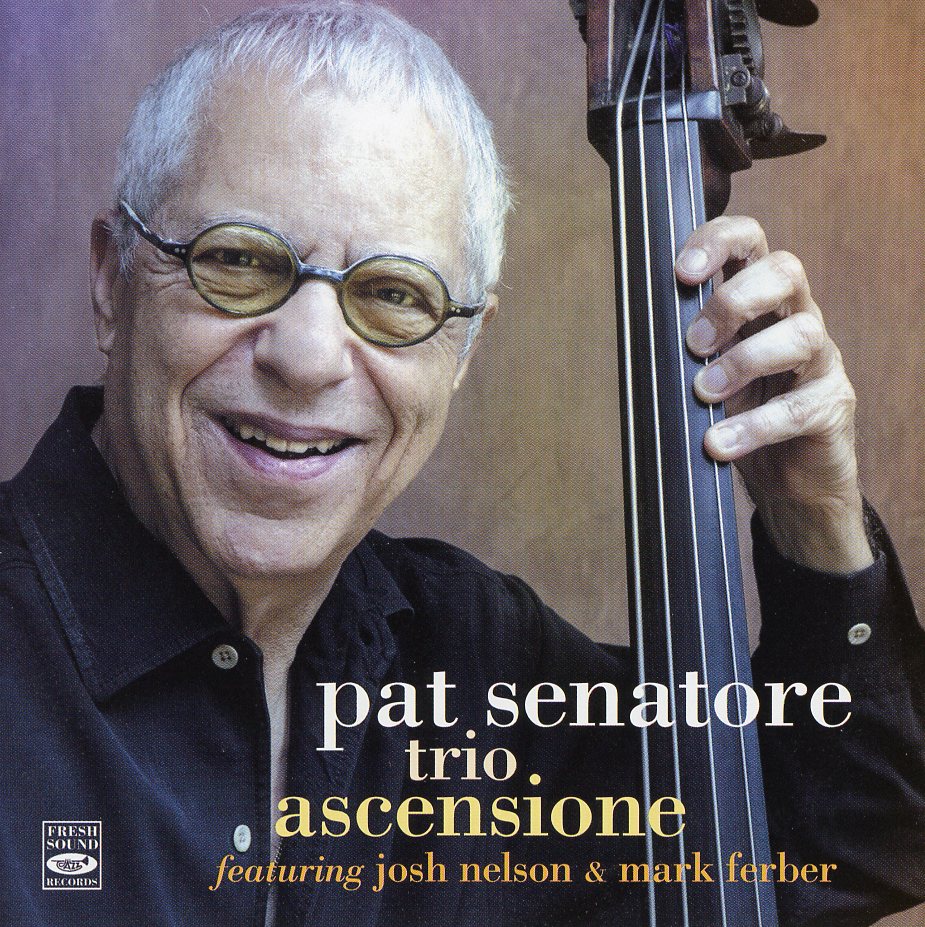
Pat Senatore - Ascending Inspirations

© Copyright ® Steven Cerra, copyright protected; all rights reserved.


“When I moved to LA in 1960 from Newark I wanted to transfer my Union card to Local 47 and the rule was you couldn’t work for 6 months. They didn’t want guys coming from out of town, taking work from LA cats then splitting. I had a record shop in NJ and knew the record business well. Artists, labels, album numbers etc.


[At Music City], I would wait on three customers for one of the other salesmen. After a couple of weeks Clyde Wallichs who was the owner and also [one of] the owner[s] of Capitol Records said “You really know the record business, how would you like to be night manager “


It was great because I hung at the union all day and jammed and rehearsed with cats and the result was my gig with Stan Kenton. I got a call from the contractor who said Stan needed a bass player, you interested. I asked if I had to audition. and he said no they know about you the job is yours if you want it. Nine months and three LP’s later I quit the band. I was 25 years old.

I also met Herb Alpert at Music City.”


When Herb formed the Tijuana Brass I was the bassist in that group from 1965-1970 which included a command performance for Queen Elizabeth one at the White House for President Johnson and also one for the President of Mexico.”

- Pat Senatore to JazzProfiles


And now here we are some sixty years later, Pat has taken up residence in Rome and his close friend Jordi Pujol owner-operator of Fresh Sound Records has released two recordings under Pat’s leadership. 


Although both were recorded over an eight year period from 2008 to 2016, the music sounds as “fresh” as though it happened yesterday. Perhaps this is due in part to the timeless quality of Pat’s artistry.


After listening to the music on these CDs, I’ve no doubt that the company he keeps on them served to inspire him and ensured that his creative skills are still, in a word, ascending.


The first of these Fresh Sound CD’s is entitled Ascensione: The Pat Senatore Trio [FSR CD 5051] and features him with two relative newcomers to Jazz performance: pianist John Nelson and drummer Mark Ferber. You can locate order information via this link.


Pat wrote the insert notes to both recordings so let’s have him provide the “interview” that explains how the music came about and what he sees as being special about the musicians and the music on them.


The first time I played with Josh Nelson and Mark Ferber, I knew they were special. After a career of playing with some of the best in the business — too many to mention here but a few great ones like Joe Pass, Joe Henderson, Eddie Harris, Joe Farrell, Freddie Hubbard, Cedar Walton, Alan Broadbent, George Cables, Billy Higgins, Carmen McRae, Peggy Lee, Anita O'Day — I knew it would be fun to record with them.


Both of them could be my sons and you know how hard it can be to communicate with your children. Yet when I play with these guys, it's timeless. I benefit from their musical youth and I hope they benefit from my many years of playing with greats. I know they like to hear my stories. They make me feel connected to my younger self.


There was a long interval between the two sessions we did and time for us to evolve even further after the many times we played together. Never rehearsed. Just spontaneous playing, much like I did at my club, Pasquale's, and at Vibrato with all the famous players that have played there.


Jazz to me is the now. Each time you play is a different experience, and at the worst, it is superb. It's a form of communication like no other, and unless you've done it, there's no way to explain the feeling of being in the moment. I think that's why we make the commitment to this music. The passion, the hours of practice, and all the other sacrifices we make are rewarded when we walk off the bandstand and people are touched by what we play. They feel the intensity. The groove as we call it. This is the ultimate reward and what keeps us addicted to the devotion of reaching the supreme high of being in the zone. This is why so many of my peers literally continue to play until they leave this planet and hope to continue in the hereafter. How lucky we are to have this form of expression. It's unique.


As for the music on this CD, we opened and closed with two compositions by the late Michel Petrucciani, one of the most exceptional musicians I have known in my life. Sahara and The Prayer are two examples of his beautiful soul.


Con Alma is one of Dizzy's most famous tunes. It features a drum solo by Mark, then a fugue by piano and bass that opens into Josh's solo.


A Change in the Wind by Josh Nelson is an example of the extent of his development as a composer, among his many musical talents. In his piano solo you become aware of his classical chops as well as his writing skill.


Positano Blues is a tune we used to warm up, "Let's play a blues." This tune evolved after I returned from a vacation in Positano, one of the most beautiful places on earth. While the name may seem like an oxymoron, it shows you can have the blues anywhere.


Next is my tune Ascensione. Josh and Mark nailed this tune the first time we played it. One take. Why mess with it? While writing this tune, the melody kept reaching higher and I felt a sense of ascending—thus "ascensione."


Minority by Gigi Gryce starts out as a vibe. We don't play the melody. Josh starts blowing and we support him on his journey Finally in the last chorus we state the melody with Josh's reharmonization that takes the tune to another place. I loved his creation.


Night Dreamer is by Wayne Shorter, the only true genius I can say I've known in my life so far. We both grew up in Newark, NJ, a few blocks from each other and went to grammar school and to Arts High School together, where we were both Music and Art majors. There's no way I could do a CD without one of his tunes. I could have picked anyone and it would have been the best on the CD.


We played All the Things You Are in 3/4. It's a different feel — more spacey and open.


We closed with Michel's The Prayer. I hope this CD is uplifting, an "Ascensione" and I pray that you enjoy this CD and jazz forever.”

—Pat Senatore


The second of Pat’s Fresh Sound CD’s is entitled Inspirations: The Pat Senatore Trio [FSR CD 5057] and you can locate order information via this link.


Inspirations: "A divine Influence directly and immediately exerted upon the mind or soul."


All the people associated with this project are and have been inspirations to me.


Tom Ranier: A consummate musician who can do it all: play, compose, orchestrate. He's a master accompanist to singers—a lost art. Just recently, he added Seth Mac-Farlane and Tony Bennett to his long list of credits. But most of all, he's a great jazz musician. He plays piano, clarinet (his first instrument), tenor sax, and bass clarinet, as you can hear on The Duke.


Every time I play with Tom, we inspire each other to experiment with different harmonies and we look at each other and smile. "Yeah, that works!" It's fresh, spontaneous, and from beat one there's never a doubt where the groove is. To me that's the most important thing in playing jazz. If it doesn't feel good, why do it? As I get older, I realize that every time you play is very special. Time is limited, so I use it preciously. When we were recording, I asked Tom to let his beautiful soul be more on display. He responded eloquently. Miyako, Song of the Jet are two inspiring examples.


Christian Euman: A young drummer that Tom and I heard about and hired to play with us at Vibrato [Jazz Club]. After the first eight bars, we looked at each other and smiled. He felt really good. We were both inspired and knew we wanted to record with him. He'd just graduated from The Monk Institute, and is on his way to being one of the most in-demand jazz drummers on the LA. scene.


Larry Koonse: Larry and I have played together many times with different cats and it's always been a positive experience. His melodic harmonic and rhythmic concept has always been inspiring to me. After doing Laura, Herb and I decided that it would be fun to do Georgia on My Mind with nylon string guitar. The obvious choice was Larry and it's a great track.


Herb Alpert: What can I say about Herb? He has inspired me since I first met him in 1960.1 had just moved here from Newark, NJ. In order to transfer my Musician's Union Card from Local 16 to Local 47 in L.A., I had to establish residence here for six months before I could work. Since I had my own record shop in Kearney, NJ, I knew the record business so I got a job at Wallich's Music City on Sunset Boulevard and Vine Street, owned by Clyde Wallichs, who also [was an] owner in Capitol Records. (A year later, I recorded three albums with Stan Kenton in the renowned Studio A at Capitol after nine months on the road with his band.)


Herb used to come into Wallich's Music City about once a week to buy sheet music for the top 10 songs of the day. One day, I asked him if he was a player and he said, “Yes, I play the trumpet." So, I said, "I play base, here's my number. If you ever need a bass player, give me a call." The rest is history]. Millions of record sales, command performances for President Johnson, Queen Elizabeth II, party with the Beatles, many TV shows, world tours—all with his Tijuana Brass [from 1965-1970].


In my opinion, his playing on this CD is some of his best work. Thanks Herb!


Jordi Pujol: The owner of Fresh Sound Records, is one of my favorite people. Jordi inspires me with his passion for jazz. He has released over 3,000 CDs on his label. Being a trumpet player and an admirer of Herb Alpert, he asked if Herb would play on the CD. He said, "I'd love to have Herb on my label." I said, "It's a long shot, but I'll ask."


The composers:


Charlie Parker & Dizzy Gillespie, Wayne Shorter, Wes Montgomery, David Raksin, Antonio Carlos Jobim, Dave Brubeck, Bill Evans, Hoagy Carmicbael, Miles Davis, Henry Mancini. If these guys don't inspire you, your heart is not beating — check it immediately.


The Music:


Anthropology — I got to play with Dizzy at the Monterey Jazz Festival when I was with Buddy Rich and Dizzy sat in with us. I got to see Bird live once, right before he died. I'm glad that I got to see the man who created bebop.


Miyako — Wayne and I went to school together in Newark, NJ and have been friends ever since. I would never do a project without one of his tunes. He ia a true genius and a constant inspiration to me.


Road Song — I met Wes when he guested on a T.J.B special. His unique style of picking with his thumb made his sound immediately recognizable. It's a good tune to get a groove on—like any of his tunes.


Laura — In my many years of playing, I found that whenever there was a lull in the audience's response to what we were doing, I would call Laura and we would get their attention right away. It's been one of my favorite tunes ever since I saw the movie, "Laura"


Song of the Jet — One of Jobim's lesser known tunes. When Tom brought a transcription of Eliane Elias' record to me, I thought it was great but I didn't want to do it the same way, So, I said, "Let's do it as a ballad instead of abossa." He said, "Yeah" and played the shit out of it. I think it's one of the best tracks on the CD.


The Duke — Years ago I had the Eric Dolphy and Richard Davis LP "Iron Man," with bass clarinet and bass fiddle only. The clear simplicity of the music inspired this track. I met Dave Brubeck and his wife at Vibrato when he did a benefit for the Brubeck Institute. Dave was ninety-years old and still wanted to play every day. That inspired me to play at least until I'm 90. Since clarinet was Tom's first axe, I asked him if he also played bass clarinet. He does. So we did The Duke with me and Tom playing the melody in unison, and just Christian's brushes as our rhythm section.


Fun Ride — When I was a young, aspiring bass player, I heard Bill Evans’ Trio at the Village Vanguard, with his original trio: Bill, [bassist] Scott La Faro, and [drummer] Paul Motian. I almost decided at that point to forget it. Scott completely blew my mind and I thought if I couldn't play the bass like that, why even bother. So actually, I was inspired to have something to shoot for even though it felt like it was as close to me achieving as going to Mars. 

While playing through the Bill Evans Fakebook on piano, I came across Fun Ride. It's a difficult tune to improvise on because of its chromatic chord progressions yet Tom, Christian and I hit it in one take. By the way, all these tunes were done in one take. I think that's the way jazz should be recorded on most occasions. Nowhere to hide. Spontaneous. Fresh. You lose something, the more takes you do.


Georgia on My Mind — After Herb played so great on Laura, I asked if he would do another tune. He agreed and said he'd like to do Georgia, which presents Herb without embellishments, just letting his familiar melodic sense shine. Hoagy Carmichael is another natural writer who is probably best known for this song but he wrote so many other great songs, like Skylark, Memories of You, Heart and Soul, Stardust. These are just a few that have inspired every musician at some time in their career.


The Theme — When Miles would come to L.A. with Wayne Shorter, Wayne would call me to hang out. I would go to the Chateau Montmartre Hotel to pick him up. One night he asked me if I wanted to meet Miles. "Sure." Wayne introduced me as his friend from Newark who went to school from kindergarten to Arts High with him. At the time, Miles was cooking something on the stove. He said, "You wanna eat?" "No thanks, I just had dinner." "Cool." Next year, it's the same scenario. Wayne calls and we stop by to see Miles, "Hey Miles, this is my buddy from Newark..." Miles stops him, "I remember that mother f**ker. He didn't want to eat my food." Miles always said what he felt, like it or not. His confidence inspired me. We did The Theme a little differently. Each of us played our solo — solo. It was fun. In all my years at Vibrato we played The Theme to end every set, as is traditional. (All the servers knew this and could sing the melody.)


Two for the Road—Tom suggested this tune to close the CD and you can hear why. It's a natural way to end a beautiful evening.


Thanks to: Tom, Christian, Larry, Herb, Jordi Pujol, Hussain Jiffery, Misaki Saito, and Paul Taverner for making this CD. I hope it inspires you to make your dreams into realities.”


Let’s close this visit with Pat and his music with something to think about. During a particularly challenging time for performing artists, it’s nice to have the opportunity to help support them by purchasing their recordings. Everyone stays safe and all of those concerned with making the recording pick up some schimolies while enriching your soul with their artistry. Maybe it’s our small way of becoming a “patron of the arts?”


Saturday, September 19, 2020

Reunion Gerry Mulligan Quartet with Chet Baker by Michael Cuscuna

© -Steven Cerra, copyright protected; all rights reserved.


Here’s a nice encapsulation of the early years of Gerry Mulligan’s 1950s association with Pacific Jazz Records.


Reunion Gerry Mulligan Quartet with Chet Baker by Michael Cuscuna
[Pacific Jazz Series CDP 746857 EMI-Manhattan]


“The original Gerry Mulligan piano less quartet with Chet Baker grew out of several circumstances in the summer of 1952. One year later, it was over. But in that time, the group had recorded prolifically for Pacific Jazz as well as 8 titles for Fantasy and 6 for GNP.


Mulligan’s first session with Pacific Jazz was the label's inauguration. It took place on June 10, 1952. It was to be a quartet with Jimmy Rowles, Red Mitchell and Chico Hamilton, but Rowles never showed up. So the trio recorded anyway with the only piano coming from Mulligan during the bass solos. Mulligans next session a month later had Chet Baker, whom he had only recently met. Rowles on piano and Joe Mondragon on bass. No drums this time.


A week or so later. The Haig, where Mulligan had become the Monday regular, hired the Red Norvo trio for an extended engagement. To make room for Norvo's vibes, the club's piano went into storage. Mulligan formed a quartet with Baker and bass and drums to accommodate the new set-up. In August, this group made its first sides for Pacific Jazz. Within a few months. Pacific Jazz, Gerry Mulligan and Chet Baker were overnight successes with the records selling like pop favorites and articles in every music magazine and such mainstream press as Time Magazine. Lines at the Haig were around the block.


In early June of 1953. it was all over as Gerry ran afoul of the law on a drug charge and had to serve several months in jail. Chet Baker kept the lamp burning at The Haig, but he was now developing his own superb quartet with pianist-composer Russ Freeman.


When Mulligan returned to the scene, he stood fast to the idea of a pianoless group that would allow more improvisational directions and freedom. Most often he has a quartet with valve trombonist Bob Brookmeyer (in which they both played occasional piano) and a sextet with trumpeter Joe Eardley and tenor saxophonist Zoot Sims.


In December of 1957, Mulligan, who had since gone on to record for Emarcy and Verve, and Pacific Jazz's Dick Bock were reunited in New York for a heavy recording schedule of special projects by Mulligan, which were all completed in a matter of two weeks. One was an album with Annie Ross, another was an unissued LP with the Vinnie Burke string quartet, another was The Gerry Mulligan Songbook arranged for an all star sax section, and finally a reunion with Chet Baker.


For the Reunion album and most of the Annie Ross material. Mulligan and Baker were joined by bassist Henry Grimes and Gerry's regular drummer Dave Bailey on December 3, 11 and 17. On those three days. ten titles with Annie Ross and thirteen with just the quartet were completed. Of the instrumental material, two additional alternate takes have also survived.


Although some have criticized this Mulligan-Baker session as not very successful, the results are actually quite excellent. Admittedly, some of the spark and spunk of the original quartet is not evident in these performances, but then these are men whose music is five years older and five years more mature. Also, it is quite obvious that neither man was attempting a 'revival' or a 'recreation', merely a 'reunion' None of the material taped was in the original quartet book.


If the sass of youth is gone, here we find in Mulligan a much more assured and mature improviser with a greater sense of the whole in his solos and more ability to construct it with a minimum of fuss. Chet Baker at this point in his life came unnecessarily under the influence of Miles Davis in some respects. The lift and pure originality of his ideas, phrasing and spontaneity were tempered briefly. But he still outplays most of the pack by a long shot. And his empathy with Gerry in the wonderfully inventive and unique Mulligan-Baker arrangements and in the contrapuntal and solo sections is still completely intact.


Of the fifteen performances here, eight were issued on the original album, two appeared on Playboy Records anthologies, three more titles and two alternate takes are issued on this Compact Disc for the first time. What is most striking is the uniform quality of all the material, which must have made the original Ip selection quite difficult.


The program is equally balanced with standards, older jazz tunes and modern jazz classics. And in each case. Mulligan fashions delightful, intricate arrangements that extract the most from the compositional materials and from the instrumentation at hand.


Thanks to the CD format, we can now enjoy these sessions in their entirety. The vocal portions of the December 11 and 17 dates can be heard in full with previously unissued material on Annie Ross Sings A Song With Mulligan on CD.”


— Michael Cuscuna