Wednesday, May 19, 2021

Tuesday, May 18, 2021
James P. Johnson - Carolina Shout by John Edward Hasse
The following appeared in the May 15, 2021 edition of the Wall Street Journal. If you click on the highlighted “Carolina Shout” title in the body of this piece, it will link you back to a performance of the tune played on a piano roll on YouTube.
Copyright ©2020 Dow Jones & Company, Inc. All Rights Reserved.
Setting a New Jazz Standard
“Released 100 years ago this month, James P. Johnson’s ‘Carolina Shout’ raised the bar of musicianship for pianists like Duke Ellington
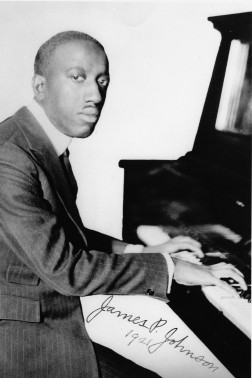
“In May 1921, James P. Johnson, a 27-year-old piano wizard now largely forgotten, released a composition that shook up pianists across the nation. His “Carolina Shout” became a test piece among professional pianists and set new standards of virtuosity and musicianship.
Johnson (1894-1955) spent his early years in New Jersey and moved to Manhattan when he was 14. He listened intently to church hymns and to ring shouts, dance music whose call-and-response patterns traced back to West Africa. Born with perfect pitch, he played and sang for school assemblies and minstrel shows, studied classical piano, attended New York Symphony concerts and idolized cabaret and sporting-house pianists. By age 18, he himself was playing at casinos, brothels and cabarets and was winning piano-playing contests.
Even as a youngster, he looked up to those he called the ragtime “ticklers.” “They had lots of girlfriends, led a sporting life and were invited everywhere there was a piano,” Johnson said in a 1953 interview. “I thought it was a fine way to live.”
When he was coming of age, the soundscape in homes and public places was radically different from today’s. At home, you couldn’t turn to radios, TVs, computers or mobile phones. Your phonograph records could hold only three to five minutes per side and sounded feeble on hand-cranked machines. In restaurants and bars, you had no jukeboxes or background music on P.A. systems. The king of music-making machines was the piano. It was an essential element in middle-class homes, even if nobody played it well.
Led by Johnson, New York pianists developed a style that took advantage of the instrument’s large melodic range and capability to sound multiple notes at once. He called it “orchestral piano—full, round, big, widespread chords and . . . a heavy bass moving against the right hand.” Johnson’s one-man-orchestra sound is still unmatched.
By 1917, the year when ragtime’s foremost composer, Scott Joplin, died, when ragtime music was fading out and jazz recordings were coming in, Johnson had started composing. In 1921, he cut a player piano roll of his creation “Carolina Shout” that mesmerized untold numbers of pianists and confirmed his arrival as a musician of the first rank. Johnson was later dubbed “the father of stride piano,” the flashy style named for its large left-hand leaps between the low and middle sections of the keyboard.
Joplin had preferred a measured approach, urging “Never play ragtime fast.” Under Johnson’s massive hands and serpentine fingers, stride was like Joplin ragtime on steroids.
Like piano ragtime, “Carolina Shout” used multi sectional form and syncopated right-hand rhythms against a steady left hand. But it left ragtime behind by featuring call-and-response patterns, blue notes, a brisker tempo, more themes, more intricate rhythms and a more propulsive feel. Playing the trickster, Johnson threw the listener off by reversing the expected left-hand oom-pah, oom-pah in favor of pah-oom, pah-oom. Or even oom-oom-pah—known as a “broken bass” line. When Johnson plays such lines, it not only beguiles my brain but pleasurably provokes my patting foot.
Johnson rooted “Carolina Shout” deeply in such African-American folk and dance traditions as the old ring shout and, he said, “Southern set or square dances. . . . I find I have a strong feeling for these dances that goes away back.”
Such aspiring pianists as Duke Ellington, Joe Turner and Johnson protégé Thomas “Fats” Waller learned to play “Carolina Shout” by slowing the piano roll way down. For two decades, “Shout” stood as a must-play at parlor socials, rent parties and piano “cutting contests.” Johnson and his song influenced a long string of pianists, including George Gershwin, Count Basie, Art Tatum, Erroll Garner and Thelonious Monk.
The secret to Johnson’s keyboard skill? Ingenuity, discipline and lifelong dedication. “In practicing technique,” he said in that 1953 interview, “I would play in the dark to get completely familiar with the keyboard. To develop clear touch and the feel of the piano, I’d put a bed sheet over the keyboard and play difficult pieces through it.”
In the late 1920s, he set a new standard for sensitively backing singers, notably Ethel Waters and Bessie Smith. His best-known piece was “The Charleston,” the 1923 dance song that became an emblem of the Roaring ’20s. He also wrote nearly 300 other works, including Broadway musicals, a rhapsody, a one-act “blues opera,” a concerto, symphonies and ballets—but had limited success with his classical works.
During 15 years of piano lessons, none of my teachers ever mentioned “Carolina Shout.” I wish they had. It’s such an American classic that colleges and conservatories ought to require that all piano majors learn it. Now that would be a righteous, rhythmic addition to the canon.”
—Mr. Hasse is curator emeritus of American music at the Smithsonian’s National Museum of American History. His books include “Beyond Category: The Life and Genius of Duke Ellington” (Da Capo) and “Discover Jazz” (Pearson).
Monday, May 17, 2021
Jazz Party: A Great Night in Manhattan by Steve Siegel
© Copyright ® Steven Cerra, copyright protected; all rights reserved.

With previous features on pianist Wade Legge, the Great Day in Harlem Photograph “Mystery Man” - William J. Crump, drummer Frankie Dunlop, vocalist Jimmy Rushing, and critic and author Nat Hentoff, Steve Siegel has assumed the role of “unofficial” staff writer for JazzProfiles.
Here’s his latest effort on the galaxy of Jazz stars that Columbia Records assembled in the late 1950’s and the seminal recordings that resulted from this constellation.
© -Steve Siegel copyright protected; all rights reserved; used with the author’s permission.
“On Tuesday, August 12, 1958, the most inclusive single piece of jazz documentation occurred when Art Kane, on an assignment from Esquire magazine, produced a group photograph of 57 mostly well-known jazz artists who had gathered on the steps of a brownstone in Harlem. The picture and the story behind it became known as A Great Day in Harlem. Collectively, these musicians were to ultimately issue recordings over a 99-year period—from Luckey Roberts’ 1916 recording to Benny Golson's 2015 recording – essentially the entire history of jazz.
Around the time that the issue of Esquire containing Kane's historic photograph hit the newsstands, a second grouping of jazz musicians were brought together who, if not quite equal in size to the Great Day in Harlem gathering, were every bit as august.
By the Fall of 1958, Columbia Records had acquired an impressive roster of talent in their jazz division. During that year, Columbia produced/released Miles Davis' Milestones and Porgy and Bess, Billie Holiday's Lady in Satin, Duke Ellington's Ellington Indigos, as well as Ellington at Newport (1958) and the studio recording of the jazz performed live on producer Robert Herridge’s December 1957 edition of CBS's series The Seven Lively Arts, entitled The Sound of Jazz. Sound of Ja5zz 1957 edition of the CBS
Columbia also had reason to celebrate their immediate future. Within the first eight months of 1959 Columbia was to produce three of the best-selling jazz albums of all time. During March and April, Miles Davis and his sextet produced his masterpiece, Kind of Blue. In May, Charles Mingus entered Columbia's 30th St. studio and recorded one of his classic albums, Mingus Ah Um. In June and August, Dave Brubeck brought his quartet to 30th St. and on the strength of Paul Desmond's composition “Take Five” and the use of some uncommon time signatures, turned out the best-selling album of his long career, Time Out.
In September 1958, Columbia’s jazz division decided to collectively puff out their chests and booked the tony Persian Room of the Plaza Hotel for a self-congratulatory party to take place on the afternoon and early evening of Tuesday, September 9, to celebrate the division’s recent and planned future artistic and financial successes – sort of a party on 58th Street to celebrate ’58. The date was exactly four weeks to the day after The Great Day in Harlem photo shoot.
The Columbia artists asked to perform included Duke Ellington and his Orchestra, the Miles Davis Sextet with John Coltrane and Julian Adderley, and the Buck Clayton Quartet with Mal Waldron. Special guests were Billie Holiday and Jimmy Rushing.
Given that it was a private party, by invitation only, any unsuspecting jazz connoisseurs who arrived at the Plaza that afternoon for the soon to be in vogue, three martini lunch or happy hour, might have been startled to pass John Coltrane in the lobby or be standing next to a sullen and silent Miles in the men’s room or notice a rather taciturn Johnny Hodges killing time in an overstuffed lobby chair between sets.
In total, there were 27 musicians who performed that afternoon. The short list included Ellington, Davis, Holiday, Rushing, Coltrane, Hodges, Carney, Adderley, Chambers, Gonsalves, Evans, Clayton and Waldron. Only Rushing and Clayton attended both the GDIH photo shoot and the Columbia Records party.
Columbia sent out a remote recording crew to capture the event, though the intent was not to release the performances commercially but merely to provide documentation for the record company's archives in case such an event should never be repeated.
In those archives is where the tape remained for the next 15 years.
In the early 1970s, perhaps driven by the bohemian leanings of college students, and an emerging interest in the reissuing of jazz from the bebop era forward, Columbia rediscovered the Plaza tapes and in 1973 issued the Miles Davis performances as Jazz at the Plaza Vol. 1 as well as the Ellington performances, which included guest performances from Holiday and Rushing, as Jazz at the Plaza Vol. 2. The two volumes were accompanied by separate sets of liner notes written by Columbia producer, Irving Townsend.
Beyond a small bump up in the market demand for jazz product, we might speculate that another marketing strategy for releasing the tapes might have been at work. Perhaps the primary reason that Columbia issued the Davis recording was to further cash-in on Miles Davis' great financial success for the label with his fusion albums of the early 1970s. If the label could get some of Davis' earlier work into the hands of his rather young fusion fans, perhaps they could create some more demand for his classic 50s and 60s Columbia albums. The Plaza recordings were the only classic period Davis that they had in the vaults that they wished to release at that time (The Plugged Nickel sessions sat until the early 80s for U.S. release), so perhaps a “new-old" Miles Davis album could create more demand for the retro era releases. To a lesser financial extent, the same rationale might apply to the Ellington Plaza release, as the label had much Ellington product on hand from the late 50s and early 60s.
In getting the two Plaza releases ready for market, Columbia Records ran into some problems. The performances from 1958 were a distant memory to those personnel who had been involved with the original production. The co-producer of the event, Irving Townsend, had, by 1960, relocated to the west coast offices of Columbia as Vice President of A&R. Few top Columbia executives who were around in 1958 were still with the organization in 1973. Goddard Lieberson, Columbia’s president in 1958, had been succeeded by Clive Davis in 1967, whose dismissal in May 1973—around the time that the two albums were in production—threw the label into turmoil. By the early 70s, Columbia had reduced its commitment to jazz and invested heavily in the emerging rock, pop and soul market segments. So there existed little institutional memory for all that happened that afternoon in September 1958.
Because this was never intended to be released commercially, the normal level of background documentation for the recording was scarce or non-existent. Most of the musicians involved probably had not been aware that they had been recorded. If they were, they assumed it was for documentation purposes because they were not paid union scale as they would have been for a formal recording session. In fact, as Bill Evans recalled upon the 1973 release of the albums, the surviving musicians from the session were, in 1973, offered union scale … at the 1958 rate!
Consequently, those who were still alive in 1973 may have viewed this as a party and not a recording session and were of little help to Columbia in piecing together the session.
Collectively, these factors likely were responsible for the large number of inaccuracies and embarrassing errors—both major and minor—present in the reissues track names and listing of the musicians. Irving Townsend’s liner notes for both albums were inaccurate and out of character for him. Given that Townsend was present at the party that day, the inaccuracies are even more surprising.
In those liner notes, Townsend indicates that the venue was The Plaza's Edwardian Room, when in fact it was the Persian Room. He compounds the confusion by then describing the Edwardian Room’s attributes, normal class of clientele and physical size.
Townsend goes on to describe the opening selection on the Ellington record which is listed as “Jazz Festival Suite” as being written “…for his 1958 Newport appearance.” Actually, the suite that Ellington and his Orchestra performed at the Plaza had never been entitled Jazz Festival Suite. Further, it had not been written for Newport, nor was it performed at Newport. It had been commissioned to Ellington by the directors of the Great South Bay Jazz Festival and premiered at the GSBJF on August 3, 1958, one month after Newport and was originally entitled, The Great South Bay Suite. Ellington must have felt that the suite had possibilities for further development because twelve days later, on August 15, 1958, it was again performed when the band appeared at the Sheraton Hotel in French Lick, Indiana as part of the French Lick Jazz Festival. However, as Ellington might phrase it: It is in very bad taste for one to play the Great South Bay (Jazz Festival) Suite at the French Lick Jazz Festival. Easy solution – simply rename the suite. So, it appears quite likely that the suite was then renamed Toot Suite. Eventually, Columbia recorded Toot Suite in its entirety on February 19, 1959 for the Ellington Jazz Party album.
Townsend then proceeded to reveal that the Ellington band at The Plaza was “…the same band that broke up the Newport Jazz Festival that summer (1958) and made a popular hero out of Paul Gonsalves.” Obviously, he confused the 1956 NJF with the 1958 NJF.
In the Ellington reissue's liner notes, no mention was made of the presence of the Buck Clayton/Mal Waldron Quartet—understandable in that no quartet performances were included on either record. But what was a major historical oversight was that no mention was made that it was Waldron, Holiday's regular accompanist on piano, not Ellington, accompanying Holiday for her two songs with Buck Clayton joining Jimmy Woode and Sam Woodyard of the Ellington Orchestra. The significance of that fact is that it establishes that there is presently no known commercially released recording of Ellington on piano accompanying Holiday.
Holiday did sing with the Ellington band with Ellington on piano in the short film from 1935, Symphony in Black. In 1945, Holiday participated in a radio broadcast with Duke’s Orchestra in the California Philharmonic Auditorium during Esquire Magazine’s Second Annual Jazz Concert. This was never commercially recorded. Finally, in 1952 she was present at Ellington's 25th Anniversary Concert (in show business) which took place at Carnegie Hall. Again, no commercial recording.
Two further errors are real head scratchers. The Miles Davis volume starts out with Monk's “Straight No Chaser” which is listed correctly on the record label, but as “Jazz at the Plaza” on the back of the record's jacket. In the liner notes, Townsend was evidently provided the false information about the name of track #1 and repeated it in the notes, calling it “an original (composition).” Rather strange how someone at Columbia could possibly not identify the Monk piece and then compound the error by simply creating another name for it with nobody at the label catching the mistake. After all, “Straight No Chaser” is one of the most easily identified pieces in the Monk canon and Monk had been a Columbia artist from 1963 to 1968.
Finally, in the personnel listings for the Davis album as well as in Townsend's liner notes, they list Philly Joe Jones as the drummer. Earlier that year, Davis fired Jones for the second time and had replaced him with Jimmy Cobb who appears on the Plaza recording and claimed the drum chair for the duration of the 1st classic Davis group.
I focused upon all these errors because the music contained within both volumes is mostly excellent and truly deserved to be treated with a bit more respect. Additionally, because liner notes are the primary source of educational information for most jazz fans, there exists an implied responsibility to the record companies to be as accurate as possible with documentation.
So, here we have two musical giants of the 20th century who came from two different, though overlapping eras, who were brought together on a Tuesday afternoon at a very ritzy, formal environment for the purpose of satisfying the whims of some well-to-do corporate bosses and their business associates. Consequently, the gig had all the makings for the musicians of simply an afternoon of free top shelf booze, food beyond the usual fare of what you might get on the road. (Think what the Ellington band might have had to eat in French Lick, Indiana.) So, why bust a gut when just an adequate effort would suffice?
In searching for an explanation for why both recordings exceeded expectations, let us turn to the thoughts of one of the esteemed invited attendees, the writer and critic, Ralph Ellison.
In a letter that Ellison wrote to Albert Murray, dated September 28, 1958, Ellison offers some rather interesting observations of the unspoken dynamic that he observed taking place between Duke, his musicians, and the Davis band members who, because the two groups were alternating sets, were presumably present in the Persian Room observing each other’s handiwork.
I was at a party given by Columbia Records at the Plaza recently, where they presented Duke, Miles Davis, Jimmy Rushing and Billie Holiday and it was murder. Duke signified on Davis all through his numbers and his trumpeters and saxophonists went after him like a bunch of hustlers in a Georgia skin game fighting with razors. Only Cannonball Adderley sounded as though he might have some of the human qualities which sounds unmistakably in the Ellington band. And no question of numbers was involved. They simply had more to say in a hundred more ways in which they say it.
Notwithstanding the bias that Ellison might freely admit that he had toward the big bands of the post-bop era and, in particular, Ellington and Basie, as well as his perceptions of the lack of emotional commitment on the part of the “New Thing” musicians, his statement is supported by the times.
If we believe Ellison's observations to be true, then perhaps what elevated the session was that unbeknownst to most of the invited guests, they were witnessing an old school, friendly cutting contest ala Chick Webb or the Savoy Sultans, with the Ellington organization coming prepared to give a performance that would leave no doubt as to the band’s bona fides. One can further speculate that because the two organizations alternated sets, the Davis group had the opportunity to become aware of what Ellison had sensed and responded to it with a fine performance of their own – Ellison's opinion notwithstanding.
To shed further light on why Ellington might have been signifying to Davis we can look toward the mid-1950s into the early 1960s. This period was a rather interesting time in jazz history where two different generations of musicians straddled a musical divide—that divide being created mostly through the advent of the modernist movement that came about in the mid-1940s. It is oftentimes conjectured that this movement was in part, intended to challenge the older generation through the younger generation creating “barriers-to-entry” to the music, based upon the new rhythmic and harmonic structure of bebop (amusical to many ears of the time).
Unlike previous generations, where many untrained or intuitive musicians were supplanted by changing times, the best musicians of Ellington’s generation gave away nothing to the youngsters. Possessing crackerjack reading skills, great musical imaginations and total mastery of their instruments, many of the older musicians, such as Coleman Hawkins, moved comfortably back and forth between both camps, as did Ellington, which he demonstrated in his solo or trio piano albums of the 1950s and 60s and his work on Money Jungle with Max Roach and Charles Mingus. When the best musicians representing these two eras came together at jazz festivals or in the clubs and ballrooms in the major cities throughout the country, sparks might fly and wounds could be inflicted, as both camps were busy signifying in support of their music or even to demonstrate their mastery of the other generation’s musical approach.
Beyond the difference in musical styles, the philosophical difference between the two bands boiled down to the manner in which Ellington and Davis viewed their audience. Ellington came from a generation that in addition to stressing artistic excellence rarely lost track of the fact that they were entertainers; Davis, on the other hand, carried the flag for those of the modernists who considered much of the audience incapable of appreciating the aesthetic that drove the new music. We might refer to this dichotomy of how the two groups viewed the audience as the Entertainers versus the Disdainers. Of course, not all individual musicians within both organizations adhered to this split. Hodges could provide Davis with some stiff competition in a disdainful look competition (Hodge’s disdain was generally focused upon Ellington). On the other hand, Adderley, in his personal appearances, established an excellent rapport with his audience.
Another factor which could explain the fine performances of the participants was the great respect the two leaders had for each other and the desire to impress. Davis once offered this about Ellington: At least one day out of the year all musicians should just put their instruments down, and give thanks to Duke Ellington. Heady stuff from the Prince of Darkness. In fact, Ellington might have been one of the only jazz musicians who Davis cared about impressing.
Despite the unintentional yet unrelenting assault these albums perpetrated on the concept of historically accurate jazz information, ultimately these recordings are all about the music and that is the albums' strength. The fact that after 15 years Columbia thought to release two performances from musical icons of the 20th century, that were never meant to be heard by the general public, was commendable.”
Sunday, May 16, 2021
The Creative World of Stan Kenton - Part 2
© Copyright ® Steven Cerra, copyright protected; all rights reserved.

“... the Kenton bands from the late 1960s until his death in 1979 sounded different and I could never quite figure out why until I found some possible explanations in Michael Sparke’s seminal - Stan Kenton: This Is An Orchestra [2010].
In sharing these excerpts from Michael’s Kenton book, I plan to use them as a point-of-departure for a multi-part feature covering the Kenton bands and their recordings during the last decade or so of Stan’s career [he died in 1979].
- The editorial staff at JazzProfiles
The Creative World of Stan Kenton [1970]
‘The truth is, none of the few remaining touring bands of the Seventies, whose leaders roamed the land like the sole remaining dinosaurs of an almost-extinct species, were quite the same as they had been in their younger days. Conditions were so totally different the decline was inevitable, especially as age and illness took its toll. But it is also true, many talented musicians worked for Kenton in the Seventies, and a lot of significant music was played. The listener who ignores this last decade will be the loser.’
- Michael Sparke, Stan Kenton: This Is An Orchestra [2010]
“As the decade [of the 1960s] came to a close it was clear the status quo between leader and record label was no longer tenable. By common consent Kenton and Capitol decided to call it quits, and their contract (which actually ran until May 26, 1970) was quietly revoked. There was no bad feeling on either side, proven by Stan's unique arrangement with Capitol whereby he was able to lease his deleted recordings from the company to sell by mail-order LPs on his own Creative World label, a name derived from his long-time slogan, "The Creative World of Stan Kenton." The first seven-album release, ranging from City of Glass to Kenton's Christmas, was announced in Down Beat dated September 18, 1969.
For Kenton, losing the backing of the record company that had supported, protected, and promoted him for 25 years was rather like detaching the umbilical cord. Most artists flit from label to label with abandon, but Capitol had been Stan's home, his rock for most of his recording career, and to lose that shelter at 58, and be cast adrift in a world growing ever more hostile to everything he represented in music and the arts, was shattering. But Kenton had always thrived on new adventures, and the success of his own record label was a challenge to strive for. After several years of virtual stagnation, Stan's Creative World would grow in future years, and together with a revitalized, permanent orchestra, would catapult Kenton into the Seventies, and see him regain his place as the leading trendsetter in the advancement of big-band jazz.
Whatever the comparative limitations of these later Kenton Bands …” Most fans just welcomed the fact that Stan had returned to music with a concert Jazz orchestra.” Dances were consigned to a sideline category, something made possible only because of the increasing number of college bookings, usually combined with an afternoon clinic. The downside was this youthful audience would inevitably be reflected in the band's repertoire and style. Every artist is attracted by the nectar of applause, and wants to be loved by their audiences, and Kenton was no exception. Stan knew he had to engage the youngsters attracted to currently popular rock rhythms, and had to incorporate this in his music, while retaining enough of his traditional trademarks not to alienate his older fans. It was a difficult tightrope to walk, and he probably succeeded in satisfying many listeners only part of the time.
So, dependent upon your age and inclination, there were many pros and cons associated with the new band, but overall the outlook was brighter than for many years. As John Worster put it, "The band was now a full-time thing in Stan's mind. The musicians knew it, and it was infectious. It was a more totally serious venture on everyone's part."
Musicians from the Seventies often feel like the underdogs, because they know they played good music well, yet in general it is the earlier bands that are most often feted and remembered. In moments of honesty, however, many will admit they understand and endorse this comprehension. The truth is, none of the few remaining touring bands of the Seventies, whose leaders roamed the land like the sole remaining dinosaurs of an almost-extinct species, were quite the same as they had been in their younger days. Conditions were so totally different the decline was inevitable, especially as age and illness took its toll. But it is also true, many talented musicians worked for Kenton in the Seventies, and a lot of significant music was played. The listener who ignores this last decade will be the loser.
At least Mike Vax will endorse the last couple of sentences above, even if some other comments leave him seething! Of all the alumni, Vax remains one of the staunchest Kenton supporters, commenting, "The day that Stan gave me the encouragement to play lead trumpet in his band, at the 1960 summer clinic, changed my life forever."
Mike achieved his goal in 1970, leading the high-powered trumpet section of Jim Kartchner, Dennis Noday, Warren Gale, and Joe Ellis, Of his team, Vax claimed Warren Gale to be the most significant soloist in the band: " If ever there was a fiery jazz trumpet player that was perfect for the Kenton band it was Warren. I don't know that Dennis Noday is a great lead player in terms of consistency and swing, but he's certainly the loudest trumpet player I've ever played with. If he wanted to he could bury me, and I'm pretty loud. But he never did—I had him to rest on.
"Dick Shearer was the most important person on the band. I think that Stan felt about him like a son. Dick was a good soloist, even though he didn't play any jazz. Very rarely did he ever improvise much. Most of 'Bon Homme Richard' was written, and he would play it pretty much the same every night, which really contradicted what Stan liked from his soloists. But the thing is, the way Dick played trombone, that was the Kenton sound. Dick's trombone was derivative of all the great Kenton lead players, going all the way back to Kai Winding. But sometimes the person who's the end of a legacy, becomes the culmination of the legacy, so I think Dick was the greatest lead trombone player of them all."
Shearer himself spoke well of both saxophone soloists, Quin Davis on alto and Richard Torres tenor, telling me, "Torres was always very concerned about his health, he'd walk out with a sweater and top-coat protégé. Von Ohlen resembled an even more dynamic Dee Barton but with more contemporary technique, and had similarly started out on trombone, only switching to the percussion on which he was entirely self-taught at age 17, after hearing the inspirational Mel Lewis with the Stan Kenton orchestra.
Musicians in the band were themselves quick to recognize John's qualities:
Mike Vax: "John Von Ohlen was just perfect for Stan Kenton. John could swing, but he loved doing the more way-out things as well. The Levy time-charts were nothing to John—real easy."
Dick Shearer: "John never had a dull moment, he was always extremely bright. The minute we got on the stand, no matter how he felt, or how long we'd traveled, he got right in there. He would lift the band up all the time—he had such spirit. A very musical drummer, and a very strong player."
John Worster: "John to me was just amazing. Music is everything in the world to John. Music is 100%. It's a religion with him. He's eliminated a majority of other things from his thinking: he quit drinking, and almost has excluded women from his life. Everything just to make more room for music. It's really amazing—his ability to devote himself that completely. That's why he was so easy to play with." (All quotes to author, October 4, 1976)
John Von Ohlen: "We take the money for riding the bus. The music we play for free!" (Crescendo, November 1971)
To be continued in Part 3