© Copyright ® Steven Cerra, copyright protected; all rights reserved.
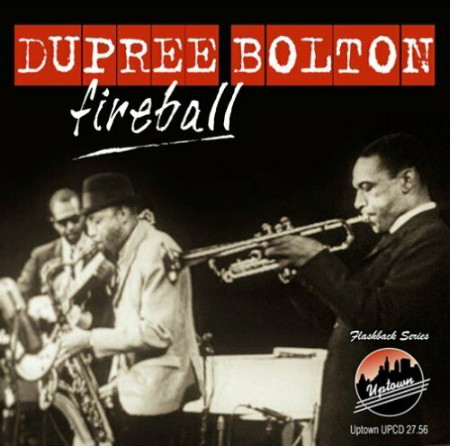
Steve Siegel has assumed the role of “unofficial” staff writer for JazzProfiles. His latest effort is about the obscure trumpet player Dupree Bolton [1929-1993], who appeared, seemingly from nowhere in California in 1959 and set the West Coast jazz world abuzz with his performance as a sideman. He then disappeared just as quickly and reappeared a few years later, again as a sideman, displaying mind-blowing chops. He was then gone again, never to officially record again for the remainder of his life.
© -Steve Siegel copyright protected; all rights reserved; used with the author’s permission.
“Prologue: At the time of Dupree Bolton's first major recording project in 1959, on the classic Harold Land session that yielded “The Fox,” there was really no useful information about Bolton—only that he ran away from home at the age of 14. After his appearance on the 1963 Curtis Amy led session “Katanga,” Bolton once again disappeared into the ether. His outstanding playing on both of these sessions were tantalizing appetizers and combined with his phantom-like existence served to create the perfect ingredients from which musical legends are born. Finally, through the 1985 discographic work of British jazz writer Bob Weir, we learned more of Bolton the musician and after Ted Gioia‘s 1988 interview with Bolton, we learned more of him as a person. Subsequent to this breakthrough information, further research filled in other gaps in Bolton’s life.
This article’s purpose is to reveal new information as well as to review other known information in order to create a written timeline in an effort to further flesh out the enigmatic Mr. Bolton.
The decade of the 1950s yielded, in both quantity and quality, perhaps the greatest generation of trumpet players in jazz history. The trumpet’s architecture lent itself well to the jagged, convoluted lines of the evolving music.
Following the 1940’s Parker/Gillespie model for the classic jazz quintet, the 1950s provided the trumpet with a more prominent role of ensemble leadership — oftentimes being the driving force expected to provide the listener with much of the visceral impact and excitement of the music.
The 1950s began with the brilliance of Theodore “Fats" Navarro who entered the decade with a fully formed style which became the blueprint, either directly or indirectly through his early disciples, for generations of trumpet players. Unfortunately, Fat’s blazing style on the instrument was silenced 6 months into the decade, when on July 6, 1950, he died at the age of 26.
Within 3 years of Navarro's passing, his heir apparent, 22-year-old Clifford Brown, arrived on the scene. While in Europe as a member of Lionel Hampton’s group, Brown made a series of small group recordings with various configurations of Hampton band members. Following his return home, Brown recorded for Blue Note records—his first recordings as a leader and his first recordings to receive wide distribution. In 1955, he joined forces with Max Roach to form one of the seminal groups in jazz history.
The later years of the 1950s found trumpet players such as Lee Morgan, Thad Jones, Chet Baker, Don Fagerquist and Blue Mitchell on the scene and the trilogy of albums produced by Miles Davis with Gil Evans ending the decade with Davis' Kind of Blue.
In contrast to the beginning of the decade of the 1950s, with the loss of Navarro, the end of the decade provided a glimpse of another branch on the musical tree of Navarro. In August 1959, as the vaunted trumpet decade of the 1950s was about to give way to the 1960s, a quintet led by Harold Land entered the Radio Recorder Studios in Los Angeles to record for the HiFi Jazz label.
The quintet consisted of Harold Land, leader and tenor sax; Elmo Hope, piano; Frank Butler, drums; Herbie Lewis, bass and a totally unknown trumpet player—at least to the general jazz public and even most jazz musicians—Dupree Bolton.
Every art form has enigmatic figures. The romanticism attached to many art disciplines all but demands that these individuals exist or, perhaps, even be created. The enigma may lie in the artist themselves or in the nature of their art—or perhaps both. Over the past 60 years, Dupree Bolton has, within the art form of jazz, served the former role admirably.
In John Tynan’s liner notes for the original 1959 release of The Fox, Tynan relates that when he interviewed Bolton, all he would provide was that he ran away from home at the age of 14. In those same notes Land reveals that his first encounter with Bolton was when “I walked into this club one night and Bolton was on the stand blowing.” Land further explained that he had no idea where Bolton came from or knew anything else about him.
So, here we have an immensely talented, fully matured jazz trumpeter, unknown to the peripatetic west coast-based musician Harold Land, who provides not a clue about the path he followed in order to progress from being a 14-year-old runaway to a world class 30-year-old musician. Evidently, Bolton must have put those elusive years to good musical use because, upon the release of The Fox, Bolton would soon find himself being compared to the great Clifford Brown.
This true story forms a rather unlikely circumstance that even nearby Hollywood would, in all likelihood, have rejected as a storyline.
In tracing Dupree's lineage, we find that his father, Dupree Bolton Sr. was born somewhere between 1876 and 1881. His work history included fireman, cook, porter, laborer, carpenter and, most importantly to his son's musical development, a musician (1940 census).
Various sources have mentioned that Bolton Sr. had been an important influence on Charlie Christian's development on the guitar. Though both were in Oklahoma City during Christian’s teenage years—until Christian left Oklahoma City—there appears to be little or no evidence to support that claim and a great deal of evidence to support rejecting it. The primary argument being that Bolton Sr. was born circa 1880 and it's rather unlikely that the style of guitar playing he was exposed to in the early part of the century would have much impact on a player who was born 40 years later and was playing advanced bebop lines by the late 1930s. If there was any influence, it was most likely a youthful infatuation which was eventually supplanted by more modernistic ideas.
But there is also little doubt that Bolton Sr. had an impact on Bolton Jr's musical growth through his encouragement, his experience and his shared musical knowledge.
Dupree Ira Lewis Bolton, the first born to Dupree and Juanita Bolton, entered this world on March 6, 1929 in Oklahoma City. The Boltons resided in a rooming house at 423 E. 2nd Street. Dupree was the oldest of what would eventually be a family of four children – three sons and a daughter.
The 1940 census shows the family living at 315 South Phillips Street in Oklahoma City. Dupree Sr. is listed as a laborer with no income and Juanita as a “laundress in a private home” with a yearly income of $200.
Probably due to the family’s challenging financial situation, it appears that sometime in late 1942 or early 1943 the Boltons left Oklahoma and moved to Los Angeles where good paying jobs were plentiful due to the war effort.
At this point it appears that Dupree was already playing the trumpet.
As Bolton related to Ted Gioia: I started playing the violin when I was about four or five, but I wanted to play the trumpet. Later the music instructor at school gave me an E flat alto horn. I took that home and my daddy said, “Hey, you can't play this! This is an after-time instrument.” But in three or four days, I had learned the fingering on that instrument and could play it. So, my daddy told me, “Okay, I'll get a trumpet for you.” He sent to Sears & Roebuck for one of those mail order trumpets for me. I think it cost $19.95. I remember watching for the mail truck every morning, waiting for it to arrive. Finally, one morning the mailman arrived and had that big package. I rushed out there and there it was. I had a trumpet.
Shortly after the family’s arrival in SoCal, Bolton's proficiency on the trumpet coupled with his wanderlust to join a traveling big band led him to contemplate leaving home at the age of 14.
The opportunity presented itself when the territorial band of fellow Oklahoma native Jay McShann showed up in L.A. for an extended gig. We might assume that Bolton had grown up listening to records and radio broadcasts of McShann. We might also assume that McShann was familiar with the boy-wonder from Oklahoma City because for Bolton to talk his way into the trumpet section of a well-established professional big band (Charlie Parker had just left the band at this point) is very unlikely. McShann must have been convinced that the 14-year-old (or whatever age he passed himself off as) kid could handle both the musical, as well as the emotional demands of life on the road.
His stay with McShann was to be short-lived as McShann related to Terry Gross in a 1987 episode of NPR's “Fresh Air”:
GROSS: During the War, you were drafted, right? And a lot of guys in the band were drafted. Did you realize that that was going to be the end of the band?
MCSHANN: Well, no, I didn't have any ideas that would be the end of the band because at that time we were booked about a couple of years ahead, and we were really stretched out. But they had been trying to catch up with me, and we was on the road traveling and they couldn't find me (laughter), so we'd play this one-night stand and so then they took me right on to Leavenworth right after that, during intermission.
So, Bolton almost immediately got a taste of one of the rite-of-passage hazards of life on the road—being stranded by the dissolution of the organization due to the exigencies of big band employment; though one might have to laugh at the novelty of the cause being that the leader was essentially inducted into the Army between sets.
So, now at the age of 15, with little or no money (he was obviously the lowest paid band member, if he was paid at all) and already exposed to the drug issues that would eventually haunt him for the remainder of his life, Bolton was stranded.
From the Gioia interview: Almost immediately Bolton was initiated into the world of drugs. The older bandsmen sent 15-year-old Dupree to a drugstore with a forged prescription. When he returned with drugs, he was given a portion as his reward. "That was the first time I used dope. It was a painkiller for babies. Each dose had one ounce of opium in it. The dope addicts would take it, fix it, burn it, boil it, and draw the dope out of it.”
Upon the break-up, most likely, band members took pity on the band's man-child and provided him transportation to New York City where many members of defunct bands headed to resume their careers.
Bolton next emerges in New York City as a member of the Buddy Johnson Orchestra organization, participating in his first recording session on 10/4/1944 for Decca Records. Two sides of a 78 rpm, 10” single were recorded that day - “That's the Stuff you Gotta Watch" b/w “One of Them Good Ones.” Many musicologists have identified Bolton as the soloist on the later selection.
In an effort to hide his whereabouts from his parents who were still looking for him, on this session Dupree used the name “Lewis Dupree”—an amalgamation of his first and middle names—for the session log.
On October 9, 1945, near the end of Bolton's time with Johnson a recording was made at the Savoy Ballroom in NYC titled “Traffic Jam.” On this piece, Bolton enters the fray towards the end with the second trumpet solo. Over the riff figures, Bolton's solo generates great excitement and high note figures demonstrate his excellent technical facility in that difficult range of the instrument. Though the piece is merely an over-the-top riff intended to please the savoy dancers, the 16-year-old Bolton delivers a well-controlled solo.
The following month, in December 1945 or early 1946, Bolton left Johnson and joined Benny Carter's band. Sources indicate that Bolton, while with Carter, was a section musician with no solos assigned.
By 1947, at the age of 17, Dupree Bolton’s life was now not his own. It was shared with whatever drug dealer was servicing his need in whatever town he was playing in. His use of narcotics, which started in the McShann band at 15 where he served as pick-up man for the band’s drug needs, had become unmanageable. It was dominating his life at the expense of his music and was about to lead to some very serious personal consequences.
In 1947, Bolton was arrested for marijuana possession and sent to the hospital/prison in Lexington, Kentucky, a facility rather famous for all the jazz musicians who served time there, foremost being Billie Holiday.
Because Bolton was 17 years-old he was detained there until his 21st birthday – an almost four-year term for possessing a joint.
Upon his release he headed back to his family in California.
His first experience with incarceration had little impact on his drug habit or his fear of prison life—an attitude he retained almost to the end of his life.
The singer Ed Reed was a friend and fellow addict of Bolton’s in 1950. His account of their relationship provides insight into Bolton's life after his first four-year incarceration and just before his second prison term:
Dupree lived around the corner from me on 97th Street. I lived on Hickory Street in Watts. I loved his trumpet playing. He was my friend, my music mentor, and a friend of my family. He was also my crime partner; I gave him the stolen money orders that sent us to San Quentin prison in 1951. My Mother once asked him, as she was making lunch for us, why he always seemed hungry, he replied that he never had enough money, after buying heroin, to waste on food. My mom, my dad and my younger brother, and I loved Dupree. I always had a day job and had to keep something for lunch and gasoline, etc. Dupree never understood that. His main objectives were getting high and playing music. I was trying to sing and we played some Bucket of Blood gigs in and around Watts, we even got as far as Phoenix, Arizona before it fell apart over drugs and money. One day he and I got in an argument because I had some money I had to keep. Dupree felt I was being stingy and socked me on my head. I was driving and I stopped the car to duke it out with him. As I was getting out of the car he said, “Just a minute, we’re going to fight but you can’t hit me in the chops, ok?” After we went to prison in 1951, I did not see him again but once, briefly, in 1968. We were coppin’ some dope in Watts. I was interning in a program at UCLA. We promised to get together; we didn’t. The next time we met was in 1987. I had been clean about a year and I knew that I could not hang out with Dupree and stay clean. When I felt stronger, I went looking for him and listened to him play in San Francisco, Chinatown. His playing wasn’t the same and a sadness shadowed him. I saw him one last time shortly before his death in 1993 and we didn’t have much to say to each other. When I heard that he had died, I felt my heart break.
When all the known facts of Bolton’s life are laid out on a timeline, the romanticized mystery of Bolton, the shooting star who burned himself out by flying too close to the sun, quickly falls apart. This is not Sonny Rollins, already a great musician, but still uncomfortable enough with his personal assessment that he isolates himself from public appearances and possibly, using the rhythmic slapping of tires on the pavement of the Williamsburg bridge as his metronome, woodsheds until he feels that he can execute, through his horn, every nuance of human emotion.
In Bolton we have an individual who, because of the iron grip that narcotics had on him, spent most of 36 years of his life behind bars practicing and creating some incredible licks, most of which was only heard by the prison’s guards. During that 36-year period he appeared on two albums, both destined to become classics: Harold Lands’ The Fox and Curtis Amy's Katanga. His total time soloing on them: less than 20 minutes.
(Note: In 1963 Bolton also appeared on a Pacific Jazz session led by alto sax player Earl Anderza, who Bolton had met in San Quentin. Only two songs were recorded at the session and were not released until 2007.)
Speaking of Rollins, it's rather interesting to compare him to Bolton. They were born within 18 months of each other. Both could be considered as teenage prodigies. Both developed a drug dependency. Rollins beat his in 1955 and stayed clean for the next 66 years and counting. Bolton never even confronted his, much less beat it.
During the 36-year period in-question, Bolton appeared on the previously referenced two albums—neither as a leader. Rollins led or co-led nearly 70 released sessions and numerous others sessions as a sideman.
One can only imagine what level of music a Rollins-Bolton session might have yielded.
Perhaps the real mystery surrounding Bolton is how does a musician, cut off from the life blood of his art—the nightclubs, the jam sessions, the rap sessions with other musicians of his caliber, as well as the critical appraisal of his solo work by his peers and critics—manage to evolve?
The musical evolution of Bolton into a world-class musician was rather amazing in that regard. He related to Gioia that while incarcerated in Soledad he practiced on scales and exercises 10 to 12 hours per day, so his chops were maintained as was his technical proficiency. When in San Quentin he did have access to other musicians of his caliber such as Art Pepper. They concurrently served time in San Quentin from March 1961 to October 1962.
Possibly the best comparison for what Bolton accomplished in staying current through three eras of jazz is to look at Dexter Gordon’s career. Gordon, who was six years older than Bolton, adapted and maintained his musical mastery as he moved from swing to bop to modal. He also served some time in prison in the 1950s but was not off the scene for anything like the time that Bolton was.
Due to the frequency of his time in the studio throughout his career Gordon's growth can easily be charted incrementally. With Bolton, we have a 15-year gap from his 1944-45 big band recordings to his bebop-oriented work on The Fox and an additional 4-year gap until some modally influenced performances on Katanga.
To illustrate how Bolton managed to quickly assimilate the changing nature of jazz despite being in prison, one only has to listen to his solo on 1959’s title piece “The Fox" and compare his playing on that to his solo work on “Native Land” from Katanga. His playing on “The Fox" is pure bebop with flawless execution at a tempo in excess of six beats per second. On “Native Land” his solo is modal with increasing and decreasing tempos.
He spent almost the entire time between the two recordings imprisoned in San Quentin. It almost seems that Bolton considered prison to be a place where one goes for musical enrichment because, despite being incarcerated for most of the 1950s, upon his release his musical skills had improved measurably.
It is strange that Bolton had such a powerful driving force within him to continue to grow and excel as a musician under challenging circumstances, but so little fortitude and strength to overcome his drug habit—the very issue that prevented him from sharing his gifts with the jazz world. How ironic that a man who lost his freedom for much of 36 years to the penal system, could spend his time there thinking about and playing a music that, for so many worldwide, symbolizes freedom.
Musician Paul Brewer was hired by the Oklahoma Department of Corrections, the Oklahoma Arts and Humanities Council, and the National Endowment for the Arts as part of a program that was designed to study the effect of arts programs on recidivism and other issues among prison inmates in Oklahoma. Dupree Bolton was serving his final prison sentence at the time (circa 1980) and was a member of the prison band that Brewer led. Here are his remembrances of Bolton:
Dupree was not just a brilliant jazz musician. He was quite the erudite and articulate conversationalist, too. Dupree and I had many engaging conversations during the time he was in the prison band before he was paroled. We even co-wrote two jazz compositions together. I always enjoyed hearing Dupree play and spending time with him in conversation.
However, I also found myself exasperated with him in that he remained incorrigible in his refusal to do anything about his drug problem. I saw him a few times after he was paroled and I even played a couple of jazz sit-in performances at jazz clubs in Oklahoma City—clubs he was not supposed to be in because of the rules of his parole.
Dupree Bolton’s uneven life came to an end on June 5, 1993 at the age of 64. There is a certain irony that a man who endured so many life altering arrests would ultimately die of… cardiac arrest.
I am sure that there are many ways to look at the life of Dupree Bolton. One perspective is that with addicts, feeding the habit comes before all else. Therefore, we might posit of what great successes should have come Bolton's way if only he could have stayed clean and made music the driving force in his life? What musical mountains he could have scaled, what joy his playing could have brought us. But Bolton WAS an unrepentant addict and from the age of 15, that rosy scenario was unrealistic. As Ed Reed pointed out, Bolton’s main objectives were getting high and playing music. Thirty years later, Paul Brewer perceived Bolton as incorrigible about his drug habit and lived his life as he wished—terrible consequences and all.
Another way to view Bolton's life is that perhaps by spending so much time in prison, apparently, due to circumstances, focusing more on music than on dope, Bolton didn’t end up on the street dead, with a needle stuck in his arm as so many addicts did. Perhaps we should focus on the miracle that when he reached his musical peak in 1959, it coincided with his release from prison and that Harold Land walked into that bar, that evening and gave Bolton the chance. And Bolton delivered.
Four years later, again between prison stints, Bolton got his second chance with Curtis Amy and again delivered the goods.
So regardless of how sad a story his life was, no lament for Dupree Bolton is really necessary. Somehow, regardless of all the self-imposed obstacles he placed in his way, he still managed to produce great art when given his only two opportunities.”
Research Assistant: Nancy Sheridan Siegel


