Friday, September 17, 2021

Jon Gordon - Stranger Than Fiction

 © Copyright ® Steven Cerra, copyright protected; all rights reserved.


“Jon Gordon is one of these amazing young musicians I'm speaking of. We first met in 1988 when Jon called me for a lesson. I was doing quite a bit of teaching at the time on the faculties of William Paterson College as well as New York University. I had the chance to have some very intimate musical exchanges with some very inspiring young saxophonists. I'll never forget when Jon came to my loft. He played with such a strong sound and direction. It didn't feel like a lesson at all! We played music together!”

- Joe Lovano, insert notes Jon Gordon Ask Me Now [Criss Cross 1099] 


“In addition to Phil Woods, his first inspiration, Jon believes he "really learned to play Jazz by sitting in at Sweet Basil with Eddie Chamblee. I used to go down there every Saturday for almost seven years. That was important to me.


I also got to play with Roy Eldridge one time, which was a real honor." "One thing that's important to me is that I've often been in situations with a lot of older musicians, many of whom were very traditional and I feel really honored about that.  People like Roy Eldridge, Eddie Locke, Red Holloway, Barney Kessel, Doc Cheatham, Jay McShann and others.  I try to be as forward looking as I can be but I don't want to ever lose the central qualities that those guys had and I got to be around."

- Bret Primack, insert notes to Jon Gordon Witness [Criss Cross 1121] 


"Right around the time I hit 16, though, I fell in love with Jazz. I heard two Phil Woods records, Musique Du Bois and Song of Sisyphus, and they totally flipped me out. That started a one-year odyssey where I followed Phil around to all the clubs and haggled him for a year.  Finally one day, he looked at me and said, 'Well, can you play?' Before I could respond, he said, 'Well, it doesn't matter because you've got to pay me anyway.  Here's my card. Call my wife.' That began a wonderful two-year association where I studied with him maybe 10 or 11 times over a two-year period. After the second lesson, he never accepted a cent!  I think there's something very magical about being able to stand next to one of your heroes, and something happens to you when you hear music live as opposed to hearing records.  I was able to play duets with Phil at a point where he was like my hero, the one guy in the world I would choose to study with.”

As told to Ted Panken, insert notes to Jon Gordon Along the Way [Criss Cross 1138]


"Jon Gordon is a master. His compositions, improvisation, tone, and technical virtuosity set him apart as an elite musician for our time."

 - Brandon Bernstein, Jazz Improv NY


"Gordon has embraced the history of his instrument, carrying with it the ability to extend music as a universal language."

- Wayne Shorter


I wanted to get this feature up on this date to coincide with the September 17, 2021 release date of saxophonist-composer Jon Gordon's new recording - Stranger Than Fiction -  on ArtistShare AS 0190.


Figuratively-speaking, I’ve known Jon since the mid-1990s through the release of three recordings under his leadership on Gerry Teekens’ Criss Cross label.


His version of Chick’s Tune flashed across my car’s FM radio on the way to work one foggy San Francisco morning, and on the way home [in still more fog] that afternoon I stopped off at the Tower Records Store in North Beach and picked up the source of the recording - Jon Gordon Ask Me Now [Criss Cross 1099 - 1994]] that also featured trumpeter Tim Hagans [whom I remembered from his stint with the Stan Kenton band in the late 1970s]. Jon and Tim were “surrounded” by a powerful rhythm section made up of Bill Charlap [piano], Larry Grenadier [b] and Billy Drummond [d].


Chick’s Tune is based on You Stepped Out of a Dream, and the familiar strains of both melodies coupled with workouts on What Is This Thing Called Love, Giant Steps, Gaslight and Ask Me Now, also all familiar tunes, gave me a chance to set my ears, so to speak, and checkout what Jon was laying down. [I still hold my breath every time I hear Tim solo as his improvisations are the Jazz equivalent of roller coaster rides. If you’ve ever heard Conte Candoli solo on trumpet, then you know what I mean.]


Although Jon did contribute an original composition to Jon Gordon Ask Me Now [Joe Said So], it wasn’t until I picked up a copy of Jon Gordon Witness, his next CD for Criss Cross [1121] which followed in 1995 that I was introduced to the compositional side of Jon Gordon as the recording features seven of his originals. He was an interesting composer then and continues to be one now.


As you would imagine, a lot has changed over the past 25 years and the principal change that I’ve discerned in Jon’s music is that his original music and saxophone playing have become more integrated. His earlier music, while thematically interesting, was essentially vehicles to solo over; now the compositions are structured in such a way that Jon’s improvisations are extensions of his themes, that is to say, they are almost inseparable.


Enter Jon Gordon Stranger Than Fiction -  on ArtistShare AS 0190. After searching for ways to describe Jon’s latest effort, I re-read the following media release by Ann Braithwaite of Braithwaite & Katz and decided to share it with you “as is” because it does such an excellent job of describing the background to and the music on the recording.


“Saxophonist/composer Jon Gordon confronts our bizarre reality with true beauty on his stunning new nonet recording Jon Gordon Stranger Than Fiction, due out September 17, 2021 via ArtistShare, features a stellar band with Derrick Gardner, Alan Ferber, John Ellis and others, with special guests including Orrin Evans and Jocelyn Gould


Truth has become a bizarrely contentious issue in this divisive era of fake news and alternative facts. Still, as alto saxophonist and composer Jon Gordon points out on his latest album, one oft-repeated maxim may be more true now than ever: that truth itself is indeed Jon Gordon Stranger Than Fiction. Over the course of ten original compositions arranged for a stellar nonet, Gordon explores the warped modern existence that we've all grappled with during the past several months and years.


The music on Jon Gordon Stranger Than Fiction, due out September 17, 2021 through ArtistShare, reflects Gordon's realization that reality takes twists and turns far more unpredictable than any author would dare write. In both his personal and professional life as well as the topsy-turvy world of politics, the composer has been forced to pinch himself repeatedly to confirm that what he was living was cold, hard truth rather than some strange dream (or, quite often, nightmare).


Fortunately that awareness has resulted in a great deal of stunning new music, brought to very real life by a top-notch band of peers and former students and fellow faculty from the University of Manitoba, where Gordon has taught for nearly a decade. On Jon Gordon Stranger Than Fiction he's joined by trumpeter Derrick Gardner, trombonist and arranger Alan Ferber, saxophonists Reginald Lewis and Tristan Martinuson, bass clarinetists John Ellis and Anna Blackmore, guitarist and vocalist Jocelyn Gould, guitarist Larry Roy, pianists Orrin Evans and Will Bonness, bassist Julian Bradford and drummer Fabio Ragnelli.


"Around 2000, I began to be aware that things were not as I'd hoped in our country", Gordon said. "For all the troubles of our past, I had hope that the country was headed in a better direction. But I became disillusioned and angered by so many people seeming to cede to a kind of non-reality. And in the last few years that's only gotten more apparent."


The album's title track was written at the time of that initial revelation, though like the reality it reflects has only grown in scale and complexity with Alan Ferber's nonet arrangement. The trombonist, who served as assistant producer for the project, also contributed the bold arrangement for "Havens," which Gordon originally recorded in quintet form on 2008's Within Worlds. Gordon himself arranged the remainder of the pieces.


"Pointillism" opens the album with gradually accruing fragments of sound from the horns, which finally give way to a tense duel between Gordon and drummer Ragnelli as the ensemble surges behind them. "Havens" settles into a taut groove that belies the fact that the band did not record together thanks to geography and the pandemic. Gordon recorded initially with the core quintet, then added horns and guests who recorded in their own homes. The inquisitive title track follows, leading into the deceptively simple, graceful "Dance." Referring to a wandering mendicant in the Hindu tradition, the brief, through-composed "Sunyasin" reflects the temptation of renouncing the trappings of modern life while realizing the challenges it presents. Jocelyn Gould, a former student of Gordon's who won this year's Juno (Canadian Grammy) for "Jazz Album of the Year," adds an air of enticing mystery with her wordless vocals.


"Counterpoint" is a self-explanatory title for the tune's intricately interwoven lines and harmonies, while "Bella" sways alluringly, with one of a pair of guest appearances by pianist Orrin Evans. The massed horns of "Modality" allow a ray of hope to peek through the clouds, leading into the stunning fanfare of "Steps." The album ends with "Waking Dream," a summation of the surreal experience that attempts to shake the listener out of their somnambulant reverie and, hopefully, into some kind of constructive action.


While recording with a larger ensemble has been a long-held desire, the impetus for Stranger Than Fiction came with a series of Leonard Bernstein concerts which Gordon was involved in for the composer's 2018 centennial. He found one famous Bernstein quote continuing to resonate with him: "This will be our reply to violence: to make music more intensely, more beautifully, more devotedly than ever before." Gordon's first response to that call to aesthetic arms was 2019's quartet outing Answer, which pushed towards beauty; on Stranger Than Fiction he aimed for something even more lush but also more urgent and confrontational.


"I feel like we're in a crisis on many levels," he says. "And the only way you deal with these crises - the bullying and lies and authoritarian denial of reality - is by calling it out."


Gordon comes to this with first-hand experience, as he documented in his 2012 memoir, For Sue. "I grew up in an alcoholic family," he recalls. "When you're dealing with an alcoholic or an addict, sometimes they'll look at you and say one thing, then 30 seconds later they'll turn around and say the polar opposite. You're trying to argue with somebody that's not in reality. I feel like we're dealing with that as a country and a planet, and it causes the same kind of pain in a family relationship, in a community, in a society and in the world."”


Jon Gordon


A native New Yorker, saxophonist and composer Jon Gordon was born into a musical family and began playing at age ten. Classically trained, Gordon's love for jazz was sparked when a friend played him a Phil Woods record. He began lessons with the legendary altoist while sitting in regularly with saxophonist Eddie Chamblee at Sweet Basil. Since attending Manhattan School of Music, Gordon has worked with the likes of Maria Schneider, Ron McClure, Clark Terry, Benny Carter, Phil Woods, T.S. Monk, Bill Mays, the Vanguard Orchestra, Bill Charlap, Ray Barretto, Mark Turner, George Colligan, Chico Hamilton, Jimmy Cobb, Ben Riley, Harry Connick Jr., Bob Mintzer, Bill Mobley, and the N.Y. Pops Orchestra, among many others. In November of 1996, he won the Thelonious Monk International Jazz Saxophone Competition, judged by Wayne Shorter, Jackie McLean, Joe Lovano, Jimmy Heath and Joshua Redman. He has released more than a dozen albums under his own name and is the author of three acclaimed books.


Jon Gordon - Stranger Than Fiction

ArtistShare - AS0190 - Recorded October 2020

Release date September 17, 2021


More about Jon can be found at www.jongordonmusic.com 


Order information is available here.


Wednesday, September 15, 2021

Blue Train - John Coltrane Keeps His Promise

© Copyright ® Steven Cerra, copyright protected; all rights reserved.


JOHN COLTRANE has often been called a "searching" musician. His literally wailing sound—spearing, sharp and resonant that seems to suggest (from a purely emotional standpoint) a kind of intense probing into things far off, unknown and mysterious. Admittedly such a description is valid only in a personal way but "searching" remains applicable to Trane in view of actual fact. He is constantly seeking out new ways to extend his form of expression — practicing continually, listening to what other people are doing, adding, rejecting, assimilating — molding a voice that is already one of the most important in modern jazz.


John's "sound" as mentioned in the lead is rather unique. It is certainly his most obvious trademark (similar to Dexter Gordon, his earliest and strongest influence) but has meaning apart from just a "different sound." His way of thinking is at one with his tonal approach. His ideas often seem to run in veering, inconsistent lines appearing at first to lack discipline but, like Miles Davis and Thelonious Monk (two of his closest musical associates, both of whom have been labeled by some as "eccentric" and/or "poorly equipped" instrumentalists) John is aware and in control of what he is doing. What may appear to be suddenly rejected is used, rather, as a basis for further exploration.


Trane feels that working with Miles and Monk have been "invaluable musical experiences." His employment with each of these giants has provided him with an education


Miles, and now Monk (being of this school themselves) have never inhibited John's musical sense of freedom. He is able to experiment while on the stand with no fear of being called down and with a good chance of being congratulated.


John, though highly self-critical, has broad and varied tastes when it comes to others. His favorites are many [but especially Miles and Monk]; Miles ("His style of playing is very interesting to me. He has a very good knowledge of harmonics and chord structure. I used to talk with him quite often."), and Monk ("He plays with a whole range of chords. I had never heard anything like it before and I've learned a lot from him.").

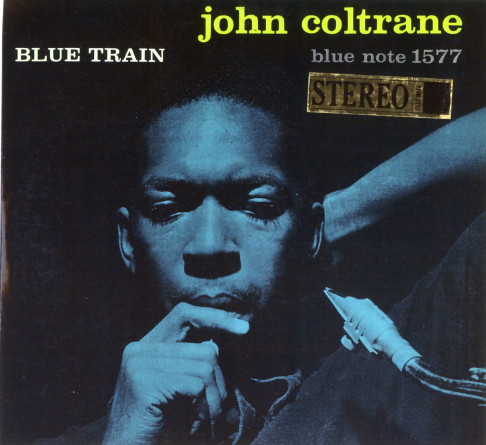
- Robert Levin, liner notes to Blue Train [BN LP 1577] 


As developments outlined in the following pieces indicate, the title of this feature could just as easily have been “the accidental making of Blue Train, one of the greatest albums in Jazz history,” or something to that effect.


Along with Giant Steps, which John would record for Atlantic two years later in 1959, Blue Train recorded in 1957 for Blue Note - Coltrane’s only album for that legendary Jazz label - came about so casually that it could have just as easily not come about at all.


Here’s the back story from Richard Cook’s The Biography of Blue Note Records [2001] with a more technical analysis of the music to follow from Lewis Porter, John Coltrane: His Life and Music [1999].


The year 1957 was the one that saw Blue Note's recording activity really explode. No less than forty-seven sessions were recorded for release during the course of the year. Considering that the company was still basically being overseen -including all matters pertaining to A&R, recording, packaging and distribution - by the original two-man team, the pace was extraordinary. It was not, though, the label's finest year in terms of quality: if anything, a look through the session book for the year suggests that a sense of routine was already starting to set into the company's activities. But the strongest Blue Notes of the year were good enough to rank with the greatest jazz albums of the era.


A few players who'd already recorded as sidemen were offered their first Blue Note dates as leaders: Curtis Fuller, Sonny Clark, Clifford Jordan, John Jenkins. But the most important 'debut' of Blue Note's year was the sole record to be issued on the label under John Coltrane's leadership, Blue Train.


The existence of the album offers one of the most tantalising might-have-beens in jazz. At the beginning of the year, Coltrane, already attracting great attention through his work with the Miles Davis Quintet, paid an informal visit to the Blue Note offices around seven o'clock one evening, ostensibly to ask Alfred Lion for some of his Sidney Bechet records (Coltrane had not yet recorded on the soprano saxophone, an instrument which had been all but outlawed in modern jazz). Lion was there on his own, Wolff having left for the day. The two men talked about the possibility of a record deal, but with Wolff - the man who looked after the contractual side - absent, there was not much more than talk. Still, Lion sensed that he was on the verge of a deal with the saxophonist.


The chronology here is a little difficult to figure out. The meeting took place either late in 1956 or early in 1957, but Coltrane signed a deal with Prestige early in 1957 and made his first date for them as a leader on 31 May. On 6 April, though, he participated in the Johnny Griffin Blue Note date A Blowing Session. Did he discuss the earlier proposition with Lion once again at that session? Either way, the first office meeting concluded in somewhat bizarre circumstances. Lion offered Coltrane a small advance for the making of at least one record, which Coltrane took and agreed to. Just as things were about to be even further formalised, the cat which resided in Blue Note's office leaped out of the window and into the street (they were not very high up). Concerned for its welfare, Lion ran to the window, looked out, and saw the animal being shepherded into a taxi by a woman who'd just opened the door of the cab. Alarmed that someone was trying to steal his cat (the second time a feline had played a part in Blue Note history, after the incident with Bud Powell!), he ran down into the street, and apparently managed to recover the animal. But on his return, Coltrane had disappeared. The contract remained as no more than a handshake agreement.


However, even though he had a new deal with Blue Note's great rival, Prestige, Coltrane didn't forget his promise. On 15 September he led a top-drawer Blue Note line-up through five compositions at the Van Gelder Hackensack studios. Blue Train has acquired an enormous reputation through the years, and after A Love Supreme and Giant Steps it is surely Coltrane's most renowned and frequently encountered record. It sits in collections which otherwise have none of Coltrane's Prestige or later Impulse! recordings, the most convenient and tolerable example of the first period of a difficult musician.


It's not hard to see why the album has been so successful. As the sole Blue Note by one of the most famous musicians in jazz, it has always staked a comfortable place in browser bins. For once, Reid Miles did little messing around with Frank Wolff's cover shot, cropping closely in on Coltrane's head and shoulders: he looks down, apparently lost in thought, saxophone hanging off his sports shirt, his left hand caught in the crook of his neck, his right raised to his lips as if he is musing on an imminent question. The title, Blue Train, almost suggests a kind of mood music, bolstered by the warm blue tint which Miles put on the photograph.


The music is beautifully delivered. Bob Porter's adage about Blue Note having two days of rehearsal where Prestige had none is borne out better by Blue Train than by any other session. As big and powerful as many of Coltrane's Prestige recordings are, none has quite the precision and polish of his Blue Note offering. Even so, the album is, in many ways, a high-craft, functional hard-bop record. Coltrane brought four original compositions to the date, of which at least two - A Moment's Notice and Lazy Bird - became frequently used parts of the jazz repertory. But there's a sense of impeccable routine about the music, which perhaps prophesies the way hard bop would go. In the notes to the latest reissue of the record, Curtis Fuller, who plays trombone on the record, says that 'I've been with younger musicians trying to work out that tune ["A Moment's Notice"]. And I tell them that that's just how we did it ... on a moment's notice.' That prosaic summary says much about the occasion.


The opening four minutes of the record are still electrifying. The stark, sombre blues theme of the title piece is elaborated through Coltrane's opening solo, beginning with long notes but quickly departing into a characteristic labyrinth where the chords are ransacked for many-headed motifs and trails of melody. It's a quite magisterial statement which Van Gelder captured in a sound more handsome than Coltrane had hitherto been blessed with. Yet from there, the performance becomes almost a matter of playing the blues until its end. Lee Morgan and Curtis Fuller were plausible choices for the front-line roles, and ones which the leader was responsible for, yet neither does anything other than, well, play the blues. Morgan, still finding his way, could be excused (what might Kenny Dorham have made of the role?), and the dyspeptic Fuller sounds far better as an ensemble colourist than as a soloist. It is always Coltrane himself one waits to hear. Paul Chambers and Philly Joe Jones are men he knew well, and they play with exemplary attention, although pianist Kenny Drew is again perhaps too bland a presence. All that seems forgotten once one hears the proud beauty of the tenorman's interpretation of I’m Old Fashioned and the fast, controlled excitement of Lazy Bird.


In the currently available CD edition of Blue Train, the originally issued version of the title track, take nine, is placed alongside take eight - with the added complexity that Drew's solo on take eight was the one featured on the familiar version, thanks to some tape splicing at the time of the first LP release. Some may be shocked that Lion's Blue Note would do such a

thing, but as Tony Hall remembers Alfred telling him, it was not an uncommon practice for them to adopt, particularly where an ensemble head was much cleaner than on a take where the solos were hotter. Since the advent of tape mastering, jazz had become no more immune to post-production than any other kind of recorded music, and while such matters are often thought to have grown up in the sixties and seventies, it was a convention that started early. One of the more famous examples in fifties' jazz was Thelonious Monk's Brilliant Corners date for Riverside, where a finished version of the title piece had to be spliced from three different takes.”


Lewis Porter, John Coltrane: His Life and Music [1999]:


“Just a few months after Coltrane [1957 Prestige – PRLP 7105, Prestige – 7105, Prestige – LP 7105], the Blue Note label got special permission from Prestige to produce the second album under John's leadership. According to Orrin Keepnews and Michael Cuscuna, Coltrane had agreed to do this album before signing with Prestige. Blue Train was recorded during his stint at the Five Spot, on September 15, 1957, and released that December. It quickly gained status as the best display of Coltrane's talents as a player and composer to date — all but one of the five tunes were his, and Blue Note paid for rehearsals.


The title piece is a haunting blues, basically a riff. The barrage of notes in his extended solo helps to create the urgency of a man spilling out his innermost feelings. (The first take, issued in 1997, has a much shorter, but still effective solo.) Locomotion is another blues riff, this time in AABA form— twelve-bar blues, blues again, eight-bar bridge, and blues again. Lester Young had used this structure in 1947 on D. B. Blues, which Coltrane probably knew. Coltrane was to reprise this structure on Trancing In.


On Moment's Notice, Coltrane is preoccupied with placing changing harmonies under a repeated note in the melody. That's interesting, because Dizzy Gillespie had done something like it on Con Alma, which had been in his repertory since 1954, when he recorded it with Latin percussionists. This exercise of finding different chords to harmonize the same note forces one to find some unusual chord connections, and I would suggest that sequences like these led partly to the unusual chord sequence of Giant Steps. In Con Alma the first two chords under each note are a major third apart, paving the way for Coltrane's exploration of roots moving by thirds in "Giant Steps." 


The chords to Coltrane's Lazy Bird, have the composer's cryptic comment "Heavy Dipper" under the bridge. The title of this piece is evidently a play on Lady Bird by Tadd Dameron, the much admired composer with whom Coltrane had in fact recorded in November 1956. This leads one to look for connections, but Dameron's piece is a sixteen-bar form without repeats and Coltrane's is a thirty-two-bar AABA. I suggest the following relationship: Take Dameron's sixteen-bar chord progression, transposed from C to Coltrane's key of G, but make each chord last half as long, so the whole progression takes eight measures. Now you basically have the A section of Lazy Bird—it becomes exact if you make the substitutions shown in parentheses:


For the bridge, Coltrane used a variation of the bridge of the standard tune Lover Man, which he had arranged for Jimmy Heath's band nine years earlier.


The coda may be seen as a very extended version of Dameron's original "turnaround" (which brings the piece back to the beginning). Coltrane's fresh and bubbling solo here is particularly full of what Barry Harris calls "[dominant] seventh scales."


On Blue Train Coltrane impresses as a player and as a writer. When Davis took Coltrane back into his group at the end of the Five Spot engagement, he was getting a powerhouse of a saxophonist who played with charisma and authority. And he was getting a powerhouse of a person, with a renewed vision of what he could accomplish in life.”


Monday, September 13, 2021

The Genius of Coleman Hawkins

 © Copyright ® Steven Cerra, copyright protected; all rights reserved.


Every so often, I like to pull a record out of the collection and share some comments and thoughts about it with you. I’m especially fond of calling to your attention recordings by musicians who helped me - in pianist Barry Harris’ phrase - “look out a bit.” [In other words, that helped to broaden my understanding of Jazz.]


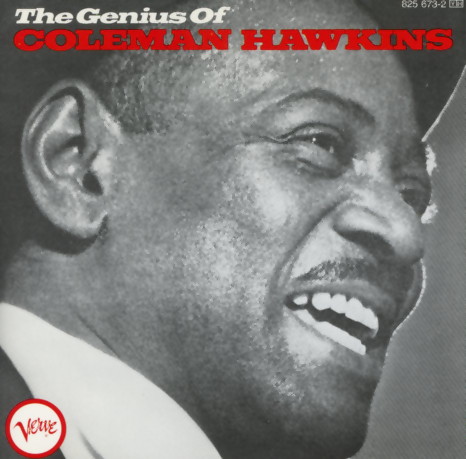
Such is the case with The Genius of Coleman Hawkins [Verve 825 673-2] which features “Bean” with a rhythm section comprised of pianist Oscar Peterson, guitarist Herb Ellis and bassist Ray Brown - the Oscar Peterson Trio of that time - augmented with drummer Alvin Stoller, a wonderful player who would go on to become a first call studio drummer.


“Genius,” notwithstanding, on his recordings, “Hawk” always put forth a straightforward interpretation of songs from the Great American Songbook along with a few tunes from the Jazz Standards and the occasional original.


On The Genius of Coleman Hawkins the melody for each tune is stated in a recognizable manner, Hawkins improvises for a chorus or two and the group then takes the tune out. All but one of the 12 tracks are 3.30 to 4.00 minutes long and each manages to encapsulate one or more aspects of Coleman’s genius as described in the accompanying notes to the original LP by the distinguished Jazz writer and critic Nat Hentoff.


“One value judgement on which everybody in jazz agrees is the perennial vitality and imagination of Coleman Hawkins. Now in his mid-fifties, Hawkins can still take command of any session in which he becomes sufficiently interested. He can still record with the most "modern" players (Thelonious Monk, for one example); and he is still recognized by fellow musicians as one of their continuing resources. Sonny Rollins, for instance, always lists Bean when asked the tenor saxophonists he most admires, and these days so do many modernists even younger than Sonny.


Hawkins' stature has never been in doubt historically since he began — while with Fletcher Henderson in the twenties — to liberate the tenor saxophone and become the first major, pervasive influence on that instrument. Jazz fashions being as mercurial as they are, however, he experienced a relative eclipse in poll-like estimation for some years in the forties and even into the early fifties when the Lester Young-dominated school of tenor was predominant. Hawkins' "return" (he had never, of course, been away) to interviews in the jazz magazines and higher rungs in the polls was partially set in gear by the rise of such younger, post-cool players as Sonny Rollins who clearly owed him as well as Charlie Parker a basic debt.


Coleman himself has never worried especially about who's been in office nor, unlike some of his generation, has he become embittered by the changes in styles and popularity. He hired Monk and Dizzy in his bands and on his records during that period when "bop" was used as an epithet by most writers and even by many older musicians. "It's all a natural way that jazz grows," he said recently. "You can't stop it. That's the way it is, and you're bound to pick up things yourself if you listen."


Hawkins, while always remaining strongly himself, has always been listening. Garvin Bushell, while traveling with Mamie Smith, heard Hawkins in the pit band of the 12th Street Theatre in Kansas City as early as 1921. "He was ahead of everything I ever heard on that instrument. It might have been a C melody he was playing then. He was really advanced. He read everything without missing a note. I haven't heard him miss a note yet in 38 years. And he didn't — as was the custom then — play the saxophone like a trumpet or clarinet. He was also running changes then, because he'd studied the piano as a youngster. The only thing he lacked in the early twenties," Bushell added, "was as strong a sense of the blues and the 'soul' the southern players had. He was like a typical midwest musician of that time in that respect."


Compare, however, his first recordings with Henderson with those that followed his growing absorption of the influences brought to New York by players from the south and southwest, most notably by Louis Armstrong in his stay with the Henderson band. By the end of the twenties, Hawkins was supreme on the tenor. Wherever he traveled, he was looked up to by all the younger players. Jo Jones, explaining a rare time when Coleman Hawkins was bested at a session (in Kansas City by Ben Webster, Lester Young and Herschel Evans) points out: "You see, nobody in those days would walk in and set up with Hawkins, except maybe in New York where Chu Berry was just coming up. But most of the time at sessions guys would just be trying to show Hawkins how they had improved since he had last heard them."


Hawkins continued being the  arbiter for many young musicians  — without

publicity — for years. British writer Nevil Skrimshire noted in the Jazz Journal:


"Coleman Hawkins was apparently one of the musicians responsible for Oscar Peterson's discovery. Peterson told me that one night at a club in Toronto, Hawkins sat and listened to him all evening without saying a word. When everyone had gone, Hawkins asked him to play a tune. He said, 'I'd like to hear It's The Talk of the Town but I'd like to hear it in B natural.' As Peterson said to me, he managed that one and a couple of other teasers and was thus accepted by Hawkins."


Hawkins enjoyed this date. He'd played with the Peterson trio before on the JATP tours; and with his customary disinclination to go into long verbalizations of music, he said of this session: "It all went down pretty easy. We got several first takes that were so good we didn't do any more. They were all 'heads' and I picked most of the tunes." The original, Blues for Rene, is by Hawkins.


This is unfettered Hawkins — no strings, no paper, nothing but his horn and rhythm. He remains as described by Benny Green, the British musician, in a chapter in The Decca Book of Jazz: ". . . He was the first of the jazz saxophone virtuosi, with a technique equal to the task of playing anything his mind could conceive. And his mind could conceive patterns of great ingenuity and beauty. For all the apparent hot-headedness of Hawkins in full cry over a faster tempo or his seeming blind fervor on a ballad, the Hawkins mind behind the Hawkins heart was always perfectly poised, weaving ingenious melodic patterns almost mathematical in their precision and in the inevitability of their resolutions."


Inevitability, the feeling that a solo could not have been otherwise, is one mark of a major improviser. Coleman Hawkins, for one.”


—NAT HENTOFF, Co-Editor, The Jazz Review


Saturday, September 11, 2021

Sir George Shearing and The Guv'nor, Robert Farnon [From the Archives]

 © -  Steven A. Cerra, copyright protected; all rights reserved.


“To call George Shearing a jazz pianist is certainly accurate, yet also limiting and nowhere near complete. It fails to encompass the immense diversity of riches in his playing and a sheer pianistic brilliance which can move easily from what Whitney Balliett calls the "swinging abandon" of improvisation to a grasp of the language of Beethoven or Bartok or Mozart or Bach. 

Pianist Marian McPartland says, "Without question, he's a genius. Every time I hear him or play with him, I rediscover how much music of all kinds he's absorbed." 

All of the Shearing influences — from classical composers to the jazz masters — Art Tatum, Teddy Wilson, Nat Cole, Hank Jones, Erroll Garner, Bud Powell — become a natural part of what is a very individual sound. Each performance he creates is a little gem, a sort of tone poem of invention that relates a story, building dramatically and logically with incredible wit.
- Donald Elfman, Jazz producer, director and writer

"Most of what I know is based on having stolen everything I could from Farnon. I'll say that right off. I've listened to him and tried to approximate what I thought he was doing. He made strings sound like they always should have and never did. Everybody wrote them skinny. He knew how to write them so that it could wrench at you. I'd never heard anybody like him before and I've never heard anybody like him since. We're all pale imitations of him, those of us who are influenced by him."
- Johnny Mandel, Academy Award and Grammy winning composer-arranger

Pianist George Shearing [1919-2011] was one of the most accomplished Jazz musicians who ever lived. 

During his lifetime Robert Farnon [1917-2005] was considered by many to be the finest arranger in the world an acclamation connoted in the reference to him by many in his trade as “The Guv’nor.”

It took a very long time in their respective careers for them to record together and when they finally did with George’s trio and the Farnon Orchestra in 1979 on the MPS album entitled On Target, the LP had very limited distribution when it was released in 1982, and subsequently has not, to my knowledge, made it to CD/digital. 

Those of us who love beautiful sounding Jazz had to wait again until 1992 when George Shearing [who was knighted for services to music in 2007 hence the honorific in the title of this piece] had switched to the Telarc label which issued the magical results of the union between the George Shearing [this time with his quintet] and The Robert Farnon Orchestra on the CD named after an original composition by Farnon entitled How Beautiful is Night [Telarc CD-83325].

Inexpensive copies of the CD are still available through online sellers along with MP3 and audio cassette versions of the recording.

George recounts the background to both of these unions in these excerpts from his autobiography written with Alyn Shipton, Lullaby of Birdland.

“Through the years I've been with several record labels. First there was Decca in England, then my first American recording was on Savoy and the launch of the Quintet on Discovery. I joined MGM in February 1949 and stayed with them until I began my long association with Capitol in the fall of 1955. That ran until the end of the 1960s and after recording in the early 70s for my own label, Sheba, I went first to MPS, and then to Concord, where I had another long-running business relationship, including all my work with Mel Torme.

At the beginning of the 1990s, I made another move to Telarc. Things began for them with a couple of live albums from the Blue Note in New York, where I appeared during February 1992 with Neil Swainson on bass and Grady Tate on drums. I never had to say one word to Grady or Neil about the musical conception of the album; we just played. We covered all kinds of material from bebop pieces by Charlie Parker and Bud Powell to Brazilian tunes by Antonio Carlos Jobim. Plus there were some originals, too, by me and Neil, including his waltz Horizon.

Later that same year, I made an album in London with Robert Farnon for Telarc, called How Beautiful is Night. Bob wrote the arrangements and conducted a full orchestra. I've been a fan of Bob's since the days of World War Two. In the world of composing and arranging, he's known as the guv'nor and deserves all the many accolades he's received over the years. Our first recording together, On Target, dates from my MPS period, in 1979. That was an interesting recording, because I originally made the trio cuts in Villingen-Schwenningen in the Black Forest. Hans Georg Brunner-Schwer, the producer, decided it was going to be a Bob Farnon album and that we would lay in the orchestral tracks at a later date in England. So Bob received the cuts from MPS and worked on the orchestrations. I had the MPS engineer record an "A" on the piano for the orchestra to tune to, and they only did so in Wembley, two years later!

Hans Georg, the owner and chief engineer of MPS, is one of the nicest people in the world, with a marvelous family and a great studio in his house, although you did occasionally get the impression that he loved everything he did so much that he was reluctant to see it leave his shelves. Nevertheless, the studio he had set up was fantastic, and overall it was one of my best experiences in terms of recording of my whole career. When you went to the Black Forest to work there, you flew first class, stayed in the finest hotel in the area, and were well paid. This was followed up by regular accounting, so the company was good to work for, except as I say it sometimes took a long time to get things out. It certainly can't have been cheap to bring in Bob and a big orchestra to complete the disc we made together. Overall, recording with Hans Georg was a joy and a privilege, never just another job.

When I was reunited with Bob for the Telarc recording, How Beautiful Is Night, we did the whole thing live with all the musicians — my Quintet and his orchestra — together in the studio. Prior to the sessions, Bob came over to our cottage in the Cotswolds during the summer before we recorded, and spent the whole day with us. He had no manuscript paper with him, just a notepad and a pencil. He'd jot down a note or two here and there, and more often than not he'd write down a word, rather than a musical idea.

Later, his son told Ellie that what Bob did next was to go home to the Channel Islands, where he would sit down in his favorite chair. Once he's there, he thinks and thinks, and then he thinks a while longer. Then he pulls out some manuscript paper and starts writing. There's no piano involved. 

And the sounds that come out from the orchestra are not to be believed.
I can't think of anybody better at writing a beautifully orchestrated ballad than Robert Farnon. But he has his jazz moments too. He has been a good friend of many jazz musicians over the years, including a lot of the guys who played at Minton's, as well as leading the Canadian Band of the Allied Expeditionary Force during the war. He stayed on in London to write for Ted Heath, Ambrose, and Geraldo, and to make his own discs for English Decca. In the days when I had my own radio show on WNEW in New York I played several of Bob's jazzier London recordings from the 1940s, including You're The Cream In My Coffee, which I announced as You're The Crime in My Cafe.

On four of the tracks we recorded together in 1992,1 featured a group playing in the style of the old Quintet, with the English musicians Frank Ricotti on vibes and Allan Ganley on drums alongside guitarist Louis Stewart, an Irishman who had played in my trio in the 70s, and Neil Swainson on bass.”


More details about the Shearing-Farnon association are recounted in Neil Tesser insightful sleeve notes to  How Beautiful is Night [Telarc CD-83325].

“In 1957, Jack Kerouac wrote:

‘Suddenly Dean stared into the darkness of a corner beyond the bandstand and said, Sal, God has arrived.

I looked. GEORGE SHEARING. And as always he leaned his blind head on his pale hand, all ears opened like the ears of an elephant, listening to the American sounds and mastering them for his own English summer's-night use. Then they urged him to get up and play. He did. He played innumerable choruses with amazing chords that mounted higher and higher till the sweat splashed all over the piano, and everybody listened in awe and fright. They led him off the stand after an hour. He went back to his dark corner, old god Shearing, and the boys said. There ain't nothin' left after that.’

It's a long drive from Kerouac's off-road encounter with Shearing, in a Chicago bop dive, to the reserved-seat, black-tie collaboration heard on this disc. Too long? Kerouac might think so; he might tell us the old god Shearing had wandered off into the long dark night of "culture," far from the seeds of the music heard on that magical summer's night north of the Loop.

But George Shearing, the many-faceted product of two English-speaking cultures, would beg to differ. The world of the concert hall belongs to him by rights, just as he made the bebop nights of the '50s his own; and he has almost always navigated these two poles with ease.

In fact, when Shearing first unveiled his innovative quintet sound in 1949, he had already begun to bridge his musical interests. The band's foreground instrumentation — featuring vibraphone, guitar, and piano, but no horns — seemed to straddle the worlds of chamber music and bebop combos. (The quintet proved politically correct before the phrase, let alone the concept, even existed. It comprised four men — two white, two black — and a woman, the vibraphonist Margie Hyams.) And Shearing's own compositions contributed to this sense of fusion: songs like "Conception" and "Lullaby of Birdland." while undeniably jazz, nonetheless showed a restraint and attention to development not always present in the exuberance of bop.

Shearing's previous Telarc release, I Hear A Rhapsody, briefly recounts his biography; for our purposes, it is important to note that by the late '50s Shearing had returned to the classical music he studied as a teenager, performing concertos with symphony orchestras and occasionally using his quintet within the same context. So by 1979, when he first collaborated on record with the Canadian-born composer and arranger Robert Farnon, the biggest shock lay in how long it had taken them to get together.

Farnon's career contains as many accolades as Shearing's; while his name may turn fewer heads, his music has been at least as influential, a result of his arrangements for such singers as Bennett, Sinatra, and Vaughan. and of a flurry of film scores (including Captain Horatio Hornblower, Where's Charley? and the last Hope-Crosby travelogue. The Road To Hong Kong). What's more, his colleagues lend to regard him with the respect, if not awe, that Kerouac accorded Shearing. Andre Previn has called him "the greatest living string writer in the world." and Tony Bennett says that every orchestrator with whom he's worked "steals from Robert Farnon. They really look at him like he's a god."

As a result, this album stacks up as much more than "George Shearing with Strings." That phrase — which connotes jazz performances sweetened by violins and the occasional high reed — has virtually nothing to do with these elaborately conceived settings for the style of George Shearing (and, on four tracks, his quintet). In wedding his control of the orchestra with Shearing's taste and swing, Farnon has done all but the impossible: he has created an album full of mini-concertos, in which the piano plays the prominent role while fully blending into the larger ensemble, and in the process he has drawn on a vast array of musical devices.

Only a handful of orchestral jazz projects have so fully accomplished this integration of seemingly incompatible components, and for obvious reasons. First, only a handful of orchestrators display the conceptual prowess of Robert Farnon. And second, only a handful of modern instrumentalists combine the traditional virtues of classical and jazz musics with the elegance of George Shearing.

Dancing In The Dark, the darkly romantic, even fatalistic Arthur Schwartz ballad, concerns more than ballroom swirls in a power failure. Titled after a book by the philosopher Martin Buber. who used the phrase as an analogy for the human condition, it reflects lyricist Howard Dietz's ambition to delve beneath the usual love-song surface. The arrangement showcases Shearing's lovely quintet sound — a sound for which he is noted — and Louis Stewart's carefully stated improvisation on guitar.

Farnon's treatment of Heather On The Hill (from the musical Brigadoon) is less an arrangement than a fantasia, which uses the original song as its source material. It contains some unusual associations. For instance, in the flute solo of the introduction, Farnon borrows a phrase from the verse of
Gershwin's But Not For Me: at the end, the music is reminiscent of Debussy's Prelude to the Afternoon of a Faun. The piece has the structure of ballet music, with Shearing's piano the lead dancer.

Farnon further extends his invitation to the dance on the next two songs. He has unexpectedly turned Oh, Lady Be Good! — the classic Broadway tune from the show Lady Be Good, and a longtime jazz vehicle — into a waltz, delightfully reharmonized by Shearing (who tosses in a snippet of Farnon's own Portrait of a Flirt in closing). After a somewhat melodramatic verse, he treats More Than You Know with a light, swinging lope. If you listen carefully, you will hear a quote from Farnon's To a Young Lady.

Our Waltz will surprise those fans of television's Red Skelton Show, who figured never to hear it again after Skelton left the air in 1971. Written by David Rose, who led the orchestra on Skelton's show, it served as an intermittent theme for much of the program's twenty-year history. A double-time waltz feeling sets the mood for the quintet entrance.

Shearing insisted that this recording contain one of Farnon's compositions; thus the new arrangement of How Beautiful Is Night, one of Farnon's most recorded compositions. With its chromatic harmonic movement and pastel tone portraiture, it's Farnon's Clare de Lune. and Shearing brings to his part all the impressionistic passion and control one could want. Once Upon A Time calls for similar qualities in the entirely different context of northern European folk music. The piece is actually an adaptation of an adaptation: Farnon has grounded his flights of fancy in Edvard Grieg's Lyric Pieces For Piano, which is itself based on both a Swedish folk song and Norwegian folk dance.

Days Gone By,a sweepingly gorgeous ballad by the Canadian jazz bassist and pianist Don Thompson, glories in a perfectly realized setting. It also adds a new sound to the wide palette explored by Farnon and Shearing: the unmistakable jazz color of Tommy Whittle's tenor saxophone and Shearing's piano obligato, against a layered backdrop of strings and harp. The full quintet returns, front and center, for Farnon's inventive version of Put On A Happy Face (from the first "rock musical," Bye Bye Birdie). For the theme, Shearing unveils his famed quintet sound — vibes on top, guitar on the bottom, and piano chords sandwiched in the middle — before a classic locked-hands solo.

If Haunted Ballroom sounds like more dance music, it comes by il naturally: the theme derives from a ballet of the same name, composed by Geoffrey Toye. Farnon opens with harp, vibes, strings, and bass flute combining to create pools ot raindrops before the waltz tempo grows active. Towards the end of Just Imagine, from the musical Good News, there is an interesting question and answer segment between the piano and solo violin. The quintet returns lor this program's finale, The Surrey With The Fringe On Top, for which Farnon has saved some of his best ideas. His rhythmic displacement of the theme both confounds our expectations and re-examines the melody, while the arrangement's airy reliance on flutes provides an orchestral correlative to the lightly swinging sound of the Shearing ensemble.
— Neil Tesser

What a joy it was to record this album with Robert Farnon. He has earned every accolade he has received. To me. he will always be "The Guv'nor."
— George Shearing