Thursday, July 14, 2022

"Ladies Day" - Billie Holiday by Gary Giddins

 © Copyright ® Steven Cerra, copyright protected; all rights reserved.


As you will note if you quickly peruse the subject headings of past blog features under LABELS in the right-hand column or sidebar of the blog, the editorial staff at JazzProfiles has been remiss about posting features about the iconic Jazz vocalist Billie Holiday.


In order to rectify this omission, we wrote to Gary Giddins and asked his permission to post his seminal essay Ladies Day from Lady Day: The Complete Billie Holiday on Columbia 1933-1944, Columbia/Legacy, 85470-2, July 2001]. He graciously granted permission and the article appears below in its entirety.


The piece is also found in Gary’s Weather Bird: Jazz at the Dawn of the Second Century [Oxford, 2004]. Order information can be located by going here.


After you read the following, I think you will agree with David Rubien of The San Francisco Chronicle when he states that “Giddins’ insights are so compelling and his writing so crisp that matters like past, present and future become moot.”


© -Gary Giddins, copyright protected; all rights reserved; used with the author’s permission.
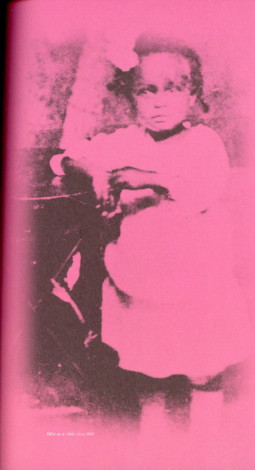


“How many Billie Holidays are there and which do you prefer? Elated or dour, funny or truculent, sweet or sour, our Lady of Sorrows or 52nd Street's Queen, early Billie or late, Billie of hope or heartache, Billie with Pres or with strings. Lady Day or Lady Nightmare or Lady in Ermine, Lady Be Good, Lady in Red, Lady Luck, Lady Blue, Lady Divine, the Lady who Swings the Band, Lady Mine—crank up the record machine, listen closely, and take your choice. For Billie Holiday is one of those exceptional artists whose work is a perfect tuning fork for our own inclinations. She echoes our emotions, rehabilitates our innocence, cauterizes our nerves.


How she managed so capacious a vision with her slim vocal range and infinite capacity for nurturing demons is a miracle to which generations of interpreters have been and will continue to be drawn. The greatest art never loses its mystery. The better we know hers, the more dreamlike and sensational it seems.


I am inclined to connect her with the equally inscrutable Edgar A. Poe, perhaps because I became mesmerized by both at the same age. What can she and the 19th-century writer have in common, beyond sharing an association with the South; spending critical years in Baltimore and New York; taking to drink and drugs; and dying, derelict, in their forties? For one thing, their power to haunt the soul. Consider that flawless short fiction, "The Fall of the House of Usher,” a story peculiarly remade by the imagination of each reader who, obliged to identify with a deliberately vague narrator, must examine feelings and maladies the narrator discounts as beyond analysis. Holiday, whether singing a stalwart lyric like "I'll Get By" or an insipid one like "What a Little Moonlight Can Do," requires no less rapport. The songs cannot account for the passion she engenders; it's a matter of alchemy. We transform such artists into romantic figures and bring our baggage to them, expecting them to lighten it. And they do!


Asked to choose one visual image to suggest the character of Holiday's sublime Columbia recordings, made between 1933 and 1942 (and in most cases originally issued by Brunswick, Vocalion, and OKeh), I would turn to the casual photography of Denmark's Timme Rosenkrantz. A jazz diehard and scion to a family that left him a title — baron —  but little funds, Rosenkrantz crossed the Atlantic whenever possible, exploring Harlem from the ground up, or down, drinking his way through bars visited by few whites. He was 24 in the late summer of 1935, armed with a camera in the Apollo's back alley, shooting a singer that few people had ever heard of. Only a month earlier, Billie had recorded her first important session, as vocalist with Teddy Wilson, and one selection, "What a Little Moonlight Can Do," was about to break as a jukebox hit. The Dane was clearly enchanted by her: The most famous of the pictures he took captures a radiantly lovely young woman, 20 years old, flashing a direct and perfectly symmetrical smile, arms entwined with those of two musicians, while another kneels before her and a fourth stands behind.


This picture has been reproduced many times, though never as dramatically as in the booklet to Columbia's 1962 three-LP box, Billie Holiday: The Golden Years, where it bleeds over a full two pages, including a wall of lovelorn graffiti. (A Rosenkrantz shot of Billie alone was used on the cover.) It offers us a very different Holiday than the star — gowned in scarlet with a white orchid in her hair — she would quickly become.


In 1935, with her hair brushed back and skin glowing, she is a country girl in a short-sleeve, open-neck, gingham dress with pockets on the skirt. Her figure is, to use a favorite press adjective, buxom. Pigmeat Markham, a comedian who shared an Apollo bill with her the same year, remembered her as "a simple lookin' girl" who didn't know how to do "the things that girls do to pretty up." Yet she appears sexy and sure, happy to be one with the musicians: saxophonists Ben Webster (who played on the Wilson date), to her right, looking off, distracted, and Johnny Russell, to her left; pianist Ram Ramirez, an erstwhile prodigy who would later co-write her signature hit, "Lover Man," in front; and, behind, a man with a guitar who turns out not to be a musician at all, but a stagehand known as Shoebrush.


The camaraderie Rosenkrantz caught characterizes the best of Holiday's early records, made when she was just another musician, waiting her turn and often singing no more than a chorus. Yet her contributions never indicate an obligatory vocal refrain of the sort bandleaders included to sell a lyric. Holiday's choruses are genuine solos. Working in fast company with the greatest players in New York, which is to say the world (Wilson, Webster, Benny Goodman, Roy Eldridge, Bunny Berigan, Artie Shaw, Lester Young, Buck Clayton, Chu Berry, Johnny Hodges, and on), she always holds her own, singing confidently behind the beat with an improvisational bravura that frequently bests them all. By that time, she had endured a childhood of fear and privation far worse than anything Dickens contrived for Little Nell. But unlike Nell, Billie lived to tell her own tale.


Her 1956 memoir, Lady Sings the Blues, opens with one of the most widely quoted passages of its time: "Mom and pop were just a couple of kids when they got married. He was eighteen, she was sixteen, and I was three." In truth, Billie was no writer; the ironic style is the work of "ghost" William Dufty, a journalist and one of her most loyal friends. (Two years later, he wrote the autobiography of Edward G. Robinson, Jr., whose only accomplishments were drunk driving and an attempted suicide, but whose tale starts off with a similar wallop.) In any case, like much of the book — which is well worth reading — it was only slightly true. Mom and Pop were kids when Billie was born, on April 7, 1915, but did not marry. Sadie, at 18, had two years on Clarence Holiday, who abandoned her and the child. As biographer Donald Clarke has shown, Billie was born Eleanora Harris (Sadie's family name), but her mother, whose own parents did not marry, assumed her father's name, Pagan, and Billie grew up in Baltimore as Eleanora Pagan.


Clarence, who went on to play banjo and guitar in prominent bands, played no role in Eleanora's upbringing, except perhaps to draw her, by example, to jazz and to capricious and abusive men. Sadie, with whom she developed a close relationship, was rumored to have run a whorehouse, and often sent her to board with relatives. Eleanora spent her tenth year in charge to the nuns at the House of the Good Shepherd for Colored Girls, where she may have been molested. A year later, she was raped by a neighbor and sent back to the nuns. At 12, she worked in a waterfront brothel, picking up extra change by singing to records. She later claimed her favorites were Bessie Smith and Louis Armstrong. If she never picked up Bessie's devotion to 12-bar blues, she did learn to infuse everything she sang with a blues feeling and tonality. From Louis, she learned style, swing, improvisation. Above all, she recalled, "I wanted Louis Armstrong's feeling."


After moving with her mother to New York, she worked in a whorehouse, did time on Blackwell's Island, and began singing for tips at small Harlem clubs like the Nest, Pod's and Jerry's, the Yeah Man, and Monette's. This was before microphones were common in high-class nightclubs (Bing Crosby had begun popularizing them in 1930, at Hollywood's Coconut Grove), let alone after-hours joints where the performers sashayed from one table to the next, often collecting tips with body parts other than their fingers. Eleanora, who scorned such indignities, learned to project at the same time she learned how to communicate intimately. She changed her name — borrowing Holiday from her father and Billie from actress Billie Dove and, possibly, Clarke suggests, a friend and fellow singer named Billie Haywood.


In 1933, entertainer Monette Moore opened Monette's Supper Club. With her hands full as hostess, she hired Billie to do the singing. In that late-night environment, Billie met a great many musicians and personalities, not least the talent scout, critic, and jazz lover, John Hammond, who had come to see Moore and left raving about Holiday. He, at 22, was a wealthy prude with powerful connections; she, at 18, was a hellion, eking out a living the best she could. Hammond introduced her to Benny Goodman, who briefly dated her, and arranged for her to sing one number at a record session on November 17, 1933. The featured performer that day was the great and imperious Ethel Waters, backed by a Goodman ensemble. The irony was Poe-etic.


Waters had been a Columbia recording star for eight years. This session would end her affiliation with the company and, except for a dozen Decca sides and a superb but little-noted comeback for Bluebird in the late-'30s, wrap up the recording career of one of the most influential singers in American music. After she completed her numbers, the highly competitive Waters listened to Billie make her debut, romping through "Your Mother's Son-in-Law" in an uncharacteristically high key. She was not impressed, and later commented that Holiday sang as though her shoes were too tight. Billie had been unnerved by her until pianist Joe Sullivan advised her to just close her eyes and sing. For years, I wondered about a seemingly incomprehensible line in the lyric—"You don't have to sing like fatso"—until the producer Michael Brooks pointed out that she is actually singing "Bledsoe," as in Jules Bledsoe, who played Joe in the original production of Showboat. Fatso or Bledsoe, her record went nowhere.


Still, on the same day that Ethel — whose great triumphs on the stage and in film were still ahead of her — departed Columbia, Billie's career was inauspiciously launched, at $35. And if the rivalry between those two women led the younger to omit the older from all discussions of her musical influences, we are obliged to stand outside the ropes and credit Waters's unmistakable impact. The 1923 "Ethel Sings 'Em" includes a stanza ("love is like a faucet...") that Billie would make famous in "Fine and Mellow," and the 1928 "My Baby Sure Knows How to Love" bodes Billie's way of inflecting vowels with a waver. Waters's style also anticipates the elocutionary precision with which Billie attacks consonants — for example, the dentalized t's in songs like "Getting Some Fun Out of Life," "Back in Your Own Backyard," and "Swing, Brother, Swing!" ("stop this dit-tle dat-tle") — an articulation that Dinah Washington, in turn, picked up from Billie. One could argue that Waters's influence on Holiday exceeded Bessie Smith's. Her most decisive model, however, remained Louis Armstrong.


Hammond, who contrived to get Billie on another Goodman side in 1933 ("Riffin' the Scotch," with a Johnny Mercer lyric that has nothing to do with the title), did not find the right formula for her until the summer of 1935, when she recorded with a seven-piece pick-up band fronted by Teddy Wilson. Several months earlier, she had sung, without credit, "Saddest Tale," in the Duke Ellington film short, "Symphony in Black," in a scene in which she is knocked down by a lover. Ellington did not, however, hire her for his band. When Wilson first heard her, he was no more impressed than Ellington. Near the end of his life, Wilson conceded that he initially thought of Billie as a gimmick: a girl who sang like Louis — a cute idea, but so what? He soon changed his mind.
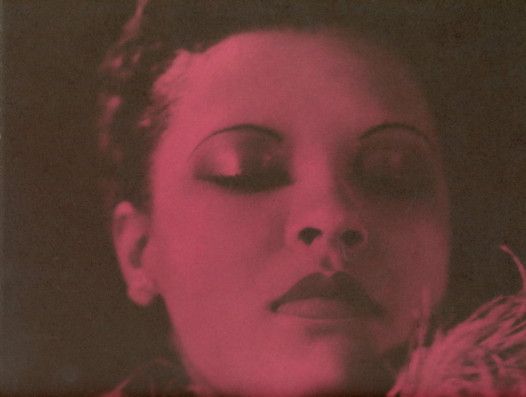


The Wilson sessions are among the preeminent glories of recorded jazz, brisk and pointed and incredibly swinging. They were made largely for the jukebox trade, which in the ghastly years of the Depression emerged as the largest single market for records. Yet as brief and spontaneous as they are, these exemplary tracks overflow with detail and invention, rarely wasting a second, with each player obliged to make a personal, identifiable statement in just a few measures. Benny Carter once noted, "It's a pleasure to hear a guy like Ben Webster. He blows a note and you know he's there — and who he is." The great players could do that; they developed individual styles that told you right off who they were and what they were like. Fans did not need an announcer to inform them that a soloist was Webster or Young or Coleman Hawkins. Wilson's sides offered a de facto guide to the era's giants, because Hammond raided the big bands that happened to be playing New York when a session was scheduled, recruiting key players from Basie, Ellington, Goodman, Calloway, and the rest. These sessions remain an  unbeatable primer on the leading soloists and rhythm players of the swing era.


They also offer an unusually rounded thesaurus of American song-writing in the golden age, juxtaposing the gold and the tin. Except for “I Wished on the Moon," the songs at the first session were decidedly second-rate, and they did not get much better over the ensuing year. Yet Holiday, Wilson, and friends readily turned Tin Pan Alley dross into bullion. Of the first 15 songs, three—"I Wished on the Moon," "What a Little Moonlight Can Do," and to a lesser extent, "Miss Brown to You"— became a permanent part of Billie's repertoire. Others endured as classic records. The quality of her material took a dramatic turn for the better in the summer of 1936. At the June 30 date, Billie helped to establish "These Foolish Things" as a standard and revived the 1920s hit, "I Cried for You." She also performed magic with the utterly forgotten "It's Like Reaching for the Moon," confirming the jazz axiom: 'Tain't what you do, it's the way that you do it.


The songs got even better in late-summer, after John Scott Trotter — a former arranger for Hal Kemp who would become famous as Bing Crosby's music director on Kraft Music Hall — was hired as chief of recording for the American Record Corporation, the holding company that controlled Brunswick, Vocalion, Columbia, and other labels through most of the 1930s. Hammond considered Trotter merely a busybody executive. But the fact that Billie immediately recorded the three main songs from Pennies from Heaven, a film Trotter had just finished orchestrating, and was backed at the first session by Bunny Berigan, Trotter's buddy in the Kemp days, suggests that Hammond understated his contribution, perhaps because he resented Trotter's authority. Trotter was undoubtedly a square. Yet during his tenure, Holiday recorded new songs by Porter, Kern, and Berlin, as well as older tunes, like "I Must Have That Man," which, with Berlin's "This Year's Kisses," inaugurated the uncanny bond between Billie and Lester Young, whose tenor saxophone — borrowed from Hammond's favorite orchestra, the Basie band — invariably complements, echoes, spurs, and inspires her in one of the most gratifying, unusual, and far too brief musical collaborations of the past century.


My favorite of the records they made together was generated not by a classic of the songwriter's art, but by one of the dimmest numbers Holiday ever sang, "A Sailboat in the Moonlight," written by Carmen Lombardo and John Jacob Loeb ("Boo-Hoo!" was another of their creations) for the former's brother, Guy. When I first got to know the record, playing it endlessly, I thought it a fine melody, with pretty chord changes, and words that might be corny but didn't seem so bad when Lady Day delivered them. Then I chanced to find the sheet music at a midwestern bazaar; at home, I picked out the melody with one finger and was astonished at how different it was from what Holiday sang. Until that moment, I had not fully gauged how freely imaginative her embellishments could be. By ironing out a phrase here, retarding another there, raising this note, slurring that, she transformed a hopelessly banal and predictable melody into something personal, real, meaningful. When she and Lester "sail away/to Sweetheart Bay," riding the waves side by side, you've got to clamber on board.


Another profound example of her transformative powers comes from her last wartime Columbia session, on February 10, 1942, and an impossible song called, "It's a Sin to Tell a Lie," the subject six years earlier of one of Fats Waller's most extravagant burlesques. "I love you, I love you, 1 love you," he intoned contemptuously. And here comes Billie, declaiming, "I love you, yes I do, I love you," rhythmically pinning every syllable to its post and employing a Lestorian slur on the last "love." Do you believe her? How can you not?


By then, she had become a very different performer, a jazz star of high rank, proudly bearing the nickname, Lady Day, conferred upon her by Young (he called her mother Duchess). She in turn dubbed him Pres: Lester, she said, was to the saxophone what President Roosevelt was to the nation. Their musical association, however, was largely in the past. The very nature of her records had changed. Between 1937 and 1939, she recorded as often under her own name as under Wilson's; after the January 30, 1939, Wilson session, she recorded almost exclusively under her own name. The level of musicianship remained high and her own singing grew increasingly nuanced, but she was no longer one of the guys, waiting her turn. She was every inch a star.


When Lester had appeared on the "I Must Have That Man" session, he was 27, six years older than Billie, yet it was only his third time in a recording studio. His accompaniment was tenderly amorous, sometimes exuberantly so ("Me, Myself and I," "When You're Smiling"), but usually gentle and more delicate than the ardent honking and high-flying fancies he offered followers of Count Basie. The platonic tenderness that sheltered Lester and Billie could not, however, be sustained for long. In all, he appeared on five sessions with her in 1937, not including a couple of Basic broadcasts, five more in 1938, and only one per year between 1939 and 1941. Over time, his alcoholism and her addiction to heroin tore them apart, and though they occasionally shared the stage at Jazz at the Philharmonic concerts, producer Milt Gabler never used him on her Decca sides and producer Norman Granz, who had Lester under contract, never used him on her Clef and Verve records. They were reunited on one serene number in an unforgettable television broadcast, in 1957, and died two years later — Lester on March 15 (his widow prohibited her from singing at the funeral), and Billie on July 17, after nearly two months in a hospital, much of that time with a police guard at her door. She was, as Faulkner famously wrote of one of his own characters, "Doomed and knew it; accepted the doom without either seeking or fleeing it."


Tough as nails yet prone to abuse, Lady had long since become America's Little Sparrow (she and Edith Piaf were born in the same year), perhaps even better known for her woes than her music. And yet she had come a long way on her own terms. In the beginning, she played the Famous Door on 52nd Street for four days, having walked out when the owner told her not to socialize with white customers. At that time she had to contend with stage managers who complained that she sang too slow and with song publishers who griped that she took too many liberties. Her standing took a turn in 1939, working at Barney Josephson's Cafe Society and closing her sets with Abel Meeropol's vivid threnody about a lynching, "Strange Fruit." She returned to the Famous Door as a major draw — treated accordingly — and, ironically, something of an earth mother to white servicemen who spent shore leave listening to her. After recording "Strange Fruit" for Milt Gabler's Commodore, because Hammond wouldn't touch it, Holiday was taken up by some with political agendas. But she had her own reasons for sticking with that song for 20 years, making it her personal anthem, thrusting it in the teeth of people who thought they had come to be amused.


She had toured briefly with Basie and Artie Shaw, leaving the former, she claimed, because Hammond wanted her to sing more blues like Bessie Smith (maybe, maybe not, though Hammond told me a few weeks before his death that he much preferred Bessie), and the latter because of racism. Forget the South: New York's Hotel Lincoln insisted she use the freight elevator and the Old Gold cigarette company would not allow her to broadcast with Shaw's band. She retained her independence and spirit, living the life she chose, singing the music she loved in a style she invented. She did not suffer slights quietly: In 1946, she was signed to appear in her only feature film, with her idol Louis Armstrong, but, cast as a maid, she stormed off the set of New Orleans before it was completed. Melancholy themes had begun to loom over her repertoire, and they increased over time. No longer sailing in the moonlight in a sunbonnet blue and laughing at life, she sang of despair, longing, betrayal: "Gloomy Sunday," "Lover Man," "Travelin' Light," "Good Morning, Heartache," "Detour Ahead," "Don't Explain," "God Bless the Child."


She suffered for love, evidently indulging a masochism that sometimes got out of hand. It also bound her to drugs. In 1941, Holiday married a handsome hustler named Jimmy Monroe and began smoking opium. Then she moved in with trumpet player Joe Guy, who used heroin. She capitulated to an addiction that could not be tempered by a voluntary six-week hospital cure or a judge's 1947 decision to incarcerate her for a year and a day at the Federal Reformatory for Women in Alderson, West Virginia — the result of Billie's decision to plead guilty and not to testify against Guy, with whom she was busted. Guy, a musician of limited abilities, walked. Billie served her time and lost her cabaret card. That meant she could not work anyplace in New York where alcohol was sold, undermining her career and guaranteeing her return to narcotics. There were subsequent arrests and countless tabloid articles that almost always referred to her as "blues singer Billie Holiday."

She took up with a vicious pimp named John Levy (not to be confused with the bassist of that name who often performed with her), and then fulfilled the prophetic lyric of "Riffin' the Scotch": "Swapped the old one for a new one / Now the new one's breaking my heart / I jumped out of the fryin' pan / And right into the fire." Louis McKay was a low-level hoodlum whose one saving grace was that he lacked Levy's unreasoning violence. But he was a relentless exploiter, who squandered her money and used drugs to keep her under control. In 1956, Billie and McKay were busted in Philadelphia, and he convinced her to marry him to prevent her from testifying. That she could see through him, but loved him, is apparent from her desperately scribbled letters, almost always written on hotel stationery and occasionally quoting song lyrics (I have not attempted to replicate Holiday's quirky use of capitals, and have ventured a few guesses about punctuation):


Mr. McKay,

Let's face it you're not my husband. Not even my boyfriend. You have no time for me. Everything is your kids, Mildred or just anything comes before me so I am not important to you in any way. You have even made cracks about [some?] dirty bitches that meant more to you than me. So why don't we come to some kind of understanding. Well you know. Just be my manager until after the Phila story. No I have no one else and don't want anyone. But Louie how much can I take. You're in New York two days and I, your wife, see you five minutes. So just lets be friends and forget it.

Lady


Louis when you left this morning I know you had no more feeling for me so lets get together, lets call this whole thing off. Your not happy with me and I am very unhappy. Thank you for everything you have done for me. Lady Day


This is It


I've had it goodbye


Waited hoped and prayed but nothing goes my way. This is it, so

long. Tried not to see but I am not blind to all the tricks you played

on me. This is it. Oh well you say that I am dumb but how dumb

can you get. This is it This is it This is it This is it. You can't be

mine and someone else's too. What are you trying to do. This is it.

Good bye.


On one occasion Billie had McKay tailed, and what she saw made her "feel sort of cheap and dirty." Had she lived, she undoubtedly would have sent him packing. Instead, he assumed control of her estate, making sure he was portrayed — by Billy Dee Williams, no less — as the romantic and devoted sole love of her life in the appalling movie Lady Sings the Blues, which didn't even use her voice, never mind her story. But then her voice is her story, the only one that counts, the one that can't be distorted by lovers or haters, exploiters or philanthropists, critics or fans. Her enchanted records tell the truth and nothing but the truth — indeed, more truth than most of us knew, if you pay attention to the alternate takes and ponder the risks she took, gliding too high for her range or, touchingly, casting for the right note on which to end. Lady Day at the summit of her art is as glorious now as 60 years ago, an imperishable fixture in the cultural life of America and the world.”


[Lady Day: The Complete Billie Holiday on Columbia 1933-1944,

Columbia/Legacy, July 2001]


Tuesday, July 12, 2022

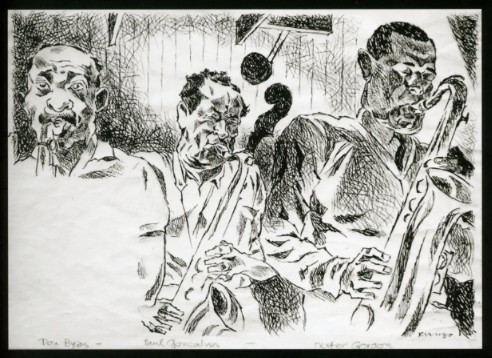
Dexter Gordon "One Flight Up" - The Blue Note Years Part 7

 © Copyright ® Steven Cerra, copyright protected; all rights reserved.


“Whether or not he was given credit, Dexter Gordon is the man who wove an important piece into the great tapestry of the modern tenor saxophone style. Time, which has given proof of his importance, happily has not robbed him of his talents. His most recent work only enhances his position as a jazz master.”

- Ira Gitler, Jazz Masters of the 40s


Recorded on June 2, 1964 at the CBS Studios in Paris and released the following year, One Flight Up is the last of the recordings released by Blue Note during the five year association with Dexter which began in 1961.


As with its European predecessor Our Man in Paris, this one also finds Francis Wolff. Alfred Lion’s partner at Blue Note, stepping out from his usual role behind the scenes to assume the duties of producer.


At the time of its release, Dexter had settled into his ex-patriate status in Europe with Copenhagen as his base and an almost artist-in-residence status at the city’s primary Jazz club - The Montmartre


Dexter elaborates further about the importance of both Denmark and the club, which featured Jazz from 1959-1976, in the following insert notes to One Flight Up by the distinguished Jazz author and critic, Leonard Feather.


As is the case here, often with Leonard the reader gets treated to an explanation of how the music is constructed in terms of keys, time signatures, chord progressions, modulations and the like, all of which serves to enhance the listener’s awareness and pleasure. 


“In July 1964 an informal and mutually stimulating discussion by Dexter Gordon, Kenny Drew and two other expatriate jazzmen was published in Down Beat. The subject was "American in Europe." Perhaps the most significant remark in the entire round-table talk was made by Dexter. "Since I've been over here," he said, "I felt that I could breathe, and just be more or less a human being, without being white or black...I think the Scandinavian audiences are very discerning. In fact, my biggest experience in communicating with audiences has been here in Copenhagen.. .The audience here is very 'inside.' This is their capacity."


The intelligent interest shown by their listeners, and the almost total lack of racial prejudice, are not the only factors that have lured so many American musicians to the Continent and kept them there in recent years. An equally vital attraction is the opportunity to work steadily in a single job without having to shift around constantly from club to club or city to city every other week.


"I have played for months on end at the Montmartre in Copenhagen," said Dexter recently. "That's been more or less my headquarters ever since I moved over here in 1962. Now I've never in my life played three or four months continuously at a place in the U.S. The opportunity to work regularly in the same spot gives you the kind of feeling you need to stretch out, relax, and at the same time develop musically without having those job-to-job worries hanging over your head."


Kenny Drew had some similar observations to make along these lines, in the Down Beat report. Asked what he had gotten out of living and playing in Europe, he replied, "In a way, I've found myself, because I've had to be more responsible to myself and for myself … I'm my own man. I've been taking care of business myself — something I never did in the States … Musically, I've found myself by working so long and so much. I can

think more, act more, be more, I guess. My mind is functioning properly now."


Obviously, conditions and reactions like these must be reflected in the music. Dexter's first overseas album, Our Man in Paris (Blue Note 4146), made it apparent that his residence abroad would stimulate him to a consistently high performance level, and that there would be no danger of his stagnating in the new milieu.


Though Copenhagen has been Dex's home for the past couple of years, the other European capitals are of course within easy reach and he has made several field trips, including a couple to Paris. It was here that Francis Wolff of Blue Note arranged for him to assemble an all-star group for the present sides.


Kenny Drew left his native land for Paris in June of 1960 to play with The Connection. Though only set for six weeks work with the play, he says: "I actually knew I wasn't going back under any circumstances." He has lived and worked in Paris since then.


Donald Byrd and Art Taylor spent the last half of 1958 touring the Continent with the late Bobby Jaspar. Byrd returned to Paris in 1963 to study with Nadia Boulanger, but came home in the summer of 1964 to teach at Ken Morris' Summer Jazz Clinics. Taylor, after working around New York with various groups, left for Paris, Rome and other points East in the early fall of 1963.


This leaves one member of the present group unaccounted for: the gentleman with the double-barreled name, Niels-Henning Orsted Pedersen.

"This is a remarkable example," says Dexter, "of the kind of talent that's coming up now on the Continent. He's only 18 years old, but I believe he's the very best bass player in all of Europe. Kenny and I worked with him in Copenhagen, and of course I just had to bring him to Paris to make this session with us."


Orsted (he is usually known by this name) was only 17 when Count Basie heard him and promptly offered him a job. Because of problems that arose concerning his tender age, the young Dane never came to the U.S., but the fact that men like Dex and Basie have flipped over him would seem to indicate that if and when he does decide to make the hop, there will be limitless opportunities for him. As these sides show, he has everything required of a bass player nowadays — a great sound, suppleness, ideas and a firm beat.


Given this unusual concentration of talent, it is not surprising that the five musicians were compatible and eloquent enough to stretch out extensively, so that the Donald Byrd composition Tanya runs to 18 minutes and occupies the entire first side [of the LP].


What is remarkable about this track is not its length, but rather the consistency of performance that is maintained throughout; it is evident that each soloist felt free to blow until he had completed his thoughts, or sustained the mood for what he felt was just the right duration.


There are two simple thematic patterns. The first is based on a hauntingly declamatory E Flat Minor7 figure:


This figure is retained, with variations, as Kenny Drew uses it for introduction, interludes and backgrounds, off and on throughout the side.


Dexter's solo, while displaying all his expected warmth and strength, is most notable for its conservative yet imaginative use of spare melodic lines, sometimes even of single notes bent downward in a spellbinding lament. A less mature artist might have used this time to build up to endless flurries of sixteenth notes; yet at the end of his performance the feeling is the same — rhythmically, melodically and technically — as when he began, which gives the solo an extraordinary consistency. Donald maintains the same spirit in his own work; then Kenny, in a harmonically rich contribution, shows the extent to which he has absorbed the new modal feeling that has been invading so much of the modern jazz scene.


Coppin' The Haven, a Kenny Drew line, is a 32-bar minor theme played in unison by the two horns. Though somewhat shorter and taken at a slightly faster tempo, it has some of the same qualities as Tanya in terms of mood-building. Kenny's touch and sound, both in the comping and during his admirable solo, indicate that he has indeed developed impressively under conditions nourished by steady work in happy company. The entire rhythm section, in fact, distinguishes itself on this track, and the great clarity and separation enables one to hear exactly what each member is doing to instill a maximum of variety into the performance.


Darn That Dream is a quartet track; in other words, a ballad solo by Dexter. The 25-year-old song, its pretty changes untarnished by time, makes as suitable a vehicle for his slow, rhapsodic style as did You've Changed, a highlight of an earlier album (Doin' Allright, Blue Note 4077). Kenny's half-chorus offers a simply beautiful example of how to keep a solo moving without ever losing the lyrical essence of the theme.


I don't know whether there was any special significance in the title of this album, other than whatever can be deduced from the cover photo (could it be that that's Tanya's pad up there?). Anyhow, it could aptly be interpreted as meaning that the participants have moved one flight up in creativity, that their flights of fancy are freer than ever under Paris skies. Here are four men who have spent a substantial proportion of their time lately learning the ins and outs of French, Danish and other languages; with them is a teen-aged musical prodigy who has spoken Danish all his life. Together, the five offer a splendid demonstration of how to speak the international language of jazz.”

-LEONARD FEATHER


Kong Neptune, which is included in the boxed set and the CD reissue, an eleven minute original composition by Dexter does not appear on the LP configuration and is therefore not referenced in Leonard’s notes.


Dan Morgenstern Sessions Notes from the Boxed Set Booklet -


(I) JUNE 2,1964


Back in Paris, a year or so later, and with some new faces in the cast. Trumpeter Donald Byrd, born in Detroit in 1932, had thorough musical training at Cass Tech High, Wayne University, and the Manhattan School of Music, and did considerable gigging from his teens on, also playing in Army bands. In 1955, he broke through in George Wellington's group at New York's Cafe Bohemia, and later that year he replaced Kenny Dorham in Art Blakey's Messengers; he also worked with Max Roach and co-led the Jazz Lab group with Gigi Gryce, aside from an astonishing amount of recording activity and frequent European touring. In 1963, he studied with Nadia Boulanger in Paris.


Bassist Niels-Henning 0rsted Pedersen had just turned 18 the week before this session, but already had a few years in the major jazz leagues under his belt. In his native Denmark, he played piano as a child and picked up bass in his early teens; by 1962, he was in the house band at the Montmartre, Copenhagen's leading jazz club, where he backed visiting greats, including Dexter. He'd regretfully turned down an offer from Count Basie, and had played with both Kenny Drew and Arthur Taylor. The drummer, born in New York in 1929, had been a resident of Europe since 1958, living in France and Belgium He'd grown up with Sonny Rollins and Jackie McLean and Drew, made his debut with Howard McGhee in 1950, and worked with a who's who of jazz, including Coleman Hawkins, Buddy DeFranco, George Wellington and the Byrd-Gryce Jazz Lab. A.T., as he was known to friends, returned to New York in 1984 and died in 1995. His book of interviews, Notes And Tones, first published in 1979, has become a classic.


COPPIN' THE HAVEN, by Kenny Drew, is a 32-bar minor theme presented by the horns in unison, with a 1960's Blue Note sound. (After having presented Dexter in a classic be-bop quartet setting, the label undoubtedly wanted to show him in a more "contemporary" context, and this is a modish as well as modal session.) Dexter solos against a shifting rhythmic backdrop, with his customary direct and TANYA, a Byrd original, has an interesting structure, rooted in a repeated minor figure that creates a kind of hypnotic effect, relieved by passages in 4/4. After the long ensemble opening, Dexter starts mournfully, creating interest by varying his phrase-lengths and managing to sustain tension, backed by Taylor's sharp accents and NH0P's big-toned solidity. Byrd, on open horn, solos well at first, but seems to run out of steam. Drew makes intriguing use of the "vamp" pattern, well supported by the bass, which surfaces in the ensemble ending. At more than eighteen minutes, this performance is the longest in Dexter's Blue Note output, but he returned to "Tanya" some twelve years later and it became a staple in his post-homecoming repertory; one Village Vanguard performance captured on tape runs nine minutes longer.


KONG NEPTUNE (the title is most often given as "King Neptune," but Dexter insisted to Michael Cuscuna that he meant it to be "Kong") picks up the tempo quite a bit; it's a 32-bar Dexter original and Byrd lays out. Dexter digs in, serving up a string of choruses with unflagging energy and drive — he was a master at this kind of groove. Drew and Pedersen solo, then Taylor trades eights and fours with Dexter before the neat arranged ending.


DARN THAT DREAM, a Jimmy Van Heusen tune introduced by Louis Armstrong and Maxine Sullivan in the ill-fated musical "Swinging The Dream" (it ran for just 13 performances at Radio City Music Hall in 1939, despite a cast that also included the Benny Goodman sextet and other luminaries, and Satchmo never played or sang the song again) is given royal treatment by Dexter. He starts gently in the middle register, his pensive and soulful phrasing close to the melody, but with telling touches, and moves up in range for the second chorus, bit by bit, with that beautiful sound. An apt quote (from "Polka Dots And Moonbeams," another Van Heusen tune) opens the bridge, and Dex goes way up high before handing off to Drew, who's choice of double-timing makes sense here, the piano not having the sonic weight of Dexter's tenor. Pedersen's fat sound and well-chosen notes again stand out behind him. Dexter's concluding 16 bars and cadenza are yet another example of his balladic mastery and maturity.”


Sunday, July 10, 2022

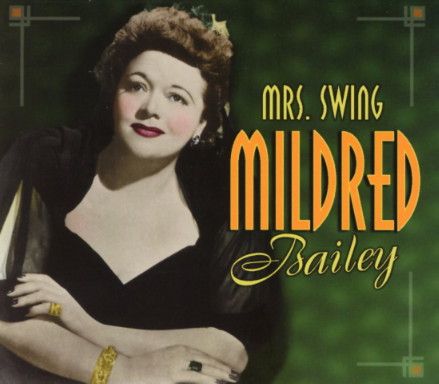
Mildred Bailey by Henry Pleasants

 © Copyright ® Steven Cerra, copyright protected; all rights reserved.


“The emergence ol three girl singers at virtually the same time: heralded the beginning of the age of the female jazz and band singers at the beginning of the 1930's. Decca's Jack Kapp recorded Mildred Bailey with the Casa Loma band in September 1931, that same year Lee Wiley recorded two sides with Leo Reisman's popular society band for Victor and Connee Boswell, the dominant voice of the Boswell Sisters vocal trio, recorded a number of solo sides with musicians of the calibre of Tommy and Jimmy Dorsey and Eddie Lang.”

- Will Friedwald, Jazz Singing [paraphrase]


“She made her first record in 1929, with Eddie Lang, and became an instant favorite of the jazz elite—the one white woman (she preceded Lee Wiley and Connie Boswell by a couple of years) with an identifiable style who could hold her own in a field dominated by black singers. She had been one of the first to assimilate the styles of Bessie Smith (whose blues she sang in an audition for Hammond), Ethel Waters (whose lighter voice was closer to home), and Louis Armstrong (whose time and invention liberated everyone). She would emerge as a transitional figure between them and the band singers that followed, including Billie Holiday and Ella Fitzgerald, though Bailey had a style all her own. Her high, light voice inclined to a whirring in the top notes while packing plenty of power; her time and enunciation were exemplary. After a couple of years as a side woman, indulging in excessive vibrato, she rid herself of affect and ornamentation. She focused on the language of a song, the meaning, the special story it had to tell. She was funny, cool, smooth, and always in a groove.”

- Gary Giddins, Weather Bird


“The best thing that ever happened to Mildred Bailey was Red Norvo, her third and last husband and her most important collaborator. They met in Whiteman's ranks (he played vibes behind her on "Rockin" Chair") and were married in 1933—the same year Kapp stupidly prevented Norvo from putting his advanced ideas on wax—and organized a touring band together in 1936, appropriately christened "Mr. and Mrs. Swing." Together with the young arranger Eddie Sauter, they created three years' worth of the most beautiful vocal records ever produced, each a perfect blend of written ensemble passages, vocal refrains, and instrumental improvisations and each a minor classic of shading and dynamics that would have a profound influence on many singers, including Frank Sinatra, and even more arrangers.”

- Will Friedwald, Jazz Singing


Blessed with a light, clear, bell-like voice and a musician’s ear, coupled with excellent diction, Mildred Bailey [1909-1951] could sing a song with such conviction and warmth, the she could make you, the listener, believe in it, no matter how superficial the actual message. She was the number one white singer of The Swing Era. She was truly - Mrs. Swing.


The following is from The Great American Singers by Henry Pleasants. Himself a trained musician and esteemed literary critic, the piece is a succinct yet comprehensive explanation of the qualities that made Mildred Bailey one of the most significant vocalists in the early history of Jazz.


The feature also represents the continuing efforts of the editorial staff at JazzProfiles to commemorate important developments as part of the 100th anniversary in the history of Jazz and its makers.


“Mildred Bailey, more than any other of the great American popular singers, was a jazz musician's singer, a jazz musician's delight. This was the secret of her unique success. But it also had a lot to do with the commercial limitations of that success.


Jazz singing, until the late 1920s [wrote Leonard Feather in The Book of Jazz] was largely confined to the Negro artists, and, despite occasional exceptions, such as Armstrong and Waters, was limited in substance to the form of the blues. The break on both levels may have been completed with the advent of Mildred Bailey. Where earlier white singers with pretensions to a jazz identification had captured only the surface qualities of the Negro styles, Mildred contrived to invest her thin, high-pitched voice with a vibrato, an easy sense of jazz phrasing that might almost have been Bessie Smith's overtones.


She sang popular music. Indeed, she sang every kind of popular music, from blues and pseudo-blues, gospel and pseudo-gospel, through Tin Pan Alley and show tunes to Charles Wakefield Cadman's "From the Land of the Sky-Blue Water." And she sang it all idiomatically — with the possible exception of the Cadman piece, which had once figured in the programs of Lillian Nordica. Her career in radio, her numerous records, her association with the Paul Whiteman, Red Norvo and Benny Goodman bands and her work as a single in prestigious nightclubs earned her a considerable portion of fame and money. Yet she never quite made it, as show-biz terminology has it, really big.


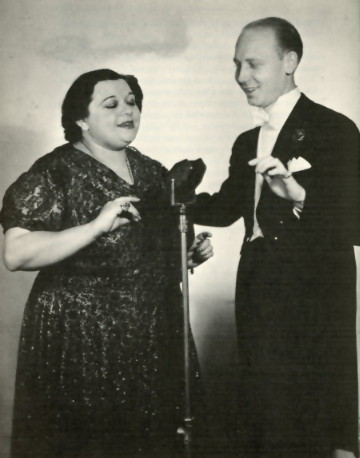
Mildred blamed it on her personal appearance. She was fat. For a variety of reasons, probably representing a fatal combination of biological and psychological factors, she was never able to keep her weight down. She loved to eat. She ate too much. She ate compulsively. Even in the later stages of the diabetes that killed her—on December 12, 1951, at the age of forty-four—she used to say: "Now, I've ate the diet, so bring on the food."


Obesity may have had something to do with it. She was no beauty. Dainty feet and trim ankles could not divert the onlooker's eye from the hulk they supported. She had, moreover, plenty of prettier contemporaries, some of whom made it bigger than she without being in her class as a singer or musician. But there were, I suspect, other, more musical reasons.


She was, to begin with, ahead of her time. As a featured vocalist with Paul Whiteman, beginning in 1929, she became the first girl singer to front a jazz band, or, in the jargon of the period, a jazz orchestra. More significantly, she and Connee Boswell were the first white singers, male or female, to absorb and master the blues, or rather the early jazz idiom of the black singers of the 1920s. Mildred Bailey was singing bluesy jazz, and swinging, when the rest of white America had hardly got beyond the Charleston.


Her place in American musical history is with those white musicians who as youngsters in the 1920s were listening to Sidney Bechet and Louis Armstrong, to Bessie Smith and Ethel Waters, at a time when middle-class America's idea of jazz was Ben Bernie, Vincent Lopez, Fred Waring and Paul Whiteman — or Gene Austin, Al Jolson, Harry Richman, Sophie Tucker and Rudy Vallee.


Many of those youngsters went on to great careers —Jimmy and Tommy Dorsey, Benny Goodman, Woody Herman, Harry James and Glenn Miller. Others — Bix Beiderbecke, Bunny Berigan and Dave Tough, for example — achieved only posthumous recognition. For all of them, however, the transition years from the Jazz Age to the Swing Era were difficult and precarious. The musicians knew what they had heard in the black nightclubs and theaters of Chicago and New York, and on race records. They had learned to play it. But the general public was not ready for it, or for anything very much like it.


What these young musicians heard, and what they wanted to play, was, in ethno-musical terms, something closer to a black original than was being offered by the white theater and dance bands of the 1920s. Benny Goodman made the breakthrough in 1935-36. Swing, if not yet the blues, was in. The musicians had been swinging, privately and on records, for years. One of the most exciting, and also one of the most instructive, ways of hearing what they were up to, individually and collectively, is to listen to them playing behind Mildred in more or less ad hoc groups on the records she made in 1933-34-35.


The personnel on these dates reads like a Who's Who of early swing: Bunny Berigan, Chu Berry, Jimmy and Tommy Dorsey, Benny Goodman, Coleman Hawkins, Johnny Hodges, Gene Krupa, Red Norvo, Teddy Wilson and many more. The presence of black musicians is significant. This was before Benny Goodman and Artie Shaw had broken the color line in public performance, Benny with Wilson and Lionel Hampton, Artie with Billie Holiday. But behind the scenes, and in the recording studios, jazz was one world. Benny Goodman's famous trio was hatched, it is pertinent to recall, when he met Teddy Wilson at Mildred Bailey's home on Long Island.


Mildred, on these records, appears with bands variously designated. There are the Dorsey Brothers' Orchestra, Benny Goodman and His Orchestra, and Red Norvo and His Orchestra, all subsequently famous. There are more ephemeral titles: Mildred Bailey and Her Orchestra, Mildred Bailey and Her Alley Cats, and Mildred Bailey and Her Oxford Greys, the personnel sprinkled with names now hallowed. Listening to those records, and noting how Mildred always emerges not just as a singer fronting a band but as the lead voice in any band she worked with, one is tempted to forget the names of the bands and think of them simply as Mildred Bailey and Her Friends.


They were her friends. Red Norvo was her second husband. This was her music. So it had been since she was a young girl. Bing Crosby remembers her singing in Charlie Dale's Cabaret in Spokane (she was born in Tekoa, Washington, in 1907) during his college days, when he and Mildred's brother, Al Rinker, had a six-piece band called the Musicaladers. Mildred, he recalled in a prose portrait for


CBS's Her Greatest Performances album, "used to get some great records from the east from time to time, and Alton and I and our band would copy them. Believe me, with such a library in those days in Spokane, we were pretty avant. This was in 1925."


Mildred married and went on to Los Angeles. Bing and Al Rinker, then on their way to becoming the Rhythm Boys, found her there a year later, working in a club called The Swede's.


“I'll never forget my first visit there [Bing recalls] how my eyes bugged when I saw Gene Pallette, eminent actor of the period, lay a Benjy [a hundred-dollar bill, so called because it bears a portrait of Benjamin Franklin] on her for two choruses of "Oh, Daddy!" "Ace in the Hole" was good for a brace of Benjys. And "Sweet Mama, Where Did You Stay Last Night" might get pretty near anything.


There it was that she introduced us to Marco, at that time a very big theatrical producer, and we were on our way — with a lot of her material, I might add. Ah! She was mucha mujer. A genuine artist, with a heart as big as the Yankee Stadium, and a gal who really loved to laugh it up. She had a beautiful sense of humor, and a way of talking that was unique. Even then, I can recall her describing a town that was nowhere as "Tiredsville."”


Obviously, Mildred was closer to jazz than were other white singers of the time. She was listening to race records, and not only singing, but also talking, in the jazz idiom, as she would continue to do for the rest of her life. "Oh, Daddy!" had been Ethel Waters' first record hit. Another of Mildred's favorites was "Down Hearted Blues," recorded by Ethel Waters in 1921 and by Bessie Smith at her first session for Columbia in 1923. Mildred's own recording of it, in 1935, is one of her finest. When Bessie Smith made her last public-appearance in New York, impromptu, in a jam session at the Famous Door on 52nd Street, Mildred was so moved that she declined to follow.


Red Norvo, reminiscing with Whitney Balliett for a New Yorker Profile, told how life was at their home on Pilgrim Circle in Forest Hills:


“Bessie Smith and her husband came to the house, too. Bessie was crazy about Mildred. She and Mildred used to laugh at each other and do this routine. They were both big women, and when they saw each other one of them would say: "Look, I've got this brand-new dress, but it's too big for me, so why don't you take it?" Fats Waller came out. And Jess Stacy and Hugues Panassie and Spike Hughes and Lee Wiley and Bunny Berigan and Alec Wilder. Red Nichols lived right across the street. . . .”


It may have been this sense of total identification with jazz, especially with jazz as it was emerging in the early 1930s, and with the young musicians, black and white, who were playing it, that inhibited Mildred's communication with a wider public. Where musicians are so obviously having a ball, so obviously playing for each other, admiring each other and liking each other, the lay public, excluding the "hot jazz" buffs of the time, may have felt excluded, The musicians were playing their own music and on their own terms.


Another problem for Mildred, probably, was the way in which her singing tended to suggest another instrument, or, as jazz musicians would put it, another horn. There was a paradox in this, for no other singer has rejoiced in a lovelier voice. But it was not the voice that suggested a horn. It was what she did with it. Her way with a phrase or a tune, particularly in the early days, tended to be an instrumentalist's way.


This has always been a way calculated to win the approval of jazz musicians, jazz critics and jazz fans. Their highest praise is to say of a singer that he uses his voice, or phrases, like a horn. It is essentially what they are talking about when they speak of a singer as being a "jazz singer." The praise has seduced and inhibited many a fine singer. It is nonsense.


Not in the sense that it can't be done, of course; but in the sense that it should be done. To encourage the singer to emulate the instrumentalist is to stand music on its head. It is to forget that the instrument is a vocal substitute, that the best instrumentalists are those who are the best singers on their instruments. What has confused and distorted our view of the singer-instrumentalist relationship in jazz has been the fact that the greatest jazz instrumentalists-Louis Armstrong and Sidney Bechet, for example—have "sung" so well on their instruments.


They learned from the singers. One notes the backing personnel on countless recordings of the 1920s by Bessie Smith, Ethel Waters, and their contemporaries. There they all are: Red Allen, Louis Armstrong, Buster Bailey, Sidney Bechet, Bunny Berigan, Henry Brashear, Jimmy and Tommy Dorsey, Benny Goodman, Charlie Green, Jimmy Harrison, Coleman Hawkins, Fletcher Henderson, James P. Johnson, Eddie Lang, Joe Smith, Jack Teagarden and so on. It is easy to miss the point when a Frank Sinatra says he learned all he knows about phrasing from listening to Tommy Dorsey play the trombone. He probably did. But Dorsey learned what he knew about phrasing from Henry Brashear, Charlie Green, Jimmy Harrison and Jack Teagarden. And they, in turn, learned from the black singers.

In Mildred Bailey's time, particularly in the early 1930s, an instrumental approach to singing was neither so hazardous nor so distinctive as it became later on, when jazz departed disastrously from its roots in song. The best instrumentalists were admirable models for a singer simply because they had modeled their own phrasing on such excellent singers, and "sang" so well. But for a singer of Mildred's extraordinary musicality, their virtuosity and invention were also a temptation. She could do with her voice what they did with their horns. Sometimes she would deliberately imitate an instrument — a trumpet, a trombone or a sax. She could do it marvelously. She enjoyed doing it.


It was not so much that she sang in an instrumental manner as that she thought instrumentally. Her enunciation was a model of clarity. The sound was vocal and feminine. But the effect was often as if a lead instrument had somehow acquired the capacity of articulating words. What one heard was admirable and delightful. The sheer virtuosity, however, sometimes overshadowed the articulation of a lyric and the probing of textual substance.


Any first-class jazz musician of the time could have taken a Mildred Bailey chorus and reproduced it on his instrument note for note, deviation for deviation, slur for slur, rubato for rubato, without the slightest suggestion of incongruity. She worked with a tune as the instrumentalists did, improvising from and around it, but never losing touch with it. This ability, and this predilection, help to explain why, on these early records, she comes through so strikingly as a member of the band.


The dangers, for a singer, of an instrumental style were compounded in Mildred Bailey's case and time, if she wished to reach a white audience, by the fact that the style itself was so blues-flavored.


All the white instrumentalists with whom she worked were also phrasing in the manner of their black contemporaries. For Mildred, as a singer, phrase was inseparable from language. So she adopted not only the black musician's way with a phrase, but also his way with a word and his vocal sound, including the pronounced nasal resonance—not nasality—which has characterized the great black female singers from Bessie Smith to Aretha Franklin.


For one born and raised in the state of Washington in the American Northwest, two or three thousand miles from the deep South and from Southern speech, Mildred's enunciation in any song requiring or even suggesting a blues inflection is astonishing. I have often played Mildred Bailey records of this type of song for unsuspecting visitors, both black and white, and asked them to describe the singer. The response, without exception, has been: "Well, to begin with, she's black." In more European material she doesn't sound black at all. I reckon it a sign of an acutely sensitive musicality that she reacted instinctively and profoundly to the indivisibility of music and language.


For all her concern with language, rendered the more conspicuous by the unfailing distinctness of her enunciation, the melody of language would seem to have been more important to her than its meaning. This has always been a problem for singers in whom musicality is combined with a beautiful voice. It has something to do with the fact that the greatest dramatic artists among the great singers in any category have rarely been those with the loveliest and most tractable voices. With the superbly endowed, the endowment takes precedence. Their singing tends to be more delightful than exciting. The fault may lie, to be sure, with the listener, so beguiled by the sound that he misses the substance.


Records Mildred made at the close of her career reveal a voice as fresh as that of records made fifteen years earlier. There is not a trace of blemish, no evidence of wear and tear, no falling of pitch. The explanation is apparent in the records themselves; there was never any wear or tear in her singing. One is tempted to put it all down to exemplary vocal production, as one can do, in good conscience, in accounting for Ella Fitzgerald's vocal longevity. What one hears in Mildred's singing is indeed exemplary. But it is only what Mildred would let you hear. It speaks more of artful resource, of taste and discretion, than, as with Ella, of technical mastery.


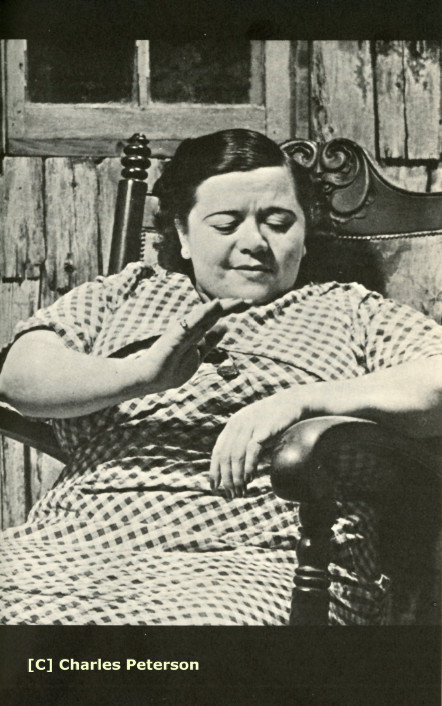
She would seem to have been a bit lazy as a singer, and possibly not just as a singer. It may be more than idle coincidence that the song most intimately associated with her is Hoagy Carmichael's "Rockin' Chair," and that she was known in her prime as "the rockin' chair lady." The best photograph ever taken of her shows her idly swatting a fly on her arm as she reposes in that rocking chair.


Not that her singing was ever slovenly. She was too fine a musician for that, too conscientious an artist, and sufficiently inventive to evade difficulties without betraying the evasion. A telling example is a recording of "Can't Help Lovin' Dat Man," where she repeatedly passes up a low E on "lovin'," reshaping the melody so artfully that only the purposefully attentive will note the discrepancy.


Those funked low Es are not the only remarkable or revealing feature of that performance. It is even more remarkable that the low Es are there to funk. She sings the Kern song in A flat, a fifth below the original E flat, in which she could easily have sung it without having to pass up any notes at all. This curious choice of key tells a lot about Mildred Bailey. It tells a lot, too, about the art and the vocation of other admirable singers working in the Afro-American idiom.


A term encountered over and over again in descriptions of Mildred's voice by those who knew her well and heard her often is "high-pitched." It was no such thing. She is frequently referred to as a soprano. She was not. The sound could seem high, even soprano-like, but the actual pitch was low. Her effective range was from a G below to an E above, or an octave and a sixth. She probably had more below. She certainly had more above, as may be heard on her 1939 recording of "St. Louis Blues," where she suddenly and easily comes up with a high G.


She had, then, a mezzo-soprano's normal two octaves from G to G. But she preferred to work in a narrower range. When a song, or the chosen key of a song, took her out of that range, she simply altered the notes to suit herself, as in "Can't Help Lovin' Dat Man." Even within her favored octave and a sixth, she took things comfortably, passing into head voice very early in the ascending scale.


This passing into head voice has been noted as a characteristic of both Bessie Smith and Ethel Waters. They had not the vocal technique to carry the full sound of the middle voice any farther. With both of them, the register break is conspicuous and sometimes disquieting. With Mildred it is not.


She, too, probably lacked the technical know-how. But she would seem to have been more aware of the break and its aesthetic consequences than either Bessie or Ethel were, and she got around it, as Bing Crosby was doing at about the same time, by easing into head voice well before it became the only alternative to vocal disaster. Instead of seeking, as opera singers do, to extend the quality of the middle voice upward, she extended the character of the light head voice downward, thus achieving a delightfully homogeneous quality throughout her range, if not without some sacrifice of fullness, power and amplitude in precisely those areas of the vocal compass where such attributes repose naturally.


She ascribed this evenness of scale to her experience as a child and young girl singing Indian music. Her mother was part Indian and, according to Barry Ulanov in his A History of Jazz in America, used to run through Indian songs with her. When the family moved to Spokane, her mother often took her over to the nearby Coeur d'Alene reservation. Ulanov quotes Mildred on what she learned there:


“I don't know whether this music compares with jazz or the classics, but I do know that it offers a young singer a remarkable background and training. It takes a squeaky soprano and straightens out the clinkers that make it squeak; it removes the bass boom from the contralto voice, this Indian music does, because you have to sing a lot of notes to get by, and you've got to cover an awful range.”


A matching of registers by easing off in the middle instead of stretching at the top has been common to many popular singers, who never learned it from the Indians, but may have learned it from Mildred Bailey. It has much to do with the failure or reluctance of European oriented vocal connoisseurs to appreciate them as vocalists and artists. The connoisseurs note the absence of the big sound while overlooking the subtleties made possible by its avoidance,


Mildred Bailey could have sung "Can't Help Lovin' Dat Man" in any one of several keys between E flat and A flat. She chose the lowest because it best served her communicative purpose. That the choice involved a melodic alteration betraying shortness of range at the bottom of the scale would not have troubled her for an instant, nor, probably, would it have troubled Jerome Kern.


It may have troubled less discerning listeners, not because they would have been aware of the distant transposition, but because they would have missed the vocal tension they were accustomed to in performances by other singers in higher keys. The opera singer Eleanor Steber, for example, transposed the same song upward to F and threw in a superfluous but vocally exciting high B flat, and a far too arty cadenza.


Mildred, as Red Norvo remembers her, "made you feel that she was not singing a song because she wanted you to hear how she could sing, but to make you hear and value that song." She may well have been to some extent a victim of her own good musical taste. She would have liked to be a commercial success. She made records with the strings and choir backings she thought would appeal to a wider public and thus offended her jazz-oriented admirers. As Bucklin Moon puts it, in his contribution to the CBS album:


“She chose to be neither the one thing nor the other, but a combination of all that was good in both. She was too deeply rooted in jazz to have a large popular following, and too commercial to be accepted by a jazz cult which, until recently, was unwilling even to admit that a musician who could read music could play jazz. . . . Songs that she introduced, records that she made, had an alarming habit of turning up as somebody else's hits. . . . She never lacked for a tight little following who loved and admired her, but somehow, just about the time you figured she had made it finally, it all started to come undone again.”


The result was a sense of frustration and resentment ill-housed in an ever volatile temperament. She was not always the laughing lady of Bing Crosby's portrait. Moon says that she was "salty as a fishwife," and he describes her rages as "monumental." John Hammond, producer of many of her CBS records, calls them "towering." Norvo, who knew her better than anyone else, passed on to Whitney Balliett an affectionate reminiscence of Mildred with her dander up. Norvo and Benny Goodman had gone fishing on Long Island. What with moving from one fishing hole to the next, they were gone two days instead of one.


“When I got home, I could tell that Mildred was hacked. Things were cool, but I didn't say anything, and a night or two after, when we were sitting in front of the fire — I was on a loveseat on one side and she was on one on the other side — Mildred suddenly got up and took this brand-new hat she had bought me at Cavanaugh's and threw it in the fire. So I got up and threw a white fox stole of hers in the fire, and she got a Burberry I'd got in Canada and threw that in. By this time she was screaming at me and I was yelling at her, so finally I picked up a cushion from one of the love seats, and in it went. The fire was really burning. In fact, it was licking right out the front and up the mantel, and that was the end of the fight because we had to call the Fire Department to come and put it out.”


Mildred's tragedy was not her weight, nor her diabetes nor her rages. These were problems, and they brought with them vicissitudes and bitterness. Her tragedy was that people could not hear her, during her short life, in the perspective we bring to her singing today. It is an old story. Ned Rorem, in his Music and People, has summed it up in a way which at once illuminates the inevitable frailty of contemporary evaluation and does tardy justice to Mildred Bailey:


“The open question of what will come is vain but tantalizing. Tantalizing, because it is the primal question of human nature. Vain, because historic events, even history itself, switch focus evew year as we funnel faster toward novel philosophies. Certainly we listen now to Mozart in a manner inconceivable to him: he was ignorant of Mascagni and Mildred Bailey, who came between to recondition us. . . .”


Similarly, we hear Mildred today with ears conditioned by our experience of Ella Fitzgerald, Billie Holiday and Frank Sinatra. Thanks to them, the vocal art that was uniquely hers in her youth is now widely appreciated. She was a great and lonely artist, born just a few years too soon. That was her tragedy, mitigated, one hopes, by the fact that she lived just long enough to see her genius and her insights perpetuated in the art of the great singers whom she inspired.”