Saturday, November 12, 2022

Billy Mitchell: 1926-2000 - A Tribute [from the Archives with Revisions]

 © -Steven Cerra, copyright protected; all rights reserved.


Billy Mitchell’s musical story is a tale of two cities: Kansas City, Missouri where he was born and Detroit, Michigan where he grew up.


What the tenor saxophonist inherited from K.C. and the Motor City can be heard every time he takes a chorus. This inheritance is the roots of the Jazz tradition.


Mention Kansas City and Bennie Moten, Walter Page’s Blue Devils and Count Basie come to mind.


Bill Mitchell was a driving force and major influence during this post WWII Detroit modern jazz explosion.


Incubating in the Detroit of Billy Mitchell’s youth were a number of future great Jazz musicians including the Jones Brothers - Thad, Hank and Elvin - Yusef Lateef, Frank Foster, Tommy Flanagan, Barry Harris, and Paul Chambers


"I had a band at the Blue Bird," Mitchell recalled in a conversation with Jazz author Bob Blumenthal. "It was a quartet until Thad sat in one night. The next night, he was working with us permanently. We recorded for Dee Gee Records, which was jointly owned by Dizzy Gillespie and Dave Usher. At that time, Terry Pollard was in the band — she was later replaced by Tommy Flanagan — and she played vibes and piano. When she took a vibes solo on the recording session, Thad comped for her on piano. Elvin was in the band at that time, too. In fact, Elvin had never played in a professional band before that."


The Mitchell session is a rare one, having last appeared in the '50s on a Savoy anthology called SWING, NOT SPRING, and the details are obscure. Discographies have given 1948 as its date, though Mitchell confirms that it was more likely done in 1951 or '52.”


Billy was to become best known for his work in the 1950’s and 60’s with Dizzy Gillespie’s Big Band and The Count Basie Orchestra. He also performed with the Clarke-Boland Big Band in Europe on several occasions.


Mitchell and trombonist Al Grey left Basie in late 1961 and formed the Al Grey/Billy Mitchell Sextet, which won the Downbeat Award for best new jazz band of 1962! This band also officially introduced vibraphone future star Bobby Hutcherson. Barry Kernfeld noted in The New Grove Dictionary of Jazz that this “... ensemble, in its use of swinging riffs and bop improvisation, captured in a small group context the essence of Basie’s orchestral approach.


Besides leaving and rejoining Basie's band several times in the 60's, Billy was an important figure on Long Island (his home) and Manhattan in the educational area of jazz; he was mentor and friend to alto saxophonist Charles McPherson and also worked for a time in Los Angeles where he and influenced LA trombonist/composer-arranger Richard Pulin.


With his bright, bouncy, on-the-beat improvisations, Billy has always personified Joyous Jazz to me. Jazz that’s not complicated and swings in a straight-ahead manner. It’s fun to play the music this way and equally as much fun to listen to it without having to reach for it.


Sonny Stitt, Lucky Thompson, Eddie “Lockjaw” Davis, Johnny Griffin, Gene Ammons, Arnett Cobb, David “Fathead” Newman, Harold Land, Paul Gonsalves - the list of big-toned bluesy tenor saxophonists is as endless as it is endlessly satisfying.


Thursday, November 10, 2022

Ahmad Jamal - Emerald City Nights

 © Copyright ® Steven Cerra, copyright protected; all rights reserved.


“The first time I heard Ahmad, I was in high school, I was getting ready to go to bed and I had the jazz station on. This was in Philadelphia, where I'm from, of course. And this song came on. "Music! Music! Music! (Put Another Nickel In)," which I remembered from having heard Theresa Brewer do it. So it was a song I knew and somebody was playing piano on it. As I was listening, I was asking myself. "Who the hell is that?" because it was just so unbelievable. The radio announcer said it was Ahmad Jamal, whom I'd never heard of before.


It was on Ahmad Jamal's album, Ahmad Jamal Trio at The Pershing/But Not for Me. Theresa Brewer's record was a hit when I was in junior high school. And then I heard Ahmad Jamal's version on the radio with the piano trio and I just couldn't believe it. I really could not believe it. I immediately went out and bought the record the next day because it was just so fantastic. And I've been an Ahmad Jamal fan ever since then.”

- Kenny Barron, Jazz pianist 


“If anybody has left jazz with an interesting and exciting approach to the piano, it's Ahmad. If someone is learning and getting his own self together, it's not a bad idea to study the piano playing of Ahmad Jamal, Ahmad is one of the few piano players who plays the 88. He plays beautiful ballads. He plays up tempo, medium tempo. He's a complete musician, a complete piano player. He's one of a kind.”

- Ramsey Lewis, Jazz pianist


“These recordings from the Penthouse in the '60s form a masterclass in what I consider to be very important qualities - space, color, control in sound and a solid groove, all while having a sense of adventure and freedom.”

- Aaron Diehl, Jazz pianist


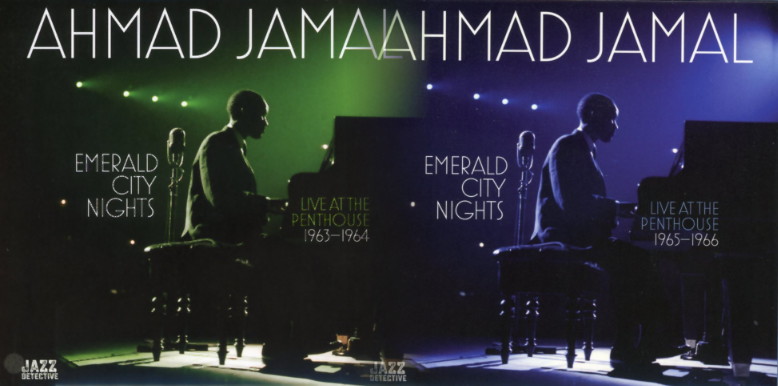
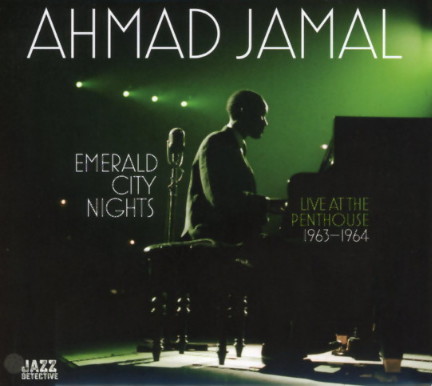
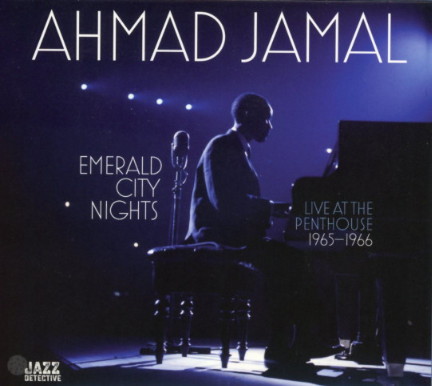
Thanks to the kindness of Ann Braithwaite of Braithwaite & Katz Communications, a distinguished media relations firm specializing in Jazz artists, the JazzProfiles editorial offices received review copies of two, double CD sets featuring legendary Jazz pianist Ahmad Jamal and his trio  recorded at The Penthouse in Seattle, WA [nicknamed The Emerald City] in 1963-1964 and 1965-1966, respectively.


The following banner from the media release that Ann sent along tells you all you need to know about the discography particulars involved with these recordings.


“PRODUCER ZEV FELDMAN'S NEW IMPRINT, JAZZ DETECTIVE, LAUNCHES ON RECORD STORE DAY NOV. 25, 2022 BLACK FRIDAY EVENT WITH TWO DOUBLE-LP SETS OF PREVIOUSLY UNRELEASED LIVE RECORDINGS BY AHMAD JAMAL.


Two Volumes of Emerald City Nights: Live at the Penthouse, Capture Spectacular 1963-64 and 1965-66 Performances by the Master Pianist's Trio at the Penthouse in Seattle, Also Available as Two-CD Sets [Deep Digs Music Group DDJD-004/005] and Downloads on December 2.


Packages Include Reflections by Jamal, Interviews with Pianists Ramsey Lewis, Jon Batiste, Kenny Barron, and Hiromi. Essays by Eugene Holley, Jr.,

Photos by Don Bronstein, Chuck Stewart and More.”


I will post the remaining information from Ann’s always informative and insightful media communiques further along in this feature.


Aside from their significance in record collectors circles, the release dates of these new recordings are timely if you wish to purchase this music in either an analog or a digital format as a gift for the Jazz fan on your holiday presents list.


Still with us at the age of 92, pianist, composer and bandleader Ahmad Jamal, who also served as the Executive Producer for these recordings, is a seminal figure in the development of modern Jazz.


His influence was felt directly as a result of the many inspired recordings he produced during his seven decade career but also indirectly because of the impact he had on other performing artists who were his contemporaries, not the least of which was trumpeter Miles Davis.


Perhaps best known as an iconic Jazz-Rock Fusion artist by many who first became familiar with his work in the late 1960s, Miles’ roots in modern Jazz dated back to his 1940s association with the legendary alto saxophonist Charlie Parker and the Birth of the Cool recordings from the close of that decade.


With Parker’s death in 1955 and the limited impact of the Birth of the Cool recordings on the New York Jazz scene where Miles was based, Miles was searching for a new stylistic identity during the 1950s. 


He found it with a change in phrasing and in a change in the basic tone of the trumpet. As Dizzy Gillespie explains the former - “Phrasing changes every so often and you can tell what age the music comes from by the way it’s played. But Miles only knew what to play from what had gone on before, then he began to find his own identity.”


As to the change in Miles’ sound, Gil Evans offered this explanation. “Miles changed the tone of the trumpet for the first time after Louis [Armstrong] - the basic tone. Everyone up to him had come through Louis Armstrong … but then all of a sudden Miles created his own wave form. It became another sound.”


But how to bring these changes in phrasing and tone into a melodic, harmonic and rhythmic framework?


Enter Ahmad Jamal whose playing Miles had first heard in a trio with guitarist Ray Crawford and bassist Eddie Calhoun [later replaced by Richard Davis and ultimately Israel Crosby]. Known as the Three Strings, you can find out more about these early Jamal trios by going here.


“Jamal's enormous influence on Davis gets its first significant airing at a [1955 Prestige] session, and it will persist until it becomes an inseparable element of Davis's style. Here, it is most obvious in the choice of tunes. Both A Gal in Calico and Will You Still Be Mine were part of Jamal's repertoire, and the bright, almost bouncy tempo at which Davis plays them is borrowed directly from Jamal's treatment of them. He had included But Not for Me in a recording session a year earlier, and this Gershwin melody would become known as Jamal's song with the commercial success of his 1958 recording of it. Soon to come were several other Davis recordings of titles borrowed from Jamal's repertoire, including Surrey with a Fringe on Top, Just Squeeze Me, My Funny Valentine, I Don't Wanna Be Kissed, Billy Boy, and the Jamal originals Ahmad's Blues and New Rhumba. No other individual had exercised so decisive effect on what Davis played since his early explorations of the Gillespie-Parker bebop repertoire. [Emphasis, mine]


Jamal's influence went much deeper than just the selection of titles. Melodic understatement, harmonic inventiveness, and rhythmic lightness were part and parcel of Jamal's style and became central to Davis's style and the style of his finest bands ….


Jamal's impact on Davis's musical thinking was pervasive, and Davis made no effort to conceal his debt. "Ahmad is one of my favorites," Davis said; "I live until he makes another record. I gave Gil Evans a couple of his albums, and he didn't give them back." To Nat Hentoff, who had the temerity to tell Davis that he considered Jamal "mainly a cocktail pianist," Davis simply said, "That's the way to play the piano." He then began playing Jamal's records for Hentoff and pointing out Jamal's strengths: "Listen to how he slips into the other key. You can hardly tell it's happening. He doesn't throw his technique around like Oscar Peterson. Things flow into and out of each other." Julian Adderley later became an advocate of Jamal under Davis's influence and he made the same point: "He has a potful of technique, but he has learned restraint." Davis says, "Listen to the way Jamal uses space. He lets it go so that you can feel the rhythm section and the rhythm section can feel you. It's not crowded." For Davis, Jamal's appeal was unqualified. "All my inspiration today," he said in the late 1950s, "comes from the Chicago pianist Ahmad Jamal."”  [I am indebted to Jack Chambers for this analysis of the influence of Ahmad on Miles. It can be found in his seminal Milestones: The Music and Times of Miles Davis.]


Toward the end of the 1950s Miles would move on to other stylistic influences [modal Jazz on Kind of Blue] and Ahmad would retain bassist Israel Crosby and replace guitar with drums in the person of Vernell Fournier about whom Jack DeJohnette has said that his use of brushes was “impeccable.”


From about 1956 until 1959, this version of Ahmad’s trio became widely popular and even produced an album that ran almost 100 weeks on Billboard's top-selling LP list - Live at the Pershing: But Not for Me - on Argo Records. Further details about this period in Ahmad’s career are detailed in Eugene Holley, Jr.'s booklet notes which appear in both volumes of the forthcoming Emerald City Nights release.


After a long residency in Chicago during most of the 1950s, Ahmad moved to New York in the early 1960s and began more than a half century of domestic and international touring with his trio.


These Emerald City Nights recordings were made during the earliest years of those junkets when Ahmad arrived in Seattle and appeared at The Penthouse which Charlie Puzzo, its owner-proprietor, had opened a year earlier as part of that city's 1962 celebration of the World’s Fair.


As the contiguous dates of the new recordings would imply, Ahmad soon became a crowd favorite of Charlie’s place at the corner of First and Cherry Streets in the historic Pioneer Square area of the city and would be welcomed back almost on an annual basis until the club closed in 1968.


From the famed “Pershing Room” version of Ahmad’s trio, Israel Crosby died in 1962 and drummer Vernell Fournier moved on to the George Shearing Quintet so by the time of the first Penthouse recordings in the new Emerald City Nights series, they had been replaced by bassist Richard Evans and drummer Chuck Lampkin.


After a brief recording career with Dizzy Gillespie, including his spectacular drumming on Lalo Schifrin’s 5-part suite Gillespiana, Chuck joined Ahmad in 1963 for a two year stay.


It’s nice to have more recordings that showcase Lampkin’s excellent drumming as he would soon leave Jazz altogether and move on to a new career as a TV broadcaster in his hometown of Cleveland, OH and later in Buffalo, NY. Drummers will welcome more examples of Chuck’s very accomplished skills on the instrument which heretofore have been in short supply.


With his impeccable brushwork on display once again, Vernell Fournier is back for a brief stay on the 1965 tracks and Frank Gant does the drumming honors on the 1966 recordings for what would be the beginning of a 10-year stay with Ahmad.


Every drummer’s time feels different and you can hear how this influences Ahmad’s phrasing throughout these recordings.


Bassist Richard Evans is featured on the 1963 tracks and Jamil Nasser [who began his career as George Joyner before converting to Islam] moves in on the 1964 dates continuing on the 1965 and 1966 and he, too, would have a long stay with Ahmad only leaving in 1972 to take up full time work as a session player in New York.


Booklet interviews with pianists Ramsey Lewis, Kenny Barron, Jon Batiste and Hiromi offer many descriptions of the elements in Ahmad’s style that come together to make it so distinctive and Ahmad also shares some thoughts and examples about how he goes about his business.


Changes in personal notwithstanding, what is markedly different about these Emerald City recordings is their length: six of the 19 tracks are over 10 minutes and five of them are over eight minutes.


Aside from an eight minute version of Poinciana on the Pershing Room LP, there are very few recorded examples of Ahmad stretching out beyond the usual three or four minute cuts that comprise most of his LPs and this includes his “live recordings” at the Spotlight Club in Washington, D.C. in 1958, his own Alhambra Club in Chicago in 1961 and San Francisco’s Blackhawk in 1962 [all incidentally recorded with Crosby and Fournier].


So another of the gifts of these Emerald City Nights performances is that they offer us something very unique in Ahmad’s recorded history - the opportunity to listen to him in full flight in a laboratory in which he is free to explore at length his improvisory musings. 


You can hear him experimenting with counter-melodies, harmonic substitutions, key changes, and his trademark rhythmic riffs - all of which, at times, give some of these performances a slightly unpolished finish, but as such, remain true to the exploratory spirit which is the essence of Jazz improvisation.


The trite expression - “like you’ve never heard him before” - has a real meaning as this is an apt description of what’s in store for you on Ahmad's Emerald City Nights sets. Even his old standbys - Squatty Roo, But Not for Me, and Poinciana - are all given slightly different “takes” [interpretations].


But there are some constants as well: Ahmad’s orchestral approach to the piano in which he accesses all 88 keys of the piano; the long interludes over which he rides the rhythmic section; the constant surprises brought about by abrupt stops-and-starts, the use of dynamics to explode or soften the sound of the instrument, and the frequent insertion of quotes from other songs. The Invitation track on disc 2 from the 1965-1966 is a shining example of all of these qualities.


When you enter Ahmad’s “world” you never know where the musical adventure will take you, but one thing you can be certain of - you will enjoy the ride.


As promised, here’s the remainder of Ann’s media release for Ahmad Jamal - Emerald City Nights:


Producer and music sleuth Zev Feldman launches his new label venture, Jazz Detective, a division of the newly created Deep Digs Music Group, on Record Store Day's November 25 Black Friday independent retail event with the release of two deluxe limited edition double-LP volumes: Emerald City Nights: Live at the Penthouse (1963-64) and (1965-66), featuring previously unreleased performances by master pianist Ahmad Jamal.


The vinyl sets will be issued on 180-gram discs transferred from the original tapes and mastered by the legendary Bernie Grundman. The music will also be available as two-CD sets and downloads on December 2. A third two-LP volume devoted to Penthouse recordings from 1966-68 will be released at a later date. All the packages have been produced by Feldman and supervised by Ahmad Jamal himself.


Taking its name from Feldman's handle "the Jazz Detective" and reflecting his determined work unearthing hitherto unheard, award-winning treasures, the Jazz Detective label is an imprint of Deep Digs Music Group, a partnership with Spain's Elemental Music, with which Feldman has enjoyed a long professional relationship.


Feldman says, "Deep Digs Music Group is a new archival record company that embodies my love and care for archival music around a variety of different genres. Jazz, to no surprise, is an enormous part of the fabric of the company, and the newly formed Jazz Detective imprint will focus on releasing previously unissued jazz treasures such as this wonderful music from Ahmad Jamal. It's an enormous thrill for me to be working with Mr. Jamal, whom I've been listening to my entire life. He's a true original and beyond category. I couldn't be more proud of this new endeavor and these releases."


The new label's premiere offerings feature dazzling performances recorded at the intimate Seattle club The Penthouse by local radio host and live broadcast engineer Jim Wilke. Other magnificent live sets from the venue produced by Feldman have been released by Resonance Records (Wynton Kelly and Wes Montgomery, and the Three Sounds) and Reel to Real Recordings (Cannonball Adderley, Harold Land and the duo of Johnny Griffin and Eddie Lockjaw Davis).


Both Jazz Detective packages include extensive booklets with new reflections by Jamal about his work; photographs by Don Bronstein, Chuck Stewart and others; and essays by Feldman, Wilke, journalist Eugene Holley, Jr., Charlie Puzzo, Jr. (son of late Penthouse owner Charlie Puzzo), and Marshall Chess of Chess/Argo/Cadet Records (the label that released Jamal's bestselling, career-making albums in the V50s). 


The 1963-64 volume includes new interviews with Jamal's hit-making contemporary and Argo label mate Ramsey Lewis and Japanese pianist Hiromi, while the 1965-66 collection contains interviews with 2022 Grammy Awards album of the year winner Jon Batiste, veteran pianist Kenny Barron and virtuoso Aaron Diehl.


On the Penthouse recordings Jamal is heard in his three-piece element, backed by bassists Richard Evans and Jamil Nasser and drummer Chuck Lampkin on the 1963-64 shows and by Nasser and drummers Lampkin, Vernel Fournier, and Frank Gant on the 1965-66 dates.


In 1958, the pianist became a household name — a rare feat for a jazz pianist — with a pair of live trio recordings that soared into the top reaches of the American record charts. Ahmad Jamal Trio at the Pershing: But Not For Me, cut live in the lounge of Chicago's Pershing Hotel, reached No. 3 nationally in the year of its release; its successor Ahmad Jamal: Volume IV, captured at the Spotlight Club in Washington, D.C., climbed to No. 11.


In his overview of the National Endowment for the Arts Jazz Master, Kennedy Center honoree, and Grammy Lifetime Achievement Award recipient, writer Holley says, "Pittsburgh-born Jamal has achieved jazz immortality in a myriad of ways: A child prodigy trained in European and American classical traditions who was professionally working at 14, Jamal developed a protean and profound pianism that ingeniously melded pianist Art Tatum's swing-at-the-speed-of-sound and his hometown hero Erroll Garner's tender and torrid touch with Franz Liszt's boundless keyboard technique and the azure French Impressionism of Ravel and Debussy."


Though Jamal has recorded prolifically in a variety of settings — his most recent album Ballades, a studio session he released in 2019 at the age of 89, comprises solo and duo piano-bass recordings — he has always stated his preference for a live environment.


“There's no comparison between performing live and performing in a studio," he says in the new Emerald City Nights collections. “That's art — performing remotely, not in the studio. It's all live, but remotely from the studio is a science and an art. If you can capture that, as some of us have, you always come up with spectacular things, in my opinion. Being in a studio has its constraints, and has its difficulties. When you're performing remotely, away from the studio, it's a different thing altogether. All you need is a good engineer."


The many unique facets of Jamal's genius are lauded by other players in admiring testimony on the new releases.


"He uses a whole 88 keys on the piano." says Ramsey Lewis, who racked up his own top-10 albums on Argo in the '60s. "With many jazz piano players, the left hand comps and the right hand does a lot of work. Well, we all do that, but there are also many times during that song or other songs during that show that we don't say, 'Look, ma, one hand.' We'd say, 'Look, ma, both hands.’ And Ahmad is one of the both-hands piano players. Left hand, right hand: Ahmad can take care of the business."


Hiromi, who brought Jamal to Japan to perform on tour, says, "What I really learned from his playing is when you improvise or when you write music, you have to tell stones. Jazz improvisation is made of a lot of scales and chord progressions and everything you can learn from the book, but something that you cannot learn from the book is telling your own story. And whenever he plays, I always feel he's telling his story of life. And that's how I want to be."


Jon Batiste, who first encountered Jamal when he was a 19-year-old phenom touring Europe for the first time, says, "When you hang with him, you realize he's a spontaneous composer, in the same way that someone would improvise a solo. He has the ability to compose at that level of hyperspeed. He'll sit down at the piano and he'll play something when you're hanging out and it'll just be him messing around, if you will. From that will come an incredible composition.


You'll ask him, 'When did you write that? When did you compose this incredible composition that we just heard?" He'll, oftentimes, say, 'Oh, just now. I just played that right in this moment.' Typically, when he's in a state of performance, he has the freedom and the mastery to do that."


Homing in on an important element of Jamal's style, veteran Kenny Barren says, "He leaves a lot of space for the rhythm section. And one of the things that's nice is sometimes he'll play an idea, and in the next course you expect him to play it again, except maybe he won't, and the rhythm section plays. So he leaves all of this space for the rhythm section to either finish an idea or complete it. And it's really nice. It's like he kind of orchestrates the piano, kind of orchestrates everything. It's just so beautiful to hear. And I know that's what one of the things that Miles loved about him."


"Miles" is, of course, Miles Davis, Jamal’s most ardent champion in the jazz world. In his 1989 autobiography Miles, the late trumpet player put his finger on the abiding qualities that one hears in Jamal’s music, and on the vibrant performances on Emerald City Nights:


"He knocked me out with his concept of space, his lightness of touch, his understatement and the way he phrased notes and chords and passages …. I loved his lyricism on piano, the way he played and the spacing he used in the ensemble voicing of his groups. I have always thought Ahmad Jamal was a great piano player who never got the recognition he deserved."


For more on the Jazz Detective/Deep Digs Music Group  please go to www.deepdigsmusic.com.


Sunday, November 6, 2022

Duke's Drummers

 © Copyright ® Steven Cerra, copyright protected; all rights reserved.


“These drummers performed for others, for the band. We neglect drummers of that kind. We don’t seem to know what a drummer really is. He’s not the showman - the guy who sits the highest or has his cymbals on backwards. He’s the guy who makes the band sound good.”

- Buddy Rich, drummer extraordinaire


Given their limited ability to influence the melodic or harmonic aspects of a big band arrangement, drummers nevertheless often play an outsized role in influencing the shape, texture and “rhythmic feel” of the sound of these “charts” [musician speak for arrangements].


So much so that big bands are often characterized by the name of the drummer: the Jo Jones, Gus Johnson or the Sonny Payne Count Basie Band; the Shelly Manne, Stan Levey or the Mel Lewis Stan Kenton Orchestra; the Davey Tough, Don Lamond or the Jake Hanna Woody Herman band. Before he got his own big band, the great Buddy Rich was associated with the big bands of Artie Shaw, Tommy Dorsey and Harry James, all of which benefited from his powerhouse drumming.


But why?


Perhaps part of the answer lies in what big band drummer extraordinaire Mel Lewis labeled - a “signature drummer.”


“In case people don’t understand what I mean by that, that’s a word I picked up from Buddy Rich and it means people who have their own unique sound and feel and are recognizable the minute you hear them have what you call a “signature.” In an interview with Loren Schoenberg, Mel went on to explain:


“They are few and far between. That’s something that everyone would like to develop and it is developed on drums the same way that Lester Young, Coltrane, Miles and all these other people did on their horns.


It’s not as easy on drums because you're still an accompanist and to get a different sound from other drummers utilizing your feel. We all have to play “ding-a-ling” or “spang-a-lang” because that’s our job as drummers, but it’s how we do it and what we do that makes it different. Remember, the drummer is still in the background, you are not out front. A drummer that puts himself out front is not a great drummer. It’s not smart, it’s stupid and, if you are gonna do that you might as well play solo.  Your group is in front of you but you have to play behind them and inspire them by being so good that you reflect your personality.”


Some clues as to how a drummer can help shape a big band’s “personality can be found in the impression Burt Korall formed after seeing Davey Tough with the Woody Herman band perform its famous arrangement of Apple Honey at New York City’s Paramount Theater, in 1945:


“He went about his business with little of the grace of a Krupa and Jones, and none of the fireworks of Rich. But the excitement built as Tough, without physically giving the impression of strength, manipulated the band much as an animal trainer would a beautiful hard-to-control beast, making it respond to him. He cracked the whip under the ensemble and brass solo passages adding juice and muscle to the pulse and accents. Each soloist got individual treatment – a stroke here, an accent there, a fill further on, all perfectly placed.


He moved the band from one plateau to another, higher and higher. By the time the band was about to go into the final segment, the audience was totally captured. There was a point during this last section when it felt as though the band would take us through the roof.


When the piece came to an end with four rapid bass drum strokes, I couldn’t figure out what he had done. He had been in the foreground only once during a four bar break, …, otherwise his was the least self-serving performance I had ever witnessed. I turned to my friend. ‘He has no chops. How’d he do it? What happened?’


He smiled, not quite as puzzled as I. ‘It might not have seemed like much,’ he said. ‘But whatever he did, he sure lit a fire under that band.’”


In practical terms, what the drummer in a big band is trying to do is give the compositions and arrangements their fullest expression by providing a rhythmic foundation that propels the music forward.


In the following excerpt from Mark Gridley -Jazz Styles 10th Edition the author makes a number of observations, among them that the Ellington drummers were unobtrusive and primarily timekeepers. In other words, they didn’t do very much to shape the sound of the band.


While that may be largely true of Sonny Greer, Duke’s first and longest serving drummers, I think that the three who followed him - Louie Bellson, Sam Woodyard and Rufus Jones - all added considerably different drumming approaches to Duke’s music.


Ironically, while maintaining that there was little difference between them, Gridley points out the differences when he states “Greer used drumming techniques in the manner of early jazz drummers. He kept time on the snare drum with sticks and brushes, often switching instruments for a new chorus or to accompany a new soloist.”


And when he asserts that “Bellson changed the technique and technology of Ellington drummers. Like a bop drummer, Bellson kept time primarily with his ride cymbal, using his left hand to play musical punctuations on his snare drum.”


He then contends that: “Replacing Bellson was Sam Woodyard (1925-1988), Ellington's drummer of 11 years. Woodyard supplied a special spark to the band. His style was hard-swinging and unrelenting. Woodyard's approach was not complicated or flashy. He established a groove. Then, by playing so hard and so passionately, he musically challenged the band members to swing equally hard.”


And finally maintaining that Rufus Jones -  “in addition to fulfilling the traditional duties for his position, Jones was notable for also devising original rhythms to fit music that Ellington composed on his world tours during this era. In generating African, Latin American, and oriental flavors for Ellington's suites, Jones played rhythms that were new to the Ellington sound.”


Whether it was Bellson’s bebop drumming, Woodyard’s hard driving grooves or Jones’ original rhythms, each became a “signature drummer” with the Ellington band.


Food for thought? See what you think.


Here’s Gridley’s text.


“DRUMS


There have been only a few drummers in the long history of the Ellington band: Sonny Greer (1919-1951), Louis Bellson (early 1950s), Sam Woodyard (mid-1955-1966), and Rufus Jones (1968-1973). Others played briefly with the band but remained relatively unknown. Ellington's drummers have performed a relatively unobtrusive role in creating the hand's sound. 


Although all were swinging drummers, none were as historically significant as Jo Jones with Count Basie, Max Roach with Charlie Parker, Elvin Jones with John Coltrane, or Tony Williams with Miles Davis. All Ellington drummers were primarily timekeepers. There are four eras of this role in the hand, reflecting Ellington's incorporating the strengths of four different drummers.


The classic tradition of Sonny Greer (1903-1982) lasted for more than half of the hand's 50-year history. Ellington's first drummer, Greer used drumming techniques in the manner of early jazz drummers. He kept time on the snare drum with sticks and brushes, often switching instruments for a new chorus or to accompany a new soloist. (Listen to how hard he swings on "Cottontail.") During the 1940s, he sometimes moved his timekeeping rhythms to high-hat. And, in a few isolated instances near the end of his tenure with the band, he played ride rhythms on the ride cymbal. Though simple in style and technique, Greer was dramatic in presentation. His equipment included timpani, gongs, vibraphone, and wood blocks. Listen to his work in "Echoes of Harlem," for which he devised exceptionally adept accompaniments.


A new era began in 1951 when Greer left and Louis Bellson (b. 1924) joined Ellington. In his two-year stay, Bellson changed the technique and technology of Ellington drummers. Like a bop drummer, Bellson kept time primarily with his ride cymbal, using his left hand to play musical punctuations on his snare drum. Blessed with enviable technique, he was a precise and tasteful accompanist.


Bellson also added a second bass drum and small tom-tom to his drum kit. Ellington took advantage of Bellson's capabilities by giving him solos. The recording of Bellson's solo on his own composition "Skin Deep" in Hi-Fi Ellington Uptown furnished a means for demonstrating sound quality in high-fidelity equipment that was just then becoming popular. The piece became a crowd-pleasing part of Ellington's repertory. Bellson's showmanship revitalized the band's appeal when all big bands were experiencing a declining audience size and Ellington was particularly low due to the temporary loss of Lawrence Brown and Johnny Hodges. After Bellson left, his successors on the drum throne were required to perform the often-requested "Skin Deep." They also employed the modern timekeeping techniques that Bellson used.


Replacing Bellson was Sam Woodyard (1925-1988), Ellington's drummer of 11 years. Woodyard supplied a special spark to the band. His style was hard-swinging and unrelenting. Woodyard's approach was not complicated or flashy. He established a groove. Then, by playing so hard and so passionately, he musically challenged the band members to swing equally hard. The records Ellington made with Woodyard have an insistence in their swing feeling that is unmatched by his records from any other period (see footnote 7 in this chapter). For many Ellington fans and a number of Ellington's musicians themselves, Woodyard was the all-time favorite drummer for the band.


The Bellson-Woodyard contributions to Ellington's style were expanded by Rufus Jones (1936-1990) between 1966 and 1973. In addition to fulfilling the traditional duties for his position, Jones was notable for also devising original rhythms to fit music that Ellington composed on his world tours during this era. In generating African, Latin American, and oriental flavors for Ellington's suites, Jones played rhythms that were new to the Ellington sound.”


Friday, November 4, 2022

Mingus Big Band - In the Beginning

 © Copyright ® Steven Cerra, copyright protected; all rights reserved.


The passing of Sue Mingus [September 24, 2022] and baritone saxophonist Ronnie Cuber [October 7, 2002] in less than a month of one another brought to mind the Mingus Big Band, or at least the one featured on Mingus Big Band 93 [FDM 36559-2] as there have been several versions over the years of the homage big band and its small group counterpart, The Mingus Dynasty.


Both were established by Sue in the years following the death of her husband Charles in 1979 as a means of keeping his memory and his music alive. She also produced legacy albums of Charles’ music, and through his Jazz Workshop publishing company, she made available copies of his compositions and other educational materials for students and educators.


Although Charles spent his formative Jazz years as a bassist in small groups based in California, most notably those led by vibraphonist Red Norvo and woodwind and sax player Buddy Collette, he moved to New York city in the mid-1950s. Since then, I always identified Charles as an integral part of the vibrant New York Jazz scene.


Mingus’ music always had an aura of youthful, hard driving, high powered energy about it, and the complimentary ambience of New York’s clubs, concert halls and recording studios were perfect platforms on which to display it. If you’ve ever been to New York City, you know that the place is all about energy: it gives you a boost of vitality during your stay and then drains your vigor as you depart. One needs a vacation to recover from a vacation in New York City!


Not surprisingly, accomplished young Jazz musicians based in New York who came of age idolizing the music of Mingus appreciated the chance to participate in both The Mingus Dynasty and The Mingus Big Band to add their creative “energy” to Charles’ legacy such that Sue rarely had to look far for participants to play in either. The band also provided a vehicle for both established arrangers [e.g. Sy Johnson] and players in the band who wanted to try their hand at arranging to develop the rich melodies, divergent harmonies and challenging rhythms associated with Mingus’ Music into new interpretations. 


This assessment is supported by Sam Burtis’ statement in the opening line of Gene Santoro’s insert notes to Mingus Big Band 93 [FDM 36559-2]


"This is New York music," says music director Sam Burtis as we walk across the big recording room upstairs at Manhattan's Clinton Studios. "Fletcher Henderson, Duke, Monk, Mingus - Their music is about the weird energy of this place. And the young guys in the band react to that and take it in their own directions." In fact, a number of the younger players like Craig Handy and Steve Slagle, as well as alumni like Jack Walrath and Ronnie Cuber, have contributed reworked charts which they then conducted. The easy-going camaraderie is intense and telling. It reflects the year and a half this pool of players has been tackling Mingus in the basement of the Time Cafe downtown where, workshop-style, they call tunes randomly in front of usually-packed houses.


Most of these tunes have not been recorded in twenty years or more and in the hands of these musicians they come alive in new ways. The weekly gig has honed the band's chops and given the musicians time to live through Mingus's music deeply, to internalize its demanding but modular, open-ended magic. Burtis continues: "The crowd that comes down to the club every

Thursday is young. They're the rock generation and they're drawn to this music because it's got such power. It kicks out at you the way good rock does. It's got that energy." There are those who say Mingus's music hasn't had that energy since he died, that his Gargantuan presence loomed over his musicians in his workshops, that he insisted in the primacy of the hands- on, by-ear learning that evolved during jazz's first few decades, that he deliberately, turbulently, stirred up trouble to highlight and heighten the music's already-high-octane emotions. But Mingus was, first and foremost, a composer, extending the genealogy that includes Jelly Roll Morton and Duke Ellington. His compositions have now taken on a life of their own, and members of the Big Band understand that Mingus helped lay the foundations for the post-bop musical syntax that has shaped them, that he's both their ancestor and their contemporary.


The tension between composition and improvisation (instant composition) is the dialectic heart of jazz. There are repertory bands, born of the neoclassical vogue of the last few years, that play only original charts complete with transcribed solos. But it is the openness of Mingus's music - the freedom that allows musicians to get inside the music and bring their own individuality to it - that keeps it so modern, that both replicates Mingus's own deliberate unpredictability and attracts a younger crowd (of players and listeners) via its energy. Listen to how it works in the wailing gospel choruses of "Ecclusiastics", or the gutbucket fervor of "Moanin"; or the circus-tent whimsy of "Don't be Afraid, the Clown's Afraid, too", or the shadowy, flickering interiors of "Weird Nightmare". The point is to re-open Mingus's music to contemporary experience, which it helped mold, and use the feedback loop to re-define the music from yet another perspective. And so Charles Mingus's rich and sprawling compositional legacy is like New York itself - an inspired, stormy nexus of past, present and future that's constantly being re-invented. The dynamic re-interpretations of the Mingus Big Band remind us just how contemporary and pertinent that legacy continues to be.”

- Gene Santoro


The booklet notes continue with Sue Mingus offering these observations about Mingus, the music and the musicians on this recording.


"It's like the city", said the trumpet player. "It's about chaos and contradiction, discipline and crazy unexpected beauty". "It's music", said the drummer, "that wears a tuxedo but has rolled around in the dirt." Shifting tempos, clashing harmonies, the unmistakable beat of the city. 


Listen to Ronnie Cuber musically strolling down 42nd Street, recalling an encounter with Mingus at Birdland back in the Fifties as he introduces "Nostalgia in Times Square" with elegant beatnick cool. But make no mistake. Nostalgia is exactly what this 14-piece band is not about. What it's about is the chemistry which has developed - here and now - among a growing pool of New York's finest musicians as they work out on some of the most challenging music in jazz.


Almost 100 musicians have played on these charts since the Mingus Big Band first unpacked its instruments in September, 1991, in the basement nightclub of a Manhattan cafe. Some twenty of them are on this recording. The band's hard core center is the Mingus Dynasty quintet, expanded to include several musicians from the orchestra which has performed Mingus's two-hour work "Epitaph" since 1989, expanded further still to include a host of new musicians able to explore the textures and densities and wider spectrums of Mingus's big band charts.


Not many in the jazz community played Mingus music after his death in 1979, which was why these bands were formed. Mingus music was intensely personal music, solidly linked to its taskmaster. And it was hard. The music could be an obstacle course at break-neck speed for the unwary. Or a deceptively simple trio of exquisite melodies like the tune "Self-Portrait in 3 Colors" on this recording. On a rousing gospel shout straight out of Mingus's roots in the Holiness Church, called "Ecclusiastics". It could be a workshop, as Mingus originally conceived it, involving stops and sudden rehearsals in front of a live audience, with nowhere to hide. It was music that demanded everything you had, and more.


But these compositions - if not quite slated for Easy Listening - are becoming familiar. The rich legacy which Mingus left behind is reaching out to audiences and to other musicians that are suddenly ready. Something is going on in the basement. And the Mingus Big Band, with its first recording in its pocket, is about to say what.

-Sue Mingus


If you are looking for a place to begin your Mingus Big Band Journey, you need look no farther than Mingus Big Band 93 [FDM 36559-2]. Fortunately, I have been able to embed YouTube videos below for many of the tracks on this recording.


Incidentally Ronnie Cuber’s playing on these recordings is some of the best on record and that’s saying something for a brilliant player who’s recording career spanned 50 years and covered every context of popular music imaginable from straight ahead hard bop to gospel and everything in between.