© -Steven Cerra, copyright protected; all rights reserved.

“The problem is that … [Claus Ogerman] knows too much, if there is such a thing as too much knowledge, about all kinds of music, and uses it throughout his idiosyncratic approach to composition.
After he retired from the commercial record business, Claus continued writing, writing, constantly writing, but only his own music, strikingly original and lyrical orchestral compositions — true compositions, not orchestrated songs — that are in my opinion some of the finest works of the late twentieth century, drawing on every idiom in which he had worked, post-serialist works of distinctively personal stamp.”
- Gene Lees, writer, editor, and publisher
"But then, I tell you what, if I [Claus Ogerman] don't think I'm good, who else will believe anything? I have to believe it first. If you think you're just able, just middle of the class, you don't do great things. I have to think, since I'm my own factory, that this factory is fantastic. Whether other people will believe in it later, that's another thing. At least the producer has to believe it's special."
I [Gene Lees] said, "The artist has enough self-doubt as it is. If you dwell on it, it will kill you."
In my opinion, no finer piece on Claus Ogerman and his music has ever been written [at least, not in English].
We thought you’d like to read it.
Claus
“When Claus Ogerman wrote the arrangements for an album by Diana Krall, recorded with the London Symphony Orchestra early in 2001, no one was as surprised as I. He had not written arrangements and orchestrations for the music of anyone but himself in twenty-two years, and had told me that he would never do such writing again, although he had been repeatedly asked — indeed begged — to do so by all sorts of singers, jazz players, and record producers.
In the twenty years from his arrival in 1959 in New York from Germany until he simply stopped writing pop and jazz albums for others in 1979 to devote himself to his own compositions, Claus wrote arrangements for an astonishing array of singers, including Frank Sinatra, Barbara Streisand, Diahann Carroll, Carroll Channing, Bobby Darin, Sammy Davis Jr., Connie Francis, Eddie Fisher, Robert Goulet, Jack Jones, Jackie and Roy, Johnny Mathis, Marilyn Maye, Gordon McRae, Wayne Newton, Mel Torme, Sarah Vaughan, and Dinah Washington. He even wrote for Josh White and David Clayton Thomas. He wrote a magnificent album for the Brazilian singer Joao Gilberto, one of the central figures in the bossa nova movement, titled Amoroso.
He also wrote for an enormous number of jazz instrumentalists, including Michael Brecker, Urbie Green, Benny Goodman, Paul Horn, Freddie Hubbard, Wes Montgomery, Oscar Peterson, Jack Teagarden, Cal Tjader, Kai Winding, and especially Bill Evans. In addition, he has written ballet scores for the American Ballet Theatre, the Cleveland Ballet, and the National Ballet of Canada.
But he became best known and respected for a series of albums with the Brazilian composer, pianist, and guitarist Antonio Carlos Jobim. These amounted to far more than arrangements of the Jobim songs. This was a remarkable collaboration, whose only precedent, really, is that between Duke Ellington and Billy Strayhorn, and it's hard to know where Jobim ends and Claus begins.
He wrote, by his own best estimate, more than two hundred albums during those years, showing an astonishing range of comprehension, from the crassest of pop music to the most elegant jazz-classical alloys.
Long after he gave up writing for others, he continued to receive requests to do so from Prince, Wynton Marsalis, Dee Dee Bridgewater, Ella Fitzgerald, Tony Bennett, Michael Feinstein, and, of course, quite a number of those he had worked with previously. He found turning them down painful, and in a 1991 letter to producer Tommy LiPuma, who had asked him to write an album for Natalie Cole of songs made famous by her father, he wrote, "I'm sure that you know as well as I that you have a big seller on your hands, no matter who's doing the string charts." He was right, of course, and Johnny Mandel took the assignment, doing a magnificent job and helping make the album Unforgettable a best-seller.
"I truly gave up arranging in 1979," Claus continued to LiPuma, "and it would be hard for me to go back to dress up pop songs now. I would have to go back in time, and if I would work on the arrangements, my ideas would be out of concept (and finally disappointing) to the artist and the fans of these songs .... I was only guesting in the arranging field for a brief time."
An odd perspective from a man who remains one of the most admired arrangers American (and for that matter Brazilian and European) music ever knew.
Claus was nominated for Grammy Awards in various categories fifteen times, but he won only once, for Best Instrumental Arrangement for the George Benson track Soulful Strut. He deserved to win it far more often than that in that one category alone, Best Instrumental Arrangement, for Jobim's Boto, Saudade do Brasil (both in the magnificent Urubu on Warner Brothers) and Wave, among others. But, and this is significant, he was the arranger on thirty-six Grammy-nominated albums, including nine in 1976 alone.
Claus abandoned the American record business so abruptly and completely that he left a hole, a hole not initially noticed. But by 1995, a reader in Miami, Florida, named John Tindall was moved to write in a letter to Down Beat:
"With all the Antonio Carlos Jobim tributes I have read about lately, not one has mentioned the contribution of master arranger Claus Ogerman. It is now time to praise him. Ogerman is responsible for some of Jobim's finest albums, including The Composer Plays and Wave. Ogerman's contributions to jazz since the early '60s include work with such diverse artists as Stan Getz, Wes Montgomery, Stanley Turrentine, Bill Evans, and George Benson. Two of his finest have been re-released recently: Symbiosis with Bill Evans and Cityscape with Michael Brecker. The only question remaining is, where is he now?"
When in 1988, a group of his classical songs, Tagore Lieder, after poems by Rabindranth Tagore, sung by mezzo soprano Brigitte Fassbaender, was released in a CD that also included songs by Mahler and Berg, "classical music" critics on both sides of the Atlantic consulted their reference books to learn more about him. They were disappointed. The critic for Gramophone in London wrote: "The composer was born in 1930, and his Tagore Lieder were written in 1975, and that is all we are told. Telephone calls and a search of Grove revealed no more . ..." In the USA, the critic for American Record Guide was equally baffled, writing, "All that I can learn ... is that he was born in 1930 . . . and he does not appear in any musical reference book I have been able to find." That is because they lived in that separate world of "classical" music. Had they looked in The New Grove Dictionary of Jazz, published earlier that year, they'd have discovered a paragraph on him. But in this sense, their unawareness of his prodigious career in popular music and jazz illustrates precisely that very insularity of the classical world against which Claus has always instinctively rebelled. The problem is that he knows too much, if there is such a thing as too much knowledge, about all kinds of music, and uses it throughout his idiosyncratic approach to composition. After he retired from the commercial record business,
Claus continued writing, writing, constantly writing, but only his own music, strikingly original and lyrical orchestral compositions — true compositions, not orchestrated songs — that are in my opinion some of the finest works of the late twentieth century, drawing on every idiom in which he had worked, post-serialist works of distinctively personal stamp. The last album he wrote for another artist was Jobim's Terra Brasilis for the Warner Bros label in 1979.
He was born in Ratibor, Prussia. It is now known as Raciborz, Poland, having been given to Poland in post-war boundary reassignments. His birth date was August 29, 1930, and thus he was only nine when Germany invaded Poland, thereby setting off World War II. Jazz was forbidden under the Nazis, as it was in various countries, including Russia, during the Communist domination of Eastern Europe. A quite striking movie called Swing Kids, released in 1993, was dismissed by American critics who simply did not understand the scope and character of the Nazi persecution of those who played jazz in Germany and the young fans who loved it.
Claus said to me recently, "At the period 1933 to 1945, the things that went on in Germany underground are unbelievable.
I am reading books about this now. And I know from myself that I was listening to nothing but jazz, or at least jazz-similar records that were done in Holland or Belgium. You know, the Nazis pressed American jazz records for export. And some records were stolen or went into the public. I was lucky enough to get some of those. It was just crazy."
I mentioned that the Belgian composer Francy Boland (who, like Claus, once wrote for the Kurt Edelhagen band), told me that in Belgium under the German occupation, when he, still a teen-ager, was playing jazz in clubs, many of the most ardent listeners were in Wehrmacht uniforms.
"Of course," Claus said. "There was a club in Berlin called Delphi. Till the end of the war, they had pretty good bands. One of them was Fud Candrix from Belgium. They played Count Basie and all the repertoire. And then in came the SS soldiers to stop that nonsense. Soldiers, mostly airmen, Luftwaffe, they beat up the SS guys and said, 'We're here on leave. Get the hell out of this place.' There are so many stories like that.
"My parents for six years had three stores, photography, film, cameras and all that. My father had the idea to add a little record store. He wasn't too happy with it. At that time you had to wind up the gramophone. And people would sit there, order coffee from the coffee shop next door, smoke cigarettes, and listen for hours to records, and then they may have bought one record, and he was tired of it. But I was left with about 8,000 78 records, among them a very few Ellington, early Armstrong, American pop records — Fred Waring— and of course a lot of classical records.
"I was eight years old, and I could hear Le Sacre du printemps. I grew up with discs. It gave me a chance to listen to music that was no longer played in concerts there, or on radio. It was forbidden music. The German radio programs at that time, the announcer came on and said, 'Until the next broadcast, you will hear march music.' That kind of thing. All the lies and all the blah-blah-blah.
"I started to study music in my home town. My very first piano teacher was Richard Ottinger. I went to a gymnasium. You start with two dead languages, Latin and Greek. A third language is your choice, French or Spanish or English. Richard Ottinger was a very good music teacher.
"It was strange. The Nazis forbade jazz, but they copied it with German bands and German singers. They forbade a lot of things. Looking back, it's ridiculous. They forbade books that were meaningless politically. Just because they didn't like the writer or something. You didn't even have to be Jewish. They clobbered you. If I look back, I see I was untouched by trouble. Ratibor was such a small town. I didn't have to join the Hitler youth or anything. I just went to the movies and played records all day.
"My father was by that time sixty. He was pulled into the army, although they had no weapons. It was an organization called Volksturm, which was the last. They took everybody, sick people, old people, people with one arm. He was useless as a soldier.
"The worst came later, when it was all over. We had to leave our home country."
Then Claus interrupted himself to say, "Nobody will be interested in this."
"Maybe just me," I said. "But I think you're wrong."
"All right. It was a territory where all Germans were forcibly expelled. You had to leave within one hour. It became Poland. Seventeen million people had to leave. During that transfer, if you call it a transfer, two million people died. It was winter, and it was pretty bad."
"That's a story that has not been told," I said.
"It's all written, oh yes."
"In Germany, maybe. Not in America."
"Ja. You have to search for it."
"I'll bet you do. In recent years, we've heard more about the Trail of Tears and what they did to the Cherokee Indians. But for a long time you had to dig for that story too. You still have to dig for a lot of it. It's the usual. We never did those things, only the Other Side did."
"It was, how can I say it? Stalin's idea," Claus said. "Because Stalin with Hitler made an agreement to divide up Poland, and Russia would keep fifty percent of Poland in the east and the western part of Poland would come under the German government. But after the war, Stalin did not give back to Poland their part. All the Germans were moved out and Poland would take over one third of Germany, which was eastern Germany, basically Prussia and Silesia. Now it's an established fact. It's now part of Poland. A few Germans wanted to stay. One of them was my piano teacher, Richard Ottinger. I still think of him. How wonderful he was. He was also a nice conductor. He conducted oratorios in our home town, the St. Matthew's Passion, the Handel oratorios. He was such a nice man, totally unpolitical, but he didn't want to leave home, and the Polish militia shot him. I dedicated my piano concerto in his memory.
"We fled overnight. My mother died during the expulsion. She couldn't make it, carrying the luggage. She was exhausted. She died, and we left her by the side of the road. We had to move on. I walked with my elder sister and one of my older brothers. We walked about 600 miles with luggage, and then we caught a train near Prague that brought us close to Bavaria, which luckily was occupied by the American Army. Then life sort of began again, but under unbelievable circumstances. My father found us eventually through the Red Cross. He'd been in a prison camp somewhere.
"I became fifteen on April 29, 1945, and the war was over on May 6. That was my first meeting with the U.S. Army. They had V-discs and they had Armed Forces Radio Network, and all of a sudden life began to make sense again, although we had lost everything.

"I had been a lazy piano pupil. Pretty bad. I rather listened. But when I came to the west, to Bavaria, near Nuremberg, I awoke, and I said, 'Now I have to really study, for good,' and I went to a very hard-hitting teacher named Karl Demmer. He was the conductor of the Nuremberg Symphony at the time. He was very good at counterpoint and conducting. And I studied with Ernst Groeschel. The guy was a world-class piano player. But sometimes I have found that people are very content with where they are. You know, in little places. He had no urge to go to Paris or become world-famous. He was very happy there. He was number one there, and maybe he thought, I'd rather be number one here than number fifteen elsewhere.'
"He made occasional records. He's now old. His records are beautiful, perfect. I studied with him, the real McCoy. The Beethoven concertos and the Bach Well-Tempered Clavier and Goldberg Variations. It got really tough. Before I was a fan of music. Then I became a laborer.
"The American culture became very dominant on western Europe through radio, records, and artists who came over. Jazz at the Philharmonic came in 1952. And Kenton, Woody Herman, Goodman, Basie, everybody came over. Like so many people, I was fascinated by the American culture, especially jazz. I had always liked jazz."
Quite soon he was playing piano with and writing for the Kurt Edelhagen band. And, briefly, he played with Chet Baker.
"Chet Baker had a piano player named Dick Twardzik in Paris. He also had an agent named Ted Napoli. Dick Twardzik died in Paris. Joachim Ernst Berendt used to be head of the radio station in Baden Baden, SWF, and he had concerts scheduled and sold, and they had no piano player. I was in Munich. He called me because I was a serviceable piano player. I knew every tune and I could play every tune in every key. And that gave Berendt a sort of security. I played these TV shows in Baden Baden with Baker when he was there, and that was about all. I muddled through. It was nice. It worked out. He was very nice." Claus is being typically self-deprecating here. He is an excellent pianist.
"As I remember," he said, "a few days before, I bought a beautiful velvet jacket. Chet had no jacket. I wanted to give him my jacket as a gift. Inge, my wife, said, 'Listen, are you crazy?' So I didn't do that. But he was in very bad condition. As a matter of fact, he didn't even have a shirt. Well he had one shirt. But the TV photographer said to Berendt, 'We cannot film this guy with this dirty shirt. It's all ripped.' Chet had a French girlfriend looking a little bit like Liza Minnelli. When show time came, Baker had on his girlfriend's blouse. We played ten or twelve tunes.
"In March, 1959, I went to New York on a three-week vacation trip. To see musicals, the regular routine. I went and came back and I decided to pack it in and go to New York and try at least. I had enough money. I could have survived in New York for about a year, without making a nickel. I had a flow of income from royalties, little stuff.
"I arrived on October 19, 1959, by boat, the United States, via Le Havre. My immigration was first class. Because I'm that kind of a guy. I don't want to go third class. I was married to Inge by then. She was hanging in with me. She was believing in something. If you go to another country, saying I have no job, I don't know anybody, I don't know what to do there, it's ridiculous. But she hung in with me.
"Before I came to New York, I knew by name everyone who played what on each record. I was a living jazz encyclopedia. I flipped out when I finally was standing next to these guys. George Duvivier, Zoot Sims. It was crazy and wonderful.
"At first the only person I knew in New York was a dentist I met. I had his number, but I didn't remember his last name, only his first name, Herb. I called him. He said, 'Come Saturday, I'm having a party.' We went to his building. There was a doorman with white gloves. I said, 'We're here for a party.' He said, 'Oh yes, on the fourth floor.' So we went up, and there were fifty people already, at least, glasses in hand. They said, 'Come in, where are you from?' We said, 'Germany.' They said, 'Oh great. Just drop your coats and have a blast.'
"After an hour, I told Inge, This is a nice party, but I don't see Herb here anywhere.'
"And I went back down to the doorman. I said, 'Of course there's a party on the fourth floor, but we're looking for a dentist named Herb. He said, 'Oh, you're talking about Herb Prager! He's on the twenty-first floor. There's another party.'
"We went back to the fourth floor and we tried to sneak out with our coats. The people said, 'Where are you going? Why are you leaving?'
"I said, 'It's embarrassing. But we are at the wrong place. We are actually at a party on the twenty-first floor. We apologize.' He said, 'Apologize? Listen, if this party upstairs isn't better than ours, you'd better come back.' It was very nice. You don't have this in Europe. In the States they want to know your first name first, not your last name. They tell you, 'My name is Harry, and this is Priscilla.' You don't get this in Europe. It was our introduction to the United States.
"So we went upstairs and we found Herb Prager. He said, 'One of my clients is Don Costa. Would you like to meet him?'"
The late Don Costa — he died in 1983 at fifty-eight — was a well-established and highly respected arranger who had written for Steve Lawrence and Eydie Gorme and many others and by the 1950s was on the A&R staff of ABC Paramount. He was in a position to assign work to Claus and introduce him to everyone in the business.
"After that it happened very fast," Claus continued. "Via Don Costa, I met Quincy Jones, Ray Ellis. They helped a great deal. Don Costa got me into the union within two weeks. Normally you have to wait six months. He made a call, he said, 'There's a guy, he's coming in to pick up his card.' And he gave me work. So did Quincy, with Josh White, of all people, and Dinah Washington. It gave me hope to hang in and stay."
Quincy Jones was then head of the A&R staff at Mercury Records, and thus he too was in a position to assign work to Claus. And he assigned a lot of it, including Lesley Gore's first record, It's My Party, which hit the No. 1 position on the charts in 1963. Claus was so adept at capturing the most egregiously commercial styles that he soon was one of the busiest arrangers in New York. He says, rather ruefully, that in those days he was like a machine gun. One sees in retrospect that American popular music was at a crossroads, one branch of it on a road to constantly descending musical standards, the other rising to heights to which popular music had never been. Enter Antonio Carlos Jobim in 1962.
An entirely new movement had arisen in Brazil at the very time Claus moved to New York. It was called bossa nova, a modem adaptation of traditional samba whose leading figures were the singer and guitarist Joao Gilberto and a composer and pianist named Jobim. I got caught up in this movement when, in Brazil, in early 1962, I translated a number of the Jobim songs, including Corcovado, which in my adaptation became Quiet Nights of Quiet Stars, and Desafinado, which became Off Key. Over the next few years I would write translations or adaptations of a number of his songs in close collaboration with Jobim — and with Claus.
While I was in Brazil, an album of bossa nova tunes performed by Stan Getz and guitarist Charlie Byrd, produced by Creed Taylor on the Verve label, came out in the United States. Despite the rise of rock-and-roll, Jobim's sophisticated and highly intelligent tune Desafinado became a huge hit. The bossa nova fad arose in a matter of months, and that fall there was a concert at Carnegie Hall, in which Gilberto and Jobim took part. I introduced Jobim to various New York musicians, including Gerry Mulligan (with whom he formed a lasting friendship) and we soon would write some new songs together. Creed Taylor at Verve produced an album with Stan Getz, Gilberto, and Jobim. It was a huge success, and aware now of Jobim's abilities as a pianist, Creed decided to produce an album ultimately titled, clumsily, Antonio Carlos Jobim, The Composer of Desafinado Plays. And he hired Claus as its arranger.
Claus and I have had a few chuckles over this in the years since then. I was appalled. I knew only the more commercial arrangements Claus had done. I could not understand the casting of this German arranger to work on this sensitive and sensual Brazilian music. In a recent conversation, Creed told me that from all the sessions he had done with Claus, he simply knew he could do it and do it superbly. "He knew space and he had taste," Creed said. "Just because he was doing crappy stuff, and doing it very effectively, didn't mean he couldn't turn around and do a completely different kind of material. I just knew he was right for the Jobim album."
Claus was so busy by then that he wrote a lot of that album in taxis on the way from one job to another. It remains a classic, superbly sensitive, as fresh today as it was when it was recorded in early May, 1963. The writing is exquisite. And Jobim's single-line piano is deceptive. It — and his playing in later albums with Claus — led to an illusion that he was a rather limited pianist. Some time ago I came across a cassette made when he and Gerry Mulligan and I were partying in my apartment in New York. He is playing solo, not orchestral, piano, and I can assure you that he, like Claus, had considerable chops on the instrument.
I was turned around completely by that album, and Claus and I have been friends ever since. For Claus, the album led to an extended relationship with Jobim; he already had one with Creed Taylor. "I did a lot of work for Creed," Claus remembers, "maybe sixty or seventy albums."
Creed still marvels, all these years later, at Claus's versatility. He recalled the instance of the theme from the Italian documentary film Mondo Cane, which, with a lyric in English, became More. Several people had recorded it, but nothing much happened. Creed was about to do a recording with Kai Winding. "I called Claus," he said, "and suggested that he double the time. He whipped it out in nothing flat. Phil Ramone was the engineer. We did it with the rhythm pattern Claus had laid out and we had a top-ten hit. The same thing when Claus worked on Soul Sauce with Cal Tjader.
"He wrote wonderful things for Wes Montgomery, Johnny Hodges, Stan Getz."
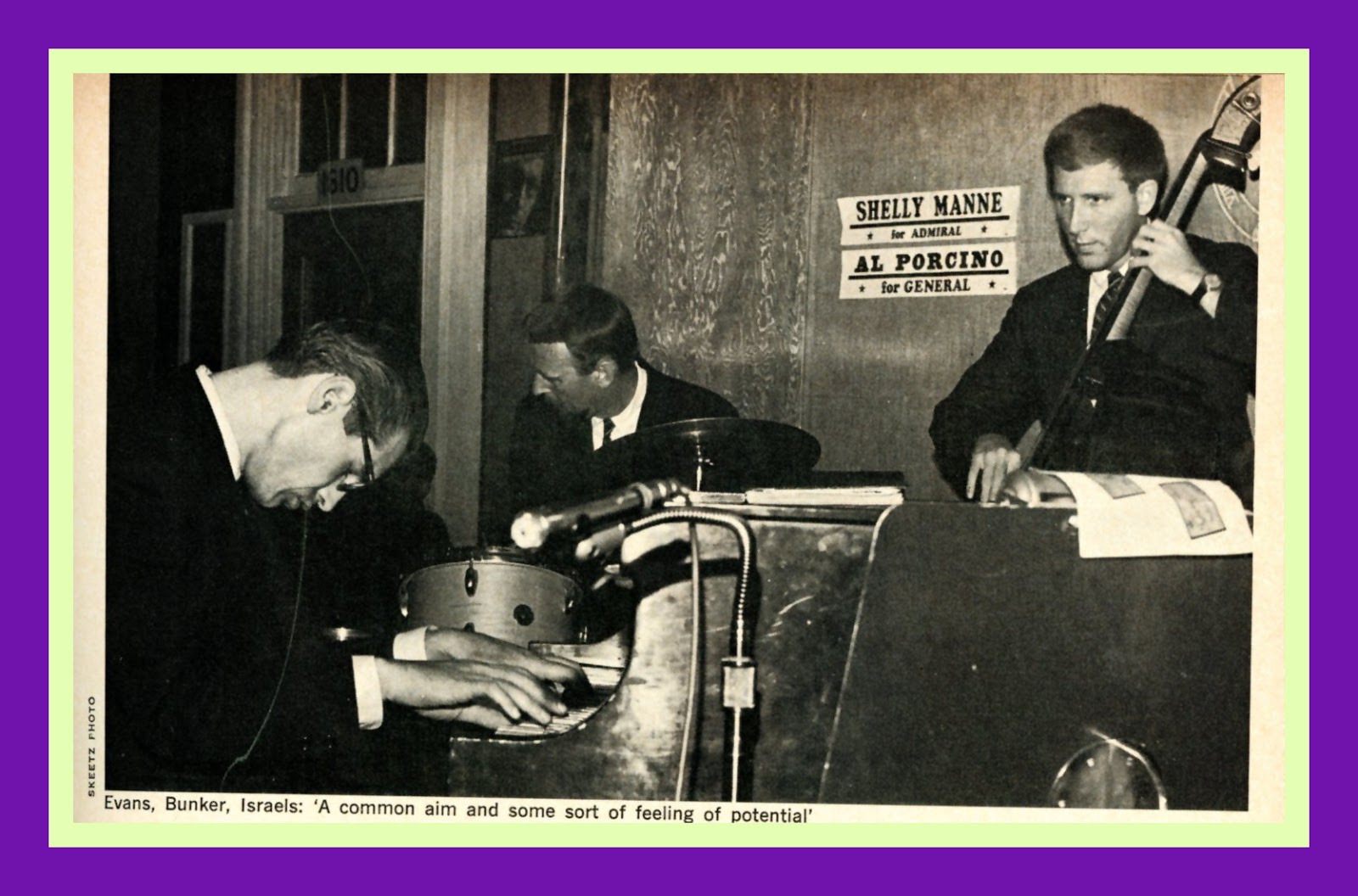
One of the most significant albums he wrote for Creed Taylor during that period was Bill Evans with Symphony Orchestra, recorded in September 1965. Bill and Claus selected themes not from the popular-song repertoire but mostly from classical composers, their names forming the titles for the tracks. I attended the recording sessions of that Getz, Gilberto, and Jobim. It was a huge success, and aware now of Jobim's abilities as a pianist, Creed decided to produce an album ultimately titled, clumsily, Antonio Carlos Jobim, The Composer of Desafinado Plays. And he hired Claus as its arranger. album.
"Did you notice the command he has of an orchestra?" Creed said. "He radiates confidence in front of the musicians. Even the violins in the B row get his attention. He just would come in and do a bang-up job. He always said, 'Thank you so much' to even the most insignificant musicians on the date."
I also attended the sessions of the album Claus wrote for Frank Sinatra, Francis Albert Sinatra and Antonio Carlos Jobim (Reprise), in 1967. Jobim played guitar on the sessions. Most of the material was Jobim's, but two songs, Cole Porter's I Concentrate on You and Irving Berlin's Change Partners, were included, done in a Brazilian style. I have no idea how many record dates I have attended or participated in, but that one was among the most memorable, for a number of reasons.
I was living in New York in those days. I had to come out to Los Angeles to work on a film song with Lalo Schifrin. I can't even remember what film. I got to my hotel, the Beverly Wilshire, about 11 in the evening, and I was undressing for bed when the phone rang. It was Claus and Jobim. How they even knew I was in town, or for that matter where I was staying, is a mystery to me to this day. With great enthusiasm they begged me to come over and have a few drinks while they worked on the Sinatra album. I told them I was tired from the trip, but Claus and Jobim could be very persuasive, and finally I got a taxi and went over to the Beverly Hills, where they had one of the bungalows behind the main hotel. They had a little spinet piano, and of course Jobim had his guitar. They asked me if I knew the Irving Berlin song Change Partners. I said, "Of course." They said, "Sing it."
Well, it happens that my register is the same as Sinatra's, and I sang it for them. Jobim played guitar, Claus worked on the chart on the piano. We sat up all night. I imagine a lot of Scotch disappeared.

And then came the session with Sinatra If I had respected Sinatra before, and I had since I was about fifteen, I was in awe when I watched him work in the studio. Frank and I had been cordial if not close friends, but I had never watched him record. When he recorded my lyric to Jobim's Corcovado, I was in some sort of transport.
Sinatra was the greatest singer American popular music has ever known. And whereas much is made of his almost mystical ability to express the inner meaning of a lyric, not too much is made of his consummate musicianship, his extraordinary technical skills. Perhaps they are not noticed because, as with all great artists, the technique becomes invisible, subservient to the art. Marion Evans, himself one of the great arrangers, remarked to me a year or two ago, "Relative to the musical surroundings, Frank Sinatra had the best intonation of any singer I have ever heard."
Musicians understand this. Pitch is not an absolute. The piano is a tempered instrument. It does not have true pitch; its pitch is, one might say, what Voltaire said of history: an agreed-upon fiction. Marion referred to Sinatra's sensitivity to the supporting chord, to everything, including the orchestration. I quoted Marion's remark to another superb arranger, Allyn Ferguson, who said, "I agree with him. And I'll add a thought of my own. For all his fame and success, Frank Sinatra remains a very under-rated singer."
That session remains as bright in my mind as if were yesterday.
Incidentally, I always thought of Claus's chart on Change Partners as "mine" and a couple of summers ago, when I was scheduled to do two concerts with l'Orchestre Populaire de Montreal, conducted by my friend Marc Fortier, I borrowed it from Claus and performed it. God, is that thing a work of beauty, and such a delight to sing on.
In 1974, Claus did an album with Barbra Streisand. Included was the wonderful song with a Michel Legrand melody and a lyric by Alan and Marilyn Bergman, Pieces of Dreams. What a chart. That same year, Claus made a second album with Bill Evans, Symbiosis, which can only be described as a jazz concerto. It is a remarkable work of art, and, interestingly, led to one of the friendships in Bill's life and Claus Ogerman's too. It came about this way.
Bill Evans enormously admired Glenn Gould, and since I had turned Glenn on to a number of Bill's albums, the feeling was reciprocal. When Symbiosis was issued, I was living in Toronto. Bill played an engagement there. He came to our apartment for dinner before the gig. Glenn called. I told him there was someone I wanted him to meet. I put Bill on the phone. They talked at least an hour and apparently talked more later. (Most of Glenn's friendships were conducted on the telephone.) Bill sent a copy of Symbiosis, of which he was in his quiet way quite proud, to Glenn.
"Glenn wrote me a very nice letter, which I still treasure," Claus said. As well he might. In the letter, dated June 12, 1977, Glenn wrote: "I have to tell you what a fantastic construction it is, and what a tremendous impression it has made on me. Symbiosis is very much my kind of music. I find your harmonic invention quite staggering, and recently, indeed, I've been listening to the work almost obsessively.
As a matter of fact, I have included it in a CBC" — Canadian Broadcasting Corporation — "program which I am guest hosting this summer and which will include only works that, in one way or another, have had a particular influence upon me over the years."
Claus said, "I think Glenn Gould was one of the greatest players in the century. I once told Michael Brecker, 'Michael, you play like Glenn Gould. It's fast but clear.' That's the art. A lot of piano players play fast, use the pedal, and you don't know what the hell they're doing.
"But Glenn Gould is remarkable. I play a lot of his records. It's very clear to me that he went totally into Bach. Romantic music, Mendelssohn, or Schumann, or Chopin, did not do anything to him. Bach is something different. I talked to great musicians in Munich about Bach. My impression, after all these years, is that if you put together a program of great composers, and you are now listening to Georges Bizet, Gretchaninov, and Johann Sebastian Bach, then Bach is wrong in that context.
"It could be that Bach wasn't even a composer. To me, he's more like Copernicus — somebody who was able in notes of music to pull down the universe. He was not a composer to impress people by composition. He put something down almost like a scientist who knows something about the universe. That's down on paper as notes. But he was not the typical so-called composer, like Puccini or Bizet or someone like that.
"Bach took what the Italians had done and did something else with it. He used it in the concertos. But at that time it was an honor if someone used another composer's theme and did something with it. There was no copyright, no money involved. But Bach is strange. He does things that others don't do. It almost makes your heart stop.
"It's the universe. He was a living man, but he was able to bring that down on paper. It's strange. I don't consider him, like, one of the great composers. You know? It's different. I think Glenn Gould realized that, and he spent all his life filing in his mind every note Bach ever wrote. He didn't have to go back to a piece of paper for anything by Bach."
I told Claus, "Glenn told me he never practiced. I said, 'Never?' He said, 'Occasionally, if I see a digital problem, I'll go to the keyboard and work it out. But otherwise, no.'"
Claus said, "At an early age he developed the technique he needed. And then from there, he had it all the time."
My late mentor and friend Robert Offergeld, one of the greatest musical scholars I ever knew, had a theory that those who build up prodigious technique at an early age retain it without effort and don't have to practice. Those who build technique in later years have a perpetual struggle to retain it.
I pointed out to Claus that Glenn's mother was a music teacher with a dream of having a son who would become a great concert artist. She started him very early. And she got her wish. I remember asking someone wise about an up-and-coming young concert violinist in New York. I said, "Does he really have it?"
He said, "Yes. He has the two requisites for a major concert artist — talent and a pushy mother."

In 1969, Claus wrote an album for Oscar Peterson titled Motions and Emotions on the MPS label. Some of it's good, some of it's commercial, and some of it is knockout, above all the chart and performance of the Jobim tune Wave. The chart is, as one might expect, exquisite, but particularly noteworthy is the extended ending, and the way Claus can build incredible tensions with rising ostinatos. It is stunning writing, and the extended closing passage an indication of an emerging method in his compositional techniques.
In the 1977 album Amoroso that Claus wrote for Joao Gilberto, one finds the Italian song Estate, which means "summer." The arrangement is almost unbearably poignant. That one recording launched the tune as an international jazz standard. Then in 1979, Claus wrote Terra Brasilis (Warner Brothers) for Jobim. The album (containing another of the tunes I wrote with Jobim, Double Rainbow), came out in 1980.
After that, Claus arranged and orchestrated only his own music, including Cityscape, featuring tenor saxophonist Michael Brecker, in 1982. In 1989 they collaborated again on Claus Ogerman featuring Michael Brecker.
But let us back up to 1976. That was the year of an album on Warner Bros entirely of Claus's compositions, a suite titled Gate of Dreams. It is marvelous, haunting, brooding, expressing that poignant Prussian melancholy that I think is the core of Claus's work. Bill Evans called the suite "a reminder of finer things." And so it is. But it presents problems to those who want to put things in labeled shoe-boxes as "classical" or "jazz" or "pops" because Claus draws on all these idioms. It's simply gorgeous, with the writing reflecting all his musical experience up to that time. And it is the shape of things to come in Claus's writing. The Gramophone critic who in 1988 couldn't find out who Claus was wrote of the Tagore Lieder. "I can only report that these seven songs are in a loose post-serial idiom." He got that right, and also the perception of their "sparse, tonal lyricism."
Gate of Dreams was produced by Tommy LiPuma, another of the most respected producers in the history of the business. He told me that when he started producing, Creed Taylor was his hero. Tommy is the producer of the Diana Krall albums, including the one Claus wrote for her and recorded in London.
This brings us to something Claus and I both believe. After nearly a century of serialism (or atonalism, if you prefer) and an unrelenting attempt to convert the concert public to its acceptance, it is gradually dawning on a good many people that it just doesn't work. For even our speech is tonal, and so is the music of all nature, including the songs of birds. In postwar Germany, as the late Henry Pleasants (who lived there), pointed out, it became the fashion, indeed the imperative, to embrace Arnold Schoenberg because the latter was Jewish, and his music was anathema to the Nazis. And so to emulate it and follow its precepts was a way of declaring "I was never a Nazi!" The grip of serialism on European and American classical music became, in the postwar years, unbreakable, and accessibly tonal new music was considered second-class, if it was considered at all. It was a kind of musical McCarthyism. Claus never bought it. And that is one reason critics generally have not known where to put him — and particularly given the influence of jazz, and even pop idioms, in his work. (Gate of Dreams uses electric bass, wah-wah guitar, Latin percussion and guitar solo by George Benson.)
The conformity was particularly rigid in the 1950s. In one of our many conversations on this subject, Claus said: "It's amazing that I didn't know the world was so crazy in the early '50s, already — conspiracies between the press and modern composers. It's unbelievable what was going on.”
"The term 'post-modern' was born in the States. And the Europeans don't like it. They don't want the avant-garde to be finished. But now they have to live with it. And it means, actually, that this crazy avant-garde, the serialism, is at an ending line. It is another period now. We are in the period of post-modernism, no longer the avant-garde. And the guys like Pierre Boulez hate it: they hate the label postmodern. They think they're still so goddamned in. But the chaos is over. New people are coming now, trying language that is at least accessible."
I said, "Well, jazz, if anything, proves that the system is anything but depleted. You need only consider some of the pianists: Teddy Wilson, Oscar Peterson, Bill Evans, McCoy Tyner. You can hear them play the same tune and they all sound different using the same tonal system."
"It has never left," Claus said. "You know, the greatest musical mind in America is a gentleman named Alan Forte. A music scientist. He was the first one to nail it down, as far back as 1957, where he proved that the twelve-tone system, the serial system, is nothing but what has been said before. He has been able to define clusters or chord structures by number. It is very interesting.
"It could be that Schoenberg, with Transfigured Night, knew that he could not step into Wagner's shoes. He tried in that direction. But to me, it was a break into a jewelry store. The ones who would take over the scene. And they had enough music politicians behind them to get this number across for a while.
"But I think with the term 'post-modernism,' this book is closed."
"Yeah," I said, "and they're rediscovering people like Samuel Barber and David Diamond."
"And Faure!" Claus said. "People who have been neglected forever and ever. And new composers know now that they cannot go on like that, speaking a language that no one understands.
"Now I'm thinking in very big terms. Grossenwahn is the right German word, which means the total overestimation of your own abilities.
"German, like all languages, is ultimately untranslatable. My German dictionary defines grossenwahn as meaning megalomania, and in popular usage, swelled head. Grossen, obviously, relates to large, gross. Wahn means illusion, hallucination, delusion, madness, or folly.
"I think Wagner had that. He thought he was the greatest.

"But then, I tell you what, if I don't think I'm good, who else will believe anything? I have to believe it first. If you think you're just able, just middle of the class, you don't do great things. I have to think, since I'm my own factory, that this factory is fantastic. Whether other people will believe in it later, that's another thing. At least the producer has to believe it's special."
I said, "The artist has enough self-doubt as it is. If you dwell on it, it will kill you."
Symphonic Dances was composed in 1971 and premiered that year by the Stuttgart Radio Orchestra. In June, 1980, Claus recorded this three-movement piece with the London Symphony Orchestra. It is not a jazz work, yet Claus's experience with jazz results in certain subtle touches. For example, there is a low string figure in the second movement (marked molto tranquillo) that is drawn from the blues. It is a gorgeous piece of music.
Claus composed his Concerto Lirico for violin in 1986, and recorded it with the National Philharmonic Orchestra (Koch). The soloist was Aaron Rosand, who earlier had premiered the Samuel Barber violin concerto with Leonard Bernstein and the New York Philharmonic.
His Lyric Suite was composed in 1952, a full seven years before Claus made his first trip to the United States. He was thirty-two at the time. The suite was recorded by the London Symphony Orchestra and released in an album titled Claus Ogerman: Lyrical Works (EMI Classics) in 1997. His Symphonic Dances and ballet music Some Times were recorded in 1973 and released on the Bay Cities label.
Elegia was first recorded by Claus and Bill Evans in the Bill Evans with Symphony Orchestra album of 1965. He recorded it again, with his Preludio and Chant, with the London Symphony Orchestra in June 1988 (Helios). And most of his work with Jobim will be found on Verve or Warner Brothers.
A final point Claus has a prodigious knowledge of the other arts, including painting and literature, and there are often references to them in his music.
Tommy LiPuma said:
"The thing about this guy — it finally came to me — he's steeped in the classics, but then there is all the popular song he loves. He's brilliant. And his command of the orchestra is wonderful. He knows how to get the dynamics. Everything is balanced in the studio, you don't have to fix it later. When I'm mixing, I never feel like I'm fighting the orchestra. Everything seems to sit in the right places."
Tommy is awed by the way Claus writes unison string lines that are somehow perfect. It sounds like a simple thing — after all the violins are playing the same lines. But there is always something eerily beautiful about those lines.
"One thing about his unison lines," Tommy said, "they never get in the way of the singer or the instrumental soloist. Sometimes he'll just lay back and let eight, sixteen bars go by with only the rhythm section. And then when the orchestra comes back in it's always perfect, and it's wonderful."
"If Claus were an architect," Creed Taylor said, "and someone said he wanted a Frank Lloyd Wright house, he could do it. Or a cottage from Better Homes and Gardens, he could do that too. He can do anything.
"And there's that unison string sound. I have never asked him how he does it, and I don't know, but it's beautiful. It's nothing less than magical."
A footnote. Some time in the late 1970s, Claus was due to visit Los Angeles. Knowing that the revered German-American film composer Hugo Friedhofer was my dear friend, Claus asked if it might be possible to meet him. I set up a lunch for the three of us.
When I wanted Hugo to hear a piece of music, I would play a tape of it in the car, wherever we might be going. Now Hugo, you must know, then nearing eighty, managed to sustain a remarkably somber view of life despite great successes and the admiration of musicians around the world. He was not familiar with Claus's writing, and so on our way to that luncheon, I played him some of Claus's music.
He listened closely for a time, made some perceptive analysis of the music, then said in his sepulchral voice, "That kraut friend of yours has a melancholy streak."
I said, "That kraut friend of mine? What about this kraut friend of mine?"”