Saturday, May 8, 2021

The 1962 Monterey Jazz Festival Presents The Real Ambassadors

 © Copyright ® Steven Cerra, copyright protected; all rights reserved.


“Why was Pops’ performance in Dave and Iola Brubeck’s The Real Ambassadors such a moving and meaningful experience for him? Does this project have a special significance in Pops’ life beyond the music itself?”


“I think it does.  First, there was the challenge of learning an entire score of new material, something he really had never done before.  Even on Verve albums with Ella such as “Porgy and Bess,” I’m sure he was at least familiar with some of those great songs.  But the Brubeck’s wrote all these new songs with Louis in mind and Louis rose to the challenge by nailing it.  Also, there was the subject matter, songs about race, politics, religion, etc.  This was deep stuff and Louis responded with more seriousness and sensitivity than even Brubeck imagined bringing tears to those who heard Louis in the studio or those who witnessed the only live performance of The Real Ambassadors at Monterey in 1962.  I really think he considered it one of the highlights of his life (he dubbed it many, many times on his private tapes, right up to the end of this life) and proudly told reporters that Brubeck had written him ‘an opera.’”

-response to JazzProfiles interview question by author Ricky Riccardi, What a Wonderful World: The Magic of Louis Armstrong’s Later Years


Great things happen when Jazz greats come together and The Real Ambassadors is certainly one such result.


I’ve previously posted extensively about Dave and Iola Brubeck’s The Real Ambassadors which they wrote as a tribute to Jazz in general on the world stage and its “real” ambassadors of goodwill - the Jazz musicians who made a number of such tours abroad in the 1950s.


Prominent among them was Ambassador Satch, Louis “Pops” Armstrong, who featured in The Real Ambassadors  - “the opera the Brubecks wrote for me” - along with Carmen McRae, Lambert Hendricks and Bavan when said “opera” made its debut at the Monterey Jazz Festival in 1962.


Thanks to a friend based in Canada, I have a copy of the program from the 1962 Monterey Jazz Festival marking the original performance of The Real Ambassadors. Sadly, this unique extended composition was never performed again in its entirety by these musicians.


I’ve placed the graphics from the 1962 MJF brochure throughout this piece and copied out the text to make it more readable for you. Incidentally the music on The Real Ambassadors [Columbia CK 57663] recording was done in the studios in 1961 when Annie Ross was a part of the vocal trio with Dave Lambert and Jon Hendricks and released in 1962.
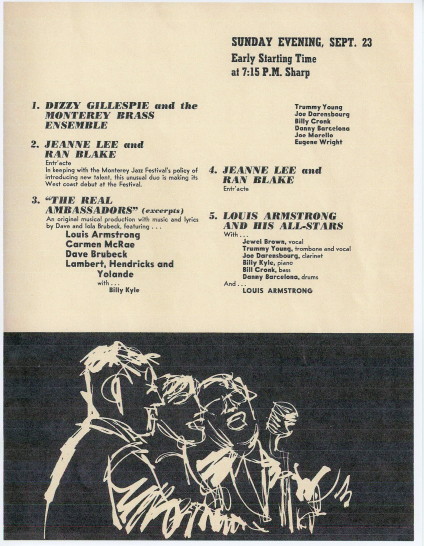


WORLD PREMIERE OF DAVE AND IOLA BRUBECK'S original musical production THE REAL AMBASSADORS starring LOUIS ARMSTRONG, CARMEN McRAE and LAMBERT,HENDRICKS & YOLANDE


The theme of "The Real Ambassadors" is contained in the title. Louis Armstrong, Brubeck, Dizzy Gillespie — all of whom have made extensive and highly acclaimed overseas tours under the auspices of the U, S. Department of State —- are the "real ambassadors" representing America to foreign peoples. And since jazz has become an international language and a force for world understanding, it may well be that the very phrase "foreign peoples" will one day become happily archaic.


On the closing night of the Monterey Jazz Festival, Sunday, September 23 (at 7:15 p.m, sharp), one of the most ambitious and unusual programs ever presented on any festival stage will be given its first public performance.

Excerpts from the original musical production "The Real Ambassadors," with music by Dave Brubeck and lyrics by lola (Mrs. Dave) Brubeck will be presented. Heading the cast will be Louis Armstrong, Dave Brubeck, Carmen McKae and the Lambert, Hendricks and Yolande Trio.


The internationalism of jazz serves as a unifying theme of the new Brubeck musical, and for the 1962 Monterey Jazz Festival as well. Lalo Schifrin's "New Continent" which has its world premiere on opening night, and Dizzy Gillespie's "The Relatives of Jazz," on Sunday afternoon both have as their subject the universality of jazz. The appearance of Israel's Yaffa Yarkoni, Ceylon's Yolande Bavan, Brazil's Bola Sete, Argentina's Lalo Schifrin, and Cheraw, South Carolina's Dizzy Gillespie! make this Festival a truly international spectacle.


Known primarily as a pianist and leader of the poll-winning Dave Brubeck Quartet, the scholarly, serious Brubeck is coming to be recognized as an important jazz composer. Many of his songs, like "The Duke" and "In Your Own Sweet Way," are becoming modern jazz standards, having been incorporated into the repertoire of Miles Davis, Gil Evans and other major figures in the jazz world.


lola Brubeck, a gifted actress, poet, writer and mother of the five Brubeck children, has written all of the lyrics to Dave's songs.


Recorded in its entirety by Columbia Records (the Festival can only present excerpts) "The Real Ambassadors" includes the following songs: EVERYBODY'S COMIN' 

CULTURAL EXCHANGE 

GOOD REVIEWS 

REMEMBER WHO YOU ARE 

MY ONE BAD HABIT 

SUMMER SONG 

KING FOR A DAY 

BLOW SATCHMO 

THE REAL AMBASSADORS 

IN THE LURCH 

ONE MOMENT WORTH YEARS 

THEY SAY I LOOK LIKE GOD 

SINCE LOVE HAD ITS WAY 

I DIDN'T KNOW UNTIL YOU TOLD ME 

SWING BELLS


In Cincinnati a few weeks ago, Dave and Louis got together for a little advance rehearsal for their Monterey appearance. If the audience has half as many kicks as they did, "The Real Ambassadors" will be remembered as a high point during the five year history of the Monterey Jazz Festival.


So listening to The Real Ambassadors sends you off to the record collection searching for when you first heard these tunes by the Dave Brubeck Quartet. [Just to prove, of course, that either you’ve still got it, or you’re not losing it – depending on your point-of-view.]


For example: I Didn’t Know Until You Told Me, a feature for Carmen McRae with Pops harmonizing the ending, was originally Curtain Time from the quartet’s Jazz Impressions of the U.S.A. about which Dave wrote:


Curtain Time is like a pencil sketch of Broadway, a mere suggestion of what the full-color painting should be with strings, brass and the full complement of a theatre orchestra. All we have here of the real pit band is the soft tinkle of the triangle in the opening bars. The rest of the or­chestration is for you to paint as the four of us try to conjure some of the excite­ment and glamour of a Broadway musical at curtain time.”


The piece retains its lightness and gentleness when Carmen performs it as I Didn’t Know Until You Told Me and having Pops do the harmony at the end is so unexpectedly perfect – a moment in time.


Carmen also is the primary vocalist on In the Lurch, which adds lyrics to Dave’s Two-Part Contention, previously performed on Brubeck Plays Brubeck [Columbia CK-65722] solo piano album and is also a featured piece by the quartet on their recording from the group’s 1956 appearance at the Newport Jazz Festival [Columbia CL 932; SRCS 9522].


Mercifully for Carmen, the structure of In the Lurch is revised a bit from this description by Dave of the more complicated original:


"Two-Part Contention is divided into three sections, marked by three tempo changes. The first is a medium tempo; the second, slow; and the last, a fast tempo. The written portion of this tune is heard in the opening 32 bars. These two melodic lines are repeated throughout the piece. In the second section (slow tempo) I introduced a pattern of answering the right hand with the left hand, abruptly changing the register of the piano. In the third (fast) section, I tried to improvise within the limitation of two lines in the first chorus.”


Everybody’s Comin’, the tongue-twisting, jaw-cracking opening track is based on Everybody’s Jumpin’ from the Time Out album [Columbia CK-65122] with the 6/4 time signature of the original replaced by a straight 4/4 call and response between Pops and the LHR that serves to summon the faithful to the celebration.


To my ears, one of the great surprises on The Real Ambassadors is Pops’ performance on Nomad. The original version of the tune is contained on Jazz Impressions of Eurasia [Columbia CK 48351] and features a sultry, very Middle Eastern sounding alto saxophone played by the late Paul Desmond over Joe Morello’s use of tympani mallets on tom toms.


As described by Dave, the effect he was trying to achieve in Nomad was “the intricacies of Eastern rhythms … suggested by … superimposing three against the typical Jazz four.”


This Nomad is taken at a slower tempo to give Pops a chance to enunciate its clever lyrics. Clarinet replaces the alto and Joe’s tom toms are subdued while the beat is carried on a tambourine. Pops sings the first and third choruses and then takes an instantly recognizable Satchmo trumpet solo on the middle chorus which switches to straight 4/4 time.


Yet, despite these changes, The Real Ambassadors’ Nomad still evokes Dave’s intent when he originally wrote the piece: “I tried to capture the feeling of the lonely wanderer. The steady rhythm is like the ever-plodding gait of the camel, and the quicker beats are like the nomadic drums or the clapping of hands.”


It’s a credit to Pops’ genius that he could take music that is so recognizably Brubeckian and make it his own without changing the inner spirit of the piece.


Other previously recorded tunes that were converted by Dave and Iola for use in The Real Ambassadors include My One Bad Habit [My One Bad Habit is Falling In Love from The Dave Brubeck Quartet in Europe]; You Swing, Baby [The Duke from Jazz Red Hot & Cool, Brubeck Plays Brubeck and The Dave Brubeck Quartet at the Newport Jazz Festival]; Swing Bells [Brubeck Plays Brubeck], One Moment Worth Years [Brubeck Plays Brubeck]; Summer Song [Time Signatures].


Friday, May 7, 2021

"GOODBYE, FRANK" by Joe Lang

 © Copyright ® Steven Cerra, copyright protected; all rights reserved.


“Before Frank, there were Rudy Vallee and Bing Crosby, but they only laid some groundwork for the man who would write the book on how to sing those great songs of the Gershwins and Berlin, Kern and Porter, Mercer and Carmichael, Arlen and Rodgers, and, most particularly for him, the words of Sammy Cahn blending with the music of Jimmy VanHeusen and Jule Styne.  No one could swing harder or be more tender with a ballad.  He respected both the words and the music.  He made us aware of what phrasing meant in a musical sense.  He didn't always sing them the way that they were written, but when he applied his sensitivity to a song, it was somehow his forever.”

- Joe Lang


The banner under JazzProfiles reads: “Focused Profiles on Jazz and its Creators while also featuring the work of guest writers and critics on the Subject of Jazz.” [Emphasis mine].


My intention from the outset was to share this page with others whose writings on the subject of Jazz I respect. Over the years, I learned a great deal about the music from the insights, observations and commentaries of many knowledgeable and experienced authors, essayists and critics, so why not share some of these with you from time-to-time?


Which brings me to Joe Lang who lives in New Jersey and writes articles and audio-visual reviews about Jazz and popular culture for JerseyJazz the magazine of the New Jersey Jazz Society which you can locate more about by visiting their website.


Given the transcontinental distance between us, Joe and I visit via the internet, a chat group devoted to West Coast Jazz to which we both belong and via the occasional phone call.


Joe wrote this on May 14, 1998 - the day Frank died. Ultimately, I suppose there is something quintessentially congruent about bringing up a piece about Frank Sinatra by a writer of Jazz and socio-cultural themes based in New Jersey.


“He wasn't a jazz singer, but he was a jazz kind of guy.  A skinny kid from Hoboken who had the will, wit and talent to become one of the defining figures of 20th Century American culture.  There never was and never will be another quite like him.  Francis Albert Sinatra a.k.a. The Voice,  a.k.a. Ol' Blue Eyes, a.k.a. The Chairman of the Board.  Well, Ring-A-Ding-Ding and Scoobee-Doo-Bee-Doo, he's seen the final curtain, but he will live on through his music and his legend.


There are certain figures who become bigger than life in the eyes of the masses.  Frank stood right up there with Louis, Bing, Judy and Elvis, those special someones who didn't need the formality of a second name.  Mention any of them, and only the very unhip or very young will give you a blank stare.  Of them all, however, Sinatra stands alone, for his fire and influence has burned brightly until this very day, and will continue to do so for a long time to come.


Before Frank, there were Rudy Vallee and Bing Crosby, but they only laid some groundwork for the man who would write the book on how to sing those great songs of the Gershwins and Berlin, Kern and Porter, Mercer and Carmichael, Arlen and Rodgers, and, most particularly for him, the words of Sammy Cahn blending with the music of Jimmy VanHeusen and Jule Styne.  No one could swing harder or be more tender with a ballad.  He respected both the words and the music.  He made us aware of what phrasing meant in a musical sense.  He didn't always sing them the way that they were written, but when he applied his sensitivity to a song, it was somehow his forever.


Listen to any who came after him, Tony Bennett, Vic Damone, Mel Torme, Jack Jones, Matt Monro, Harry Connick, Jr., John Pizzarelli or any of hundreds of others, and you hear part of The Man.  Sure he spoke of his influences, Bing, his inspiration, Louis, who played with words, Billie Holiday, who started the book on phrasing, Tommy Dorsey, who taught him how to breathe, and Mabel Mercer, a lyric's special friend.  Listen to Bing after Frank, however, and you will hear the inspiration being influenced by the insipireree.  That is how important Sinatra was to pop music.


Ah, the music!  Before all else comes the music.  Once he decided to make it as a singer, nothing could stop him.  The boy was brash, and you had better not get in his way.  The Hoboken Four on Major Bowes, a sustaining show on WNEW, the Rustic Cabin gig, a few minutes with Harry James, a bit longer with Dorsey, and then he was ready to take on the world.  The world would never be the same.  The Paramount with the screamers, and on to Hollywood for some nifty musicals.  Then came Ava, and the constantly shifting highs and lows.  Mitch Miller didn't help, but Frank didn't either.  He was running himself into the ground, physically and emotionally.  The voice disappeared and the bottom arrived swiftly.  Thank God for Maggio!


Funny how it happened, but the turnaround for the greatest of all popular singers found its roots in an acting role.  The Oscar was the icing, the real thing was the return of the voice.  Great as those 40's Columbia recordings were, they never unleashed the real Capitol swinger who tore up the musical world.  If they thought he was cocky the first time around, they hadn't seen anything yet.  He could out swing and out sensitive them all.  There were songs for swinging lovers to come fly and dance and swing with all the way. Others were for only the lonely, to be heard in the wee small hours of the morning when no one cares.


Power gives one a need to control even more and more.  He decided to Reprise his Capitol success on his own, no bosses to tell him what he should record.  It was a kick being the boss for a while, but it gets in the way of the music and the fun times.  Some cats at Warner Bros. made him an offer he couldn't refuse.  You can be your own boss without the responsibilities.  OK!


The true quality recordings were fewer and farther between, but the concerts were getting better and better.  Suddenly, enough was enough.  Time to step back and take a break.  Maybe for a day, maybe forever.  A couple of years off were as long as it took.  The music was still within and had to come out.  All the affirmation coming from the audiences didn't hurt either.  The voice was heavier, wearing the years of hard living on its sleeve.  That's all right, the phrasing was still there, and the wisdom grown from experience made for deeper readings of lyrics.


Time plays its own game, however, and the best was no longer yet to come.  There were still the flashes of brilliance, and even on most off nights, he was still better than most, but not better than all.  Still they came, perhaps expecting miracles, perhaps just happy that he was still there for them.  Funny, but the last song sung publicly was not "My Way," but "The Best Is Yet to Come."  He never stopped believing, at least in public.


He made no formal announcement, but we all knew that the public side was over.  We were sad that he couldn't do it anymore.  We were glad that he didn't continue to try.  There were still the recordings and videos to provide a fix for those addicted to his art.     


There was another side to his oh so public life.  The fighter for the rights of  black Americans long before it was the thing to do.  The pugnacious swinger who loved and fought and partied right on the front pages.  He just couldn't be ignored.  This Jersey guy became a world figure who influenced not only music, but also lifestyles.  There he was, shoulder to shoulder with presidents, but always thought of by the folks on the street as one of them.


Then there was the private side.  No one could be more generous.  Countless stories came to light of how he was there to help, usually with little or no fanfare.  Some of those he assisted were friends, but many were just acquaintances or even strangers.  They needed a helping hand, and he was moved to be the one to offer it.  It was not pleasant to be on his wrong side, however, for he had a long memory for those he didn't favor.  Ask especially some of those in the world of journalism who felt his wrath.  This anger should have remained private, but such was his nature that he often felt the need to make it public.  Truly a man of extremes!


I have always loved music, but must admit to having come to Sinatra later than I wished that I had.  I was naive about his genius for too long a time, but when I saw the light, the passion became intense.  The first album I bought was Come Fly With Me, then Only the Lonely and then and then and then...  Books also, more than I can remember or probably find.


The in-person thing didn't happen for me until the mid-80's at the arena in the Meadowlands.  Buddy Rich opened.  Nice, but we weren't really there for that.  When it was time for Frank, an electricity burst through the crowd like nothing I had ever experienced.  The love and devotion of the Sinatraphiles jumped out of every pore of their essence, and you could not help but become part of this very special feeling.


Several times after this I saw the same thing happen, and reveled in being a part of it.  The moment I remember most vividly is an unbelievably powerful reading of "Soliloquy" at the Garden States Arts Center.  Here was a man who was really too old to sing this young father's song, but he made you believe that he was once again in his twenties and waiting for his first child.  Underneath it, however, he brought a depth of wisdom that could only have come from a man who had already experienced all of life.  I was moved then, and I am moved now with the remembrance.


The last time I saw him, I recall less fondly.  Again it was at the Garden State Arts Center.  He was only a dim ghost of what I had come to expect.  The words were sometimes forgotten, the voice just could not reach the right notes, and some of his comments you would rather not have heard.  I can remember what served as an exclamation point for my disappointment that evening.  As I left, I overheard a young man say to his date "Well, I'm glad that I saw him, but he's no Harry Connick."  I could have cried, but quickly realized that it had become time to listen to the recordings and remember the good times.


When I heard the news of Frank's passing, I felt a mixture of sadness and relief, a reaction which I am sure was shared by countless others.  He was no longer a living part of our world, but his difficult last years were finally over.  We still have the music and the memories, and that should be plenty enough to carry us through the grief.


He sang of doing it his way.  His behavior did not always please everyone.  His music, however, has crossed more generational lines than any other performer.  There are still teenagers today who respond to his music.  Some may have "jewelry" stuck into parts of their body that I cannot believe were meant for such things, and buy albums that I find it difficult to believe even exist, but I am never shocked when they hear Sinatra playing and are visibly moved by what they are hearing.  Words of admiration often follow.  From the 1930's into the 1990's, his star stayed brighter than any other.  There were a lot of pretenders along the way, but there was only one Sinatra, and we are glad that there was.  We'll never stop listening, Frank.”       


Thursday, May 6, 2021

Thelonious Monk - Bemsha Swing

Blumenthal on Thelonious [From the Archives]

© -  Steven A. Cerra, copyright protected; all rights reserved.


“He dealt in phrases with odd shapes, placed into odd niches on the bar line, stressed in odd places. Melodically, he created tight, stark nuggets that served as seeds for complete musical statements once cultivated through his surprising use of modulation and accent. Monk's strong, aggressive touch produced tones of hornlike boldness on the piano, and his rhythmic patience highlighted the rich overtones this attack produced.


When he worked with horns, this tonal character carried over to the rough-edged ensembles he preferred to bebop's characteristic unison lines. And there was Monk's dense and pungent harmonic palette, which Andre Hodeir likened to an acid bath when applied to popular material. These various techniques functioned so integrally as to seem inseparable.


These attributes of Monk’s music, so familiar to us now and more central to the ongoing evolution of Jazz with each passing day, took an uncommonly long time for the public to grasp.”
- Bob Blumenthal, Jazz writer, columnist and critic


During the many years that he wrote about Jazz for The Boston Globe, CD Review, The Atlantic Monthly, Downbeat and numerous other publications, Grammy-Award winning author, columnist and critic Bob Blumenthal became one of my most consistent teachers about all-things-Jazz


For his long affiliation with it and studied application of it, Bob knows the music.


Equally important is his ability to communicate this knowledge and awareness in a writing style that is clear, cogent and concise.


Bob’s a mensch and a mentor.


My first awareness of Thelonious Monk’s music was based on the LPs he recorded for Orrin Keepnews at Riverside Records from approximately 1955-1960. The significance of these recordings was that they helped make the Jazz public of that period aware of Monk’s genius, such that Thelonious career was set on a path that would lead to fame and fortune.


The Riverside albums were a renaissance of sorts for Monk who, although he was one of the originators of modern Jazz along with Charlie Parker, Dizzy Gillespie, and Kenny Clarke and others from the Minton's Playhouse days of the early 1940’s, had largely become a forgotten man by the end of that decade.


In 1994, Blue Note Records issued a boxed set of the music that Thelonious had recorded for the label under his own name and as sideman on a 1957 date with Sonny Rollins as the leader. The set also includes the five tracks that were recorded by John Coltrane's wife Naima at the Five Spot in NYC during Coltrane's tenure with Monk's quartet in 1958.


This reissued set provided a sort of missing link in my quest to appreciate the early years of Monk’s music.


And if that wasn’t enough, wouldn’t you know that the insert notes to the four CD’s that make up Thelonious Monk: The Complete Blue Note Recordings [CDP 7243 8 30363 2 5] were written by none other than … you guessed it … Bob Blumenthal.


Bob has kindly granted the editorial staff at JazzProfiles permission to use the introductory portion of his Blue Note annotations on these pages.


© -  Bob Blumenthal, copyright protected, all rights reserved; used with the author’s permission.


“Thelonious Sphere Monk inherited his striking name, yet it is doubtful that the collective energy of all the slogan-makers could have devised a more appropriate appellation. Never has a moniker so perfectly reflected someone's music. "Thelonious" announces imposing complexity and originality with roots in tradition, "Monk" signals abrupt angularity, and the rhythmic impact of the two in juxtaposition is indelible and unique. The rich internal detail was frequently lost on others in the past, who tended to fashion the first name as "Thelonius," mirroring the confusion that surrounded Monk's music (fortunately, misunderstandings of both types have diminished over time). Most revealing of all, though, is "Sphere," with its intimations of rounded, three-dimensional completeness, of a self-contained planet pursuing its own course in the musical universe.


That sense of fullness, together with Monk's brilliant use of sound, silence, dissonance, rhythmic surprise and melodic cogency, marked the music in this collection from its initial appearance as something exceptional. For many, musicians as well as listeners, it was also somewhat undecipherable when first released on a series of 78 rpm records taken from the six sessions that form the bulk of this collection. At the time, Monk was considered the jazz world's primary enigma, the farthest out of the far out. He was said to be one of the fountainheads of bebop, its "high priest"; yet his music did not sound like bebop. The breathless, arpeggio-driven virtuosity of bop that was already becoming cliche when Monk recorded his first sessions as a leader was replaced in his music by a concept of space that was poetic. He dealt in phrases with odd shapes, placed into odd niches on the bar line, stressed in odd places. Melodically, he created tight, stark nuggets that served as seeds for complete musical statements once cultivated through his surprising use of modulation and accent. Monk's strong, aggressive touch produced tones of hornlike boldness on the piano, and his rhythmic patience highlighted the rich overtones this attack produced. When he worked with horns, this tonal character carried over to the rough-edged ensembles he preferred to bebop's characteristic unison lines. And there was Monk's dense and pungent harmonic palette, which Andre Hodeir likened to an acid bath when applied to popular material. These various techniques functioned so integrally as to seem inseparable.


These attributes of Monk’s music, so familiar to us now and more central to the ongoing evolution of Jazz with each passing day, took an uncommonly long time for the public to grasp The uniqueness of his music was reinforced by the eccentricities of his personality. He may have been the "genius of modern music," as Blue Note proclaimed when it first reissued some of the enclosed performances on 10-inch IPs in the early '50s; but to many he was a mad genius, given to wearing odd hats and sunglasses and with what his wife Nellie once described as a "marvelous sense of withdrawal." When he cut his first session as a leader in October 1947, he was five days past his 30th birthday, a point at which too many of the music's innovators had exhausted both their creative and biological spans. By the time of his sixth and final Blue Note date as a leader in 1952, he was nearly 35 and, thanks to public indifference and his willingness to take a drug possession rap for a friend, seemingly even further from the acclaim that would put him on the cover of Time Magazine little more than a decade later and elevate him still further in the years following his death in 1982.


Of course, Monk was nothing if not patient. At the time of his first Blue Note session, he had been a key figure in the emergence of the modern style for years; yet all he had to show for his efforts on record were four titles cut in 1944 with Coleman Hawkins and some samples of the already legendary jam sessions at Minton's taped at the club and issued under Charlie Christian's name. As a composer he fared better, with Hawkins, Cootie Williams, Dizzy Gillespie, Kenny Clarke and Bud Powell already having introduced several of his most famous compositions. The three sessions he led for Blue Note in a span of 38 days in 1947, which included 10 of his compositions, might be viewed as one of the greatest bursts of creative energy in history if Monk had not been waiting to unleash this brilliant music for a decade. On record at least, he began fully formed and more than ready.


Monk was born on October 10, 1917 in Rocky Mount, North Carolina and was named after his father. (His son, the drummer T. S. Monk, is actually Monk III.) His family moved to New York City in 1923, occupying a house on West 63rd Street in the San Juan Hill neighborhood that would remain Monk's home for much of his life. His musical career began typically enough for an African-American youth of the time: piano lessons at 11, rent parties and amateur contests three years later, and regular work in church, where he accompanied his mother. Despite excelling in math and science at Stuyvesant High School, Monk dropped out in 1934 to accompany an evangelist on a tour that ultimately took him to the Midwest. Mary Lou Williams, one of his earliest champions, heard him at the time and later reported that he displayed a fluid swing piano technique, with touches of Teddy Wilson.


Back in New York by 1936, Monk studied briefly at Juilliard and began taking the diverse gigs that are a young musician's lot. He also quickly immersed himself in the Harlem after-hours scene, landing a job in the house rhythm section at Minton's Playhouse in 1940. This was the period during which young musicians began developing a more technically advanced approach that went beyond the conventions of swing music, in clubs like Minton's and Monroe's Uptown House. At Minton's, Monk and his rhythm section mate Kenny Clarke jammed with such sympathetic contemporaries as Charlie Christian, Dizzy Gillespie and Charlie Parker.

The pianist also began introducing his compositions to the sessions, and encouraged a second generation of even younger players, especially his protege Bud Powell. These efforts continued when Monk moved with Clarke to Kelly's Stables in 1942.


Gillespie and others have verified that Monk participated actively in the give-and-take of these sessions, and the music that evolved from this period expressed, especially in its harmonic approach, certain aspects of Monk's thinking. The rapid tempos and arpeggiated melodies generally identified with bebop are far removed from Monk's aesthetic, however, and he quickly distanced himself from the center of bop activity. Although he did some work with Lucky Millinder, Coleman Hawkins and both the early combo and big band of Dizzy Gillespie, much of his time in the remainder of the '40s was spent organizing his own groups, often with young players like the teenaged Sonny Rollins. A few jobs cropped up, but his bands spent much of their time rehearsing in Monk's kitchen (where he kept his piano), even after he began recording for Blue Note.


The notoriety of his accompanists was less important to Monk than their ability to learn his music correctly. He had little tolerance for complaints about his music's difficulty - he famously told Sahib Shihab at one of the Blue Note sessions, "You a musician? You got a union card? Then play it!" - his insistence on writing little down and forcing players to use their ears only heightened the challenge. Most responded surprisingly well, whether they turned out to be giants like Art Blakey and Milt Jackson, or obscure journeymen who would be totally forgotten if not for their role in the documentation of Monk's music.


Saxophonist Ike Quebec, a Blue Note leader and adviser to label owners Alfred Lion arid Francis Wolff, was


instrumental in bringing Monk to their attention when they expressed interest in documenting modern jazz. His input is most obvious on Monk's initial session, recorded on October 15, 1947, where Quebec takes composer credit on two of the four titles and where his 17-year-old cousin Danny Quebec West is the alto saxophonist. The other saxophonist, tenor man Billy Smith, is similarly unknown, while the remaining sidemen proved to have greater longevity. Trumpeter Idrees Sulieman, born Leonard Graham in 1923, worked in various big bands and combos before moving to Europe in 1961 and is still playing in 1994. Bassist Gene Ramey (1913-84) was a colleague of Charlie Parker's in the Jay McShann orchestra and became one of the most widely recorded players of the period. Art Blakey (1919-90), soon to be identified as Monk's perfect drummer, would begin his own career as a leader for Blue Note before the year was out. …”


At this point, Bob begins a session-by-session analysis of the tunes and musicians that make up the music on the four Blue Note CD’s and concluded his essay with the following observations about the importance of Monk’s music on Blue Note in the evolution of Monk’s own career and to the development of modern Jazz in the 1950s and beyond.


“Some might consider the lengthier tracks with Rollins and Coltrane extraneous additions to what otherwise would be a perfectly acceptable set of "complete" Blue Note Monk. Given that Monk's music grew and expanded, though, sounding ever more clearly in the ears of musicians and listeners, these later performances strike me as essential complements to the groundbreaking sessions of 1947-52.


They take us into the future, where Monk becomes more and more central to jazz of the late 20th century and where, in the years following the issuance of this collection, he will no doubt assume his rightful place as one of the greatest contributors to American culture.”


- Bob Blumenthal

Tuesday, May 4, 2021

See/Saw. Looking at Photographs, by Geoff Dyer

For as long as I can remember, Jazz and photography have been inextricably linked. 

I hear one and I see the other.

While not strictly speaking about Jazz photography - with one notable exception [Roy Decarava] - Christopher Irmscher’s review of Geoff Dyer’s new book See/Saw. Looking at Photographs [Graywolf 2021] reveals the many ways in which photographs are so powerful, both as an artform themselves, and in their relationship to other forms of art.

Like Jazz, “what a photograph documents is gone for good,”

Like the next Jazz improvisation, “... each photograph also inevitably points toward the future, to the next photograph or series of photographs [improvisations] about a similar subject.”

And like each photograph, each Jazz recording “ … mak[es] a distant past present again every time we look at [listen to] it.”

—Mr. Irmscher is the co-editor of the Od Review, an online journal for the photographic arts.

Copyright ©2020 Dow Jones & Company, Inc. All Rights Reserved. 

Appeared in the May 1, 2021, print edition as 'Every Picture Tells a Story.'

Geoff Dyer begins his rich new collection of essays with a consideration of “Saint-Cloud, 1924,” a magical picture by the French photographer Eugène Atget (1857-1927), quietly reflective in the way some Rilke poems are. Here, claims Mr. Dyer with his trademark playfulness, Atget’s “Atgetness” is in full display. We see a landscape devoid of human presence: a broad, tree-lined promenade, divided by rows of ornamental shrubs, receding into a hazy, mysterious distance that, thanks to the camera’s off-center position, seems even farther away than it is. Marble statues preside over the emptiness. The time is early morning; no one except the photographer is up and about. Whatever life there is in this park—originally created for the brother of Louis XIV—appears to reside in the billowing trees on either side.

A photograph is “a witness of something that is no more,” sighed the French critic Roland Barthes in “Camera Lucida” (1980), a book that has cast its melancholy shadow over most recent writing about the medium. For Barthes, what a photograph documents is gone for good, like that misty morning in Saint-Cloud, or it will be gone soon. But where Barthes always felt the painful prick of his own mortality, Mr. Dyer’s “See/Saw” finds the delicate promise of new life: A photograph, like one of the silent statues in the royal gardens of Saint-Cloud (that’s Mr. Dyer’s comparison), endures, at least for now, making a distant past present again every time we look at it. We see anew what someone else once saw, a dizzying experience to which the clever title of the book alludes. Averse to jargon, Mr. Dyer never strays too far away from an ordinary viewer’s experience. A proud interloper in the compartmentalized halls of academe—an experience he has previously celebrated in the witty essay “My Life as a 

Apart from lifting the past into our present—allowing us, in the case of Atget’s Saint-Cloud photograph, to wander, with our mind’s eye, through a vacant park as if not a day had passed since 1924—each photograph also inevitably points toward the future, to the next photograph or series of photographs about a similar subject. If Barthes, somewhat exaggeratedly, dubbed photographers “agents of death,” Mr. Dyer celebrates them as active participants in an ongoing conversation—an idea reflected in the title of his brilliant 2005 book on the subject, “The Ongoing Moment.” Thus Atget’s austere street scenes live on in the impressions of Paris recorded during the interwar period by Ilse Bing (1899-1998), the “Queen of the Leica,” the deserted Southern plantation homes visited, during the 1940s, by Walker Evans (1903-75), or the recent reworkings of Google Street View by the photographer Michael Wolf (1954-2019).

In the preface to “See/Saw,” Mr. Dyer asserts, entirely too modestly, that writing about photography has just been a sideline for him. Not counting “The Ongoing Moment,” he has published prolifically on the subject, in prominent places such as the Guardian, the New Republic and the New York Times Magazine—enough for him to envision, tongue in cheek, a “deathbed or—yikes!—posthumous edition” of his collected photography essays. Fortunately, that grand finale still seems a long way off. In the interim, the 52 scintillating essays in “See/Saw” provide reassuring Despite the range and the staggering number of artists represented, most of Mr. Dyer’s essays remain focused on just one photograph, each of them beautifully reproduced by Graywolf Press. Intriguingly, the timeless statues of Saint-Cloud lurk behind many of Mr. Dyer’s choices, which reveal a predilection—handled with a degree of self-conscious irony—for impersonal structures, such as houses, streets, and monuments. Thus, Mr. Dyer praises the work of American photographer Bevan Davies (born 1941), whose photographs, in Mr. Dyer’s understanding, exemplify how buildings, if they had cameras, would take pictures of each other. And he admires the dreamy compositions of Oliver Curtis (born 1963), which show us what we, the visitors, would look like from the perspective of a monument such as the Taj Mahal—a bunch of scraggly, indistinct shapes milling around the famous Basin of Abundance.

The author of more than a dozen works of fiction and criticism [including But Beautiful: A Book About Jazz - 2009], Mr. Dyer has cultivated an unmistakable narrative voice, by turns lofty and self-deprecating, acerbic and arch, dismissive and sympathetic. A virtuoso example of his skill is his meditation on August Sander’s 1926 portrait of the forgotten writer Otto Brües (1897-1967). His head drooping like that of a sick bird, eyes watery behind thick, wire-framed glasses, Herr Brües sits hunched, as if imprisoned in his oversized black suit, his right hand resting idly on his right leg, an unhappy young man grown old before his time. Reflecting on Sander’s photograph, Mr. Dyer lets his imagination run riot: If Brües’s black-trousered leg, looming large at the bottom of the picture, looks like it could be a sort of writing desk, it reminds him also of the plinth of a statue—which would, jokes Mr. Dyer, make that entire portrait a “photographic memorial to the unknown writer.” Or, wonders Mr. Dyer, does that leg rather represent the dark, “swampy ooze” from which all intelligent life, including that of the prematurely petrified Herr Brües, once sprang?

If these ruminations strike you as a little overwrought, that is Mr. Dyer’s intention. His readings, entertaining, nuanced and irreverent, never pretend to uncover any single truth about a photograph. Instead, they are an attentive viewer’s creative attempts—always incomplete, often fantastical, sometimes wrong—to determine what a photograph might mean. Even cursory biographical research (which Mr. Dyer concedes he hasn’t undertaken) would have disclosed the unpleasant fact that, a few years later, Otto Brües joined eighty-seven other writers in signing a pledge of loyalty to Adolf Hitler. But such additional research would only have distracted from Mr. Dyer’s point—that a good photograph is always superior to the stories we tell about it. Anything truly relevant about Otto Brües’s life is already present in Sander’s sardonic memorial.

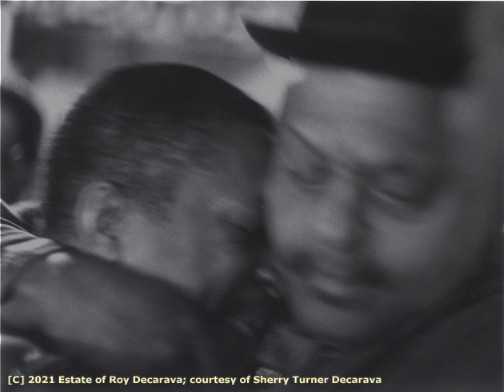
Among all the photographs gathered in “See/Saw,” the one likely closest to Mr. Dyer’s heart is a blurry black-and-white portrait of two jazz giants, Ben Webster and John Coltrane, taken in 1960 by the inimitable Roy DeCarava (1919-2009), with what must have been the slowest shutter speed possible. For Mr. Dyer, this picture is a monument of sorts, too, a commemoration of an intimate moment carved in such a way from the flux of time that, like the music of Coltrane and Webster, it remains alive today. With Webster’s giant hand wrapped around his jaw, Coltrane, his face visible only in profile, sinks into his older friend’s embrace. Topped by the inevitable hat, Webster’s head floats beside Coltrane’s, huge, like that of a benign god just come in from the mist. The two men’s closed eyes reflect the intensity of their hug, which spills beyond the frame into the viewer’s world. Webster was already past his prime then, but, thanks to DeCarava’s now iconic photograph, what could have been a melancholy leave-taking becomes also, as Mr. Dyer suggests, a new beginning for both men—one that, like a love supreme, lasts longer than a lifetime.”


Sunday, May 2, 2021

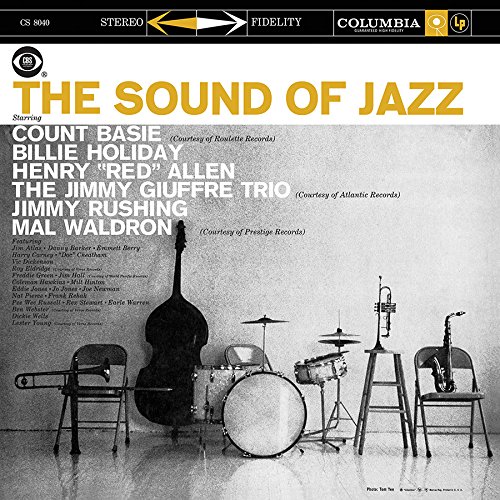
The Sound of Jazz (1957)

A Fickle Sonance by Art Lange

 © Copyright ® Steven Cerra, copyright protected; all rights reserved.


Here’s one more essay from the www.pointofdeparture.org website, an online musical journal which is published and produced on a monthly basis by Bill Shoemaker and Troy Collins, respectively. I highly recommend that you visit their page and check out the archives which date back to 2005 for a wealth of interesting articles and information on Jazz and related topics as well as many interviews and essays of a general nature on all aspects of American culture.


This one is by Art Lange who is an adjunct professor at Columbia College in Chicago and who has had a long association with Jazz and the creative arts most especially from 1981-84 when he was Associate Editor, and from 1984-88, Editor, of Down Beat magazine. He also published and edited Brilliant Corners: a magazine of the arts, from 1975-77 and was a founding member, and was elected the first President of the Jazz Journalists Association.


I always associated the title of his essay - A Fickle Sonance - with a 1961 Blue Note LP of the same name by alto saxophonist Jackie McLean [1931-2006]. In his liner notes to the album, Ira Gitler defines the title as “a changing sound may be a simple definition.”


The implication is changeableness with sonance being a now obsolete term for a sound or a tune. 


See if you can identify how Art uses the meaning of the title of his piece in the following essay. Maybe what he is describing is that a fickle sonance is another way of saying Jazz?


“When an artistic experience truly and totally clicks with an individual, a special connection is made and a profound level of awareness is reached, one which stops time and renders it inconsequential. The proverbial light bulb goes on, or as Frank O’Hara once said in a poem, “Everything suddenly honks.” It might be a monumental painting like Picasso’s Guernica or a small Kurt Schwitters collage, a film like Citizen Kane or a Roadrunner cartoon, a Shakespeare play or a third grader’s haiku. The scope of the achievement doesn’t matter, what’s important is how it affects us personally, the impression that it leaves on our psyche, the way it makes us feel, and the understanding we take from it. When we connect with a piece of music in this fashion, the world looks and sounds different ever after.


Every jazz fan knows, or should know, The Sound of Jazz. Broadcast on the CBS television show The Seven Lively Arts in December 1957, it was in effect a relaxed, informal live concert featuring the reigning stars of mainstream swing—Count Basie, Billie Holiday, Coleman Hawkins, and a luminescent galaxy of supporting artists shrewdly handpicked by consultants Whitney Balliett and Nat Hentoff. But in addition to established swing players like Rex Stewart, Red Allen, Roy Eldridge, and Ben Webster, Balliett and Hentoff spiced the personnel with a few eccentric modernists—clarinetists Pee Wee Russell (was anyone playing as far out as early as the ‘30s?) and Jimmy Giuffre, and Thelonious Monk (still considered by many an outsider in ’57). To our great fortune, a decent videotape of the program was issued back in 1990. There have since been issued a couple of DVD transfers from Europe which I haven’t seen, but beware the DVD version from Music Video Distribution (MVD)—one entire segment, Monk’s appearance, has been removed, and the black and white visual contrast is so bad that faces are often washed out. And the faces of these great artists reveal as much about the emotion of the creative moment, and the pride and passion inherent in the process, as the music itself. For those of us born after World War II, filmed documentation like this is our only opportunity to have seen several generations of innovators at work, in the moment.


What makes The Sound of Jazz a classic is that it contains not just one but several of these undeniable time-negating moments. I suspect for most viewers one will be the sight of a gaunt but unbowed Billie Holiday offering an exquisitely phrased “Fine and Mellow,” especially the poignant moment when Lester Young stands to blow one soft, slow, simple blues chorus as Billie nods in empathy—two bodies sharing one musical heart. Ironically, Young’s face is on screen for just the first few measures of his solo (the rest of the time the camera lingers on the singer), and we see various shots of the other musicians throughout the performance, but his image otherwise appears only briefly at the song’s very beginning and very end. Though the other three saxophonists stand, he remains seated, seen from the back, bathed in shadow and unrecognizable. At this point in his life, suffering from the maladies that will consume him a little over a year later, he’s already a ghost; all that remains is his music echoing in the air.


Another classic moment, this one potentially confrontational, is when Count Basie literally gets in Monk’s face, sitting with casual audacity in the crook of the piano as if to say, “Okay kid, show me what you’ve got.” Monk of course, hidden behind shades, pays no attention and slices and stomps his way through an edgy “Blue Monk.” As he plays, reaction shots of Jimmy Rushing and Coleman Hawkins reveal various degrees of engagement, from bemusement to finger-snapping rapport, but it’s not until Basie’s face erupts in glee that the moment’s tension is released and we see an older generation willing to accept Monk’s abstracted chords and reconfigured rhythmic accents as part of the common vocabulary and not a foreign language.


Personally, I love the way Red Allen kicks off his ad-hoc group’s numbers with a “Watch it…whamp…whamp” and ends them with “Niiiice!” (And Pee Wee’s solo on “Wild Man Blues” is stunning.) But for me, the moment that clicks is the augmented Basie Band’s performance of Dickie Wells’ tune “Dickie’s Dream.” It is one of the most astonishing things I have ever seen. The performance is just over six minutes long, a sequence of solo after solo, but it is all of a piece, a single indivisible electrifying experience, a slice of life so real and so intense that it suspends the passing of time. It starts with Basie’s piano and the deceptively elfin Jo Jones behind the drums setting a deviously fast tempo with the tune’s introductory descending notes. The band kicks right in with Nat Pierce’s fierce orchestration of the minor-key theme that was originally recorded by Basie’s Kansas City Seven. What was in its 1939 incarnation simultaneously suave and mysterious here becomes rousing and suspenseful, a foreboding of potent things to come.


And they come quickly and without respite. Ben Webster emerges first from the ensemble with a gruff, almost antagonistic solo that serves as a challenge, a call-to-arms, to each of the players to follow. When he finishes, he nearly rips the tenor saxophone out of his mouth with a “take that!” gesture. Trombonist Benny Morton tries to sustain Webster’s vigor with cascading countermelodies, and trumpeter Joe Wilder substitutes multi-note flurries, but it’s the band’s riffing that keeps the music hot and the tension building. Gerry Mulligan’s baritone sax grabs a nice phrase from the mix to start his solo, as he sways and rides the waves of energy the band is feeding him. Trombonist Vic Dickenson’s slippery initial notes elicit shouts of joy from Wilder and saxophone section leader Earle Warren—and suddenly the camaraderie and spirit that is fueling the music is palpable. Next trumpeter Roy Eldridge enters full blast, then tries some intricate figures, but soars out of them with sizzling stratospheric shrieks, forsaking pitch for pure emotion—a gesture so shocking that subsequent trumpeter Emmett Berry’s only recourse is a brief return to melodic restraint. But this doesn’t last long, as Coleman Hawkins—eyes squeezed shut in concentrated effort—takes over and sails through the changes, his tenor sax growling more aggressively with each connected phrase. Dickie Wells, ever the imp, naturally takes the opposite tact, his trombone muted, sliding to and fro with cool insouciance (but notice how hard bassist Eddie Jones is working behind him), followed by Joe Newman’s likewise muted but tart trumpet, precariously balanced atop the momentum of a ruthlessly driving rhythm section.


The band drops out, leaving Basie to rebuild the tension once more, alternately stabbing at and clawing out chords, jolting with characteristic stride feel—I wonder if watching Monk just moments earlier inspired Basie to dissect the chords even more surgically than usual? The full band re-enters, punching and counterpunching, with stop-time chords visually punctuated by Jo Jones’ crisp, precise arm movements. Basie takes one final, tongue-in-cheek run up to the very tip of the keyboard, and the band shouts out one last relentless cadence until Warren cuts them off with a chop. In the next few seconds, the silence, as someone once said, is deafening.


No doubt, this was a once-in-a-lifetime event. They couldn’t have captured lightning in a bottle twice—and the proof is in the studio recording made during rehearsals four days earlier (and issued by Columbia instead of the actual soundtrack), which is fine in its own way, and includes memorable solos by Lester Young and Harry Carney, who were not part of the televised version. But what is it that makes the latter transcendent? I’m sure it has something to do with the power of group dynamics and the uniqueness of this particular personnel and these special circumstances. I have no illusion that a description of the music can substitute for or explain the drama and exhilaration of this experience. I wrote this for selfish reasons—looking for the right words has helped me come a bit closer to understanding why I get chills whenever I watch it. If this piques your interest enough to check it out yourself, so much the better. Just be prepared to lose all sense of time.”

Art Lange©2007