Monday, January 13, 2025
Saturday, January 11, 2025
Emily Remler 4 Queens Las Vegas 1988

Friday, January 10, 2025
Thursday, January 9, 2025
A Gerry Mulligan Reader: Table of Contents.
© Copyright ® Steven Cerra, copyright protected; all rights reserved.
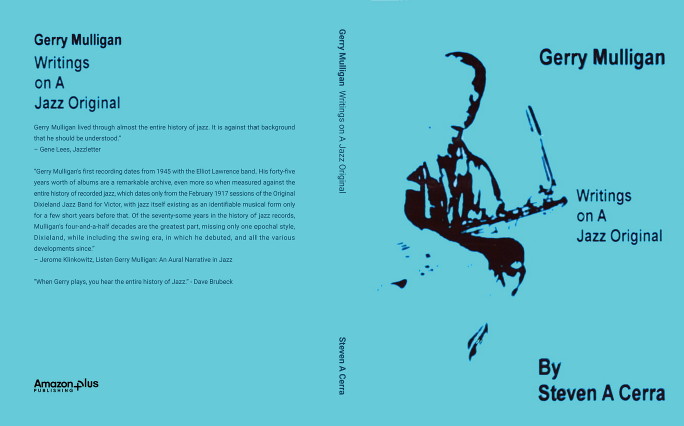
Dear Steve,
“Thanks so much for sending and, indeed, for composing your opus on GM. You did an extraordinary job of finding obscure and illuminating pieces that would otherwise never be seen and which fully represent Jeru as man and musician. It’s the kind of book that you dare not open unless you’ve got time to spare because it’s impossible to stop flipping through and getting ambushed by pieces you never expected. I hope it gets the attention and readership it deserves.”
Best,
Gary Giddins
“Gerry Mulligan lived through almost the entire history of jazz. It is against that background that he should be understood.”
Gene Lees, Jazzletter
The Gerry Mulligan Reader: Select Writings on a Jazz Original is my first book which I self-published on Kindle Direct Publishing. It took the better part of three years to collect, compile and annotate the articles, interviews and commentaries contained in this anthology. A special shout out to Gordon Jack who was my constant companion and invaluable counselor throughout the research process. His assistance was invaluable.
It is available exclusively through Amazon.com and, given that it offers 355 pages of information about Gerry and his music, I have priced it very reasonably at $25.99 for the paperback and $9.99 for an eBook.
To give you some idea of the breadth and depth of the writings on offer in the anthology, some of which are extremely rare, I am posting the book’s Table of Contents for you to look over.
Also, please keep in mind that I am sharing 50% of the profits from the sale of the book with The Gerry and Franca Mulligan Foundation for the purchase of musical instruments for individual students and school music programs.
“A man is all the people he has been.”
William Manchester, Prologue,
Goodbye Darkness, A Memoir of the Pacific War
Table of Contents
Chapter 1 - THE 1940’s:
BOP; BIG BANDS; BIRTH OF THE COOL
Peter Clayton, Insert Notes to Gene Krupa Plays Gerry Mulligan Arrangements. [Verve MGVS 6008] and [World Record Club LP release [TP 351]
George T. Simon, Insert Notes to Elliot Lawrence Plays Gerry Mulligan
Arrangements. [Fantasy F-3 206; OJCCD-117-2]
Gerry Mulligan with Ken Poston, “Claude Thornhill, Gil Evans and Gerry Mulligan: Three of a Mind - from CLAUDE AND GIL” in Being Gerry Mulligan: My Life in Music. [2023]
Ira Gitler, Jeru and Bird, from Swing to Bop to Bop: An Oral History of the Transition of Jazz in the 1940s. [1985]
Peter Welding/Gerry Mulligan Insert Notes to CD Reissue Birth of the Cool. [Capitol Jazz CDP 7 92862 2]
Chapter 2 -THE 1950s:
THE QUARTETS, TENTETTE, AND SEXTETS; THE “MEETS” LPs;
OVERVIEW: Joe Goldberg, Gerry Mulligan, Jazz Masters of the 1950s. [1965]
Steven A. Cerra, “Gerry Mulligan and Stan Kenton - Opposites That Didn't Attract Excerpts from the Jazz Literature.”
Gordon Jack, Interviews with Gerry Mulligan and the following members of the 1952-53 Gerry Mulligan Quartet featuring Chet Baker: bassists Bob Whitlock and Carson Smith; drummers Chico Hamilton and Larry Bunker in Fifties Jazz Talk: An Oral Retrospective. [2004]
Will MacFarland, Mulligan - The Sound Alone, Theme Magazine, January, 1954.
Herb Kimmel, Mulligan - The Man Behind the Sound [An Unpublished Rejoinder to Will MacFarland sent to Jimmy Valentine, publisher/editor of Theme Magazine].
Arlene [Arlyne] Mulligan, Make Mine Mulligan, Theme Magazine, March, 1954.
Gordon Jack, Arlyne Brown Mulligan and Gerry Mulligan. [May 16, June 20, July 25, 2019, Jazz Journal]
Gerry Mulligan, "Gerry Mulligan Tells - The Importance of Jazz Tradition." [Downbeat, September 21,1955]
Peter Welding - The Complete Pacific Jazz and Capitol Recordings of the Gerry Mulligan Quartet and Tentette with Chet Baker. [Excerpts from the Insert Booklet notes to Mosaic Records, MR 5-102]
Matthew Ruddick, Chapter 4, The Gerry Mulligan Quartet in The Life and Times of Chet Baker. [2012]
Michael Cuscuna, Konitz Meets Mulligan: Lee Konitz and The Gerry Mulligan Quartet. [Pacific Jazz LP PJM 406 and Capitol CD CDP 7 46847 2]
Alun Morgan, The Fabulous Gerry Mulligan Sextet. [Insert Booklet notes Fresh Sound Records FSRCD 418-419]
Gordon Jack, The Gerry Mulligan Sextet, Jazz Journal 3/2016.
Michael Cuscuna, Insert Notes to Reunion: Gerry Mulligan with Chet Baker. [Pacific Jazz Series 1957 CDP 7 46857 2]
Gordon Jack, Gerry Mulligan Quartet - Newport Rarities from 1957. [intended as sleeve notes for a never released CD; submitted to Jazz Journal, as yet unpublished]
Raymond Horricks, Gerry Mulligan and the“MEETS” LPs, in Gerry Mulligan: Jazz Masters Series. [1986]
Gordon Jack, Stan and Gerry: Occasional Collaborators, Jazz Journal 10/2017.
Chapter 3 - THE 1960s:
THE BLINDFOLD TESTS; THE CONCERT JAZZ BAND; BRU & JERU - COMPADRES WITH BRUBECK
OVERVIEW: Nat Hentoff, Gerry Mulligan, The White Mainstreamer, Jazz Is. [1991] and The New Yorker [3/21 and 3/28, 1959]
Leonard Feather, Before and After, Gerry Mulligan, Down Beat May 26, 1960 and June 9, 1960.
Leonard Feather, “Mulligan Stew,” - Gerry Mulligan Blindfold Test, Down Beat, November 14, 1957.
Leonard Feather, “Gerry Mulligan - The May 26,1960 Down Beat Blindfold Test.”
Robert Gordon, The Gerry Mulligan Quartet in Concert -[1957 and 1962]. [Insert notes to Pablo PACD-5309-2]
Leonard Feather, Harry Carney and Gerry Mulligan - Two of a Kind, Blindfold Test, Down Beat, November 18, 1965.
Bill Crow, Gerry Mulligan, From Birdland to Broadway: Scene from a Jazz Life. [1992]
Bill Kirchner, Booklet Notes to Mosaic Records “The Complete Verve Gerry Mulligan Concert Band Sessions. [MD4-221]
Bert Vuijsje, Gerry Mulligan and the Concert Jazz Band: Young Blood Live in Amsterdam 1960. [Netherlands National Jazz Archives NJA CD - 1902]
Gordon Jack, Gerry Mulligan and the Concert Jazz Band, JazzJournal September 7, 2021.
Gerry Mulligan and Judy Holliday as Told By Gene Lees from Meet Me at Jim and Andy’s. [1988]
Jerome Klinkowitz, Compadres with Gerry Mulligan, Listen Gerry Mulligan: An Aural Narrative. [1991]
Chapter 4 - THE 1970s:
THE AGE OF STEAM; THE 1974 REUNION WITH CHET BAKER; THE RECONSTITUTED CONCERT JAZZ BAND
Steven A. Cerra, “Gerry Mulligan at Mid-Career, The 1970's and Onward.”
Gerry Mulligan with Ken Poston- “The Age of Steam: A Turning Point.” Being Gerry Mulligan: My Life in Music. [2023]
Michael Cuscuna, Booklet Notes to The Age of Steam, A&M CD, Artist House Music DVD.
Steven A. Cerra, “Gerry Mulligan - Chet Baker 1974 Carnegie Hall Concert: Some Personal and Professional Perspectives.”
Steven A. Cerra, Gerry Mulligan’s European Period aka The Mulligan Renaissance.
Richard Cook, “Gerry Mulligan - The Elusive Giant,” Jazz Review, October, 2001.
Richard Brown, “Gerry Mulligan, Cool Charts Bearish Tone, Down Beat, June 7, 1979.
Chapter 5 - THE 1980s:
WALK ON WATER; LITTLE BIG HORN; SYMPHONIC MULLIGAN; MORE CJB; QUARTETS WITH PIANO
Steven A. Cerra, Mulligan in the 1980’s, Busier than Ever, Meeting New Challenges.
Les Tomkins, “Gerry Mulligan: My Approach to the Orchestra,” Crescendo International, June/July, 1985.
Richard Cook, “Gerry Mulligan, Big Band, Baritone and Beard, The Wire, No. 25, 1986.
Michael Bourne, Gerry Mulligan, Singing a Song of Mulligan, Down Beat, January 1989.
Chapter 6 -THE 1990s:
REBIRTH OF THE COOL; DOWN BEAT HALL OF FAME; OBITUARY
Steven A. Cerra, “Gerry Mulligan, 'Rebirth of the Cool' - 1991 - A Collective Overview.”
Steven A. Cerra, “Into the 1990s - Gerry Mulligan and the Piano Quartets.”
Gordon Jack, After You Jeru, [On the 50th Anniversary of the Original Gerry Mulligan Quartet], March 22, 2002, JazzJournal.
Mitchell Seidel, “Mulligan Enters the Hall of Fame,” Down Beat, January, 1994.
Gerry Mulligan 1927-1996 - The Obituaries.
Chapter 7 -RECAPITULATION:
Gene Lees, “Gerry Mulligan: I Hear The Shadows Dancing,” Arranging the Score: Portraits of Great Arrangers. [2000]
Epilogue
Franca R. Mulligan 6.12. 2023 Phone Interview
Selected Discographies
Selected Writings
Wednesday, January 8, 2025
Just In Time - Gerry Mulligan Quartet featuring Art Farmer
Tuesday, January 7, 2025
Swing Street - The Eric Ineke JazzXpress featuring Tineke Postma
© Copyright ® Steven Cerra, copyright protected; all rights reserved.
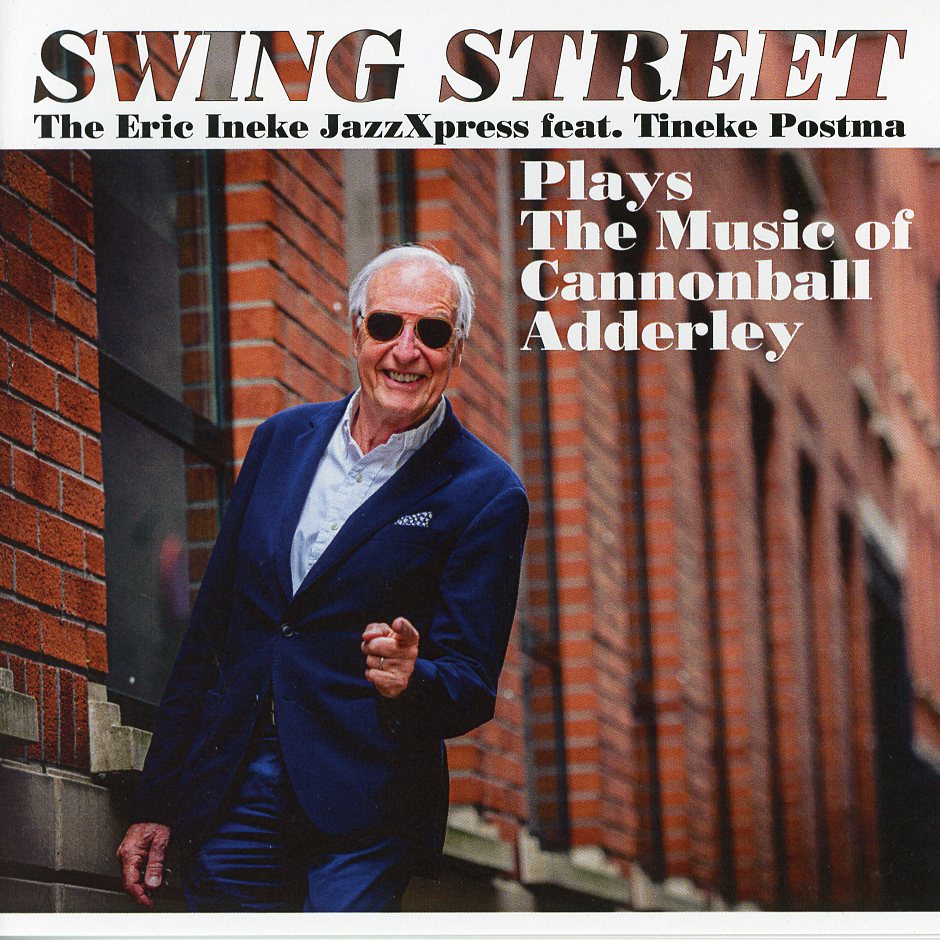
For those of you who like your Jazz served up in a straight-ahead, hard-bop style, then a musical feast celebrating this genre is on hand for you in Swing Street - The Eric Ineke JazzXpress featuring Tineke Postma [Timeless Records CDSJP 495].
For this recording, Eric’s JazzXpress, which turns 20 next year, has added the soprano and alto saxophone talents of Tineke Postma to perform a repertoire of music closely associated with the Cannonball Adderley quintet and sextet of the 1950s and 60s.
In addition to the superb soloing - Eric always leaves plenty of room on his recordings for his players to stretch out - each tune is masterfully arranged to give them a freshness and allow the band to put its own stamp on the material.
While the rhythm section of pianist Rob van Bavel, bassist Marius Beets and Eric on drums have been a part of the group from its inception along with tenor saxophonist Sjoerd Dijkhuizen, trumpeter Nico Schepers is new to the band. Tineke appeared on the group’s CD previous to this one - What Kind of Bird Is This? The Music of Charlie Parker.
This sextet’s configuration is similar to the one that the Adderley Brothers had in place which featured the “soulful brother” Yusef Lateef on tenor sax with a rhythm section of pianist Joe Zawinul, bassist Sam Jones and Louis Hayes on drums.
Regrettably this sextet was short-lived but they did leave us with three albums on Riverside Records: The Cannonball Adderley Sextet in New York Recorded Live at The Village Vanguard [RLP 404, 1962], Jazz Workshop Revisited: Cannonball Adderley Sextet [RM 444, 1963] and the Cannonball Sextet in Europe Riverside LP [RM 499, 1963]
Trombonist J.J. Johnson’s sextet with Freddie Hubbard on trumpet and Clifford Jordan on tenor sax, The Jazztet with a front line of Art Farmer [tp], Benny Golson [ts] and Curtis Fuller [tb] and drummer Art Blakey’s sextet which featured Freddie, Wayne Shorter on tenor and Curtis came into prominence for a brief period from the late 1950s to the mid 1960s. This instrumentation allowed these small groups to create a wide range of textures [sonorities] in their arrangements that produced ensembles with full, rich voicings.
Sadly, the economics of a declining Jazz audience by the mid-1960s made these groups too expensive to book and they were basically phased out, but not before leaving a wealth of terrific music in their wake.
Now, thanks to Eric, Tineke, Sjoerd, Nico, Rob and Marius, you can once again sample Jazz in a sextet configuration which includes new takes on the Cannonball Adderley Sextet Songbook as the band has reimagined each of the eleven original tracks tracks.
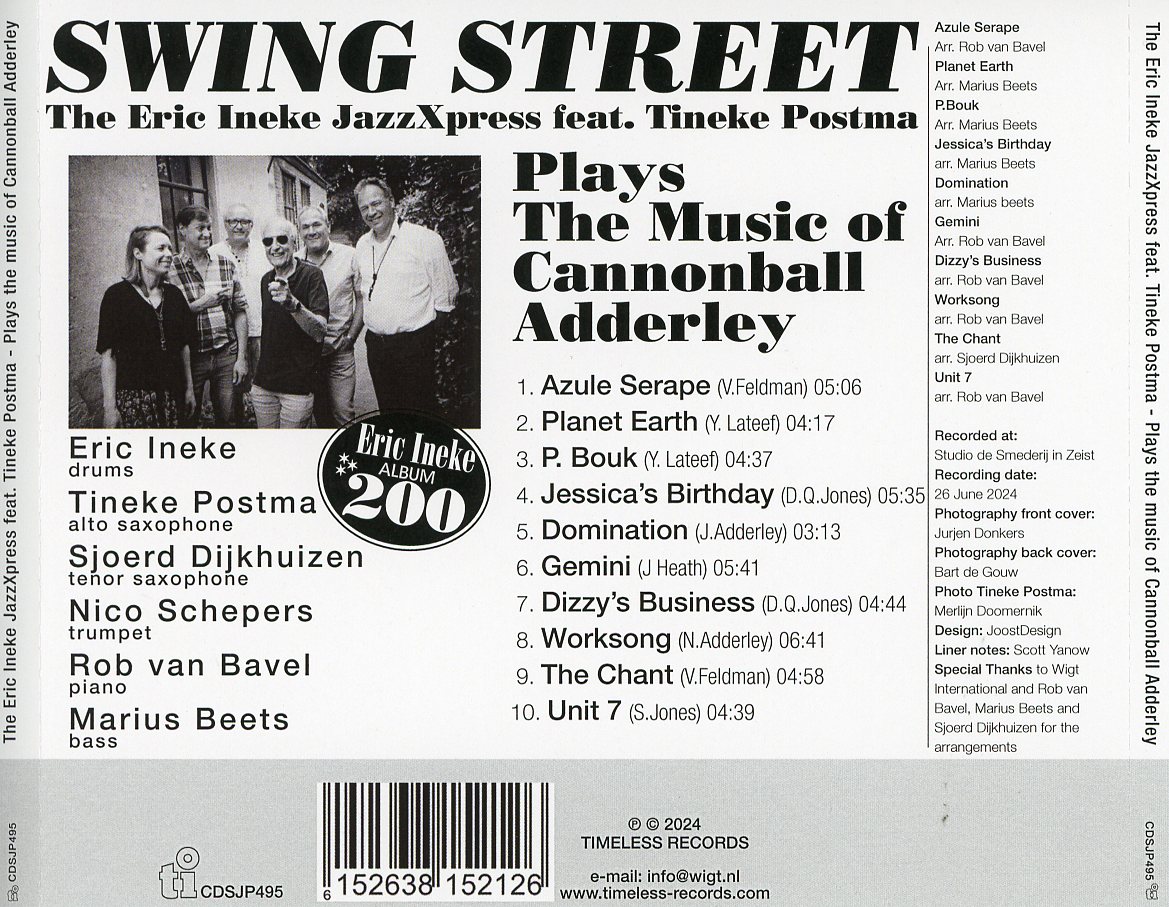
Rob van Bavel does the arranging honors on the opening track, Victor Feldman’s Azule Serape. The London-born pianist, vibraphonist and drummer was with Cannonball from 1960-1961 and contributed a number of compositions to the band’s book.
On the Cannonball’s live album at The Lighthouse Café in Hermosa Beach California [where Victor was the resident pianist in Howard Rumsey’s All-Stars from 1957-59], Adderley introduces the tune this way: “I've been trying to figure out a long time what this name means for this tune that Victor Feldman wrote for us. This one is called "Azule Serape.” Now he’s from England and I know it's not English. It's something else. "Azule Serape." That’s what the next tune is.”
Rob’s arrangement approaches the tune as a sort of fanfare to open the album in a stirring and energetic manner. After the intro, Eric launches into an Afro-Cuban beat over which the band plays a staccato montuno which evolves into a series of Latin riffs. Rob then commences the melody on piano performing it in its original locked-hand fashion, the band comes in and swings the bridge and the whole thing gets the recording off in a rousing manner. Solos by Sjoerd, Nico, and Rob set the stage for four bar trades with Eric before the band segues the tune into a big finish.
Bassist Marius Beets does the arranging honors on Planet Earth and P. Bouk, both written by Yusef Lateef. The former features Tineke and a fine intervallic solo by Rob showing his interpretive range [think McCoy Tyner].
The latter was released on the 1963 Cannonball Sextet in Europe Riverside LP [RM 499], although it was first recorded by Yusef on his 1961 New Jazz LP - Yusef Lateef Into Something [NJLP 8272]. P. Bouk is an intriguing title and Yusef explains its meaning this way in Nat Hentoff’s notes to the New Jazz album: “It’s kind of an idiomatic language developed in Detroit that refers to a man’s idiom or “bag.” Now I can’t say that this tune sums up what’s in my bag because there is more than one thing in my bag, or rather, there ought to be.” Nat goes on to add: “The ingredients in Yusef’s bag which are primary in this tune is his commanding sense of swing, his gutsy forcefulness and his preference for economical clarity of design.”
Over an opening strummed bass ostinato which is amplified by Rob and Eric, Marius feeds into his arrangement of P. Bouk ingredients from his own “bag” that create a soaring statement of the novel features of the tune and then go on to serve as a launching pad for solos by all of the band members. Oscillating chords establish a vamp for Eric to stretch out over before the band takes the tune out with a full measure of “gusty forcefulness” which would have no doubt pleased Mr. Hentoff.
One thing you can always count on when listening to Eric’s bands is that they always SWING - and that quality is on display in the slow burn the band gives to its interpretation of Quincy Jones’ Jessica Birthday, which is another arrangement by Marius. Jazz played at a slower tempo requires a lot of control because nothing is slurred and everything is stated; clearly enunciated notation. No clichés are on display in the solos by the band members who seem to relish the chance to play out their ideas in a slower rhythmic context. The unison phrasing is clean and articulated which serves to give the slower tempo a nice bounce throughout.
Marius Beets closes out his turn on the arranging chair with a reworking of Oliver Nelson’s arrangement of Cannonball’s original Domination.
Tineke and Marius state the theme to Domination in unison which then relies on a series of countermelodies as contained in the original to set the piece in motion. This is small group orchestration at its finest and everyone had their reading chops on to make this one happen.
Jimmy Heath’s Gemini, Ernie Wilkins’ Dizzy Business and Nat Adderley’s Work Song comprise the next three tracks; three very distinct tunes which Rob honors with three distinctive arrangements.
Gemini, Jimmy Heath’s lovely use of a loping 6/8 to waltz time rhythmic pattern, features interesting interludes that Rob has voiced in such a way so as to create a contrast to launch the soloists with Nico, Sjoerd and Rob doing the honors.
Ernie Wilkins’ claim to fame was as a big band arranger and this orientation really shows in the way the melody to Dizzy’s Business is constructed with its punchy phrasing and pulsating rhythmic kicks and licks. An uptempo bash that finds all the band members in fine form, especially Sjoerd who does “the big horn” proud with a take-prisoner solo that is reminiscent of Yusef when he was on the Adderley band. The sextet-as-big-band is on tap on this one.
Next up is Nat Adderley’s Work Song which in later years he would introduce to his audience as “the tune that paid all my bills for a long, long time!” This 16-bar minor blues was one of the most requested tunes in the Adderley’s band repertoire and Rob gives it new life with a refreshing take built around a rubato statement of the melody that makes it even more expressive and emotional.
Marius then sets the tone for the JazzXpress’s interpretation by laying down a driving bass walk over which Tineke’s alto soars before brassman Nico takes over with a vigorous and muscular solo. Sjoerd and Rob get in on the fun before the “van Bavel express” shouts the tune out.
It’s impossible not to have fun playing Nat’s Work Song and this version by the JazzXpress shows why.
Next up is The Chant, another original by Victor Feldman which became the title for the eponymous Sam Jones Riverside album [RLP 9358]. Sam was the first and longest serving bassist with Cannonball’s groups so as you would imagine Sjoerd Dijkhuizen arranged this to feature Marius Beets skillful bass work. Rob joins in after Marius’ solo and the two lock in with Eric to form the driving rhythm section that makes the JazzXpress such a splendid straight-ahead Jazz band. Sjoerd jumps in with a powerful solo until the band returns and takes the tune to a righteous close.
Unit 7 by Sam Jones was Cannon’s closing theme. It’s a 12-bar blues with a bridge which Rob infuses with countermelodies to give the tune a wonderfully crisp sonority. Tineke steps up and steps out with a marvelous solo on alto that’s gotta have Cannonball smiling. Sjoerd follows with some Texas-tenor style phrasing in his solo - what Cannonball describes as a “moan within the tone.” Another fine unison interlude acts as a shout chorus before the band joyfully ends the tune.
As a note in passing, the CD comes with fine booklet notes by the Jazz journalist and historian, Scott Yanow, which provide further insights into the musicians and the music.
Swing Street is the seventh recording in my collection by Eric’s JazzXpress and each one is a gem replete with meticulous musicianship and joyous, swinging Jazz.
As Scott says in his closing remarks: “Swing Street succeeds at paying an affectionate and very musical tribute to the great Cannonball Adderley.”
Do yourself a favor and grab a copy.
You won’t regret it.
Monday, January 6, 2025
On The Jazz Research Table
Three fine books by Preston Lauterbach plus Tad Richards' excellent book on the research table today.
Jazz has always been an amalgamation of styles and the influences described in these works were involved with the evolution of hardbop, soul jazz and some forms of show or lounge jazz that came into existence in the 1950s and 60s.


Saturday, January 4, 2025
AHMAD JAMAL - Poinciana - Live Olympia