Thursday, January 23, 2025

Ted Heath and His Music

Wednesday, January 22, 2025
J.J. Johnson's "Lament"

Tuesday, January 21, 2025
Chet Baker by Bob Rosenblum
© Introduction Copyright ® Steven Cerra, copyright protected; all rights reserved.
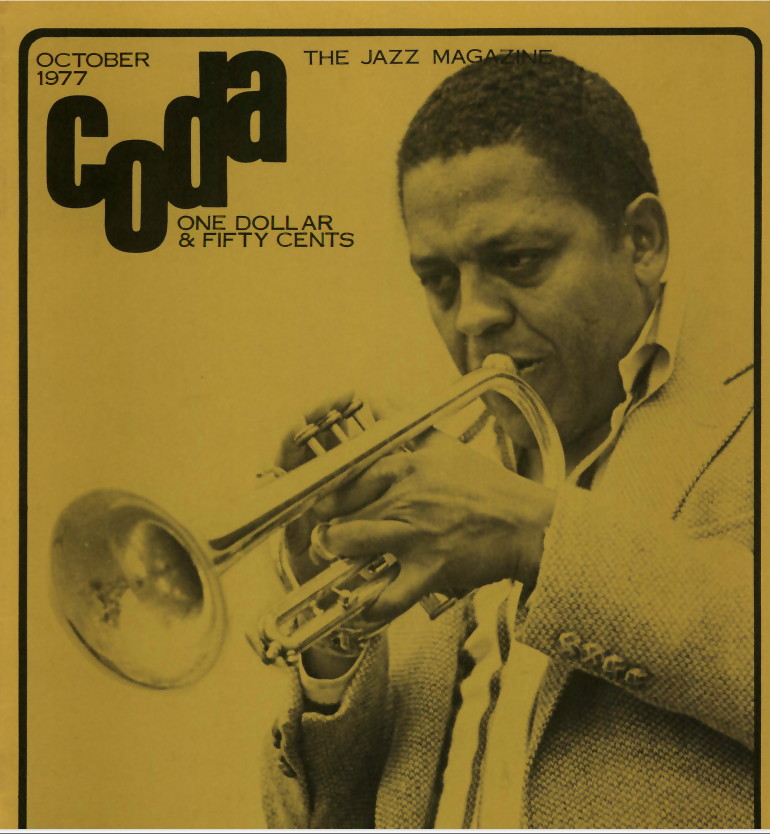
This piece on Chet Baker is in the October 7, 1977 issue of Coda - The Jazz Magazine.
Bob tells me that as of January 13, 2025 it is also available on AllAboutJazz.com under the title of “Chet Baker: A Conversation in 1977.”
The 1977 date is significant because not much was being written about Chet at that time, certainly not in the form of an interview. Bob’s piece closes with a reference to Chet’s new contract with CTI, but it would be short-lived. Soon thereafter, Chet returned to Europe where he would perform until his death on May 13, 1988 at the age of 58.
The film about his life would come, but not until 1988 when Bruce Weber wrote, directed and produced the documentary Let’s Get Lost.
Although Baker would do a 1984 interview with Jerome Reece published in Musician Magazine, the biographies would have to wait until 1989 with the publication of Jeroen de Valk, Chet Baker His Life and Music [revised and republished in 2017], 2002 for James Gavin, Deep in a Dream: The Long Night of Chet Baker, and 2012 for Matthew Ruddick, Funny Valentine: The Story of Chet Baker.
© Copyright ® Bob Rosenblum, copyright protected, all rights reserved, used with permission.
“Back in the early 1950's, a young trumpet player whose personal appearance and demeanor was more that of an alley-way hood than of a suit and tie jazz musician, burst on the scene with a sound so gentle and lyrical that he nearly pulled the rug out from under many of the harder bebop trumpet players, and along with Miles Davis, set a style and standard for trumpet playing that was to permeate most of the decade, and create a fiery controversy whose smoke remains around us to this day. His name is Chet Baker.
Today more than 20 years later, after paying more dues than most of us would like to think about, Baker's face is drawn and tired, his eyes quietly resigned. He still has that boyish mischievous grin, he still plays gracefully and unpredictably, and the crowds still come out to catch the 47 year-old trumpet player's sermons.
Chet Baker was born in Yale, Oklahoma, on December 23, 1929 in "a little farming town with a few oil wells around". He moved to Oklahoma City when he was a year old, where he remained until he was 10. Then his father left for California to tie down a job with Lockheed while little Chet stayed with his Aunt. In a year Baker moved to California - a move that was to play an important part in both his development as a musician, and the direction jazz was to take in the coming years.
"I didn't start playing until I was 13. My father was a Jack Teagarden fan. He was a musician, but he gave up playing during the depression, shortly after I was born, because you couldn't make money playing music. People didn't have money to go out and listen to music, and didn't do much dancing in those days - or eating". One day his father brought home a trombone, and Chet tried to play it without much success. “It was too big, and I could hardly reach the bottom position. " Soon the trombone disappeared and a trumpet was in its place. In Junior High School, Chet began an instrument training class, but he had a lot of difficulty because, “I would rely too much on my ear, instead of the notes.” "That's why he plays so damn good, " one prominent musician told me recently.
Eventually he found a place for himself in the high school band and played all the marches and other standard repertoire. His extracurricular time was consumed by playing in a dance band.
Chet joined the army at the age of 16, and was sent to Germany. Although originally assigned a clerk's position, he quickly managed to be transferred into the band. “I stayed there for a year - and it was the first time I got to listen to any jazz. They had V-discs coming over the armed forces network. Stan Kenton, Dizzy Gillespie - so I guess those were my earliest influences. Especially Dizzy. Before that I heard more of Harry James than anyone else - such tunes as
You Made Me Love You.
After being discharged at 18 he devoted more time to listening to other prominent trumpet players - Red Rodney, Miles, Fats and those on the L.A. scene at the time - the Condoli brothers, Kenny Bright.
Although he played at a lot of sessions during this time, he felt he accomplished more while he was in the army so he re-enlisted directly into the 6th army band. “I played in the band all day, went to sleep in the evening, got up about 1 a.m., and went to this after-hours club called Jimbos in San Francisco. It didn't open until 2:30 a.m. So I'd go there and play until about 6. Then I'd race back for Reveille, play in the band, and go back to sleep." That routine continued for about a year, until they transferred Chet to Fort Huachuca, Arizona. “I stayed there for a couple of months before I decided it just wasn't happening. " The idea of being 70 miles out in the desert, roasting in the unbearable heat did not especially appeal to a young budding trumpet talent who thrived on urban life and the music it produced. He went AWOL, stayed away 32 days and turned himself in back in San Francisco, spent three weeks in the neuro psychiatric clinic and got a general discharge - unadaptable to army life.
After a year he got a regular gig in the Dixieland band of Freddie "Snickelfritz" Fisher. But it was only a few weeks later that he received a telegram informing him that there was an audition for trumpet players being held in L.A. by Charlie Parker. "When I got to this club, every trumpet player in L.A. was there. I got up and played two tunes and he stopped the audition and he hired me right on the spot. I was 22 at the time. "
Baker worked with Bird at the Tympani Club, Billy Berg's and did a few Canadian concerts before the great altoist returned east. "Bird was certainly a very strong influence on me. I had heard a lot of his records. He was a very nice man. He protected me any way he could. He didn't have a car, and I used to drive him around to places. He drank a lot of Hennessey cognac and did some other things too, but he didn't try to give me anything or even let anyone else give me anything in terms of drugs. He always looked out for the guys in the band too. When we worked for Billy Berg at the Five Four Ballroom, and if there were a lot of people and business was really good, he would talk Berg out of an extra $25 apiece for each of the sidemen. He was really a talker, man. Another thing that Bird was really good at was laying out the tunes - calling out the right tune at the right time by feeling out the audience. At the Five Four Ballroom they would dance. The first tune would be really fast, and the evening would be easy after that. It was a colored joint and I guess they are just more rhythmic than white people and they can feel the rhythms a lot better. Anyway, they loved to dance and they danced to Bird! And had a good time! And they didn't need a strong back beat, you know, oom pah, oom pah. If some people don't hear that they don't know where the beat is. After 50 years of jazz you still go to a club and see people clapping on one and three. I can't understand how people feel the rhythm in that way. They just don't know. You go into a black joint though and you won't hear people clapping on one and three. That's what I mean. "
As great as Charlie Parker was, he still was able to retain his modesty. "He didn't go into a prima donna bag while I was around. I don't think Bird was that way. I never ran into race problems with Bird at all. I think I was the only white guy in the band. I know even today blacks say jazz is the black man's music and Dixieland is the white man's jazz. But I've always tried to disprove that theory. But Bird didn't feel that way. He used to go down into Texas and he would sit in with western bands, if the time and rhythm were right. And he used to say, 'Some of those bands can swing like crazy.' And when he went back East he told Dizzy and Miles, 'You better look out, there's a little white cat out on the West Coast gonna eat you up, ' referring to me."
Another jazz giant that Chet respects and loves is Dizzy Gillespie. ''He's the one that got me the job at the Half Note last year when I came to New York. We were in Denver, and he was working there, so I went to see him. I told him I was on my way to New York and I was going to try to get myself together and play again and he said, 'Let me make a call' and we went to his hotel room and played cards and about a half hour later he got a phone call from New York, and they gave me two weeks just on his say so. He's a beautiful guy and the daddy of the modern trumpet players - I don't care what anybody says. No matter what you play, nine chances out of ten Dizzy's already played it. "
Baker didn't see Bird again until a few years later when he came to New York with his own group. At the time, Parker was leading a string orchestra in Birdland and conducting it with a Bermuda Short suit. “It was around that same time that he got a horse in the park and rode it right down 7th Avenue and through the front door of Charlie 's Tavern. There was kind of a panic there for a few minutes."
Chet's next collaboration was his most famous - the Gerry Mulligan Quartet. He heard that Mulligan was auditioning men for his new group, and Baker was quickly chosen for the trumpet spot. Despite Baker's admiration for Mulligan, he found the baritonist rather hard to get along with. "The thing that gets on people's nerves and he was quite guilty of at that time was letting people know how wonderful he was. I've known other cats like that - who are really quite good at the things they do, but are quite good at letting people know that they know. People don't like to have you cram it down their throat all the time. He wasn't called Jeru for nothing - which means sort of like Jesus. He was really messed up with drugs, too, at the time. He's mellowed out quite a bit lately. But Gerry said things that could hurt you, and he didn't have much regard for people's feelings.
He was a wise man, and a great teacher with all his disciples down on their knees and it kind of went to his head. I saw that kind of thing in him, and I saw it in others and I told myself that it was so distasteful to me that I would never get into that trip. It's really an illness. Stan Getz is that way. You can never sit and talk to Stan. We played opposite Phil Woods at the Half Note, and he's that way too. He never spoke to me the whole engagement. One night during the week he said something like 'How ya doing Chet?', and that was all. Phil Woods thinks he's something, and cats in New York don't dig it at all. Lee Morgan was the only one that could get away with that. Last night a boy came up to me - a trumpet player - and he had tears in his eyes and he told me how much I meant to him. And that's kind of nice. So I know how guys like Mulligan and Woods get the way they are, I understand the temptation But you have to keep telling yourself we are all just men and women. We're all alike. "
The combination of Mulligan and Baker worked out beautifully on a musical level. Baker's talent for playing melodically, and Mulligan's sense of harmony, which is important for baritone players, gave the group a good feeling even though it didn't have a piano player. They were able to interweave the qualities of the two very different instruments almost effortlessly and completely spontaneously. The group got a job at the Haig in Los Angeles and in about a month people were lined up to get in.
"It was kind of a shock, because at that time the music I had been into hadn't received that kind of support. But here was a little group that was unheard of, and we made an album that did pretty well and we worked that club for eleven months. It only held 85 people, which is probably why we had people lined up."
Unfortunately things came to a fast halt when Mulligan was arrested on a drug charge, and had to spend 90 days in jail. During his confinement both Mulligan and Baker won the Down Beat Jazz Poll. So when Mulligan was back on the street, Chet and he began talking about starting the group up again. "All I wanted was $300 a week and he started laughing like I was asking for something outrageous. Up to this point all I was making was $120 a week, six nights a week. So that was the end of the group. Our original band never went on tour. $300 a week was nothing! And that's what really pissed me off. I worked for him for 11 months without asking for a raise, but after we both won the polls, I figured Jesus, it's time to get a little more bread. He was really kind of shitty about that."
In looking back, Chet Baker feels that West Coast music was "more subtle emotionally than East Coast. East Coast jazz is more straight down the middle, fiery, more soulful in a black sense. West Coast was the white man's answer. Most West Coast musicians were white so they're gonna play differently. Chet doesn't agree with many critics that East Coast music is really more emotional than West Coast, "unless you can get emotional about volume, or how many choruses somebody can play without getting tired, or how fast you can play or how many 8th notes you can string together without having to pause for breath."
In 1956 he went to Europe to meet a Parisian girlfriend. He ended up staying there for a year, tried a short comeback in the United States and returned to Europe in 1959 where he remained for almost five years. The European way of life appealed to Baker. The tempo was slower, the people more friendly. “I was shown a great deal of respect and was very well treated wherever I went. Particularly in Italy where I fell in love with the people and the country and I wanted to live there for a while."
When Baker returned once again in 1964 he recorded several albums for Richard Carpenter, his manager at the time, with George Coleman. “I never got any money for any one of those albums - not even a statement. When I found that out I took my two boys and my wife, got a car and drove from New York to Los Angeles. I had to get away from Carpenter any way I could. He didn't pay the union, he didn't pay the car rentals, he didn't pay shit. Then he took the tapes I recorded and sold them to Prestige without my knowledge or consent. I didn't know he had made a deal until the albums were on the street. "
Chet was, according to a Down Beat jazz poll, the favorite trumpet player in the country. But he does not put much stock in polls. “I feel right now I can play twice as good as I could play when I won the Down Beat poll. And right now I'm 22nd or something in the poll. I'm twice as good now as I was then, so the whole thing is kind of dumb. Yeah, I played some nice things on that first Gerry Mulligan album. It was a different style - soft, melodic. I think people were wanting and needing something like that and it just happened at that time I came along with it and it caught on. But at the time, I don't think I was one half the trumpet player that Dizzy was, or Kenny Dorham. Clifford was around then, Jesus Christ! So it just didn't make sense to me that I should have won the poll. It was kind of a temporary fad kind of thing that was bound to work itself out. "
Chet has been through the dramatic experience of being right on top and suddenly falling completely out of the public's attention. He blames a lot of that on the fact that he spent so much time in Europe, 'Laying around, working three days a week and enjoying life, " and because of his lengthy involvement with drugs, and the bad publicity that came from many of his arrests. '1n 1970 I decided that playing the trumpet and singing were the only two things I could really do. If I couldn't find a way to make a living doing these things , then I was going to have to give them up. I did give up playing for almost two years from '70 to '72. I got on the methadone program, after spending time in California at my mother's house doing nothing but getting high. I realize now it is going to be a life of travelling and accepting what work I can and trying to prove I am a reliable person and can still play and entertain people. That's what I've been doing in New York for a year."
It was the constant pressure of going on the road that got him into drugs in the first place. “It's a complete withdrawal from society. You tolerate people in the hotel, but you are separate and apart from them. Being under the pressure of going into a club and realizing you are there for one reason and that is to make money, and there are pressures of meeting with newspaper people and critics.
In order to cope with all that crap you go to drugs. I regret having wasted so many years behind drugs - so much money. Of course, if it hadn't been for the drug thing I still would be on top with Miles and Dizzy. But I think there's some good to be gotten from everything, and paying all those dues has given me a lot of insight into a lot of things I wouldn't have known. However, I'm sure ignorance is bliss, so don't get strung out. "
Things are starting to look up for Chet. He has been working frequently at various clubs in New York City. He has signed with CTI Records, and has recorded an album under his own leadership, two others with Gerry Mulligan, and a fourth with guitarist Jim Hall. He is playing better than ever. His many harsh years in the world have weathered his boyish features, and laced his playing with soul. His playing is still quiet and introverted, but there is a sharp tang in his attack, and a distant cry in his ballad playing that brings chills to your very soul.
There has even been some talk about someone writing a biography about Chet and then making it into a movie. "But it would be just my luck that they would probably dub in the trumpet parts with Ruby Braff." - Bob Rosenblum