Friday, August 20, 2021

"Dizzy Gillespie - The Lion in Winter" - The Jazz Musician Interview

 © Copyright ® Steven Cerra, copyright protected; all rights reserved.
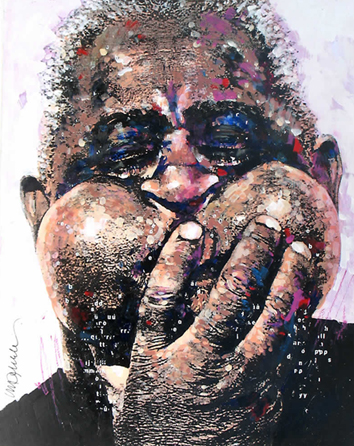


This is a rarity because by March 1992, the year it appeared in The Jazz Musician, there were very few late-in-life interviews with Dizzy that appeared in the U.S. publications, mainly because Jazz had lost the following of a national press years ago.


Thankfully, Chip Stern made this one happen because on January 3, 1993, Dizzy passed away.


I have some fond, personal recollections of Dizzy having met him on a few occasions during some of his swings to The Left Coast in the late 1950s and early 1960s.


Aside from his friendly jocularity both on and off stage, what I remember most about him was the fiery excitement his music generated on stage and the patience and grace he took as a teacher with a bunch of enthusiastic youngsters off stage. 


Although, you could tell he was exhausted after the set from Lalo Schifrin's Gillespiana he had just played with his quintet, he gathered us around him like a bunch of young lion cubs and “groomed” and steeped us in the traditions of Bebop, of which, he was one of the founders.


Here is “The Lion and Winter” interview that Chip Stern conducted with Dizzy.


“With rolling lawns, majestic driveways and obligatory collections of pricey cars, a series of splendid homes adorns Palisades Avenue, the main drag heading out towards Englewood, New Jersey, 


Here, where the reet meet the elite, resides one John Birks Gillespie: musical innovator, spiritual catalyst, twentieth-century revolutionary, still the road warrior and globe-trotting ambassador of America's classical music. 


Crossing the railroad tracks into downtown, the city appears a healthy tintype of Main Street U.S.A., its center dominated by a thirties public works-style municipal building. The scene brings to mind the considerably humbler environs of Cheraw, South Carolina, where Gillespie grew up, and the many roads since traveled that have brought him to this place.


Leaning against a street sign, I'm comforted to think that at least one of the good guys got a taste, got his due, and that, closing in on seventy-five, he's still going strong. Recent evidence includes such fine albums as Max + Dizzy: Paris 1989, an improvised encounter with the percussion master, and Live at the Royal Festival Hall, a big band/percussion date that reinforces his stature as composer and soloist. Not to mention his touring. For Dizzy Gillespie never stops working. Never. "I don't even look at my itinerary," he'd said over the phone. "Ask me where am I goin' and when I'm goin'? I don't know. The most I've been off now that I can recall was four weeks early in January [1991] when I had my cataracts operated on. Other than that, I always go. I take what I want and leave with it."


He'd just completed a week's engagement, sold out, at New York's prestigious Blue Note with his superb working band (featuring tenor discovery Ronald Holloway, who calls forth visions of Johnny Griffin and Sonny Rollins, and seasoned campaigners Ignacio Berroa, John Lee and Ed Cherry). He's planning a return in January '92 for a month of special appearances, with a different grouping each week, including an all-star ensemble, Latin band and his United Nations Big Band. In between, the road beckons.


Waiting on Birks to show, my eyes alight on a yellow-painted curb across from City Hall, signifying no parking. The sign above bears a more pointed message: DIZZY’S PLACE. Now, that's respect. Suddenly someone arrives from behind and snaps at my suspenders. "I'd have come into Manhattan to pick you up, man, but my wife won't let me take her car across the bridge," he says, sounding like a kid caught with his hand in the cookie jar. A grin lights up that enormous face, suggesting Jabba the Hutt. It is the face of a man who never forgot what it felt like to be a child — perhaps not unlike his baby brother Miles. Yet where that reflective Mr. Davis seemed to ruminate on the hurts, the exuberant Mr. Gillespie reminisces on the joy. For a few seconds all I can do is stare — this is a boyhood hero — and soon find myself doing a Ralph Kramden routine, a-hum-na-hum-na-hum-na, tongue-tied in his presence.


"You know, Diz, this'll sound funny, but I'm a little intimidated by you, man."

"Hahaha, get outta here," Dizzy chortles, with a good-natured slap on the back for punctuation. "I'm no old what do you call 'em, those guys that sit out in the deserts ... old masters. I'm still a learner, just like you."


His car — his wife Lorraine's car — is a Mercedes 250 CES, a classic set of wheels. "I bought this new back in 1966, the same time we bought our house. Before that we lived in Corona, Queens, for years, a block away from Louis Armstrong." He reaches to the floor and picks up what appears to be a carved walking stick, embellished in a vaguely Mediterranean design. "Open it up," he suggests, and it turns out to be a kind of scabbard, revealing a short, nasty-looking blade.


"The equalizer, huh, Diz?"


"Yeaaaaahhh," he drawls. "Sometimes you'll be driving around here, and people are crazy, man, they'll just cut you off and think nothin' of it. One day these guys cut me off and I beep as they go by. When we come to the light, he starts to get out of his car, so I showed him this, you believe it, and that was that."


"Sort of like when Cab Calloway called you out in front of the band," I respond, referring to an incident in the 1930s where the heigh-de-ho man confronted a young Gillespie for allegedly throwing spitballs during his performance. And got his ass cut in the bargain. Gillespie giggles at the memory. "Cut his ass. Shit, I was tryin' to kill his ass. My blade was open before it left my pocket. We're tight now, though," he adds as an afterthought. "He realizes that he was wrong; he was accusin' me of somethin' I didn't do."


Diz turns off Palisades Avenue, proceeding through some wooded areas and along a meandering series of comfortable-looking streets and homes. "See this?" He beams, pointing to a street sign. "Here's Hollywood, and here's Vine. Somebody asks where you live, you tell 'em Hollywood and Vine."


All right, say something. "Sure is nice here. Do you ever get to enjoy this? 


Are you afraid that if you come off of the road you'll lose your lip or something?"


"No, I'm not afraid. I play every day anyway. Always playin' out and gettin' paid for it, at least two hundred days a year. That's why I haven't written anything in a long time. One time I was worried about my jaws, because when I do this" — Dizzy presses forefinger to embouchure, expanding those famous cheeks to roughly the size of a bowling ball — "there's a strain, and I thought my cheeks might give out. But when I do that — push it in, go on, put your strongest finger here and try and push in." His cheek resists my finger with the tensile strength of a bear's belly. "So, I don't think they're goin' to give out for a long time, as hard as they get."


"Did you always play the horn like that?"


"No, no. I started doing it about thirty years later. Not having had a teacher was the trouble; you try anything. Lorraine say, 'Hmmm, looks like your cheeks are coming out.' Before I knew it they were out like this.


"You know, the trumpet demands your time. Practice: That does it. You need to know exactly where you put your mouthpiece — got to be the same place all the time. That's what I work on. It always kicks your ass. You get a little better, but not too much.


"I have a regimen to warm up, yes. Whole tones. Starting at low G, you go up to C, and you come back down to G. Sometimes you do scales in thirds or fourths going up and coming down, sometimes fast, sometimes real slow. The idea is to get the sound of the notes properly. See, I asked a classical musician once, a very famous cat. I said, 'Do you practice?' He said, 'Every day.' I said, 'What if you didn't?' He said, 'Well, after one day you will notice you should have practiced; two days, your compatriots will notice; three days, the whole world will notice.' I don't practice exactly the way I did when I was coming up, but pretty close."


"So you've learned to pace yourself on the horn," I propose, "sort of like Sugar Ray or Muhammad Ali when they got older and didn't have those young legs to carry them. Rope-a-dope, right?"


Dizzy laughs. "You don't look at an instrument as a physical thing of fighting somebody. It's about finesse with this"  — he points to his brain. "You got to work out your ideas. Then there's no telling how long you can play, with the proper feelings.


"Sometimes you surprise yourself, let me tell you," he enthuses, gripping the steering wheel a little tighter. "This past spring I played on that boat ride around Manhattan with my band, like I'd never played before! I'd gone to the dentist and had this tooth worked on; it was loose, and he tightened it up. On that boat ride, everything I thought I wanted to play came out." He shakes his head, amazed. "I haven't played like that, boy... I never remember playing like that."


He pulls into the driveway of a long, capacious ranch-style house and eases into the garage, pointing out a white mark on the wall that lets him know when he's in danger of totalling the front end. Along the wall are trap cases bearing his name, packed and waiting — whatcha doing home, man? Entering the kitchen from the garage, I can hear Lorraine's voice in the distance, dishing the dirt about the Clarence Thomas hearings with a friend on the phone. Their living room is laid out to emphasize its spaciousness — the kind of simple understatement only money can buy—and no one needs to say that it is set aside for special occasions. I pull a dozen roses out of my bag for Diz to give Lorraine, as he motions down to the basement.


If the rest of the house is Lorraine's domain, the expansive basement — with its wood panels, small bar, pool table, upright piano, television, synthesizer, drum machine, eight-track recorder and ancient stereo — is clearly Diz's crib, part rehearsal space, part rec room. In one corner is a 28-inch Wuhan Chinese cymbal, a real beast, and a set of golden-chrome Remo drums, compliments of Louie Bellson. There's a JVC compact stereo — still in its box— that someone has sent to Diz, he can't recall who. "People are always sending me stuff," he says simply, and offers his guest a drink.


"I was born October twenty-first, 1917. I always thought I was a musician. Thought I was a musician before I really was a musician. At first I had a trombone—I had no trombone, but I had the school's horn, you see. That was the only thing left. I played on it the best I could. I was little. I was only eleven-and-a-half, and my arms weren't long enough to make that stretch, so I could only reach a few of them positions. Didn't have a trumpet. Boy next door, Brother Hampton, he let me practice on his trumpet. So, by the time I put the trombone down, I could play a little bit in B flat.


"What happened next, a guy named Sonny Matthews came back home. Sonny was an experienced musician who took lessons from his mother and he played some piano, too. Well, he knew who I was, because everybody knows one another in Cheraw. And then his grandmother was Miss Bates. We went to the same church, and every Sunday morning I'd be there waitin' to help Miss Bates out with her cane. I was very close to that family.


"So this big guy came and got me: 'Hey, Sonny Matthews wants to see you.' 'Ahhh, yeah,' 1Isaid, 'okay.' I'm a little cocky — and here I know only one key. Sonny sat at the piano and said, 'Well, whatta ya wanna play?' I said, 'What d'you know?' He called 'Nagasaki' — but I only know the B flat key, and he calls it in C. Man, I couldn't find one note. He said, 'Something must be wrong.' I was cryin' an' everything, and I thought, 'How'm I ever gonna pick myself up and be a musician?'


"So I learned how to read. My father had a whole band in the house, almost. He had a piano, a bass violin—only had one string, but then we only played in B flat anyway. I taught myself all the chords and voicings and inversions on that piano, by myself. No teachers. We didn't have no books. All the schools were segregated. I learned how to read and started playin' at home. 


Later, I taught all the piano players how to play the comp — the accompaniment — in our music. But I never tried to really play the piano, I wanted to play the trumpet. I'd heard Roy Eldridge on the radio—on somebody else's radio. I was playing a little bit by that time, and I didn't know Louis Armstrong. Roy Eldridge, he was my man — I tried to copy his whole thing.


"The trombone player where I went to school in Cheraw, Bill MacNeil, reminded me of J. C. Higginbotham, real rough, you know, growling cat. He got caught peekin' in the white homes around there." There's a short pause, and Dizzy's voice trails off, grows distant. "They killed him. Bill MacNeil ... Bill MacNeil ... he must have been about eighteen years old then or something, you know."


It's a poignant moment. Gillespie's music has always been a freedom song, pointing to an imagined future of incredible beauty, transcending the ignorance of cracker conventions, even as it signaled black people to get out of the way, too, something new is coming through. Transforming the bluesiness and locomotion of swing-era dances into a deep, dignified modern concert music, it's full of joys and dangers. In Dizzy's hands it's been less a stage for protest than for affirmation. But if he's too proud to wear the scars of Dixie on his sleeve, the memories linger, whispering of how far we've come, how far we have to go.


"I was back in Cheraw for a Dizzy Gillespie Day, and the mayor invited me to a cocktail party in his house," he recalls. "So I thought I'd get a haircut. I went into a barber shop in town, and the guy told me, 'We don't cut colored hair.' Ain't that a bitch? And I'm definitely the most well-known person ever to come out of Cheraw. I told the mayor that, and he was shocked: 'He can't do that.' Mmmmm.


"Racism? I grew up with it. I remember it stopped me from playin' with a little boy named John Burrell; he was my little pal then, and his mother and father said, 'Now, look, you can't play with that boy no more.' Then there was a white boy, Kenny McManus. His family had two swimmin' pools: a white one and a black one. It's where I used to swim and dive when I was little, might have been ten, eleven. I used to dive for money, off a high buildin' up there, coulda broke my neck. But I was a daredevil. I've been a daredevil all my life, really. They'd say I was 'bad,' you know, but they called me by my name. I'd always get into trouble, fightin' every day in school.


"Damn, when I think how close I came to being hitched up behind a plow, man. I finally got out of Cheraw when my mother moved to Philadelphia my last year in school, and soon as summertime came, I hitched a ride up. And I stayed till I moved to New York in '37. The first week there, got a job for eight dollars a week. Yeah, big money. I don't know how many clothes I bought off that, all Parisian tailored stuff, on time. I'd pay a dollar-and-a-half a week."


That era also provided Gillespie with the best possible training grounds for a young player — the big bands. Within those juggernauts he learned the craft of his horn, how to play lead and in a section, and was tested every night by his fellow trumpet players in countless styles. A few years later Teddy Hill, in whose band Diz first traveled to Paris, began booking a Harlem club called Minton's, which became the crucible for a fiery new musical language known as bebop. Dizzy, of course, was present at the creation.


"Oh, that was some time, boy. We'd go in there and then we'd go to the Uptown House after that, and you'd come out in the daylight. That band was Nick Fenton on bass, Kenny Clarke on drums, Monk was on piano, Joe Guy on trumpet and Kermit Scott on sax. Charlie Christian used to come all the time. He left his amplifier down there when he died. Old guys didn't come down too much, except Roy, he could make it. Me, Charlie Shavers and 'Bama — Carl Wooley — all three of us would jump on Roy, gang up on him," he laughs at the memory. "Of course, Roy'd come through the door hitting high C after high C from the first note, an' he was ready to take on all comers. He was the most competitive man you ever met, ooooh weeee!


"Monk was the most individual player who came through. Monk with the minor-sixth with the sixth in the bass: He taught us that chord. We used to change stuff to keep guys who couldn't play off the bandstand. In the daytime I'd call Monk and say, 'Hey, listen to this.' I learned 'How High the Moon' from Nat Cole, who was playin' at Kelly's Stables. 'What's the name of that number, Nat? Play that for me again. Damn, them keys are movin'.' And I hurried to Minton's, showed that to Monk. We would make numbers up, but with standards, we'd change them around, put in new melodies and have a new tune. Like 'Groovin' High' came out of 'Whispering.'


"Somewhere in there I met Charlie Parker. He was with Jay McShann, I was with Cab. This was what, 1939, '40? Buddy Anderson took me to see him. We played at the Booker Washington Hotel. When I first heard Charlie Parker play, his style was basically there. He played tunes inside of tunes. And the chords were the correct ones, too. Man, he was cute, all right.


"Now you see, my training was a little more sophisticated than Charlie Parker's, harmonically. I showed him a lotta things on the piano. But Charlie Parker had the style of gettin' those notes outl And the way that he got from one note to another, the way that he set 'em up—nobody'd ever done nothin' like that before.


"We were all tryin' to play like Charlie Parker. That's why you can't tell who's who on some of them early records, like that Metronome All-Star date with me'n Miles and Fats Navarro. Even I can't tell who's playing what. All the trumpet players of that time tried to play like him. But Charlie Parker was indescribable.... 'You took advantage of my friend, you cur,'" he chuckles, recalling an incident where Bird confronted a redneck who'd gone upside Dizzy's head with a bottle. "Mmm, mmm ... a spiritual man."


Though Diz and Bird were the priest and prophet of bebop, they went separate ways off the bandstand, and their differing lifestyles pulled them apart at times. "Because Charlie Parker used dope — they said — all the young musicians who wanted to follow Charlie Parker went that way: like Miles, Sonny Rollins, Sonny Stitt, J. J. Johnson, Fats Navarro. They all felt that would help them — hah hah hah. I mean, we were brothers. But he was the one who was interested in that. He never offered me none. And I never saw him do it."


Diz wanders off upstairs to check in with Lorraine, the anchor who helps him stay focused, who kept his other life together while Gillespie led his great big bands of the Forties and Fifties and expanded on the Afro-Cuban and Latin innovations he introduced to modern jazz through his association with Mario Bauza and Chano Pozo. When he returns downstairs with a big case, I've started to unpack and set up his new stereo. The technology fascinates him, particularly the compact discs.


"How many of those you get in that little drawer, there?"


"One at a time seems to work best, Diz." He unpacks his case to appraise a new gold-plated trumpet from Martin, engraved with his name and otherwise busy with ornate detail. The Dizzy bell points up at a 45-degree angle. 

"Don't play no regular horn anymore," he explains. "The sound is prettier to my ear when it's less direct."


He takes out the mouthpiece and begins warming his lip with bends and shakes and long tones that sound like soulful duck calls. Now and then he pauses to pick up and admire the new horn, check out the action; then he returns to the mouthpiece. Finally he puts them together and runs through pedal tones and scales with the mute, finishing with several of his melodies on the open horn.

"Yeaaaah," he says, fingering the valves, "when she gets broken in, a few weeks down the road, this is going to be a nice horn."


"Sounds like she blows real easy, Diz."


He fixes me with a stagey stare. "Sheeeeeet. Ain't none of them blow easy," he laughs, and starts in again with more purpose. At times he stops and yawns, then jumps back in; got to stay on that horn. Maybe I'm beginning to wear too, with this "tell me all about 1941" line, and here we are in 1991. I pack up so that he can get on and rest.


It's dark as he backs out of the driveway. "Maybe next time I'll get to say hello to Lorraine," I suggest.


"Sure, man," Diz nods. "She really appreciated them flowers. What people don't understand about Lorraine, her being so strong and all, is that she's really very shy. I've always felt comfortable around people, but sometimes I'm too trusting. But Lorraine, man, no one can put anything over on her."


"Does she follow the Baha'i faith also?"


"Noooo," he says gravely. "She's a devoted Roman Catholic. She thinks Baha'i is some kind of weird religion out the jungle. I just say to her, 'Now you take care of yours and I will take care of mine— "—and I'll meet you at the finish line?"


"Yeah. She believes all of this about Jesus, how he brought somebody up from the dead, and he died and went to heaven and come back. I don't see no sense in making all that happen to make you live a full life. I don't exactly believe in heaven and hell. But I believe that there is a Being somewhere that can create miracles over here and in the outer realms. I'm a believer. I believe in God.


"I was raised Methodist, but I never followed any one religion. I read some of the Koran, like I read the Bible and other books. The Baha'i religion came out of Islam — all religions are similar, but these two are closer together. It originates with this very religious Muslim in Persia during the last part of the past century. He started preaching that now is the time for a new message from God. Well, you know how the Muslims felt about that, because they think God's not going to talk to mankind no more after the Koran. They think that's the last message we're going to get. But I don't know why God would stop now. If God was that intelligent, how could he give you everything he'd want you to know in that little time?"


How indeed? But then, among God's more sublime miracles, John Birks Gillespie must rank up there with sunsets and tax refunds. For Dizzy is all about music and spirit.


Simple as that, and if Charlie Parker came down with the word, Dizzy made it into flesh, gave it substance and, for fifty years on, has been performing and teaching it to succeeding generations of jazz musicians. His innovations remain the cornerstone of almost everything we play.


Dimly through these reflections, it occurs to me that we've been circling these streets for several minutes. "Yeah," Diz confirms absentmindedly, "I don't do much driving at night. Can't hardly read them street signs."


He tries another route but ends up in the same place. Diz makes a U-turn and doubles back around, cruising past an enormous California-style house, enclosed by high stucco walls.


"You know who's supposed to have bought that house and be movin' in? The Boss."


"Bruce ... ?"


"Yeaaahhhh. You think that's something, Eddie Murphy's got him like a seven-million dollar estate up around here that's something else. Oooooo weeee!"


Dizzy stops to inspect a street sign and regain his bearings. He clucks his tongue and shakes his head as he makes another attempt to reach Palisades Avenue. At the next corner there's a middle-aged couple out on the street, unpacking their car from a shopping trip. Diz rolls down his window. "Excuse me," he says, beckoning, and there's a giddy glint of recognition in their eyes.

"Answer me this. How can you be driving around only a block from where you live and be so totally lost?"


They double over with laughter. They're still laughing as we drive off.”


— March 1992


Thursday, August 19, 2021

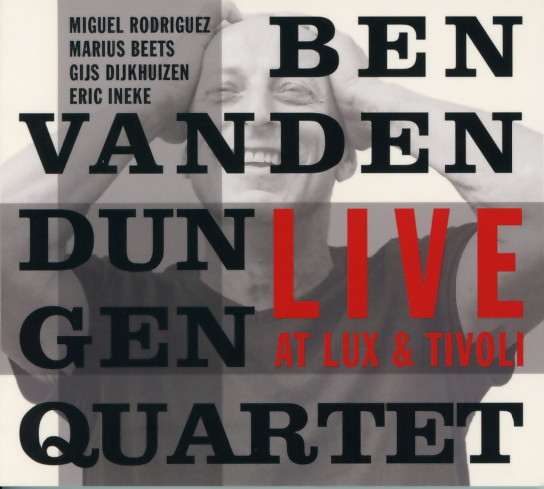
Ben van den Dungen: Live At Lux & Tivoli

 © Copyright ® Steven Cerra, copyright protected; all rights reserved.


“With great pleasure and pride we present the new album of the Ben van den Dungen Quartet ”Live At Lux & Tivoli.” The album was recorded during two (livestream) concerts at the Lux Theater in Nijmegen and Tivoli Vredenburg in Utrecht. These concerts were part of the ”Tribute To John Coltrane” tour, with which the Ben van den Dungen Quartet has already played more than 50 concerts at various festivals and venues throughout the country.


The repertoire of the CD consists of songs inspired by classical works of the legendary jazz saxophonist John Coltrane. Familiar works that you might already know plus the twist of the Ben van den Dungen Quartet.

- The Jazz and Worldmusic Agency


“The first records that blew me away when I was trying to learn to play the saxophone were the Miles Davis Quintet's recordings of the two albums Cookin' and Relaxin'. The saxophone player in that band was John Coltrane. Those recordings - and Coltrane's playing on it - were a big influence on my initial development and the rest of my musical life. There were of course many other players that inspired me as well. In fact, all prominent figures in jazz history did. However, those recordings of Miles were, for me, the start of it all. John Coltrane has always continually inspired me, especially his sound and never-ending devotion to the music.


This is the fourth album of my quartet. It is not meant as a tribute per se, but rather it captures a moment in time where I found myself wanting to dive deeper into the music and heritage of John Coltrane. This album consists of two live performances of my band at LUX in Nijmegen and Tivoli in Utrecht, located in the Netherlands. It captures the essence of jazz: music being created in the moment.

Thank you to SENA PERFORMERS for making this recording possible.”

- Ben van den Dungen


For many years, being able to play on the compositions of the late John Coltrane was akin to a litmus test marking the arrival, in the sense of having made it, to an elite level as a improvising Jazz tenor saxophonist. This ascension [my apologies to those more familiar with the Coltrane canon] has to do with the degree of difficulty that must be mastered in order to play Coltrane changes as advanced harmonic substitutions used in jazz improvisation.


Put more technically, Coltrane changes (Coltrane Matrix or cycle, also known as chromatic third relations and multi-tonic changes) are a harmonic progression variation using substitute chords over common jazz chord progressions. 


In his seminal book on the subject of The Jazz Standards: A Guide to the Repertoire [2012], Ted Gioia explains how these “Coltrane changes” are at work in his examination of two of John’s more famous compositions: Giant Steps and Moment’s Notice.


Giant Steps


Composed by John Coltrane


"Giant Steps," first recorded by John Coltrane for his 1959 Atlantic album of the same name, quickly became famous in jazz circles —but more as an obstacle course than a favored jam session tune. The song "Cherokee" had played a similar role for the boppers of the early 1940s, weeding out the wannabes not ready for the demands of modern jazz. Think of "Giant Steps" as "Cherokee" on steroids.


“True, "Giant Steps'' was not as revolutionary as some of the more avant-garde offerings of the day. Coltrane's song stayed in 4/4 time, followed a i6-bar form, and did not veer outside the conventional boundaries of tonality. The chord progression borrowed many elements used previously by jazz players — listen to Richard Rodgers's bridge to the 1937 standard "Have You Met Miss Jones?" for an important predecessor. Yet at Coltrane's brisk tempo and with a few of his own ingenious harmonic twists added to the mix, this musical steeplechase presented a stiff challenge to an unprepared soloist, circa 1959.


Ah, Coltrane was quite prepared (...). The saxophone titan, for his part, had developed some handy improvisational patterns to employ on the song, most notably a repeated phrase that draws on the opening four notes of the pentatonic scale. Coltrane relies on this motif repeatedly in his solo, and close study of his improvisation reveals a certain rote quality to it.”


Moment's Notice


Composed by John Coltrane


“Did John Coltrane think that casual listeners would notice that all 12 notes of our well-tempered scale show up as roots during the first 16 bars? Probably not. But he did know that the saxophonists who followed in his wake — no small crew, that — would be painfully aware of how quickly the chords were flashing by, and how unusual the harmonic landscape was in comparison with other songs of the day.


No, it's not as taxing as "Giant Steps," the obstacle course that Coltrane would launch on the world two years later, but "Moment's Notice" is still luxuriating in the harmonic maximalism that characterized this stage in the tenorist's evolution. Almost any melodic phrase or scale you rely on for soloing over bar one is unlikely to work for bar two — and this unsettling discontinuity continues for most of the song. Shortly before the final turnaround, Coltrane lets the improviser relax for a brief spell with only one chord change per bar blocking the road ahead. But this is merely time for a deep breath before the form returns to the top, and the battle begins all over again.


So it's a good workout, the musical equivalent of a full circuit around the Nautilus gym.”


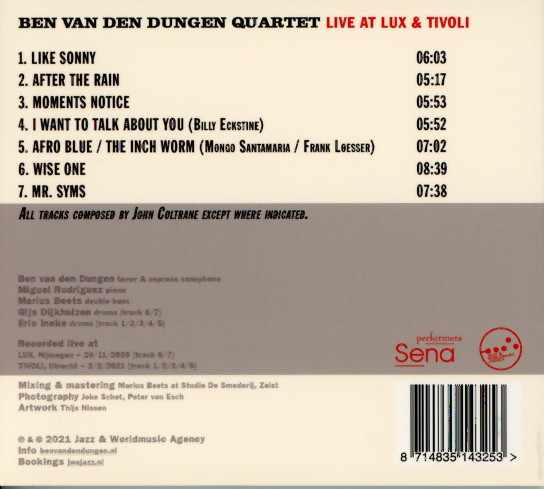
Which brings me to tenor saxophonist Ben van den Dungen’s new CD Ben van den Dungen Quartet ”Live At Lux & Tivoli” on which Moment’s Notice features as the third track.


[Ben does not play Giant Steps on any of his recent quartet CD’s but he did perform it in 1988 as a member of Nueva Manteca on their Varadero Blues album and I have included a YouTube link to it at the conclusion of this piece.]


This a a prepared album in that Ben, along with pianist, Miguel Rodriquez, bassist Marius Beets, and drummer Eric Ineke [with Gijs Dijkhuizen, Ben’s regular drummer, in on tracks 6 & 7] have taken the time to create arrangements for each of the tunes and songs. In other words, it’s not a blowing session; a great deal of thought, planning and preparation has gone into the making of this recording and its shows in the consistently high level of creativity the music attains.


The other welcomed dimension is that it’s music is performed before an audience which always seems to give Jazz a special magic as the energy that the audience brings is transferred to the musicians which results in the quality of the music being kicked up a notch.


Although, five of the seven tracks are devoted to compositions by John Coltrane, it’s a varied program with ballads After the Rain, and I Thought About You, medium tempo cookers Wise One and Mr. Syms interspersed between up tempo burners such as Like Sonny, Moment’s Notice, and Afro Blue [which cleverly has Frank Loesser’s The Inch Worm added as a tag].


Throughout, the listener can revel in Ben’s big, bold and bountiful sound for in his hands, the tenor is appropriately named The Big Horn. While Coltrane chromatics, harmonics and chord substitutions are everywhere apparent in his playing, Ben never gets away from a powerful and primary swing in his soloing. He drives the music forward with a pulsating sense of urgency.


And while, for obvious reasons, ‘Trane is always a presence in Ben’s approach, you also hear a lot of Sonny Rollins, Dexter Gordon, and some occasional Johnny Griffin flights of fancy in some of the fast runs he incorporates into his playing. Ben is the real deal; he comes to play.


Throughout he is aided and abetted by a driving rhythm section of Miguel Rodriguez, Marius Beets and Grand Jazz Master Eric Ineke whose classic straight-ahead drumming is featured on two choruses of Moment’s Notice. 


Miguel, Marius and Gijs Dijkhuizen have been with Ben on Ciao City [2013], A Night at the Club [2014] and 2 Sessions [2017] and have evolved into a very cohesive rhythm section, as well as, individually defined voices on their respective instruments.


In terms of the Dutch Jazz scene, Rodriquez is the relative newcomer in the mix, but he plays with a maturity well beyond his years, both as an effective accompanist and as a soloist whose inventions bubble over with seemingly endless ideas. As usual, Marius is his usual immoveable self: keeping time, framing the chords and contributing masterful solos on Wise One and Mr. Syms. And one wouldn’t have to look too far to find the next “Eric Ineke” in Dutch Jazz circles as drummer Gijs Dijkhuizen will ably fill that role.


Ben’s albums are always satisfying as the music on them quickly brings the listener into an atmosphere filled with the essence of swinging and sonorous Jazz. He envelops you in his music; it’s like he gives you the musical equivalent of a big bear hug. 


Van den Dungen Jazz is exciting, adventurous and burning with intensity.


If, as Louis Armstrong says, “Jazz is who you are'' - then the music on Ben van den Dungen Quartet ”Live At Lux & Tivoli” will leave you in no doubt as to who Ben van den Dungen is - one, monster Jazz tenor saxophonist!


You can sample this music on the Jazz and Worldmusic Agency website and locate order information by going here.


Wednesday, August 18, 2021

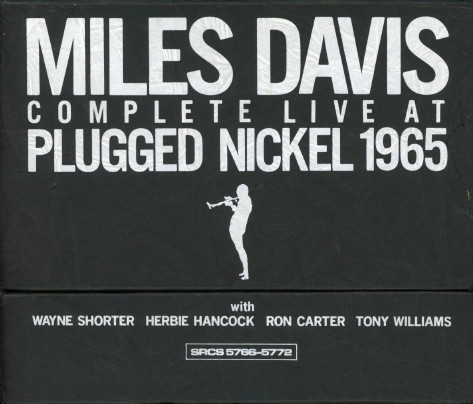
The Miles Davis Quintet at the Plugged Nickel

 © Copyright ® Steven Cerra, copyright protected; all rights reserved


The album My Funny Valentine was released in May of 1965 to great acclaim. E.S.P was issued in November of 1965, when Miles began touring. again after a six-month recuperation from his first of many hip operations. The album did not get the hurrahs expected of a new Miles Davis Quintet studio recording. The momentum that the group had built up from 1964 had to start over.


The group was taped at the Plugged Nickel in December of 1965, but the 

tapes remained unissued for 11 years. Of the new material, only "Agitation" had made it into his book, but he was still playing "Stella By Starlight" and "My Funny Valentine" as well as other standards and blues associated with his earlier bands.


Still, E.S.P. summed up the form and rhythm experiments that the Quintet was developing from live performances into a compositional structure. Stop-and-go ("R.J.," "Agitation"), pedal points ("Little One," "Mood"), creating a "harmonic" direction from "suggestions" and implications ("E.S.P."), rhythmic suspension ("R.J.," "Eighty-One") and form modulation ("Iris"). The melodies themselves became more independent of the harmony, and thus strengthened the idea of improvising phrases (as Ornette Coleman) and not cliches.


Behind the success of My Funny Valentine, Columbia released the rest of the February 14,1964 Lincoln Center concert as Four & More in March of 1966 (barely 4 months after E.S.P.!). Prestige repackaged old sessions (For Lovers and Classics) and then went further by releasing a greatest hits compilation in December of 1966, making a total of six Miles Davis releases in 17 months.


No wonder E.S.P. confused the public. The music is light years ahead of anything previously released. The public was bombarded with Miles' accessible side, the romantic lover. The success of My Funny Valentine further imbedded that stereotype into the minds of the jazz public. Eventually. Miles would completely separate the studio recording process from the live performance process, but it took two incredible sessions to launch him on his way.”

— BOB BELDEN, insert note excerpts from E.S.P.


For those of you who read the earlier blog posting on Miles’ E.S.P. Columbia LP, you may remember the above introduction to the piece. What struck me at the time was how much the Jazz world was shocked by the sound of Miles’ music on this recording.


I often wondered if the Plugged Nickel “live” sessions recorded a month later than E.S.P. in December of 1964 had been released in conjunction with E.S.P. instead of My Funny Valentine and other more “romantic” sounding Miles music if the continuity of the group would have been better understood and appreciated.


Given that the Plugged Nickel sessions were not released until the mid-1970s, the opportunity to gauge Miles’ transition to a looser, freer style of Jazz in the company of a group of young players each of whom were to go on to become Jazz legends was kept from the Jazz public


Put another way -


Listeners who formed their impressions through recordings (especially in the U.S., where the Berlin concert was not issued until 1983) had a totally different sense of the new quintet than those who were fortunate enough to hear the band in person. [Emphasis mine.] 

- Bob Blumenthal, Jazz author and critic


Mosaic Records released The Complete Plugged Nickel Sessions MQ10-158 on vinyl in 1995 with the CD versions going to Sony Japan and Columbia for distribution.


We wrote to Michael Cuscuna at Mosaic and to Grammy-Award winning Jazz author Bob Blumenthal and asked their permission to reproduce a portion of the booklet notes for the set so as to give you more background on the context of the Plugged Nickel set and they kindly consented. Bob also added this comment: "The only thing I would add is to note that George Russell and Miles Davis did a lot of woodshedding together in the late ‘40s, when Russell was pulling his Lydian Chromatic Concept together. So although the two never created any documented music together, Russell should be acknowledged with having some impact on Davis’ embrace of modes./Bob"


© Copyright ® Mosaic Records and Bob Blumenthal, copyright protected; all rights reserved; used with permission.


“Being a leader of a jazz group is not something that can be learned in the way one learns how to play a musical instrument, or even how to conduct a symphony orchestra. There are no lessons available for perfecting the combination of insight, foresight, intuition, direction, flexibility, charisma and luck that turns a jazz musician into a leader; and even close observation will not guarantee that a master's techniques can be replicated. The cliche that leaders are born and not made may just be true - otherwise there would be dozens of Count Basies, Duke Ellingtons, Art Blakeys, Betty Carters and Miles Davises out there leading bands.


Even in this rarefied company, the achievements of Ellington and Davis are in a class by themselves. These men, clearly the greatest leaders in jazz history, simply had a sixth sense for picking talent and molding it into a unit of singular personality and quality. Even with Ellington's half-century of continuous work and larger ensemble, it is difficult to say that he was superior, for the very size of a big band allows a leader some slack. That third trombonist or fourth trumpeter may not need to be so exceptional to keep the group personality intact. On the smaller scale of the Miles Davis groups, every chair was exposed and every choice counted.


Miles Davis was born to lead, and he showed it for nearly a decade before he could put a permanent band on the road.  The famous 1949-50 nonet, filled with so many great playing and writing talents, was clearly his band.  ("Miles...took the initiative and put the theories to work," Gerry Mulligan has testified.) The studio bands he assembled for Prestige and Blue Note in the early '50s always featured the strongest personalities and the freshest compositions. When he finally got around to forming a working group in 1955, the assembled quintet of John Coltrane, Red Garland, Paul Chambers and Philly Joe Jones made immediate history; and his second legendary quintet - the one with Wayne Shorter, Herbie Hancock, Ron Carter and Tony Williams heard on the present recordings - had an equally powerful impact on the jazz world.


While ensembles as seminal as these classic Davis units are so perfectly staffed that they may seem to spring to life full-blown, this is rarely the case. They more often evolve out of the leader's maturing interests and ambitions, and take shape over time. For this reason, it may be more accurate to think of Davis's first quintet as a metamorphosing unit that often grew to sextet size and existed until the beginning of 1963, at which point quintet two began its life. The element of luck played a role in both instances, since even a presence as magnetic as Davis's could not always obtain the services of each specific player he sought. Coltrane joined the first quintet at Philly Joe Jones's suggestion, when Sonny Rollins, Davis's first choice for the tenor chair, was unavailable. What if Rollins had taken the gig? How would musical history differ if Shorter had accepted Davis's original invitation to replace Coltrane in 1960, thereby joining a band with Wynton Kelly, Chambers and Jimmy Cobb in the rhythm section, rather than staying with Art Blakey and waiting until 1964 to come aboard? We do know how Davis responded to the band members at hand, what priorities he established in his first quintet that carried over to the later group, and what notions were modified through further development.


To begin with, the 1955 quintet set standards for contrast and balance that became Davis trademarks. Many listeners initially felt the group was a total mismatch, with Coltrane verbosely inept and out of tune, Jones overbearing and Garland a dispensable cocktail stylist. Yet the diverse personalities of Davis, Coltrane and Garland only added to the overall drama and content of each performance, and were further enhanced by the rhythm section's ability to tailor its dynamic and textural approach to the needs of each soloist. This fit of support to soloist was retained in later editions of the first band, and informs every performance in the present collection as well.


Davis also quickly assembled a diverse and highly influential repertoire that would best expose his group's strengths. The material he selected fell into three distinct categories: blues and original jazz lines, romantic ballads, and other popular songs that could be given more swinging treatments.  Many of the items in this last category could be launched "in two," with the bass stating a tempo half as fast as the melodic lead (which provided yet another contrast when the group shifted to 4/4), and could be modified with short cyclical chord patterns, known as "tags," [sometimes also referred to as tails, outros or turnarounds] to provide an alternative to the basic chorus structures. Davis drew much of this repertoire and many of these ideas from pianist Ahmad Jamal, whom he frequently acknowledged as his primary inspiration at the time, although his increased harmonic daring in this period can also be traced to his renewed friendship with arranger Gil Evans.


Another idea shared with Gil Evans was Davis's growing fascination with scales or modes as an escape from the recurring chord sequences of popular songs. This de-emphasis on harmony allowed greater melodic freedom, which held obvious interest for someone with Davis's lyrical gifts and unorthodox technical approach to his instrument. He had used chordal suspensions in his music as early as the 1950 nonet recording Deception, and based his 1954 composition Swing Spring on a scale; it could be argued that the tag endings, though clearly chordal, also had the effect of leveling the harmonic terrain through their brevity and frequent repetition. After Davis reunited with Evans for the 1957 album Miles Ahead, he became more immersed in the modal alternative, as evidenced by his soundtrack for the French film Ascenseur pour l'échafaud and the title track of his 1958 album Milestones. In 1959, while Coltrane and Cannonball Adderley were both still in the band and with Bill Evans (Davis's pianist for part of 1958) briefly back on board, he recorded an entire album based on the sketchiest of modal material. Kind of Blue was such an eloquent recital, so simple yet complex, that it immediately popularized the use of modes and pointed the way toward Davis's further development.


Unfortunately, circumstances temporarily delayed his progress. Coltrane and Bill Evans, the two musicians with the deepest insight into how to explore scales, left to organize bands that each added distinctive rhythmic and textural advances to the modal concept. The revised Davis band, with Wynton Kelly on piano, Jimmy Cobb on drums and a succession of saxophonists (including Jimmy Heath, Sonny Stitt and Hank Mobley), was more comfortable with material that swung hard in the accepted sense, and never incorporated the more impressionistic material from Kind of Blue into its repertoire.  Davis's studio focus on orchestral projects with Gil Evans through much of the late '50s also meant that less new material was being worked into the band's book. The trumpeter's own playing grew more chromatic and abstract, as live recordings made at the Blackhawk nightclub in San Francisco and New York's Carnegie Hall in the spring of 1961 documented; and a few new tunes became fixtures in live performances. Yet the familiarity of what Davis chose to play, and the hard bop style of his sidemen (however expert they might be), created a general impression that the trumpeter was standing still at the very time that Coltrane, Ornette Coleman and Cecil Taylor were proposing radical alternatives.


It was not until early 1963, when he effectively disbanded the original quintet by letting Kelly and Chambers go, that Davis began to assemble the present band. The first to arrive was bassist Ron Carter, who at age 25 had earned a Bachelor's degree from the Eastman School and a Master's degree from the Manhattan School of Music. Carter, who performed professionally on cello as well as bass, had symphonic experience as well as tours with Chico Hamilton's quintet (where he first encountered Eric Dolphy) and Bobby Timmons's trio. He was already in great demand for studio recording, and had issued his first album (featuring his bass and cello) on Prestige/New Jazz. Davis brought Carter to California in March 1963 for an extended engagement at the Blackhawk. The band at that time was a sextet with a heavy contingent of Memphis musicians (saxophonists Frank Strozier and George Coleman, pianist Harold Mabern); and it went through a few changes while in California, with Victor Feldman also heard on piano and Frank Butler taking over the drums after Cobb left to rejoin Kelly and Chambers in a trio venture. Carter stayed in place, recording with Davis in Los Angeles in April. When the trumpeter returned to New York in May, Carter and Coleman were still in the band.


The rest of the rhythm section came together by the May 14 recording session that produced Seven Steps to Heaven. The drummer, who at the time was still known as Anthony Williams, was as precocious as any talent in jazz history. The son of a tenor saxophonist, Williams began studying with Alan Dawson in Boston during junior high school, and was working with Sam Rivers while barely into his teens. Jackie McLean had played with the young drummer in Boston the previous December, right around the time Williams turned 17. He was so impressed with the youngster's authority and audacious conception that he immediately invited Williams to New York. Williams made the move and quickly became a regular on Blue Note sessions.   Davis first heard the drummer with McLean's exciting new quintet. After getting a favorable second opinion from Philly Joe Jones, Davis offered the youngster a job.


Herbie Hancock, at age 23, was more of a known quantity, having arrived in New York more than two years earlier with Donald Byrd after completing his college studies at Grinnell. Byrd introduced the pianist into the Blue Note Records orbit, and Hancock's contacts and reputation grew rapidly. He first recorded with future associate Wayne Shorter by the end of 1961 (on Byrd's Free Form album) and already had two studio encounters with Williams (on Hancock's own My Point of View in March '63 and Kenny Dorham's Una Mas the following month). The pianist's most notable achievement, however, was his May 1962 debut as a leader, Takin' Off, which contained the funky composition Watermelon Man that [conquero] Mongo Santamaria quickly covered and turned into a hit. The success of that tune could not disguise that this pianist was more than just another soul stylist. He combined a beautiful keyboard touch with daring ideas that surfaced in both his solos and writing. Byrd had described Hancock as a cross among Bill Evans, Ahmad Jamal and Hank Jones, which is the kind of synthesis Davis could appreciate; but it was Hancock's originality and range that ultimately made him the logical choice.


For the next year, with Coleman in the saxophone chair, the new quintet developed. Its evolution can be charted by two significant concerts - the July '63 Juan-les-Pins performance that produced the album Miles Davis in Europe and the February 1964 voter registration benefit at Lincoln Center that yielded My Funny Valentine and Four and More. The daring up-tempo improvisations on the European recording, and the slow, abstracted ballad readings on My Funny Valentine were major steps forward. Harmony, even on the standards, was giving way to a chromaticism that liberated the soloists in a manner akin to the modality of Kind of Blue, while the rambunctious support of the rhythm section introduced new levels of rhythmic drama.


The transition was not complete, however. Often the rhythm section would save its most adventurous notions until after Davis soloed, a sign of both respect for their leader (who, at age 37, must have seemed quite venerable) and uncertainty as to how far he would follow. Davis kept verbal communication with his young band to a minimum, yet quickly made it known that he planned to be a full participant in the ensemble explorations.


Repertoire was a somewhat knottier problem.  Davis was still playing the material he became identified with when Coltrane and Garland were in the band. To a large extent, he would continue to do so until his electric makeover in 1968, even after recording a score of excellent new originals in the studio. This decision reflected a continuing fondness for the likes of Autumn Leaves and If I Were a Bell, a conviction that they could be molded to more abstract ends, and a realization that the audience expected at least this much familiarity in a Davis performance.  


Still, new music was needed to fit the band's new ideas.


The need was met when Wayne Shorter, who Coltrane had suggested as his replacement over four years earlier, finally joined the quintet in the late summer of 1964. By this point, Shorter was 31 years old and had been a featured soloist and composer with Art Blakey's Jazz Messengers for five years. His tenor playing had been heralded for its power and originality, combining in an unmistakably personal synthesis elements of both Coltrane (the keening tone and complex arpeggiated phrases) and Rollins (thematic development, frequent use of the lower register and broad humor); and his writing was filled with melodic and structural wrinkles. Shorter also possessed what his future Weather Report partner Josef Zawinul referred to as the "new thinking." In April of 1964, he had made the first of several albums as a leader for Blue Note, Night Dreamer, and spoke in the liner notes of "the new blues coming, the new period of enlightenment." Elsewhere in those notes, commenting on the album's theme of judgment (one piece is titled Armageddon), Shorter notes that "The word, however, is not 'beware' but rather it's 'be aware!.'" Few musicians were in such possession of what might be termed late"60s consciousness so early.

On the September '64 concert that produced the album Miles in Berlin, Shorter proved to be exactly the player Davis had been looking for. He was not as deeply into the avant-garde as Sam Rivers, who had worked briefly with Davis after George Coleman left the band (and who was present on a Tokyo concert recording from July), although Shorter pushed the envelope constantly in his solos.  What he had that his immediate predecessors lacked was a deep, unshakeable lyricism and a growing tendency to make more out of fewer notes that suggested no other player so much as Davis himself.


With Shorter aboard, the quintet's approach to rhythm and tempo exploded. Meters would frequently change and instruments would drop in and out of support, leaving the forms bent but unbroken. Hancock grew more circumspect in his comping, laying out for long stretches behind the trumpet and tenor while Williams juggled the beat with ferocious glee and Carter used his exceptional harmonic ear to redefine the limits of the walking bass. Ballads might turn into flagwavers, flag wavers into head-shaking groovers. 


The second great Miles Davis quintet was finally complete.


Even so, the band appeared to take divergent paths in the recording studio and on the job. With Shorter turning out numerous originals and each member of the rhythm section also making important contributions, Davis was able to launch a series of albums featuring innovative new compositions, the first of which, E.S.P., was taped in January 1965. In person, the repertoire remained much as it had been, although the warhorses were now pulled like taffy into unprecedented new shapes. Listeners who formed their impressions through recordings (especially in the U.S., where the Berlin concert was not issued until 1983) had a totally different sense of the new quintet than those who were fortunate enough to hear the band in person. [Emphasis mine.] 


For this reason, the two-record Live at the Plugged Nickel, recorded during a December 1965 engagement at the Chicago nightclub, caused an incredible stir upon release in Japan (in 1976) and then in the U.S. (in 1982). Here was the quintet in full flight, showing even greater daring with numbers from the old Davis book than it had with the originals on the contemporaneous E.S.P. and Miles Smiles (the latter recorded in October 1966). A third album, Cookin' at the Plugged Nickel, followed in 1987, though that release still brought less than half of the music recorded on the nights of December 22 and 23, 1965 into circulation.


What we have here is everything played on those evenings, three sets from the 22nd and four from the 23rd. The tune choices are familiar yet radically different than original studio and earlier live versions. Even successive performances of the same titles show disparate approaches, and reveal as much as any single set of recordings about this magical unit. At root, they also remind us how, through nonverbal cues and an uncompromising example, by knowing his own mind yet letting his talented charges have their head, Miles Davis once again proved to be as brilliant as any leader in jazz.”