There are four elements that combine in such a way so as to make The Drive [Goschart 031547] commendable and these are the musicians who perform on it:
Christian Torkewitz: Tenor Saxophone and Flute, Austin Walker: Drums, Leon Boykins: Bass (tracks 1,2,3,4,5,6,11), Dylan Shamat: Bass (tracks 7,8,9,10)
A fifth element makes it especially enjoyable to my ears and that is the music itself.
This is because, unlike many of the self-produced CD that manage to find their way to the editorial office of JazzProfiles which are made up of exclusively new music, that is to say, original compositions, The Drive actually emphasizes seven Jazz Standards and tunes from the Great American Songbook among the eleven tracks on the recording.
For former Jazz musicians and enduring Jazz fans like me who have a knowledge of the idiom dating back over half a century, it’s wonderful to hear new players bring the tradition forward by superimposing their improvisations over familiar melodies.
Of course, it is costlier to produce a CD in this manner because there is the question of royalties that must be paid to gain licenses to perform copyrighted music.
But like Jung’s “collective unconscious,” Jazz is an evolving extension of what went before it so how does one discern these associations if there are no references to the Jazz tradition by musicians on the current Jazz scene?
On The Drive Chris, Austin, Leon and Dylan test their mettle as improvisors by offering well-played and interesting improvisations on Jazz classics that include
Minority by Gigi Gryce and Ask Me Now by Monk and on Harry Warren’s You’re My Everything and Jimmy van Heusen’s Like Someone in Love.
And they do it without a net, so to speak, as this is a pianoless trio that relies very heavily on the bassists Boykins and Shamat to provide harmony for Chris much the same way that Gerry Mulligan’s pianoless quartet relied on bassist Bill Crow to provide the harmony for Jeru and Chet Baker.
Jim Eigo of Jazz Promo Services is handling the public relations for the group and he sent along the following media release for the new recording which provides detailed information about the musicians and the music on The Drive.
'The Sugar Hill Trio" comprised of multi-instrumentalist Chris Torkewitz, drummer Austin Walker and bassists Leon Boykins and Dylan Shamat, is a modern day innovative/avant-garde jazz combo whose wide breadth of musical repertoire extends and expands popular music from a time once forgotten. The musicians are actively continuing to work as internationally recognized freelance musicians performing around the world basing themselves out of Hartem New York City. "The Drive" has been recorded in two very spontaneous sessions at the Samurai Hotel Studios in Astoria/Queens. Many of the tracks are first takes and capture the moment.
Chris Torkewitz (tenor sax, flute, composition) Firmly rooted in the traditions of Western music and home-based in Modern Jazz, Chris Torkewitz took up studies
in Cuba at the age of 18. Re-settling to NYC in 2007 and being a part of the scene enabled him to merge his prior influences and find influences from the contemporary NYC jazz scene, Afro-Cuban rhythm culture, and European music traditions.
In 2013, he established his NYC-based jazz orchestra and the chamber project “Vista” showcasing his large ensemble compositions. Torkewitz shared the stage and recorded with many renowned world-class artists and holds a Doctor of Musical Arts degree (DMA) in performance, composition and education from the Manhattan School of Music.
Austin Walker (drums) Austin Walker is a drummer and percussionist who hails from Massachusetts. His style of drumming captivates with an uncanny ability to be explosive while supportive at the same time. Austin is now a modem drummer currently based out of New York City. In the past ten years, Austin has distinguished himself as a musician who has shared the stage with artist such as: Chris Potter, Luis Bonilla, Shai Maestro, Joe Sanders, Matt Ciohesy, Kurt Bacher, Gilad Hekselman, John Raymond, Sullivan Fortner, Tony Malaby, and Dan Tepfer.
Leon Boykins (bass) Lam Boykins has developed a reputation for tastefully blending music tradition with innovation. With several studio projects as a sideman, and countless worldwide performances under his belt. As an in-demand sideman, Leon prides himself in interpreting the artistic vision of each artist lhat he makes music with.
Dylan Shamat (bass) Dylan Shamat is a bassist, composer and educator based in New York City. Dyman was born and raised in St. Paul, Minnesota where he began his musical studies on the violin at the age of 4. He moved to New York in 2005 where he studied at the Manhattan School of Music and The Juilliard School. In 2010, Dylan was selected to participate in the Jazz Aspen Snowmass Summer Academy to learn from jazz greats Christian McBride, Dianne Reeves, Russell Malone and Terence Blanchard. He can be found performing in New York with Lea Delaria, Allan Harris, Cyrille Aimee and countless others as well as in the off-Broadway production of ‘Sleep No More.’
Artist: THE SUGAR HILL TRIO
Title: THE DRIVE
Label: Goschart Music
Release Date: JANUARY 6,2017
UPC Code: 701197395114
All Songs Composed/arranged/produced by: Chris Torkewitz & Austin Walker
Track listing w/composer credit and track time
1. Minority (Gigi Gryce/Totem Music) 6:27
2. Open Circle (Christian Torkewitz) 3:35
3. Spiral (John Coltrane / Jowcol Music) 4:12
4. Sunbeams (Christian Torkewitz) 3:08
5. The Night Has A Thousand Eyes (Jerome Brainin/Paramount Music) 5c55
6. The Drive (Oliver Nelson / Noslen Music) 3:02
7. You're My Everything (Harry Warren / Redwood Music LTD) 5:42
8. Handles (Christian Torkewitz) 5:26
9. Ask Me Now (Thelonious Monk/ Thelonious Music Corp.) 5:44
10. Like Someone in Love (Jimmy Van Heusen/ Bourne Co. Music Publishers) 3:50
11. Theme for Basie (Phineas Newborn, Jr. / Pamela Publishing Company) 4:12
The following audio only file showcases The Sugar Hill Trio’s unique style on pianist Phineas Newborn, Jr.’s classic Theme for Basie.
As a point in passing with reference to the Jazz Tradition, I’m guessing that the group’s derives its name from the “Sugar Hill” section in New York City that’s bound on the north by West 155th Street, on the south by West 145th Street, on the east by Edgecome Avenue and on the west by Amsterdam Avenue and that once was the home of Jazz luminaries such as Duke Ellington, Cab Calloway and Thelonious Monk, among many other Stars of Jazz.
It would seem then that The Sugar Hill Trio is in good company.
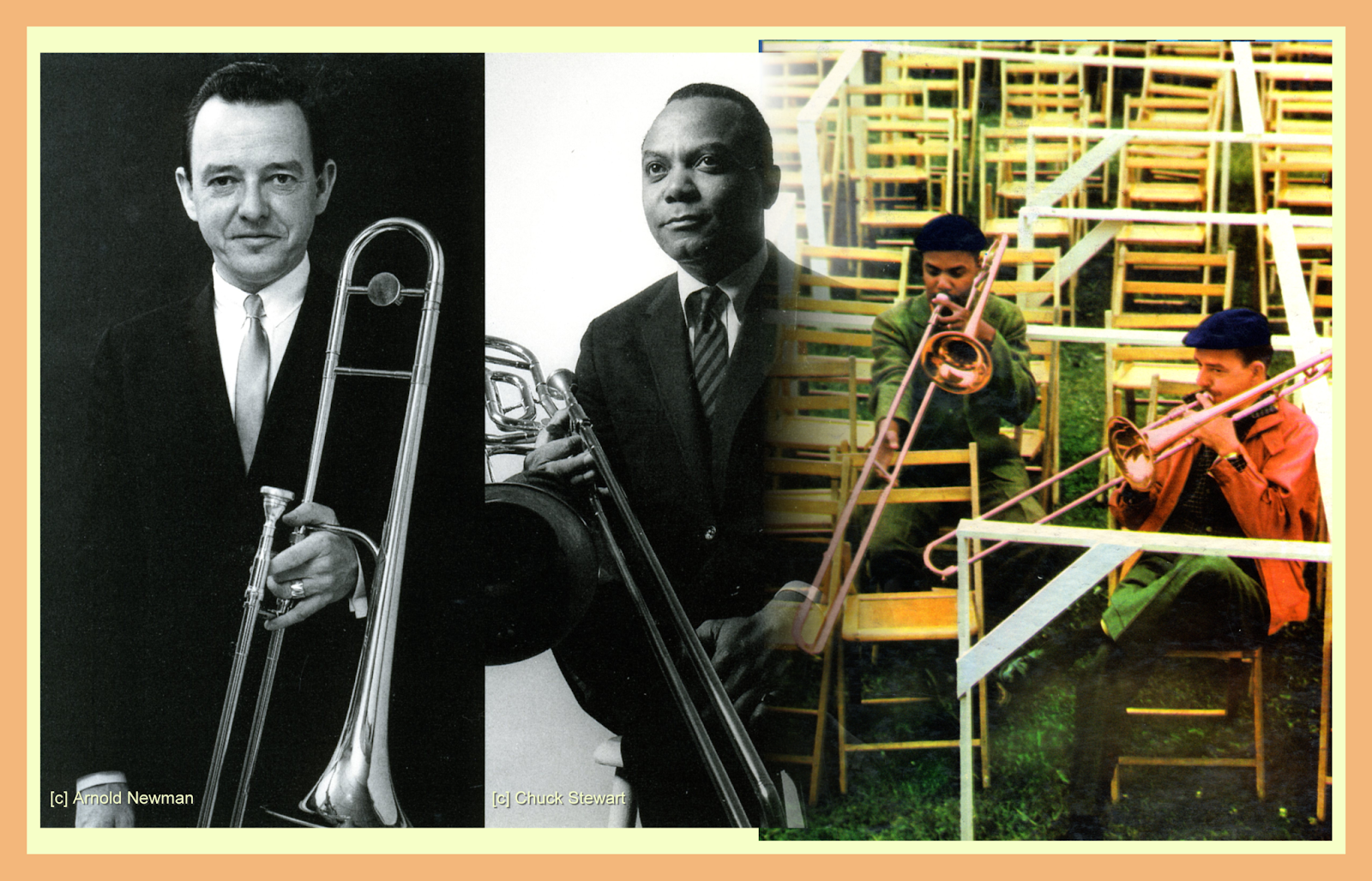
“'You can't play all night in a club with just two trombones and rhythm!’ a friend told Kai Winding when he announced that he and J. J. Johnson were going to do just that.
He was wrong, but awfully right at the same time. The answer is that you can do it, but not with ‘just two trombones.’ You have to have the best—Kai Winding and J.J. Johnson.
Their ability as trombonists is only part of the story. The entire "book" for the group has also been written by them, and it is their imagination as arrangers which has carried off this tour de force even more than their extraordinary talent as soloists.
Jay and Kai have done it the musicianly way, with no gimmicks—just solid musicianship. Working without a guitar, which would have given them variety in the coloring of the solos as well as another voice in the ensembles, makes their job that much harder. But in order to get engagements in clubs, they had to confine the group to five men, and the added challenge has only spurred them to greater creative height.
Each has had a wealth of big band and small combo experience. During the hop era, Jay was in the rare position of establishing a school of trombone playing which consisted of himself alone; no one else was remotely in his class. Kai came up through the big band field, achieving prominence as a soloist with Stan Kenton in 1946. In recent years, both men have gigged extensively with small groups, and Kai still keeps his hand in as a studio sideman between the quintet's bookings.
The arranging of the book has been divided equally between them, and each man has contributed several fine originals. Their choice of repertoire is discriminating; they seem to have a knack of choosing half-forgotten but exceptional show tunes and songs which are fine vehicles for "class" singers. (Perhaps the lyric quality of their trombone playing is responsible for this taste.) Both play with a technical ease which is the envy of lesser slide men. Although they play quite unlike each other most of the time, there are many occasions on which it is impossible for even their closest followers to tell them apart.”
- George Avakian, insert notes to CD re-issue of Trombones for Two
The idea for this piece came from revisiting the J.J. Johnson and Kai Winding Columbia recording made at the 1956 Newport Jazz Festival [the LP is shared with the Dave Brubeck Quartet]. Along with bassist Bill Crow and drummer Rudy Collins, the two trombonists’ quintet featured Dick Katz on piano. Dick was to be the pianist with Jay and Kai’s group throughout its existence from 1954-56.
Listening to this recording reminded me of what an excellent pianist Dick Katz was, he died in 2009 at the age of 86, but it also brought back thoughts about Dick Katz the record producer [he founded Milestone Records with Orrin Keepnews], Dick Katz the Jazz educator [he taught at the New School and the Manhattan School of Music], but most especially about Dick Katz, the gifted Jazz author [Bill Kirchner tapped him to write The History of Jazz Piano essay in his The Oxford Companion to Jazz].
I never got to attend any of Dick’s Jazz courses, but I always learned so much about the music from his writings.
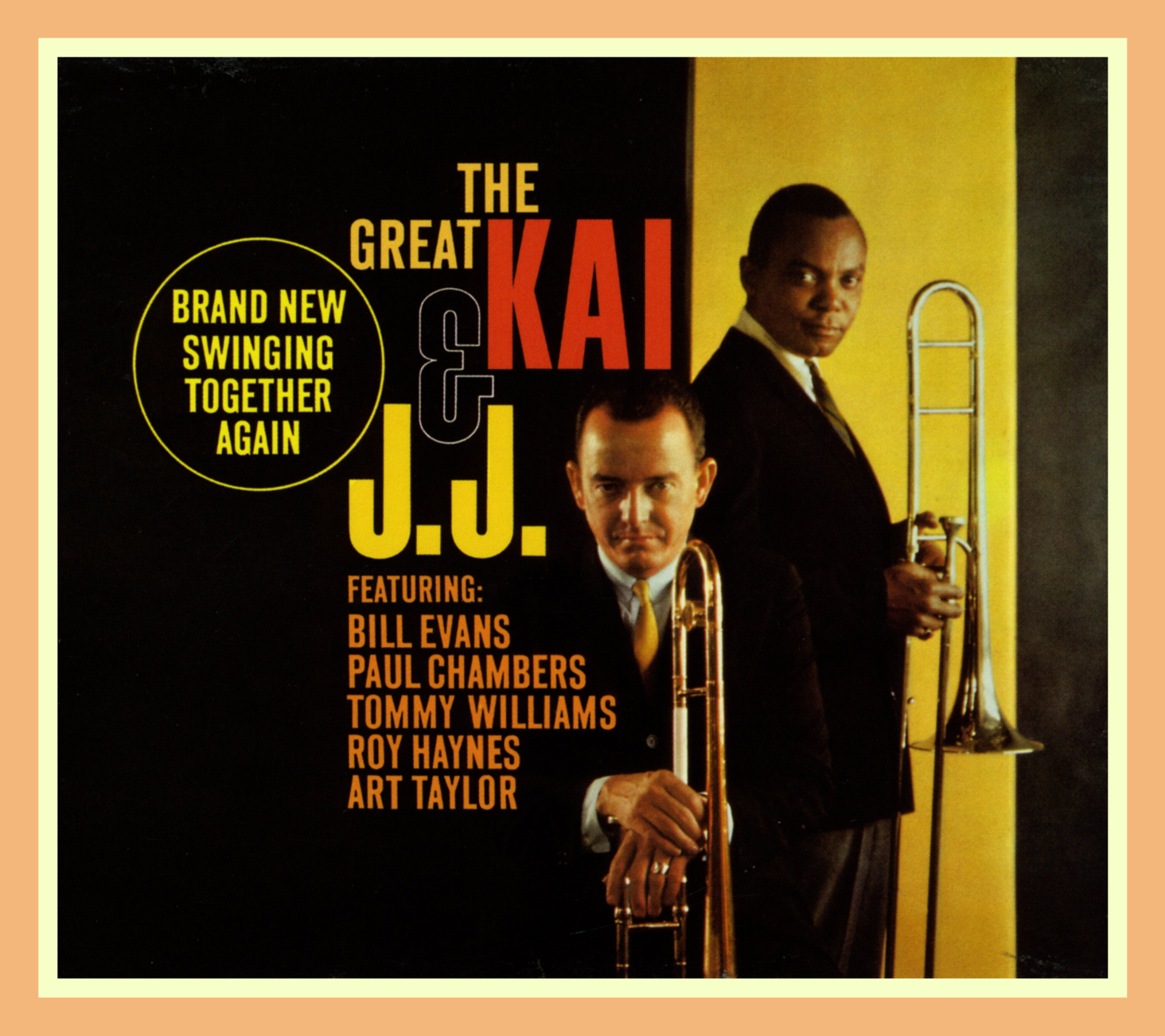
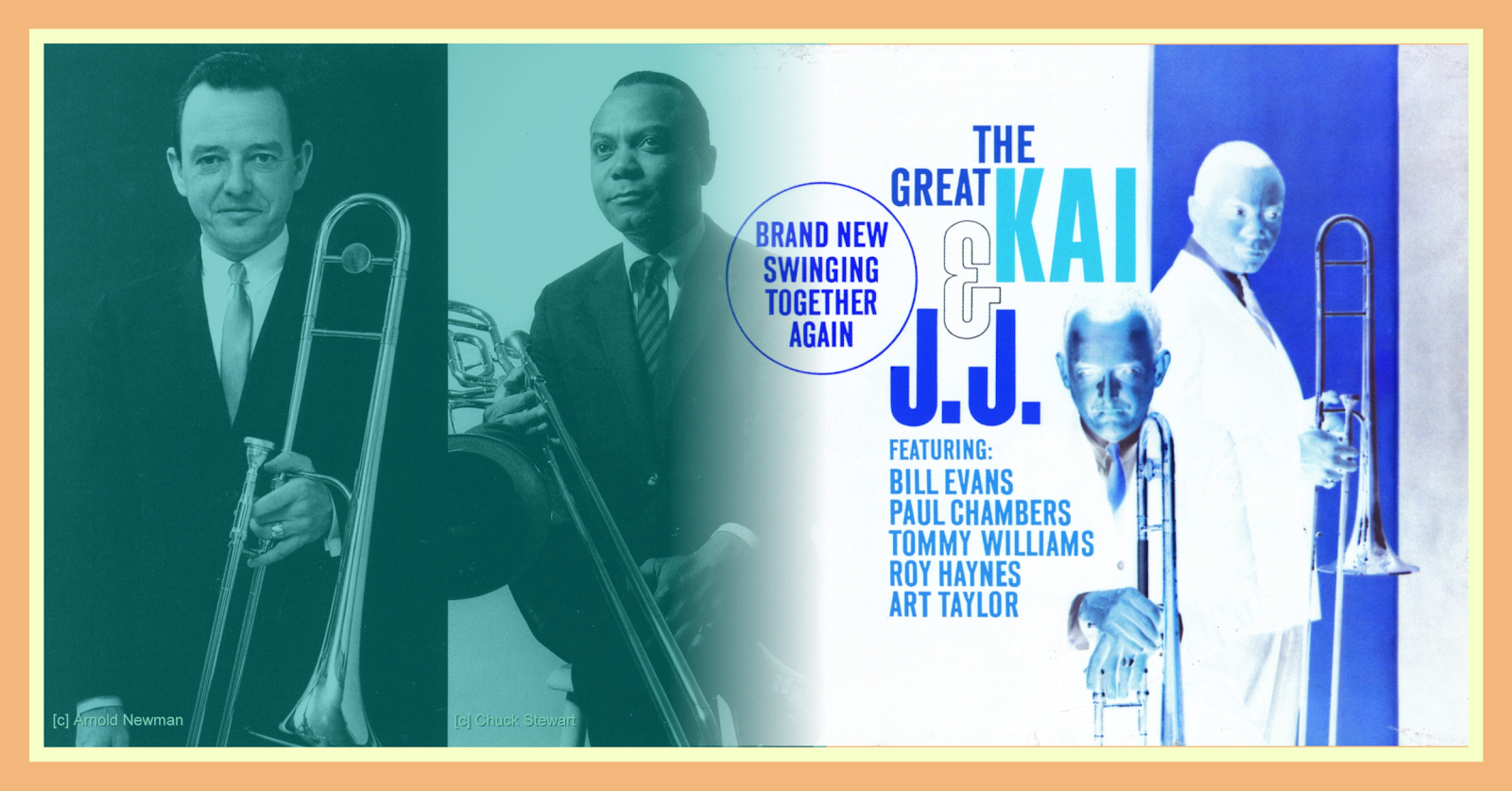
Sure enough, when I went digging around my collection of Jazz recordings, there was Dick writing his usual, clever and insightful insert notes to the 1960 reunion album by Jay and Kai’s quintet on Impulse! Records [The Great Kai & J.J.! IMPD-225].
A sample Dick’s expository skills, flowing style of writing and considerable knowledge on the subject of Jazz and its makers can be found in the following excerpts from the J.J. Johnson and Kai Winding Impulse! notes:
“‘I don't know anything about music, but I know what I like.’
This bon mot is usually attributed to the celebrated Common Man, and while the sophisticate might wince upon hearing such a bromide, an element of truth is present. The sentence often indicates that knowing how music is made does not necessarily assure one's enjoyment, or even enlightenment. The intellectual, armed with the tools of musical analysis, will not experience music any more intensely than someone not blessed with musical scholarship — if the conditions for being "moved," or emotionally stimulated, do not occur in the music. Indeed, knowing too much can actually interfere with hearing the music.
You see, music has to do with feelings, and the knowledge of what makes it tick should be a bonus that adds to or enhances the listener's understanding. It should never be a substitute for emotional involvement.
Now, the "conditions" referred to above are what concern us here. Good jazz does not come out of the air like magic. True, a genius sometimes creates this illusion, but in the main, it is the result of an artistic balance between the planned and the unplanned. Even the great improviser is very selective, and constantly edits himself.
Throughout the relatively short history of jazz, many of the great performances have been ensemble performances where the improvised solo was just a part of the whole. This tradition of group playing, as exemplified by Henderson, Basie, Ellington, Lunceford, John Kirby, Benny Goodman's small groups, the great mid western and southwestern bands, big and small (Kansas City, et. al.). almost came to a rather abrupt halt with The Revolution. And that is exactly the effect Charlie Parker, Dizzy Gillespie and their colleagues (J. J. Johnson among them) had on jazz music. Their extreme improvising virtuosity seemed to take the focus off the need to play as a group. But herein lies the irony — the precision with which they played their complex tours de force was due in large measure to the extensive ensemble experience they gleaned as members of disciplined bands like Hines, Eckstine, etc.
It was their talented, and not-so-talented, followers who often missed the point. Musically stranded without the opportunity to get the type of experience their idols had (due to many factors, economic and otherwise), they resorted to all they knew how to do — wait their turn to play their solos. This type of waiting-in-line-to-play kind of jazz has nearly dominated the scene for many years. Although it has produced an abundance of first-rate jazzmen, many excellent performances, and has advanced some aspects of jazz, the lack of organization has often strained the poor listener to the point where he doesn't "know what he likes."
So, in 1954, when J.J. Johnson and Kai Winding formed their now celebrated partnership, one of their prime considerations was to help remedy this chaotic state of affairs. Both men, in addition to being the best modern jazz trombone stylists around, were fortunate enough to have had considerable big and small band experience. They astutely realized that a return to time-tested principles was in order. Variety, contrast, dynamics, structure (integrating the improvised solos with the written parts) — these elements and others which give a musical performance completeness — were accepted by Kai and J.J. as both a challenge and an obligation to the listener.
This awareness, combined with their individual composing and arranging talents, plus an uncanny affinity for each other's playing, made their success almost a certainty. That success is now a happy fact. From their Birdland debut in 1954 to their climactic performance at the 1956 Jazz Festival at Newport, they built up an enviable following. Also, they have created an impressive collection of impeccable performances on records. That they overcame the skeptical reaction to the idea of two trombones is now a near-legend. One only need listen to any of these performances to demonstrate once again the old adage — ‘It ain't what you do, but the way that...’
The respective accomplishments of J. J. and Kai have been lauded in print many times before. Their poll victories, festival and jazz-club successes are well known. Not so obvious, however, is the beneficial effect they have had on jazz presentation. Their approach to their audience, the variety of their library (a good balance between original compositions and imaginative arrangements of jazz standards and show tunes), together with their marvelous teamwork, helped to wake up both musicians and public alike to the fruits of organized presentation. With the jazz of the future, organization will be an artistic necessity; the future of jazz will be partially dependent on it, as is every mature art form.
Hearing this album, one could easily be led to believe that J. J. and Kai have been working together all along. The precision with which they perform is usually found only in groups that have worked together for a long time. Actually, they have played together very little in the last few years, both having been occupied with their respective groups — J.J. with his quintet, and Kai with his four-trombone and rhythm combination. However, it is quite evident from these performances that both have continued to grow musically and bring an even greater finesse and seasoning to their work. This is a welcome reunion.
What can't be verbalized are the feelings expressed in the music. That's where you, the listener, are on your own.”
This piece gets its title from the “Catching Trout” essay in Dinosaurs in the Morning: 41 Pieces on Jazz by Whitney Balliett. Published in 1962 by the J.B. Lippincott Company, it along with The Sound of Surprise is one of the earliest compilations of the writings of Whitney, the long-time Jazz editor for The New Yorker magazine.
Aside from its literary elegance, another of the wonderful qualities of Whitney’s writing is that as a non-musician, it relies heavily on metaphors, allusions, and imagery.
Balliett’s style is less about analysis, theory and structure and more about similes, euphemisms, and personification.
However he chooses to express his singular point-of-view, Whitney’s way with words never detracts from the pleasure he derives from the music and its makers.
See what you think.
Catching Trout
“THERE is an unbroken Olympian lineage at the top of jazz — Jelly Roll Morton, Duke Ellington, Count Basie, Thelonious Monk, and John Lewis — which has been distinguished by the curious fact that all its members are composers, arrangers, leaders, and pianists.
Monk, however, has added an authentic dimension to the qualities he shares with his colleagues, for he is an almost unparalleled performer. Monk is not a vaudevillian in the sense that Louis Armstrong, Dizzy Gillespie, and Gene Krupa are. Instead, he offers the rare spectacle of a man pleasantly and unselfconsciously obsessed by his art. He is, in fact, a transparent, pliable vessel that takes on the shapes, colors, and movements that his emotions, washing against each other within, may dictate on a particular night.
A bearish, densely assembled man, with a square head and an oblique face that emits a veiled but unmistakable light, Monk never merely sits at a keyboard. He will hunch his shoulders, elbows akimbo, and knead the keys, bend backward, bring his elbows in, shoot out his forearms, and pluck notes from either end of the keyboard, as if he were catching trout with his bare hands. Then, a giant hammer, he will hit several closely grouped chords, simultaneously jerking his torso. If he is accompanying he may abruptly "lay out" and unconcernedly mop his head, neck, and hands with a flag-size handkerchief, or he may wind his body sinuously from side to side in half time to the beat and, his arms horizontally crooked, slowly snap his fingers — a dancer gracefully illustrating a step in delayed motion. Monk's feet carry on a steady counterpoint. Flattish and nimble, they alternately rustle about beneath the piano, flap convulsively, and dig heel first into the floor. All of this is by way of saying that Monk's five selves were in notable balance early last week, at the most recent of the "Jazz Profiles" concerts.
The affair, held at the Circle in the Square, was given over entirely to Monk's present quartet, which includes Charlie Rouse, Ron Carter, and Art Taylor.
There were eleven numbers, all by Monk, including "Straight No Chaser," "Crepuscule with Nellie/' "Well, You Needn't," "Blue Monk," and "Ruby, My Dear," as well as less familiar pieces like "Hackensack," "Epistrophy," and "Ask Me Now." Two infrequently heard Monk compositions—"Monk's Dream" and "Criss-Cross" — were scheduled but never rose to the surface. There were surprises in almost every number. "
'Round Midnight," a ballad with a purplish melody that gives the impression of being too finished for the meddling of improvisation (Monk himself generally sticks close to its melody in his solos), was taken at a jogging double time, which stripped it of some of its stateliness.
In "Well, You Needn't," done in a medium tempo, Monk offered an exceptional display of his accompanying technique behind Rouse. He started with offbeat melodic chords, changed to dissonant chords that climbed steadily and slowly up and down the keyboard, released acrid single notes in the upper registers, splattered a chord with his right elbow, and then, falling silent, began one of his Balinese dances. His backing here suggested that he was using Rouse's work as a soft clay on which to record his thoughts; elsewhere, he seemed to be rubbing pleasurably against the grain of Rouse's playing.
"Crepuscule with Nellie," a slow hymn-lullaby, received tantalizing treatment. The first chorus was played straight by the group, and then, with the audience prepared for improvisation, the number ended.
"Blue Monk" was taken at a medium-fast tempo instead of its usual slow rock, and thus paved the way for the closing numbers, "Hackensack" and "Rhythm-n-ing," two steam baths that left the audience at that exquisite point between satisfaction and wanting more at which all audiences should be left. Monk is a master of this art — in the way he measures his solos, his numbers, and even whole concerts.”
I realize that Jazz is blessed with a Pantheon of Tenor Saxophone Gods that include the likes of Coleman Hawkins, Lester Young, Zoot Sims, Stan Getz, Sonny Rollins and John Coltrane, but let me tell you that when Dexter Gordon planted his feet and decided to bring it, he was one incredible tenor saxophone player. From every perspective - tone, sound, ideas, feel, time, swing - Dex was a master player.
Jazz is not about rating; Jazz is not about ranking; Jazz is not about contests and polls.
But if I had to select one tenor saxophonist to take with me to the proverbial desert island, I would run to find my copy of Dexter Gordon: The Complete Blue Note Sixties Sessions. Figuratively and literally, the music on these recordings is an example of a time when Giants Ruled The Jazz World and one of them was named “Dexter Gordon.”
- The editorial staff at JazzProfiles
To my ears, the quintessential sound of modern Jazz is a quintet fronted by trumpet and tenor sax and backed by a piano-bass-drums rhythm section.
[Of course, I could be persuaded to consider a trumpet and alto sax front line if these were occupied by Donald Byrd and Phil Woods or Stu Williamson and Charlie Mariano, respectively. And then there’s the quintet that Donald led with baritone saxophonist Pepper Adams …. What am I getting myself into here?]
When it comes to the tenor saxophone portion of the trumpet + tenor saxophone equation, my thoughts often turn to the Blue Note Recordings that the late, Dexter Gordon made in the early 1960s with Freddie Hubbard in the trumpet chair. Talk about fireworks!
Because of those Blue Note recordings, many Jazz fans are not aware that Dexter was a Westcoaster before he became prominent on the East Coast. Of course, later in his career he would secure more international fame as a result of his long residence in Europe.
Before he relocated to New York City, I got to meet Dexter during his tenure as a member of the quartet appearing in Jack Gelber’s play The Connection when we were introduced by a friend that we had in common - drummer, Stan Levey. At the time of this meeting, Dexter was anything but the laconic and languid personality he adopted in his later life. He had recently overcome some personal issues and was bursting with energy as was reflected in the quips and barbs which he traded freely with Stan, whom he greeted as something akin to a long-lost brother. “Lord Stanley, my Man!”
[I have reposted my earlier piece on Dexter’s appearance in The Connection at the Ivar Theater in Hollywood to the side bar of the blog as an accompaniment to this feature].
Jazz is continually evolving and, as such, doesn’t provide too many opportunities these days to hear the music in my favorite quintet format featuring a trumpet and tenor sax front line.
Imagine my delight, then, when drummer Eric Ineke contacted me from his base in The Netherlands to share with me that his working group - The JazzXpress - had just released a new CD featuring ten [10] original compositions by none other than Dexter Gordon!!
It gets even better because Eric’s JazzXpress is fronted by … you guessed it … Ric Mol on trumpet and Sjoerd Dijkhuizen on tenor saxophone, both of whom are more than ably supported by a rhythm section of Rob van Bavel on piano, Marius Beets on bass and, of course, the grand master himself, Eric Ineke on drums. All of the arrangements were done by Marius, Rob and Sjoerd with Marius pulling it all together at the chief recording engineer, mixer and master-maker.
The CD is entitled Dexternity [Daybreak DBCHR 75225] and it is available from Challenge Records via this linkand as an audio CD from Amazon and CD Universe.
Along with the music, Eric sent along a wealth of information about how the recording came into existence written by both he and by Maxine Gordon who was instrumental in developing the recording as a tribute to her late husband.
Since I couldn’t improve upon them, I thought I would present these annotation “as is” and follow them with my own contribution to this piece in the form of a video tribute to Dexter featuring the Mrs. Minniver track from the Dexternity CD.
DEXTERNITY - THE MUSIC OF DEXTER GORDON
The new album of The Eric Ineke JazzXpress on Challenge/Daybreak Records
Back in 2014 Dexter Gordon's widow, Maxine Gordon, contacted Eric Ineke and asked him if she could interview him for the book she is currently writing about her late husband. Some months later they met at a hotel in Amsterdam where Eric told her about the many concerts he played with Dexter back in the 1970's. Together with pianist Rein de Graaff and bass player Henk Haverhoek they formed one of the regular rhythm sections behind Dexter when he was living in Copenhagen and touring Europe.
In 1972 Dexter recorded a live album entitled All Souls with the Rob Agerbeek Trio that also features Eric on drums. On his 1977 European tour, Eric accompanied him together with Tete Montoliu from Spain on piano and Rob Langereis, also from The Netherlands, on bass.
Last year [2015] Maxine Gordon invited Eric to join her during a special night at the Conservatory of Amsterdam where the 1986 movie Round Midnight was displayed. The movie stars Dexter Gordon, Herbie Hancock, Wayne Shorter and many other jazz legends. That night Eric told her about his plan to record an album that pays tribute to the musical legacy of her husband.
She responded with much enthusiasm so he decided to ask her to write the liner notes. While working on Dexter's biography in Paris a few weeks later she wrote the liner notes for the album, Dexternity, which we now proudly present to you.
Dexternity is the seventh studio album of the Eric Ineke JazzXpress. The band consists of five of The Netherlands' top jazz musicians: Rob van Bavel on piano, Rik Mol on trumpet, Sjoerd Dijkhuizen on tenor saxophone, Marius Beets on bass and Eric Ineke on drums. Earlier albums feature American vocalist Deborah Brown on vocals and Benjamin Herman on alto saxophone.
A historic recording of Dexter Gordon, Eric Ineke, Rein de Graaff and Henk Haverhoek, is to be released on LP on Gearbox Records (England) on November 4. It was recorded live at Societeit Heemskerk for Dutch national radio (VPRO) on November 3,1972, right after a two month tour of Dexter and the trio through Europe. The album is named after one of Dexter’s own compositions that was on the set list that night: Fried Bananas. Maxine Gordon wrote the liner notes for this album as well.
For more information about Eric Ineke's career, upcoming gigs and releases, visit www.ericineke.com
Contact: ericinekeiazzxpress@gmail.com
ERIC INEKE JAZZXPRESS - DEXTERNITY by Maxine Gordon
“When Dexter Gordon arrived in London in 1962 to play at Ronnie Scott's Club, he had no plans to remain in Europe as long as he did. As he liked to say, "I came for one gig in London and when I looked up it was 14 years later." Dexter eventually settled in Copenhagen where he rode a bicycle, bought a house, got married, had a son, and performed for months at a time at Jazzhus Montmartre.
But he didn't stay exclusively in Denmark. He traveled to France, to Germany, to Italy, to Spain, to Portugal, to Switzerland, to Luxembourg, to Belgium, to Austria, to Switzerland, to Sweden, to Norway, to Finland and very often to Holland. There was a booking agent in the town of Wageningen, named Wim Wigt who could find a gig for Dexter and his Dutch band in the smallest venues in the country and neighboring countries as well.
Normally when Dexter toured in Europe it was as a solo musician picking up local rhythm sections in each city along the way. But in Holland, he had a "working band" with Rein de Graaff on piano, Henk Haverhoek on bass and Eric Ineke on drums.
On October 12,1972, Dexter wrote to friends in Copenhagen from Liege, Belgium. He writes: ‘Dear Folks, This is 'den gamle rejsemusiker' [the old traveling musician] letting the folks back home know that I'm O.K and am defending the colors! This tour is quite fantastic; we are traveling through Holland, Germany, Luxembourg, Beige and France! It's six weeks, no 7 weeks and I'm getting rich! Anyway, it's very well organized and seems to be a success. For the most part I'm working with the same group... Hope everything is in order. Love, Absalon (Gordonsen).’
In the Netherlands, Wim Wigt managed to find gigs in Hilversum, Leiden, Veendam, Venlo, Zwolle, Den Haag, Heemskerk, Amsterdam, De Woude, Rotterdam, and Enschede. When Dexter would tell people about all the towns he had played in during his time in Holland, they were incredulous. He would tell them that there were jazz lovers in all these places in a country the size of the state of Maryland.
When a band travels together and eats meals together and works this often, they get to know each other in a very special way. They know their habits and moods and they learn to play together when they have this rare opportunity to be in such close proximity for these weeks. The music improves every night and with Dexter, we can be sure that he found a way to communicate what he expected from the rhythm section.
Dexter had a particular idea of what he wanted to hear and if he wasn't comfortable with the band, he would definitely let them know. Dexter had very kind words about his "Dutch band" and how serious they were about the music and how much they cared about the musicians from the States who came to Europe to play.
[Drummer] Eric Ineke spoke about Dexter in an interview in 2014 in Amsterdam. "With Dexter, I had communication right away. Dexter had a way of telling you things in a very nice way. In the car, when we were driving, he'd say, 'Eric, can you...' He thought that if he told me some things to do in the music, it would get even better. I remember all of one thing that was right on stage. It was Germany and we were playing a ballad. I got out the brushes, but I used to have my brushes a little smaller for fast playing, it was easier than the other way. So I played a ballad. And Dexter was doing this thing with his ear, and on the ear like he couldn't hear me! And he was looking at my brushes, and he said, on stage, 'Eric! Open up those m*****f***ers!' (laughter). When Eric Ineke talks about the time with Dexter, he remembers many things Dexter said to him and he smiles at the memories of those days.
This tribute CD that Eric Ineke has organized includes some of Dexter's signature compositions including Fried Bananas,The Panther (composed in tribute to the Black Panthers), Tivoli, Boston Bernie, Sticky Wicket, Soy Califa, Mrs. Minniver, and Cheese Cake. They have also included the classic Body and Soul in honor of Dexter and the composition that "must" be played every night, according to Dexter Gordon. We are very grateful to Eric Ineke for never forgetting his time with Dexter and for honoring him with this lovely recording. We can be sure that Dexter would be very pleased indeed. Dank u wel.”
“After more than 40 years the time had come for me to do a tribute to one of the masters of Bebop and certainly one of my teachers: Mr Dexter Gordon, one of the giants of the tenor saxophone. The year was 1972 and I was 24 years old when I was given the opportunity to play my first gig with him, thanks to promoter Wim Wigt.
It was the beginning of a 2 month tour through The Netherlands, Belgium and Germany as a member of the trio of bebop master, pianist Rein de Graaff with Henk Haverhoek on bass. For all three of us it was one of the greatest learning experiences you can get. Dexter knew what he wanted. It was also the first time in my life that I experienced what it is to play with a soloist whose way of phrasing is behind the beat. I just had to stay right on top and the magic worked.....For me playing with Dexter was a lesson in sound and swing.
Since that tour in 1972, I worked on and off with Dexter until 1977. I have great memories of the concert at the Amsterdam Concertgebouw in 1973 when we were the supporting act for singer Dionne Warwick. In that same year Rein, Henk and I flew with Dexter to Italy to perform at the famous Pescara Jazz Festival on the same bill with Miles Davis (with Keith Jarrett and David Liebman) and Horace Silver (with the Brecker Brothers).
I can't forget our only radio performance together with the great Gene Ammons for Dutch Public Radio. The concert we did in The Hague (as far as I remember it was above a laundry), the place was packed and Dexter was in top form. The piano player was Rob Agerbeek, subbing for Rein who was not available due to other obligations. Luckily that concert was recorded and released on a double LP called All Souls (Yes, it was on November 2nd, 1972, All Souls Day) now unfortunately out of print.....
The last tour I did with Dexter was in 1977, after he made his glorious comeback in New York. He still had this obligation to Wim Wigt before he went back to the USA. Wim hired the great Spanish piano player Tete Montoliu, Rob Langereis on bass and me to do a week long tour in Holland and Germany. I wish I could do it all over again.
The last time Dexter and I met was in 1983 during the North Sea Festival where he performed with his great quartet. I just finished my own performance in another room and ran up the stairs to catch Dexter backstage. The show was already over and Dexter was on his way to the hotel. He was already near the door at the end of this long corridor. I called out his name, he turned around, he smiled and yelled out loud: "Ineke, S.O.S, Same Old Shit!!".
Thank you so much Dexter for giving me the experience of a lifetime!”